
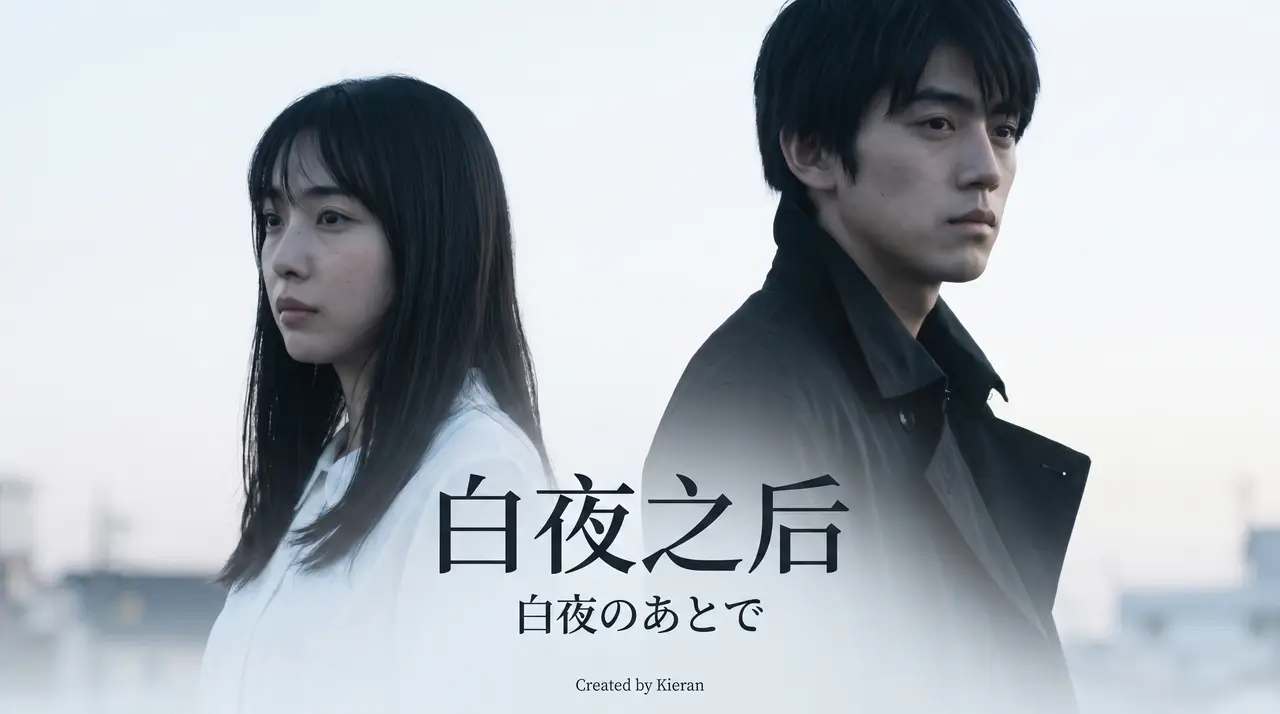
这是一个关于遗憾的故事。
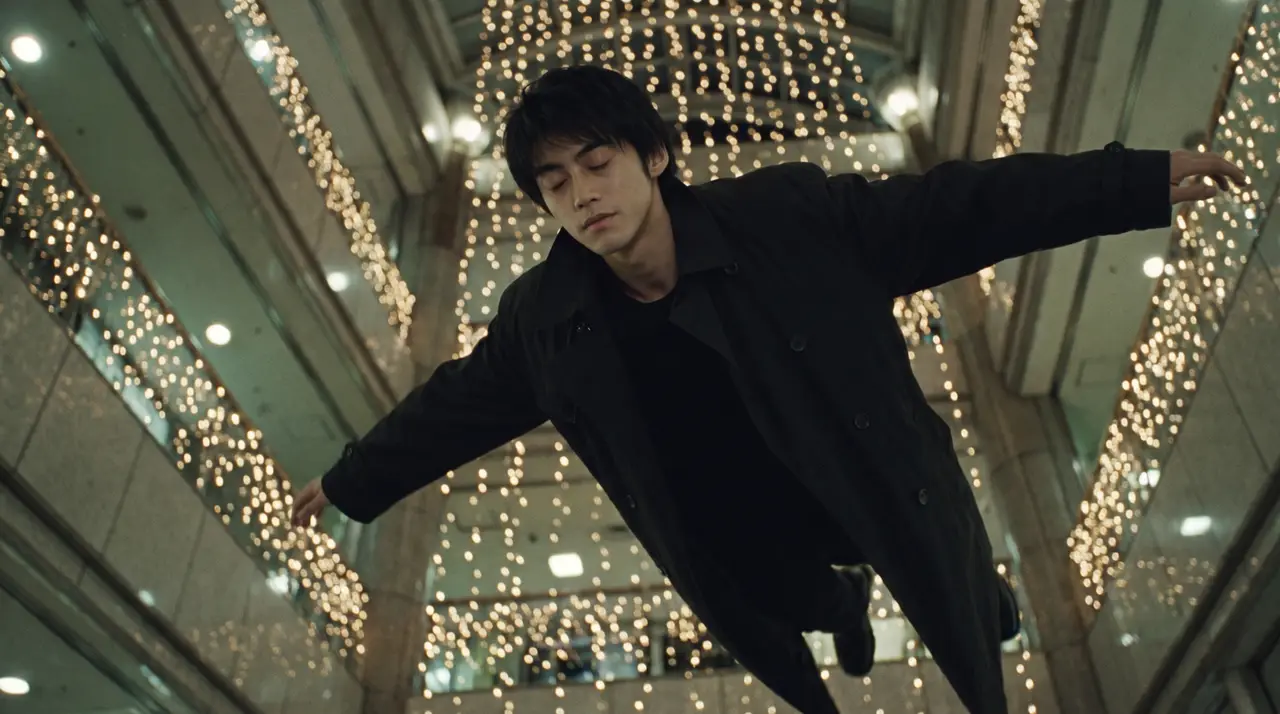
Photorealistic film still in the style of 1990s Japanese art-house youth cinema (Shunji Iwai), late-1990s Osaka, shot on 35mm Kodak film, soft natural light, muted greens and greys, gentle film grain, shallow depth of field, 16:9, East Asian cast, no text, no subtitles, no watermark. Low angle looking up inside a multi-story shopping mall atrium at night, a man in a long black trench coat falling through the air past strings of warm Christmas lights, coat spread open like wings, eyes closed, serene, slow-motion feeling, bokeh lights. The falling man's face and hair must match the reference {{Image 1}}.
Photorealistic film still in the style of 1990s Japanese art-house youth cinema (Shunji Iwai), late-1990s Osaka, shot on 35mm Kodak film, soft natural light, muted greens and greys, gentle film grain, shallow depth of field, 16:9, East Asian cast, no text, no subtitles, no watermark. Medium shot from behind, a woman in an off-white coat walking away against a crowd rushing toward the camera inside a mall corridor, she is the only one in focus, cold blue-white light. Character reference: {{Image 1}}.
Photorealistic film still in the style of 1990s Japanese art-house youth cinema (Shunji Iwai), set in 1970s-80s Osaka, shot on 35mm Kodak film, soft natural light, muted greens and greys, gentle film grain, shallow depth of field, 16:9, East Asian cast, no text, no subtitles, no watermark. Wide shot of a dim concrete basement at night, a thin East Asian boy and a East Asian girl around fifteen crouched in opposite corners, not looking at each other, a pair of scissors on the floor between them, a single dusty yellow bulb, heavy shadows. Character reference: {{Image 1}}. Character reference: {{Image 2}}. Both children are looking down at the floor, faces turned away from each other, never making eye contact. The girl's hair hangs still, no wind. The boy's face and hair must match the reference; the girl's face and hair must match the reference.
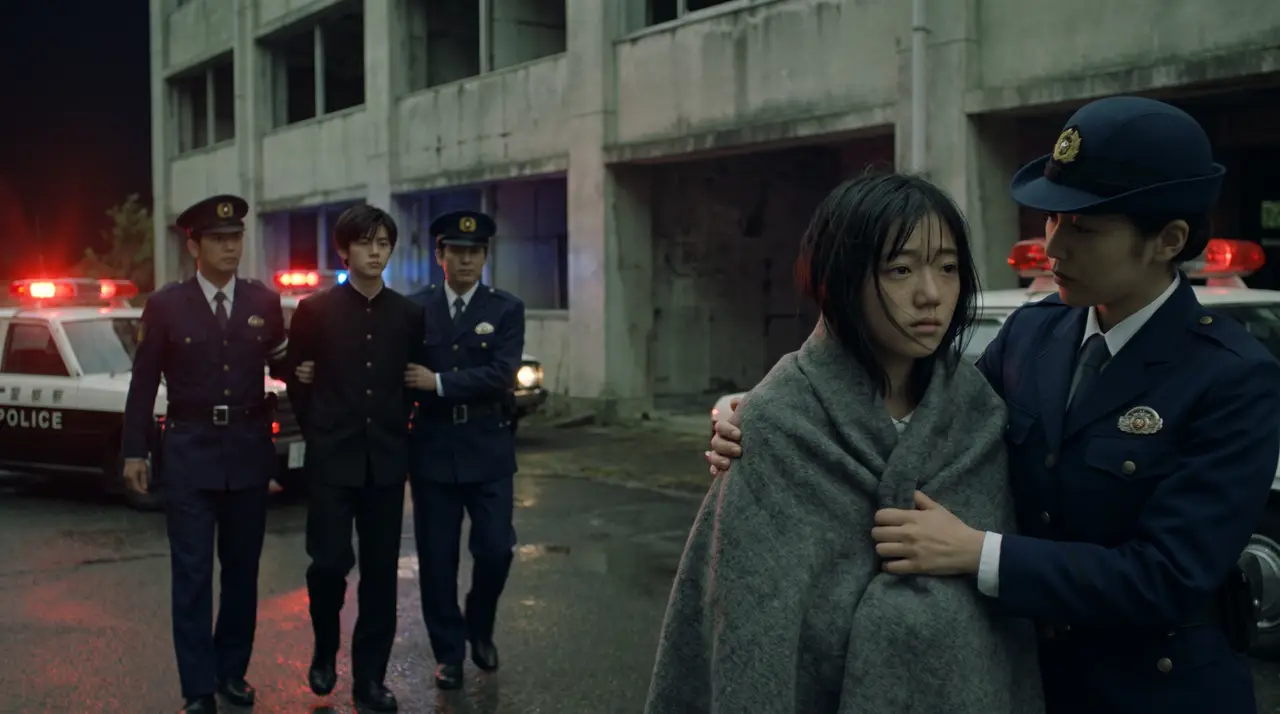
Photorealistic film still in the style of 1990s Japanese art-house youth cinema (Shunji Iwai), set in 1970s-80s Osaka, shot on 35mm Kodak film, soft natural light, muted greens and greys, gentle film grain, shallow depth of field, 16:9, East Asian cast, no text, no subtitles, no watermark. Night outside an abandoned building, red and blue police lights flashing, a thin fifteen-year-old East Asian boy escorted by two 1970s Japanese police officers each holding one of his arms, no handcuffs, head held high, in the foreground a girl of the same age wrapped in a grey blanket by a policewoman, watching him. Character reference: {{Image 1}}. Character reference: {{Image 2}}.
Photorealistic film still in the style of 1990s Japanese art-house youth cinema (Shunji Iwai), set in 1970s-80s Osaka, shot on 35mm Kodak film, soft natural light, muted greens and greys, gentle film grain, shallow depth of field, 16:9, East Asian cast, no text, no subtitles, no watermark. A quiet Japanese family court corridor in daylight, wooden benches, a fifteen-year-old girl sitting with hands on her knees, a door opens and a thin boy of the same age is led out by a court officer, the two children lock eyes across the corridor, soft window light. Character reference: {{Image 1}}. Character reference: {{Image 2}}.
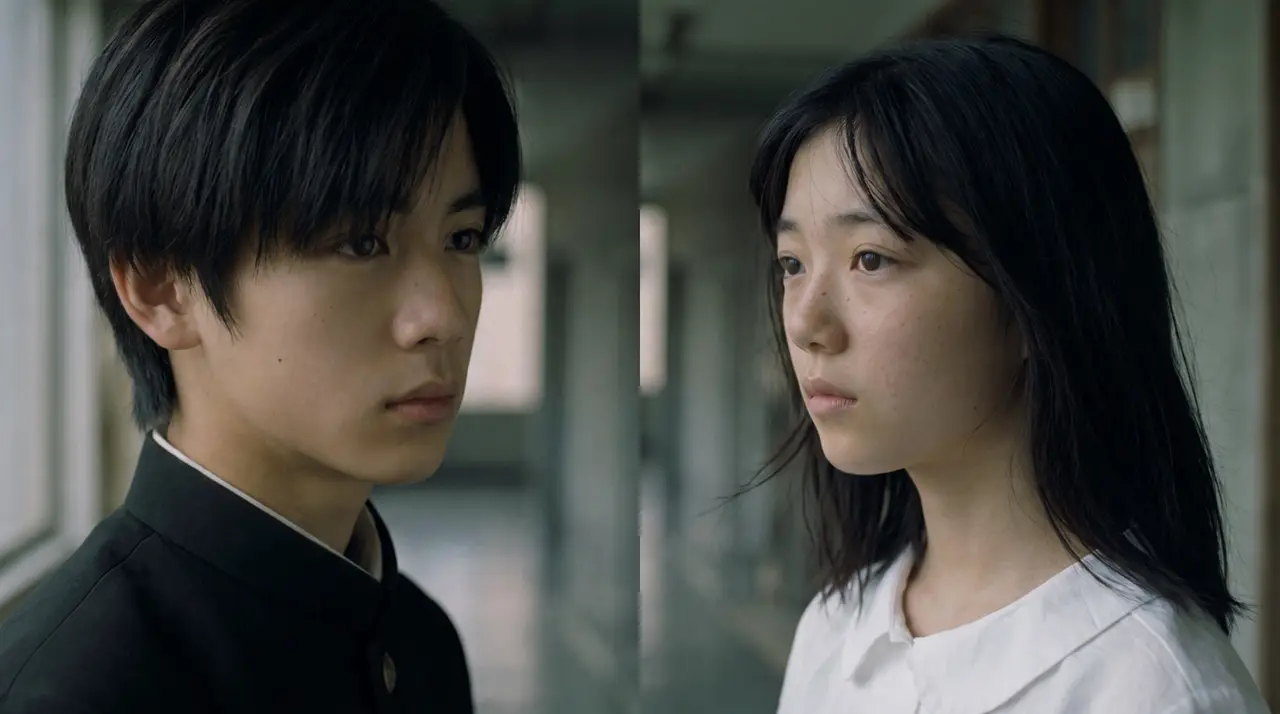
Photorealistic film still in the style of 1990s Japanese art-house youth cinema (Shunji Iwai), set in 1970s-80s Osaka, shot on 35mm Kodak film, soft natural light, muted greens and greys, gentle film grain, shallow depth of field, 16:9, East Asian cast, no text, no subtitles, no watermark. Split-screen composition: left half a close-up of a thin fifteen-year-old East Asian boy with a stubborn jawline, right half a close-up of a fifteen-year-old East Asian girl with long black hair, both facing slightly toward the center, side lit, court corridor background. Character reference: {{Image 1}}. Character reference: {{Image 2}}.
Photorealistic film still in the style of 1990s Japanese art-house youth cinema (Shunji Iwai), set in 1970s-80s Osaka, shot on 35mm Kodak film, soft natural light, muted greens and greys, gentle film grain, shallow depth of field, 16:9, East Asian cast, no text, no subtitles, no watermark. Inside a spare Japanese juvenile training school dormitory, a thin teenage boy in a plain grey tracksuit sitting on the edge of an iron bed, a sharp rectangle of sunlight from a high window on the concrete floor dividing it into light and shadow, his bare foot slowly entering the light. Character reference: {{Image 1}}.
Render the described scene as a single cinematic frame. Face identity reference only, do NOT copy its layout or grey background: {{Image 1}}. Face identity reference only, do NOT copy its layout or grey background: {{Image 2}}. Face identity reference only, do NOT copy its layout or grey background: {{Image 3}}. Face identity reference only, do NOT copy its layout or grey background: {{Image 4}}. Photorealistic film still in the style of 1990s Japanese art-house youth cinema (Shunji Iwai), set in 1970s-80s Osaka, shot on 35mm Kodak film, soft natural light, muted greens and greys, gentle film grain, shallow depth of field, 16:9, East Asian cast, no text, no subtitles, no watermark. Close-up shot-reverse-shot pair: a teenage East Asian girl in a navy sailor uniform smiling gently in warm morning light; a thin teenage boy with a stubborn jawline looking back at her, eyes softening, dawn street background.
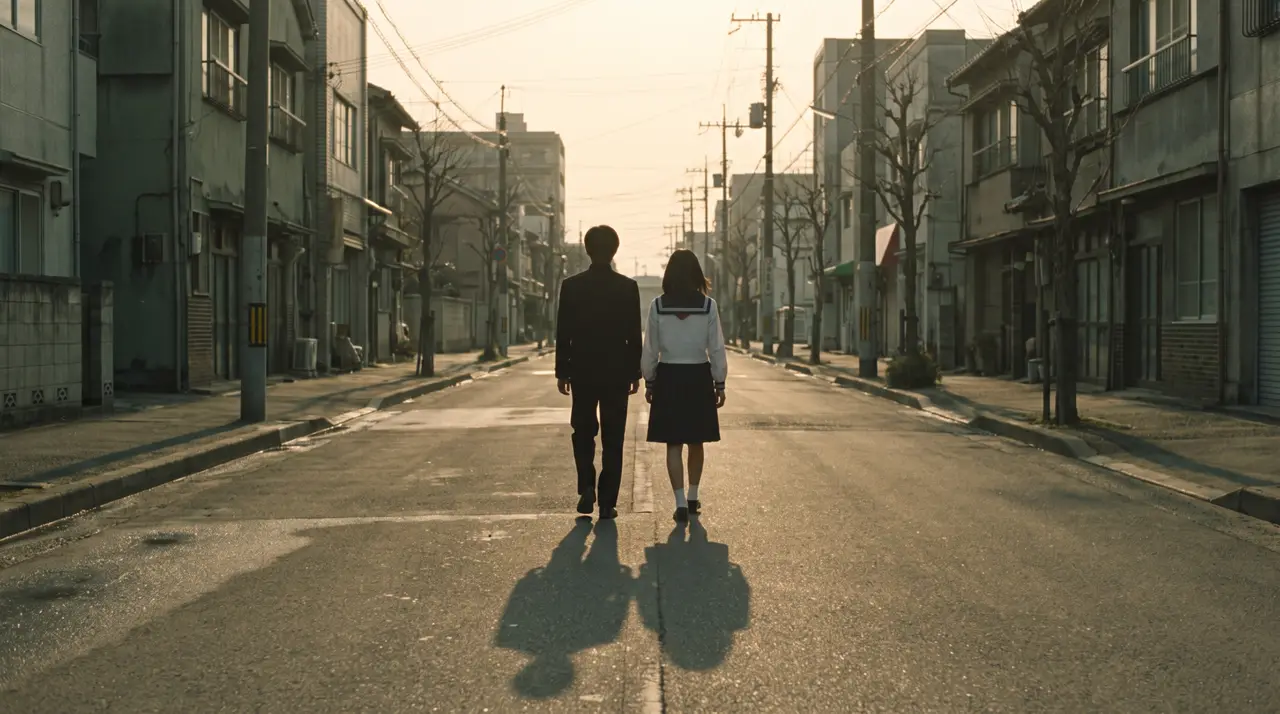
Render the described scene as a single cinematic frame. Face identity reference only, do NOT copy its layout or grey background: {{Image 1}}. Face identity reference only, do NOT copy its layout or grey background: {{Image 2}}. Face identity reference only, do NOT copy its layout or grey background: {{Image 3}}. Face identity reference only, do NOT copy its layout or grey background: {{Image 4}}. Photorealistic film still in the style of 1990s Japanese art-house youth cinema (Shunji Iwai), set in 1970s-80s Osaka, shot on 35mm Kodak film, soft natural light, muted greens and greys, gentle film grain, shallow depth of field, 16:9, East Asian cast, no text, no subtitles, no watermark. Wide shot from behind, a teenage boy and a teenage girl in a sailor uniform walking side by side down an empty morning street directly into the rising sun, not holding hands but their long shadows overlapping on the road, silhouettes against warm golden light.
Render the described scene as a single cinematic frame. Face identity reference only, do NOT copy its layout or grey background: {{Image 1}}. Face identity reference only, do NOT copy its layout or grey background: {{Image 2}}. Face identity reference only, do NOT copy its layout or grey background: {{Image 3}}. Face identity reference only, do NOT copy its layout or grey background: {{Image 4}}. Photorealistic film still in the style of 1990s Japanese art-house youth cinema (Shunji Iwai), set in 1970s-80s Osaka, shot on 35mm Kodak film, soft natural light, muted greens and greys, gentle film grain, shallow depth of field, 16:9, East Asian cast, no text, no subtitles, no watermark. Over-the-shoulder shot from behind a teenage East Asian boy carrying a small cloth bundle stepping out of a heavy iron gate at dawn, across the street a teenage girl in a navy sailor high school uniform stands waiting, wind lifting her long hair, she is smiling, warm golden backlight, long shadows. Over-the-shoulder medium shot: the boy's back and shoulder blurred in the near foreground, the girl in sailor uniform in sharp focus at mid distance, her face clearly visible and large enough to read, wind in her hair, smiling warmly. Her face must be the same girl as the references.
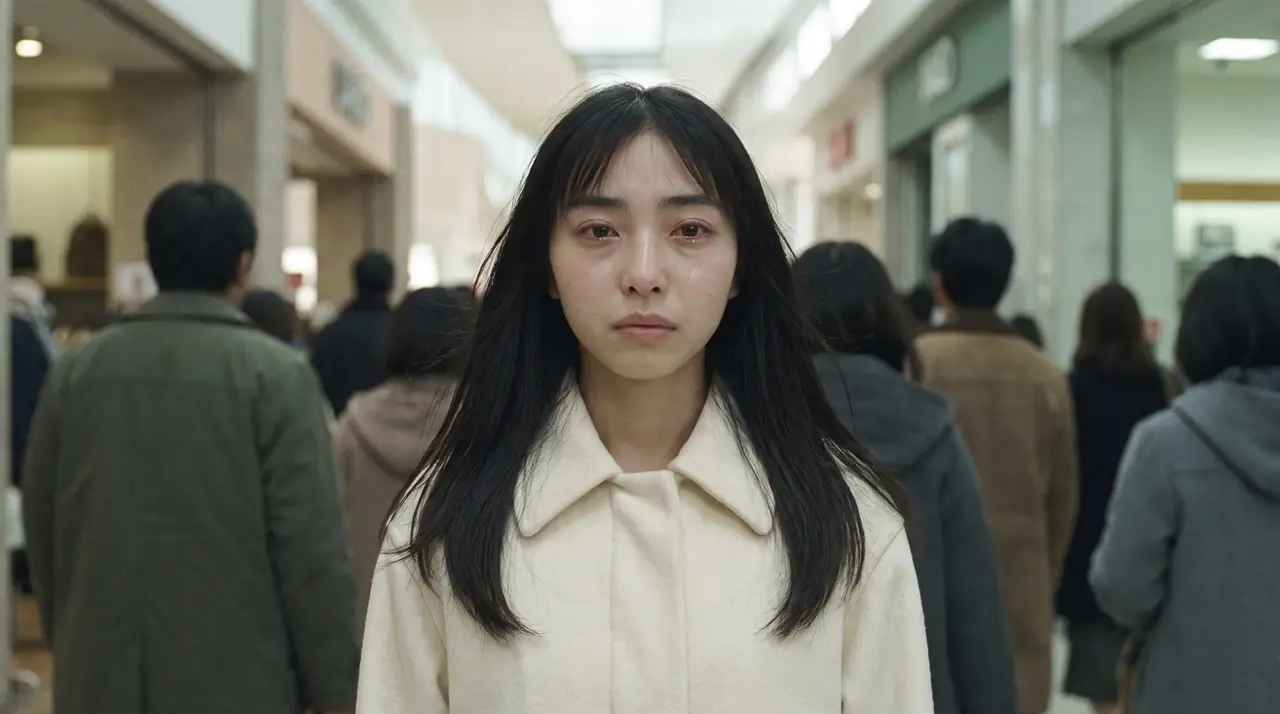
Render the described scene as a single cinematic frame. Face identity reference only, do NOT copy its layout or grey background: {{Image 1}}. Face identity reference only, do NOT copy its layout or grey background: {{Image 2}}. Photorealistic film still in the style of 1990s Japanese art-house youth cinema (Shunji Iwai), late-1990s Osaka, shot on 35mm Kodak film, soft natural light, muted greens and greys, gentle film grain, shallow depth of field, 16:9, East Asian cast, no text, no subtitles, no watermark. Close-up, camera at eye level right in front of her, moving backward with her: an elegant East Asian woman in her late twenties, long black hair, off-white wool coat, walking straight toward the camera through a mall corridor, mid-stride, face expressionless, eyes red-rimmed, wet and glossy as if about to cry, but absolutely nothing on the cheeks, skin of the cheeks completely dry and clean. Behind her every person is seen only from the back, walking and hurrying away from the camera toward something deeper in the mall; only backs of heads and coats, no faces visible at all. Blurred background, cold white light. Cheeks must be completely dry, no liquid, no streaks on the face.
Render the described scene as a single cinematic frame. Face identity reference only, do NOT copy its layout or grey background: {{Image 1}}. Face identity reference only, do NOT copy its layout or grey background: {{Image 2}}. Face identity reference only, do NOT copy its layout or grey background: {{Image 3}}. Face identity reference only, do NOT copy its layout or grey background: {{Image 4}}. Photorealistic film still in the style of 1990s Japanese art-house youth cinema (Shunji Iwai), set in 1970s-80s Osaka, shot on 35mm Kodak film, soft natural light, muted greens and greys, gentle film grain, shallow depth of field, 16:9, East Asian cast, no text, no subtitles, no watermark. Side medium shot: a teenage East Asian boy and a teenage girl in a navy sailor school uniform sit side by side on concrete riverbank steps at dusk, a school bag between them; the girl is holding out one earbud of a wired earphone toward the boy, a small cassette walkman in her other hand, the boy glances at it hesitantly; warm golden backlight over the river, both faces lit softly from the side.
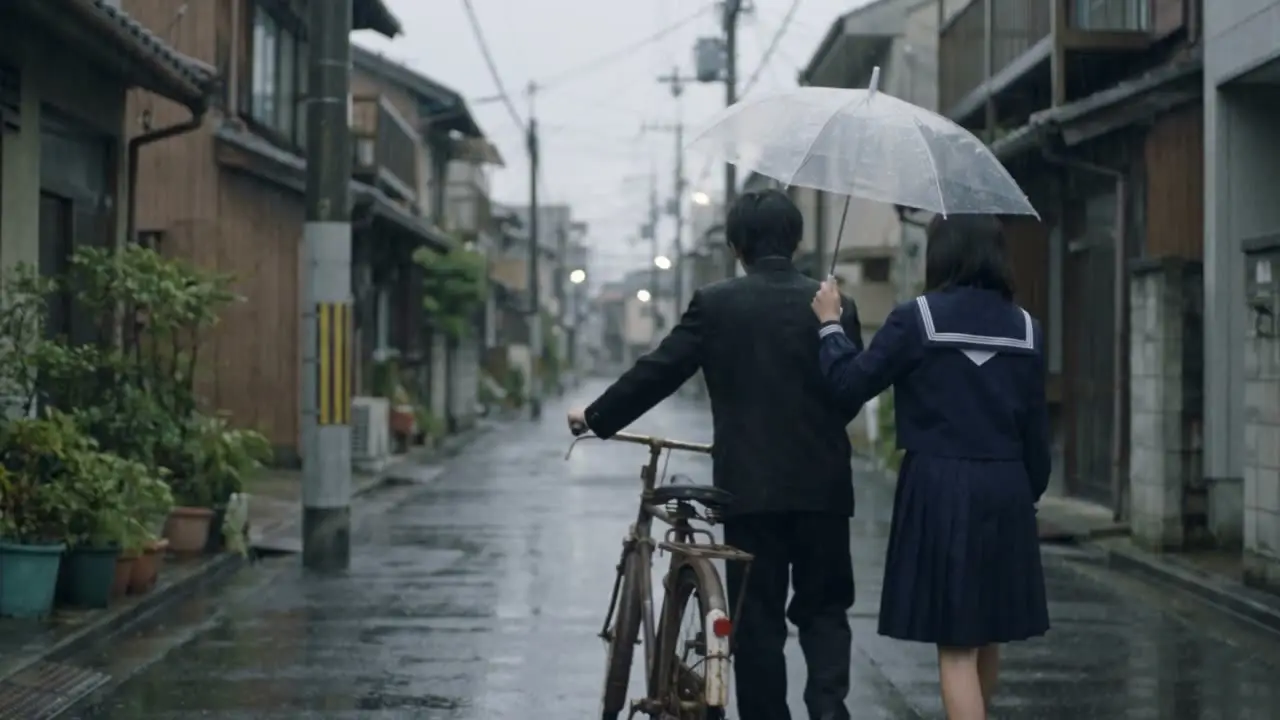
Render the described scene as a single cinematic frame. Face identity reference only, do NOT copy its layout or grey background: {{Image 1}}. Face identity reference only, do NOT copy its layout or grey background: {{Image 2}}. Face identity reference only, do NOT copy its layout or grey background: {{Image 3}}. Face identity reference only, do NOT copy its layout or grey background: {{Image 4}}. Photorealistic film still in the style of 1990s Japanese art-house youth cinema (Shunji Iwai), set in 1970s-80s Osaka, shot on 35mm Kodak film, soft natural light, muted greens and greys, gentle film grain, shallow depth of field, 16:9, East Asian cast, no text, no subtitles, no watermark. Medium shot from behind: on a narrow rainy residential street after school, a teenage East Asian boy in a black gakuran uniform walks pushing an old bicycle, beside him a teenage girl in a navy sailor uniform holds a clear vinyl umbrella tilted toward the boy so that her own shoulder is getting wet; light drizzle, wet asphalt reflecting the grey sky, soft diffused light, seen from behind, their backs to the camera.
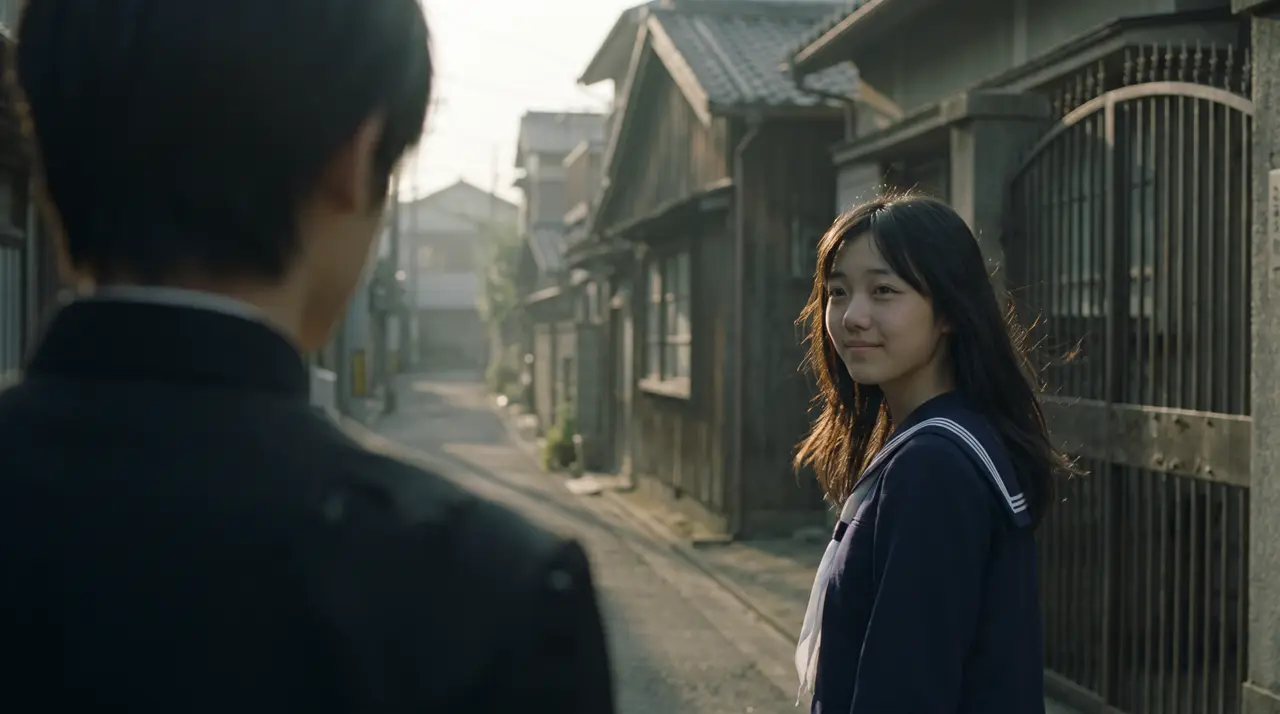
Render the described scene as a single cinematic frame. Face identity reference only, do NOT copy its layout or grey background: {{Image 1}}. Face identity reference only, do NOT copy its layout or grey background: {{Image 2}}. Face identity reference only, do NOT copy its layout or grey background: {{Image 3}}. Face identity reference only, do NOT copy its layout or grey background: {{Image 4}}. Photorealistic film still in the style of 1990s Japanese art-house youth cinema (Shunji Iwai), set in 1970s-80s Osaka, shot on 35mm Kodak film, soft natural light, muted greens and greys, gentle film grain, shallow depth of field, 16:9, East Asian cast, no text, no subtitles, no watermark. Over-the-shoulder close-up in a narrow morning lane outside a reformatory gate: in the soft-focus foreground the back of a teenage boy's head and his black gakuran shoulder; in sharp focus across the lane a teenage East Asian girl in a navy sailor uniform looks at him, wind lifting her long black hair, a gentle small smile, warm golden dawn backlight, long shadows, old wooden houses behind her.
Render the described scene as a single cinematic frame. Face identity reference only, do NOT copy its layout or grey background: {{Image 1}}. Face identity reference only, do NOT copy its layout or grey background: {{Image 2}}. Face identity reference only, do NOT copy its layout or grey background: {{Image 3}}. Face identity reference only, do NOT copy its layout or grey background: {{Image 4}}. Photorealistic film still in the style of 1990s Japanese art-house youth cinema (Shunji Iwai), set in 1970s-80s Osaka, shot on 35mm Kodak film, soft natural light, muted greens and greys, gentle film grain, shallow depth of field, 16:9, East Asian cast, no text, no subtitles, no watermark. Reverse over-the-shoulder close-up in the same narrow morning lane: in the soft-focus foreground the back of a teenage girl's head and her navy sailor-collar shoulder; in sharp focus a thin teenage East Asian boy in a black gakuran uniform carrying a small cloth bundle stands in front of an open iron gate, looking at her with an almost expressionless face and softening eyes, warm golden dawn light on his face, long shadows.
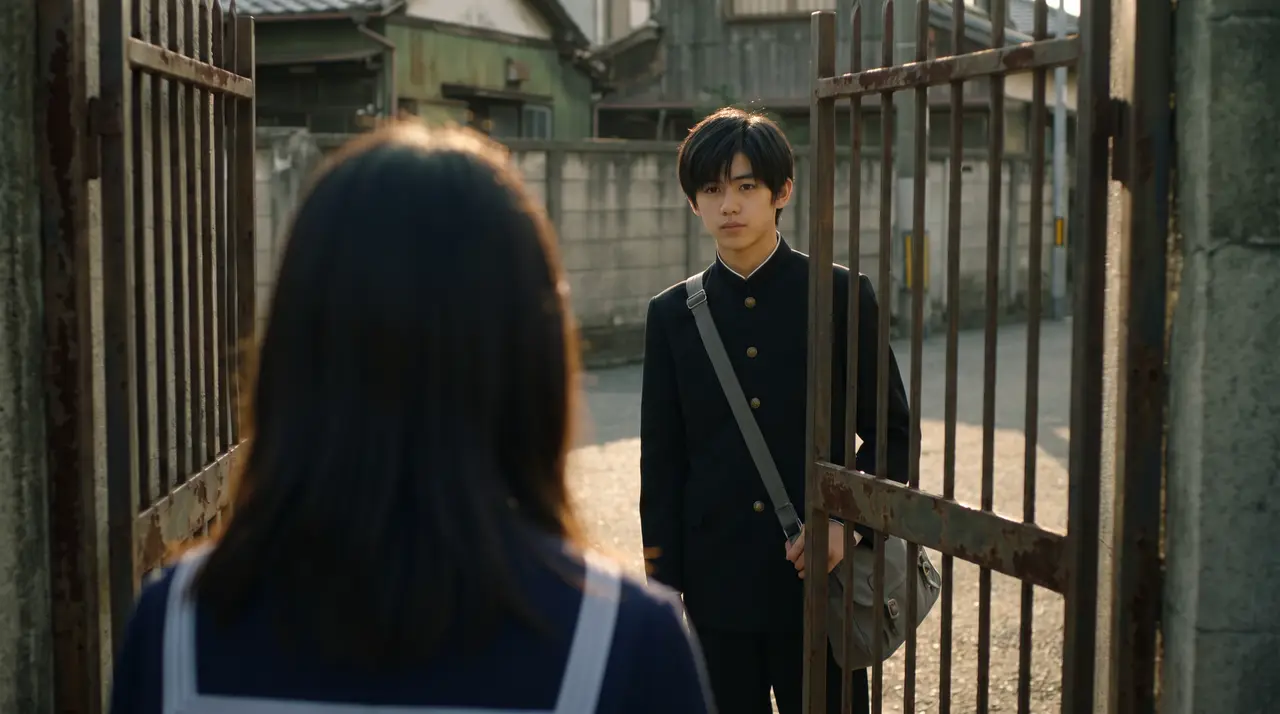
Render the described scene as a single cinematic frame. Scene and set reference, match this exact location, gate, walls, buildings and light: . Face identity reference only, do NOT copy its layout or grey background: {{Image 1}} . Face identity reference only, do NOT copy its layout or grey background: {{Image 2}} . Face identity reference only, do NOT copy its layout or grey background: {{Image 3}} . Face identity reference only, do NOT copy its layout or grey background: {{Image 4}} . Photorealistic film still in the style of 1990s Japanese art-house youth cinema (Shunji Iwai), set in 1970s-80s Osaka, shot on 35mm Kodak film, soft natural light, muted greens and greys, gentle film grain, shallow depth of field, 16:9, East Asian cast, no text, no subtitles, no watermark. Reverse over-the-shoulder close-up in the SAME location as the scene reference: the heavy rusted iron-bar gate of a reformatory set in a grey concrete wall, gate open. In the soft-focus foreground the back of a teenage girl's head and her navy sailor-collar shoulder; in sharp focus a thin teenage East Asian boy in a black gakuran uniform with a grey canvas shoulder bag stands just outside the open iron gate, looking at her with an almost expressionless face and softening eyes, warm golden dawn light on his face, long shadows.
Render the described scene as a single cinematic frame. Scene and set reference, match this exact location, gate, walls, buildings and light: . Face identity reference only, do NOT copy its layout or grey background: {{Image 1}} . Face identity reference only, do NOT copy its layout or grey background: {{Image 2}} . Face identity reference only, do NOT copy its layout or grey background: {{Image 3}} . Face identity reference only, do NOT copy its layout or grey background: {{Image 4}} . Photorealistic film still in the style of 1990s Japanese art-house youth cinema (Shunji Iwai), set in 1970s-80s Osaka, shot on 35mm Kodak film, soft natural light, muted greens and greys, gentle film grain, shallow depth of field, 16:9, East Asian cast, no text, no subtitles, no watermark. Over-the-shoulder close-up in the SAME location as the scene reference: a plain morning lane outside a reformatory, low grey concrete-block wall and flat grey-green buildings behind the girl (no wooden houses). In the soft-focus foreground the back of a teenage boy's head and his black gakuran shoulder with a grey shoulder-bag strap; in sharp focus across the lane a teenage East Asian girl in a navy sailor uniform looks at him, wind lifting her long black hair, a gentle small smile, warm golden dawn backlight, long shadows on the asphalt.
Render the described scene as a single cinematic frame. Face identity reference only, do NOT copy its layout or grey background: {{Image 1}}. Face identity reference only, do NOT copy its layout or grey background: {{Image 2}}. Face identity reference only, do NOT copy its layout or grey background: {{Image 3}}. Face identity reference only, do NOT copy its layout or grey background: {{Image 4}}. Photorealistic film still in the style of 1990s Japanese art-house youth cinema (Shunji Iwai), set in 1970s-80s Osaka, shot on 35mm Kodak film, soft natural light, muted greens and greys, gentle film grain, shallow depth of field, 16:9, East Asian cast, no text, no subtitles, no watermark. Tight over-the-shoulder close-up, 85mm lens, f/2.8. Foreground left third: a teenage East Asian boy in a black gakuran with a grey shoulder-bag strap, seen in a clean LEFT PROFILE looking toward the girl; his profile is only slightly soft and clearly readable, and it must match the SIDE VIEW of his turnaround reference exactly: same hairline, nose bridge, lips and jawline. Sharp focus on the right two thirds: the face and shoulders of a teenage East Asian girl in a navy sailor uniform, her face large in frame, looking straight at him with a gentle small smile, wind lifting her long black hair. Background is a quiet old residential street at dawn, out of focus. Warm golden dawn backlight, rim light on both. Both faces must be identical to the character references.
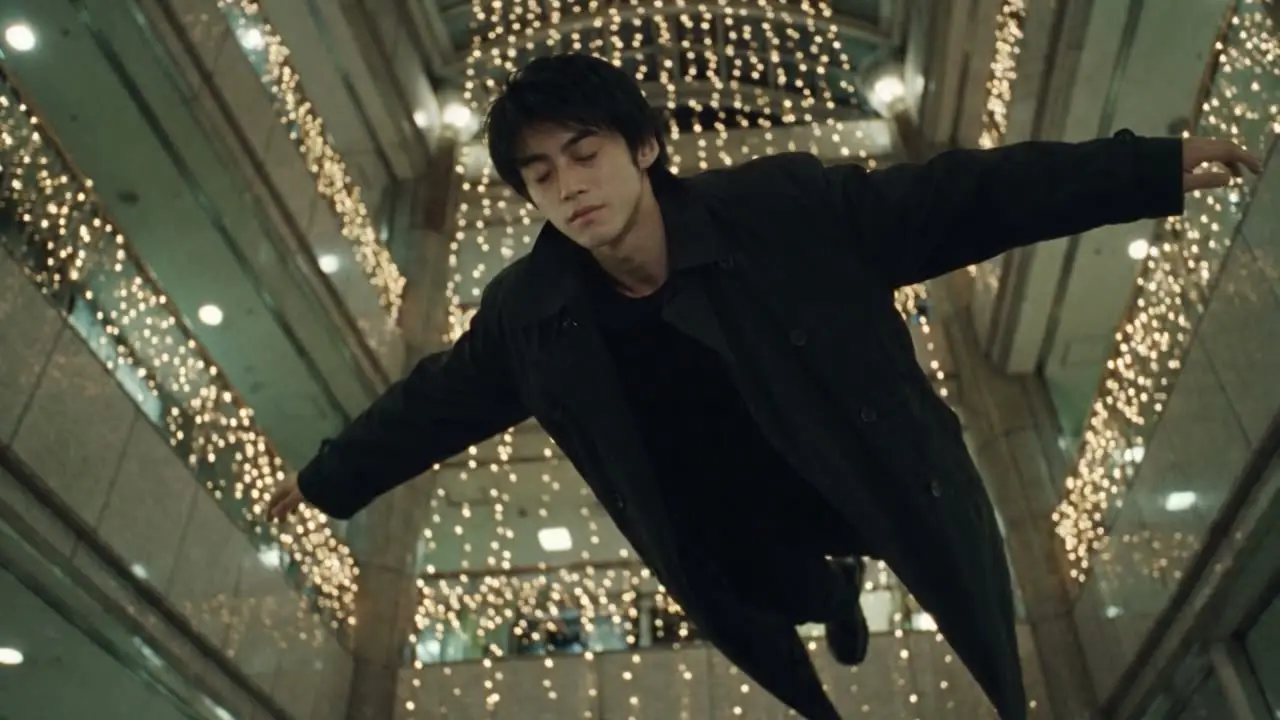 视频截图
Start from the reference frame {{Image 1}} and keep its composition, characters, lighting and 35mm film look. A real free fall with gravity: the man drops from the top of the frame and accelerates downward, faster and faster, coat whipping upward, hair pulled up by the wind; the camera is locked low, he rushes past and toward the lens and exits the bottom of the frame before the shot ends; Christmas lights streak into vertical light trails as he passes. Slight slow-motion feel but clearly accelerating, not floating, not hovering. Photorealistic, 1990s Japanese art-house film, no text, no subtitles. Keep the man's face identical to the reference frame throughout the fall, same facial features from first frame to last.
Start from the reference frame {{Image 1}} and keep its composition, characters, lighting and 35mm film look. Static wide shot or a very slow dolly. From the very first frame Yukiho is already mid-walk at a normal, steady pace; there is no standing still and no starting-to-walk moment. In an off-white coat, seen from behind, she walks toward the mall exit and never looks back. The crowd moves the opposite way: people pass the camera on both sides and surge toward the accident deeper in the mall, hurried, some jogging, some pushing past each other; only backs and profiles are visible, nobody looks at the camera. Photorealistic, 1990s Japanese art-house film, no text, no subtitles.
Start from the reference frame {{Image 1}} and keep its composition, characters, lighting and 35mm film look. Handheld tracking shot moving backward at her walking pace. From the very first frame Yukiho is already walking toward the camera at a steady pace. Close-up: she is holding back heartbreak, helplessness and grief; eyes red-rimmed, wet and shining with tears that never fall, cheeks dry; subtle shifts in her expression as if forcing herself to keep it in. Behind her the blurred crowd hurries away from the camera toward the accident deeper in the mall, everyone seen only from the back, nobody turns, nobody looks at the camera. In the last third the crowd behind her freezes completely mid-step while she alone keeps walking, then the image fades to black. Photorealistic, 1990s Japanese art-house film, no text, no subtitles.
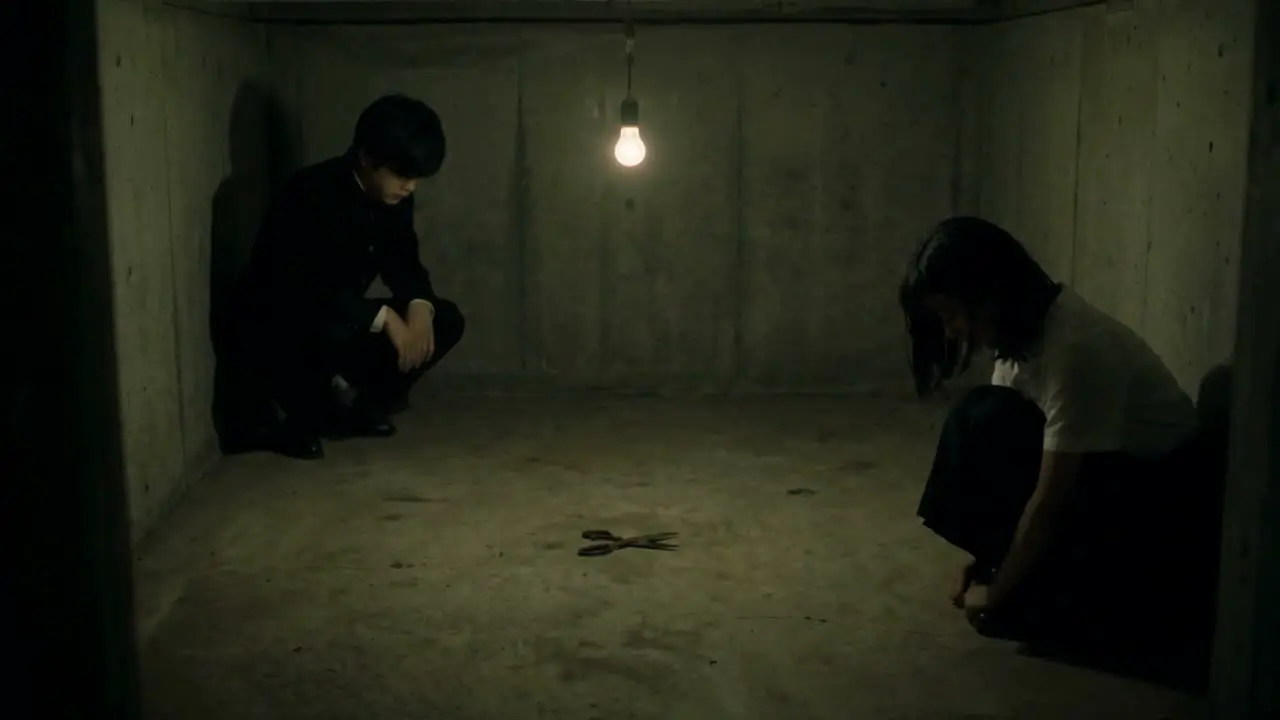 视频截图
Start from the reference frame {{Image 1}} and keep its composition, characters, lighting and 35mm film look. Scene: a basement at night, 1973. Locked-off camera, nearly static. The bare bulb overhead flickers faintly once or twice. Two children crouch in opposite corners, heads down, never looking at each other. All dialogue is in Japanese, spoken softly, only these two lines: the girl whispers 「これから、どうなるの……」; after a pause the boy answers 「大丈夫。僕がやったんだ。」 without lifting his head. No other voices, no English, only faint basement ambience. The scissors on the floor do not move. In the last second and a half the image slowly fades to black. Film look: photorealistic, 1990s Japanese art-house cinema, 35mm Kodak film grain, no text, no subtitles.
Start from the reference frame {{Image 1}} and keep its composition, characters, lighting and 35mm film look. Scene: outside an abandoned house at night, 1973. The frame emerges from black as red and blue police lights strobe in the dark; a distant siren. The teenage boy, held by the arm by a police officer on each side, walks out of the house slowly toward the camera, head held high, never lowering it. In the foreground the girl, wrapped in a grey blanket with a policewoman's hand on her shoulder, turns her head and her eyes follow him as he passes. No dialogue, no speech; only siren, footsteps and night ambience. Film look: photorealistic, 1990s Japanese art-house cinema, 35mm Kodak film grain, no text, no subtitles. Audio: ambient sound only, no speech and no narration unless Japanese lines are explicitly given above; any dialogue must be in Japanese, never English.
Start from the reference frame {{Image 1}} and keep its composition, characters, lighting and 35mm film look. Scene: a family court corridor, daytime, 1973. Start exactly from the reference frame: the door is already open, the judge in plain clothes and the boy are standing in the doorway, the girl is sitting on the bench. Slow push-in along the corridor. The judge steps aside; the boy takes one step out of the doorway into the corridor. The moment he is out he sees the girl; the two children hold eye contact across the corridor for one second, nobody speaks. Then the judge puts a hand on the boy's shoulder and leads him away along the corridor toward the right side of the frame, the girl's eyes following him. The door does not move again; no other people enter or exit. No speech; only corridor ambience and footsteps. Film look: photorealistic, 1990s Japanese art-house cinema, 35mm Kodak film grain, no text, no subtitles. Audio: ambient sound only, no speech and no narration unless Japanese lines are explicitly given above; any dialogue must be in Japanese, never English.
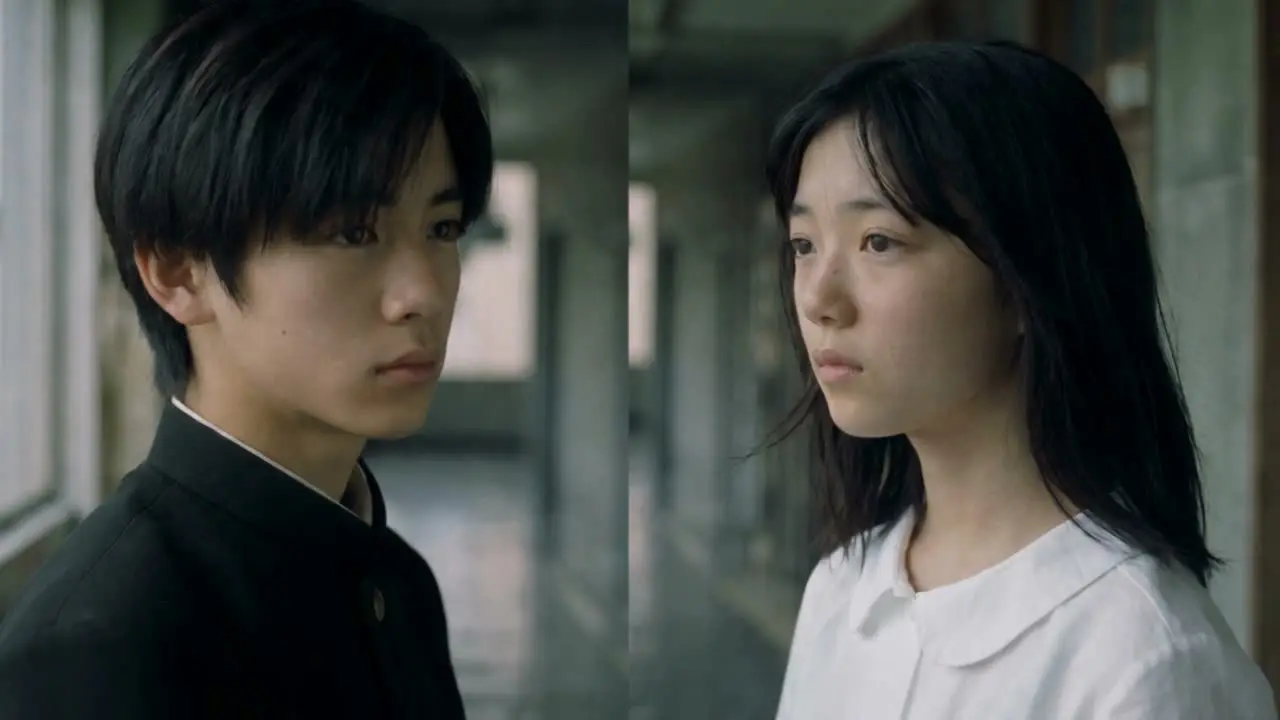 视频截图
Start from the reference frame {{Image 1}} and keep its composition, characters, lighting and 35mm film look. Scene: a family court corridor, daytime, 1973. Keep the split-screen composition: the boy on the left half, the girl on the right half, each facing slightly toward the center line, standing at opposite ends of the corridor. Both halves push in very slowly. The characters only breathe and show subtle shifts of expression, emotion in the eyes, but their lips do not move; the monologue is voice-over added later. No speech, no voices; only corridor ambience. Film look: photorealistic, 1990s Japanese art-house cinema, 35mm Kodak film grain, no text, no subtitles. Audio: ambient sound only, no speech and no narration unless Japanese lines are explicitly given above; any dialogue must be in Japanese, never English.
Start from the reference frame {{Image 1}} and keep its composition, characters, lighting and 35mm film look. Scene: a juvenile reformatory dormitory room, daytime. Static wide shot. The boy in a grey gym uniform sits on the edge of the bed, head down, hands on his knees. Sunlight through the barred window throws a sharp bright rectangle on the floor with a clear line between light and shadow; dust motes drift slowly in the light. He waits a moment, then slowly extends one bare foot forward, toes first entering the light, until the whole foot rests in the sunlit patch. The camera tilts down slowly to the floor and ends on the foot and the light. No speech; only the quiet room ambience. Film look: photorealistic, 1990s Japanese art-house cinema, 35mm Kodak film grain, no text, no subtitles. Audio: ambient sound only, no speech and no narration unless Japanese lines are explicitly given above; any dialogue must be in Japanese, never English.
Scene and composition reference for the over-the-shoulder shot: {{Image 1}}. The boy's face must match {{Image 2}} and {{Image 3}} from every angle. The girl's face must match {{Image 4}} and {{Image 5}} from every angle. Keep the lighting and 35mm film look of the scene reference. A three-shot sequence with cuts. Shot 1 (about 3 s): frontal camera from the lane side. The iron gate is already fully open from the very first frame and never moves. A uniformed reformatory staff member stands just inside, holding the open gate. The boy, carrying a small cloth bundle, walks out past him through the gateway, squints once in the sunlight and stops; the staff member stays inside and does not move. Cut. Shot 2 (about 2 s): over-the-shoulder past the boy, the composition of the reference frame: the girl in a sailor uniform stands in the lane, wind in her hair, looking at him, a smile slowly appearing. Cut. Shot 3 (about 3 s): frontal close-up of the boy looking at her, eyes reddening, a swallow, the corners of his mouth lifting slightly, then he takes one step toward her. Faces and clothes stay identical to the reference frame in every shot. No speech; only morning wind, the creak of the gate hinge and distant street ambience. Film look: photorealistic, 1990s Japanese art-house cinema, 35mm Kodak film grain, no text, no subtitles. Audio: ambient sound only, no speech, no English.
Start from the reference frame {{Image 1}} and keep its composition, characters, lighting and 35mm film look. Keep the split-screen composition from the reference frame: the girl on the left, the boy in profile on the right, both in the lane with morning backlight. Each half is a locked-off close-up. First the girl: looking at him with a small smile, she softly says 「おかえり」. A beat of silence. Then the boy: looking at her, almost expressionless, he says quietly 「ただいま」. After that neither moves, only the wind in their hair. All dialogue is in Japanese, only these two lines, no English; otherwise only the morning wind ambience. Film look: photorealistic, 1990s Japanese art-house cinema, 35mm Kodak film grain, no text, no subtitles. Audio: ambient sound only, no speech and no narration unless Japanese lines are explicitly given above; any dialogue must be in Japanese, never English.
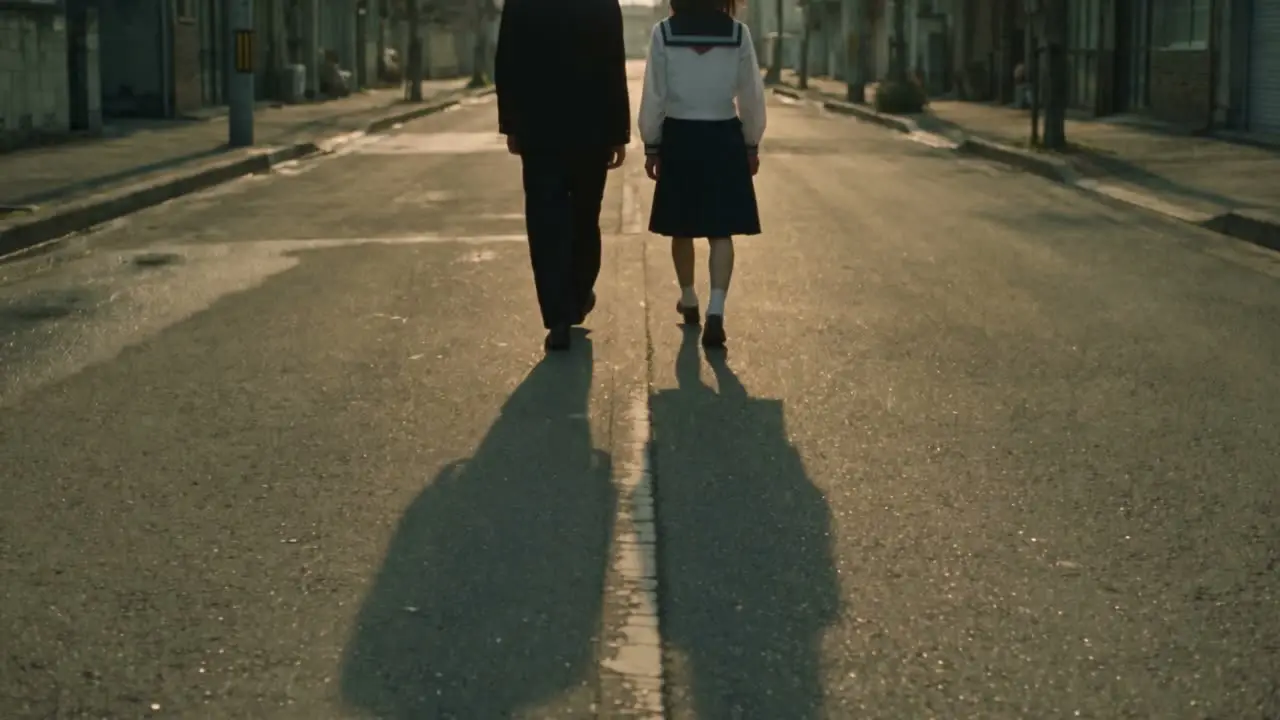 视频截图
Start from the reference frame {{Image 1}} and keep its composition, characters, lighting and 35mm film look. Start from the reference frame: the two figures seen from behind, side by side on the morning street, their shadows overlapping on the road. From the very first frame they are already walking forward in step, not holding hands, a small gap between them. The camera slowly dollies back and cranes up; the two figures grow smaller and walk into the backlight, the lens flare slowly intensifies until the figures dissolve into the light. In the last two seconds the image fades to black. No speech; only morning wind and distant street ambience. Film look: photorealistic, 1990s Japanese art-house cinema, 35mm Kodak film grain, no text, no subtitles. Audio: ambient sound only, no speech and no narration unless Japanese lines are explicitly given above; any dialogue must be in Japanese, never English.
Start from the reference frame {{Image 1}} and keep its composition, characters, lighting and 35mm film look. Start from the reference frame: the two figures seen from behind, side by side on the morning street. The girl wears a NAVY BLUE sailor school uniform with white collar lines and a navy pleated skirt (dark top, never a white top), the boy wears a black gakuran; their clothes must stay exactly as in the reference frame for the whole shot. From the very first frame they are already walking forward in step, not holding hands, a small gap between them, and their two long shadows on the road overlap into one. The camera slowly dollies back and cranes up; the two figures grow smaller and walk into the backlight, the lens flare slowly intensifies until the figures dissolve into the light. In the last two seconds the image fades to black. No speech; only morning wind and distant street ambience. Film look: photorealistic, 1990s Japanese art-house cinema, 35mm Kodak film grain, no text, no subtitles. Audio: ambient sound only, no speech and no narration unless Japanese lines are explicitly given above; any dialogue must be in Japanese, never English.
Start from the reference frame {{Image 1}} and keep its composition, characters, lighting and 35mm film look. Start from the reference frame and keep its reverse over-the-shoulder composition, characters, clothes, lighting and 35mm film look. The girl's shoulder in the foreground stays still. The boy looks at her, almost expressionless, holds for one beat, then quietly says 「ただいま」; his eyes soften slightly. After a short pause he takes one step forward and walks out of the frame past the camera. Locked-off camera. All dialogue is in Japanese, only this one line, no English; otherwise only morning wind ambience. Film look: photorealistic, 1990s Japanese art-house cinema, 35mm Kodak film grain, no text, no subtitles. Audio: ambient sound only, no speech and no narration unless Japanese lines are explicitly given above; any dialogue must be in Japanese, never English.
雪穂、もう君の空の太陽ではいられない。これからは、白夜の中で生きなくていい。
あの夜、もし自首していたら――
大丈夫。僕がやったんだ。
これから、どうなるの……
今度は、夜の中を歩かなかった。
今度は、あなたを夜の中に歩かせない。
ただいま。
おかえり。
A Japanese-language theme song with a clear female lead vocal singing these lyrics, quiet J-folk-rock ballad, 60 seconds, piano and acoustic guitar, light drums and strings in the chorus, restrained but with forward momentum, not idol pop. The singer must sing the words audibly. [Verse] 白夜の果てで 君を待っていた 影が重なる 朝の光の中 [Chorus] もう太陽じゃなくていい ただ隣を歩いて ただ隣を歩いて
Japanese art-house film score, instrumental, solo piano only. The piano plays continuously from start to end, one soft note every one or two seconds with the sustain pedal held, never silent; cold, suspended, minimal, like holding one's breath; very quiet but always audible. No strings, no drums, no fade out, ends on an unresolved held note.
Japanese art-house film score, instrumental. A soft, thin, distant string pad in the middle register at pianissimo, like a layer of mist far away, with a slow single piano note every few seconds on top. Quiet unease and sadness, not heavy, not dramatic, no low cellos or basses, no swelling, no drums. Sustained continuously, no fade out.
镜头1(8s) 剧情:序幕。商场中庭,夜。亮司从高层回廊坠落,穿过中庭的圣诞灯饰,风衣张开,没有挣扎。 景别:全景→特写 角色动作:坠落,身体放松,闭眼 情绪:解脱,平静 场景标签:商场中庭,圣诞灯饰,夜 光影氛围:暖色灯饰点光,冷调环境,慢镜头 音效:人群抽气声被抽掉,只剩风声;钢琴停 角色【桐原亮司(成年)】:日本男性,28岁左右,短黑发,黑色长风衣,眼神疲惫而平静 ▼ 图片生成提示词: Photorealistic film still in the style of 1990s Japanese art-house youth cinema (Shunji Iwai), late-1990s Osaka, shot on 35mm Kodak film, soft natural light, muted greens and greys, gentle film grain, shallow depth of field, 16:9, East Asian cast, no text, no subtitles, no watermark. Low angle looking up inside a multi-story shopping mall atrium at night, a man in a long black trench coat falling through the air past strings of warm Christmas lights, coat spread open like wings, eyes closed, serene, slow-motion feeling, bokeh lights. ▼ 视频动作提示词: A real free fall with gravity: the man drops from the top of the frame and accelerates downward, faster and faster, coat whipping upward, hair pulled up by the wind; the camera is locked low, he rushes past and toward the lens and exits the bottom of the frame before the shot ends; Christmas lights streak into vertical light trails as he passes. Slight slow-motion feel but clearly accelerating, not floating, not hovering. 镜头2(6s) 剧情:全景。人群涌向事故现场,只有一个穿米白大衣的女人背对事故,逆着人流往外走,头也不回。 景别:中景 角色动作:转身,逆人流行走 情绪:决绝,心碎 场景标签:商场通道,人流 光影氛围:冷调,人流虚化 音效:亮司独白,钢琴单音 角色【唐泽雪穗(成年)】:日本女性,28岁左右,长黑发,米白色羊毛大衣,妆容精致,眼下含泪 ▼ 图片生成提示词: Photorealistic film still in the style of 1990s Japanese art-house youth cinema (Shunji Iwai), late-1990s Osaka, shot on 35mm Kodak film, soft natural light, muted greens and greys, gentle film grain, shallow depth of field, 16:9, East Asian cast, no text, no subtitles, no watermark. Medium shot from behind, a woman in an off-white coat walking away against a crowd rushing toward the camera inside a mall corridor, she is the only one in focus, cold blue-white light. ▼ 视频动作提示词: Static wide shot or a very slow dolly. From the very first frame Yukiho is already mid-walk at a normal, steady pace; there is no standing still and no starting-to-walk moment. In an off-white coat, seen from behind, she walks toward the mall exit and never looks back. The crowd moves the opposite way: people pass the camera on both sides and surge toward the accident deeper in the mall, hurried, some jogging, some pushing past each other; only backs and profiles are visible, nobody looks at the camera. 镜头3(8s) 剧情:雪穗特写。她面对镜头,逆着人流往前走,眼里含泪没有落下。内心独白后,身后的人流全部冻结,只有她在动。黑场。 景别:近景特写(跟拍) 角色动作:逆人流朝镜头走,不擦泪,不回头 情绪:压抑的剧痛,克制 场景标签:商场一层,人群 光影氛围:冷白商场灯,人群虚化 音效:环境声压低,一声心跳 台词:亮司(画外):雪穂、もう君の空の太陽ではいられない。これからは、白夜の中で生きなくていい。/雪穗,我没办法再做你天空里的太阳了。往后,你不必再活在白夜里。 雪穗(内心):あの夜、もし自首していたら――/那一晚,如果我们去自首了—— 角色【唐泽雪穗(成年)】:日本女性,28岁左右,长黑发,米白色羊毛大衣,妆容精致,眼下含泪 ▼ 图片生成提示词: Photorealistic film still in the style of 1990s Japanese art-house youth cinema (Shunji Iwai), late-1990s Osaka, shot on 35mm Kodak film, soft natural light, muted greens and greys, gentle film grain, shallow depth of field, 16:9, East Asian cast, no text, no subtitles, no watermark. Close-up, camera at eye level right in front of her, moving backward with her: an elegant East Asian woman in her late twenties, long black hair, off-white wool coat, walking straight toward the camera through a mall corridor, mid-stride, face expressionless, eyes red-rimmed, wet and glossy as if about to cry, but absolutely nothing on the cheeks, skin of the cheeks completely dry and clean. Behind her every person is seen only from the back, walking and hurrying away from the camera toward something deeper in the mall; only backs of heads and coats, no faces visible at all. Blurred background, cold white light. ▼ 视频动作提示词: Handheld tracking shot moving backward at her walking pace. From the very first frame Yukiho is already walking toward the camera at a steady pace. Close-up: she is holding back heartbreak, helplessness and grief; eyes red-rimmed, wet and shining with tears that never fall, cheeks dry; subtle shifts in her expression as if forcing herself to keep it in. Behind her the blurred crowd hurries away from the camera toward the accident deeper in the mall, everyone seen only from the back, nobody turns, nobody looks at the camera. In the last third the crowd behind her freezes completely mid-step while she alone keeps walking, then the image fades to black. 镜头5(6s) 剧情:回溯。地下室,1973年,夜。两个孩子蜷缩在角落,隔着一段距离,谁也不看谁。地上有一把剪刀。雪穗很轻地问了一句,亮司沉默片刻后回答。画面缓缓黑下去。 景别:全景 角色动作:蜷缩,低头 情绪:惊恐,煎熬,未做决定 场景标签:废弃大楼地下室,1973年 光影氛围:单一昏黄光源,大面积阴影 音效:只有两人的呼吸声,无乐 台词:雪穗(很轻,没抬头):これから、どうなるの……/接下来,会怎么样…… 亮司(停了一会儿):大丈夫。僕がやったんだ。/没关系的。是我做的。 角色【桐原亮司(少年)】:日本男孩,13岁左右,短发,偏瘦,倔强的下颚线 角色【唐泽雪穗(少年)】:日本女孩,13岁左右,长黑发,安静,尾声穿深蓝色水手高中制服 ▼ 图片生成提示词: Photorealistic film still in the style of 1990s Japanese art-house youth cinema (Shunji Iwai), set in 1970s-80s Osaka, shot on 35mm Kodak film, soft natural light, muted greens and greys, gentle film grain, shallow depth of field, 16:9, East Asian cast, no text, no subtitles, no watermark. Wide shot of a dim concrete basement at night, a thin East Asian boy and a East Asian girl around fifteen crouched in opposite corners, not looking at each other, a pair of scissors on the floor between them, a single dusty yellow bulb, heavy shadows. ▼ 视频动作提示词: Scene: a basement at night, 1973. Locked-off camera, nearly static. The bare bulb overhead flickers faintly once or twice. Two children crouch in opposite corners, heads down, never looking at each other. The girl's lips move slightly as she says something very quietly; the boy stays silent for a moment, then his lips move as he answers, still not lifting his head. The scissors on the floor do not move. In the last second and a half the image slowly fades to black. 镜头6(8s) 剧情:黑场中先响起远处警笛。红蓝光在黑暗里闪烁,画面渐亮。少年亮司被警察带出那栋房子,手腕上是手铐,但他抬着头。雪穗站在警戒线外,女警把毛毯披在她肩上。 景别:中景 角色动作:亮司抬头走出;雪穗披毯凝视 情绪:亮司坦然;雪穗担忧 场景标签:废弃大楼门口,警车,夜 光影氛围:红蓝警灯交替,黑暗中逐渐显影 音效:警笛由远及近,警灯电流声 角色【桐原亮司(少年)】:日本男孩,13岁左右,短发,偏瘦,倔强的下颚线 角色【唐泽雪穗(少年)】:日本女孩,13岁左右,长黑发,安静,尾声穿深蓝色水手高中制服 ▼ 图片生成提示词: Photorealistic film still in the style of 1990s Japanese art-house youth cinema (Shunji Iwai), set in 1970s-80s Osaka, shot on 35mm Kodak film, soft natural light, muted greens and greys, gentle film grain, shallow depth of field, 16:9, East Asian cast, no text, no subtitles, no watermark. Night outside an abandoned building, red and blue police lights flashing, a thin fifteen-year-old East Asian boy escorted by two 1970s Japanese police officers each holding one of his arms, no handcuffs, head held high, in the foreground a girl of the same age wrapped in a grey blanket by a policewoman, watching him. ▼ 视频动作提示词: Frame emerges from black with strobing red and blue light, the boy walks slowly toward camera, the girl in the foreground turns her head to follow him. 镜头7(10s) 剧情:家庭裁判所少年审判室,日。圆桌,法官穿便装说话(无声)。雪穗在走廊长椅上等,双手放在膝盖上。门开,亮司被带出来,两人隔着走廊对视一秒。 景别:中景→双人中景 角色动作:法官说话;雪穗等待;两人对视 情绪:克制,隐忍 场景标签:日本家庭裁判所,审判室,走廊 光影氛围:日光从高窗斜入,木质家具,安静 音效:只有环境音,法官无声 角色【桐原亮司(少年)】:日本男孩,13岁左右,短发,偏瘦,倔强的下颚线 角色【唐泽雪穗(少年)】:日本女孩,13岁左右,长黑发,安静,尾声穿深蓝色水手高中制服 ▼ 图片生成提示词: Photorealistic film still in the style of 1990s Japanese art-house youth cinema (Shunji Iwai), set in 1970s-80s Osaka, shot on 35mm Kodak film, soft natural light, muted greens and greys, gentle film grain, shallow depth of field, 16:9, East Asian cast, no text, no subtitles, no watermark. A quiet Japanese family court corridor in daylight, wooden benches, a fifteen-year-old girl sitting with hands on her knees, a door opens and a thin boy of the same age is led out by a court officer, the two children lock eyes across the corridor, soft window light. ▼ 视频动作提示词: Slow push-in along the corridor, the door opens, the boy steps out, both children hold eye contact for one second, no other movement. 镜头8(10s) 剧情:两人同步独白(画外)。分割画面:亮司在走廊这一端,雪穗在那一端。 景别:双人特写,分割画面 角色动作:静止对视 情绪:各自的决心 场景标签:家庭裁判所走廊 光影氛围:侧光,两人各占半边画面 音效:两人独白交叠,钢琴主题动机 台词:亮司:今度は、夜の中を歩かなかった。/这一次,我没有走在黑夜里。|雪穗:今度は、あなたを夜の中に歩かせない。/这一次,我不会让你走在黑夜里。 角色【桐原亮司(少年)】:日本男孩,13岁左右,短发,偏瘦,倔强的下颚线 角色【唐泽雪穗(少年)】:日本女孩,13岁左右,长黑发,安静,尾声穿深蓝色水手高中制服 ▼ 图片生成提示词: Photorealistic film still in the style of 1990s Japanese art-house youth cinema (Shunji Iwai), set in 1970s-80s Osaka, shot on 35mm Kodak film, soft natural light, muted greens and greys, gentle film grain, shallow depth of field, 16:9, East Asian cast, no text, no subtitles, no watermark. Split-screen composition: left half a close-up of a thin fifteen-year-old East Asian boy with a stubborn jawline, right half a close-up of a fifteen-year-old East Asian girl with long black hair, both facing slightly toward the center, side lit, court corridor background. ▼ 视频动作提示词: Both halves nearly static, a very slow push-in on each face, breathing only. 镜头9(10s) 剧情:少年院寝室,日。亮司穿少年院统一体操服坐在床边。窗口阳光落在地上,形成一条分明的明暗分割线。他把脚慢慢伸进光里。 景别:全景→脚部特写 角色动作:坐在床边,把脚伸进光里 情绪:试探,接纳 场景标签:日本少年院寝室,铁床,高窗 光影氛围:强烈直射日光,地面清晰的光暗分界 音效:无台词,远处操场声,钢琴单音 角色【桐原亮司(少年)】:日本男孩,13岁左右,短发,偏瘦,倔强的下颚线 ▼ 图片生成提示词: Photorealistic film still in the style of 1990s Japanese art-house youth cinema (Shunji Iwai), set in 1970s-80s Osaka, shot on 35mm Kodak film, soft natural light, muted greens and greys, gentle film grain, shallow depth of field, 16:9, East Asian cast, no text, no subtitles, no watermark. Inside a spare Japanese juvenile training school dormitory, a thin teenage boy in a plain grey tracksuit sitting on the edge of an iron bed, a sharp rectangle of sunlight from a high window on the concrete floor dividing it into light and shadow, his bare foot slowly entering the light. ▼ 视频动作提示词: Static wide shot, then slow tilt down to the floor as the boy's foot slides into the sunlit rectangle, dust motes drifting in the light. 镜头10(4s) 剧情:字幕卡:数年後/数年后。黑底白字。 景别:字幕卡 场景标签:黑场 光影氛围:纯黑 音效:钢琴主题动机,单手 台词:字幕:数年後/数年后 ▼ 图片生成提示词: Pure black frame, no text, 16:9. ▼ 视频动作提示词: Static black frame. 镜头11(10s) 剧情:少年院大门,晨。铁门缓缓打开,亮司(约14岁)提着小布包走出来,眯眼适应阳光。镜头从他背后越肩:马路对面,雪穗穿高中水手服站在那里,风吹乱头发,掩不住笑。 景别:过肩中景 角色动作:亮司走出铁门;雪穗站立微笑 情绪:重逢,释然 场景标签:日本少年院大门,清晨街道 光影氛围:清晨逆光,暖金色,长影 音效:铁门吱呀,鸟鸣;弦乐第一次进入(大提琴铺底) 角色【桐原亮司(少年)】:日本男孩,13岁左右,短发,偏瘦,倔强的下颚线 角色【唐泽雪穗(少年)】:日本女孩,13岁左右,长黑发,安静,尾声穿深蓝色水手高中制服 ▼ 图片生成提示词: Photorealistic film still in the style of 1990s Japanese art-house youth cinema (Shunji Iwai), set in 1970s-80s Osaka, shot on 35mm Kodak film, soft natural light, muted greens and greys, gentle film grain, shallow depth of field, 16:9, East Asian cast, no text, no subtitles, no watermark. Over-the-shoulder shot from behind a teenage East Asian boy carrying a small cloth bundle stepping out of a heavy iron gate at dawn, across the street a teenage girl in a navy sailor high school uniform stands waiting, wind lifting her long hair, she is smiling, warm golden backlight, long shadows. ▼ 视频动作提示词: The iron gate swings open slowly, the boy steps forward squinting into the sun, camera holds over his shoulder as wind moves the girl's hair across the street. 镜头12(6s) 剧情:正反打。雪穗:おかえり。亮司:ただいま。 景别:正反打近景 角色动作:对话 情绪:平静的喜悦 场景标签:少年院门前街道,晨 光影氛围:清晨暖光 音效:对白,弦乐渐入 台词:雪穗:おかえり。/欢迎回来。|亮司:ただいま。/我回来了。 角色【桐原亮司(少年)】:日本男孩,13岁左右,短发,偏瘦,倔强的下颚线 角色【唐泽雪穗(少年)】:日本女孩,13岁左右,长黑发,安静,尾声穿深蓝色水手高中制服 ▼ 图片生成提示词: Photorealistic film still in the style of 1990s Japanese art-house youth cinema (Shunji Iwai), set in 1970s-80s Osaka, shot on 35mm Kodak film, soft natural light, muted greens and greys, gentle film grain, shallow depth of field, 16:9, East Asian cast, no text, no subtitles, no watermark. Close-up shot-reverse-shot pair: a teenage East Asian girl in a navy sailor uniform smiling gently in warm morning light; a thin teenage boy with a stubborn jawline looking back at her, eyes softening, dawn street background. ▼ 视频动作提示词: Two static close-ups cut together, she speaks first with a small smile, he replies, minimal movement. 镜头13(12s) 剧情:两人并肩走向阳光,镜头缓慢后移升起。没有牵手,影子叠在一起。越走越小,走进逆光。画面渐黑。 景别:远景,升降镜头 角色动作:并肩行走 情绪:全片唯一的情绪释放 场景标签:清晨街道,逆光 光影氛围:强逆光,暖金色,人物剪影 音效:弦乐达到高点,然后收 角色【桐原亮司(少年)】:日本男孩,13岁左右,短发,偏瘦,倔强的下颚线 角色【唐泽雪穗(少年)】:日本女孩,13岁左右,长黑发,安静,尾声穿深蓝色水手高中制服 ▼ 图片生成提示词: Photorealistic film still in the style of 1990s Japanese art-house youth cinema (Shunji Iwai), set in 1970s-80s Osaka, shot on 35mm Kodak film, soft natural light, muted greens and greys, gentle film grain, shallow depth of field, 16:9, East Asian cast, no text, no subtitles, no watermark. Wide shot from behind, a teenage boy and a teenage girl in a sailor uniform walking side by side down an empty morning street directly into the rising sun, not holding hands but their long shadows overlapping on the road, silhouettes against warm golden light. ▼ 视频动作提示词: Slow dolly back and crane up, the two figures walk away and shrink into the backlight, lens flare grows, then fade to black. 镜头14(13s) 剧情:片尾字幕卡。引原作名句(日上中下),随后右下角小字同人声明。 景别:字幕卡 场景标签:黑场 光影氛围:纯黑 音效:弦乐收,回到钢琴单音,最后一个音留到黑场 台词:字幕:あたしの上には太陽なんてなかった。いつも夜。でも暗くはなかった。太陽に代わるものがあったから。/我的天空里没有太阳,总是黑夜,但并不暗——因为有东西代替了太阳。——東野圭吾『白夜行』|本作は東野圭吾『白夜行』を原作とした二次創作です。/本片为东野圭吾《白夜行》同人创作。 ▼ 图片生成提示词: Pure black frame, no text, 16:9. ▼ 视频动作提示词: Static black frame.
《白夜之后》14 镜分镜表(手工写入,勿重新生成)
生成一段日语人声。说话者是一个16岁的日本高中女生,声音清亮、干净、略带气声,不是小孩子的声音,也不是成年女性;情绪温柔、平静、压着一点点哽咽,轻声、语速慢。她用日语说一句话:「おかえり。」只有这一句人声,没有背景音乐,没有音效。
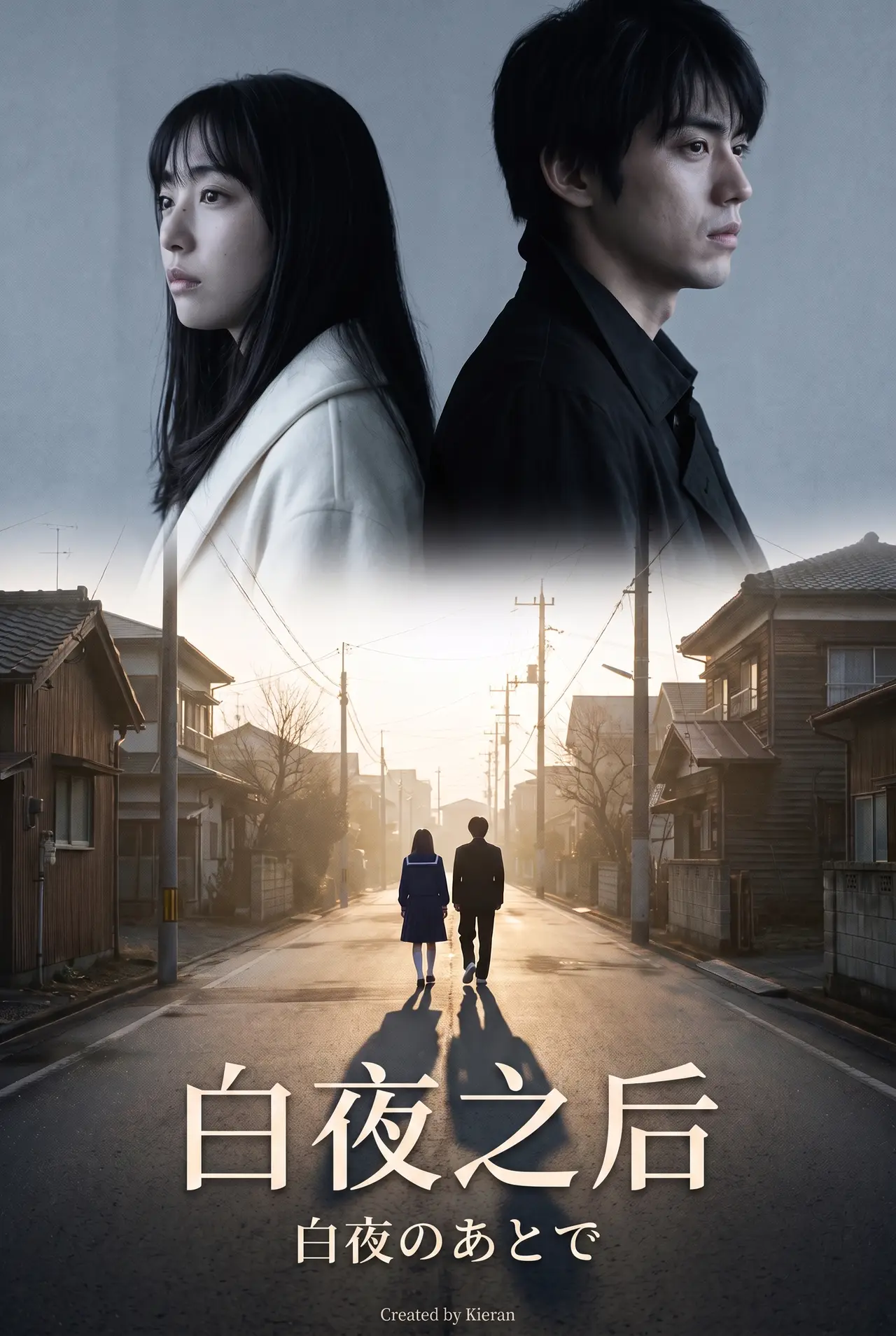
Edit this poster image. Keep everything in the picture EXACTLY as it is: the two portraits and their faces, the street, the two small figures and their merged shadows, colors and light. Only add movie poster typography in the lower third, centered over the dark road area: the main title in large elegant Chinese Song/Mincho serif type 「白夜之后」, below it a smaller Japanese subtitle 「白夜のあとで」, and at the very bottom a tiny line of Latin text "Created by Kieran". Text in soft off-white, crisp, correctly spelled, integrated like a real film poster. No other changes. Source image: {{Image 1}}.
Cinematic film poster artwork, 1990s Japanese art-house cinema, shot on 35mm Kodak film with gentle grain, dominant cold grey-blue palette, no text, no letters, no logo, no watermark. Upper part: half-body portraits of an adult East Asian woman in a white blouse and an adult East Asian man in a black coat standing back to back, each gazing off-frame in opposite directions, restrained expressions, cold side light. Lower part: an old residential street at dawn in warm golden backlight, the small distant back view of a teenage girl in a navy sailor uniform and a teenage boy in a black gakuran walking away side by side, their two long shadows merging into one on the road. Between the two layers a pale, thin white-night sky light blends them together. Leave the lower third relatively calm and dark for a title to be added later. All four faces must match the character references exactly. Face identity references only, do NOT copy their layout or grey background: {{Image 1}} {{Image 2}} {{Image 3}} {{Image 4}}.
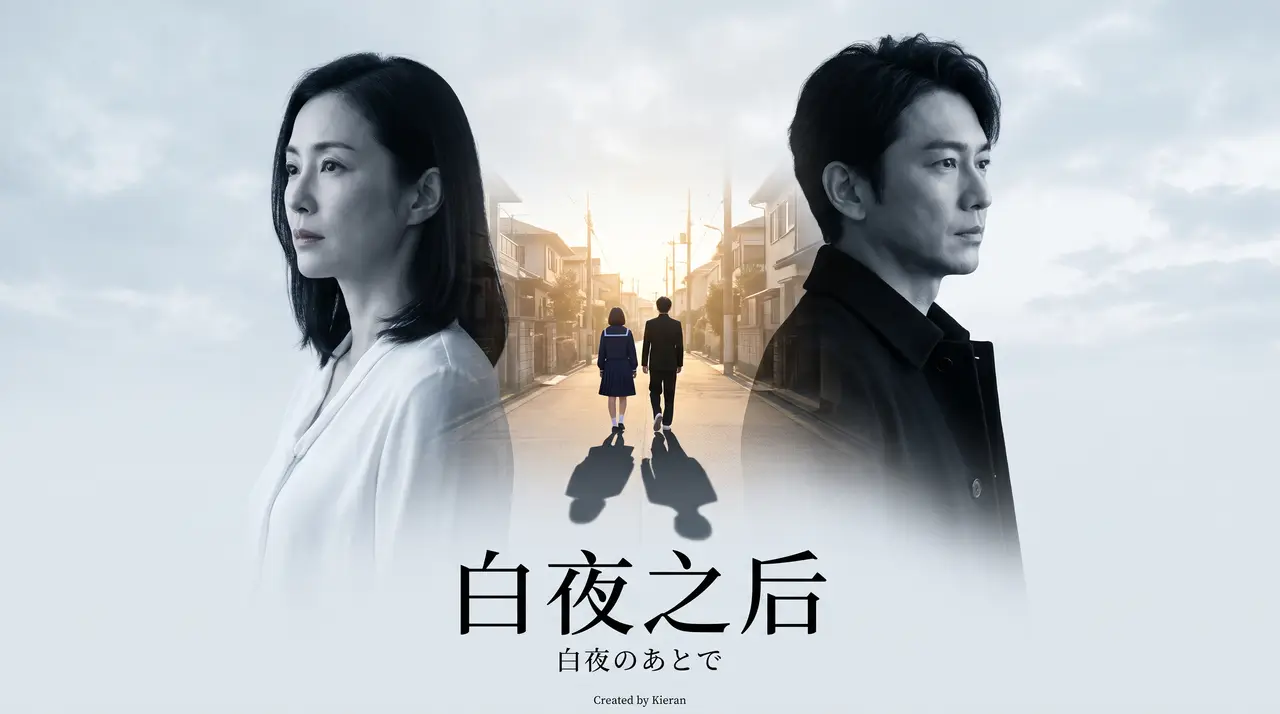
Cinematic widescreen key-art poster for a film, 1990s Japanese art-house cinema, shot on 35mm Kodak film with gentle grain, dominant cold grey-blue palette. Composition as ONE seamless double-exposure image, no rectangles, no inset picture, no photo frame, no borders: left and right are half-body portraits of an adult East Asian woman in a white blouse (left) and an adult East Asian man in a black coat (right) standing back to back, each gazing off-frame in opposite directions, restrained expressions, cold side light; their lower bodies and the space between them dissolve softly, like a double exposure, into an old residential street at dawn in warm golden backlight, where the small distant back view of a teenage girl in a navy sailor uniform and a teenage boy in a black gakuran walk away side by side, their two long shadows merging into one on the road. The street fades out at its edges into the pale white-night sky, fully blended with the portraits. Typography, centered in the lower middle: the main title in large elegant Chinese Song/Mincho serif calligraphy-like type 「白夜之后」, below it a small Japanese subtitle 「白夜のあとで」, and at the very bottom a tiny line of Latin text "Created by Kieran". Text must be crisp, correctly spelled, and integrated like a real movie poster. All four faces must match the character references exactly. Face identity references only, do NOT copy their layout or grey background: {{Image 1}} {{Image 2}} {{Image 3}} {{Image 4}}.
Cinematic widescreen key-art for a film, 1990s Japanese art-house cinema, shot on 35mm Kodak film with gentle grain, dominant cold grey-blue palette, no text, no letters, no logo, no watermark. Left and right: half-body portraits of an adult East Asian woman in a white blouse (left) and an adult East Asian man in a black coat (right) standing back to back, each gazing off-frame in opposite directions, restrained expressions, cold side light. Center between them, lower and smaller: an old residential street at dawn in warm golden backlight, the small distant back view of a teenage girl in a navy sailor uniform and a teenage boy in a black gakuran walking away side by side, their two long shadows merging into one on the road. A pale, thin white-night sky light blends the layers. Keep the lower center relatively calm and dark for a title to be added later. All four faces must match the character references exactly. Face identity references only, do NOT copy their layout or grey background: {{Image 1}} {{Image 2}} {{Image 3}} {{Image 4}}.
Edit this poster image. Keep the two portraits, their faces, hair, clothes, the pale grey-blue sky and the soft city skyline EXACTLY as they are. Remove the rectangular inset picture in the middle-bottom completely and fill that area with the same continuous pale sky, hazy distant rooftops and soft morning light so the background looks seamless, as if the inset never existed. Then add movie poster typography in the lower middle, between the two figures: the main title in large elegant Chinese Song/Mincho serif type 「白夜之后」, below it a smaller Japanese subtitle 「白夜のあとで」, and at the very bottom a tiny line of Latin text "Created by Kieran". The text must be crisp, correctly spelled, dark charcoal color on the pale background, integrated like a real film poster. No other changes. Source image: {{Image 1}}.
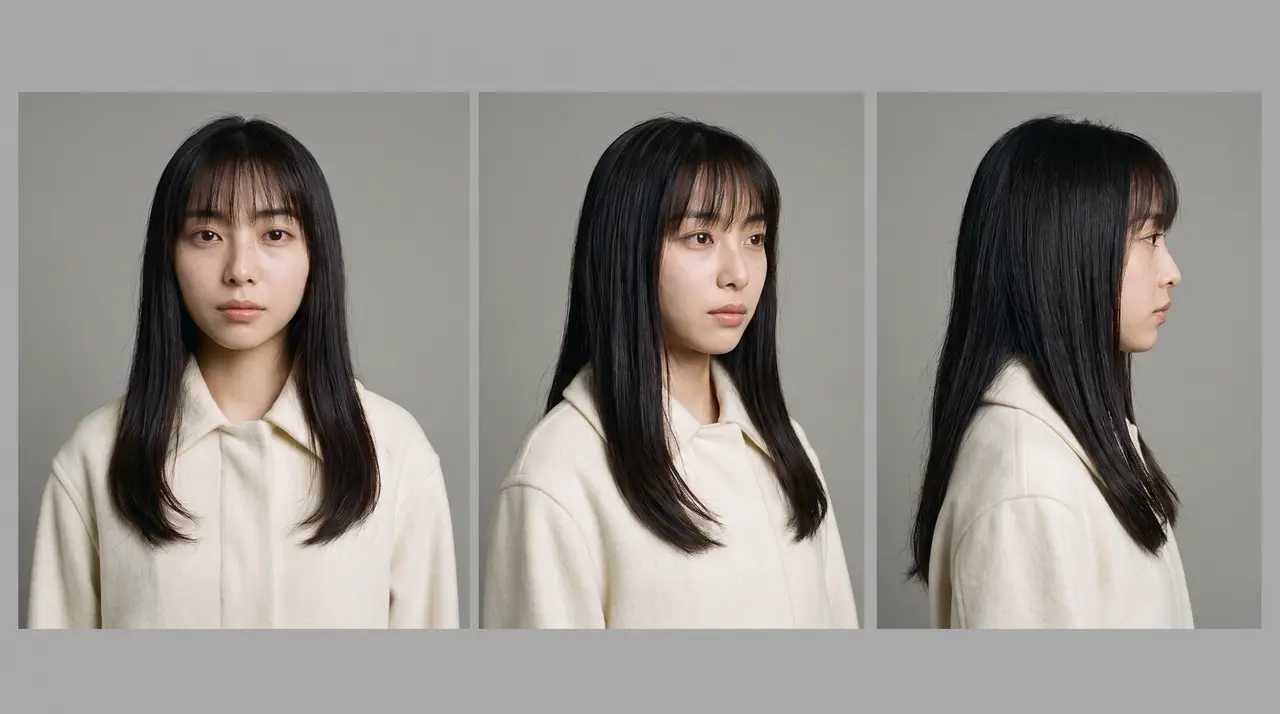
Character turnaround sheet of the exact same person as the reference {{Image 1}}: three head-and-shoulders views side by side on a plain neutral grey background, left is front view, center is three-quarter view, right is full profile view. Identical face, hairstyle, hair length and off-white wool coat in all three views. Photorealistic, Japanese live-action film look, soft even studio light, 35mm film grain, neutral expression, no text, no labels, no watermark.
Character turnaround sheet of the exact same person as the reference {{Image 1}}: three head-and-shoulders views side by side on a plain neutral grey background, left is front view, center is three-quarter view, right is full profile view. Identical face, hairstyle, hair length and black gakuran school uniform with stand collar in all three views. Photorealistic, Japanese live-action film look, soft even studio light, 35mm film grain, neutral expression, no text, no labels, no watermark.
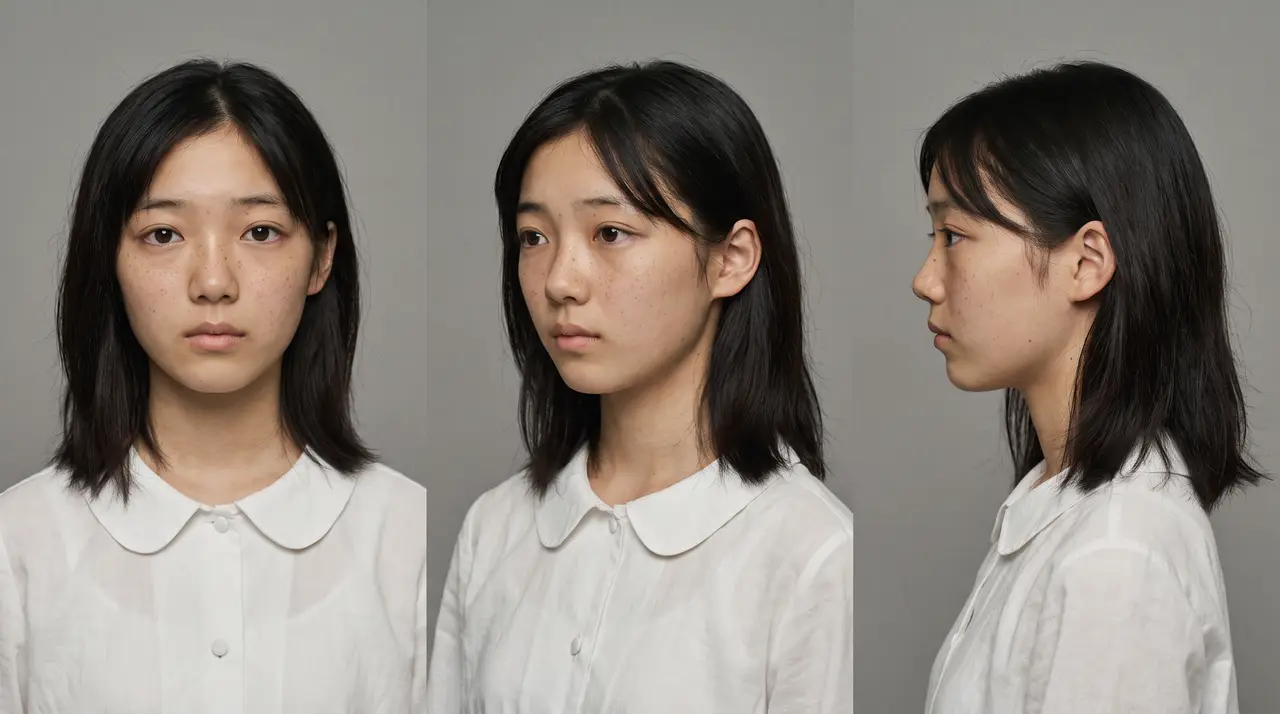
Character turnaround sheet of the exact same girl as the reference {{Image 1}}: three head-and-shoulders views side by side on a plain neutral grey background, left is front view, center is three-quarter view, right is full profile view. Identical face, hairstyle, hair length and white collared blouse in all three views. Photorealistic, 1970s Japanese live-action film look, soft even studio light, 35mm film grain, neutral expression, no text, no labels, no watermark.
生成一段日语人声独白。说话者是一个14岁的日本少女,声音稚嫩、纤细、清亮,明显是未成年少女而不是成年女性;情绪压抑、不安、轻轻发抖,几乎是小声自言自语,语速偏慢,句尾拖长、渐弱。她用日语说:「これから、どうなるの……」。只有这一句人声,安静的地下室环境,没有背景音乐,没有音效,不要英语,不要中文。
生成一段日语人声独白。说话者是一个14岁的日本少女,声音稚嫩、纤细、清亮;情绪平静而坚定,低声、温柔、语速偏慢。她用日语说:「今度は、あなたを夜の中に歩かせない。」。只有人声,没有背景音乐,没有音效。
Character turnaround sheet of the exact same person as the reference {{Image 1}}: three head-and-shoulders views side by side on a plain neutral grey background, left is front view, center is three-quarter view, right is full profile view. Identical face, hairstyle, hair length and black shirt and long black trench coat in all three views. Photorealistic, Japanese live-action film look, soft even studio light, 35mm film grain, neutral expression, no text, no labels, no watermark.
生成一段日语人声。说话者是一个14岁的日本少女,声音稚嫩、纤细、清亮;情绪温柔、带笑意、有点哽咽,轻声。她用日语说一句话:「おかえり。」只有这一句人声,没有背景音乐,没有音效。
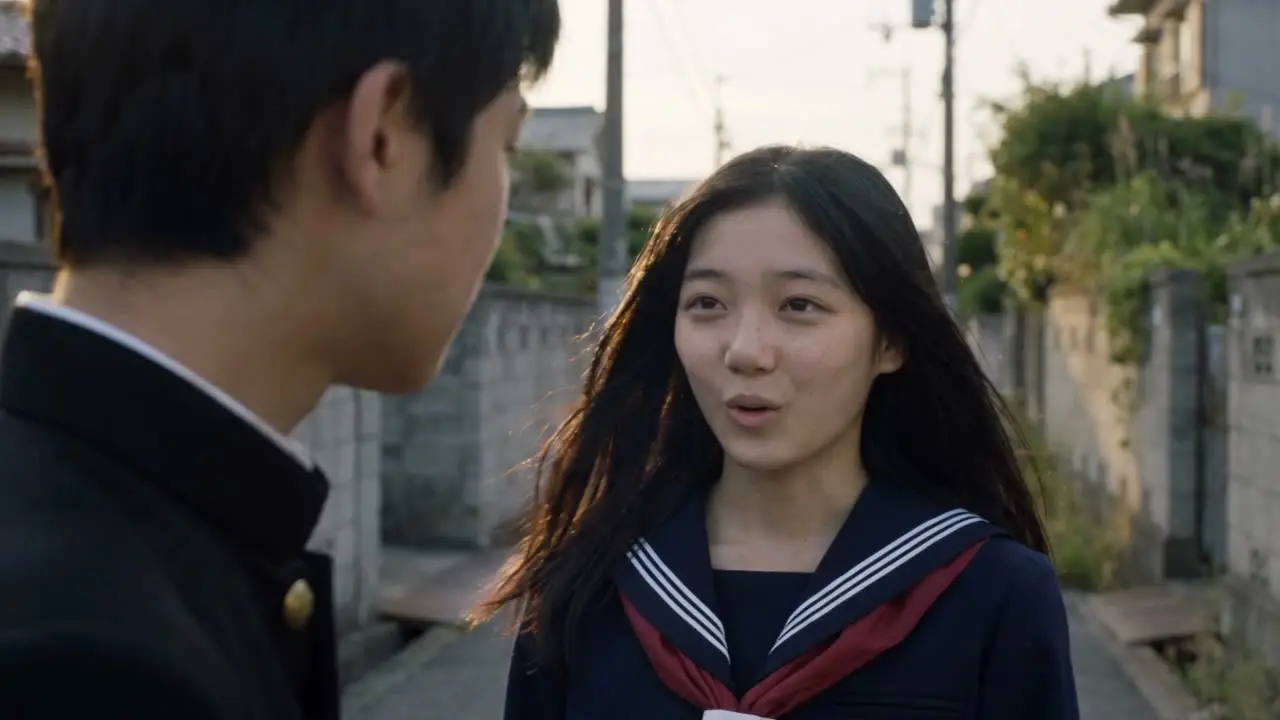
Render the described scene as a single cinematic frame. Face identity reference only, do NOT copy its layout or grey background: {{Image 1}}. Face identity reference only, do NOT copy its layout or grey background: {{Image 2}}. Face identity reference only, do NOT copy its layout or grey background: {{Image 3}}. Face identity reference only, do NOT copy its layout or grey background: {{Image 4}}. Photorealistic film still in the style of 1990s Japanese art-house youth cinema (Shunji Iwai), set in 1970s-80s Osaka, shot on 35mm Kodak film, soft natural light, muted greens and greys, gentle film grain, shallow depth of field, 16:9, East Asian cast, no text, no subtitles, no watermark. Tight over-the-shoulder close-up, 85mm lens: the blurred back of a teenage boy's head and black gakuran shoulder fills the left third of the frame; in sharp focus, filling the right two thirds, the face and shoulders of a teenage East Asian girl in a navy sailor uniform, her face large in frame, looking straight at him with a gentle small smile, wind lifting her long black hair. Background is a quiet old residential street at dawn, grey block walls and telephone poles, completely out of focus. Warm golden dawn backlight, rim light on her hair. Her face must be identical to the character reference.
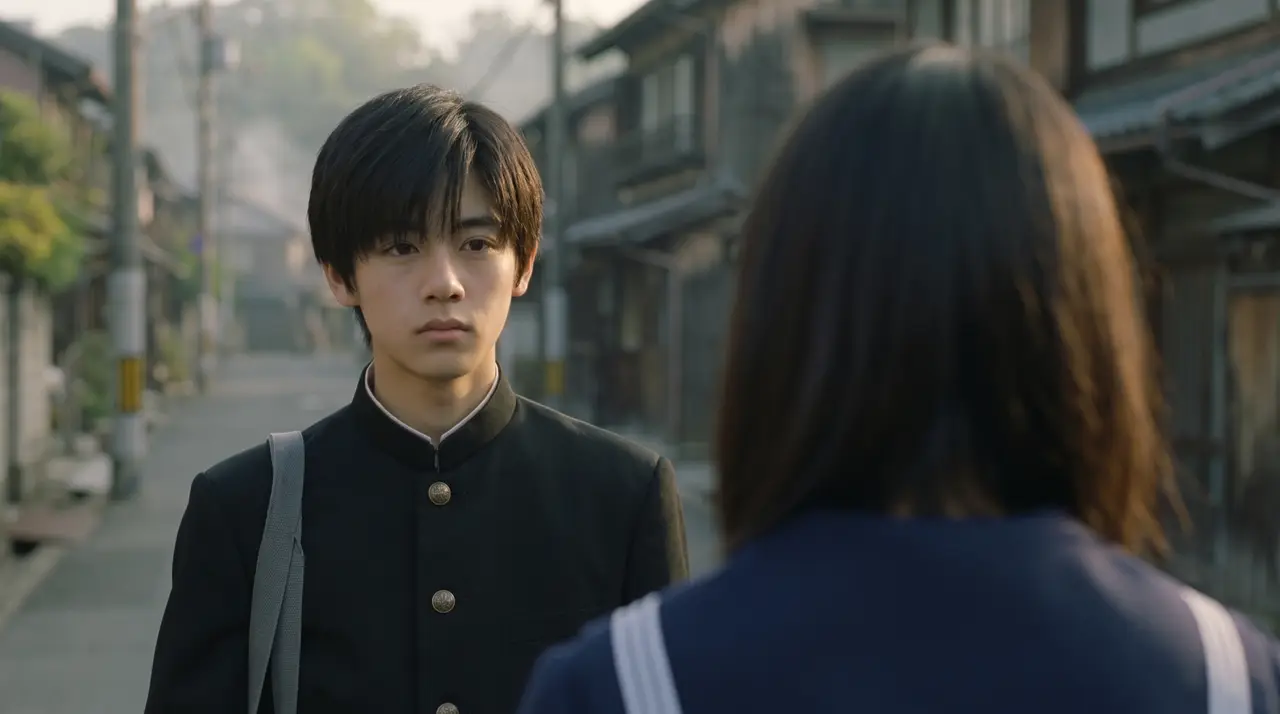
Render the described scene as a single cinematic frame. Face identity reference only, do NOT copy its layout or grey background: {{Image 1}}. Face identity reference only, do NOT copy its layout or grey background: {{Image 2}}. Face identity reference only, do NOT copy its layout or grey background: {{Image 3}}. Face identity reference only, do NOT copy its layout or grey background: {{Image 4}}. Photorealistic film still in the style of 1990s Japanese art-house youth cinema (Shunji Iwai), set in 1970s-80s Osaka, shot on 35mm Kodak film, soft natural light, muted greens and greys, gentle film grain, shallow depth of field, 16:9, East Asian cast, no text, no subtitles, no watermark. Tight reverse over-the-shoulder close-up, 85mm lens: the blurred back of a teenage girl's head and navy sailor-collar shoulder fills the right third of the frame; in sharp focus, filling the left two thirds, the face and shoulders of a thin teenage East Asian boy in a black gakuran uniform with a grey shoulder-bag strap, his face large in frame, looking straight at her, almost expressionless, eyes softening. Background is the same quiet old residential street at dawn, completely out of focus. Warm golden dawn light on his face. His face must be identical to the character reference.
生成一段日语人声。说话者是16岁的日本高中女生,声音清亮干净、略带气声,不是小孩子;温柔、平静、轻声、语速慢。她用日语说:「おかえり。」只有人声,没有背景音乐,没有音效。
室内大型商场中庭的环境音效,约5秒。开头0.5秒是普通的商场环境嘈杂声,然后一个很重的大件物体从高处落到坚硬的大理石地面,发出一声沉闷、厚重的撞击声,低频很足,带大空间的回声和余震;撞击后有半秒近乎寂静,接着周围人群的惊呼、倒吸气和骚动声由远及近,脚步声凌乱。只有音效和环境人声,没有音乐,没有台词。
室内大型商场中庭的环境音效,约5秒。开头0.5秒是普通的商场环境嘈杂声。然后一个又重又软的大件物体(像一个装满沙子的大麻袋)从高处落到坚硬的石材地面,只有一声非常沉闷、低频的钝响,短促、发闷、没有任何金属声、没有空桶般的共振,只有大空间里很短的一点低频余音。撞击后有半秒近乎寂静,接着周围人群的惊呼、倒吸气和骚动声由远及近,脚步声凌乱。只有音效和环境人声,没有音乐,没有台词。
商场中庭环境音效,5秒。先0.5秒商场嘈杂声;然后一个又重又软的大麻袋从高处落到石材地面,一声非常沉闷的低频钝响,短促发闷,没有金属声,没有空桶共振;半秒寂静;随后人群惊呼、倒吸气和骚动由远及近。没有音乐,没有台词。
 视频截图
Start from the reference frame {{Image 1}} and keep its composition, characters, lighting and 35mm film look. Start from the reference frame and keep its composition, characters, clothes and 35mm film look. The camera follows them from behind at walking pace. From the first frame they are already walking: the boy pushes the bicycle with his left hand and holds the clear umbrella in his right hand tilted over the girl, so that his own right shoulder is getting wet in the drizzle. The girl notices, reaches up and gently pushes the umbrella back toward him; he tilts it toward her again; a small silent back-and-forth, then they keep walking side by side. No speech; only rain, bicycle chain and wet footsteps. Film look: photorealistic, 1990s Japanese art-house cinema, 35mm Kodak film grain, no text, no subtitles. Audio: ambient sound only, no speech and no narration unless Japanese lines are explicitly given above; any dialogue must be in Japanese, never English.
Start from the reference frame {{Image 1}} and keep its composition, characters, lighting and 35mm film look. Start from the reference frame and keep its composition, characters, clothes and 35mm film look. From the first frame the girl is already holding out one earbud toward the boy. The boy hesitates for a second, then takes it and puts it in his ear. Both turn their heads to look out at the river in the same direction. The corner of the girl's mouth lifts slightly. The camera pushes in very slowly. No speech; only river water, evening wind and distant traffic. Film look: photorealistic, 1990s Japanese art-house cinema, 35mm Kodak film grain, no text, no subtitles. Audio: ambient sound only, no speech and no narration unless Japanese lines are explicitly given above; any dialogue must be in Japanese, never English.
Start from the reference frame {{Image 1}} and keep its composition, characters, lighting and 35mm film look. Start from the reference frame and keep its over-the-shoulder composition, characters, clothes, lighting and 35mm film look. The boy's profile in the foreground stays still. The girl is already looking at him from the first frame, wind in her hair. She softly says 「おかえり」, then closes her lips with a small smile and keeps her eyes on him without moving. Locked-off camera. All dialogue is in Japanese, only this one line, no English; otherwise only morning wind ambience. Film look: photorealistic, 1990s Japanese art-house cinema, 35mm Kodak film grain, no text, no subtitles. Audio: ambient sound only, no speech and no narration unless Japanese lines are explicitly given above; any dialogue must be in Japanese, never English.
 视频截图
Start from the reference frame {{Image 1}} and keep its composition, characters, lighting and 35mm film look. Start from the reference frame and keep its over-the-shoulder composition, characters, clothes, lighting and 35mm film look. The boy's shoulder in the foreground stays still. The girl is already looking at him from the first frame, wind in her hair. She softly says 「おかえり」, then closes her lips with a small smile and keeps her eyes on him without moving. Locked-off camera. All dialogue is in Japanese, only this one line, no English; otherwise only morning wind ambience. Film look: photorealistic, 1990s Japanese art-house cinema, 35mm Kodak film grain, no text, no subtitles. Audio: ambient sound only, no speech and no narration unless Japanese lines are explicitly given above; any dialogue must be in Japanese, never English.