
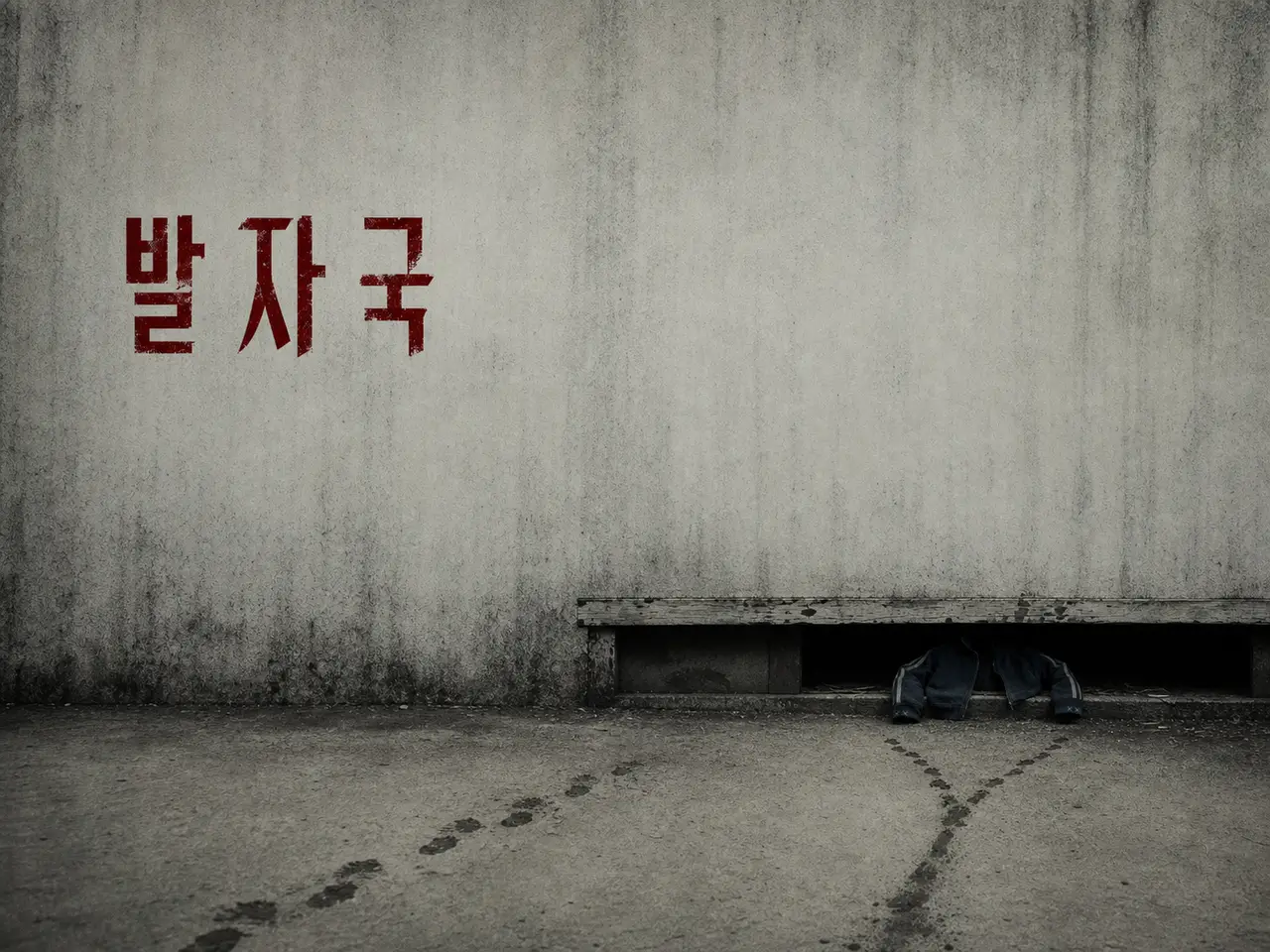
画布内容为资产图与初版sd2.0制作版本,视频为2.5重制版
Instrumental cinematic underscore for the Korean psychological mystery film “Footsteps” (발자국), set in a damp late-1990s suburban fringe community. Restrained child-perspective suspense: a warm friendship gradually contaminated by an unseen threat. Subtle and unsettling, never openly theatrical. Approximately 68 BPM, sparse arrangement, wide negative space, no vocals. Begin with a felt upright piano playing a hesitant two-note minor-third friendship motif, with natural key noise and room resonance. Add faint harmonium, distant cello harmonics and low bowed double bass, retaining a small amount of childhood warmth without sentimentality. Gradually corrupt the motif: delay and slightly detune the second note, remove expected resolutions and widen the silence between phrases. Introduce restrained prepared-piano resonance, muted wooden taps and three soft uneven knocks at long intervals, suggesting footsteps and shovel impacts without becoming literal sound effects. Slowly replace the warm harmonium with cold string harmonics, subtle bowed-metal texture and a faint sub-bass drone. In the final section, return to the two-note motif with its second note subtly altered and emotionally unfamiliar. Repeat one unresolved piano note over restrained minor-second string tension, then end with a short low resonance and an abrupt cut to complete silence. Dialogue-friendly mix, restrained volume, open midrange and controlled bass. Natural acoustic texture with subtle late-1990s analog instability. No singing, spoken words, choir, child vocals, sentimental orchestral swell, heroic melody, jump-scare sting, trailer braam, heavy percussion, drum kit, electronic beat, horror violin screeches, music-box cliché, supernatural effects or triumphant ending.
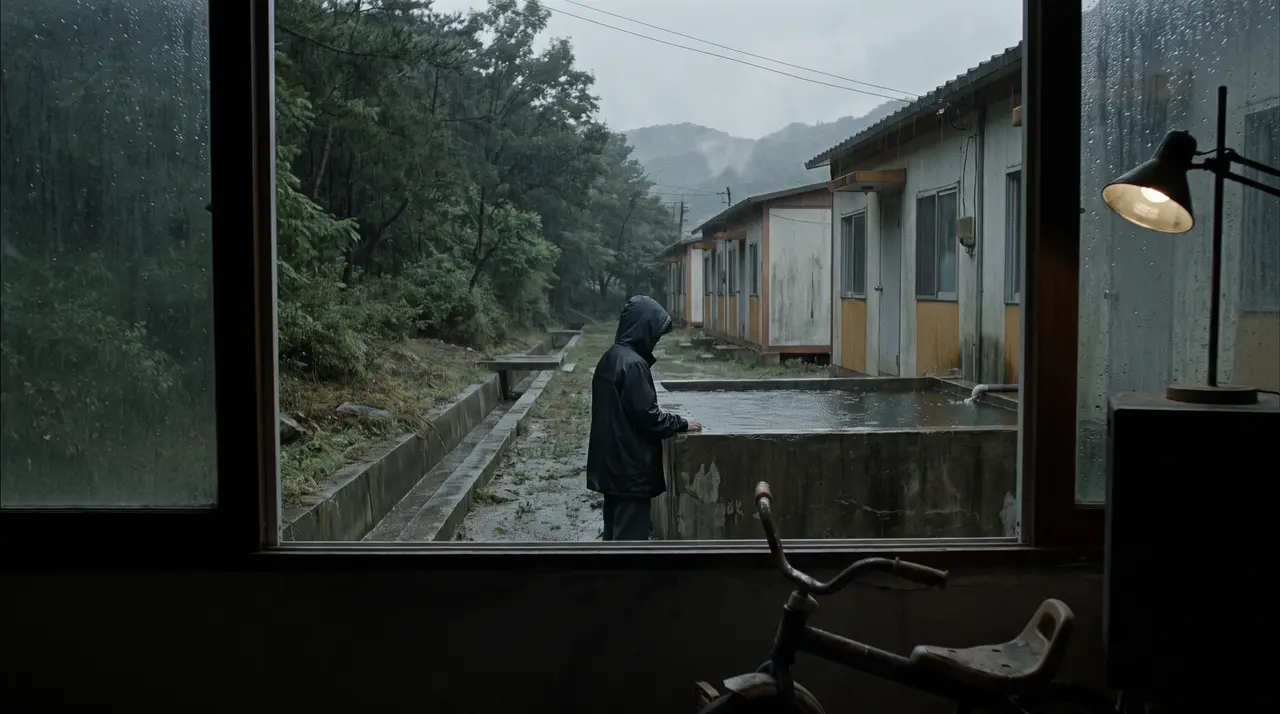 图片节点 3
Late-1990s South Korean suburban fringe, restrained realist psychological horror seen primarily from an eight-year-old child’s eye level, damp overcast atmosphere, weathered prefab houses, concrete drainage channels, reservoirs and dense woodland, muted concrete gray, moss green, faded ochre and washed deep blue palette, subtle 35mm film grain, soft highlight roll-off, spherical Super 35 cinematography, mostly 35mm and 50mm lenses, natural skin texture, directional motivated lighting, strong negative fill, layered exposure, localized pools of practical light, controlled chiaroscuro, foreground shadow, clear subject-background separation, practical tungsten interiors, quiet negative space, frames within frames, controlled depth of field, understated performances, ordinary childhood objects gradually becoming threatening, no supernatural imagery, no glossy stylization
Use case: production location design and spatial-continuity asset Asset type: unoccupied 16:9 cinematic environment reference for the Korean psychological mystery film “Footsteps” Asset ID: LOC-OLDHOUSE-INT-01A Location: Han Doyun’s bedroom in the old prefab house Location state: normally occupied, lived-in base version, before the photograph wall and before the family moves out Output: 1920×1080, photorealistic, no people Primary request: Create a complete, spatially readable master environment asset of Han Doyun’s small bedroom inside an aging single-story prefab house in the suburban fringe of South Korea in 1998. The room must feel modest, ordinary and genuinely inhabited, not abandoned and not designed as an obvious horror set. No people, no partial bodies, no human silhouettes, no reflections of people and no human-shaped shadows anywhere in the image. Spatial geometry: A narrow rectangular bedroom approximately 3.2 meters by 2.8 meters with a low 2.35-meter ceiling. A worn dark-painted metal bunk bed runs lengthwise along the left wall. The upper bunk is the regularly used sleeping space, with a thin mattress, a faded beige cotton fitted sheet, a flattened pillow and a washed gray-blue cotton blanket. The lower bunk is neatly made but visibly less used. Both bunks must remain fully readable. The bedroom door is positioned on the back-left wall and opens into a narrow, dim residential corridor. The corridor must remain visible as a clear future threat direction, but it contains no person or human shadow. A compact freestanding wooden wardrobe stands on the back wall to the right of the doorway. Beside the wardrobe is a broad uninterrupted section of faded wall that can later support the photograph-wall state without changing the room’s architecture. In this base version, that wall remains empty. A single aluminum-framed window with aged cream-colored venetian blinds occupies the right exterior wall. Through the gaps, only an indistinct overcast tree line and part of the modest backyard are visible. No human figure may appear outside. A small scratched wooden desk sits below or immediately beside the window. It contains an old adjustable desk lamp, several closed school notebooks, pencils, a small collection drawer and a few ordinary period-appropriate childhood objects. Keep the objects sparse and non-narrative. Leave enough open floor space in the center of the room for dozens of Polaroid photographs to be spread out in later scenes. The floor consists of thin, worn wooden planks above the house’s crawlspace. A narrow faded brown-gray carpet runner lies between the bunk bed and the doorway. The carpet must not cover the entire floor. Preserve the visual and structural relationship between the bunk bed, the thin floor and the hidden crawlspace below. Architecture and period details: Late-1990s South Korean low-income suburban prefab housing. Thin interior walls, slightly uneven wooden trim, faded beige vinyl wallpaper, small areas of peeling seam adhesive, aged metal window frame, simple electrical outlets, exposed pull-cord ceiling fixture and inexpensive practical furniture. The room should show normal wear from daily life: softened furniture edges, small scratches, faded surfaces, slight discoloration near the window and minor dents in the floorboards. It must remain clean enough to feel actively inhabited. Do not include modern electronics, smartphones, flat-screen displays, LED strips, contemporary furniture, modern plastic storage systems or fashionable interior decoration. Material realism: Render every surface as a physically distinct material. The wooden floor must show directional grain, small gaps, compression marks, worn varnish and restrained reflected light. The carpet runner must show short dense fibers, softened edges and uneven flattening from foot traffic. The metal bunk bed must show matte painted steel, worn contact points, small chips and realistic joint construction. Bedding must show washed cotton fibers, stitched hems, seam thickness, compression folds, pillow indentation and natural gravity-driven drape. The wardrobe and desk must show different types of aged wood veneer, scratched edges, dull hardware and realistic thickness. Wallpaper must retain subtle paper-vinyl texture, faded printing and visible seams. The venetian blinds must show thin aged slats, dust along the edges and physically believable spacing. Avoid smooth textureless surfaces, painted-on bedding, rubber-like fabric, floating folds, glossy CGI wood, perfectly clean metal, plastic-looking wallpaper or artificial HDR sharpening. Style and medium: Late-1990s South Korean suburban fringe, restrained realist psychological horror seen primarily from a low protagonist-aligned camera height, damp overcast atmosphere, weathered prefab houses, concrete drainage channels, reservoirs and dense woodland, muted concrete gray, moss green, faded ochre and washed deep blue palette, subtle 35mm film grain, soft highlight roll-off, spherical Super 35 cinematography, mostly 35mm and 50mm lenses, identity preserved from supplied character assets, directional motivated lighting, strong negative fill, layered exposure, localized pools of practical light, controlled chiaroscuro, foreground shadow, clear subject-background separation, practical tungsten interiors, quiet negative space, frames within frames, controlled depth of field, understated performances, ordinary personal and household objects gradually becoming threatening, no supernatural imagery, no glossy stylization. Composition and camera: 16:9 landscape composition. Use a restrained 24mm spherical lens only for this spatial master asset, without fisheye distortion or exaggerated wide-angle stretching. Place the camera approximately 110 cm above the floor in the near front corner of the bedroom, looking diagonally across the room. The composition must simultaneously establish: - the bunk bed and both sleeping levels; - the thin wooden floor and carpet runner; - the window and venetian blinds; - the wardrobe and empty future photograph wall; - the open doorway and part of the narrow corridor. Use the bed frame as a foreground layer, the open floor and desk as the middle layer, and the doorway, wardrobe and corridor as the background layer. Keep all important architectural relationships readable. Lighting: Late-afternoon overcast daylight enters directionally through the right-side venetian blinds, casting pale linear patterns across the bed, carpet and wooden floor. A modest tungsten ceiling fixture creates a localized warm pool around the bunk bed and central floor. The cool window light and warm practical light must remain visibly separate. Use restrained negative fill in the doorway and beneath the lower bunk. Preserve readable wood, fabric and wallpaper texture in the darker areas. The corridor is dim but not pure black. Do not use flat, evenly distributed room lighting. Color palette: Faded beige wallpaper, old wood brown, muted gray-blue bedding, worn brown-gray carpet, dull dark metal and cold overcast blue-gray window light. No saturated red and no bright modern colors. Text rendering: No visible writing, labels, posters, calendar text, book titles, product branding or watermark anywhere in the image. Continuity constraints: The room must remain architecturally ordinary and unchanged across later lived-in, locked-window, moving, empty and photograph-wall states. Do not display the deep-blue jacket JKT-01, Polaroid photographs, letters, maps, police evidence, animal remains, food bowls, mysterious objects or any clue that belongs to a later scene. Avoid: Any person, partial body, face, hand, foot, human silhouette, human reflection, human-shaped shadow, figure outside the window, antagonist presence, supernatural imagery, ghost imagery, hidden figure beneath the bed, obvious horror decoration, excessive decay, abandoned-house styling, dramatic blood, photo wall, exposed Polaroids, deep-blue jacket, modern furniture, modern electronics, LED light, flat lighting, evenly illuminated room, pure-black corridor, saturated blue night, extreme wide-angle distortion, fisheye lens, dutch angle, excessive shallow depth of field, glossy commercial rendering, plastic surfaces, textureless fabric, duplicate furniture, impossible room geometry, extra doors, extra windows, random text, malformed Korean, logos or watermark.
Design an isolated minimalist title logo for the Korean psychological thriller film “Footsteps”. Render the exact Korean title “발자국” once and only once. Every Hangul character must be complete, correctly formed and immediately legible. Do not translate, romanize or add any secondary text. Create a custom Korean wordmark based on a restrained late-1990s printed Gothic typeface: compact square proportions, firm blunt strokes, slightly narrow spacing, imperfect dry-ink edges and subtle analog printing wear. The typography should feel ordinary at first glance but quietly unsettling upon closer inspection. Keep “발자” aligned on one stable baseline. Lower the entire final syllable block “국” by only two to three percent of the letter height, preserving its exact structure and full legibility. This tiny displacement should suggest a missed step, a floorboard settling downward and an identity slipping out of place. Add one extremely thin horizontal negative slit beneath the main baseline, echoing the gap between old wooden floorboards; it must remain an abstract typographic element, not an illustration. Use faded bone-white and cold concrete gray for the primary lettering, with an extremely restrained washed deep-blue tint visible only along a few lower worn edges. No red. Realistic dry ink, aged paper-print irregularity and lightly abraded stroke edges, but keep the outer silhouette clean enough for professional title use. 16:9 horizontal canvas, logo centered horizontally and positioned slightly below the vertical center, occupying approximately forty percent of the canvas width. Generous empty space around the wordmark. The background must be perfectly uniform absolute black, exact RGB 0,0,0 / #000000, extending cleanly from edge to edge. Zero background texture, zero film grain, zero noise, zero vignette, zero gradient, zero lighting variation and zero visible compression artifacts, suitable for clean black-background keying. Minimal, restrained, psychologically disturbing, realistic Korean crime-thriller identity design. No literal horror imagery. Avoid: malformed Hangul, misspelled title, missing or duplicated characters, additional Korean text, Chinese text, English text, romanization, subtitles, footprints, shoes, blood, scratches resembling blood, handprints, faces, eyes, human silhouettes, houses, forests, photographs, floorboard illustration, decorative icons, neon colors, red accents, glow, drop shadow, bevel, metallic texture, glossy 3D lettering, cinematic background, gray background, transparent checkerboard, mockup presentation, border, frame, watermark or logo duplication.
{{Image 1}} 门前是一条马路,挨着马路是干涸的排水渠,排水渠的另一边是树丛。镜头拍摄排水渠,树丛和房子在镜头两侧
Create an unoccupied master exterior asset of Han Doyun and Lee Sunyoung’s old single-story prefab house in Baekrim-dong, South Korea, shortly before dawn in 1998. The house must appear modest, weathered and actively inhabited. It is an ordinary low-cost home at the edge of an old residential district, not a haunted house and not yet abandoned. Architecture: A small rectangular single-story prefab house raised approximately 80–90 centimeters above uneven ground on visible concrete pier foundations. The raised wooden floor creates a low crawlspace beneath the entire building. The exterior walls are made from faded off-white and light-gray prefabricated siding panels with aged seams, minor rust marks around fasteners and worn muted-green trim. The roof is a shallow-pitched dark gray corrugated roof with a simple gutter and downspout. A short concrete stoop with three steps leads to the front door. Include a plain painted-metal railing with minor chips and rust. A small practical porch light is mounted beside the door. The front façade has a larger living-room window and a smaller bedroom window fitted with aged cream venetian blinds. Warm tungsten interior light is visible through the windows, but no person, face, silhouette or moving shadow appears behind the blinds. The kitchen and backyard lie behind the house. The large old tree associated with the house rises behind and slightly to one side of the roofline. Its trunk and main branches must remain fixed in later versions. A narrow route along the right exterior wall leads toward the back door, porch steps and crawlspace entrance. The entrance itself may be partly obscured by grass from this front angle, but its location beneath the rear-right portion of the house must remain architecturally possible. The yard contains patchy damp grass, compacted soil, a short wire fence, a modest gate and a small aged metal mailbox near the roadside. No readable text or house number. The drainage channel and forest direction should be suggested beyond one side of the property so the house remains connected to LOC-BAEKRIM-01A and LOC-FOREST-01. Style/medium: Late-1990s South Korean suburban fringe, restrained realist psychological horror seen primarily from a low protagonist-aligned camera height, damp overcast atmosphere, weathered prefab houses, concrete drainage channels, reservoirs and dense woodland, muted concrete gray, moss green, faded ochre and washed deep blue palette, subtle 35mm film grain, soft highlight roll-off, spherical Super 35 cinematography, mostly 35mm and 50mm lenses, identity preserved from supplied character assets, directional motivated lighting, strong negative fill, layered exposure, localized pools of practical light, controlled chiaroscuro, foreground shadow, clear subject-background separation, practical tungsten interiors, quiet negative space, frames within frames, controlled depth of field, understated performances, ordinary personal and household objects gradually becoming threatening, no supernatural imagery, no glossy stylization. Composition/camera: 16:9 landscape composition, 35mm spherical lens, camera approximately 110 cm above the roadside. Frame the house from a slightly off-center frontal three-quarter angle. Keep the front door, concrete steps, both principal windows, raised foundations, yard, large rear tree and the route toward the side of the house readable in one image. Use a dark fence post or shrub at the edge of the foreground. The house and yard occupy the middle layer. The large tree, old neighboring rooftops and forest edge form the background. Do not center the house like a real-estate listing. Preserve modest negative space on the forest-facing side. Lighting: Cold pre-dawn sky light comes from side-back and separates the roof, siding and large tree from the darker surroundings. Warm practical tungsten light glows from inside the house and from the small porch fixture. It must remain localized rather than illuminating the entire yard. Use restrained negative fill beneath the raised floor, beside the house and behind the large tree. The crawlspace remains dark but retains faint structural detail. No human-like form or shadow may appear beneath the house. Materials/textures: Show realistic weathered siding, panel seams, oxidized fasteners, corrugated roofing, damp concrete steps, chipped painted metal, cloudy window glass, dusty venetian blinds, wet soil, flattened grass, rusted wire fencing, tree bark and dull mailbox metal. The house must show ordinary age and maintenance, not severe abandonment. Text rendering: No visible house number, mailbox text, address, sale sign, advertisement, poster, label or watermark. Continuity constraints: Preserve the position of the front door, steps, windows, large tree, side route, back door direction, raised foundations and crawlspace entrance across all later states. The lived-in, locked-window, moving-day and empty-house versions must use this same architecture. Only lighting, vegetation, locks, household traces and deterioration may change. Do not include a moving truck, sale sign, police vehicle, investigators, missing-person notice, JKT-01, photographs, letters, maps or any other later-story clue. Avoid: Any person, partial body, face, hand, foot, human silhouette behind blinds, human reflection in windows, human-shaped shadow, figure beneath the house, antagonist presence, supernatural imagery, ghost imagery, haunted-house styling, extreme decay, broken windows in the lived-in version, overgrown abandoned yard, moving truck, police car, modern car, modern neighboring buildings, LED light, neon light, security camera, satellite dish, modern mailbox, readable text, house number, sale sign, artificial fog, saturated blue night, bright moonlight, flat lighting, real-estate photography, glossy CGI surfaces, impossible foundations, extra floors, extra doors, extra windows, random text, logos or watermark.
Create an unoccupied master environment asset of the familiar concrete drainage channel at the forest edge of Baekrim-dong, a declining suburban neighborhood in the fictional city of Haewon, Gyeonggi Province, South Korea, shortly before dawn in 1998. A shallow open concrete drainage channel runs diagonally from the forest edge in the foreground toward the old residential streets in the distance. The channel is approximately 1.5 meters wide and 70–80 centimeters deep, with sloped concrete sides, visible expansion joints and a narrow trickle of water. It is shallow and accessible enough to function as an ordinary play area during dry weather. The forest and dense shrubs end irregularly behind the camera position and along one side of the channel. On the opposite side, a narrow worn concrete footpath runs beside low retaining walls, wire fencing and the rear edges of old prefab houses. Include one small utilitarian concrete slab bridge crossing the channel farther down. Weathered wooden utility poles and loose overhead cables lead toward the neighborhood. Distant low rooftops {{Image 1}} are visible but not individually emphasized. The channel must connect visually toward Doyun’s old house and the larger Baekrim-dong street system. Preserve its direction, width, bridge position, forest opening and utility poles in all future states. Style/medium: Late-1990s South Korean suburban fringe, restrained realist psychological horror seen primarily from a low protagonist-aligned camera height, damp overcast atmosphere, weathered prefab houses, concrete drainage channels, reservoirs and dense woodland, muted concrete gray, moss green, faded ochre and washed deep blue palette, subtle 35mm film grain, soft highlight roll-off, spherical Super 35 cinematography, mostly 35mm and 50mm lenses, identity preserved from supplied character assets, directional motivated lighting, strong negative fill, layered exposure, localized pools of practical light, controlled chiaroscuro, foreground shadow, clear subject-background separation, practical tungsten interiors, quiet negative space, frames within frames, controlled depth of field, understated performances, ordinary personal and household objects gradually becoming threatening, no supernatural imagery, no glossy stylization. Composition/camera: 16:9 landscape frame, restrained 24mm spherical lens, camera approximately 110 cm above the ground at the point where the forest opens onto the channel. Use wet shrubs at the forest exit as a dark foreground edge. The drainage channel occupies the middle layer and becomes the main leading line. Old rooftops, utility poles and the first residential alley form the background destination. Keep the horizon level and the spatial route immediately understandable. Lighting: Pre-dawn blue-gray ambient light comes from the open sky above the neighborhood. A single distant amber sodium-vapor streetlamp remains lit farther down the channel. The concrete channel receives slightly more sky light than the surrounding shrubs. Negative fill preserves darkness beneath the bridge and along the forest edge. Wet concrete and shallow water catch restrained reflections without becoming glossy. Materials/textures: Realistic aged concrete with aggregate, hairline cracks, expansion joints, water stains, mineral streaks, moss at the wet line and chipped edges. Show shallow moving water, damp weeds, rusty wire fencing, weathered wood poles, patched asphalt and aged prefab roofing. The location must feel used and neglected rather than post-apocalyptic. Text rendering: No visible street names, advertisements, house numbers, posters, package labels or watermark. Avoid: Any person, partial body, human silhouette, human reflection, human-shaped shadow, animal, antagonist presence, supernatural imagery, ghost figure, modern cars, smartphones, LED streetlights, contemporary buildings, neon signs, modern guardrails, dramatic flooding, deep river, clean new concrete, oversized sewer tunnel, graffiti, readable signage, police tape, missing-person posters, random evidence, heavy fog, saturated blue night, teal-and-orange grading, flat lighting, glossy CGI concrete, impossible channel geometry, extra bridges, random text, logos or watermark.
Asset type: cinematic storyboard keyframe for a psychological horror film Primary request: nearly fifty instant photographs cover a Korean child’s bedroom floor in a large imperfect grid; eight-year-old Han Doyun kneels in the exact middle, one hand braced on the floor and the other holding a photograph close, realizing that a tiny version of himself appears somewhere in every image Scene/backdrop: modest late-1990s bedroom in a worn prefab house in suburban Gyeonggi-do; wooden floor, edge of a bunk bed, low desk lamp, venetian blinds and a dark corridor at the room edge; no other person present Subject: slim, slightly short eight-year-old Korean boy with black slightly wavy short hair, washed deep-blue zip sports jacket over plain period-appropriate clothes, restrained panic and inward posture; dozens of period instant photographs showing ordinary shops, school grounds, parks and streets, with one very small indistinct child shape recurring in each image Style/medium: photorealistic cinematic film still, restrained realist psychological horror, spherical Super 35, subtle 35mm film grain, tactile worn paper and wood, late-1990s Korean period accuracy Composition/framing: 16:9 landscape image designed as a near-vertical overhead shot using a 35mm spherical lens; Doyun is surrounded on all sides by the photograph grid like an object inside an archive; bed frame and room edges create a frame within the frame; photographs are organized enough to imply a deliberate system but not perfectly geometric; no cropped limbs Lighting/mood: a localized warm tungsten desk-lamp pool covers the boy and central photographs while cold venetian-blind light cuts into one edge and the corridor remains a textured dark zone; strong negative fill at the perimeter; layered exposure with clear separation between paper, boy and floor; escalating quiet dread Color palette: old wood brown, faded paper white, muted concrete gray, washed deep blue, a small amount of dirty tungsten amber, low saturation without gray flatness Constraints: photographs contain no readable text and no clearly recognizable faces; Doyun remains small inside each photo; realistic child anatomy and hands; no antagonist anywhere; no watermark; no logo Avoid: evidence-board strings, detective office styling, perfect graphic-design grid, supernatural symbols, ghost, antagonist silhouette, readable generated text, modern instant-camera design, flat lighting, uniformly lit floor, excessive shallow depth of field, distorted photographs
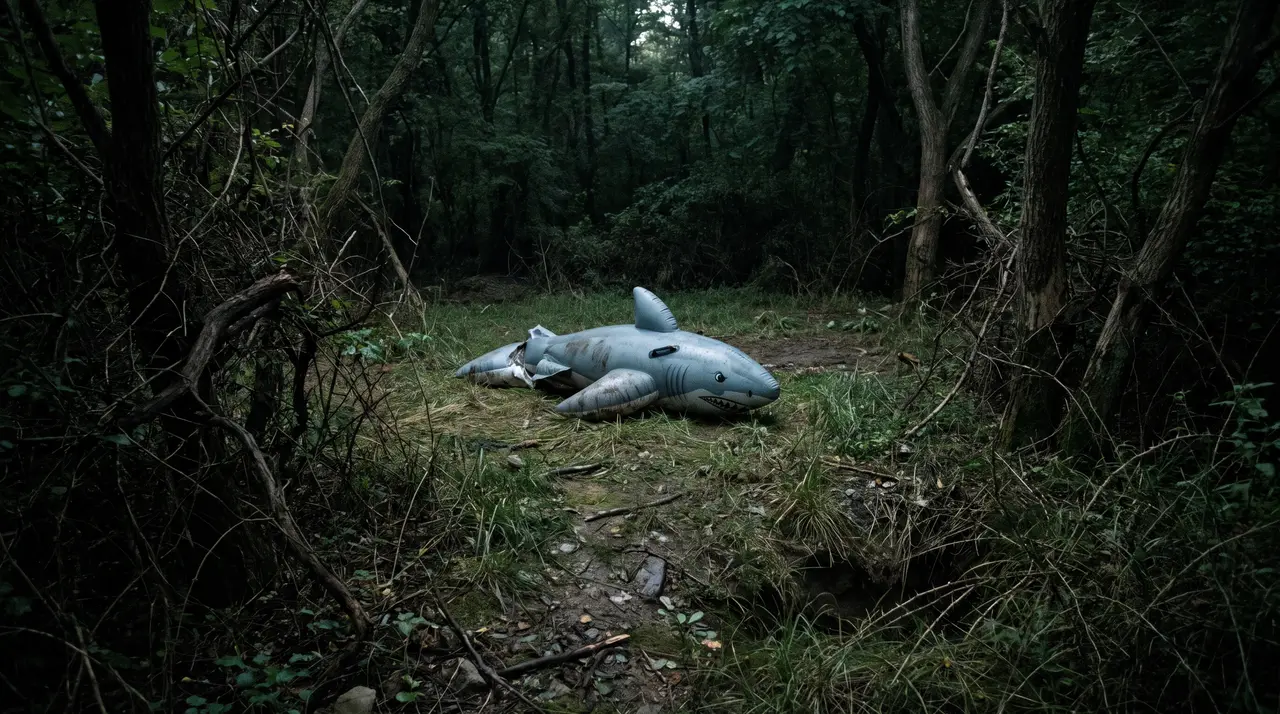
Create an unoccupied nighttime master environment asset of a small isolated clearing inside dense woodland near Baekrim-dong, South Korea, in 1998. The clearing is irregular rather than circular, approximately eight meters across, surrounded on every side by dense shrubs, thorny vines, mature deciduous trees and tangled lower branches. It must feel possible to enter from several directions while providing no immediately readable exit. Place a deflated shark-shaped inflatable pool mattress, FLOAT-01, slightly off-center in the clearing. It is large enough for a person to lie on, but one side has collapsed almost completely. FLOAT-01 has a muted faded gray-blue body, a low raised dorsal fin, a blunt shark-shaped nose, small printed black eyes and restrained white teeth graphics. The vinyl surface is damp, creased and slightly muddy. One seam has weakened, causing the uneven deflation. No branding, lettering or decorative text. The float rests partly on flattened grass and partly on exposed dark soil. Its underside is dirtier than its upper surface. Preserve this exact shape, color, fin position, printed eye position, seam layout and damage pattern in all future versions. Near the frame edge, include an irregular ground depression partly concealed by thorny grass and shadow. It must not become the visual focus, but its position must remain fixed for the later return to this clearing. The ground contains coarse weeds, thorns, fallen leaves, small stones, snapped twigs and patches of cold damp soil. No blood, footprints, clothing, rope, tools or explanatory evidence. Style/medium: Late-1990s South Korean suburban fringe, restrained realist psychological horror seen primarily from a low protagonist-aligned camera height, damp overcast atmosphere, weathered prefab houses, concrete drainage channels, reservoirs and dense woodland, muted concrete gray, moss green, faded ochre and washed deep blue palette, subtle 35mm film grain, soft highlight roll-off, spherical Super 35 cinematography, mostly 35mm and 50mm lenses, identity preserved from supplied character assets, directional motivated lighting, strong negative fill, layered exposure, localized pools of practical light, controlled chiaroscuro, foreground shadow, clear subject-background separation, practical tungsten interiors, quiet negative space, frames within frames, controlled depth of field, understated performances, ordinary personal and household objects gradually becoming threatening, no supernatural imagery, no glossy stylization. Composition/camera: 16:9 landscape frame, restrained 24mm spherical lens, camera approximately 105 cm above the ground at the edge of the clearing. Use dark leaves and thorny branches as a partial foreground frame. Place FLOAT-01 in the middle layer with enough exposed ground around it to establish its location. Dense tree trunks and unreadable woodland exits form the background. The clearing must feel spatially real and navigable. Do not make it a symmetrical stage or a perfect circle. Lighting: A clear opening in the canopy reveals a dense natural star field. Do not include a large visible moon. Weak cold sky illumination enters from above and slightly behind the clearing, revealing the upper surfaces of the float, wet leaves and selected tree trunks. Use strong but controlled negative fill under shrubs and behind tree trunks. Preserve three exposure layers: near-black thorny foreground, readable float and ground in the middle, and deep ink-green woodland in the background. Shadows must retain faint leaf, bark and vinyl texture rather than becoming pure black. Materials/textures: Show realistic wet bark, matte leaves, coarse thorny stems, compressed grass, cold damp soil, decomposing leaf litter and thick creased PVC vinyl. The inflatable must have realistic material thickness, welded seams, collapsed air chambers, surface tension and gravity-driven folds. Text rendering: No visible writing, labels, signage, branding or watermark. Avoid: Any person, child, adult, partial body, hand, foot, face, human silhouette, human reflection, human-shaped shadow, hidden antagonist, animal, supernatural figure, ghost imagery, footprints, blood, clothing, rope, tools, random evidence, dramatic fog, artificial spotlight, flashlight beam, oversized moon, saturated blue night, teal-and-orange grading, pure-black background, fantasy forest, tropical vegetation, symmetrical clearing, perfectly inflated float, new glossy float, extra inflatable toys, malformed shark shape, random text, logos or watermark.
Create an unoccupied master environment asset of the dense woodland route surrounding the shark-float clearing near Baekrim-dong, South Korea, during the same deep night. The forest must use exactly the same season, moisture, ground material, tree species and darkness level as LOC-FOREST-01A. Show a realistic mixed deciduous woodland composed primarily of mature oak and chestnut-like trees, thinner secondary trunks, tangled shrubs, thorny vines and low branches. The vegetation is dense but not primeval or fantastical. A barely readable route passes between the shrubs. It is not a maintained trail. Fallen branches, exposed roots, low vines, wet stones and a diagonal fallen trunk repeatedly interrupt the route and force anyone passing through to change direction. The route should visually divide into several plausible openings that become obscured after only a few meters, making it believable that someone could circle back toward the same clearing. The ground gradually slopes downward toward the unseen drainage channel. Preserve this downhill direction in future forest shots. Do not include the shark float in this asset. Do not include maps, markers, inserted sticks, flashlights, footprints or other evidence. Style/medium: Late-1990s South Korean suburban fringe, restrained realist psychological horror seen primarily from a low protagonist-aligned camera height, damp overcast atmosphere, weathered prefab houses, concrete drainage channels, reservoirs and dense woodland, muted concrete gray, moss green, faded ochre and washed deep blue palette, subtle 35mm film grain, soft highlight roll-off, spherical Super 35 cinematography, mostly 35mm and 50mm lenses, identity preserved from supplied character assets, directional motivated lighting, strong negative fill, layered exposure, localized pools of practical light, controlled chiaroscuro, foreground shadow, clear subject-background separation, practical tungsten interiors, quiet negative space, frames within frames, controlled depth of field, understated performances, ordinary personal and household objects gradually becoming threatening, no supernatural imagery, no glossy stylization. Composition/camera: 16:9 landscape frame, 24mm spherical lens, camera approximately 105 cm above the ground. A cluster of wet leaves and thorny branches forms the foreground obstruction. The narrow broken route and fallen trunk occupy the middle layer. Repeating trunks, overlapping shrubs and several false openings fill the background. Use the route and leaning trunks to create directional confusion without using a dutch angle. Preserve natural vertical tree growth and realistic terrain. Lighting: Weak cold starlight filters through irregular canopy openings from side-back. Selected wet trunks and leaf edges catch restrained gray highlights. Strong negative fill lowers the interior of the shrub masses, but the route, fallen trunk and major tree positions must remain readable. Do not illuminate the entire forest evenly. Use ink green, damp bark gray, dead-leaf brown and cold blue-gray. No saturated moonlight and no artificial flashlight beam. Materials/textures: Highly realistic wet bark, moss, matte broad leaves, thorny stems, exposed roots, damp stones, rotting wood, compacted soil and layered leaf litter. Different plants must retain visibly different leaf shapes and surface textures. Text rendering: No visible writing, signs, trail markers or watermark. Avoid: Any person, partial body, human silhouette, human reflection, human-shaped shadow, antagonist figure, animal, supernatural presence, ghost imagery, glowing eyes, footprints, blood, clothing, bags, tools, trail signs, modern litter, artificial fog, blue fantasy moonlight, oversized trees, tropical jungle, perfectly straight path, symmetrical vegetation, pure-black empty background, studio lighting, flat lighting, fisheye distortion, dutch angle, excessive shallow depth of field, repeated cloned trees, plastic leaves, random text, logos or watermark.
Create an unoccupied master environment asset of the dense woodland route surrounding the shark-float clearing near Baekrim-dong, South Korea, during the same deep night. The forest must use exactly the same season, moisture, ground material, tree species and darkness level as LOC-FOREST-01A. Show a realistic mixed deciduous woodland composed primarily of mature oak and chestnut-like trees, thinner secondary trunks, tangled shrubs, thorny vines and low branches. The vegetation is dense but not primeval or fantastical. A barely readable route passes between the shrubs. It is not a maintained trail. Fallen branches, exposed roots, low vines, wet stones and a diagonal fallen trunk repeatedly interrupt the route and force anyone passing through to change direction. The route should visually divide into several plausible openings that become obscured after only a few meters, making it believable that someone could circle back toward the same clearing. The ground gradually slopes downward toward the unseen drainage channel. Preserve this downhill direction in future forest shots. Do not include the shark float in this asset. Do not include maps, markers, inserted sticks, flashlights, footprints or other evidence. Style/medium: Late-1990s South Korean suburban fringe, restrained realist psychological horror seen primarily from a low protagonist-aligned camera height, damp overcast atmosphere, weathered prefab houses, concrete drainage channels, reservoirs and dense woodland, muted concrete gray, moss green, faded ochre and washed deep blue palette, subtle 35mm film grain, soft highlight roll-off, spherical Super 35 cinematography, mostly 35mm and 50mm lenses, identity preserved from supplied character assets, directional motivated lighting, strong negative fill, layered exposure, localized pools of practical light, controlled chiaroscuro, foreground shadow, clear subject-background separation, practical tungsten interiors, quiet negative space, frames within frames, controlled depth of field, understated performances, ordinary personal and household objects gradually becoming threatening, no supernatural imagery, no glossy stylization. Composition/camera: 16:9 landscape frame, 24mm spherical lens, camera approximately 105 cm above the ground. A cluster of wet leaves and thorny branches forms the foreground obstruction. The narrow broken route and fallen trunk occupy the middle layer. Repeating trunks, overlapping shrubs and several false openings fill the background. Use the route and leaning trunks to create directional confusion without using a dutch angle. Preserve natural vertical tree growth and realistic terrain. Lighting: Weak cold starlight filters through irregular canopy openings from side-back. Selected wet trunks and leaf edges catch restrained gray highlights. Strong negative fill lowers the interior of the shrub masses, but the route, fallen trunk and major tree positions must remain readable. Do not illuminate the entire forest evenly. Use ink green, damp bark gray, dead-leaf brown and cold blue-gray. No saturated moonlight and no artificial flashlight beam. Materials/textures: Highly realistic wet bark, moss, matte broad leaves, thorny stems, exposed roots, damp stones, rotting wood, compacted soil and layered leaf litter. Different plants must retain visibly different leaf shapes and surface textures. Text rendering: No visible writing, signs, trail markers or watermark. Avoid: Any person, partial body, human silhouette, human reflection, human-shaped shadow, antagonist figure, animal, supernatural presence, ghost imagery, glowing eyes, footprints, blood, clothing, bags, tools, trail signs, modern litter, artificial fog, blue fantasy moonlight, oversized trees, tropical jungle, perfectly straight path, symmetrical vegetation, pure-black empty background, studio lighting, flat lighting, fisheye distortion, dutch angle, excessive shallow depth of field, repeated cloned trees, plastic leaves, random text, logos or watermark. 场景很暗的夜晚,还未天亮
标题下方加一个小的副标题:
无噪点,无密集高光。 Create an unoccupied nighttime master environment asset of a small isolated clearing inside dense woodland near Baekrim-dong, South Korea, in 1998. The clearing is irregular rather than circular, approximately eight meters across, surrounded on every side by dense shrubs, thorny vines, mature deciduous trees and tangled lower branches. It must feel possible to enter from several directions while providing no immediately readable exit. Place a deflated shark-shaped inflatable pool mattress, FLOAT-01, slightly off-center in the clearing. It is large enough for a person to lie on, but one side has collapsed almost completely. FLOAT-01 has a muted faded gray-blue body, a low raised dorsal fin, a blunt shark-shaped nose, small printed black eyes and restrained white teeth graphics. The vinyl surface is damp, creased and slightly muddy. One seam has weakened, causing the uneven deflation. No branding, lettering or decorative text. The float rests partly on flattened grass and partly on exposed dark soil. Its underside is dirtier than its upper surface. Preserve this exact shape, color, fin position, printed eye position, seam layout and damage pattern in all future versions. Near the frame edge, include an irregular ground depression partly concealed by thorny grass and shadow. It must not become the visual focus, but its position must remain fixed for the later return to this clearing. The ground contains coarse weeds, thorns, fallen leaves, small stones, snapped twigs and patches of cold damp soil. No blood, footprints, clothing, rope, tools or explanatory evidence. Style/medium: Late-1990s South Korean suburban fringe, restrained realist psychological horror seen primarily from a low protagonist-aligned camera height, damp overcast atmosphere, weathered prefab houses, concrete drainage channels, reservoirs and dense woodland, muted concrete gray, moss green, faded ochre and washed deep blue palette, subtle 35mm film grain, soft highlight roll-off, spherical Super 35 cinematography, mostly 35mm and 50mm lenses, identity preserved from supplied character assets, directional motivated lighting, strong negative fill, layered exposure, localized pools of practical light, controlled chiaroscuro, foreground shadow, clear subject-background separation, practical tungsten interiors, quiet negative space, frames within frames, controlled depth of field, understated performances, ordinary personal and household objects gradually becoming threatening, no supernatural imagery, no glossy stylization. Composition/camera: 16:9 landscape frame, restrained 24mm spherical lens, camera approximately 105 cm above the ground at the edge of the clearing. Use dark leaves and thorny branches as a partial foreground frame. Place FLOAT-01 in the middle layer with enough exposed ground around it to establish its location. Dense tree trunks and unreadable woodland exits form the background. The clearing must feel spatially real and navigable. Do not make it a symmetrical stage or a perfect circle. Lighting: A clear opening in the canopy reveals a dense natural star field. Do not include a large visible moon. Weak cold sky illumination enters from above and slightly behind the clearing, revealing the upper surfaces of the float, wet leaves and selected tree trunks. Use strong but controlled negative fill under shrubs and behind tree trunks. Preserve three exposure layers: near-black thorny foreground, readable float and ground in the middle, and deep ink-green woodland in the background. Shadows must retain faint leaf, bark and vinyl texture rather than becoming pure black. Materials/textures: Show realistic wet bark, matte leaves, coarse thorny stems, compressed grass, cold damp soil, decomposing leaf litter and thick creased PVC vinyl. The inflatable must have realistic material thickness, welded seams, collapsed air chambers, surface tension and gravity-driven folds. Text rendering: No visible writing, labels, signage, branding or watermark. Avoid: Any person, child, adult, partial body, hand, foot, face, human silhouette, human reflection, human-shaped shadow, hidden antagonist, animal, supernatural figure, ghost imagery, footprints, blood, clothing, rope, tools, random evidence, dramatic fog, artificial spotlight, flashlight beam, oversized moon, saturated blue night, teal-and-orange grading, pure-black background, fantasy forest, tropical vegetation, symmetrical clearing, perfectly inflated float, new glossy float, extra inflatable toys, malformed shark shape, random text, logos or watermark.
无噪点,干净的画面 Create an unoccupied nighttime master environment asset of a small isolated clearing inside dense woodland near Baekrim-dong, South Korea, in 1998. The clearing is irregular rather than circular, approximately eight meters across, surrounded on every side by dense shrubs, thorny vines, mature deciduous trees and tangled lower branches. It must feel possible to enter from several directions while providing no immediately readable exit. Place a deflated shark-shaped inflatable pool mattress, FLOAT-01, slightly off-center in the clearing. It is large enough for a person to lie on, but one side has collapsed almost completely. FLOAT-01 has a muted faded gray-blue body, a low raised dorsal fin, a blunt shark-shaped nose, small printed black eyes and restrained white teeth graphics. The vinyl surface is damp, creased and slightly muddy. One seam has weakened, causing the uneven deflation. No branding, lettering or decorative text. The float rests partly on flattened grass and partly on exposed dark soil. Its underside is dirtier than its upper surface. Preserve this exact shape, color, fin position, printed eye position, seam layout and damage pattern in all future versions. Near the frame edge, include an irregular ground depression partly concealed by thorny grass and shadow. It must not become the visual focus, but its position must remain fixed for the later return to this clearing. The ground contains coarse weeds, thorns, fallen leaves, small stones, snapped twigs and patches of cold damp soil. No blood, footprints, clothing, rope, tools or explanatory evidence. Style/medium: Late-1990s South Korean suburban fringe, restrained realist psychological horror seen primarily from a low protagonist-aligned camera height, damp overcast atmosphere, weathered prefab houses, concrete drainage channels, reservoirs and dense woodland, muted concrete gray, moss green, faded ochre and washed deep blue palette, subtle 35mm film grain, soft highlight roll-off, spherical Super 35 cinematography, mostly 35mm and 50mm lenses, identity preserved from supplied character assets, directional motivated lighting, strong negative fill, layered exposure, localized pools of practical light, controlled chiaroscuro, foreground shadow, clear subject-background separation, practical tungsten interiors, quiet negative space, frames within frames, controlled depth of field, understated performances, ordinary personal and household objects gradually becoming threatening, no supernatural imagery, no glossy stylization. Composition/camera: 16:9 landscape frame, restrained 24mm spherical lens, camera approximately 105 cm above the ground at the edge of the clearing. Use dark leaves and thorny branches as a partial foreground frame. Place FLOAT-01 in the middle layer with enough exposed ground around it to establish its location. Dense tree trunks and unreadable woodland exits form the background. The clearing must feel spatially real and navigable. Do not make it a symmetrical stage or a perfect circle. Lighting: A clear opening in the canopy reveals a dense natural star field. Do not include a large visible moon. Weak cold sky illumination enters from above and slightly behind the clearing, revealing the upper surfaces of the float, wet leaves and selected tree trunks. Use strong but controlled negative fill under shrubs and behind tree trunks. Preserve three exposure layers: near-black thorny foreground, readable float and ground in the middle, and deep ink-green woodland in the background. Shadows must retain faint leaf, bark and vinyl texture rather than becoming pure black. Materials/textures: Show realistic wet bark, matte leaves, coarse thorny stems, compressed grass, cold damp soil, decomposing leaf litter and thick creased PVC vinyl. The inflatable must have realistic material thickness, welded seams, collapsed air chambers, surface tension and gravity-driven folds. Text rendering: No visible writing, labels, signage, branding or watermark. Avoid: Any person, child, adult, partial body, hand, foot, face, human silhouette, human reflection, human-shaped shadow, hidden antagonist, animal, supernatural figure, ghost imagery, footprints, blood, clothing, rope, tools, random evidence, dramatic fog, artificial spotlight, flashlight beam, oversized moon, saturated blue night, teal-and-orange grading, pure-black background, fantasy forest, tropical vegetation, symmetrical clearing, perfectly inflated float, new glossy float, extra inflatable toys, malformed shark shape, random text, logos or watermark.
 视频截图视频节点 34
使用提供的Logo成品作为 {{Mixed 1}} 和唯一字形参考,生成一段8秒、16:9、1920×1080、24fps的极简电影片名动画。摄影机完全固定,画面始终只有韩文片名“발자국”和纯黑背景。 起始状态为绝对纯黑画面,背景必须始终保持RGB 0,0,0 / #000000,没有颗粒、噪点、渐变、暗纹、光晕或明暗变化。 短暂黑场后,“발자국”不是整体淡入,而是像干燥油墨逐渐被纸面吸收一样,从极微弱的冷灰色笔画边缘开始显现。显形过程缓慢、克制、不均匀,但不产生粒子、烟雾或飞散碎屑。先出现“발자”,最后出现“국”。所有韩文字形必须完全继承Image 1,笔画结构、字体、间距、材质和位置不得改变。 “국”出现时,整个字块先与前两个字处于同一基线,随后作为一个完整、刚性的字块极轻地下沉,移动距离仅为字高的2%—3%,平稳停在 {{Mixed 1}} 规定的最终位置。内部笔画不能拉伸、变形、拆散或错位。下沉动作像一块承重后的旧木地板轻微沉落,不做弹跳、震动或夸张冲击。 完整Logo稳定停留。片名使用褪色骨白与冷混凝土灰,少量洗旧深蓝只保留在 {{Mixed 1}} 既定的下缘磨损处;颜色和纹理不闪烁、不呼吸、不漂移。背景继续保持绝对纯黑。 退场时不使用普通整体淡出。“발”“자”“국”按照从左到右的顺序依次失去可见度,像油墨缓慢被黑色表面重新吸收。每个完整字块只降低亮度和透明度,不破碎、不融化、不产生粉尘;“国”最后消失,下沉位置保持不动。字下方既定的细窄负空间线最后残留半拍,随后也完全隐入黑色。 结束状态重新回到彻底纯黑,并保持短暂停顿,方便衔接后续画面。 声音设计:无音乐、无低频轰鸣、无耳语。Logo开始显形时保持近乎完全静默;“국”下沉停止的一刻出现一次沉闷、贴近地面的旧木板受力声。三个字依次消失时,分别配合三次极轻的木板脚步声,距离逐渐变远、音量逐渐降低;最后一次声音消失后只剩纯静默。 严格限制:只出现准确韩文“발자국”一次;不得生成中文、英文、罗马音、副标题、制作名单或其他字符。不得改变、替换、遗漏、重复或畸变任何韩文字形。不得出现脚印、鞋、人物、影子、房屋、树林、血迹、抓痕、烟雾、液体、火焰、粒子、灰尘、故障闪烁、扫描线、VHS效果、霓虹、镜头光斑、3D旋转、金属反光、缩放、推镜、抖动、背景纹理、边框、Logo副本或水印。
Generate the specified late-1990s Korean everyday wardrobe as a clean front view and rear view, shown on a neutral invisible or featureless mannequin without a visible head. Preserve exact color, fabric, cut, seams, closures, pockets, wear, wrinkles and repairs. Soft neutral daylight, plain gray background, honest textile detail. No fashion styling, no modern brand logo, no body, no hands, no text labels, no watermark, no fabric-plastic look. A practical moving-day outfit sized for CHAR-SUNYOUNG-01: rolled-sleeve work shirt, dark durable trousers, inexpensive canvas shoes and simple cotton work gloves. Muted beige, gray-green and brown palette, natural perspiration wrinkles and box dust, no modern outdoor gear or bright safety colors.
Generate the specified late-1990s Korean everyday wardrobe as a clean front view and rear view, shown on a neutral invisible or featureless mannequin without a visible head. Preserve exact color, fabric, cut, seams, closures, pockets, wear, wrinkles and repairs. Soft neutral daylight, plain gray background, honest textile detail. No fashion styling, no modern brand logo, no body, no hands, no text labels, no watermark, no fabric-plastic look. A distinct summer play outfit sized for CHAR-MINJAE-01: faded rust-beige or muted green short-sleeved cotton top, practical shorts or light trousers and worn sneakers. More relaxed movement allowance than his school outfit, but no bright athletic branding. Real fabric fibers, sweat-softened collar and ordinary play wrinkles.
Generate the specified late-1990s Korean everyday wardrobe as a clean front view and rear view, shown on a neutral invisible or featureless mannequin without a visible head. Preserve exact color, fabric, cut, seams, closures, pockets, wear, wrinkles and repairs. Soft neutral daylight, plain gray background, honest textile detail. No fashion styling, no modern brand logo, no body, no hands, no text labels, no watermark, no fabric-plastic look. A late-1990s Korean school-day casual outfit sized for CHAR-MINJAE-01: muted olive or brown-gray cotton top with a simple collar detail, dark practical trousers, plain socks and worn sneakers. It must not resemble COST-DOYUN-02 or form a matching set. Provide classroom and summer-market continuity states without changing the core garment identity. Authentic weave, seams and everyday wear.
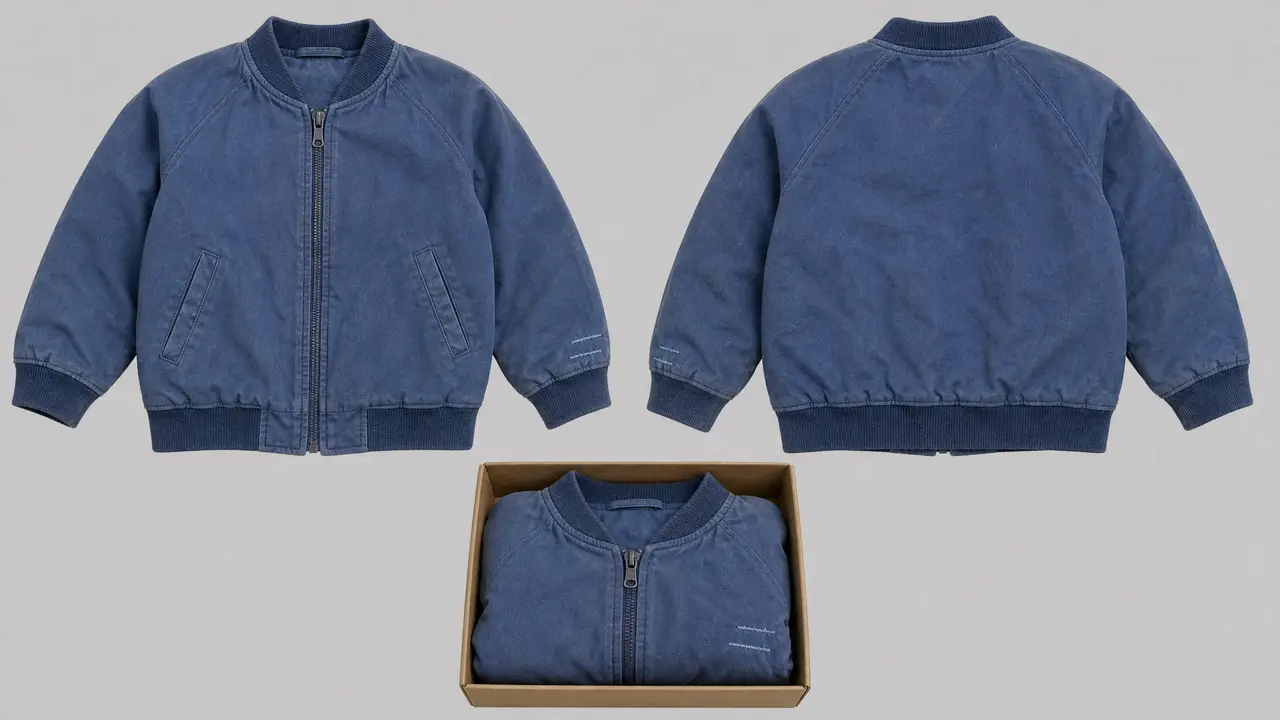
Generate the specified late-1990s Korean everyday wardrobe as a clean front view and rear view, shown on a neutral invisible or featureless mannequin without a visible head. Preserve exact color, fabric, cut, seams, closures, pockets, wear, wrinkles and repairs. Soft neutral daylight, plain gray background, honest textile detail. No fashion styling, no modern brand logo, no body, no hands, no text labels, no watermark, no fabric-plastic look. A child-sized washed deep-blue zip-front athletic jacket from the late 1990s, gray-blue rather than saturated navy, slightly faded nylon-cotton shell, soft worn ribbing, ordinary plastic zipper, no logo. The right sleeve cuff has exactly two short pale-blue repair stitch lines, clearly handmade but subtle. Preserve the exact stitch position, spacing, thread color, sleeve wear and jacket proportions in all states. Generate clean worn state and folded-in-clothing-box state. No extra patches, text or modern reflective trim.
Generate the specified late-1990s Korean everyday wardrobe as a clean front view and rear view, shown on a neutral invisible or featureless mannequin without a visible head. Preserve exact color, fabric, cut, seams, closures, pockets, wear, wrinkles and repairs. Soft neutral daylight, plain gray background, honest textile detail. No fashion styling, no modern brand logo, no body, no hands, no text labels, no watermark, no fabric-plastic look. A late-1990s summer everyday outfit sized for CHAR-DOYUN-01: faded muted-blue cotton T-shirt, light gray-beige shorts or thin trousers, simple socks and worn sneakers. Provide A outdoor-play state and HOME indoor state, preserving the same basic clothing while allowing minor date-appropriate layering. Natural laundering fade and child activity wrinkles, no fashionable coordination.
Generate the specified late-1990s Korean everyday wardrobe as a clean front view and rear view, shown on a neutral invisible or featureless mannequin without a visible head. Preserve exact color, fabric, cut, seams, closures, pockets, wear, wrinkles and repairs. Soft neutral daylight, plain gray background, honest textile detail. No fashion styling, no modern brand logo, no body, no hands, no text labels, no watermark, no fabric-plastic look. A practical late-summer school-day outfit sized for CHAR-DOYUN-01: washed light cotton shirt, muted blue-gray trousers, simple period sneakers and backpack-compatible silhouette. Include a separate continuity overlay showing CAST-01 on the left forearm. The outfit is ordinary, inexpensive and slightly rumpled, never a formal uniform. Real cotton, rubber and stitching; no modern sportswear branding.
Generate the specified late-1990s Korean everyday wardrobe as a clean front view and rear view, shown on a neutral invisible or featureless mannequin without a visible head. Preserve exact color, fabric, cut, seams, closures, pockets, wear, wrinkles and repairs. Soft neutral daylight, plain gray background, honest textile detail. No fashion styling, no modern brand logo, no body, no hands, no text labels, no watermark, no fabric-plastic look. A faded oatmeal cotton pajama set sized for CHAR-DOYUN-01, late-1990s inexpensive household clothing, long-sleeved top and loose trousers, small worn piping, repeated washing, softened cotton fibers. 睡衣是儿童睡衣
Create a small reference group of two ordinary South Korean moving workers in 1998, practical work shirts, cotton gloves, faded trousers and worn work shoes. They are background labor only, not named characters. Natural working builds, realistic skin and heavily used fabric, no modern reflective safety vests, no corporate branding, no readable text. Provide neutral full-body reference views with consistent identities.
Create a production crowd library of ordinary neighborhood residents attending a small South Korean community flea market in summer 1998: adults, elders and families in practical low-cost casual clothing, muted colors, period hairstyles and simple shopping bags. Each person must be a distinct identity, fully clothed, realistic and non-performative. No fashionable Seoul streetwear, no modern logos, phones or accessories. Real skin, woven fabric and worn footwear, neutral reference lighting, no text.
Create a production crowd library of twelve distinct late-1990s Korean elementary-school students, fully clothed, varied ordinary faces, haircuts, heights and postures, all belonging to one believable public-school class. Muted cotton shirts, knitwear, windbreakers, skirts or trousers, simple sneakers and indoor school shoes, no uniforms unless period-correct for the specific school, no modern logos. Neutral reference poses on a plain background, separated identities with no duplicates. Real skin, hair and cloth texture; no model styling, no text and no watermark.
Create one coherent casting reference board containing: one front-facing full-body standing view, one front portrait, one true side-profile portrait, and one rear portrait. Preserve one identical person across all views. Neutral relaxed posture and neutral expression, fully clothed, no dramatic action. Soft neutral daylight with mild directional modeling, plain warm-gray studio background, 50mm-equivalent perspective, honest proportions, consistent scale, high-resolution photorealism. Preserve real human skin texture, visible pores, fine facial hair, natural tonal variation, realistic eyes and hair strands. Preserve authentic garment fibers, seams, wrinkles, weight and wear. No beauty retouching, no plastic skin, no fashion-editorial lighting, no glamour pose, no stylization, no text labels, no watermark, no duplicate limbs, no identity drift between views. Create a second fully clothed late-1990s Korean elementary-school student identity reference, clearly different from CROWD-SCHOOL-01/A, CHAR-DOYUN-01 and CHAR-MINJAE-01. Ordinary practical haircut, neutral expression, period cotton sweatshirt, simple trousers and indoor school shoes. Real skin and clothing texture, no exaggerated hostile expression, no text, consistent identity across front full-body, front portrait, side portrait and rear portrait.
Create one coherent casting reference board containing: one front-facing full-body standing view, one front portrait, one true side-profile portrait, and one rear portrait. Preserve one identical person across all views. Neutral relaxed posture and neutral expression, fully clothed, no dramatic action. Soft neutral daylight with mild directional modeling, plain warm-gray studio background, 50mm-equivalent perspective, honest proportions, consistent scale, high-resolution photorealism. Preserve real human skin texture, visible pores, fine facial hair, natural tonal variation, realistic eyes and hair strands. Preserve authentic garment fibers, seams, wrinkles, weight and wear. No beauty retouching, no plastic skin, no fashion-editorial lighting, no glamour pose, no stylization, no text labels, no watermark, no duplicate limbs, no identity drift between views. Create a fully clothed late-1990s Korean elementary-school student identity reference, matching the class cohort of CHAR-DOYUN-01 but clearly a different person. Ordinary short school haircut, expressive but realistic face, neutral reference posture. Use a faded striped cotton top, simple trousers and period indoor school shoes. Real skin and cloth texture, no fashionable styling, no bullying caricature, no text, consistent identity across front full-body, front portrait, side portrait and rear portrait.
Create one coherent casting reference board containing: one front-facing full-body standing view, one front portrait, one true side-profile portrait, and one rear portrait. Preserve one identical person across all views. Neutral relaxed posture and neutral expression, fully clothed, no dramatic action. Soft neutral daylight with mild directional modeling, plain warm-gray studio background, 50mm-equivalent perspective, honest proportions, consistent scale, high-resolution photorealism. Preserve real human skin texture, visible pores, fine facial hair, natural tonal variation, realistic eyes and hair strands. Preserve authentic garment fibers, seams, wrinkles, weight and wear. No beauty retouching, no plastic skin, no fashion-editorial lighting, no glamour pose, no stylization, no text labels, no watermark, no duplicate limbs, no identity drift between views. Subject: POLICE-02, a different late-1990s South Korean local police officer, early-to-mid thirties, practical and routine demeanor, clearly distinguishable from POLICE-01 without stylization. Wear the same historically accurate local police uniform system with different natural fit and wear, no modern tactical vest, body camera or LED equipment. Neutral public-servant posture, real skin and uniform fabric, no menace, no comedy. Preserve the same identity across all views. 人物为一名青年,平头发型,人物服装参考 {{Image 1}}
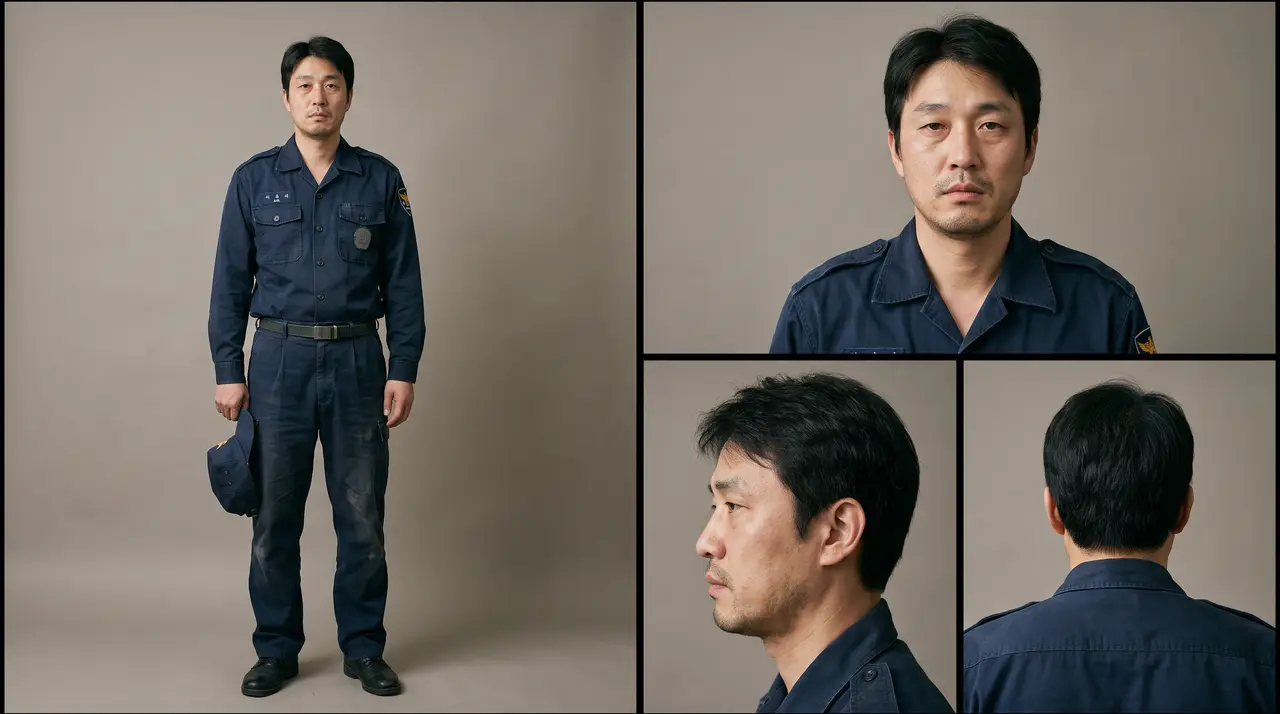
Create one coherent casting reference board containing: one front-facing full-body standing view, one front portrait, one true side-profile portrait, and one rear portrait. Preserve one identical person across all views. Neutral relaxed posture and neutral expression, fully clothed, no dramatic action. Soft neutral daylight with mild directional modeling, plain warm-gray studio background, 50mm-equivalent perspective, honest proportions, consistent scale, high-resolution photorealism. Preserve real human skin texture, visible pores, fine facial hair, natural tonal variation, realistic eyes and hair strands. Preserve authentic garment fibers, seams, wrinkles, weight and wear. No beauty retouching, no plastic skin, no fashion-editorial lighting, no glamour pose, no stylization, no text labels, no watermark, no duplicate limbs, no identity drift between views. Subject: POLICE-01, a late-1990s South Korean local police officer in his late thirties or early forties. Ordinary public servant appearance, slightly tired eyes after night duty, controlled neutral expression, no aggressive authority pose. Wear a historically accurate 1998 local police night-duty uniform with authentic woven fabric, seams, modest wear, period cap available as a separate accessory, and no modern tactical gear. Keep insignia understated and do not generate readable fake text. Preserve one identity across all views; no villain lighting or heroic styling.
Create one coherent casting reference board containing: one front-facing full-body standing view, one front portrait, one true side-profile portrait, and one rear portrait. Preserve one identical person across all views. Neutral relaxed posture and neutral expression, fully clothed, no dramatic action. Soft neutral daylight with mild directional modeling, plain warm-gray studio background, 50mm-equivalent perspective, honest proportions, consistent scale, high-resolution photorealism. Preserve real human skin texture, visible pores, fine facial hair, natural tonal variation, realistic eyes and hair strands. Preserve authentic garment fibers, seams, wrinkles, weight and wear. No beauty retouching, no plastic skin, no fashion-editorial lighting, no glamour pose, no stylization, no text labels, no watermark, no duplicate limbs, no identity drift between views. Subject: TEACHER-01, a Korean elementary-school teacher in the late 1990s, early-to-mid thirties, calm and practical classroom presence. Neat period-appropriate hair, attentive but not sentimental expression, ordinary public-school professional appearance. Dress in a muted cream blouse, modest dark skirt or straight trousers and a simple knitted vest, with no modern fashion details. Real skin and cloth texture, no beauty-advertising presentation. Keep the same identity across all views.
Create one coherent four-view reference board of Sangja, CHAR-SANGJA-01: full-body front standing view, left profile, right profile and rear view. A small domestic short-haired orange-and-white cat with one permanently fixed asymmetrical coat pattern; lock the exact orange patches across the forehead, ears, back, tail and legs, with a white muzzle, chest and lower legs. Natural body proportions, healthy but not show-cat groomed, realistic whiskers, paw pads, fur direction and subtle household dust. Neutral alert behavior only. Soft neutral daylight, plain warm-gray background. No collar unless later separately approved, no text, no cartoon expression, no oversized eyes, no supernatural stare, no duplicate legs, no coat-pattern drift.
Create one coherent casting reference board containing: one front-facing full-body standing view, one front portrait, one true side-profile portrait, and one rear portrait. Preserve one identical person across all views. Neutral relaxed posture and neutral expression, fully clothed, no dramatic action. Soft neutral daylight with mild directional modeling, plain warm-gray studio background, 50mm-equivalent perspective, honest proportions, consistent scale, high-resolution photorealism. Preserve real human skin texture, visible pores, fine facial hair, natural tonal variation, realistic eyes and hair strands. Preserve authentic garment fibers, seams, wrinkles, weight and wear. No beauty retouching, no plastic skin, no fashion-editorial lighting, no glamour pose, no stylization, no text labels, no watermark, no duplicate limbs, no identity drift between views. Subject: Kim Sunja, CHAR-SUNJA-01, an elderly Korean neighborhood resident in the late 1990s. Short practical stature, ordinary aging, softly lined face, alert but occasionally uncertain eyes, short permed gray-black hair typical of the period. Her neutral expression should feel sociable and familiar, not ominous, prophetic or senile caricature. Dress her in a faded floral blouse, simple brown cardigan, loose dark trousers and practical walking shoes. Preserve natural aged skin texture, wrinkles, pores, hair detail and real woven fabric. Keep identity consistent in all views.
Create one coherent casting reference board containing: one front-facing full-body standing view, one front portrait, one true side-profile portrait, and one rear portrait. Preserve one identical person across all views. Neutral relaxed posture and neutral expression, fully clothed, no dramatic action. Soft neutral daylight with mild directional modeling, plain warm-gray studio background, 50mm-equivalent perspective, honest proportions, consistent scale, high-resolution photorealism. Preserve real human skin texture, visible pores, fine facial hair, natural tonal variation, realistic eyes and hair strands. Preserve authentic garment fibers, seams, wrinkles, weight and wear. No beauty retouching, no plastic skin, no fashion-editorial lighting, no glamour pose, no stylization, no text labels, no watermark, no duplicate limbs, no identity drift between views. Subject: Kang Minjae’s father, CHAR-KANGFATHER-01, a Korean working father around forty in 1998. Ordinary practical build, weathered but not exaggerated features, short low-maintenance hair, reserved and reliable everyday presence. Avoid heroic, tragic or suspicious styling. Dress him in a muted checked cotton shirt, worn dark slacks and an inexpensive period windbreaker for the identity board. Real skin, visible texture, authentic garment fibers and ordinary late-1990s working-family appearance. Keep the same identity in every view.
Use case: professional character casting and identity asset creation Asset ID: CHAR-SUNYOUNG-01 Character: Lee Sunyoung Required height: exactly 162 cm Visual age: 34 Output: one photorealistic 16:9 horizontal four-panel casting reference sheet Create a professional casting reference sheet for the late-1990s Korean psychological mystery film “Footsteps”. Depict the same adult performer consistently in four clearly separated panels. Character design: A thirty-four-year-old Korean woman, exactly 162 cm tall, with realistic average-to-slim physical proportions shaped by ordinary work and daily responsibilities rather than exercise or fashion styling. She has a natural oval face with understated cheekbones, a gently defined jaw, straight natural eyebrows, attentive dark-brown eyes, a moderate nose and naturally shaped lips. Preserve mild under-eye fatigue, subtle unevenness in skin tone and restrained expression lines around the eyes and mouth. Her face should suggest someone who sleeps too little and carries practical responsibilities, but she must not appear emotionally cold, severely depressed, neglectful or prematurely aged. Her underlying expression remains calm, protective and approachable. She is tired, but still emotionally present. Her dark, nearly black hair is straight, shoulder-length and gathered into a simple low ponytail. A few naturally loose strands remain near the temples and ears. The hairstyle is practical, slightly imperfect and appropriate for an ordinary working mother in South Korea in the late 1990s. No modern salon styling, glossy blowout or fashionable layered haircut. Her neutral posture is practical and slightly guarded: shoulders relaxed but not slumped, arms naturally at her sides, feet firmly placed, gaze steady and direct. She should feel dependable rather than fragile. Wardrobe: A faded gray-beige cotton button-front shirt beneath a muted dark-olive wool-blend cardigan, dark-brown straight-leg work trousers and worn black leather low-heeled shoes. The clothing should be modest, practical and visibly used but clean. No logos, jewelry, handbag, decorative accessories, fashionable tailoring or modern synthetic sportswear. The cotton shirt must show a fine woven structure, softened fibers, realistic stitching, slight collar wear, natural sleeve creases and compression folds around the elbows and waist. The wool-blend cardigan must show a restrained knitted texture, subtle fiber variation, slightly softened cuffs, realistic thickness and natural gravity-driven drape. It must not resemble smooth fleece, rubber or painted fabric. The trousers must show a dense woven surface, stitched seams, realistic fabric weight, mild wear at the knees and natural folds around the hips, knees and ankles. The shoes must show genuine worn leather texture, restrained creasing across the toe box, stitched edges, matte rubber soles and mild everyday scuffing. Sheet layout: Panel 1 — front full-body view: Occupying the left side of the sheet, show a complete front-facing full-body photograph. Sunyoung stands upright on a clearly visible floor baseline. Both hands and both shoes must remain fully visible. Her arms rest naturally at her sides, and she looks directly toward the camera with a neutral, calm and attentive expression. Place a simple vertical height marker beside her. The top marker must align accurately with the crown of her head and display the exact text “162 cm”. Do not include any other words, numbers or labels. Panel 2 — front portrait: Head-and-shoulders portrait, exact frontal view. Neutral closed-mouth expression, steady gaze toward the camera. Preserve her natural fatigue without turning it into exaggerated sadness or emotional detachment. Panel 3 — side portrait: Head-and-shoulders portrait, exact left-side profile at 90 degrees. Level gaze, closed mouth, natural neck posture. This must be a strict profile rather than a three-quarter view. Panel 4 — rear portrait: Head-and-shoulders rear view showing the back of the head, low ponytail, loose hair strands, ears, neck, shoulder line, shirt collar and cardigan texture. No part of the face may be visible. Identity continuity: All four panels must depict exactly the same performer. Preserve identical facial proportions, head shape, ear shape, hairline, hairstyle, ponytail length, skin tone, body proportions and wardrobe. These must be four camera angles of one person, not four similar women. Skin realism: Render highly realistic adult skin with naturally varied microtexture. Preserve visible but restrained pores, fine facial fuzz, mild tonal variation, faint under-eye texture, subtle expression lines, natural lip texture and small non-idealized surface details. The skin should respond physically to directional light with soft translucency, realistic shadow transitions and restrained highlights. Fatigue should appear through believable under-eye tone and facial tension, not through heavy wrinkles, gray skin or theatrical makeup. Do not beautify, smooth, rejuvenate or excessively age the face. The result must resemble an unretouched professional casting photograph. Hair realism: Render the hair as naturally grouped individual strands with realistic density, subtle shine variation, fine flyaway hairs and believable overlap around the temples, ears, neck and ponytail. The ponytail must respond naturally to gravity. Avoid solid helmet-like hair, perfect symmetry or glossy commercial hair treatment. Lighting and photography: Neutral light-gray seamless casting-studio background. Soft directional daylight enters from camera-left, with restrained negative fill from camera-right. Preserve a natural shadow beneath the jaw and enough side lighting to reveal skin, hair, cotton, knitwear and leather textures. Use restrained contrast, accurate natural skin tone and sharp identity detail without beauty lighting. Use a distortion-free 50mm lens appearance for the full-body panel and an 85mm lens appearance for the portraits. Eye-level camera, realistic perspective, no horror atmosphere, no cinematic location background and no fashion-editorial styling. Material separation: Skin, hair, cotton, wool-blend knitwear, woven trousers and worn leather shoes must remain visibly distinct materials. Skin is softly translucent, hair consists of natural grouped strands, the shirt shows fine cotton fibers, the cardigan shows knitted loops and thickness, the trousers retain dense woven texture, and the shoes retain matte creased leather. Lighting must reveal these material differences without artificial HDR sharpening or glossy commercial highlights. Character constraint: Lee Sunyoung is Doyun’s principal source of safety. Her casting image must communicate practical warmth, alertness and emotional availability beneath visible fatigue. Do not portray her as cold, negligent, hostile, glamorous, mysterious or melodramatically tragic. Avoid: Glamorous K-drama styling, model-like beauty, fashion-editorial posing, luxury clothing, heavy makeup, visible foundation, lipstick emphasis, cosmetic contouring, beauty retouching, airbrushed skin, poreless skin, plastic skin, wax-figure appearance, porcelain texture, excessive wrinkles, elderly appearance, artificial HDR detail, oily beauty highlights, helmet-like hair, glossy salon hair, rubber-like clothing, textureless fabric, painted-on garments, incorrect fabric weight, floating folds, identical wrinkle patterns, synthetic CGI surfaces, mannequin appearance, identity drift, hairstyle drift, costume changes, different people between panels, severe emotional coldness, exaggerated misery, cropped head, cropped hands, cropped shoes, hidden feet, three-quarter profile replacing the strict side view, face visible in the rear view, duplicated limbs, props, furniture, scenery, extra people, logos, watermark, Korean writing, random measurements or any text other than the exact label “162 cm”, illustration, anime or CGI.
Use case: professional character casting and identity asset creation Asset ID: CHAR-DOYUN-01 Character: Han Doyun Required height: exactly 124 cm Output: one photorealistic 16:9 horizontal four-panel casting reference sheet Create a professional casting reference sheet for the late-1990s Korean psychological mystery film “Footsteps”. Depict the same child performer consistently in four clearly separated panels. Character design: An eight-year-old Korean boy, exactly 124 cm tall, with slim and realistic physical proportions. He has a softly rounded oval face with a slightly narrower lower face, gentle cheek fullness, natural straight eyebrows, observant dark eyes, a modest nose and a small closed mouth. Black hair with soft loose waves and a slightly irregular fringe above the eyebrows. His resting expression is sensitive, inward-looking and quietly attentive rather than visibly sad or frightened. His posture is restrained: shoulders slightly drawn inward, arms resting naturally close to the body, weight distributed evenly across both feet. Wardrobe: A plain faded off-white cotton crewneck T-shirt, faded charcoal straight-leg cotton trousers, white cotton socks and worn beige canvas sneakers. No logos, printed graphics, accessories, hat or deep-blue jacket. The T-shirt must show visible washed cotton fibers, a slightly softened collar edge, realistic stitching, seam thickness, subtle fabric pilling and natural tension around the shoulders and waist. The trousers must show a denser cotton weave, stitched hems, realistic fabric weight, compression folds behind the knees and gravity-driven folds around the ankles. The canvas sneakers must show woven canvas texture, rubber sole texture, stitching and mild everyday wear. Sheet layout: Panel 1 — front full-body view: Occupying the left side of the sheet, show a complete front-facing full-body photograph. Doyun stands upright on a clearly visible floor baseline, both hands and both shoes fully visible, arms relaxed naturally at his sides, looking directly toward the camera with a neutral expression. Place a simple vertical height marker beside him. The top marker must align accurately with the crown of his head and display the exact text “124 cm”. Do not include any other words, numbers or labels. Panel 2 — front portrait: Head-and-shoulders portrait, exact frontal view, neutral expression, eyes looking directly toward the camera. Both ears remain naturally positioned and facial symmetry is clearly readable. Panel 3 — side portrait: Head-and-shoulders portrait, exact left-side profile at 90 degrees. Level gaze, closed mouth, natural neck posture. This must be a strict profile, not a three-quarter view. Panel 4 — rear portrait: Head-and-shoulders rear view showing the back of the head, hair shape, ears, neck, shoulder line, collar and upper-back fabric. No part of the face may be visible. Identity continuity: All four panels must depict exactly the same person. Preserve identical facial proportions, head shape, ear shape, hairstyle, hairline, hair length, body proportions, wardrobe and skin tone. These are different camera angles of one performer, not four similar performers. Skin realism: Render highly realistic, naturally varied skin appropriate to the character. Preserve subtle pores, fine facial fuzz, gentle tonal variation, faint under-eye texture, natural lip texture and small non-idealized surface details. Skin should show soft physical translucency and restrained highlights under directional light. Do not exaggerate pores, wrinkles, blemishes or adult skin characteristics. The skin must appear naturally photographic rather than artificially sharpened, polished or airbrushed. Hair realism: Render the hair as naturally grouped individual strands with realistic density, soft flyaway hairs, subtle variation in shine and physically believable overlap around the forehead, ears and neck. Avoid helmet-like solid hair or excessively perfect styling. Lighting and photography: Neutral light-gray seamless casting-studio background. Soft directional daylight enters from camera-left, with restrained negative fill from camera-right. Preserve a natural shadow beneath the jaw and enough side lighting to reveal skin, hair and fabric texture. Use restrained contrast, accurate natural skin tone and sharp identity detail without beauty lighting. Use a distortion-free 50mm lens appearance for the full-body panel and an 85mm lens appearance for the portraits. Eye-level camera, realistic perspective, no horror atmosphere, no cinematic location background and no fashion-editorial styling. Material separation: Skin, hair and clothing must remain materially distinct. Skin is softly translucent, hair consists of natural grouped strands, cotton clothing retains visible woven fibers, and the canvas shoes retain their coarse textile and rubber surfaces. Lighting must reveal these differences without producing glossy commercial highlights. Avoid: Adult or teenage facial maturity, toddler proportions, oversized head, exaggerated eyes, fashion-model posing, makeup, beauty retouching, airbrushed skin, poreless skin, plastic skin, wax-figure appearance, porcelain texture, excessive skin sharpening, artificial HDR detail, oily beauty highlights, helmet-like hair, rubber-like clothing, textureless fabric, painted-on garments, incorrect fabric weight, floating folds, identical wrinkle patterns, synthetic CGI surfaces, mannequin appearance, identity drift, hairstyle drift, costume changes, different people between panels, cropped head, cropped hands, cropped shoes, hidden feet, three-quarter profile replacing the strict side view, face visible in the rear view, duplicated limbs, props, furniture, scenery, extra people, logos, watermark, Korean writing, random measurements or any text other than the exact label “124 cm”, illustration, anime or CGI.
Use case: professional character casting and identity asset creation Asset ID: CHAR-MINJAE-01 Character: Kang Minjae Required height: exactly 128 cm Output: one photorealistic 16:9 horizontal four-panel casting reference sheet Input image: If an approved Han Doyun casting sheet is supplied as Image 1, use it only as a broad resemblance reference. Kang Minjae may share a comparable facial silhouette, age range and overall casting type with Han Doyun, but he must remain a clearly separate person. Do not copy, merge or average Han Doyun’s identity. Create a professional casting reference sheet for the late-1990s Korean psychological mystery film “Footsteps”. Depict the same child performer consistently in four clearly separated panels. Character design: An eight-year-old Korean boy, exactly 128 cm tall, with slim and realistic physical proportions. He has a softly rounded oval face broadly comparable to Han Doyun’s general facial silhouette, but with an independent identity and a subtly fuller lower face. Natural straight eyebrows, alert dark eyes, a modest nose, gentle cheek fullness and a small relaxed mouth. Straight chestnut-brown hair with a tidy but naturally uneven fringe. His resting expression is open, curious and quietly confident. His posture is slightly more open than Han Doyun’s: relaxed shoulders, a direct gaze and arms resting naturally without stiffness. He should look capable of being confused with Doyun at a distance or when their hair is covered, but not like an identical twin. Wardrobe: Use the same neutral comparison wardrobe as Han Doyun: a plain faded off-white cotton crewneck T-shirt, faded charcoal straight-leg cotton trousers, white cotton socks and worn beige canvas sneakers. No logos, printed graphics, accessories, hat or deep-blue jacket. The T-shirt must show visible washed cotton fibers, a slightly softened collar edge, realistic stitching, seam thickness, subtle fabric pilling and natural tension around the shoulders and waist. The trousers must show a denser cotton weave, stitched hems, realistic fabric weight, compression folds behind the knees and gravity-driven folds around the ankles. The canvas sneakers must show woven canvas texture, rubber sole texture, stitching and mild everyday wear. Sheet layout: Panel 1 — front full-body view: Occupying the left side of the sheet, show a complete front-facing full-body photograph. Minjae stands upright on a clearly visible floor baseline, both hands and both shoes fully visible, arms relaxed naturally at his sides, looking directly toward the camera with a neutral expression. Place a simple vertical height marker beside him. The top marker must align accurately with the crown of his head and display the exact text “128 cm”. Do not include any other words, numbers or labels. Panel 2 — front portrait: Head-and-shoulders portrait, exact frontal view, neutral expression, eyes looking directly toward the camera. Both ears remain naturally positioned and facial symmetry is clearly readable. Panel 3 — side portrait: Head-and-shoulders portrait, exact left-side profile at 90 degrees. Level gaze, closed mouth, natural neck posture. This must be a strict profile, not a three-quarter view. Panel 4 — rear portrait: Head-and-shoulders rear view showing the back of the head, straight hair shape, ears, neck, shoulder line, collar and upper-back fabric. No part of the face may be visible. Identity continuity: All four panels must depict exactly the same person. Preserve identical facial proportions, head shape, ear shape, hairstyle, hairline, hair length, body proportions, wardrobe and skin tone. These are different camera angles of one performer, not four similar performers. Skin realism: Render highly realistic, naturally varied skin appropriate to the character. Preserve subtle pores, fine facial fuzz, gentle tonal variation, faint under-eye texture, natural lip texture and small non-idealized surface details. Skin should show soft physical translucency and restrained highlights under directional light. Do not exaggerate pores, wrinkles, blemishes or adult skin characteristics. The skin must appear naturally photographic rather than artificially sharpened, polished or airbrushed. Hair realism: Render the straight hair as naturally grouped individual strands with realistic density, soft flyaway hairs, subtle variation in shine and physically believable overlap around the forehead, ears and neck. Avoid helmet-like solid hair or excessively perfect styling. Lighting and photography: Neutral light-gray seamless casting-studio background. Soft directional daylight enters from camera-left, with restrained negative fill from camera-right. Preserve a natural shadow beneath the jaw and enough side lighting to reveal skin, hair and fabric texture. Use restrained contrast, accurate natural skin tone and sharp identity detail without beauty lighting. Use a distortion-free 50mm lens appearance for the full-body panel and an 85mm lens appearance for the portraits. Eye-level camera, realistic perspective, no horror atmosphere, no cinematic location background and no fashion-editorial styling. Material separation: Skin, hair and clothing must remain materially distinct. Skin is softly translucent, hair consists of natural grouped strands, cotton clothing retains visible woven fibers, and the canvas shoes retain their coarse textile and rubber surfaces. Lighting must reveal these differences without producing glossy commercial highlights. Similarity constraint: Han Doyun and Kang Minjae may plausibly be confused at a distance, in dim light or when their hair is covered. However, preserve Minjae’s independent facial identity, straight chestnut-brown hair, 128 cm height and more open resting posture. Do not make them identical twins and do not blend the two identities. Avoid: Direct duplication of Han Doyun, blended identity, identical-twin appearance, adult or teenage facial maturity, toddler proportions, oversized head, exaggerated eyes, fashion-model posing, makeup, beauty retouching, airbrushed skin, poreless skin, plastic skin, wax-figure appearance, porcelain texture, excessive skin sharpening, artificial HDR detail, oily beauty highlights, helmet-like hair, rubber-like clothing, textureless fabric, painted-on garments, incorrect fabric weight, floating folds, identical wrinkle patterns, synthetic CGI surfaces, mannequin appearance, identity drift, hairstyle drift, costume changes, different people between panels, cropped head, cropped hands, cropped shoes, hidden feet, three-quarter profile replacing the strict side view, face visible in the rear view, duplicated limbs, props, furniture, scenery, extra people, logos, watermark, Korean writing, random measurements or any text other than the exact label “128 cm”, illustration, anime or CGI.
气球缓缓升起,然后突然爆裂开,文字浮现
去掉图中的红色气球
Input image role: use the supplied final “사진” still as the exact middle hero frame and visual reference, not as the opening frame. Duration and cadence: approximately 3.4 seconds, 24fps, slightly faster and sharper than the previous transition. Start state: complete black with faint natural film texture. No photographs and no title. Primary motion: a very brief restrained cold-white flash rises from the far-right edge without filling the screen. The first instant-photograph border slides into frame from the right, followed by two secondary photograph edges at different depths and slightly different speeds. Their paper shadows overlap and settle. Every photograph image area remains completely black with no recognizable content. Title appearance: immediately after the photographs settle, reveal the exact Korean title “사진” as one complete graphic through a quick but smooth opacity fade. Preserve the exact typeface, size, spacing, faded off-white color and screen position from the supplied still. Do not animate the title character by character. Hold: maintain the complete title frame briefly. Allow only a faint emulsion reflection, several dust particles and a narrow flash afterglow to move across the photograph borders. The title remains perfectly still. Disappearance: the cold reflection narrows and retreats to the right. The rear photograph edges withdraw first, followed by the main foreground photograph. The title fades uniformly without changing shape. A final thin reflected line disappears into black. Camera: completely fixed, no zoom, pan, tilt, shake or focus change. Sound design: one restrained camera shutter click, a short mechanical film-motor sound and soft paper sliding. No loud flash impact. Text continuity: “사진” must remain correctly spelled, sharp and stable whenever visible. No flicker, rewriting, character substitution, deformation, duplication or position drift. Avoid: visible photograph content, faces, silhouettes, photographer, camera entering frame, captions, excessive flash, lens flare, malformed Hangul, additional text, Chinese, English, subtitles, logo or watermark. Only physical sound, no BGM, no subtitles apart from the intended title.
Input image role: use the supplied final “민재” still as the exact middle hero frame and visual reference, not as the opening frame. Duration and cadence: approximately 4 seconds, 24fps, slower and heavier than the previous two transitions. Start state: complete black. Begin with only faint distant rain and subtle natural film texture; no wood, police-light reflection, waterproof sheet or title. Primary motion: a restrained cold-blue reflection slowly travels along the lower-left edge, revealing wet old wood grain and individual rain droplets. A very dark red reflection appears separately at the far lower-right edge. The lower wooden layers rise only slightly into visibility while the thin upper wooden edge emerges from darkness, creating a subtle rectangular frame without opening or closing like a literal box. The small gray-black waterproof-sheet fold becomes visible in the bottom-right corner and moves once with a weak damp-air current. Title appearance: after the upper and lower edges become readable, reveal the exact Korean title “민재” as one complete, fully formed graphic. Fade it smoothly from black while preserving the exact typeface, size, spacing, faded off-white color and position from the supplied still. Never assemble or redraw the characters. Hold: keep the completed frame stable. Rain continues across the edge light, while the separated blue and red reflections pulse once at very low saturation. Neither color enters the central black field or touches the title. Disappearance: the distant red reflection fades first, followed by the blue reflection. Rain-darkened wood and waterproof sheeting gradually lose their edge light and sink back into black without physically closing. Let “민재” remain alone for a fraction of a second, then fade uniformly to complete black. Allow the rain sound to continue briefly after the image disappears. Camera: completely fixed, no push-in, shake, focus breathing or perspective change. Sound design: fine rain, one low wooden pressure creak and an extremely distant filtered police siren pulse. Keep all sounds restrained and realistic. Text continuity: “민재” must remain correctly spelled, sharp and geometrically stable whenever visible. No flicker, rewriting, character substitution, deformation, duplication or position drift. Avoid: literal box opening or closing, visible interior contents, body, face, clothing, photographs, police officers, saturated red or blue light, supernatural fog, malformed Hangul, additional text, Chinese, English, subtitles, logo or watermark. Only physical sound, no BGM, no subtitles apart from the intended title.
Input image role: use the supplied final “가출 편지” still as the exact middle hero frame and visual reference, not as the opening frame. Duration and cadence: approximately 3.8 seconds, 24fps, restrained and continuous. Start state: a completely black frame with faint natural film texture. No paper and no title. Primary motion: a narrow warm tungsten reflection slowly enters from the lower-left corner and reveals floating dust and the first edge of the folded writing paper. The layered paper sheets slide gently into frame from the lower left, each fold arriving with a slight delay. The paper stops naturally and its overlapping shadows settle. Title appearance: only after the paper stops, reveal the exact Korean title “가출 편지” as one complete, fully formed graphic. Fade it smoothly from zero opacity to full visibility without writing, assembling or morphing the individual characters. Preserve the exact typeface, size, spacing, color and position from the supplied still. Hold: keep the completed frame stable for a brief readable pause. Only dust and the weakest paper-edge shadow may move. Disappearance: the warm light retreats toward the lower left. The title fades uniformly as one locked graphic. The upper paper layer slides out first, followed by the lower layer. The final fold shadow disappears and the image returns to complete black for the last few frames. Camera: completely fixed, no zoom, pan, tilt, shake or focus breathing. Sound design: faint dry paper friction, a restrained graphite scrape and one soft paper-settling sound. No musical sting. Text continuity: “가출 편지” must remain correctly spelled, sharp and geometrically stable whenever visible. No flicker, rewriting, character substitution, deformation, duplication or position drift. Avoid: additional writing, readable pencil marks, hands, people, envelope, blood, dramatic smoke, bright flare, malformed Hangul, extra Korean text, Chinese, English, subtitles, logo or watermark. Only physical sound, no BGM, no subtitles apart from the intended title.
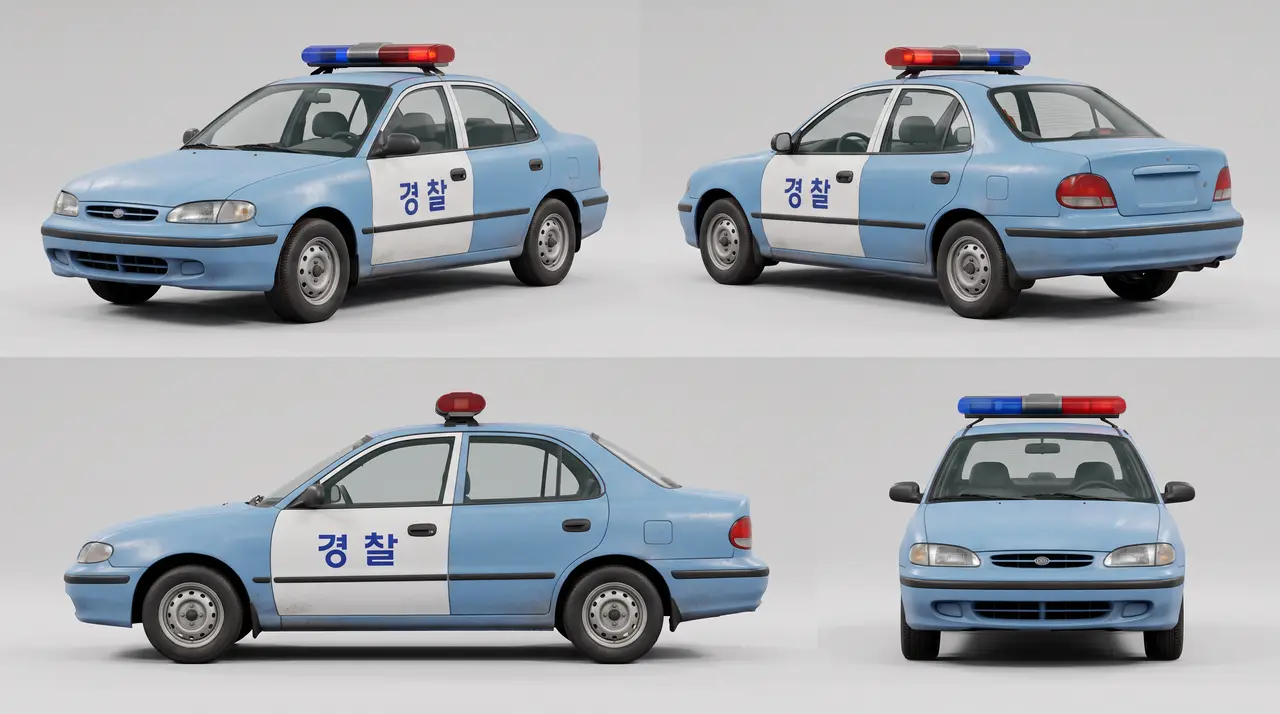 图片节点 28
Create a production-ready vehicle turnaround reference sheet for one late-1990s South Korean local police patrol car. Show the exact same vehicle in four clearly separated views: front three-quarter view, full left-side profile, rear three-quarter view and direct front view. Neutral light-gray studio background, even reference lighting, consistent scale and proportions, no environment and no people. A modest mid-1990s Korean compact four-door sedan with a slightly boxy rounded silhouette, narrow rectangular headlights, simple grille, black side moldings, small period steel wheels with plain hubcaps, black rubber trim and compact black side mirrors. Authentic ordinary municipal service vehicle rather than a modern performance police car. Period-correct pale sky-blue and white two-tone police livery, with both front doors painted white. Render the exact Korean word “경찰” in dark blue on both white front doors, centered in a plain period sans-serif style. No other readable words or numbers. A low rectangular red-and-blue halogen roof lightbar with translucent colored domes and a simple dark mounting base, switched off. Slightly faded paint, restrained scratches around the doors, light road dust, realistic steel, glass, painted metal, rubber and plastic materials. Clean enough to remain operational but visibly used. Photorealistic Korean crime-film production asset, restrained muted colors, accurate late-1990s material response, realistic vehicle proportions, sharp design continuity, no stylization. No modern LED lightbar, no blue-and-yellow contemporary livery, no SUV, no sports car, no American police design, no modern alloy wheels, no tinted luxury windows, no touchscreen, no dashboard tablet, no roof camera, no body-camera equipment, no emergency light glow, no people, no environment, no additional vehicles, no malformed Hangul, no random logos, no watermark, no subtitles.
Create a production-ready hero prop reference card for Minjae’s forged runaway letter, photographed as a real physical object. A single sheet of inexpensive late-1990s Korean writing paper, slightly yellowed off-white paper, thin and modestly fibrous, one visible horizontal fold crease, faint handling wrinkles and lightly softened corners. The entire unfolded sheet is visible from a straight overhead view against a neutral charcoal-gray background. The message is handwritten in dull graphite pencil. The handwriting looks restrained, stiff and slightly over-controlled rather than emotionally spontaneous. Natural but clearly readable Korean handwriting, realistic pencil pressure, subtle variation in line weight, no decorative calligraphy. Render exactly the following Korean text, preserving every character, punctuation mark, blank line and line break: “나는 혼자 떠날 거다.아무도 나를 찾지 않았으면 좋겠다. 강민제” Place the two body lines in the upper half of the page. Leave a suspiciously deliberate blank space before the signature. Place “강민제” alone near the lower-right area and make it clearly legible. Photorealistic paper fibers, graphite granulation, fold shadows and minor handling wear. Restrained forensic realism, late-1990s Korean period authenticity, clean asset presentation, no dramatic lighting. No envelope, no date, no destination, no apology, no additional writing, no stamps, no fingerprints, no blood, no evidence labels, no hands, no pillow, no surrounding objects. Do not write the correct name “강민재”. Do not alter, omit or duplicate any Korean character. No subtitles, no watermark, no graphic overlay.
单独生成【第2行】的分镜图像
将 {{Image 1}} 人物穿搭换成 {{Image 2}} ,不改变原图的格式排版
Create a production-ready prop reference sheet for 「匿名生日卡」 in the film “Footsteps”, set in late-1990s Korea. Show the same physical folded card in two consistent views: the closed front on the left and the fully opened interior on the right. No hands or additional objects. A small inexpensive folded birthday card made from warm off-white matte paper stock. The closed front has a restrained printed illustration of three small faded balloons in pale ochre, washed blue-gray and muted moss green. No printed words on the front. The opened interior has a blank left page. On the right page, render the exact handwritten Korean text once: “민제야, 생일 축하해.” The correct name is “민재”, but the card must deliberately use the incorrect spelling “민제”. Preserve every Hangul character and punctuation exactly as quoted. Use slightly stiff, uneven dark-blue ballpoint handwriting, centered loosely on the inner right page. The writing should feel anonymous and ordinary rather than theatrical or threatening. No signature, sender name, date, additional message or decorative lettering. Integrate the handwriting naturally into the paper perspective, fiber, fold and lighting; the text must not look digitally overlaid. Photorealistic late-1990s paper prop photography, realistic matte paper fibers, central fold, lightly softened corners, subtle handling marks and minor ink-pressure variation. The card is recently used, not heavily aged, torn or stained. Neutral charcoal-gray studio background, soft directional light revealing the paper edge, fold and surface texture. The entire card and all edges must remain visible in both views. No hands, no envelope, no gift, no additional card, no duplicate phrase, no correct spelling “민재”, no malformed Hangul, no missing or substituted character, no signature, no extra readable text, no fake Korean, no logo, no watermark, no glossy modern greeting-card finish, no bright saturated red, no horror symbols, no blood, no threatening illustration.
Create a production-ready group casting reference for four classmates attending Minjae’s home birthday gathering in the film “Footsteps”. Do not include Doyun or Minjae. Show four clearly separate and consistently identifiable classmates standing side by side in one full-body group reference. Each person must have a distinct identity, posture and period-correct weekend outfit; no duplicated faces, cloned bodies or blended identities. From left to right, assign four fixed costume palettes: 1. faded mustard cotton sweatshirt with charcoal corduroy trousers; 2. dusty olive cardigan over an off-white shirt with warm gray trousers; 3. gray-brown striped knitted pullover with muted olive trousers; 4. faded plum cardigan over a beige top with dark brown trousers. All clothing should be modest late-1990s Korean casual wear suitable for an indoor birthday gathering. Use clean indoor socks rather than outdoor shoes. Avoid washed deep blue and bright red so the supporting classmates do not compete with Doyun’s jacket or later threat colors. Natural relaxed expressions and ordinary standing postures, friendly but not exaggerated. Photorealistic casting photography with authentic untreated skin, visible pores, natural hair, realistic cotton, knitwear and corduroy materials, fabric creases, stitching and mild wear. No beauty retouching or commercial child-fashion styling. Clean warm-gray studio background, soft directional studio lighting, full bodies unobstructed, enough space between each person for later compositing. Preserve each identity and assigned costume exactly in all future birthday scenes. No Doyun, no Minjae, no adults, no extra classmates, no repeated face, no identical twins, no identity blending, no school uniforms, no modern sportswear, no branded clothing, no hats, no bags, no gifts, no party props, no text, no labels, no watermark, no plastic skin, no glossy fabric, no exaggerated poses. 人物的年龄都在10岁左右,韩国人
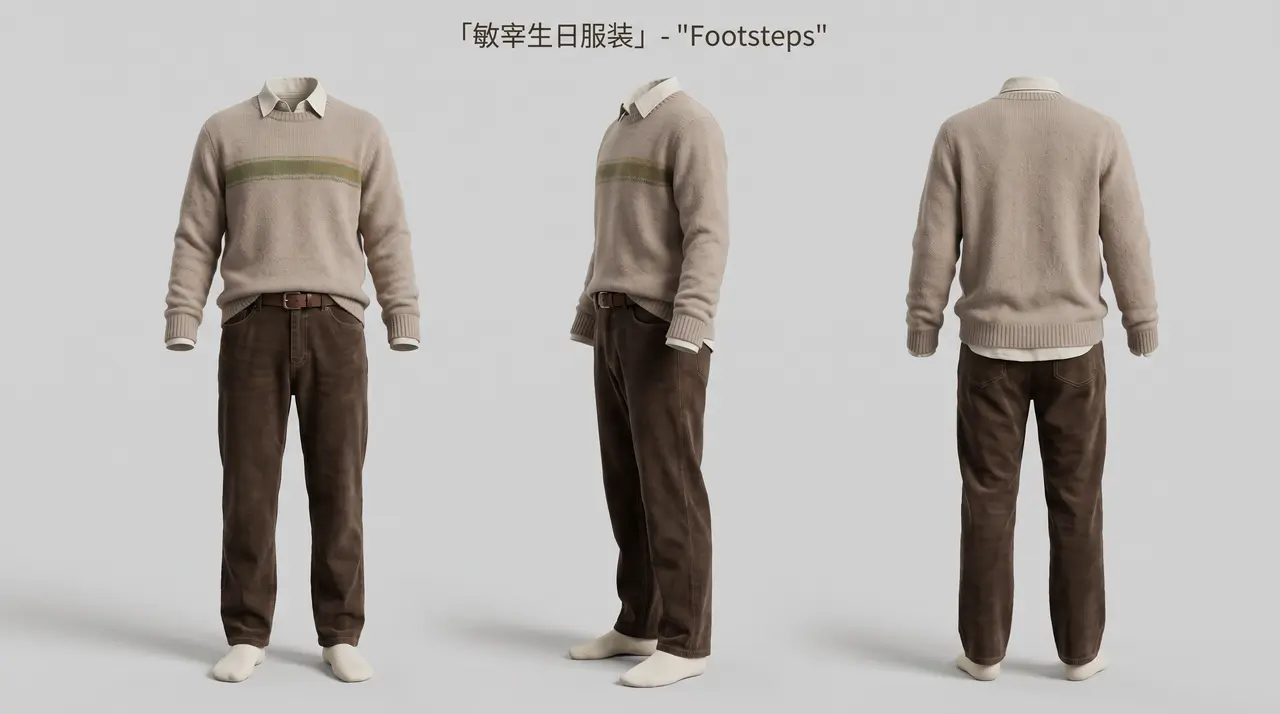 图片节点 25
Create a production-ready costume reference sheet for 「敏宰生日服装」 in the film “Footsteps”. Show the same complete outfit consistently from the front, side and rear, displayed on an invisible ghost mannequin with no visible body, head, hands or skin. A modest late-1990s Korean weekend birthday outfit: a soft muted beige knitted pullover with a small faded moss-green and ochre horizontal detail across the upper chest, worn over a plain off-white cotton collared shirt. Dark brown corduroy trousers with a relaxed practical cut, a simple period belt, and clean cream indoor socks. The outfit should feel chosen by a family for a home birthday gathering—slightly neater than everyday school clothing but not formal, fashionable or expensive. Photorealistic costume asset photography. Real knitted wool-blend texture, visible yarn structure, natural pilling, ribbed cuffs, cotton collar fibers, realistic shirt folds, corduroy ridges, stitching, seams, buttons and slight wear. Muted beige, moss, faded ochre and dark brown palette. No washed deep-blue outerwear, preserving that color for Doyun’s jacket. Neutral light-gray studio background, soft directional light showing garment construction and texture, consistent proportions and identical clothing details in every view. No person, no visible mannequin, no body parts, no modern fashion cut, no oversized branding, no printed words, no school uniform, no suit, no necktie, no bright red, no glossy synthetic fabric, no fashion-editorial styling, no extra outfit, no accessories, no shoes, no hanger, no watermark.
Create a production-ready empty location asset for 「敏宰家客厅」 in the Korean psychological mystery film “Footsteps”, prepared for Minjae’s birthday gathering. No people or animals. A modest late-1990s Korean family living room, ordinary and lived-in, neither affluent nor severely impoverished. Compact rectangular floor plan with faded cream wallpaper, warm brown vinyl flooring, a small fabric sofa, a low wooden cabinet with a period CRT television, a cream wired household telephone near the hallway, thin patterned curtains and practical wooden storage furniture. Place a low folding party table in the central living area with six floor cushions around it. The table is prepared with a simple birthday cake, ordinary home-cooked food, period tableware, opened gift wrapping and several modest presents. Decorations are restrained: a few faded balloons and handmade paper chains in pale ochre, muted olive and washed blue-gray. No banner, lettering or readable decorative text. The spatial relationship must be clear and reproducible: the party table occupies the middle plane; a doorway on the background-right leads to a narrow entrance vestibule and the exterior door; the doorway must remain fully readable so Minjae can later leave the warm gathering and move into the colder exterior zone. A side window and the exterior door should suggest the residential street without revealing any person or vehicle outside. Late-afternoon moving into early evening. Practical tungsten ceiling light and a small table lamp create localized warm pools over the party table, cake and cushions. Cool gray daylight enters from the side window and entrance area. Use directional motivated lighting, negative fill and layered exposure: a darker foreground furniture edge, the warm party area in the middle, and the cooler doorway and vestibule in the background. Preserve wallpaper, vinyl floor, food, wood, fabric and paper texture in the shadows. 16:9 landscape location reference, camera positioned near a room corner at a low protagonist-aligned height. Use the sofa or cabinet as a soft foreground frame, keep the complete party table readable, and preserve the entrance doorway as a large background negative space. Photorealistic late-1990s Korean domestic realism, restrained color, subtle 35mm film texture, soft highlight roll-off, no glossy commercial styling. No people, no human silhouette, no person outside the door or window, no reflection, no supernatural figure, no modern furniture, no flat-screen television, no smartphone, no laptop, no LED lighting, no modern party decoration, no bright saturated colors, no readable text, no malformed Hangul, no logos, no watermark, no luxury interior, no excessive clutter.
去掉画面中央的鲨鱼充气床
Create a production-ready empty location asset for 「敏宰卧室」 in the Korean psychological mystery film “Footsteps”. A compact, modest bedroom inside a late-1990s Korean low-rise family home, lived-in and practical, neither affluent nor severely impoverished. No people or animals. Fixed room layout: one low single wooden bed placed against the side wall, a temporary floor mattress with folded cotton bedding laid parallel beside it for an overnight guest, a narrow wooden study desk, a simple chair, a small open bookshelf with a few unbranded comic books and school supplies, and a cream-colored wired household telephone resting on a small wall-mounted shelf near the doorway. A low rear-yard window is the key architectural feature. It has a period-correct metal latch, slightly worn wooden frame, thin faded curtains, a broad accessible sill and enough open floor space for someone to approach and climb through. Through the glass, only the layered rear yard and its old fence are visible; the deeper exterior remains indistinct. Keep the doorway, both sleeping positions, the desk, telephone and window readable within one coherent spatial view. Early-night state. A small tungsten bedside lamp creates a restrained warm pool across the bed, floor mattress and nearby desk. Cool gray exterior light enters from the rear-yard window at a side angle. Use directional motivated lighting, negative fill and layered exposure: a darker foreground doorframe, the readable sleeping area in the middle plane, and the cooler window and rear yard in the background. Preserve wallpaper, floor, curtain and furniture texture in the shadows; no pure black areas and no flat, evenly illuminated room. Muted faded cream, old wood brown, dusty olive and cool gray-blue palette. Photorealistic late-1990s Korean domestic realism, subtle 35mm film texture, soft highlight roll-off, realistic cotton bedding, worn wood, aged wallpaper, matte vinyl floor, curtain fabric, telephone plastic and metal-window-latch materials. Restrained atmosphere: the room should initially feel ordinary and safe, while the open visual direction toward the rear-yard window introduces quiet unease. 16:9 landscape scene reference, camera positioned just inside the doorway at a low protagonist-aligned height. The near doorframe forms a subtle foreground frame; the bed and floor mattress occupy the central visible area; the low window and rear-yard fence create the background depth. Spatial geometry must remain practical and easy to reproduce in later shots. No characters, no human silhouette, no shadow figure, no face or reflection in the window, no supernatural imagery, no readable text, no posters with lettering, no logos, no watermark, no modern furniture, no smartphone, no laptop, no flat-screen television, no LED lighting, no contemporary toys, no neon colors, no glossy interior styling, no excessive clutter, no luxury decoration, no dramatic horror lighting.
院门口的邮箱的特写镜头
改为夜晚
Late-1990s South Korean suburban fringe, restrained realist psychological horror seen primarily from a low protagonist-aligned camera height, damp overcast atmosphere, weathered prefab houses, concrete drainage channels and dense woodland, muted concrete gray, moss green, faded ochre and washed deep blue palette, subtle 35mm film grain, soft highlight roll-off, spherical Super 35 cinematography, mostly 35mm and 50mm lenses, identity preserved from supplied character assets, directional motivated lighting, strong negative fill, layered exposure, localized pools of practical light, controlled chiaroscuro, foreground shadow, clear subject-background separation, practical tungsten interiors, quiet negative space, frames within frames, controlled depth of field, understated performances, ordinary personal and household objects gradually becoming threatening, no supernatural imagery, no glossy stylization. Empty bathroom inside 「道允家旧屋」, a compact late-1990s Korean prefab-house wet bathroom, visibly used but normally maintained. Small yellowed off-white ceramic wall tiles with aged grout, worn gray terrazzo floor sloping toward a metal drain, an old porcelain sink, simple metal faucets, exposed shower plumbing, a modest toilet, a faded plastic washbasin and a narrow frosted-glass window. Subtle mineral stains, soap residue, damp tile edges and light rust around the pipes; realistic ceramic, metal, plastic and wet-surface textures. 16:9 landscape establishing frame, spherical 35mm lens, fixed camera approximately 110 cm above the floor, positioned just outside the half-open bathroom door. The dark wooden doorframe and a softly defocused wall edge form the foreground frame; the sink, washbasin and damp floor occupy the readable middle plane; the toilet, shower corner and frosted window recede into a cooler background one stop darker. Keep the room slightly asymmetrical, with open negative space beside the shower corner, but no human-like shape or implied hidden figure. Cold overcast daylight enters from the small frosted window at frame-right and grazes the damp tiles from side-back. A weak aged tungsten ceiling fixture near the doorway creates a limited warm pool over the sink and near floor. Strong but natural negative fill lowers the window-opposite side; the warm sink plane remains separated from the cooler rear wall, while tile texture and pipe details remain visible in shadow. The worn sink rim and narrow reflection across the damp floor are the brightest justified areas; the frosted window must retain detail and never blow out. Muted off-white, concrete gray, old wood brown, pale washed blue and restrained moss-green staining. Ordinary domestic realism with quiet spatial unease, not an abandoned or haunted bathroom. No people, no body parts, no human shadow, no face or figure in the mirror or window, no antagonist presence, no blood, no supernatural imagery, no horror props, no excessive filth, no readable text, no logos, no modern toiletries, no LED lighting, no luxury fixtures, no glossy renovation, no flat lighting, no fisheye lens, no Dutch angle, no teal-and-orange grading, no watermark.
Create a clean front three-quarter view and a rear or alternate-state view of the specified object on a neutral mid-gray surface. Late-1990s South Korean period accuracy, exact scale, realistic paper fibers, woven cloth, aged plastic, scratched metal, old wood, oxidation, dust and ordinary use wear as appropriate. Soft directional neutral daylight, moderate depth of field, no dramatic horror lighting, no hands, no people, no modern object, no invented brand, no text unless exact text is explicitly quoted, no extra readable text, no watermark. A hand-cut off-white paper price card for the shaved-ice stall. Render the exact Korean text “한 잔에 1,000원.” once in thick dark marker, centered but slightly uneven, child-made and fully legible. Paper fibers, soft bends, tape marks and market light affect the lettering naturally. No extra menu item, logo, duplicated text, malformed Hangul or watermark.
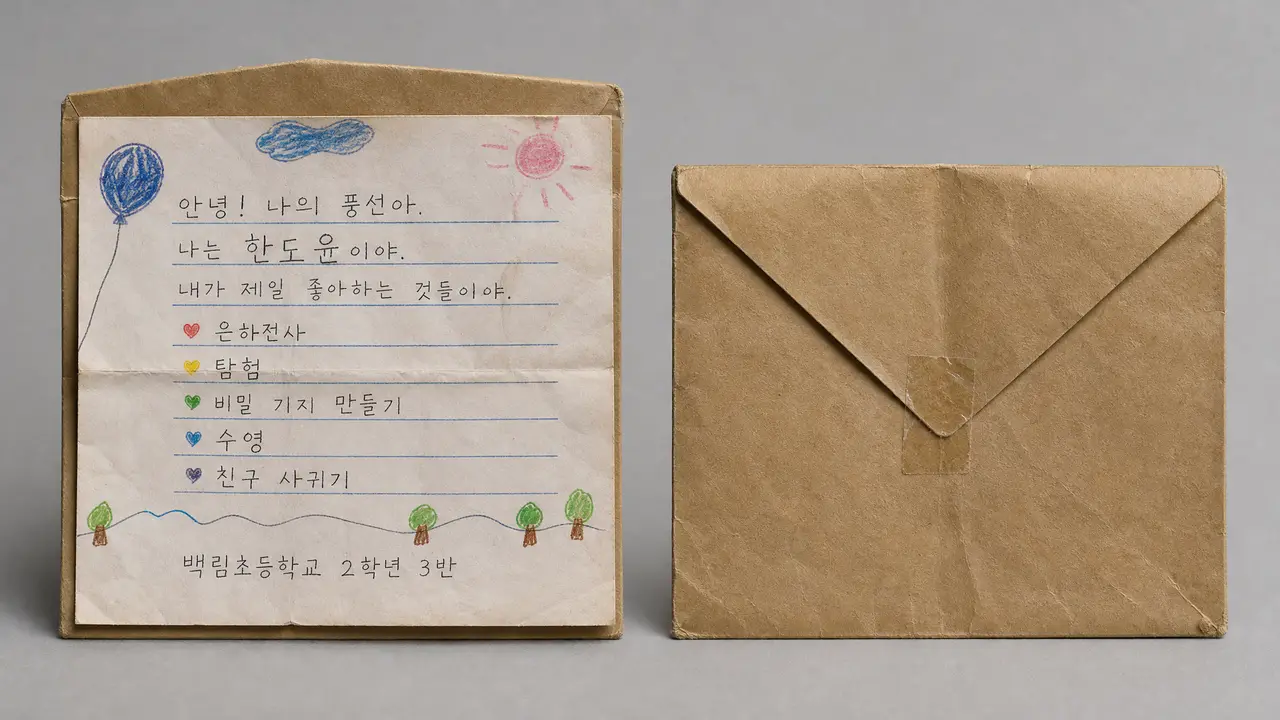 图片节点 8
Create a clean front three-quarter view and a rear or alternate-state view of the specified object on a neutral mid-gray surface. Late-1990s South Korean period accuracy, exact scale, realistic paper fibers, woven cloth, aged plastic, scratched metal, old wood, oxidation, dust and ordinary use wear as appropriate. Soft directional neutral daylight, moderate depth of field, no dramatic horror lighting, no hands, no people, no modern object, no invented brand, no text unless exact text is explicitly quoted, no extra readable text, no watermark. An inexpensive child-written balloon letter on period paper, attached to the matching BALLOON-KIT-01 envelope. Render the exact Korean name “한도윤” and the exact class line “백림초등학교 2학년 3반”. Render the listed interests exactly once each: “은하전사”, “탐험”, “비밀 기지 만들기”, “수영”, “친구 사귀기”. Use enthusiastic but readable child handwriting, integrated with paper fibers, folds and perspective. Do not use the incorrect name 한도연. No extra hobby, address, decorative text, malformed Hangul or watermark.
房子背面
门前是一条马路,挨着马路是干涸的排水渠,排水渠的另一边是树丛。镜头拍摄排水渠,树丛和房子在镜头两侧
Create a clean front three-quarter view and a rear or alternate-state view of the specified object on a neutral mid-gray surface. Late-1990s South Korean period accuracy, exact scale, realistic paper fibers, woven cloth, aged plastic, scratched metal, old wood, oxidation, dust and ordinary use wear as appropriate. Soft directional neutral daylight, moderate depth of field, no dramatic horror lighting, no hands, no people, no modern object, no invented brand, no text unless exact text is explicitly quoted, no extra readable text, no watermark. Primary request: close production reference of a folded, naturally worn sheet of inexpensive late-1990s writing paper. Render the exact Korean body text “나는 행복하지 않다. 엄마도 친구들도 다시 보고 싶지 않다. 영원히 떠날 거다.” once, followed below by the exact incorrect signature “한도연”. Use unstable childlike gray pencil handwriting with uneven pressure and spacing, integrated into the paper fibers, folds, perspective and light. The wrong name must not be corrected to 한도윤. No other text, no fake Korean, no missing, malformed, substituted or duplicated characters.
Create a clean front three-quarter view and a rear or alternate-state view of the specified object on a neutral mid-gray surface. Late-1990s South Korean period accuracy, exact scale, realistic paper fibers, woven cloth, aged plastic, scratched metal, old wood, oxidation, dust and ordinary use wear as appropriate. Soft directional neutral daylight, moderate depth of field, no dramatic horror lighting, no hands, no people, no modern object, no invented brand, no text unless exact text is explicitly quoted, no extra readable text, no watermark. A period-accurate South Korean 1,000-won banknote appropriate to 1998, naturally circulated, folded and lightly worn. Add the exact handwritten Korean word “우편요금” once in gray pencil on the designated front-side margin, legible and integrated into the paper wear and perspective. Preserve denomination layout accurately without redesigning the currency. No additional writing, no fake Korean, no extra currency and no watermark from the generation platform.
拍摄时间改为中午
Create a clean front three-quarter view and a rear or alternate-state view of the specified object on a neutral mid-gray surface. Late-1990s South Korean period accuracy, exact scale, realistic paper fibers, woven cloth, aged plastic, scratched metal, old wood, oxidation, dust and ordinary use wear as appropriate. Soft directional neutral daylight, moderate depth of field, no dramatic horror lighting, no hands, no people, no modern object, no invented brand, no text unless exact text is explicitly quoted, no extra readable text, no watermark. A consumer instant camera appropriate to South Korea in 1998, off-white and dark-gray aged plastic, fixed lens housing, flash position, viewfinder, film-ejection slot and hand strap. Ordinary school equipment wear, no modern digital screen, no invented readable brand. This is the clearly visible school camera. Do not imply that the unseen camera in scene20 is the same physical unit; the upper episode never reveals the unknown camera body.
Create a clean front three-quarter view and a rear or alternate-state view of the specified object on a neutral mid-gray surface. Late-1990s South Korean period accuracy, exact scale, realistic paper fibers, woven cloth, aged plastic, scratched metal, old wood, oxidation, dust and ordinary use wear as appropriate. Soft directional neutral daylight, moderate depth of field, no dramatic horror lighting, no hands, no people, no modern object, no invented brand, no text unless exact text is explicitly quoted, no extra readable text, no watermark. A small homemade shaved-ice sales kit for a neighborhood flea market in summer 1998: two matching household manual or simple electric ice shavers, plain paper cups, metal or plastic scoops, syrup containers with no readable brand, napkins and one scratched metal cash box. Lock the two machine models, handle direction, cup size and cash-box wear. Modest household equipment, not a commercial food truck. ```
Use case: production location design and spatial-continuity asset Asset type: unoccupied 16:9 cinematic environment reference for the Korean psychological mystery film “Footsteps” Asset ID: LOC-OLDHOUSE-INT-01B Location: kitchen and dining area in Han Doyun’s old prefab house Location state: normally occupied, lived-in base version, before the family moves out Output: 1920×1080, photorealistic, no people Primary request: Create a complete, spatially readable master environment asset of the small kitchen and dining area inside Han Doyun and Lee Sunyoung’s aging prefab house in the suburban fringe of South Korea in 1998. The kitchen must feel modest, practical, slightly worn and actively used by a working single-parent household. It must not look luxurious, newly renovated, abandoned or deliberately frightening. No people, no partial bodies, no human silhouettes, no reflections of people and no human-shaped shadows anywhere in the image. Spatial geometry: A compact rectangular kitchen and dining area approximately 3.4 meters by 2.9 meters with a low 2.35-meter ceiling. The camera looks into the kitchen from the narrow interior corridor. The corridor connection must remain visible so future scenes can move naturally between the kitchen, living area and Doyun’s bedroom. A stainless-steel sink is positioned against the far exterior wall directly beneath a medium-sized aluminum-framed window. The window overlooks the fenced backyard and allows a person standing at the sink to watch the rear yard. Outside the window, show only damp grass, part of a simple fence and an indistinct overcast tree line. No person or human reflection may appear outside. A short laminate countertop runs along the far and left walls. Include a period-appropriate two-burner gas stove, an enamel kettle, a metal dish rack, a small rice cooker and a limited number of ordinary utensils. Appliances must belong to the late 1990s and must not display readable branding or digital text. A compact refrigerator with an aged off-white enamel surface stands near the left wall. Its exterior remains mostly bare, without modern magnets, photographs, notes or readable labels. A small rectangular dining table occupies the center-left portion of the room. It has a worn beige laminate top, metal legs and two mismatched practical chairs. The table must remain clearly visible as the place where Doyun eats, examines photographs and speaks with his mother. Mount a beige corded landline telephone on the right wall near the corridor entrance, positioned at an accessible adult height. Its coiled cable, handset cradle and connection wire must remain clearly readable. Do not display any numbers or written labels. A shallow wall cabinet and simple open shelf contain a few plain bowls, cups and kitchen containers. Keep the arrangement functional and restrained rather than decorative. Architecture and period details: Late-1990s South Korean low-income suburban prefab housing. Faded warm-beige vinyl wallpaper, old wood trim, inexpensive laminate cabinets, an aged aluminum window frame, visible grout around the sink, simple electrical outlets and a small tungsten pendant or ceiling fixture above the dining table. The kitchen floor is covered with worn yellow-brown sheet vinyl over the wooden subfloor. The edges near the sink and doorway show slight lifting, dull scuffing and years of ordinary foot traffic. The space should contain believable daily-use wear: scratches on the table, softened cabinet handles, faint water marks near the sink, minor discoloration around the stove, slightly cloudy window glass and a few clean dishes drying in the rack. Do not include modern induction cooktops, dishwashers, large contemporary refrigerators, LED lights, touchscreens, smartphones, modern packaged products or fashionable open-plan kitchen design. Material realism: Render every surface as a physically distinct material. The stainless-steel sink must show brushed metal grain, faint water spots, restrained reflections and realistic edge thickness. The countertop must show slightly worn laminate, dull corners, seam lines and small scratches. Cabinets must show inexpensive wood-pattern laminate, aged plastic or metal handles and subtle edge separation. The dining table must show a different laminate pattern, chipped edge banding and believable contact shadows beneath objects. The vinyl floor must show a thin flexible surface, matte wear, shallow creases and scuffed traffic areas. The chairs must show painted metal tubing, small chips and textured vinyl seats. Dish towels must show absorbent cotton fibers, stitched hems and natural hanging folds. Curtains, if present, must be a simple faded cotton café curtain with visible weave and restrained wrinkles, never lace or decorative modern fabric. The telephone must show aged matte plastic, a slightly yellowed surface, realistic molded seams and a naturally hanging coiled cord. Avoid glossy CGI surfaces, mirror-like sink reflections, plastic-looking food, textureless fabric, perfectly clean cabinetry, floating objects, artificial HDR sharpening or identical material treatment across different surfaces. Style and medium: Late-1990s South Korean suburban fringe, restrained realist psychological horror seen primarily from a low protagonist-aligned camera height, damp overcast atmosphere, weathered prefab houses, concrete drainage channels, reservoirs and dense woodland, muted concrete gray, moss green, faded ochre and washed deep blue palette, subtle 35mm film grain, soft highlight roll-off, spherical Super 35 cinematography, mostly 35mm and 50mm lenses, identity preserved from supplied character assets, directional motivated lighting, strong negative fill, layered exposure, localized pools of practical light, controlled chiaroscuro, foreground shadow, clear subject-background separation, practical tungsten interiors, quiet negative space, frames within frames, controlled depth of field, understated performances, ordinary personal and household objects gradually becoming threatening, no supernatural imagery, no glossy stylization. Composition and camera: 16:9 landscape composition. Use a restrained 24mm spherical lens for this spatial master asset, without fisheye distortion. Place the camera approximately 110 cm above the floor at the corridor entrance, looking diagonally into the kitchen. The composition must simultaneously establish: - the dining table and two chairs; - the sink and backyard-facing window; - the countertop, stove and refrigerator; - the wall-mounted corded telephone; - the connection back into the interior corridor. Use the edge of the doorway as a dark foreground frame. Place the dining table in the middle layer. Keep the sink, window and exterior backyard in the background layer. Preserve enough depth for later medium shots and dialogue coverage. Lighting: Cool overcast morning daylight enters directionally through the window above the sink. It illuminates the sink edge, dish rack and one side of the dining table. A small tungsten pendant or ceiling fixture creates a localized warm pool over the dining table. The area beneath the upper cabinets and the corridor entrance remains gently lowered by negative fill. Maintain three readable exposure layers: darker doorway foreground, warm table and countertop middle layer, and cooler sink-window background. Preserve metal, laminate, vinyl and cotton texture throughout the shadows. Do not illuminate the whole room evenly. Color palette: Faded warm beige, old wood brown, muted olive-gray, dull off-white appliances, yellow-brown vinyl flooring, brushed steel and cool overcast blue-gray from the window. Avoid saturated colors and modern teal-and-orange grading. Text rendering: No visible writing, telephone numbers, appliance branding, package labels, calendars, notes, posters or watermark anywhere in the image. Continuity constraints: The kitchen window must always overlook the backyard. The sink must remain directly beneath the window. The wall telephone must remain beside the corridor entrance. The dining table must remain visible from both the sink and the corridor. These positions must not change across morning conversations, photograph discovery, police calls, window surveillance, moving and later empty-house states. Do not include Polaroid photographs, letters, missing-person notices, police equipment, maps, the deep-blue jacket, open evidence, modern products or unexplained story clues. Avoid: Any person, partial body, face, hand, foot, human silhouette, human reflection, human-shaped shadow, figure outside the window, antagonist presence, supernatural imagery, ghost imagery, obvious horror decoration, abandoned-kitchen styling, excessive decay, modern appliances, induction stove, dishwasher, LED lighting, touchscreen device, smartphones, contemporary product packaging, modern interior design, flat lighting, evenly illuminated room, pure-black corridor, fisheye distortion, dutch angle, excessive shallow depth of field, glossy commercial rendering, textureless fabric, mirror-like metal, impossible kitchen geometry, duplicate appliances, extra doors, extra windows, random text, malformed Korean, logos or watermark.
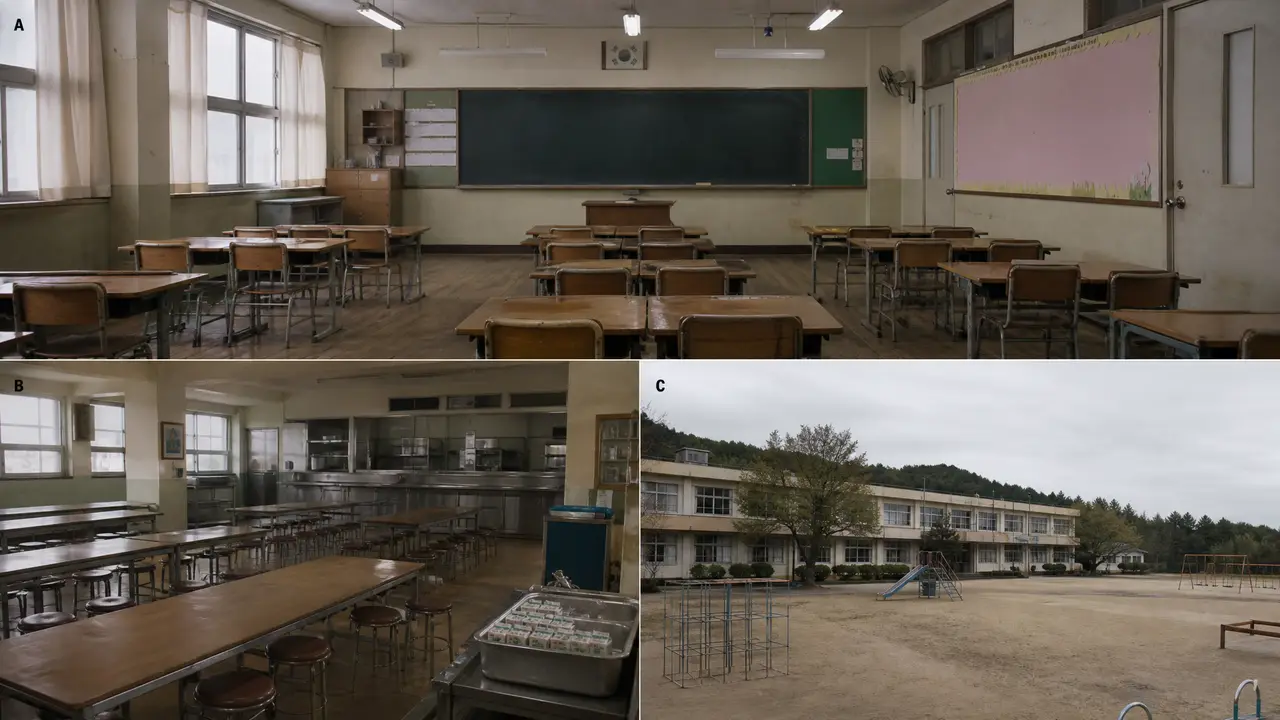 图片节点 6
Late-1990s South Korean suburban fringe, restrained realist psychological horror, photoreal production design, spherical Super 35 perspective, 35mm lens unless another lens is specified, camera around 110 cm above ground unless another height is specified. Muted concrete gray, moss green, faded ochre, old wood brown and washed blue-gray palette. Directional motivated daylight or practical tungsten lighting, strong but realistic negative fill, layered exposure, readable shadow texture, clear foreground-middle-background separation. Weathered wood, damp concrete, aged wallpaper, real metal oxidation and ordinary household wear. No people, no animals, no human silhouette, no antagonist, no reflection of a person, no modern objects, no smartphone, no LED lighting, no contemporary car, no modern interior design, no neon, no teal-and-orange grading, no glossy commercial retouching, no text unless exact diegetic text is specified, no watermark. Scene: a modest South Korean public elementary school in 1998. Faded cream walls, old wooden or metal-framed desks, chalkboard, period fluorescent fixtures that do not resemble modern LED panels, worn linoleum or wood floors, simple corridor, practical cafeteria and ordinary outdoor playground. The classroom window direction and desk layout remain fixed across activities. No electronic whiteboard, modern plastic furniture, contemporary branding or readable accidental text. ``` ```text View A — grade-two class 3 classroom, rear-door view, grouped desks, chalkboard, side windows and a wall area reserved for CLASS-WALL-01; no people. View B — school cafeteria, long shared tables, tray return area, side windows and period milk-carton context; no people. View C — playground and school facade under pale overcast daylight, enough open sky for the balloon-release scene; no balloons in the base location asset.
Late-1990s South Korean suburban fringe, restrained realist psychological horror, photoreal production design, spherical Super 35 perspective, 35mm lens unless another lens is specified, camera around 110 cm above ground unless another height is specified. Muted concrete gray, moss green, faded ochre, old wood brown and washed blue-gray palette. Directional motivated daylight or practical tungsten lighting, strong but realistic negative fill, layered exposure, readable shadow texture, clear foreground-middle-background separation. Weathered wood, damp concrete, aged wallpaper, real metal oxidation and ordinary household wear. No people, no animals, no human silhouette, no antagonist, no reflection of a person, no modern objects, no smartphone, no LED lighting, no contemporary car, no modern interior design, no neon, no teal-and-orange grading, no glossy commercial retouching, no text unless exact diegetic text is specified, no watermark. Scene: the exterior and porch of Kang Minjae’s modest family home in Haewon in 1998, distinct from LOC-OLDHOUSE-01 but belonging to the same economic and regional world. Slightly more conventional masonry or stucco construction, small driveway or curbside car position, simple gate, porch steps and a glimpse of an ordinary family interior. Muted cream, old brick and dark wood, practical maintenance, no modern renovation. ``` ```text View A — front exterior and vehicle drop-off position in overcast weekend daylight. View B — porch and small yard at dusk, suitable for the boys sitting side by side, with weak warm porch light and cold exterior light.
Late-1990s South Korean suburban fringe, restrained realist psychological horror, photoreal production design, spherical Super 35 perspective, 35mm lens unless another lens is specified, camera around 110 cm above ground unless another height is specified. Muted concrete gray, moss green, faded ochre, old wood brown and washed blue-gray palette. Directional motivated daylight or practical tungsten lighting, strong but realistic negative fill, layered exposure, readable shadow texture, clear foreground-middle-background separation. Weathered wood, damp concrete, aged wallpaper, real metal oxidation and ordinary household wear. No people, no animals, no human silhouette, no antagonist, no reflection of a person, no modern objects, no smartphone, no LED lighting, no contemporary car, no modern interior design, no neon, no teal-and-orange grading, no glossy commercial retouching, no text unless exact diegetic text is specified, no watermark. Scene: a small neighborhood residents’ association flea market in Baekrim-dong during summer 1998. Temporary cloth awnings, folding tables, used household goods, bicycles and modest homemade food stalls on an ordinary paved community lot. The shaved-ice stall has a fixed table position and view toward the old-house route. Faded fabric colors, pale directional summer light, natural crowd circulation lanes, no festival grandeur, no modern signage or branded canopies. ``` ```text View A — empty market-wide production reference before opening, 24mm, stall grid and circulation lanes readable. View B — empty shaved-ice stall reference, two matching household ice shavers, table, cup area, cash-box position and reserved sign position; exact sign generated as a separate asset.
Create a clean front three-quarter view and a rear or alternate-state view of the specified object on a neutral mid-gray surface. Late-1990s South Korean period accuracy, exact scale, realistic paper fibers, woven cloth, aged plastic, scratched metal, old wood, oxidation, dust and ordinary use wear as appropriate. Soft directional neutral daylight, moderate depth of field, no dramatic horror lighting, no hands, no people, no modern object, no invented brand, no text unless exact text is explicitly quoted, no extra readable text, no watermark. A modest late-1990s household cat kit: one reused cardboard soda carton with cut-open top and worn paper fibers, one shallow ceramic food bowl, one water bowl and a plain unbranded paper cat-food package. The carton must fit CHAR-SANGJA-01 and maintain fixed folds and tears. No modern plastic pet furniture, no glossy branding, no readable accidental text. Do not include a collar or supernatural object.
Create a clean front three-quarter view and a rear or alternate-state view of the specified object on a neutral mid-gray surface. Late-1990s South Korean period accuracy, exact scale, realistic paper fibers, woven cloth, aged plastic, scratched metal, old wood, oxidation, dust and ordinary use wear as appropriate. Soft directional neutral daylight, moderate depth of field, no dramatic horror lighting, no hands, no people, no modern object, no invented brand, no text unless exact text is explicitly quoted, no extra readable text, no watermark. A locked continuity collection of approximately fifty late-1990s instant photographs and their paper envelopes. Each photograph depicts a different mundane location around Haewon and nearby areas, with CHAR-DOYUN-01 appearing very small somewhere in every frame; use the approved character asset rather than written physical description. Establish numbered content internally without visible labels. Include PHOTO-REPLY-01, a vague sandy-ground image; PHOTO-REPLY-02, a building-corner image; PHOTO-KEY-01, a crowd entering a building with Doyun holding Sunyoung’s hand at the frame edge; PHOTO-KEY-02, an ordinary school context with Doyun small but verifiable; PHOTO-KEY-03, a park-bench view with Doyun at the edge; PHOTO-KEY-04, a shop-window image reflecting only Doyun in one corner; PHOTO-KEY-05, a street or public-space image containing only the edge of Doyun’s face; and PHOTO-NEW-01, a much closer image of Doyun and Minjae at the woodland edge. ENVELOPE-NEW-01 has an intact stamp but absolutely no postmark or cancellation mark. Preserve instant-film border size, aging, exposure variation and image order. No mystery man, no photographer reflection, no readable fake text and no postmark on ENVELOPE-NEW-01.
Create a clean front three-quarter view and a rear or alternate-state view of the specified object on a neutral mid-gray surface. Late-1990s South Korean period accuracy, exact scale, realistic paper fibers, woven cloth, aged plastic, scratched metal, old wood, oxidation, dust and ordinary use wear as appropriate. Soft directional neutral daylight, moderate depth of field, no dramatic horror lighting, no hands, no people, no modern object, no invented brand, no text unless exact text is explicitly quoted, no extra readable text, no watermark. Two physically identical late-1990s children’s plastic lunchboxes inspired by period licensed turtle-hero imagery without generating a modern logo or additional readable text. Faded green lids, fixed molded corners, matching clasp placement, scratches and interior tray layout. LUNCHBOX-01A and LUNCHBOX-01B must match in model and artwork but have separately locked small wear marks so the production can track ownership. No text labels and no contemporary lunchbox design.
Create a clean front three-quarter view and a rear or alternate-state view of the specified object on a neutral mid-gray surface. Late-1990s South Korean period accuracy, exact scale, realistic paper fibers, woven cloth, aged plastic, scratched metal, old wood, oxidation, dust and ordinary use wear as appropriate. Soft directional neutral daylight, moderate depth of field, no dramatic horror lighting, no hands, no people, no modern object, no invented brand, no text unless exact text is explicitly quoted, no extra readable text, no watermark. A coordinated 1998 school balloon-letter activity kit: several low-saturation latex balloons, thin cotton or plastic balloon line, inexpensive writing paper, small paper envelopes and a simple school return-address stamp. Colors are faded red, yellow, pale blue and green rather than modern neon. Lock knot, string and envelope attachment method for classroom and playground continuity. No released balloons in the base prop board and no readable text except in BALLOON-LETTER-01.
场景参考 {{Mixed 1}} 50mm近景极慢推进, {{Mixed 5}} 穿着 {{Mixed 4}} 走了两步先指胸口,再指向走廊深处,坚定说:“아니야. 심장 소리는 몸 안에서 나고, 발소리는 밖에서 났어.”(音色参考 {{Mixed 6}} ) 句末留一拍,走廊暗而可读但绝不出现人形。匹配切到普通晨光下的动作近景, {{Mixed 2}} 用「橡胶洗耳球」和「水盆」替道允处理耳朵, {{Mixed 5}} 紧抱「毛巾」、肩膀略绷;只拍正常器具和反应,不拍身体内部。洗耳球吸水、挤压和湿毛巾声清楚。回到50mm双人中近景, {{Mixed 2}} 放下器具问:“이제 좀 나아졌어?” (音色参考 {{Mixed 7}} )道允侧耳分别听厨房与走廊,只听排水和屋外鸟声,最后看向母亲说:“낮에는 안 나.” 善英轻叹,排水声桥接下一场。 仅保留同期声,无BGM,无字幕、文字、现代物品和额外人物。
Late-1990s South Korean suburban fringe, restrained realist psychological horror seen primarily from a low protagonist-aligned camera height, damp overcast atmosphere, weathered prefab houses, concrete drainage channels and dense woodland, muted concrete gray, moss green, faded ochre and washed deep blue palette, subtle 35mm film grain, soft highlight roll-off, spherical Super 35 cinematography, mostly 35mm and 50mm lenses, identity preserved from supplied character assets, directional motivated lighting, strong negative fill, layered exposure, localized pools of practical light, controlled chiaroscuro, foreground shadow, clear subject-background separation, practical tungsten interiors, quiet negative space, frames within frames, controlled depth of field, understated performances, ordinary personal and household objects gradually becoming threatening, no supernatural imagery, no glossy stylization Upper-episode visual-stage lock: keep the still-unconfirmed threat inside an ordinary but fragile world; use a dark foreground edge or obstruction, a readable subject plane, and an unresolved background direction one to two stops lower, with transparent shadow texture and restrained contrast, opposing cool ambient light with only the limited practical warmth already present in the scene. 16:9 cinematic storyboard keyframe for “Footsteps”, ordinary late-1990s Korean morning realism carrying restrained unease, spherical Super 35, subtle 35mm grain and controlled depth. Preserve 「 {{Image 1}} 」 with 「 {{Image 2}} 」, 「 {{Image 3}} 」 and 「 {{Image 4}} 」. Side close shot on a 50mm lens at low protagonist-aligned height, final frame of an extremely slow push-in. 「 {{Image 1}} 」 holds still and listens toward the kitchen and bedroom corridor, gaze finally fixed toward the corridor; 「 {{Image 3}} 」 remains softly visible behind after a quiet sigh. Cool directional window light shapes the subject, sink reflections form a softer middle layer, and the corridor stays darker but readable. The frame must imply only that the sound is absent in daytime, not that the problem is solved. No figure in the corridor, no antagonist presence, no text, no dramatic expression, no modern object, no flat lighting, no watermark.
场景参考 {{Mixed 1}} 「 {{Mixed 2}} 」洗碗,「 {{Mixed 5}} 」穿着 {{Mixed 4}} 揉眼坐在桌旁。 冷晨窗光为主,水槽弱钨丝灯形成小暖区。「 {{Mixed 5}} 」用韩语说:“어젯밤에도 누가 걸어 다녔어.” {{Mixed 2}} 继续冲洗碗,回答:“집에는 우리 둘밖에 없어.” 切50mm桌边中近景, {{Mixed 5}} 认真补充:“근데 진짜 들었어. 아주 천천히 걸었어.” {{Mixed 2}} 关水,水声突然消失;她用「毛巾」擦手,从水槽走到桌前蹲下,摄影机缓慢横移但不越轴。她轻触道允的脸颊,温和解释:“베개에 귀를 대고 있으니까 네 심장 뛰는 소리를 들은 거야.” 保留碗碟、毛巾和房屋晨间底噪,无音乐、字幕和多余人物。
Late-1990s South Korean suburban fringe, restrained realist psychological horror seen primarily from a low protagonist-aligned camera height, damp overcast atmosphere, weathered prefab houses, concrete drainage channels and dense woodland, muted concrete gray, moss green, faded ochre and washed deep blue palette, subtle 35mm film grain, soft highlight roll-off, spherical Super 35 cinematography, mostly 35mm and 50mm lenses, identity preserved from supplied character assets, directional motivated lighting, strong negative fill, layered exposure, localized pools of practical light, controlled chiaroscuro, foreground shadow, clear subject-background separation, practical tungsten interiors, quiet negative space, frames within frames, controlled depth of field, understated performances, ordinary personal and household objects gradually becoming threatening, no supernatural imagery, no glossy stylization Upper-episode visual-stage lock: keep the still-unconfirmed threat inside an ordinary but fragile world; use a dark foreground edge or obstruction, a readable subject plane, and an unresolved background direction one to two stops lower, with transparent shadow texture and restrained contrast, opposing cool ambient light with only the limited practical warmth already present in the scene. 16:9 cinematic storyboard keyframe for “Footsteps”, late-1990s South Korean domestic realism with restrained suspense, spherical Super 35, subtle film grain, soft highlights and authentic skin and clothing texture. Preserve 「 {{Image 1}} 」 with 「 {{Image 2}} 」, 「 {{Image 3}} 」 and 「 {{Image 4}} 」. Wide two-person shot on a 35mm lens from the kitchen doorway at 110 cm, fixed. A dark doorframe encloses the foreground; 「 {{Image 3}} 」 washes dishes at the sink in the left background while 「 {{Image 1}} 」 sits at the dining table in the right foreground, rubbing tired eyes and speaking toward her. Keep sink left, table right and the bedroom corridor readable behind. Cold directional morning window light is primary; a weak tungsten lamp makes a small warm sink pool. Muted cream, old wood and cool gray, three clear exposure layers. No additional people, no figure in the corridor, no antagonist presence, no written text, no modern appliances, no flat lighting, no watermark.
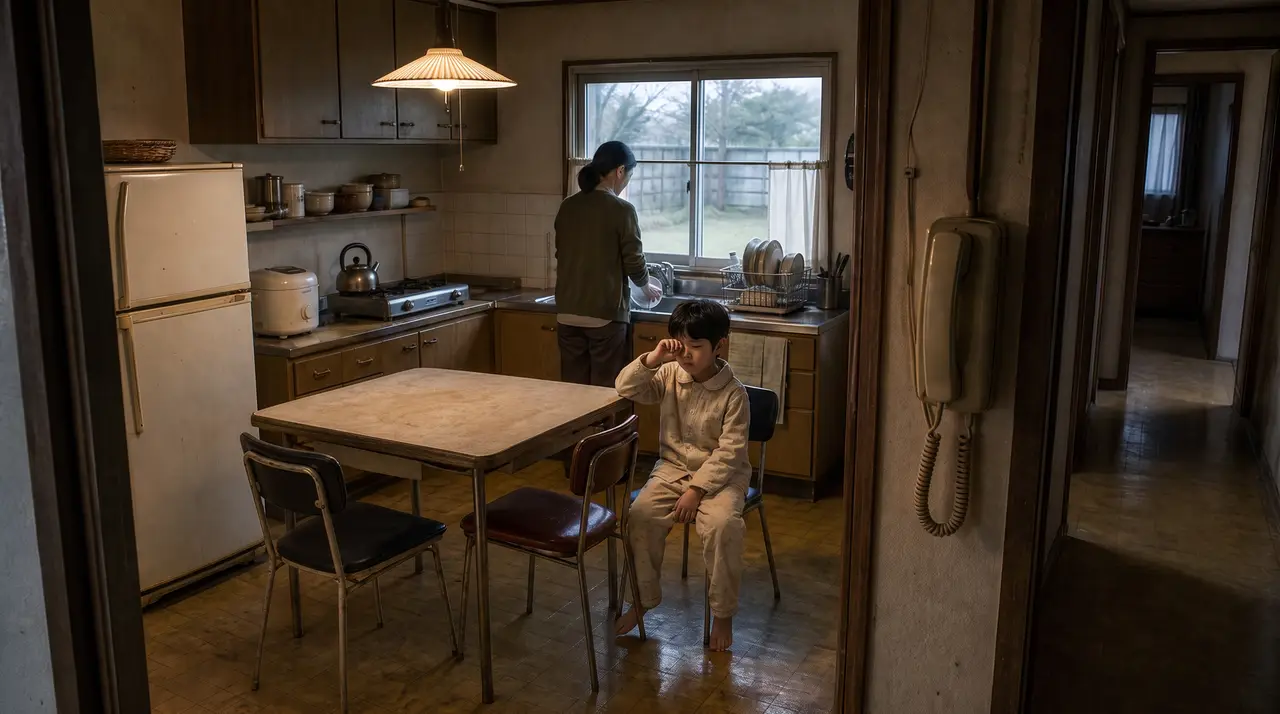 图片节点 19
16:9 cinematic storyboard keyframe for “Footsteps”, late-1990s South Korean suburban fringe, restrained realist suspense drama, spherical Super 35 cinematography, subtle 35mm film grain, soft highlight roll-off, controlled depth of field, natural textures and understated performance. Use 「 {{Image 1}} 」 with 「 {{Image 2}} 」, 「 {{Image 3}} 」, and preserve 「 {{Image 4}} 」 exactly from the supplied assets. Wide two-person shot on a 35mm lens from the kitchen doorway at approximately 110 cm camera height, fixed and level. A dark doorway frames the foreground; 「 {{Image 3}} 」 washes dishes at the sink in the left background while 「 {{Image 1}} 」 sits at the dining table in the right foreground, one hand just beginning to lower after rubbing the eyes. Keep sink left, table right and the bedroom corridor readable behind the table. Cold directional morning window light is the main source; a weak tungsten fixture above the sink creates a small warm pool. The table is brighter than the corridor, with foreground frame, occupied middle layer and cool background separated through layered exposure. Muted cream, old wood brown and cool gray palette. No additional people, no written text, no modern appliances, no flat lighting, no watermark.
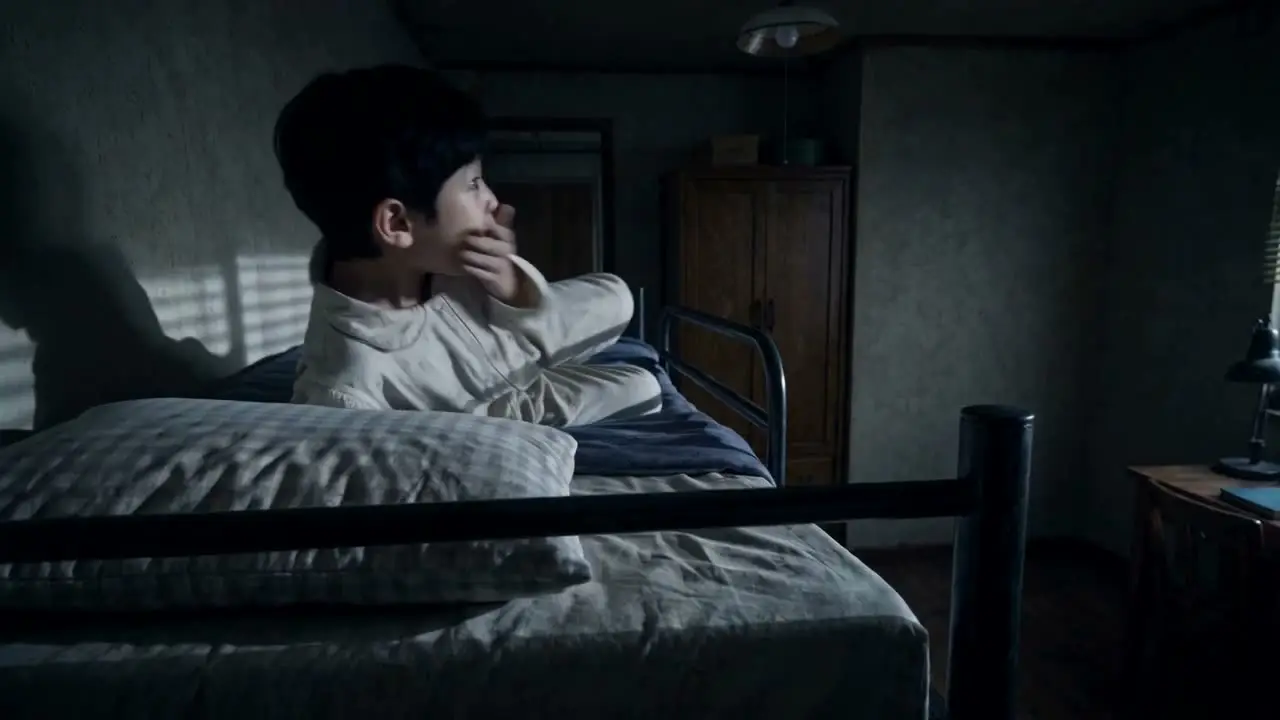 视频截图
场景参考 {{Mixed 1}} , {{Mixed 4}} 穿着 {{Mixed 3}} 躺在 {{Mixed 2}} 上铺。 16:9横画幅,24fps,35mm球面镜头,摄影机位于上铺床尾附近,以一个连续镜头完成惊起、窗户和空下铺三个视觉落点。 窗外的鸟突然掠近,翅膀短促拍击玻璃,玻璃与百叶窗同时发出清脆而急促的震响。撞击声出现的一瞬,「 {{Mixed 4}} 」从上铺猛地惊起,迅速向后退到墙边,背部贴住墙面,一只手捂住嘴,另一只手撑住床垫,肩膀随着急促呼吸明显起伏。动作完成后不再继续后退,视线牢牢停在窗户方向。床架因突然坐起产生一次短促震动,原本靠近床边的低沉脚步声在玻璃震响中立即中断。 摄影机先保持稳定,完整捕捉「 {{Mixed 4}} 」惊起并靠墙的动作;随后进行一次短促、克制而平稳的向右摇摄,把窗户和百叶窗移到画面中心。「道允」捂着嘴的肩部与侧面轮廓留在前景一侧并轻微虚焦,窗户位于中景,窗外近黑墨绿色树林位于背景。一道真实的鸟影从玻璃外快速掠过,翅膀扑动数次后立即飞离画面,不进入室内,也不长时间停留在玻璃上。焦点短暂从前景「 {{Mixed 4}} 」转移到玻璃外掠过的鸟影。 鸟影离开后,摄影机不切断,沿着窗框、床架和百叶窗投下的冷光条纹缓慢向下移动。前景中的「道允」逐渐被上铺床栏裁出画面,空着的下铺进入画面中心。镜头最终停在下铺床垫和一小段木地板上:床铺完全空着,只有自然形成的被褥褶皱;上铺床栏形成框中框,下铺和地板比上铺低一档曝光,但床品纹理、床架边缘与旧木纹仍然清楚可辨。不要展示地板下方空间。 冷色月光始终从百叶窗方向进入。鸟影掠过时,窗外运动短暂切断地板上的月光条纹;鸟飞走后,条纹恢复稳定。人物所在区域、窗户和空下铺保持不同亮度层次,暗处不能出现额外人物或类似人物的形状。 声音中没有音乐和对白。玻璃拍击声之后紧接急促翅膀声、百叶窗轻颤、床架震动和「 {{Mixed 4}} 」突然吸气;鸟飞远后,翅膀声迅速消失,只留下窗外夜风、树叶摩擦和持续而急促的呼吸声。镜头下移至空下铺时,呼吸声仍在画外持续,下方再传来一次极轻的木板摩擦声,并以呼吸和老屋环境底噪收束。 保持人物资产、服装材质、床铺结构、窗户方位和光源方向稳定;玻璃中不出现人物或摄影机倒影;房间和树林中不增加其他人物;不加入文字、字幕、Logo、水印、现代物品、超自然形象、强烈镜头抖动或夸张惊吓特效。 只保留同期声,无BGM
改为人物面部的极近特写镜头人。物紧张地闭紧双眼,手捂着耳朵,有些害怕。
改为人物面部的极近特写镜头。人物紧张地躺在枕头上闭紧双眼,手捂着耳朵,有些害怕。只改变景别
三次近距离、沉闷而规律的“咚、咚、咚”脚步声,具有贴近身体内部的低频质感,与轻微脉搏声近似同步;随后新的闷响逐渐比脉搏慢半拍,间隔越来越长,并混入房间空气和地毯吸音的质感,慢慢转变成从右后方走廊靠近床边的低沉脚步。保留细微被褥摩擦、压低的呼吸和老屋木材收缩声。 时长15s
场景参考 {{Mixed 4}} 16:9横画幅,24fps,九十年代末韩国城市边缘的旧预制住宅夜景,克制现实主义心理悬疑质感,细微35毫米胶片颗粒,柔和高光,中等景深。 50mm球面镜头,摄影机固定在上铺床垫高度。画面从「 {{Mixed 3}} 」的面部特写开始:「 {{Mixed 3}} 」穿着「 {{Mixed 2}} 」侧躺在「 {{Mixed 1}} 」上铺,双手紧紧捂住耳侧,双眼闭紧,眉心收紧,肩膀微微缩起,面部和身体因为害怕而微微颤抖,保持安静,没有尖叫。 摄影机进行极其缓慢、几乎无法察觉的向前推进。动作幅度很小,只有手掌逐渐压紧耳侧、枕头和被褥发生轻微形变。 百叶窗外的冷色月光从侧后方切入,只照到人物局部、枕套和床栏;背光侧使用较强负补光压暗。前景被褥、人物所在亮区与右侧房间暗区形成三层曝光。暗部保留床架、旧木和墙面的少量纹理,不能压成纯黑。色彩以低饱和蓝灰、褪色米白和旧木褐为主,不使用鲜艳蓝色夜景。 声音中没有音乐和对白。开场是三次近距离、沉闷而规律的“咚、咚、咚”脚步声,具有贴近身体内部的低频质感,与轻微脉搏声近似同步;随后新的闷响逐渐比脉搏慢半拍,间隔越来越长,并混入房间空气和地毯吸音的质感,慢慢转变成从右后方走廊靠近床边的低沉脚步。保留细微被褥摩擦、压低的呼吸和老屋木材收缩声。镜头结束时,脚步仿佛已经停在床边,「 {{Mixed 3}} 」仍然紧闭双眼,双手捂耳,身体保持僵住的状态。 画面中不出现额外人物、可疑轮廓或玻璃倒影;不增加现代物品、文字、字幕、Logo或水印;不使用手持晃动、荷兰角、惊吓式变焦、平光、美容光或过度浅景深。 只保留同期声,无BGM
Story function: connect the opening muffled rhythm to the pulse of 「 {{Image 1}} 」 against the pillow before the sound becomes spatial Primary request: 「 {{Image 1}} 」 lies on his side on the upper bunk with one ear pressed deeply into the pillow, eyes open, body completely still Scene/backdrop: the supplied 「 {{Image 3}} 」 at night in 1998, upper-bunk sleeping area with the bed rail and a readable dark direction beyond the mattress Input images: 「 {{Image 1}} 」 as the identity reference; 「 {{Image 2}} 」 as the wardrobe reference; 「 {{Image 3}} 」 as the location and geometry reference Subject assets: preserve 「 {{Image 1}} 」 and 「 {{Image 2}} 」 exactly from the supplied images; preserve the bed, pillow, rail, window and room direction exactly from 「 {{Image 3}} 」 Performance/blocking: 「 {{Image 1}} 」 remains side-lying, one cheek and ear compressed into the pillow, breathing held lightly, gaze directed past the bed rail toward the unlit room; no exaggerated fear Prop continuity: use the pillow, bedding and upper-bunk rail exactly as established in 「 {{Image 3}} 」; sleepwear remains clean and dry Style/medium: Late-1990s South Korean suburban fringe, restrained realist psychological horror seen primarily from a low protagonist-aligned camera height, damp overcast atmosphere, weathered prefab houses, concrete drainage channels and dense woodland, muted concrete gray, moss green, faded ochre and washed deep blue palette, subtle 35mm film grain, soft highlight roll-off, spherical Super 35 cinematography, mostly 35mm and 50mm lenses, identity preserved from supplied character assets, directional motivated lighting, strong negative fill, layered exposure, localized pools of practical light, controlled chiaroscuro, foreground shadow, clear subject-background separation, practical tungsten interiors, quiet negative space, frames within frames, controlled depth of field, understated performances, ordinary personal and household objects gradually becoming threatening, no supernatural imagery, no glossy stylization Composition/framing: 16:9 landscape close shot on a 50mm spherical lens, camera level with the upper-bunk mattress; the head of 「 {{Image 1}} 」 and the pillow occupy the left third, the softly focused bed rail crosses the middle layer, and the right half remains a readable dark negative space beyond the bed Camera: fixed camera at mattress height, no tilt, no dutch angle, no handheld effect Lighting/mood: cold venetian-blind moonlight enters from side-back and touches only part of 「 {{Image 1}} 」, the pillowcase and the bed rail; strong negative fill lowers the unlit side while preserving the eye and fabric texture; foreground bedding, the visible face area and the dark room remain separated in three exposure layers Color palette: washed blue-gray moonlight, faded off-white bedding, old wood brown and restrained near-black background Materials/textures: inherit real skin texture from 「 {{Image 1}} 」, authentic woven fabric and natural folds from 「 {{Image 2}} 」, softened cotton pillow fibers, worn bed paint and aged room surfaces from 「 {{Image 3}} 」 Text rendering: no text Constraints: preserve identity, wardrobe, upper-bunk position, body direction and room geometry exactly; keep the lower room empty Avoid: visible antagonist, body silhouette, shadow person, reflection, extra person, extra limb, identity drift, costume drift, beauty lighting, flat lighting, uniformly bright room, dead-black background, saturated blue night, extreme shallow depth of field, fisheye, modern object, text, watermark
道允 {{Mixed 2}} 穿着有些泥污和破损的睡衣 {{Mixed 1}} ,身上裹着「毯子」坐在 {{Mixed 8}} 的餐桌旁,善英 {{Mixed 5}} 蹲在旁边摸着 {{Mixed 2}} 的头安抚他,值班警察 {{Mixed 3}} 和 {{Mixed 4}} 站在桌边,黎明冷光从窗侧进入。 切50mm肩后近景,道允 {{Mixed 2}} 展开折叠起来的信 {{Mixed 7}} ,看到信的正文:“나는 행복하지 않다. 엄마도 친구들도 다시 보고 싶지 않다. 영원히 떠날 거다.” 纸张折痕、铅笔字迹和污损保持一致,下缘署名先被手指遮住。镜头沿道允视线下移至85mm纸张特写,手指松开,错误署名“한도연”完整出现。道允指着署名有点疑惑地解释说:“내가 안 썼어. 내 이름은 도연이 아니라 도윤이야.” (音色参考 {{Mixed 6}} )。 {{Mixed 5}} 听后皱着眉抢过信,仔细辨认,然后表情凝重的看向警察。 只保留同期声,无BGM。无字幕。无台词。
道允 {{Mixed 2}} 穿着有些泥污和破损的睡衣 {{Mixed 1}} ,身上裹着「毯子」坐在 {{Mixed 9}} 的餐桌旁,善英 {{Mixed 5}} 蹲在旁边摸着 {{Mixed 2}} 的头安抚他,值班警察 {{Mixed 3}} 和 {{Mixed 4}} 站在桌边,黎明冷光从窗侧进入。警察 {{Mixed 4}} 把折叠起来的「假信 {{Mixed 8}} 」递给道允 {{Mixed 2}} ,说:“꼬마야, 다시는 가출하지 말거라”,接着善英 {{Mixed 5}} 说:“네 베개 위에서 찾았어.”(音色参考 {{Mixed 7}} ) 只保留同期声,无BGM。无字幕。无台词。
道允 {{Mixed 2}} 穿着有些泥污和破损的睡衣 {{Mixed 1}} ,身上裹着「毯子」坐在 {{Mixed 9}} 的餐桌旁,善英 {{Mixed 5}} 蹲在旁边摸着 {{Mixed 2}} 的头安抚他,值班警察 {{Mixed 3}} 和 {{Mixed 4}} 站在桌边,黎明冷光从窗侧进入。警察 {{Mixed 4}} 把折叠起来的「假信 {{Mixed 8}} 」递给道允 {{Mixed 2}} ,说:“꼬마야, 다시는 가출하지 말거라”,接着善英 {{Mixed 5}} 说:“네 베개 위에서 찾았어.”(音色参考 {{Mixed 7}} ) 切50mm肩后近景,道允 {{Mixed 2}} 展开信,看到信的正文:“나는 행복하지 않다. 엄마도 친구들도 다시 보고 싶지 않다. 영원히 떠날 거다.” 纸张折痕、铅笔字迹和污损保持一致,下缘署名先被手指遮住。镜头沿道允视线下移至85mm纸张特写,手指松开,错误署名“한도연”完整出现。道允指着署名说:“내가 안 썼어. 내 이름은 도연이 아니라 도윤이야.” (音色参考 {{Mixed 6}} )。 {{Mixed 5}} 听后皱着眉抢过信,仔细辨认,然后表情凝重的看向警察。 只保留同期声,无BGM。无字幕。无台词。
{{Mixed 2}} 穿着有些泥污和破损的睡衣 {{Mixed 1}} ,刚刚从恐惧的情绪中缓解,眼睛带着点泪水,焦急、手有些颤抖地握住 {{Mixed 3}} 房门的门把手想要开门进屋,触碰到门把手的瞬间,母亲善英 {{Mixed 6}} 从侧后进入从背后抱住他,母亲身份对观众清楚但道允无法回头。道允挣扎踢动喊:“엄마! 살려 줘! 엄마!” (音色参考 {{Mixed 7}} ), {{Mixed 6}} 紧抱着 {{Mixed 2}} ,不断地安抚恐惧的 {{Mixed 2}} :“도윤아! 그만해, 엄마 여기 있어……엄마 여기 있어……”(音色参考 {{Mixed 8}} ) {{Mixed 2}} 逐渐缓解害怕,慢慢回头看清 {{Mixed 6}} ,眼泪止不住地流下,但挣扎停止。 两人对话的同时, {{Mixed 4}} 和 {{Mixed 5}} 听到动静,从屋侧跑到门前,看到抱在一起的母子,对视了一眼,表情从紧张变得有点无奈。 只保留同期声,无BGM。无字幕。无台词。
{{Mixed 2}} 穿着 有些泥污和破损的睡衣 {{Mixed 1}} ,拨开灌木树丛 {{Mixed 3}} ,从 {{Mixed 4}} 画左的树林中钻了出来,他看到面前自己家的房子亮着灯,劫后余生般地喃喃自语,带着哭腔:“엄마...엄마...”(音色参考 {{Mixed 5}} )。用尽力气连滚带爬地跑向家门。 只保留同期声,无BGM。无字幕。无台词。
{{Mixed 2}} 穿着 有些泥污和破损的睡衣 {{Mixed 1}} ,拨开灌木树丛 {{Mixed 3}} ,从 {{Mixed 4}} 画左的树林中钻了出来,他看到面前自己家的房子亮着灯,劫后余生般地喃喃自语:“엄마...엄마...”(音色参考 {{Mixed 5}} )。用尽力气连滚带爬地跑向家门。 只保留同期声,无BGM。无字幕。无台词。
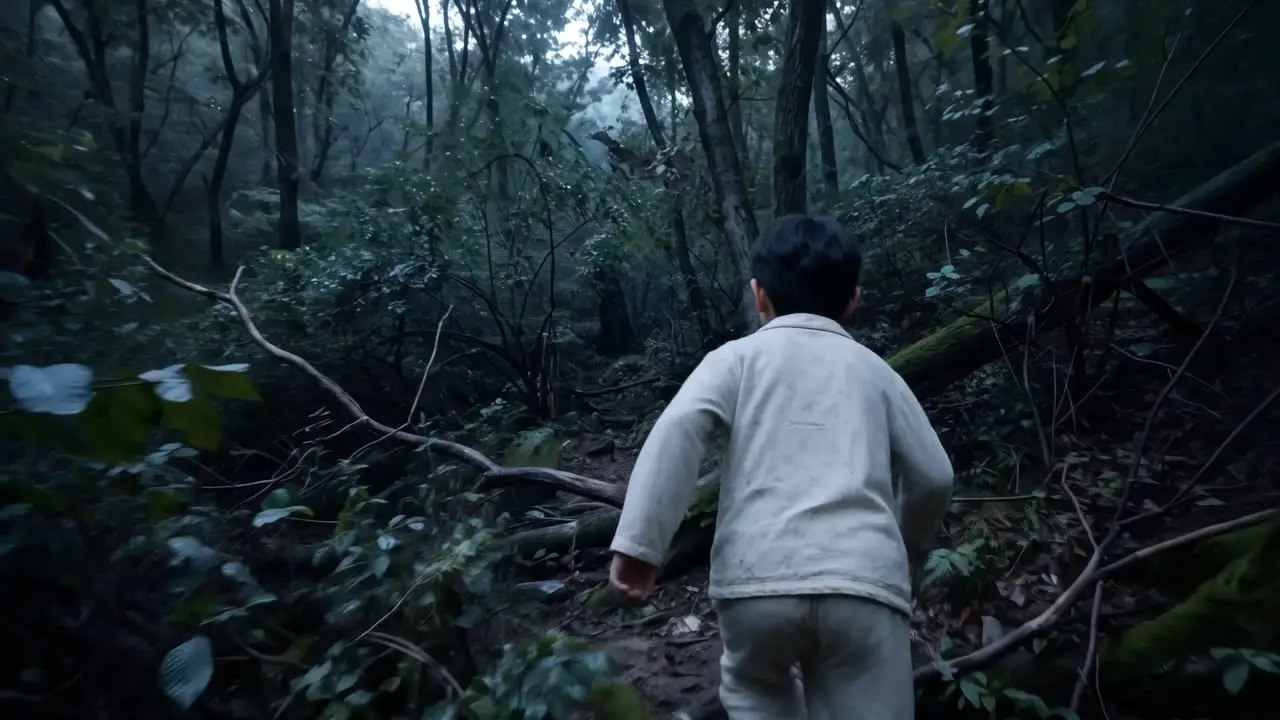 视频截图视频节点 26
一个主角在树林和灌木从中焦急找回家的路,艰难行走一段后,又回到原点的场景。 手持镜头的晃动感,展现角色的焦急和紧张。 {{Mixed 2}} 穿着 {{Mixed 1}} ,衣服有些脏污。他在 {{Mixed 4}} 树林中拨开树枝和灌木,呼吸急促,焦急地找回家的路,绕来绕去后,他震惊的发现又回到了最初的地点 {{Mixed 3}} 只保留同期声,无BGM。无字幕。无台词。
一个主角在卧室上铺闭眼,然后意外在树林中醒来的场景。 1. {{Mixed 3}} 穿着 {{Mixed 2}} 的第一视角镜头(POV),他躺在卧室 {{Mixed 1}} 的上铺,看着黑暗中的天花板,慢慢闭眼睡去。 冷风、草叶和急促吸气取代室内底噪。 2. 保持第一视角镜头(POV), {{Mixed 3}} 倒吸一口凉气后突然睁眼,发现自己在 {{Mixed 4}} 树林中醒来,身体靠在干瘪的鲨鱼充气床上。 3. {{Mixed 3}} 坐起,先看浮床再环顾,轻声:“엄마?” (音色参考 {{Mixed 6}} )但只有风叶回应他。 4. {{Mixed 3}} 他掐自己的手臂、拍自己的脸,逐渐用力,慌张低声说:“일어나. 빨리 일어나.” 随后突然转头盯着镜头。 画面中不出现其他人和手。 只保留同期声,无BGM。无字幕。
一个主角在卧室上铺闭眼,然后意外在树林中醒来的场景。 1. {{Mixed 3}} 穿着 {{Mixed 2}} 的第一视角镜头(POV),他躺在卧室 {{Mixed 1}} 的上铺,看着黑暗中的天花板,慢慢闭眼睡去。 冷风、草叶和急促吸气取代室内底噪。 2. 保持第一视角镜头(POV), {{Mixed 3}} 倒吸一口凉气后突然睁眼,发现自己在 {{Mixed 4}} 树林中醒来,身体靠在干瘪的鲨鱼充气床上。 3. {{Mixed 3}} 坐起,先看浮床再环顾,轻声:“엄마?” (音色参考 {{Mixed 6}} )但只有风叶回应他。 4. {{Mixed 3}} 他掐自己的手臂、拍自己的脸,逐渐用力,慌张低声说:“일어나. 빨리 일어나.” 随后突然转头盯着镜头。 只保留同期声,无BGM。无字幕。
多个夜晚蒙太奇。 35mm床侧固定中景,道允 {{Mixed 3}} 爬上上铺,善英 {{Mixed 4}} 替他盖好被子;床头小钨丝灯形成暖光岛,下铺占画面下半部。以灯灭匹配切到另一夜,50mm上铺床面近景,道允在百叶窗冷光中突然睁眼,模糊脚步从画外出现。切到地毯高度50mm局部,一只属于道允 {{Mixed 3}} 的赤脚缓慢落到旧褐地毯,裤脚、床架和空间方向严格连续,落地闷响与脚步音色相近。再匹配切到清晨,35mm下铺床沿固定中景,道允 {{Mixed 3}} 从下铺醒来,先看近在眼前的床顶,再抬头看向空上铺;床头灯已熄,只剩冷晨窗光、远处厨房声和困惑吸气。夜间动作保持正常睡意,不超自然化,不出现其他脚、人影或第二人物。 只保留同期声,无BGM
Late-1990s South Korean suburban fringe, restrained realist psychological horror seen primarily from a low protagonist-aligned camera height, damp overcast atmosphere, weathered prefab houses, concrete drainage channels and dense woodland, muted concrete gray, moss green, faded ochre and washed deep blue palette, subtle 35mm film grain, soft highlight roll-off, spherical Super 35 cinematography, mostly 35mm and 50mm lenses, identity preserved from supplied character assets, directional motivated lighting, strong negative fill, layered exposure, localized pools of practical light, controlled chiaroscuro, foreground shadow, clear subject-background separation, practical tungsten interiors, quiet negative space, frames within frames, controlled depth of field, understated performances, ordinary personal and household objects gradually becoming threatening, no supernatural imagery, no glossy stylization Upper-episode visual-stage lock: keep the still-unconfirmed threat inside an ordinary but fragile world; use a dark foreground edge or obstruction, a readable subject plane, and an unresolved background direction one to two stops lower, with transparent shadow texture and restrained contrast, opposing cool ambient light with only the limited practical warmth already present in the scene. 16:9 cinematic storyboard keyframe for “Footsteps”, late-1990s Korean household realism with restrained suspense, spherical Super 35, subtle film grain, soft highlights and authentic fabric texture. Preserve 「 {{Image 4}} 」穿着「 {{Image 3}} 」, 「 {{Image 1}} 」, 「 {{Image 2}} 」. Two-person medium shot on a 35mm lens from the bed side at 110 cm, fixed. 「道允」 has climbed onto the upper bunk while 「 {{Image 1}} 」 finishes drawing the bedding into place; the empty lower bunk fills the lower half of the frame. Keep bunk, window and corridor geometry unchanged from scene 1. A small tungsten bedside lamp forms a warm island around the upper bed and mother, weak cold light enters through blinds, and the lower bunk stays one stop darker but textured. No additional people, no figure below, no antagonist body, shadow or reflection, no text, no modern object, no flat room lighting, no watermark. 夜晚场景
道允 {{Mixed 1}} 穿着 {{Mixed 2}} 睡眼惺忪地从画左走入厨房 {{Mixed 4}} , {{Mixed 3}} 正在厨房擦桌子, {{Mixed 3}} 温柔又无奈地说:“아마 한밤중에 물 마시러 일어났다가 돌아와서 다른 침대에 누운 거겠지.”(音色参考 {{Mixed 5}} )道允低声回答:“기억 안 나.”(音色参考 {{Mixed 6}} ) 不同景别镜头合理切换。 仅保留同期声,无BGM
道允 {{Mixed 1}} 穿着 {{Mixed 2}} 睡眼惺忪地从画左走入厨房 {{Mixed 4}} , {{Mixed 3}} 正在厨房擦桌子, {{Mixed 3}} 温柔又无奈地说:“아마 한밤중에 물 마시러 일어났다가 돌아와서 다른 침대에 누운 거겠지.”(音色参考 {{Mixed 5}} )道允低声回答:“기억 안 나.”(音色参考 {{Mixed 6}} ) 仅保留同期声,无BGM
道允 {{Mixed 1}} 穿着 {{Mixed 2}} 因为刚起床,迷糊站在「浴室 {{Mixed 3}} 」里打哈欠、洗漱,身体轻摇;浴室昏黄灯只照局部,走廊冷暗。随后他揉着眼睛从浴室里走出来,出画。 只保留同期声,无BGM
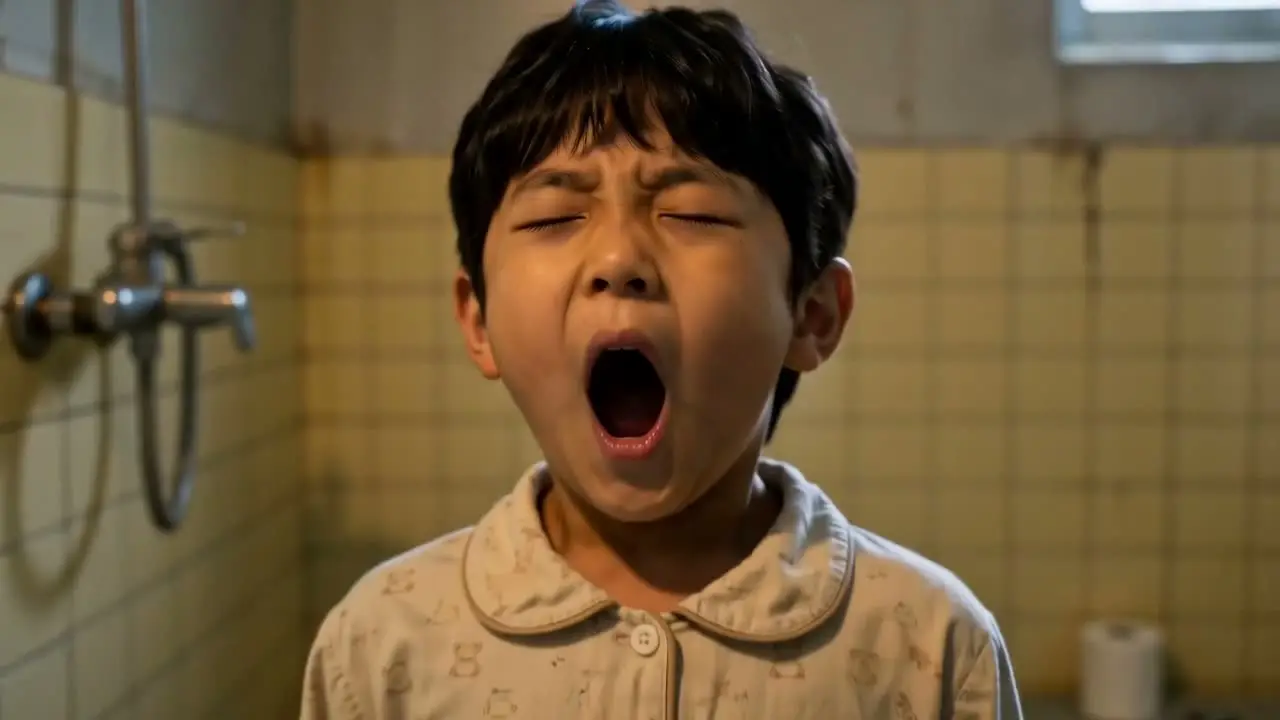 视频截图视频节点 25
道允 穿着 因为刚起床,迷糊站在「浴室 」里打哈欠、洗漱,身体轻摇;浴室昏黄灯只照局部,走廊冷暗。随后他揉着眼睛从浴室里走出来,出画。 只保留同期声,无BGM
Create a standalone prop asset: one physical late-1990s Polaroid photograph, front side only, centered on a plain charcoal-gray background, the complete print and all four edges clearly visible. Use the supplied character assets 「 {{Image 1}} 」 and 「 {{Image 2}} 」, their assigned costume assets, 「 {{Image 3}} 」, and 「 {{Image 4}} 」. Preserve character identity, hairstyle, body proportions, clothing design, realistic hair texture, and authentic fabric material exactly from the reference assets. Inside the Polaroid image, the camera is positioned within the dim interior of 「 {{Image 3}} 」, looking outward through the open front doorway. A narrow section of the dark interior doorframe and a small strip of interior floor remain visible along the edges, clearly establishing that the photograph was taken from inside the house. Outside, 「 {{Image 1}} 」 and 「 {{Image 2}} 」 stand side by side with their backs toward the camera, facing the dense woodland across from the house. Their stance is natural and slightly uneven, with a small amount of space between them. Neither character turns around; no face is visible. Keep both figures relatively small in the frame while the silent woodland occupies most of the background and upper negative space. Late-afternoon overcast daylight, cool gray-green exterior tones, faded ochre details, restrained saturation. The exterior is softly illuminated while the interior foreground remains one to two stops darker, retaining visible material texture rather than becoming pure black. Quiet, observational realism with subtle psychological unease; the unsettling feeling comes only from realizing where the photograph was taken. Authentic instant-film rendering: slightly faded color, modest contrast, delicate green-gray color shift, subtle exposure unevenness and natural optical softness. Off-white Polaroid border with a wider lower margin, slight yellowing, tiny handling marks, faint surface scratches, realistic photographic paper and emulsion texture. No handwritten caption, date, stamp, or printed text. Photorealistic late-1990s Korean setting, restrained realist psychological-horror aesthetic, believable period architecture and vegetation, realistic scale and materials. Negative control: no photographer, no adult, no third person, no human shadow, no reflection, no silhouette inside the house or among the trees, no visible faces, no extra children, no supernatural figure, no blood, no violence, no modern objects, no text, no handwriting, no watermark, no collage, no additional photographs, no hands holding the photograph, no duplicated bodies, no distorted limbs, no warped Polaroid border.
夜晚的房间 {{Mixed 1}} 里, {{Mixed 2}} 和 {{Mixed 3}} 席地而坐,台灯点亮的体积光恰好将两人周围的区域照亮, 两人周围 {{Mixed 5}} 摆成了一圈, {{Mixed 2}} 边摆边说:“我已经收到这么多只有照片的回信了……这种感觉有点怪……”(音色参考 {{Mixed 6}} )。 {{Mixed 3}} 一边仔细看着地上的照片,一边回复:“但收到回信还是值得开心的吧……诶?很多张照片里的人都好像你哦……”道允听完也疑惑地皱着眉头,手一个一个摸过地上的照片,仔细辨认。然后回复:“是哦……”。但好像突然想到了什么事情,从裤子兜里掏出来一张皱皱巴巴的纸币 {{Mixed 4}} ,他展开后递给给 {{Mixed 3}} ,说:“对了!这张纸币是之前我放到信封的那张!还记得嘛?” {{Mixed 3}} 眼睛看着纸币有些出神,喃喃地说:“是哦……好神奇啊……”,最后两人默默地对视了一眼。 仅保留同期声,无BGM,无字幕,对话均为韩语。
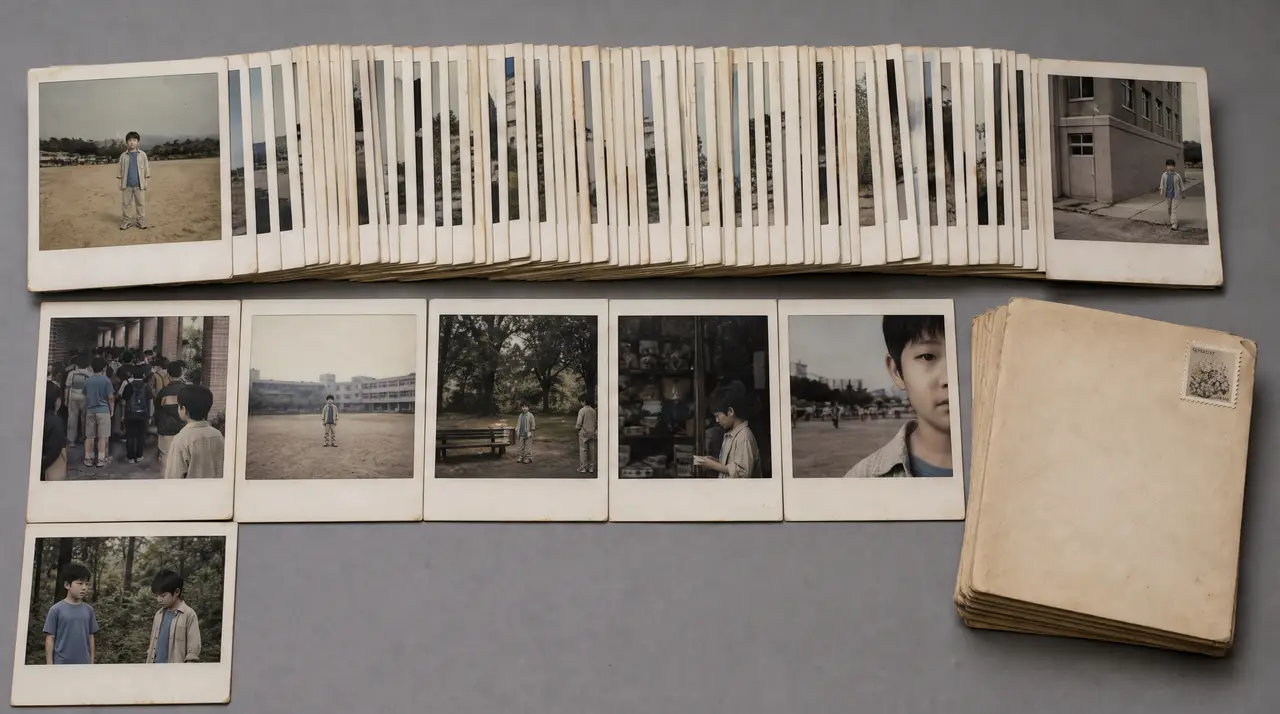 图片节点 3
图1中有男生形象的照片,形象都替换为 穿着
夜晚的房间 {{Mixed 1}} 里, {{Mixed 2}} 和 {{Mixed 3}} 席地而坐,台灯点亮的体积光恰好将两人周围的区域照亮, {{Mixed 2}} 把收到的宝丽来相片在两个人周围摆了一圈, {{Mixed 2}} 边摆边说:“从上次放飞气球开始,我已经收到了三十几张照片了……这种感觉有点怪……”(音色参考 {{Mixed 6}} )。 {{Mixed 3}} 一边仔细看着地上的照片,一边回复:“但收到回信还是值得开心的吧……诶?很多张照片里的人都好像你哦……”道允听完也疑惑地皱着眉头,手一个一个摸过地上的照片,仔细辨认。然后回复:“是哦……”。但好像突然想到了什么事情,从裤子兜里掏出来一张皱皱巴巴的纸币 {{Mixed 4}} ,他展开后递给给 {{Mixed 3}} ,说:“对了!这张纸币是之前我放到信封的那张!还记得嘛?” {{Mixed 3}} 眼睛看着纸币有些出神,喃喃地说:“是哦……好神奇啊……”,最后两人默默地对视了一眼。 仅保留同期声,无BGM,无字幕,对话均为韩语。
1998年的韩国乡镇。纪实电影片段。 道允 {{Mixed 3}} 和敏宰 {{Mixed 4}} 的刨冰摊 {{Mixed 1}} ,居民 {{Mixed 2}} 在摊位附近自然流动;两人各守一台家用刨冰机,同步操作但节奏略不同;冰屑、手与面部被棚布侧光切亮。50mm道允 中近景,他递出一杯刨冰,深蓝外套右袖两道浅蓝针脚自然可见。敏宰收钱,他接过纸币打开铁盒放进去,说了句谢谢,然后再招呼下一位顾客。顾客不露正脸。 仅保留同期声,无BGM,无字幕,对话均为韩语。
图中的铁盒单独生成一张道具卡。正面在左,背面在右。
1998年的韩国乡镇。纪实电影片段。 道允 {{Mixed 3}} 和敏宰 {{Mixed 4}} 的刨冰摊 {{Mixed 1}} ,居民 {{Mixed 2}} 在摊位附近自然流动;两人各守一台家用刨冰机,同步操作但节奏略不同;冰屑、手与面部被棚布侧光切亮。50mm道允 中近景,他递出一杯刨冰,深蓝外套右袖两道浅蓝针脚自然可见。敏宰收钱,他接过纸币放进铁盒,说了句谢谢,然后再招呼下一位顾客。顾客不露正脸。 仅保留同期声,无BGM,无字幕,对话均为韩语。
{{Image 1}} 的穿搭增加外套 {{Image 2}} ,原图格式不变
的穿搭换成
的穿搭换成 中的短袖穿搭。不改变 的格式
去掉桌子上的所有物品
去掉桌子上的物品,替换成 {{Image 2}} ,并且桌子上贴着标签 {{Image 3}}
去掉桌子上的图片,替换成 {{Image 2}} ,并且桌子上贴着标签 {{Image 3}}
单独生成【第1行】的分镜图像
极近特写镜头,道允 {{Mixed 2}} 坐在教室 {{Mixed 1}} 座位上,打开一个空白信封,拿出一张宝丽来相纸 {{Mixed 3}} 无BGM。
{{Mixed 2}} 收拾好书包,正要推门走出教室 {{Mixed 1}} 。老师 {{Mixed 4}} 走到他身旁说:“도윤아, 네 답장 왔어. / 축하해.” 道允开心地接过老师手里的信封说,“선생님, 감사합니다!”(音色参考 {{Mixed 3}} ),他拆开信封,发现里面只有一张相片 {{Mixed 5}} ,表情有些疑惑,但还是喜悦地和老师说:선생님, 안녕히 계세요.,然后走出教室。 只保留同期声,无BGM
{{Mixed 2}} 收拾好书包,正要推门走出教室 {{Mixed 1}} 。老师 {{Mixed 4}} 走到他身旁说:“도윤아, 네 답장 왔어. / 축하해.” 道允开心地接过老师手里的信封说,“선생님, 감사합니다!”(音色参考 {{Mixed 3}} ),他拆开信封,发现里面只有一张相片 {{Mixed 5}} ,表情有些疑惑,但还是喜悦地和老师说:선생님, 안녕히 계세요.,然后走出教室。
{{Image 1}} 其中一张宝丽来相片的单独特写镜头。相片内容是:一张模糊的沙地抓拍,画面边缘有一个 {{Image 2}} 背影
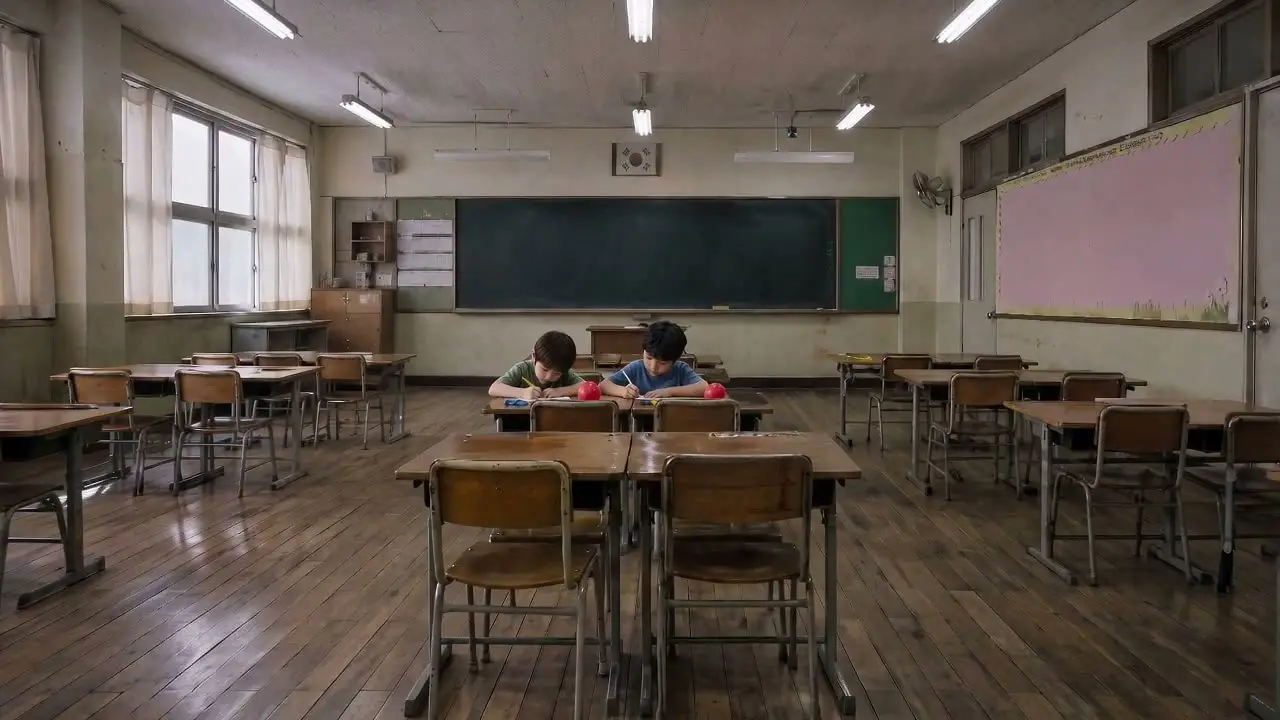 视频截图
教室 {{Mixed 1}} ,学生们 {{Mixed 2}} , {{Mixed 4}} 和 {{Mixed 5}} 坐在教室第二排中间位置。每个桌面上摆着道具 {{Mixed 3}} 教室里只剩 {{Mixed 4}} 在认真写着信 {{Mixed 6}} ,桌子上放着充好气的红色气球。 同桌 {{Mixed 5}} 惊讶地问 {{Mixed 4}} :“편지를 이렇게 자세히 써야 해?” {{Mixed 4}} 回答:“자세히 써야 답장해 줄 거 아냐!”然后神秘地从信封里拿一张折起来的 {{Mixed 7}} ,展开给 {{Mixed 5}} 看,说:“봐, 우표값까지 넣었어. / 이제 답장 안 할 이유가 없지!”(音色参考 {{Mixed 8}} )。 仅保留同期声,无BGM,无字幕,对话均为韩语。
老师 {{Mixed 3}} 带着学生们 {{Mixed 2}} 在操场上放飞气球 {{Mixed 6}} ,气球下端都绑着一个信封。 {{Mixed 5}} 拿着红色气球, {{Mixed 4}} 拿着黄色气球。 两人仰头捏住线,老师画外统一倒数:“셋, 둘, 하나——놓으세요!” 手指松开。摄影机从约100厘米缓慢上摇到树梢高度,无数气球升空,两人从画面下缘追两步,欢呼与风声进入。最后50mm从两人背后固定,他们停在操场边仰头,远处只剩属于他们的两个小点,肩膀轻微同步起伏;欢呼渐远,只留风。不要跟到高空、显示落点或加入跟踪视角;无字幕、额外文字和神秘人。 仅保留同期声,无BGM,无字幕,对话均为韩语。
教室 {{Mixed 1}} ,学生们 {{Mixed 2}} , {{Mixed 4}} 和 {{Mixed 5}} 坐在教室第二排中间位置。每个桌面上摆着道具 {{Mixed 3}} 学生们都吵吵闹闹地跑出教室,教室里只剩 {{Mixed 4}} 在认真写着信 {{Mixed 6}} ,桌子上放着充好气的红色气球。 同桌 {{Mixed 5}} 惊讶地问 {{Mixed 4}} :“편지를 이렇게 자세히 써야 해?” {{Mixed 4}} 回答:“자세히 써야 답장해 줄 거 아냐!”然后神秘地从信封里拿一张折起来的 {{Mixed 7}} ,展开给 {{Mixed 5}} 看,说:“봐, 우표값까지 넣었어. / 이제 답장 안 할 이유가 없지!”(音色参考 {{Mixed 8}} )。 仅保留同期声,无BGM,无字幕,对话均为韩语。
教室 {{Mixed 1}} ,老师 {{Mixed 2}} ,学生们 {{Mixed 3}} ,课堂道具 {{Mixed 4}} ,道允 {{Mixed 5}} ,道允的同桌 {{Mixed 6}} 教室里每张桌上放着 {{Mixed 4}} ,旁边有信纸、信封和笔,学生们 {{Mixed 3}} 和道允 {{Mixed 5}} 都在教室里吵闹; 教师 {{Mixed 2}} 拍手两次,示意学生们安静。教师拿示范信封与气球,说:“오늘은 새 친구에게 편지를 써 볼 거예요. / 풍선에 편지를 달아 보내면, / 주운 사람이 우리 학교로 답장을 보내 줄 거예요.” 说话的同时,学生们都在各自的座位上吹气球,道允也鼓着腮帮子用力吹气。 仅保留同期声,无BGM,无字幕
{{Image 1}} 的穿搭换成 {{Image 2}}
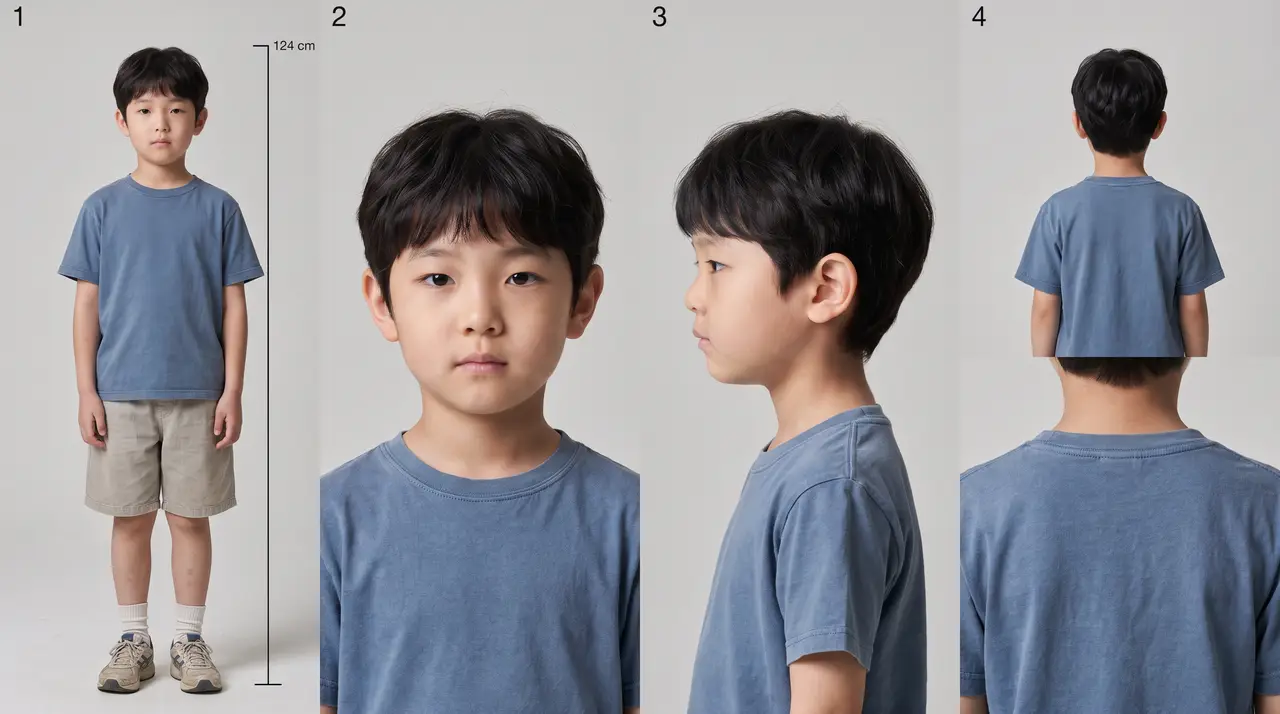 图片节点 5
{{Image 1}} 的穿搭换成 {{Image 2}} 中的短袖穿搭。不改变 {{Image 1}} 的格式
教室 {{Mixed 1}} ,老师 {{Mixed 2}} ,学生们 {{Mixed 3}} ,课堂道具 {{Mixed 4}} ,道允 {{Mixed 5}} 。 教室里每张桌上放着 {{Mixed 4}} ,旁边有信纸、信封和笔,学生们 {{Mixed 3}} 和道允 {{Mixed 5}} 都在教室里吵闹; 教师 {{Mixed 2}} 拍手两次,示意学生们安静。教师拿示范信封与气球,说:“오늘은 새 친구에게 편지를 써 볼 거예요. / 풍선에 편지를 달아 보내면, / 주운 사람이 우리 학교로 답장을 보내 줄 거예요.” 说话的同时,学生们都在各自的座位上吹气球,道允也鼓着腮帮子用力吹气。 仅保留同期声,无BGM,无字幕
图1中有男生形象的照片,形象都替换为 {{Image 2}} 穿着 {{Image 3}}
单独生成【第2行第3张】的分镜图像
单独生成【第2行第一张】的分镜图像
Create a production-ready character reference sheet for 「搬家人员」 in the film “Footsteps”, set in late-1990s South Korea. Show the same person consistently in four views: front full-body view, front portrait, side portrait, and rear portrait. Ordinary local moving worker with a neutral, practical presence, not visually distinctive and not threatening. Wearing a faded gray-green work jacket, plain light undershirt, loose dark work trousers, worn canvas work gloves, and practical dark work shoes. No company logo, name badge, jewelry, hat, or readable text. Photorealistic casting photography, realistic untreated skin texture, visible pores and natural facial details, authentic worn cotton and canvas fabric, subtle creases, faded dye, stitching, dust and signs of physical work. Neutral standing posture and expression. Clean light-gray studio background, soft directional studio lighting, accurate color, clear separation between subject and background, all views showing exactly the same identity, costume and proportions. Avoid: beauty retouching, plastic skin, fashion styling, glossy fabric, modern sportswear, reflective safety vest, branded clothing, dramatic cinematic lighting, exaggerated muscular appearance, threatening expression, extra people, tools, boxes, vehicles, text, watermark.
Create a production-ready prop reference card for BOX-01, the buried wooden box used in the final sequence of the Korean psychological mystery film “Footsteps”. Show the exact same box in four coordinated views and states: a closed front three-quarter view, a direct top view, a lid-pried-open state with a narrow gap, and a fully opened empty state. Neutral warm-gray studio background, clean separation between views, consistent scale and proportions. A large, practical rectangular storage box, approximately 150 cm long, 70 cm wide and 55 cm deep. Straight non-tapered sides and a flat lid, constructed from rough old pine boards. The lid consists of six fixed longitudinal planks reinforced by two plain transverse battens. Three small oxidized iron hinges run along one long edge; the opposite edge is secured by several corroded iron nails and can plausibly be pried open with a steel shovel. No lock and no carrying handles. Lock the exact board arrangement, wood grain, nail positions, hinges, cracks and stains across every view. The wood is dark weathered brown, structurally intact but heavily exposed to damp soil, with rough saw marks, swollen board edges, irregular water stains, embedded wet earth and restrained patches of pale moisture discoloration. The interior is completely empty and lined with thick gray-black industrial polyethylene waterproof sheeting. The liner fits closely against the base and inner walls, with heavy folded corners, overlapping seams, realistic wrinkles and small moisture beads. The liner must remain invisible when the lid is closed, appear only as a narrow dark folded edge through the pried gap, and become fully visible only in the opened state. Photorealistic rough wood, oxidized iron, damp soil and industrial plastic materials. Restrained late-1990s production-design realism, muted old-wood brown, soil gray and gray-black palette. Neutral directional studio lighting that clearly reveals construction and surface texture without turning the asset into a dramatic horror image. No person, no human remains, no anatomy, no blood, no bones, no clothing, no photographs, no police tape, no evidence marker, no writing, no symbol, no decorative carving, no dimension labels. Not a coffin, not a treasure chest, not a polished furniture box, not a modern shipping crate. No ornate metalwork, no brass fittings, no fantasy styling, no exaggerated decay, no modern plastic container, no watermark, no subtitles.
Create a production-ready vehicle reference sheet for 「搬家货车」 in the film “Footsteps”, set in late-1990s South Korea. A compact period-correct one-ton cab-over moving truck with a faded pale-blue cab, simple rectangular headlights, small steel wheels, black side mirrors and a practical open cargo bed covered by a weathered beige-gray canvas canopy on a tubular metal frame. Modest local moving vehicle, visibly used but fully functional. No cargo inside the truck. Show the exact same vehicle in three consistent views: front three-quarter view, complete side view, and rear three-quarter view. Preserve identical proportions, wheelbase, cab design, paint wear, canopy construction and surface damage across all views. Photorealistic automotive asset photography, realistic aged paint, slightly oxidized steel, dusty rubber tires, scratched cargo-bed panels, worn canvas fibers, natural dirt around the wheel arches. Neutral light-gray studio background with soft directional light revealing shape and material. Avoid: modern truck design, LED lights, modern alloy wheels, oversized commercial box body, American pickup styling, glossy restoration, heavy rust, accident damage, company branding, readable license numbers, Korean lettering, cargo, people, dramatic scenery, text, watermark.
Create a production-ready vehicle turnaround reference card for VEH-EXCAVATOR-01, a late-1990s tracked hydraulic excavator used at a modest suburban construction site in South Korea. Show the exact same excavator in four coordinated views: front three-quarter view, full left-side profile, rear three-quarter view and direct front view. In every view, the boom is folded inward and the bucket rests naturally on the ground. Neutral warm-gray studio background, even reference lighting, consistent scale and geometry. A medium-sized tracked hydraulic excavator suitable for low-rise residential earthwork, with a practical mid-1990s design: angular steel cab, flat glass panels, compact rear counterweight, exposed hydraulic hoses, simple mechanical joints, black steel crawler tracks and a conventional digging bucket with five worn teeth. Faded mustard-yellow painted body, dark charcoal undercarriage and restrained black trim. Small rectangular period work lamps with halogen bulbs, switched off. Realistic ordinary service wear: dried and wet soil trapped between track plates, worn bucket edges, oxidized bolts, subtle hydraulic oil residue, faded paint and several irregular scratches on the rear counterweight. Lock the exact cab shape, boom proportions, hydraulic-cylinder placement, track length, bucket shape, five bucket teeth and paint-damage pattern across every view. Real steel, rubber hose, glass, paint, grease and soil textures; no glossy commercial restoration. No driver, no construction worker, no people, no company logo, no model number, no Korean writing, no random text, no registration plate. No modern curved panoramic cab, no digital dashboard, no GPS equipment, no camera system, no LED work lights, no modern quick coupler, no wheeled excavator, no oversized mining machine, no crane attachment, no additional vehicle, no watermark.
Create a production-ready prop asset for 「搬家用的纸箱」 in the film “Footsteps”, suitable for duplication and stacking in multiple scenes. One medium-sized reused corrugated cardboard carton, closed with uneven strips of slightly yellowed brown packing tape. Plain exterior with faint traces of removed labels, softened corners, small compression dents, light dust and a subtle old water stain near the bottom. The box should feel like an ordinary household carton reused for moving rather than a modern professional moving box. Show the complete box in a front three-quarter view on a clean light-gray studio background. Preserve realistic scale and simple rectangular construction. Photorealistic corrugated cardboard fibers, layered cut edges, matte paper surface, tape wrinkles, slight adhesive discoloration and believable wear. No printed branding, no handwriting, no room label and no readable text. Avoid: modern shipping logos, barcodes, QR codes, plastic storage bins, bright colors, clean luxury packaging, excessive destruction, wet collapsed cardboard, open flaps, visible contents, additional boxes, hands, people, vehicle, text, watermark.
Create a production-ready 16:9 master location image for LOC-CONSTRUCTION-01, the construction site where the buried wooden box is later discovered in the Korean psychological mystery film “Footsteps”. Scene/backdrop: a modest late-1990s residential expansion site at the edge of Baekrim-dong, Haewon City, South Korea. Part of the old woodland has recently been cleared, but the location remains surrounded by dense, damp trees. This is a small peripheral construction project, not a large urban development. Use the approved VEH-EXCAVATOR-01 reference as the only heavy machine. Preserve its exact cab, boom, bucket, tracks, faded mustard-yellow paint and wear pattern. Park it on a compacted working pad in the left-middle area, facing diagonally toward the center of the site, with the bucket resting close to the ground. Lock the location geometry: A muddy vehicle-access track enters from the lower-right foreground and curves behind the central working area. Deep crawler marks and shallow rainwater puddles cross the foreground. A broad, recently levelled patch of compacted wet earth occupies the center. The future discovery point lies slightly right of center as an ordinary shallow settling area; BOX-01 remains completely buried and invisible. Uneven piles of excavated soil and gravel stand along the right side. A narrow old concrete drainage channel runs beside the left background and disappears toward the trees. Dense woodland forms the dark rear boundary of the site. A few weathered prefab houses from the old neighborhood remain partially visible beyond the far-right edge. Leave a clear open area near the access track where police vehicles and residents can later gather without changing the site layout. Late-1990s South Korean suburban fringe, restrained realist psychological horror seen primarily from a low protagonist-aligned camera height, damp overcast atmosphere, weathered prefab houses, concrete drainage channels and dense woodland, muted concrete gray, moss green, faded ochre and washed deep blue palette, subtle 35mm film grain, soft highlight roll-off, spherical Super 35 cinematography, mostly 35mm and 50mm lenses, directional motivated lighting, strong negative fill, layered exposure, localized pools of practical light, controlled chiaroscuro, foreground shadow, clear subject-background separation, quiet negative space, frames within frames, controlled depth of field, ordinary objects gradually becoming threatening, no supernatural imagery, no glossy stylization. Composition: 16:9 landscape frame, approximately 110-centimeter camera height, 35mm spherical lens, stable wide location view. Dark muddy tracks and shallow puddles form the foreground layer; the excavator and levelled working area occupy the middle layer; the drainage channel, old houses and dense woodland form the darker background layer. The excavator remains off-center, leaving the settling area and forest boundary readable without visually announcing them as clues. Lighting: cold overcast daylight enters directionally from the upper left. Wet soil and the excavator bucket catch restrained pale highlights. The right side of the machine and the woodland receive stronger negative fill. Preserve visible texture in the dark trees, tire ruts and damp earth rather than crushing them into black. Separate the excavator from the forest through brightness and material contrast, not saturated color. Color palette: concrete gray, wet-earth brown, moss green, faded ochre and restrained mustard yellow. Low saturation with clear tonal layers, no uniformly gray or flat exposure. Materials: realistic wet soil, compacted clay, standing water, rusted steel, scratched excavator paint, coarse gravel, aged concrete drainage surfaces, damp tree bark, weathered corrugated metal and old prefab-house siding. No people, no construction workers, no police, no crowd, no police car, no warning tape, no evidence markers, no visible wooden box, no exposed waterproof liner, no grave-like hole, no body or human remains. No tower cranes, no high-rise buildings, no modern excavators, no modern safety barriers, no LED signage, no digital machinery, no fresh urban infrastructure, no dramatic storm, no horror fog, no supernatural shadow, no readable text, no subtitles, no watermark.
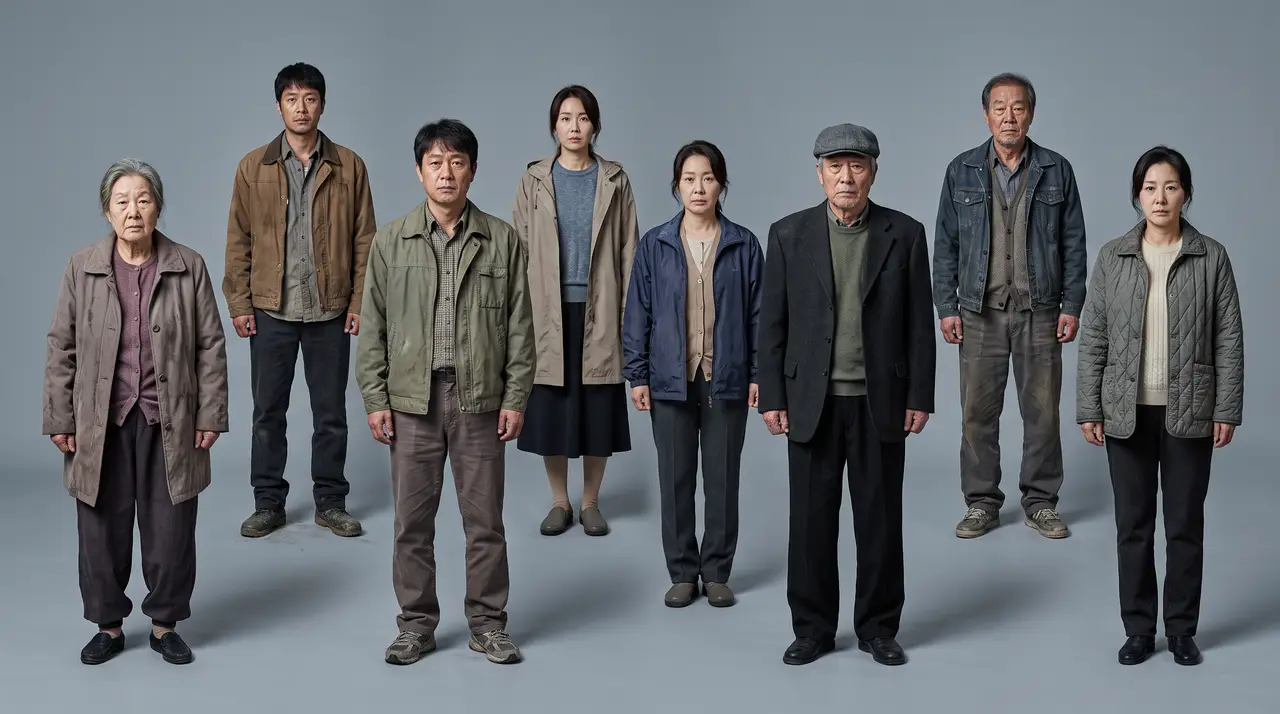 图片节点 31
Create a production-ready reusable crowd casting reference card for CROWD-RESIDENTS-01, the neighborhood residents gathered outside the police line in the final sequence of the Korean psychological mystery film “Footsteps”. 16:9 horizontal reference sheet. Show eight distinct adult neighborhood residents in two orderly rows of four, every person visible from head to toe, evenly spaced without overlap. Neutral cool-gray studio background with soft ground contact shadows. Each identity, costume and body proportion must remain clearly separate and reusable in later crowd shots. These are ordinary residents from a late-1990s suburban fringe neighborhood in South Korea, not professional models, journalists or crime-scene personnel. Their expressions show restrained curiosity, concern and uncertainty. No screaming, theatrical grief or exaggerated horror reactions. Front row, from left to right: An elderly woman wearing a weathered taupe coat over a muted plum knit top, loose dark trousers and worn black slip-on shoes; slightly stooped but attentive posture. A middle-aged man wearing a faded olive work jacket, a subdued checked shirt, brown-gray trousers and old athletic shoes; hands resting loosely at his sides. A middle-aged woman wearing a washed navy windbreaker over a beige cardigan, charcoal trousers and practical low shoes; arms held close to her body. An elderly man wearing a dark charcoal wool jacket, a faded gray flat cap, a dull green sweater and loose black trousers; quiet, reserved posture. Back row, from left to right: An adult man wearing a worn brown canvas jacket, a faded work shirt, dark straight trousers and muddy rubber-soled shoes. An adult woman wearing a muted beige raincoat over a washed blue-gray knit top, a dark calf-length skirt and simple practical shoes. An older man wearing a faded dark-denim work jacket, a gray-brown knit vest, loose work trousers and worn lace-up shoes. An adult woman wearing a weathered gray-green quilted jacket, a cream knit top, dark trousers and plain black shoes. Use authentic late-1990s Korean everyday styling: practical cool-season layers, modest cuts, slightly loose silhouettes, muted navy, olive, taupe, brown, gray and faded beige. Clothing should look repeatedly worn rather than artificially distressed. Add restrained dampness on coat shoulders, trouser hems and shoes to prepare the group for the light-rain final scene. Extremely realistic natural skin texture: visible pores, fine lines, under-eye texture, natural wrinkles, minor unevenness and age-appropriate facial detail. Realistic hair strands without salon styling. Real cotton, wool, canvas, knitted fabric, aged nylon, rubber and worn leather materials, with visible fibers, seams, pilling, creases, rain-darkened areas and ordinary use. Neutral soft directional light from front-left, enough facial and fabric detail for identity reference, with gentle negative fill on the opposite side. Natural color response, restrained saturation, no beauty lighting and no dramatic horror lighting. Keep all eight identities unique. No duplicated faces, no facial blending, no identical hairstyles, no matching outfits and no symmetrical clone-like arrangement. Preserve each person’s assigned position and clothing combination in future images. Do not include CHAR-SUNJA-01, Han Doyun, Lee Sunyoung, Minjae’s parents, police officers, forensic personnel or construction workers. No children, no celebrities, no glamorous styling, no formal mourning clothes, no funeral symbolism, no umbrellas, no bags, no cameras, no smartphones, no recording devices, no modern logos, no English text, no Korean text, no name labels, no high-visibility clothing, no police equipment, no blood, no injuries, no watermark.
场景参考 {{Mixed 1}} 50mm近景极慢推进, {{Mixed 5}} 穿着 {{Mixed 4}} 走到餐桌旁,坚定说:“아니야. 심장 소리는 몸 안에서 나고, 발소리는 밖에서 났어.”(音色参考 {{Mixed 6}} ) 句末留一拍,走廊暗而可读但绝不出现人形。匹配切到普通晨光下的动作近景, {{Mixed 2}} 用「橡胶洗耳球」和「水盆」替道允处理耳朵, {{Mixed 5}} 紧抱「毛巾」、肩膀略绷;只拍正常器具和反应,不拍身体内部。洗耳球吸水、挤压和湿毛巾声清楚。回到50mm双人中近景, {{Mixed 2}} 放下器具问:“이제 좀 나아졌어?” (音色参考 {{Mixed 7}} )道允侧耳分别听厨房与走廊,只听排水和屋外鸟声,最后看向母亲说:“낮에는 안 나.” 善英轻叹,排水声桥接下一场。 仅保留同期声,无BGM,无字幕、文字、现代物品和额外人物。
场景参考 {{Mixed 1}} 50mm近景极慢推进, {{Mixed 5}} 穿着 {{Mixed 4}} 走到餐桌旁,坚定说:“아니야. 심장 소리는 몸 안에서 나고, 발소리는 밖에서 났어.”(音色参考 {{Mixed 6}} ) 句末留一拍,匹配切到普通晨光下的动作近景, {{Mixed 2}} 用「橡胶洗耳球」和「水盆」替道允处理耳朵, {{Mixed 5}} 紧抱「毛巾」、肩膀略绷;只拍正常器具和反应,不拍身体内部。洗耳球吸水、挤压和湿毛巾声清楚。回到50mm双人中近景, {{Mixed 2}} 放下器具问:“이제 좀 나아졌어?” (音色参考 {{Mixed 7}} )道允侧耳分别听厨房与走廊,只听排水和屋外鸟声,最后看向母亲说:“낮에는 안 나.” 善英轻叹,排水声桥接下一场。 仅保留同期声,无BGM,无字幕、文字、现代物品和额外人物。
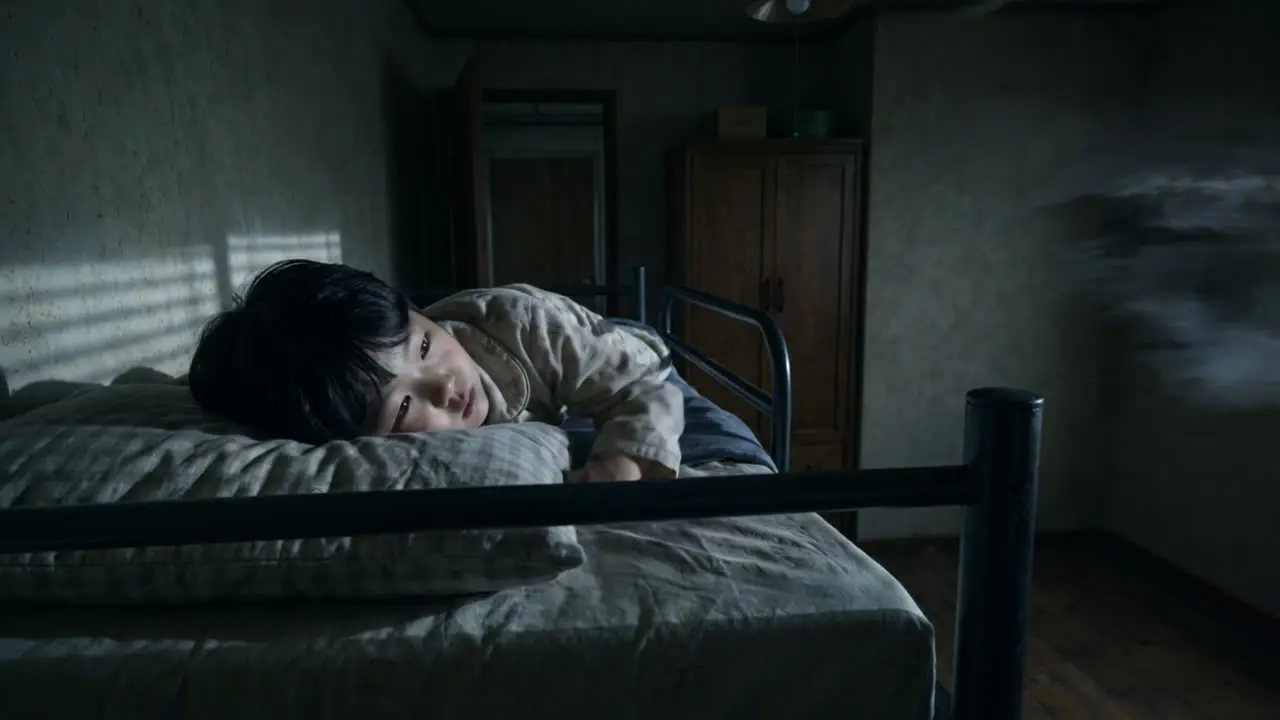 视频截图
场景参考 {{Mixed 1}} , {{Mixed 4}} 穿着 {{Mixed 3}} 躺在 {{Mixed 2}} 上铺。 16:9横画幅,24fps,35mm球面镜头,摄影机位于上铺床尾附近,以一个连续镜头完成惊起、窗户和空下铺三个视觉落点。 窗外的鸟突然掠近,翅膀短促拍击玻璃,玻璃与百叶窗同时发出清脆而急促的震响。撞击声出现的一瞬,正在睡觉的「 {{Mixed 4}} 」在上铺猛地惊起,迅速向后退到墙边,背部贴住墙面,一只手捂住嘴,另一只手撑住床垫,肩膀随着急促呼吸明显起伏。动作完成后不再继续后退,视线牢牢停在窗户方向。床架因突然坐起产生一次短促震动,原本靠近床边的低沉脚步声在玻璃震响中立即中断。 摄影机先保持稳定,完整捕捉「 {{Mixed 4}} 」惊起并靠墙的动作;随后进行一次短促、克制而平稳的向右摇摄,把窗户和百叶窗移到画面中心。「道允」捂着嘴的肩部与侧面轮廓留在前景一侧并轻微虚焦,窗户位于中景,窗外近黑墨绿色树林位于背景。一道真实的鸟影从玻璃外快速掠过,翅膀扑动数次后立即飞离画面,不进入室内,也不长时间停留在玻璃上。焦点短暂从前景「 {{Mixed 4}} 」转移到玻璃外掠过的鸟影。 鸟影离开后,摄影机不切断,沿着窗框、床架和百叶窗投下的冷光条纹缓慢向下移动。前景中的「道允」逐渐被上铺床栏裁出画面,空着的下铺进入画面中心。镜头最终停在下铺床垫和一小段木地板上:床铺完全空着,只有自然形成的被褥褶皱;上铺床栏形成框中框,下铺和地板比上铺低一档曝光,但床品纹理、床架边缘与旧木纹仍然清楚可辨。不要展示地板下方空间。 冷色月光始终从百叶窗方向进入。鸟影掠过时,窗外运动短暂切断地板上的月光条纹;鸟飞走后,条纹恢复稳定。人物所在区域、窗户和空下铺保持不同亮度层次,暗处不能出现额外人物或类似人物的形状。 声音中没有音乐和对白。玻璃拍击声之后紧接急促翅膀声、百叶窗轻颤、床架震动和「 {{Mixed 4}} 」突然吸气;鸟飞远后,翅膀声迅速消失,只留下窗外夜风、树叶摩擦和持续而急促的呼吸声。镜头下移至空下铺时,呼吸声仍在画外持续,下方再传来一次极轻的木板摩擦声,并以呼吸和老屋环境底噪收束。 保持人物资产、服装材质、床铺结构、窗户方位和光源方向稳定;玻璃中不出现人物或摄影机倒影;房间和树林中不增加其他人物;不加入文字、字幕、Logo、水印、现代物品、超自然形象、强烈镜头抖动或夸张惊吓特效。 只保留同期声,无BGM