
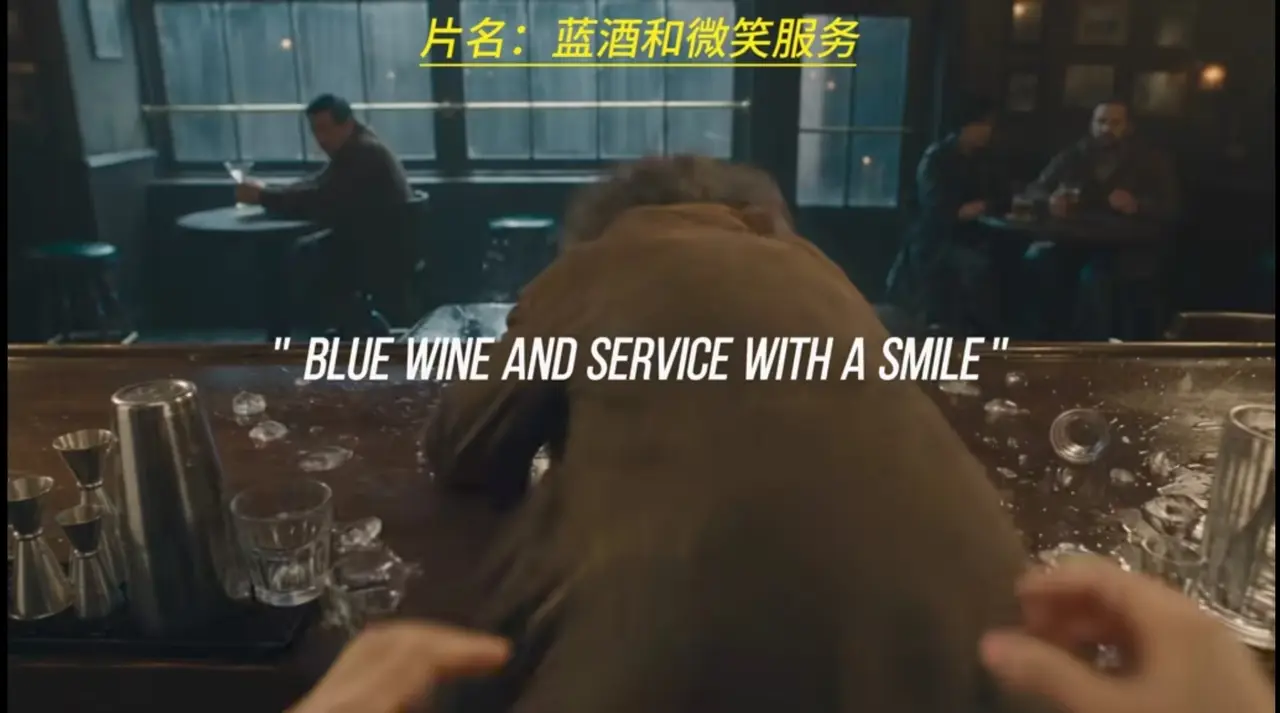
一个荒诞故事,屡次上传失败,只能截取片段,完整版还请搜索抖音观看
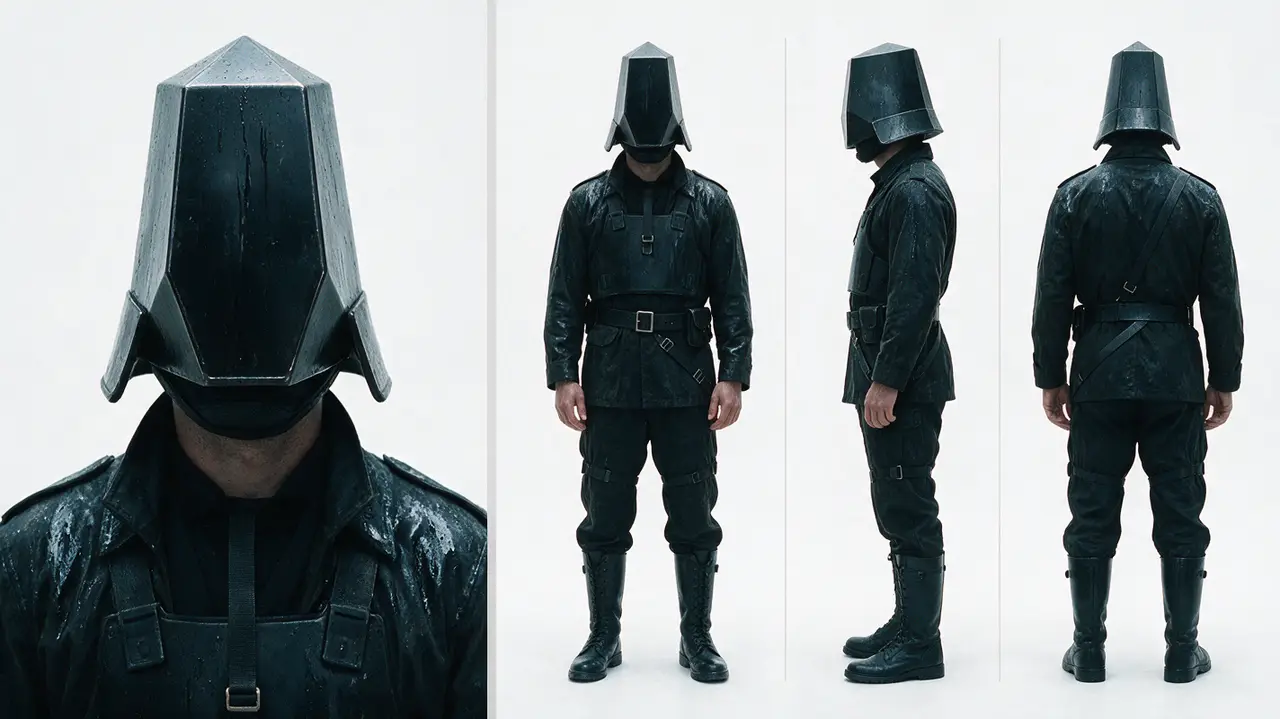
名称:士兵,雨城秩序执行者。 描述:武装执法者,男性群像,约25至45岁,平均身高1.82米,结实体型,头部被不锈钢材质方尖碑造型头盔全包围,没有露出眼睛,偏灰肤色。 服装:上衣为深黑防水军装外套和硬质护胸;下装为深黑作战裤;鞋为高筒军靴;帽为方尖碑形黑色金属头盔,饰品为黑色皮革腰带。 特征:头盔高约45厘米,制服肩部有雨水冲刷痕,整体面部被头盔完全遮挡且头盔表面无开孔。 构图规范:高质量专业角色设定图,横向构图,纯白色纯净背景,中性摄影棚灯光,平光布光;布局结构(必须是角色四视图):正面面部头部特写(占图片水平 1/3 的空间)+ [全身正面视图 + 全身左侧面视图 + 全身背面视图](占图片水平剩余的 2/3 的空间,并列排列),四个视图中间用淡灰色(#E2E2E2)的2px细线分割,无任何道具或背景物体。光影:中性摄影棚灯光,柔和的前侧光,清晰的轮廓定义,自然的肤色,服装可辨识,平视镜头,完整全身,无裁剪。不得出现任何道具/武器/食物/饮料/手持物(角色必须空手);不得出现环境背景(仅白色);不得出现其他角色;确保所有视图中的面部特征、发型、体型和服装保持一致;不得出现文字、水印、标签、UI元素;无背景场景,无过度风格化,纯 Naive 样貌。 视觉风格:雨城寓言·真人写实电影。冷蓝灰低饱和,硬冷雨光与室内钨丝暖光,35mm胶片颗粒,真人。[视觉风格:雨城寓言·真人写实电影。冷蓝灰低饱和,硬冷雨光与室内钨丝暖光,35mm胶片颗粒,真人。]
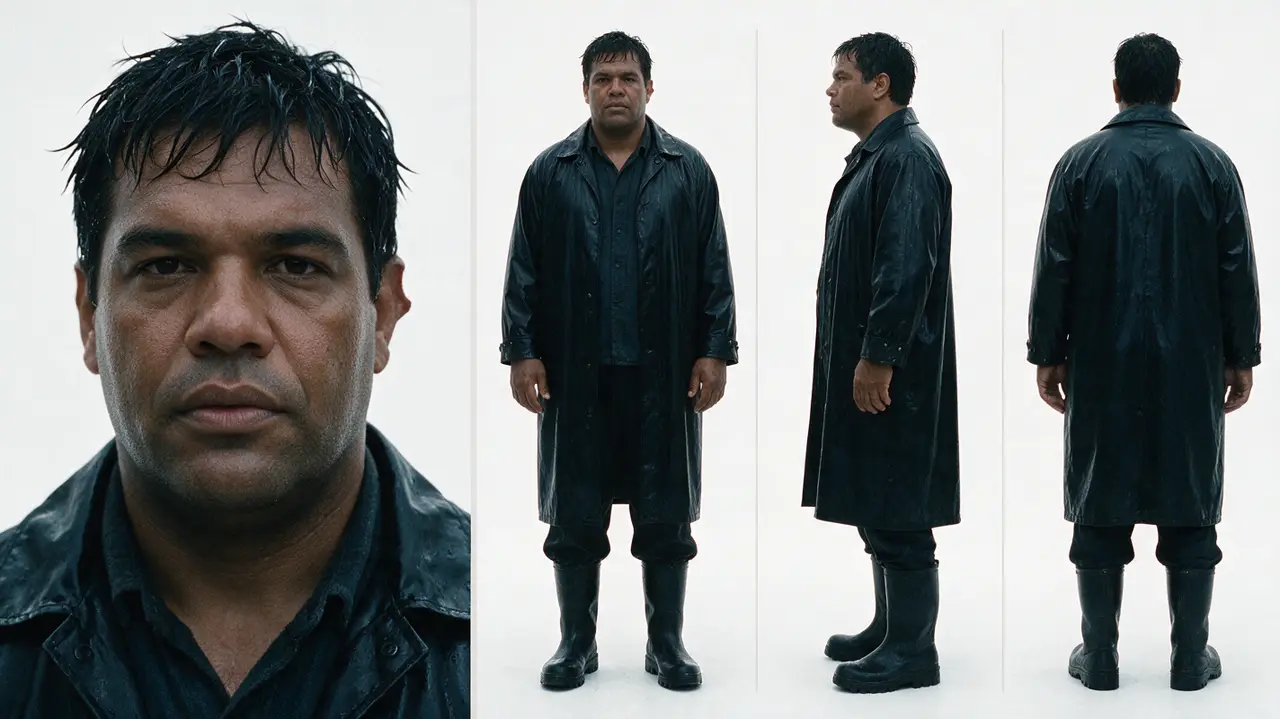
名称:乌云,要求蓝酒的高大男人。 描述:外来男人,男性,约40岁,身高1.90米,魁梧厚重体型,湿乱短发,发质粗硬,黑发,方脸,黑褐色瞳色,深麦色肤色。 服装:上衣为黑色长雨衣内搭深色粗布衬衫;下装为黑色防水长裤;鞋为重型黑色雨靴;帽为无帽,饰品为无配饰。 特征:宽下颌,厚唇,眉骨突出,左耳缺一小块,双手骨节粗大。 构图规范:高质量专业角色设定图,横向构图,纯白色纯净背景,中性摄影棚灯光,平光布光;布局结构(必须是角色四视图):正面面部头部特写(占图片水平 1/3 的空间)+ [全身正面视图 + 全身左侧面视图 + 全身背面视图](占图片水平剩余的 2/3 的空间,并列排列),四个视图中间用淡灰色(#E2E2E2)的2px细线分割,无任何道具或背景物体。光影:中性摄影棚灯光,柔和的前侧光,清晰的轮廓定义,自然的肤色,面部清晰服装可辨识,平视镜头,完整全身,无裁剪。不得出现任何道具/武器/食物/饮料/手持物(角色必须空手);不得出现复杂动作、情绪表情、面部遮挡;不得出现环境背景(仅白色);不得出现其他角色;确保所有视图中的面部特征、发型、体型和服装保持一致;不得出现文字、水印、标签、UI元素;无背景场景,无过度风格化,纯 Naive 样貌。 视觉风格:雨城寓言·真人写实电影。冷蓝灰低饱和,硬冷雨光与室内钨丝暖光,35mm胶片颗粒,真人。[视觉风格:雨城寓言·真人写实电影。冷蓝灰低饱和,硬冷雨光与室内钨丝暖光,35mm胶片颗粒,真人。]
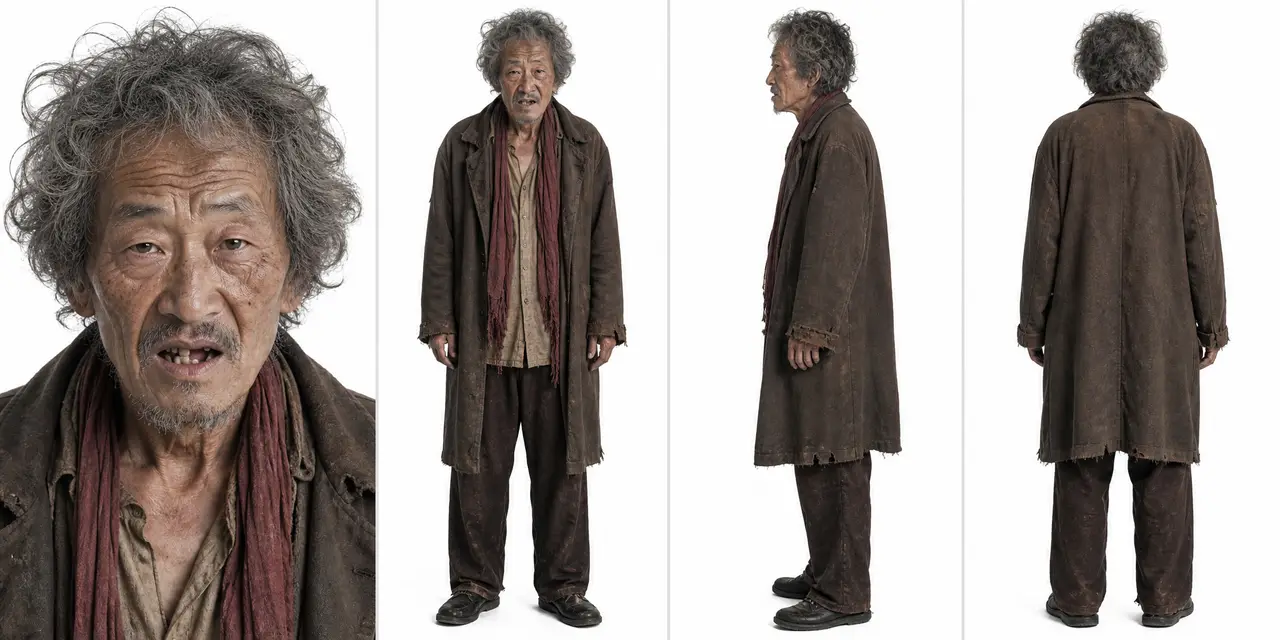
名称:老疯子,雨城酒馆的常客。 描述:流浪酒客,男性,约63岁,身高1.68米,瘦削佝偻体型,乱卷发,发质油腻蓬乱,灰白发,颧骨突出的长脸,浑浊灰褐色瞳色,蜡黄肤色。 服装:上衣为褐色破旧长呢外套内搭发黄衬衣;下装为宽松深棕旧裤;鞋为开胶黑布鞋;帽为无帽,饰品为脖颈一条褪色红围巾。 特征:缺一颗上门牙,鼻梁歪斜,额头三道深皱纹,左脸有不规则老人斑,指甲发黑且长短不齐。 构图规范:高质量专业角色设定图,横向构图,纯白色纯净背景,中性摄影棚灯光,平光布光;布局结构(必须是角色四视图):正面面部头部特写(占图片水平 1/3 的空间)+ [全身正面视图 + 全身左侧面视图 + 全身背面视图](占图片水平剩余的 2/3 的空间,并列排列),四个视图中间用淡灰色(#E2E2E2)的2px细线分割,无任何道具或背景物体。光影:中性摄影棚灯光,柔和的前侧光,清晰的轮廓定义,自然的肤色,面部清晰服装可辨识,平视镜头,完整全身,无裁剪。不得出现任何道具/武器/食物/饮料/手持物(角色必须空手);不得出现复杂动作、情绪表情、面部遮挡;不得出现环境背景(仅白色);不得出现其他角色;确保所有视图中的面部特征、发型、体型和服装保持一致;不得出现文字、水印、标签、UI元素;无背景场景,无过度风格化,纯 Naive 样貌。 视觉风格:雨城寓言·真人写实电影。冷蓝灰低饱和,硬冷雨光与室内钨丝暖光,35mm胶片颗粒,真人。[视觉风格:雨城寓言·真人写实电影。冷蓝灰低饱和,硬冷雨光与室内钨丝暖光,35mm胶片颗粒,真人。]
 视频截图视频节点 2
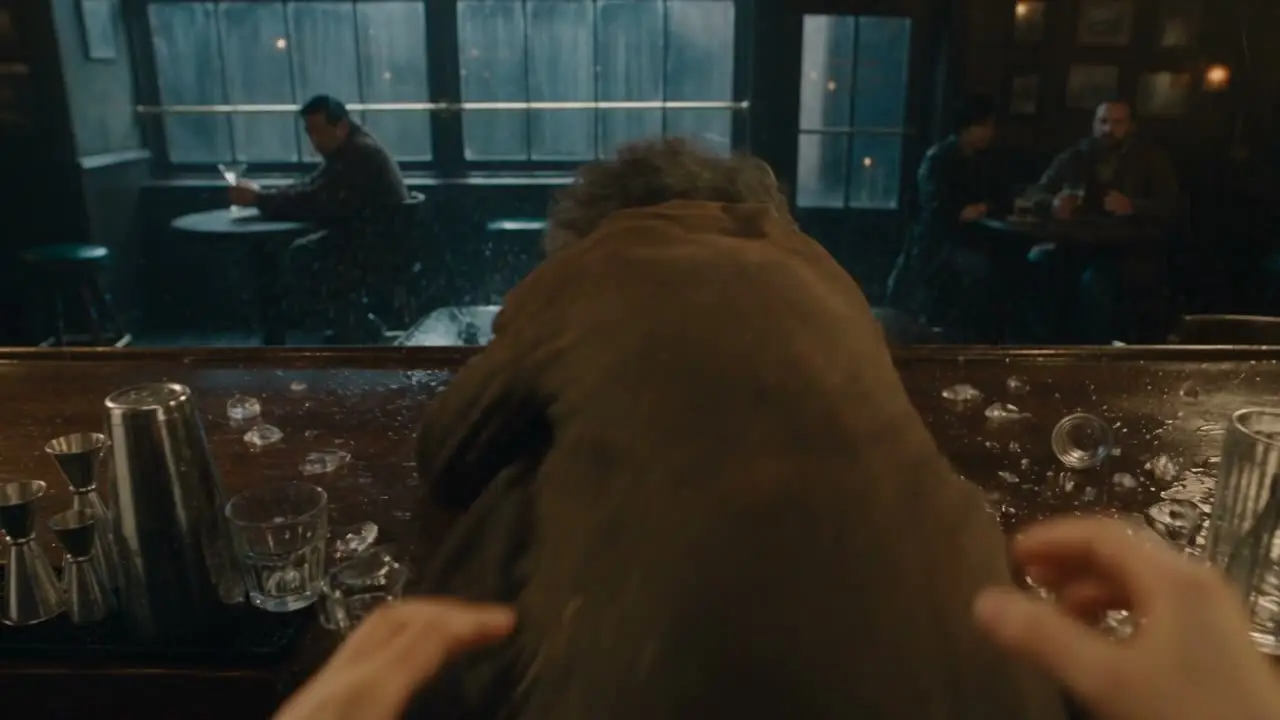
0–2s — POV facing into the room, the bartender's own hands mixing a drink. Someone crawls into frame fast and knocks it from his hands. The madman moves onto the counter at a quick, scrambling pace — fast but still deeply wrong, unnatural joint articulation, a rhythm no human body would choose. Background patrons continue their own small quiet actions, unaffected. Only ambience and rain, no dialogue. 2–5s — He keeps crawling at that same quick, wrong pace across the counter, moving further into frame. Around the 4-second mark he stops abruptly, snapping into an awkward, unnatural stillness. Slowly turns his head toward camera. Eyes hollow, no expression. A brief, heavy pause. Then, almost a whisper: "Service with a smile." He drops his head and immediately resumes the fast, wrong crawl. 5–9s — He continues crawling at pace, moving closer, angling toward the center of the counter, covering real distance across the frame. Background remains undisturbed throughout — one patron slowly turns a glass, another looks down into their drink, a third shifts weight without looking up. No one looks toward him. The quiet stretches longer than the motion suggests it should, letting the wrongness sit. 9–11s — He stops again, now positioned centered on the counter, directly in front of the camera. Same hollow stare, head turned fully toward the lens. Same quiet, flat delivery: "Service with a smile." A held pause — noticeably longer than the first time, long enough to feel wrong — before he moves again. 11–13s — He begins to move once more, a short final scramble bringing him right up against the lens. ~13–14s — Sudden shift. He lunges at the camera — not a creature-pounce, but the sudden, real-body violence of an actual person moving fast. He grabs the lens with both hands; the frame fills entirely with his body and face. The POV should read as being grabbed, physically. His face is inches from the lens, eyes wide, stare still completely hollow. He screams, nearly losing control: "SERVICE WITH A SMILE!" The sound carries real near-field pressure and spatial slam — not a mixed-in stinger, but the acoustic weight of a scream happening right against a microphone. 14–15s — Hard cut to black the instant the scream ends. Black holds through the remainder of the 15 seconds. No image, no titles, no logo, no sound explanation. Only a brief spatial tail of reverb remains at first. Then a very low, sustained brass drone begins to emerge right at the very end — like a distant tuba or bass horn held on one note, just starting to surface: a deep, distant, suppressed "hmmmm—", trailing off past the 15-second mark rather than resolving. Do not use horror-movie stingers, string shrieks, or jump-scare hits.
 视频截图视频节点 12
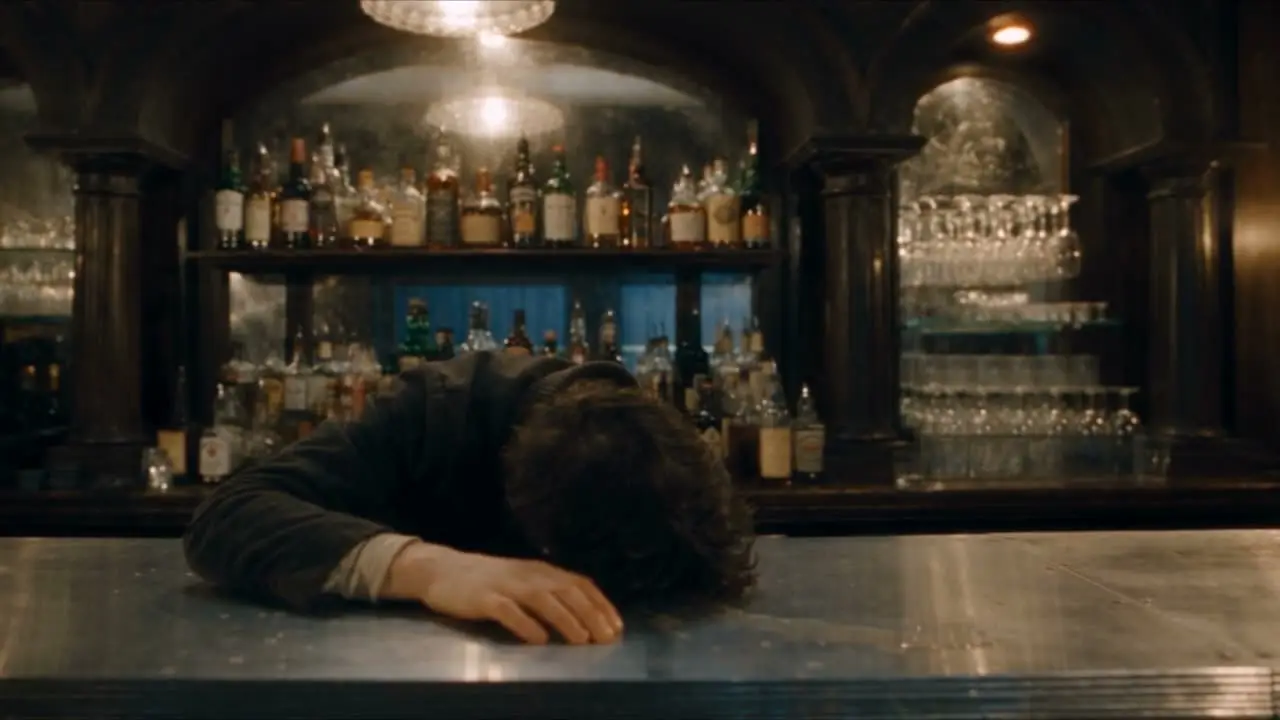
将这个图片作为首帧,做一个这个人物趴在柜台上不动,头部和桌子接触地缓缓渗出血液流淌在桌子上的视频,要求没有其他动作和人物,液体遵循物理规律,流速缓慢
 视频截图视频节点 3
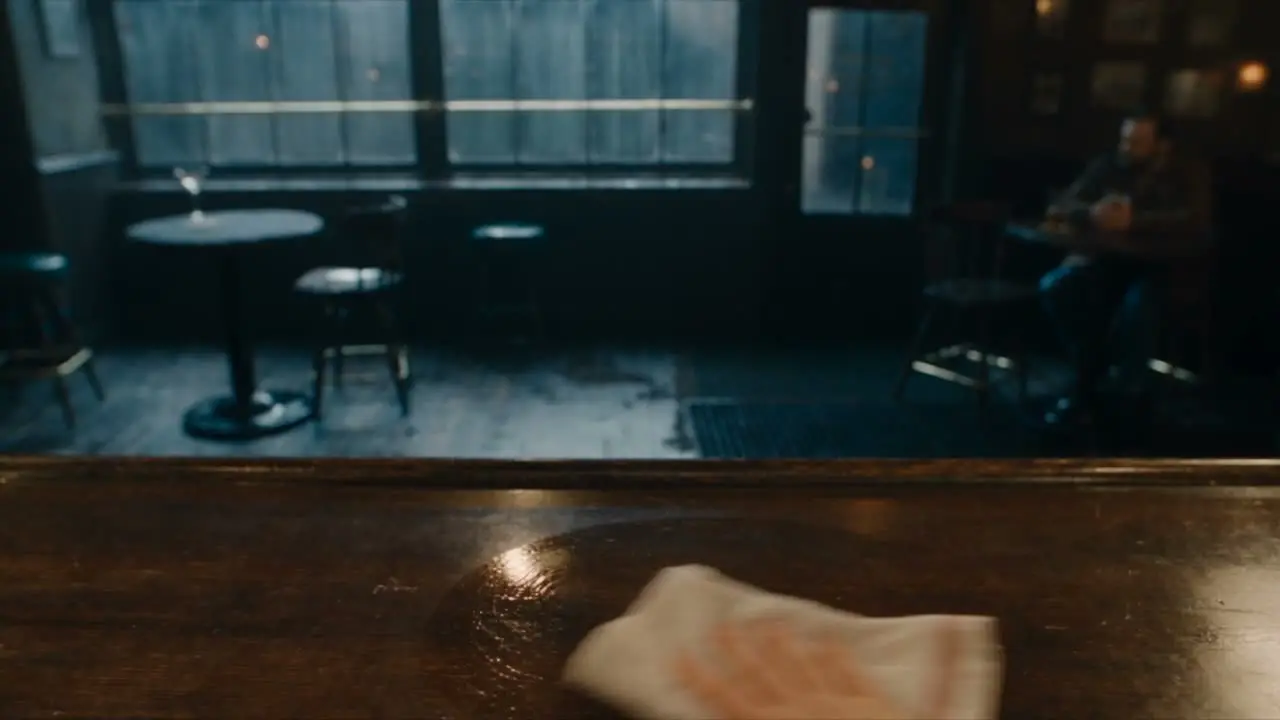
场景参考 {{Mixed 3}} ,老疯子 {{Mixed 2}} 也在画面中,在靠近吧台但是更偏右边的桌子上坐着喝酒,整体安静 Continuation of the same scene, same bartender, same bar, same visual identity established in the previous 15-second segment — same concrete industrial interior, same single overhead fluorescent tube, same underexposed film-grain look, same rain, same bartender POV rig, same wardrobe and physical build for the bartender (only seen from behind the bar / upper body, never full face-on to a mirror or reflective surface). Maintain identical color grading, lens character, and film grain profile for visual continuity between segments. 【画外音】 Tired-sounding young male voiceover, approximately 20 years old, flat and worn, no emotional performance — a voice that has said these words before. The VO plays over first-person POV footage; his mouth is never seen. 【镜头与人物】 Primarily first-person POV — camera is the bartender's eyes, same rig and eye-line as previous segment. One deliberate exception: the moment the customer looks at the bottle on the counter, the film cuts to a third-person shot from the customer's POV, showing the bartender from the front/side — first real look at the bartender's face and posture from outside his own eyes. This is the only non-POV shot in the sequence; it returns to bartender POV immediately after. 【时间轴】 0–3s — Bartender POV, slow and unhurried. He is wiping down the bar counter with a cloth, unhurried mechanical motion. VO, tired: "I live in Rain City." 3–6s — Same slow pace, camera still on the counter, cloth still moving. VO continues, same flat tone: "It's never stopped raining, not once, since I've lived here." Near the end of this beat, the sound of the door being shoved open cuts through the rain — camera POV lifts and turns toward the door. 6–8s (pace begins to quicken here) — A man enters, soaked completely through. He stands just inside the doorway and starts stripping off his rain slicker — deliberate, dripping, taking a moment. Water pools on the grate floor beneath him. He finishes, then starts walking toward the counter. VO, still flat but now picking up pace slightly: "Another one. Service with a smile, every customer — that's the job. Always has been." 8–9s — The man, noticeably taller than the bartender, arrives at the counter. He glances past the bartender at the bottles on the shelf behind him — a brief, assessing look, not lingering. 9–10s — Cut to bartender: upper body only, framed to roughly half the shot, seen from the front for the first time (this beat is still bartender POV — this is the customer looking at him, so we stay on the bartender's face as the "other side" of that exchange, i.e. camera holds on the bartender reacting, not yet the third-person cut). His expression: a stiff, practiced, polite smile, blinking slightly more than natural — a small, habitual tic, not a strong reaction. VO: "People in Rain City believe: however it's always been, that's how it's right to be." The customer voice speaks: "Give me a bottle." 10–11.5s — Hard cut to third-person POV — this is the customer's point of view now, looking at the bartender from across the counter. We watch the bartender reach up, take a bottle down from the shelf behind him, and set it down on the counter. This is the only shot in the sequence not from the bartender's own eyes. 11.5–13s — Cut back to bartender POV, same rig as always. The customer looks down at the bottle in his hand, turning it slightly, then says, flat: "This is black wine. I don't want this. I want blue wine." 13–15s — Cut back to bartender: same framing as before (upper body, roughly half-frame, front-facing). He is still smiling — but now his eyes widen slightly, and the blink rate increases further, a little more pronounced than the earlier tic but still restrained, still within the register of a nervous habit rather than an open crack. VO, flat, almost bemused: "Now that — that's not how it's always been." 【声音设计】 Continuous rain throughout, louder and sharper when the door opens. The door itself: a heavy, worn wooden scrape and thud, not a modern hinge sound. Dripping water from the man's slicker onto the iron grate floor — a distinct, isolated sound. Bottle set down on the counter: a solid glass clunk, no music sting. No score. No ambient bar chatter — the room stays as quiet and sparse as in the previous segment. 【硬性限制】 Same restrictions as the previous segment: no modern bar aesthetic, no neon, no extra light sources beyond the single fluorescent tube, no modern electronics, no CG sheen, no horror-stinger sound design. The one third-person shot must be clearly motivated (it is literally the customer's point of view, not a stylistic cutaway) and should not break the restrained, real-camera-feeling aesthetic — treat it as if a second, in-scene camera operator's perspective, same lens character and grain as the rest of the film. No subtitles, no on-screen text. The bartender's face, when shown, should read as an ordinary young man — tired, worn, unremarkable — consistent with the tired VO.
老男人参考 {{Mixed 1}} ,酒保及场景参考 {{Mixed 3}} ,士兵参考 {{Mixed 2}} ,士兵说话听感像是戴着防毒面具,酒杯跳跃镜头里酒保也必须入画,即这个镜头 {{Mixed 3}} 稍微拉远效果 **【连续性说明】** Continuation of the same scene, same bar, same visual identity established in all previous segments — same concrete industrial interior, same single overhead fluorescent tube, same underexposed film-grain look, same color grade and lens character. Same bartender, same madman, same soldiers with their established sound/movement signature. This segment contains the film's second and final explicit reality-break (the first being the ceiling shot) and ends the piece. **【时间轴】** 0–3s — Shot holds on the counter and the bartender — this is the one deliberate exception to the strict POV rule used throughout the film: a static, objective framing on the counter, bartender not yet visible. A beat of stillness, rain, quiet room tone. 3–5s — The bartender rises up from behind the counter into frame, visibly shaken, breathing hard, movements a little too fast, too raw — the first time we've seen him lose composure this openly. He is not yet speaking. 5–8s — A glass tumbler comes hopping/leaping into frame from off-screen, moving across the bar counter with genuine, unmistakable life of its own — not knocked or physically bumped, but animate, deliberate, the same fully-committed reality-break register as the earlier ceiling shot (no CG shimmer, no glitch, played completely straight and physically grounded within its own impossible logic). In a thin, high, piercing voice, it says: **"Excuse me, do you have blue wine?"** 8–9s — The bartender, in a single raw burst of breakdown, swats/punches the glass out of frame — sudden, violent, entirely unglamorous, a man losing his grip rather than a scripted action beat. 9–11s — The camera pans slightly to the right — no cut, a continuous move — and reveals the madman standing calmly off to one side, watching. Same flat, quiet register as his ceiling-scene delivery. At normal volume: **"Service with a smile."** 11–15s — Hard cut: the film's one other explicit break from first-person POV — a third-person shot showing the bartender's full body for the only time in the film. He crosses the space fast and grabs the madman by the shoulders, shaking him, his voice cracking, desperate: **"What is blue wine? Tell me. You know something, don't you?"** 15–17s — Hard cut to a new angle: low camera position, close on a soldier's head/helmet, framed tightly. Flat, procedural, unbothered: **"Who are you talking to?"** 17–20s — Hard cut back to the bartender — POV or the same objective framing, whichever reads cleaner — and now there is no one beside him. The space where the madman stood is simply empty. He is unraveling, voice rising, almost pleading: **"This old man! Can't you see him?"** 20–21s — Fast, no build-up: a gunshot. He goes down instantly, the shot landing with real, sudden, unglamorous weight — no slow motion, no lingering wound detail, consistent with the restraint used in every prior execution in the film. 21–30s — Hold on the aftermath: the bartender down, the bar around him unchanged, rain continuing outside, the fluorescent tube still humming overhead. No madman anywhere in this final frame — the shot contains only the bartender, alone. Let the stillness run for the remainder of the segment — no music, no VO, no text, just the room and the rain settling into silence. **【声音设计】** The glass tumbler's voice: thin, high-pitched, unnervingly clear against the quiet room — it should sound like a real voice, not a pitched-up effect, adding to the wrongness through sincerity rather than distortion. The bartender's breathing and voice should sound genuinely frayed — not performed hysteria, but a real person right at the edge. The soldier's line is flat, bored, procedural — same register established in earlier segments, utterly unbothered by what is clearly, to the audience, an empty space beside the bartender. The gunshot: sudden, dry, close, no reverb tail dramatized — realistic and unceremonious. After the shot: rain, thin room tone, the fluorescent tube's faint electrical hum, nothing else. No score, no stingers anywhere in this segment. **【硬性限制】** Same restrictions as all previous segments: no modern bar aesthetic, no neon, no extra artificial light sources beyond the single fluorescent tube. The soldier remains era-consistent with the established aesthetic — no modern tactical gear. The two reality-breaks in this segment (the living, speaking glass; the madman's disappearance from the group shot) must be played completely straight and deadpan, with the same grounded, real-camera-feeling treatment as the ceiling scene earlier in the film — no CG shimmer, no glitch effect, no obvious compositing seams. The two objective third-person shots (opening static counter shot, bartender's full-body shot grabbing the madman) are the only breaks from strict POV in this segment; everything else remains first-person. The execution is shown directly but without lingering gore or graphic wound detail — same restraint as every prior death in the film. No subtitles, no on-screen text. Maintain the same restrained, real-lens, film-grain character through to the final frame — the ending should feel like the quiet, unresolved final beat of a prestige drama episode, not a horror-movie stinger.
 视频截图视频节点 1
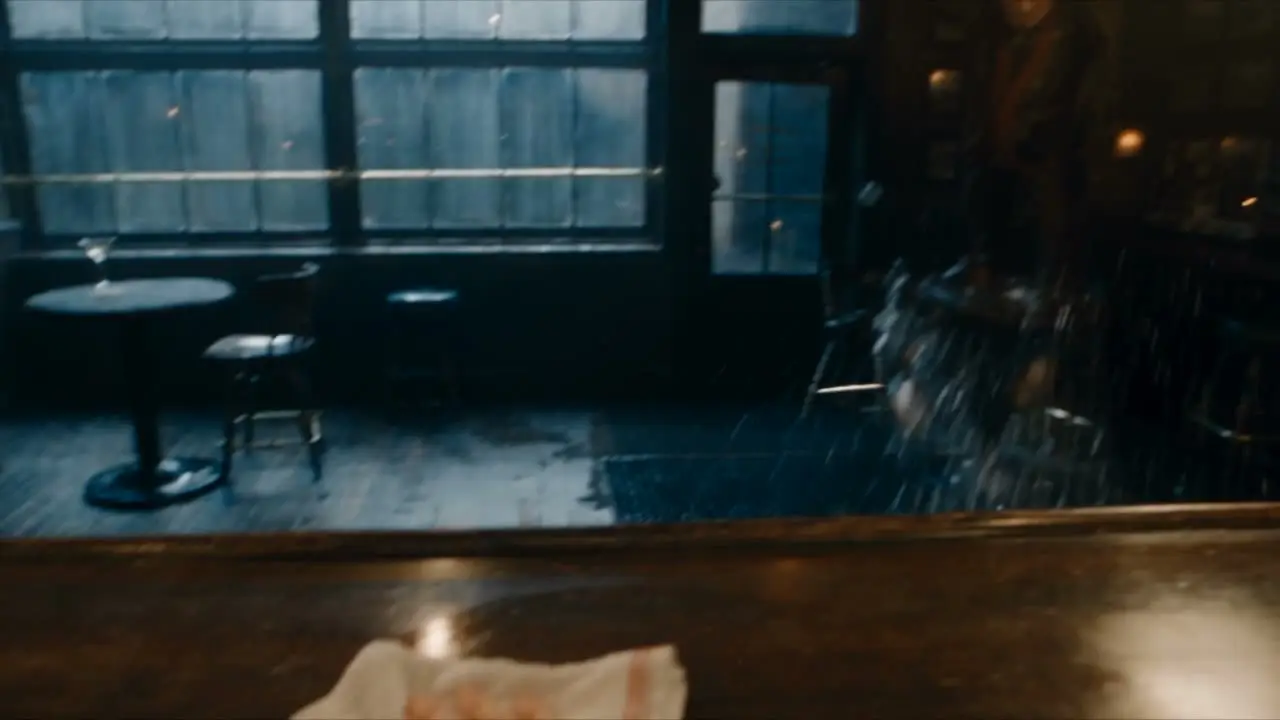
场景参考 {{Mixed 1}} 和 {{Mixed 2}} ,酒保形象参考 {{Mixed 2}} ,老疯子形象参考 {{Mixed 3}} ,士兵形象参考 {{Mixed 4}} **【连续性说明】** Continuation of the same scene, same bartender, same bar, same visual identity established in the previous segments — same concrete industrial interior, same single overhead fluorescent tube, same underexposed film-grain look, same bartender POV rig and physical build, same rain, same overall color grade and lens character. The old madman is the same character introduced earlier: gaunt, disheveled, pale, era-indeterminate worn clothing. **【人物位置】** The madman has been sitting at a small table positioned to the bartender's front-right, outside the current frame — the bartender's POV must pan/turn rightward to bring him into view. He is not visible at the very start of the segment. **【时间轴】** 0–2s — Bartender POV, mid-motion on some small bar task (wiping, arranging), facing mostly forward. A sudden crash of glass and bottles off to the right pulls the camera's attention — POV turns toward the sound, not a whip-pan, a real startled turn. 2–5s — The madman is revealed: he has just lunged up from his table to the front-right and is now standing awkwardly on the tabletop itself, having kicked over the bottles and glasses that were on it — they're still rolling, spilling, a couple still settling. His stance on the table is off-balance, clumsy, un-theatrical — a real body doing something abrupt, not an acrobatic stunt. He points one hand directly at the camera — at the bartender — and stares with fixed, unblinking intensity, holding that pointed stance for a beat before he screams, full volume, unrestrained: **"SERVICE WITH A SMILE!"** 5–7s — Immediately after, his eyes go wide, and he brings the same hand up to hover near his own mouth, and says it again — but now quiet, almost confiding, a total tonal whiplash from the scream: **"Service with a smile..."** 7–10s — He begins laughing. This laugh starts here and continues, uninterrupted, through the rest of the segment — it does not stop or reset at any of the following cuts. It should feel involuntary, escalating, slightly wrong in its rhythm rather than a normal human laugh, building steadily rather than instantly maxing out. 10–13s — Hard cut to the standard bartender-visible shot used in previous segments (upper body, roughly half-frame, front-facing). He looks visibly rattled, eyes darting left and right, scanning the room. Give this beat room to breathe — a moment of him just looking, unsettled, before he speaks. He calls out, voice tight with urgency: **"Can someone go get the soldiers?"** Throughout this beat, the madman's laughter continues off-screen, audible and unbroken, now shifting toward something more unhinged. 13–17s — Cut back to bartender POV, angled toward the madman: he is now on the floor, having toppled off or down from the table, writhing and rolling, laughing hysterically, the laugh growing more manic, more physical — but still contained, still a real person's body, no supernatural or creature-like contortion. Let this beat sit longer than feels comfortable — this is the emotional low point of the interior scene. 17–19s — Soft transition begins: the laughter starts to thin and distance itself acoustically, as if a wall and door are gradually coming between camera and sound, easing us out of the bar interior. The rain, previously a background layer, begins to swell and take over the mix. The image itself starts to shift — could be a slow push toward the door, or a soft cut that still carries the receding laughter into the next shot. 19–30s — Cut to a new exterior shot: street level, outside the bar, heavy driving rain, shot with the same restrained, naturalistic streaming-drama camera language as the interior (handheld, real lens character, no stylization). The bar's door occupies roughly a quarter of the frame. A middle-aged man pushes the door open from inside, shielding his face from the rain with one raised hand, steps partway out, and turns his body toward screen-left, shouting into the rain: **"Officer! There's a madman in here!"** He holds that shouting stance for a moment, then waits — this wait should breathe, at least 2–3 full seconds, scanning off-frame left, rain hammering down around him, his posture tense and impatient. The sound of heavy boots running through standing water begins faint and distant, then grows steadily louder, approaching from screen-left. Three soldiers come running into frame from the left, boots splashing hard through standing water, gear audibly shifting as they run. The man steps back, holding the door open, ushering them inside as they arrive. Hold on this a beat — the soldiers entering, the door, the rain — before the segment ends. **【声音设计】** The madman's laughter is continuous from the moment it starts through the entire remainder of the segment, including under the exterior shot, where it should fade naturally with distance and the door/wall barrier rather than cutting cleanly — a muffled, receding presence under the rain, audible faintly even as the soldiers arrive. Glass and bottles crashing and rolling at the start: sharp, real, physical. Boots in standing water: heavy, wet, building from distant to close, rhythmic. Rain is loud and dominant throughout the exterior portion. No score, no stingers, no horror-movie sound design. **【硬性限制】** Same restrictions as previous segments: no modern bar aesthetic, no neon, no extra artificial light sources beyond the single fluorescent tube indoors; exterior lighting should be naturalistic overcast/rain-diffused daylight or streetlamp glow consistent with the film's cold, desaturated grade — no neon or colorized lighting outside either. No modern vehicles, signage, or anachronistic elements in the exterior shot. The madman's movements, however extreme, must stay within real human anatomical limits — no creature-like contortion. No subtitles, no on-screen text. The exterior camera should carry the same restrained, film-grain, real-lens character as the interior — never a clean, stabilized, "drone-like" establishing shot.
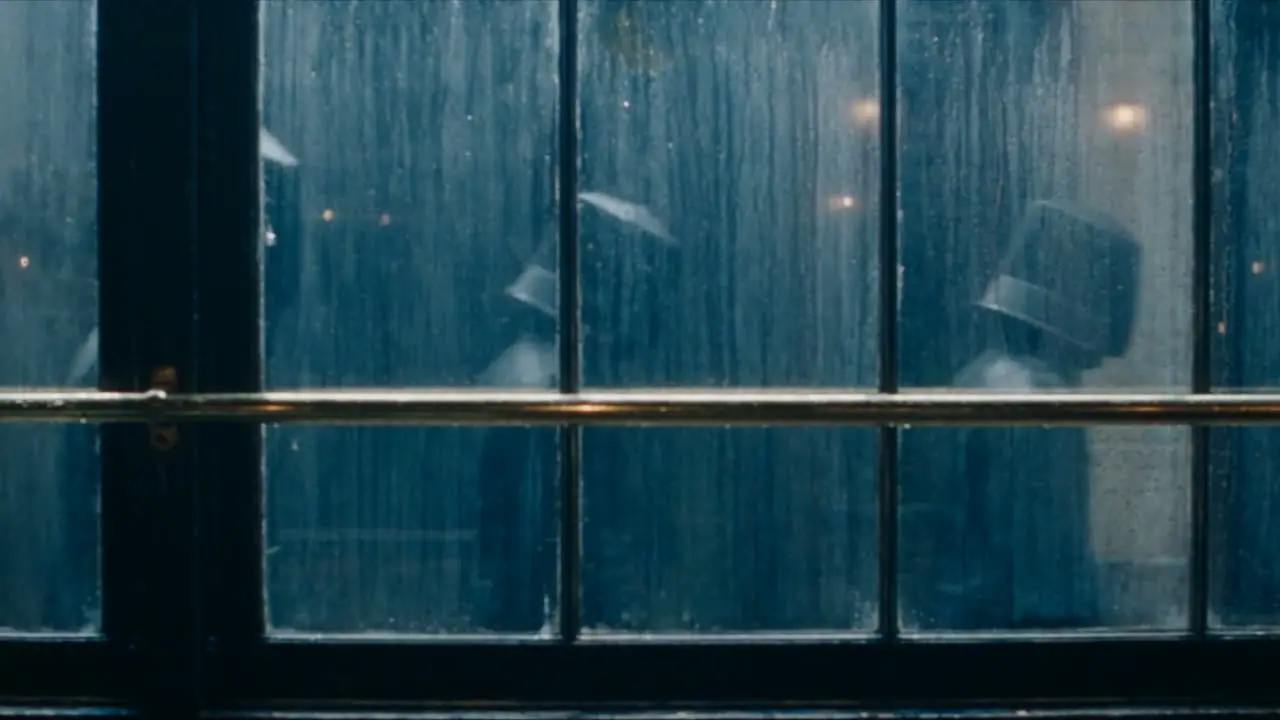 视频截图视频节点 3
酒保形象参考 {{Mixed 2}} ,被扑倒的男人参考 {{Mixed 1}} ,场景参考 {{Mixed 2}} 和 {{Mixed 1}} ,士兵参考 {{Mixed 3}} ,老疯子参考 {{Mixed 4}} ,士兵说话的时候会有一种听起来像别人戴着防毒面具说话的听感 **【连续性说明】** Continuation of the same scene, same bartender, same bar, same visual identity established in the previous segments — same concrete industrial interior, same single overhead fluorescent tube, same underexposed film-grain look, same bartender POV rig and physical build, same color grade and lens character. Same soaked customer who ordered "blue wine" from segment two. Same madman. **【时间轴】** 0–3s — Through the bar's window (visible in frame from the bartender's POV, or as a brief window-framed shot), a squad of soldiers can be seen approaching outside in the rain, moving in a loose group, gear and boots audible even through the glass. 3–6s — The door opens. Soldiers enter one by one, unhurried, procedural — this is routine to them, not urgent. One soldier steps forward, addressing the bartender directly. His delivery is flat, bureaucratic, bored: **"We heard there's a madman here?"** 6–7s — Cut to bartender: the standard visible shot (upper body, roughly half-frame, front-facing). He points, wordlessly, directly across the room toward the soaked customer who asked for blue wine. 7–11s — The soldiers move as a group toward the customer. He gets a couple of words or a half-turn of resistance in — not a real struggle, more a reflexive, useless flinch away — before they take him down. It should read as fast, practiced, and slightly rough, but not brutal or drawn-out: two or three soldiers control him to the ground, cuff his hands behind his back. His resistance is minor — a shoulder twist, a stumbled half-step — nothing sustained. 11–15s — The soldier who made the first takedown stands back up, turns to the bartender, and asks — same flat, procedural tone as before, genuinely just asking, not accusatory: **"Why'd you say he's a madman?"** 15–19s — Bartender POV, or cut to the visible bartender shot (consistent with earlier pattern) — he answers, a little too reasonable, like he's stating something obvious: **"He said he wanted blue wine. But wine is wine — how could there be a difference?"** 19–20s — Off-screen, a single voice — calm, almost casual — says: **"Hey."** The bartender's head lifts, eyes moving up and off-frame, drawn by the sound. 20–21s — Hard cut. No transition, no build-up. The shot is now the bartender's own POV, tilted straight up at the ceiling, and the ceiling is now impossibly, literally occupied: the old madman is lying flat against the concrete ceiling as if it were a floor, fully committed to the inversion — his body weight, clothing, and hair all behaving as though gravity is pulling him *up* into the ceiling, not down. No visible wires, no floating, no weightlessness — his posture is exactly what a person lying on a normal floor would look like, simply relocated to the ceiling, completely deadpan and physically grounded within that inverted logic. The concrete texture, the fluorescent tube, the dim skylight are all still present and unchanged around him. 21–25s — He looks down at the camera (i.e., down at the bartender, from his position on the ceiling) with a flat, serious expression — no manic grin, no wild eyes this time, something quieter and more unsettling in its calm. At normal speaking volume, evenly: **"Service with a smile."** 25–30s — Hold on this shot. No cut away, no reaction shot, no explanation. The bartender's POV stays locked upward at the madman on the ceiling for the remainder of the segment — the stillness itself is the ending beat. Rain and ambient room tone continue underneath, otherwise silence. **【声音设计】** Soldiers' boots and gear: procedural, unhurried until the takedown, then a sudden short burst of physical sound (scuffle, cuffs clicking, a grunt) before returning to quiet. The single "Hey" should be dry, close, almost conversational — not shouted, not eerie in delivery, letting the visual carry all the wrongness. No score, no stingers, no risers building into the ceiling reveal — the hard cut itself should do all the work. Under the final held shot: just rain and thin room tone, nothing else. **【硬性限制】** Same restrictions as previous segments: no modern bar aesthetic, no neon, no extra artificial light sources beyond the single fluorescent tube. The soldiers should read as period/era-neutral (consistent with the late-90s/early-2000s industrial aesthetic) — no modern tactical gear, no modern firearms design, no anachronistic equipment. The takedown must stay grounded and real — no exaggerated action-movie choreography. The ceiling shot is the one explicit reality-break in the film so far: it must be played completely straight, deadpan, physically consistent within its own inverted logic — no CG-shimmer, no glitch effects, no obvious compositing seams, no monster-ified anatomy on the madman. No subtitles, no on-screen text. Maintain the same restrained, real-lens, film-grain character throughout, including during the ceiling shot — it should look like it was actually filmed, not composited.
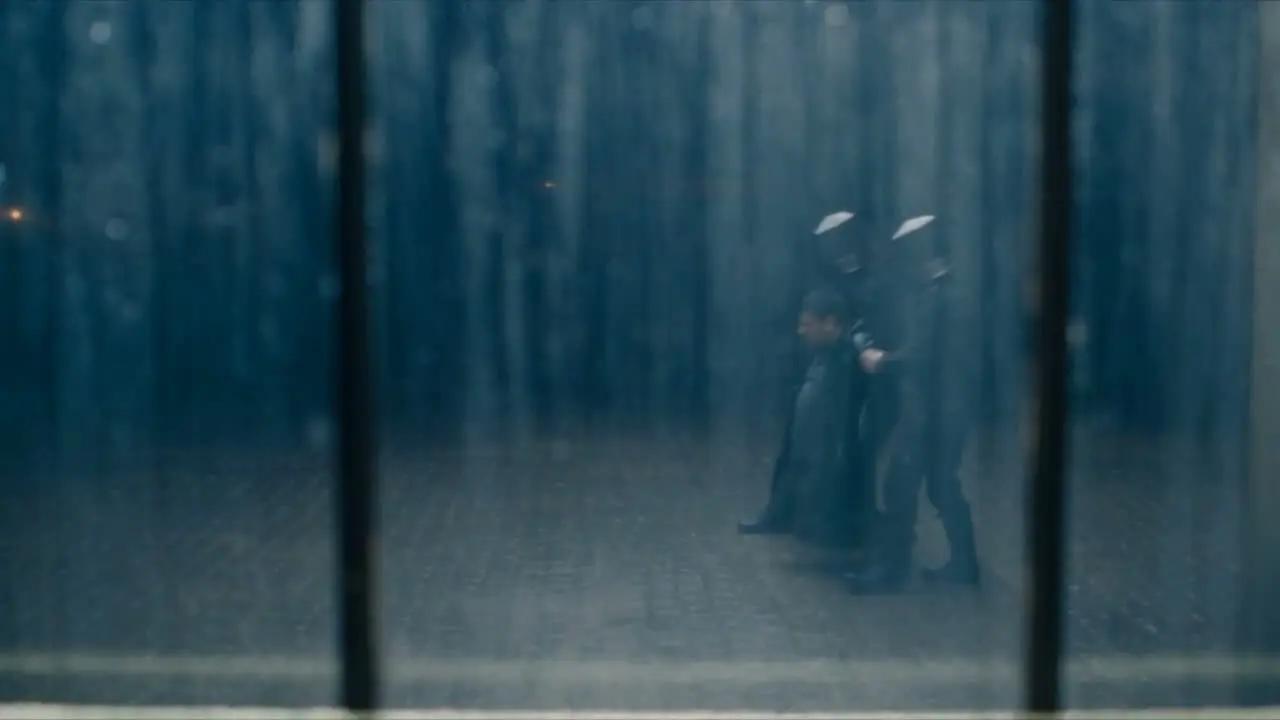 视频截图视频节点 6
酒保参考 {{Mixed 3}} ,被枪决的男人参考 {{Mixed 2}} ,站位参考 {{Mixed 4}} ,士兵参考 {{Mixed 1}} **【连续性说明】** Continuation of the same scene, same bartender, same bar, same visual identity established in the previous segments — same concrete industrial interior, same single overhead fluorescent tube, same underexposed film-grain look, same bartender POV rig and physical build, same color grade and lens character. Same soldiers, same soaked customer from segment two/four, now being led out. **【时间轴】** 0–4s — Bartender POV. Through the window, the soldiers lead the handcuffed customer out into the heavy rain. The street outside is visible through the glass — rain-streaked, dim, naturalistic exterior light matching the established grade. The man is walked a short distance, positioned, and shot — the execution is shown directly and realistically through the window glass (rain-streaked, slightly obscured by window grime and weather, adding natural distance rather than deliberate censorship), but does not linger on graphic detail — the shot registers as a real, sudden, brutal event rather than a dwelt-upon gore beat. He falls. The camera does not push in or hold on the body. 4–5s — A beat of stillness — rain, distant soldier presence outside, the bartender's POV holding on the window a moment longer, the aftermath still settling. 5–7s — The door bursts open. A set of twins rush in — identical in every visible respect: same face, same build, same clothing, same haircut, movements and even micro-expressions mirrored between them like reflections of each other, unnervingly synchronized. This happens with almost no gap after the shooting outside — the door opens again almost immediately, the soldiers still present just outside, not yet dispersed. 7–9s — Cut to the standard visible bartender shot (upper body, roughly half-frame, front-facing). His expression carries a thin, residual unease — the shooting just happened moments ago and it's still sitting with him — but he's composed, functional, doing his job. A brief beat of him processing/settling before he speaks: **"What can I do for you?"** 9–11s — Cut back to bartender POV. The twins, standing side by side, speak in perfect unison, same cadence, same pitch alignment, same timing down to the syllable: **"We want blue wine."** 11–13s — Immediately — almost no beat, underscoring that the soldiers never actually left — the door bursts open again. Soldiers rush in, same procedural, unhurried-but-forceful energy as before, same gear and boot sounds established in the earlier segment. 13–17s — This time there's no arrest procedure, no cuffing — the soldiers simply seize the twins, one soldier or pair per twin, and physically drag them out by force, faster and rougher than the earlier takedown. The twins' resistance (if any) is brief and identical between them — same small flinch, same half-word, mirrored. 17–20s — The door shuts or is left swinging. Bartender POV holds on the window again, rain streaking the glass, the street beyond dim and wet. 20–26s — Through the window, the twins are marched to the same execution spot as the previous man. Same realistic, direct, non-graphic treatment: the act is shown clearly enough to register as real, but the camera doesn't dwell on impact detail. Both twins go down — whether simultaneous or a beat apart, the visual rhyme with the earlier execution should be unmistakable: same spot, same rain, same window-glass distance. 26–30s — Hold on the window a few seconds after, rain running down the glass, the street empty and wet, no music, no VO, no bartender reaction shot — let the silence and the rain carry the ending. **【声音设计】** Gunfire through the window: sharp, real, slightly muffled/distanced by glass and rain rather than clean and close — consistent with the "seen through a window in the rain" framing. Door bursts: heavy, wooden, abrupt. Soldiers' boots and gear: same established sound signature (heavy, wet, procedural weight) but faster and more forceful in the twins' removal than in the earlier arrest. The twins' unison line should sound genuinely doubled/synchronized, not obviously post-processed or robotic — like two real voices landing perfectly together. No score, no stingers. Rain dominant under the final held shot. **【硬性限制】** Same restrictions as previous segments: no modern bar aesthetic, no neon, no extra artificial light sources beyond the single fluorescent tube indoors; exterior lighting naturalistic and rain-diffused, consistent with the established cold, desaturated grade. Soldiers remain era-neutral, no modern tactical gear. The executions are shown directly but without lingering gore, wound detail, or graphic close-up — realism through restraint, not explicitness. The twins must be genuinely identical (same actor/double treatment or seamless twin performance) without reading as a CG clone effect — no obvious digital duplication artifacts, no synchronized-uncanny-valley stutter. No subtitles, no on-screen text. Maintain the same restrained, real-lens, film-grain character throughout, including the through-glass exterior shots — rain and window grime should feel like natural optical interference, not a stylized filter.