
比上一代skill的v1.0版本又迭代了效果增强版;构图保持原有的美学风格,增强了视频的第一视角临场感,以及分镜连贯性;
 视频截图
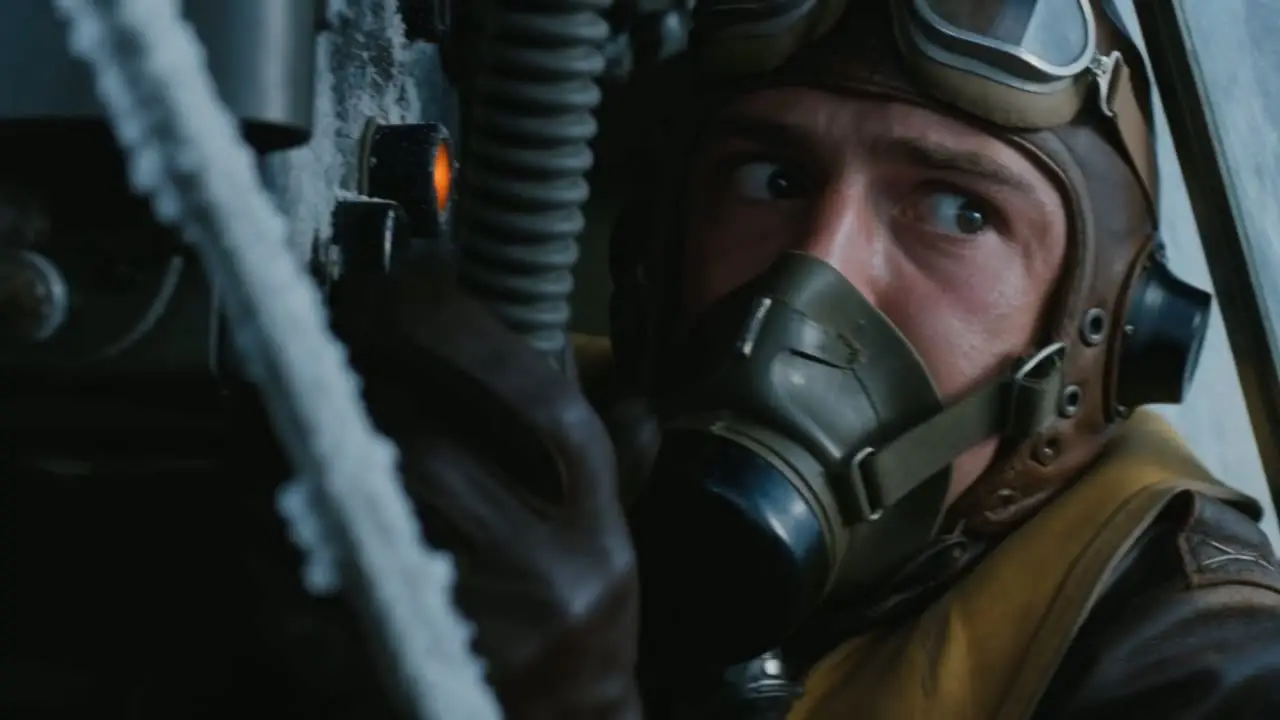
3-second invasive handheld close-up inside the bomber cockpit, less than one arm from a young aircrew observer wearing a worn brown leather flight helmet and oxygen mask. Part of his forehead and left shoulder are cut by the frame. A frost-covered cockpit strut and trembling oxygen hose occlude the foreground. His face is pushed into the right third while his eyes track flak bursts outside the narrower right edge. His pupils tighten, breathing stops for half a beat, the jaw locks beneath the mask, and two gloved fingers repeatedly fail to secure a vibrating radio switch. He abandons the switch and braces his forearm against the metal frame. The aircraft turbulence creates high-frequency camera vibration; each displacement returns focus to one visible eye or the failed hand movement. 32mm close documentary perspective, cold window light, weak amber instrument reflection, frost, sweat, natural skin texture, worn leather and oxidized metal, emotionally intense but not theatrical, large-format film character, suffocating cockpit pressure. Negative: theatrical screaming, emotionless face, staged acting, teal-and-orange blockbuster grade, plastic CGI, fisheye distortion, warped faces, text, logo, watermark.
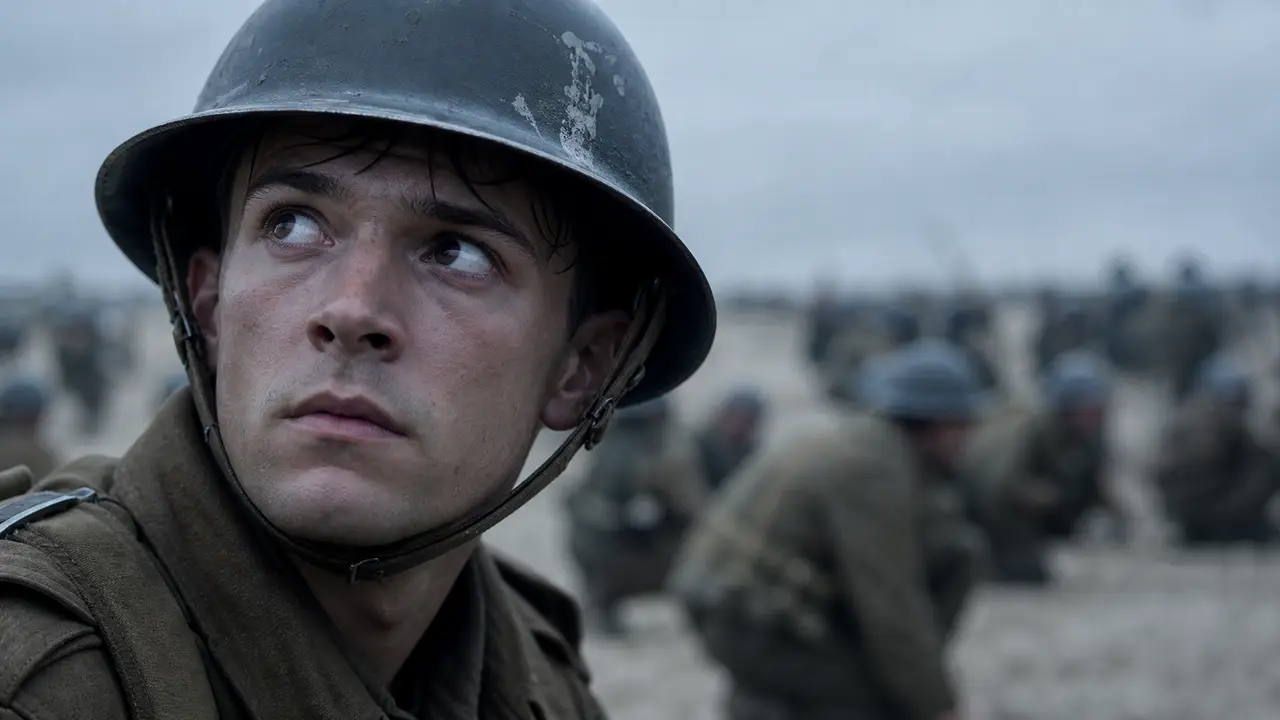
3-second invasive handheld close-up inside the landing craft, less than one arm from a young infantry soldier with a scratched steel helmet and mud-streaked wool collar. Part of his helmet rim and left shoulder are cut by the frame. A wet rifle strap and another soldier's arm occlude the foreground. His eyes snap upward and to the right, tracking a distant single-engine fighter aircraft beginning its dive against the overcast sky. His pupils tighten, breathing stalls for half a beat, his jaw locks, and his fingers tighten involuntarily on the rifle sling. 32mm close documentary perspective, cold flat overcast light, wet canvas texture, natural skin texture, sand grit, emotionally intense but not theatrical, large-format film character, suffocating enclosed-craft pressure. Negative: theatrical screaming, staged acting, plastic CGI, fisheye distortion, text, logo, watermark.
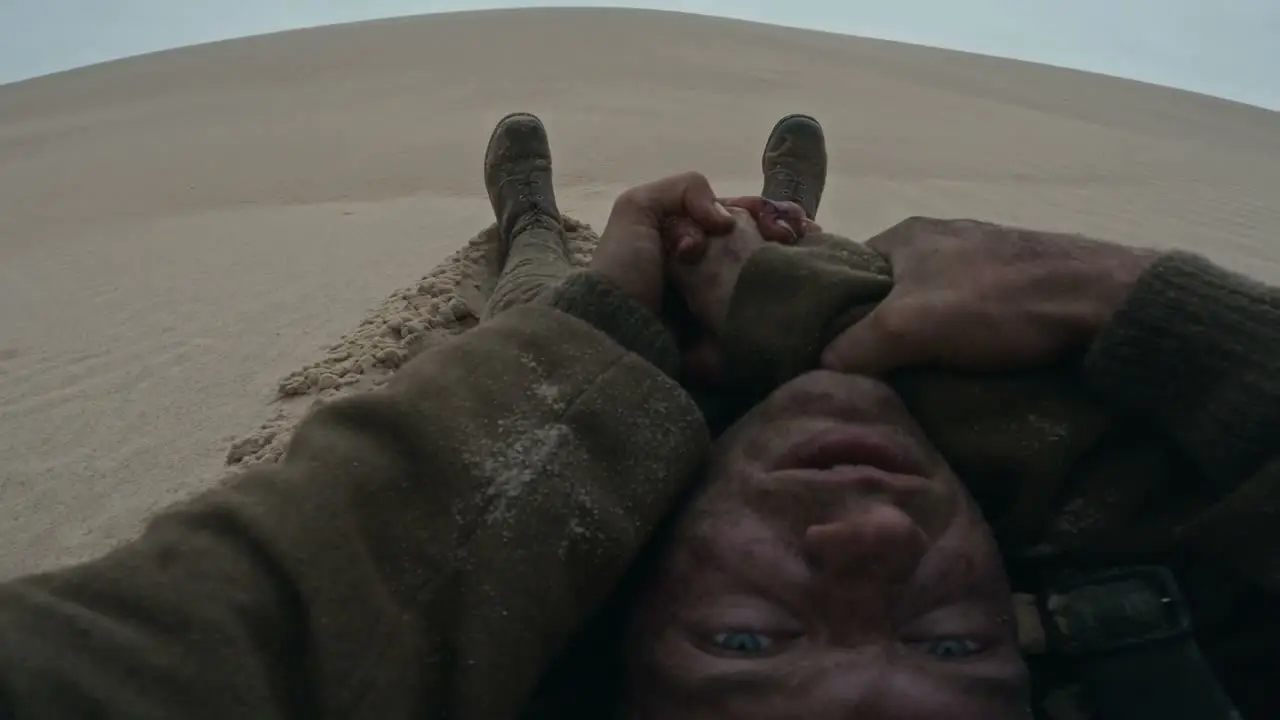
6-second embodied first-person POV low against the sand, both hands locked around the wounded soldier's forearm and webbing, continuing the exact grip established at the end of the previous shot, dragging his weight backward but along the same forward-toward-dune axis maintained throughout the sequence (dragging deeper into cover, not back toward the beach or sea). Bent knees, sand-caked boots and the lower edge of a mud-streaked sleeve anchor the body to the ground. The wounded soldier's face is less than one arm away, eyes fixed on the gripping hands rather than posing toward the camera, lips moving without audible words. The engine drone peaks directly overhead from the same established attack direction then recedes without a third strafing pass. Each pull drags a visible furrow through the sand along the dune-ward axis, the camera jolts with each step, briefly losing the horizon behind raised dust before recovering on the two locked hands and the dune's shadow finally covering both bodies. End before either man fully relaxes. 18mm rectilinear ultra-wide POV, no fisheye, no drone-camera movement, handheld motion driven by body inertia and dragging effort, cold overcast natural light, large-format film depth, dry sand grit, mud-streaked wool, desaturated bloodstain, emotionally intense documentary realism, unresolved survival pressure, dragging direction fully continuous with the sequence's established forward axis toward the dune. Negative: heroic rescue pose, gore, floating drone camera, text, logo, watermark.
5-second intimate third-person handheld follow, one arm behind the young infantry soldier continuing his sprint forward on the same established axis from the previous shots, as the strafing line chases from behind. His mud-streaked uniform and swinging rifle sling repeatedly block the frame edges. Sand kicked up by his own boots and by nearby impacts closing in from behind partially obscures the camera's view. His breathing turns to short forced exhalations, his eyes dart sideways and backward tracking the impact line's approach from the rear, and his stride briefly breaks as his boot catches on a buried obstacle marker. The camera arrives half a beat late on each stride, momentarily losing his silhouette behind thrown sand before recovering on his straining shoulders, still moving forward on the unchanged axis. 32mm close documentary lens, handheld motion driven by sprinting footsteps and blast-adjacent airflow, natural edge blur with readable running form, cold flat overcast light, dry sand grit, salt-tinged air, no clean choreography, no heroic running pose, forward direction and pursuit direction continuous with prior shots. Negative: heroic running pose, plastic CGI, fisheye distortion, text, logo, watermark. No BGM
5-second rectilinear ultra-wide shot from waterline height beside a weathered civilian rescue boat marked MERCY 17. A freezing hand, a torn life-ring and black seawater dominate the extreme foreground. The overloaded wooden boat fills the middle ground, bow pointing toward the distant right-side coastline. Survivors crowd the deck in faded khaki life jackets. Small aircraft silhouettes and broken cloud occupy the immense background sky. A falling shadow crosses the boat. A nearby bomb strikes the sea off the starboard side, producing a dense water column rather than a wall of fire. The pressure wave reaches the hull, the starboard rail rises, passenger weight shifts, and the boat rolls hard toward port. The waterline camera is lifted by the first wave, briefly loses half the hull behind foam, then drops back onto a survivor reaching toward the foreground hand. The next wave blocks the distant rescue route. 14mm rectilinear ultra-wide, no fisheye distortion, credible human proportions, strong foreground-middle-ground-background depth, overcast natural light, steel blue-gray palette, wet wood, chipped paint, strained rope, oil sheen and salt mist, large-format spatial detail, practical-effects realism. Negative: wall of explosions, fire covering the frame, random debris everywhere, fisheye distortion, impossible ship physics, weightless bodies, text, logo, watermark.
4-second intimate third-person interior view mounted inside a weathered steel landing craft, chipped gray-green paint, waterlogged wooden deck slats crowding the foreground. Rows of soldiers in mud-streaked wool uniforms and steel helmets crouch shoulder to shoulder along the hull, canvas webbing and rifles crossing the frame. Through the open bow, an open gray sand beach with scattered anti-tank obstacles and coiled barbed wire grows larger under low overcast sky. The engine drone vibrates the hull plating, spray crosses the ramp edge, and the craft pitches with each wave. 24mm rectilinear wide lens, no fisheye, large-format 65mm spatial depth, cold overcast natural light, muted gray-green palette, oxidized metal, wet wood, practical physical realism, documentary landing-craft proximity, no heroic composition. Negative: heroic propaganda poster, victory pose, teal-and-orange blockbuster grade, plastic CGI, fisheye distortion, text, logo, watermark.
5-second intimate third-person handheld approach, camera arriving half a beat behind the soldier as he reaches a wounded soldier lying near the base of the dune directly on the forward axis the soldier has been running along throughout the sequence, not off to an unexplained side. The wounded soldier has a torn sleeve soaked with a bloodstained field dressing, helmet missing, uniform half-buried in sand. The soldier drops to one knee, his hand reaching for the wounded man's forearm. His first grip catches only loose sand-covered fabric and slips before he adjusts and locks onto the wrist. The wounded soldier's breathing is labored and shallow, his eyes unfocused, lips parted without words. Engine noise swells again overhead from the same established attack direction. The camera loses the wounded man's face briefly behind the soldier's shoulder before recovering on the two gripping hands. 32mm close documentary lens, handheld motion driven by kneeling impact and urgency, cold flat overcast light, dry sand grit, bloodstain color restrained and desaturated, natural skin texture, no heroic rescue pose, wounded soldier's position consistent with the forward axis of the running sequence. Negative: heroic rescue pose, gore, graphic injury, text, logo, watermark.
6-second embodied first-person POV inside the violently vibrating bomber cockpit. Both gloved hands and the scratched control column anchor the lower frame; the lower edge of an oxygen mask, trembling instruments and frost along the side window prove the camera belongs to a human body inside the aircraft. Ahead, the bomber formation disappears and reappears between cloud layers. A moving shadow crosses the panel. One instrument needle jumps, then a near flak burst flashes outside the left window. The blast first flexes the canopy frame, then rolls the aircraft several degrees, then throws the right hand away from the control column. The horizon tilts sharply. The camera jolts with the pilot's torso and briefly loses the formation before recovering on the left hand gripping the control column with white knuckles. Through smeared frost, dark bomb silhouettes fall through a break in the cloud toward the distant channel while one damaged aircraft drops behind the formation. End before the aircraft regains stable flight. 18mm rectilinear ultra-wide POV, no fisheye, no free-flying camera, physically credible aircraft inertia, airflow and blast-pressure-driven movement, cold natural daylight, large-format 65mm clarity, restrained fire, documentary immediacy, unresolved danger. Negative: floating drone camera, disembodied POV, impossible camera position, smooth gimbal during impact, fisheye distortion, impossible aircraft geometry, slow-motion fireball, text, logo, watermark.
5-second intimate third-person handheld follow, one arm behind the young infantry soldier sprinting across the open beach as the strafing line closes in from behind. His mud-streaked uniform and swinging rifle sling repeatedly block the frame edges. Sand kicked up by his own boots and by nearby impacts partially obscures the camera's view. His breathing turns to short forced exhalations, his eyes dart sideways tracking the impact line's direction, and his stride briefly breaks as his boot catches on a buried obstacle marker. The camera arrives half a beat late on each stride, momentarily losing his silhouette behind thrown sand before recovering on his straining shoulders. 32mm close documentary lens, handheld motion driven by sprinting footsteps and blast-adjacent airflow, natural edge blur with readable running form, cold flat overcast light, dry sand grit, salt-tinged air, no clean choreography, no heroic running pose. Negative: heroic running pose, clean centered portrait, plastic CGI, fisheye distortion, text, logo, watermark.
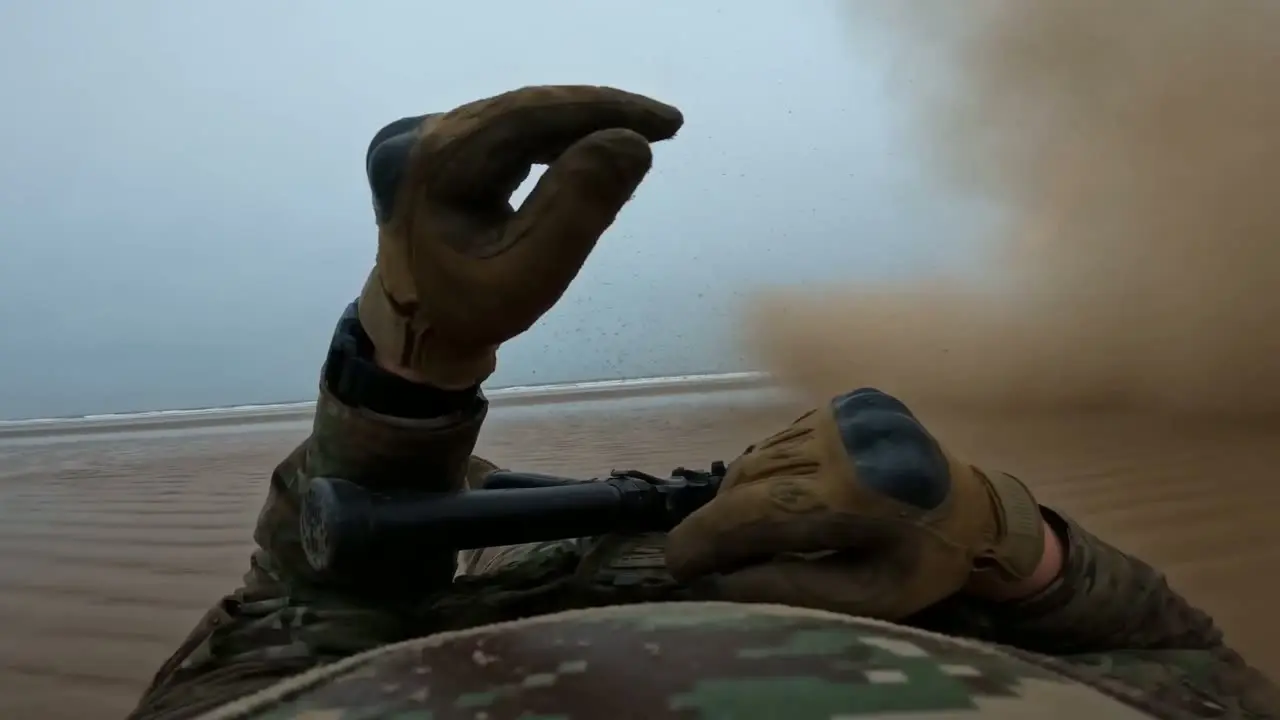
4-second embodied first-person POV as the body drops suddenly forward toward the sand while still moving along the same established forward axis, both forearms rising to shield the helmet, rifle swinging against the chest — the fall direction continues the running momentum from the previous shot rather than a sideways or reversed collapse. The lower frame is anchored by a gloved hand pressing into wet-packed sand and the edge of a scratched helmet brim entering view. Ahead, on the same side the strafing line was approaching from in the previous shot, a bright flash erupts less than ten meters away, followed immediately by a rising wall of thrown sand and grit that partially blinds the lens. The impact's pressure wave passes through the body as a single hard jolt, the camera drops the last few centimeters with the torso's impact against the ground, and the horizon briefly disappears behind settling dust before partially clearing, body still oriented along the original forward axis. 18mm rectilinear ultra-wide POV, no fisheye, no free-flying camera, physically credible fall-and-impact inertia, blast-pressure-driven camera jolt, cold natural daylight, large-format 65mm clarity, restrained fire, documentary immediacy, unresolved danger, fall direction and blast position continuous with prior shot. Negative: floating drone camera, impossible camera position, text, logo, watermark.
 视频截图
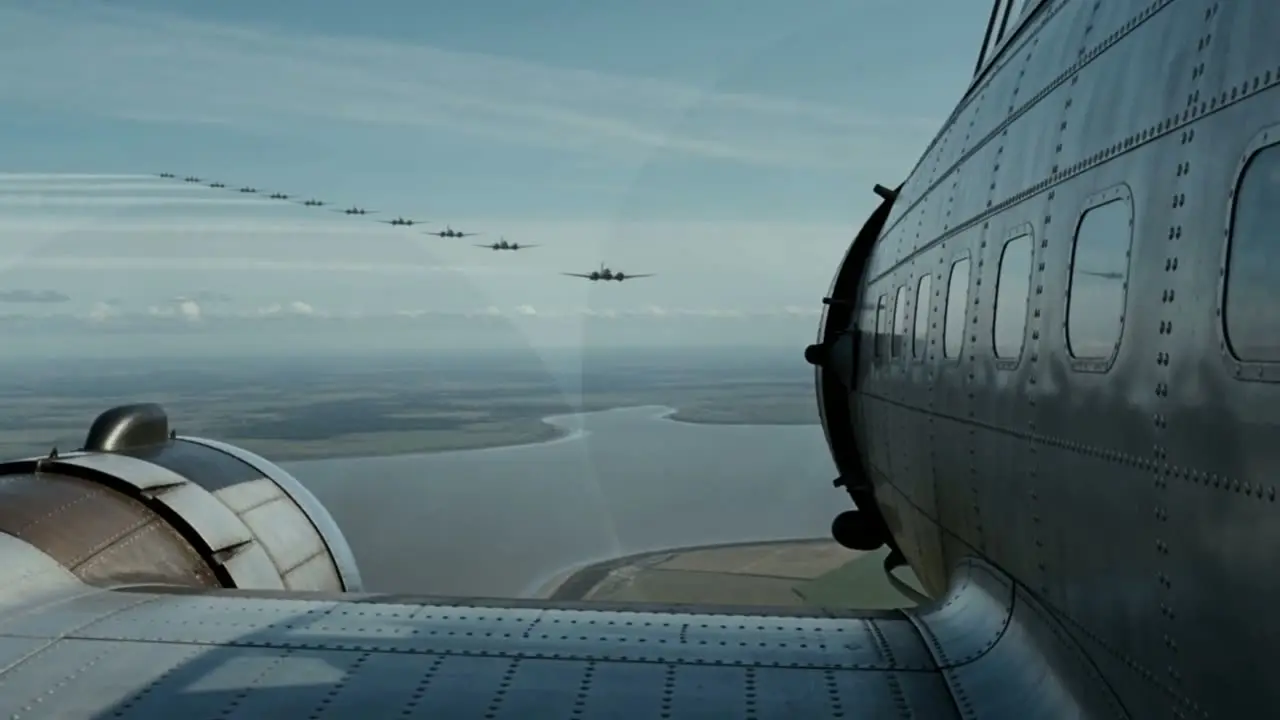
4-second continuous cinematic shot, intimate third-person exterior view physically mounted beside the rear wing root of a weathered 1940s twin-engine bomber at high altitude. The vibrating wing and riveted fuselage crop the foreground, a staggered bomber formation crosses the middle distance from left to right, an immense gray channel and faint coastline lie far below beneath broken cloud. Cold airflow vibrates the metal skin and propeller edges. Dark flak bursts begin appearing ahead, initially small and distant. One burst cuts across the formation's intended path, forcing the nearest aircraft to bank away and breaking the previously ordered geometry. The foreground wing shudders, condensation trails shear sideways, the camera movement remains attached to the aircraft's mass and aerodynamic inertia. 24mm rectilinear wide lens, no fisheye, large-format 65mm spatial depth, cold high-altitude natural light, muted blue-gray cloud, oxidized metal, chipped paint, restrained smoke, practical physical realism, documentary aerial danger, no heroic aviation composition. Negative: heroic propaganda poster, victory pose, glamorous war, teal-and-orange blockbuster grade, video game HUD, plastic CGI, floating drone camera, fisheye distortion, impossible aircraft geometry, slow-motion fireball, excessive motion blur, text, logo, watermark.
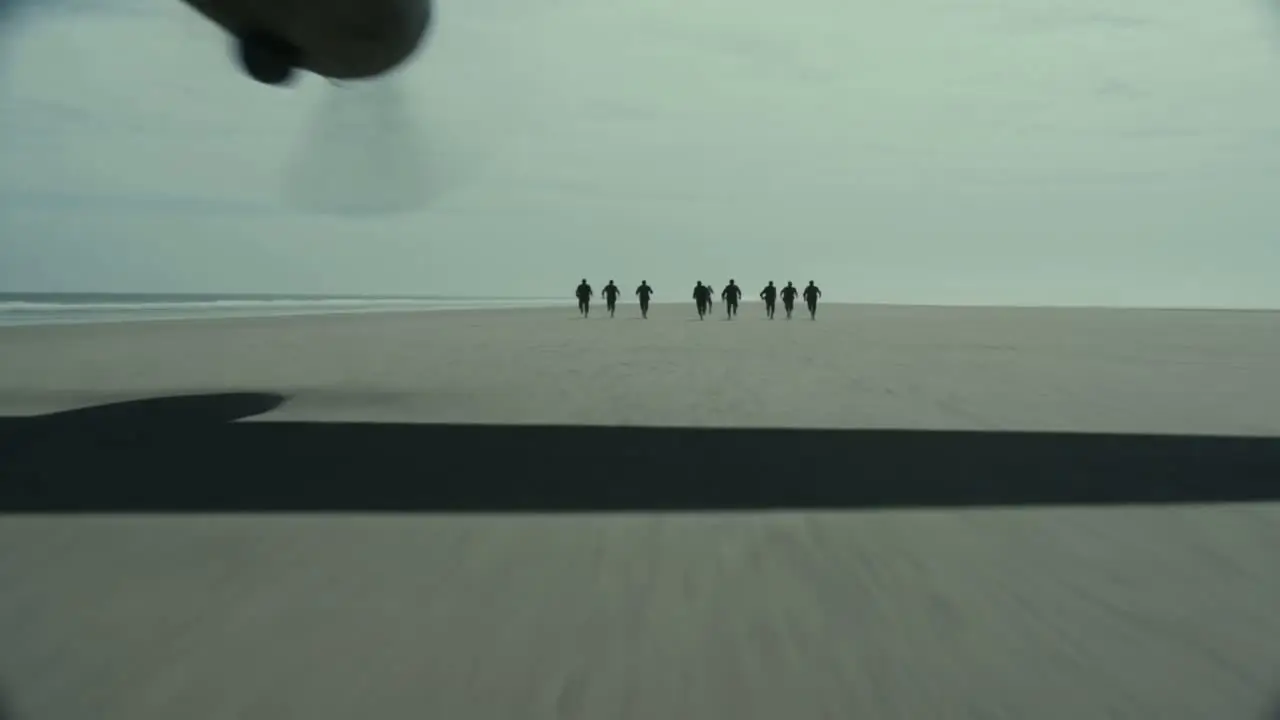
4-second low third-person tracking shot skimming just above the sand, following the shadow of a diving single-engine fighter aircraft in matte gray-green camouflage as it crosses the beach from behind the frame toward the distant dune line. Muzzle flashes flicker along its wing leading edge. A line of sand geysers erupts in rapid succession, tracking directly toward a cluster of running soldiers. The pressure wave from the nearest impact throws loose sand and grit across the lens. The camera shudders with the aircraft's passing airflow, briefly losing the impact line behind a curtain of thrown sand before recovering on the beach ahead. 24mm rectilinear wide lens, no fisheye, credible strafing-run physics, overcast natural light, steel gray-green palette, dry sand grit, restrained smoke, practical-effects realism, documentary aerial-threat proximity. Negative: wall of explosions, fire covering the frame, impossible aircraft geometry, slow-motion fireball, text, logo, watermark.
4-second intimate third-person handheld follow, one arm behind the soldier as he breaks into a final sprint continuing along the same forward axis toward the distant dune line, now the only visible cover on the open beach, starting from the position established at the end of the previous shot. His uniform is heavier with wet sand, his rifle sling has slipped to one shoulder. The returning drone of the fighter aircraft grows louder from the same rear-flank direction as its first pass; its shadow briefly crosses the frame's upper edge as it begins a second dive along the same attack vector, not a new or reversed direction. His stride lengthens, arms pumping, eyes fixed on the dune's low ridge ahead on the forward axis, chest heaving with open-mouthed breathing. The camera bounces hard with each stride, briefly losing the dune line behind his shoulder before recovering. 24mm close documentary lens, handheld motion driven by sprinting footsteps and rising engine threat, natural edge blur with readable running form, cold overcast light, dry sand grit, no clean choreography, no heroic running pose, forward axis and attack vector continuous with established sequence. Negative: heroic running pose, plastic CGI, text, logo, watermark.
8-second embodied first-person POV on the steeply sloping port side of the overloaded rescue boat. The viewer's left hand grips a rain-darkened rope, the right hand holds the soaked sleeve of the same survivor. Bent knees, the wet gunwale and the lower edge of a khaki life jacket anchor the body to the deck. The survivor's face is less than one arm away: wet eyelashes, pale lips, involuntary swallowing and eyes fixed directly on the gripping hand rather than posing toward the camera. A second wave rises behind the survivor and erases the horizon. The rope snaps taut. The right hand slips from the sleeve to the wrist, nearly loses contact, then catches again. Water crosses the near lens, briefly reducing visibility. The camera strikes the gunwale with the body and recovers on the two locked hands. The boat continues rolling toward port. The damaged rail sinks closer to the water, people compress behind the camera, breathing becomes short and partially obstructed by wet clothing. Through foam and smoke, a distant rescue vessel appears but the next wave closes the route. End before the survivor is pulled aboard. 18mm rectilinear ultra-wide POV, no fisheye, no drone movement, handheld motion driven by body inertia, vessel roll and wave impact, physically credible weight transfer, cold overcast natural light, large-format film depth, wet wood, strained rope, soaked wool and black water, emotionally intense documentary realism, unresolved survival pressure. Negative: heroic rescue pose, clean centered portrait, fisheye distortion, impossible ship physics, weightless bodies, text, logo, watermark.
5-second embodied first-person POV as the landing craft ramp drops forward with a metallic clang. Both gloved hands grip a wet rifle stock anchoring the lower frame; the lower edge of a steel helmet brim and splashing shin-deep water prove the camera belongs to a body moving off the ramp. Ahead, the open sand beach stretches wide under flat gray light, scattered obstacles and distant dune line barely visible through blowing sand. Other soldiers surge forward on either side, some falling behind, one stumbling on the ramp edge. The camera bounces with each running stride, momentarily loses the horizon in a spray of wet sand, then recovers on the open beach ahead. 18mm rectilinear ultra-wide POV, no fisheye, no free-flying camera, physically credible running inertia, footstep-driven movement, cold natural daylight, large-format 65mm clarity, documentary immediacy, unresolved danger ahead. Negative: floating drone camera, disembodied POV, fisheye distortion, slow-motion, text, logo, watermark.
5-second invasive handheld close-up following the soldier's gloved hands as they move low across the sand between half-buried mine markers and coiled barbed wire stakes, starting from the exact position where the previous shot ended, continuing to advance along the same forward axis toward the dune line rather than resetting position. His helmet rim and forearm repeatedly cross the lower frame. Each hand placement is deliberate and slow, testing the sand before weight shifts, while his eyes flick between the ground immediately ahead (still on the forward axis) and a marker leaning at an unnatural angle. His breathing is shallow and controlled, his jaw set, and one hand briefly freezes mid-motion when a marker wire catches his sleeve before he carefully disengages it. Distant engine noise rises and falls from the same rear-flank direction established earlier, and each rise tightens his shoulders further. 32mm close documentary perspective, cold flat overcast light, dry sand grit, rusted wire texture, natural skin texture, emotionally intense but not theatrical, large-format film character, suffocating ground-level pressure, position and forward progress continuous with prior shot. Negative: theatrical screaming, plastic CGI, text, logo, watermark.
3-second invasive handheld close-up inside the landing craft, less than one arm from a young infantry soldier with a scratched steel helmet and mud-streaked wool collar, his body still facing the same forward bow direction established in the previous shot. Part of his helmet rim and left shoulder are cut by the frame. A wet rifle strap and another soldier's arm occlude the foreground. His eyes snap upward and to the rear-side sky, tracking a distant single-engine fighter aircraft beginning its dive from behind and above the boat's direction of travel, not from directly ahead — establishing the aircraft's attack approaching from the rear-flank, consistent with it later chasing the soldiers as they run forward. His pupils tighten, breathing stalls for half a beat, his jaw locks, and his fingers tighten involuntarily on the rifle sling. 32mm close documentary perspective, cold flat overcast light, wet canvas texture, natural skin texture, sand grit, emotionally intense but not theatrical, large-format film character, suffocating enclosed-craft pressure, threat approaching from rear-flank consistent with forward-axis established in prior shot. Negative: theatrical screaming, plastic CGI, fisheye distortion, text, logo, watermark.
4-second intimate third-person interior view mounted inside a weathered steel landing craft, chipped gray-green paint, waterlogged wooden deck slats crowding the foreground, all soldiers facing the bow direction (screen forward), establishing this as the fixed forward axis for the entire sequence. Rows of soldiers in mud-streaked wool uniforms and steel helmets crouch shoulder to shoulder along the hull, canvas webbing and rifles crossing the frame. Through the open bow, an open gray sand beach with scattered anti-tank obstacles and coiled barbed wire grows larger under low overcast sky, directly ahead on the established forward axis. The engine drone vibrates the hull plating, spray crosses the ramp edge, and the craft pitches with each wave. 24mm rectilinear wide lens, no fisheye, large-format 65mm spatial depth, cold overcast natural light, muted gray-green palette, oxidized metal, wet wood, practical physical realism, documentary landing-craft proximity, no heroic composition, fixed forward axis established for sequence continuity. Negative: heroic propaganda poster, plastic CGI, fisheye distortion, text, logo, watermark.
5-second embodied first-person POV as the landing craft ramp drops forward with a metallic clang, continuing the same forward bow-facing orientation established in the previous two shots. Both gloved hands grip a wet rifle stock anchoring the lower frame; the lower edge of a steel helmet brim and splashing shin-deep water prove the camera belongs to a body moving off the ramp in the established forward direction. Ahead, the open sand beach stretches wide under flat gray light on the same forward axis, scattered obstacles and distant dune line barely visible through blowing sand directly ahead. Other soldiers surge forward on either side on the same heading, some falling behind, one stumbling on the ramp edge. The camera bounces with each running stride, momentarily loses the horizon in a spray of wet sand, then recovers on the open beach ahead, still on the same forward axis. 18mm rectilinear ultra-wide POV, no fisheye, no free-flying camera, physically credible running inertia, footstep-driven movement, cold natural daylight, large-format 65mm clarity, documentary immediacy, unresolved danger ahead, forward axis continuous with prior shots. Negative: floating drone camera, fisheye distortion, text, logo, watermark.
 视频截图
4-second low third-person tracking shot skimming just above the sand, following the shadow of a diving single-engine fighter aircraft in matte gray-green camouflage as it crosses the beach from behind and to the side of the running soldiers' position (matching the rear-flank approach established in shot 2), moving on a diagonal path that intersects the soldiers' forward running direction rather than head-on. Muzzle flashes flicker along its wing leading edge. A line of sand geysers erupts in rapid succession, tracking directly toward a cluster of running soldiers who continue moving forward on the established axis, the strafing line chasing from behind rather than blocking the path ahead. The pressure wave from the nearest impact throws loose sand and grit across the lens. The camera shudders with the aircraft's passing airflow, briefly losing the impact line behind a curtain of thrown sand before recovering on the beach ahead, forward direction unchanged. 24mm rectilinear wide lens, no fisheye, credible strafing-run physics, overcast natural light, steel gray-green palette, dry sand grit, restrained smoke, practical-effects realism, documentary aerial-threat proximity, attack vector consistent with rear-flank approach from prior shot. Negative: wall of explosions, impossible aircraft geometry, text, logo, watermark.
5-second intimate third-person handheld follow, one arm behind the young infantry soldier continuing his sprint forward on the same established axis from the previous shots, as the strafing line chases from behind. His mud-streaked uniform and swinging rifle sling repeatedly block the frame edges. Sand kicked up by his own boots and by nearby impacts closing in from behind partially obscures the camera's view. His breathing turns to short forced exhalations, his eyes dart sideways and backward tracking the impact line's approach from the rear, and his stride briefly breaks as his boot catches on a buried obstacle marker. The camera arrives half a beat late on each stride, momentarily losing his silhouette behind thrown sand before recovering on his straining shoulders, still moving forward on the unchanged axis. 32mm close documentary lens, handheld motion driven by sprinting footsteps and blast-adjacent airflow, natural edge blur with readable running form, cold flat overcast light, dry sand grit, salt-tinged air, no clean choreography, no heroic running pose, forward direction and pursuit direction continuous with prior shots. Negative: heroic running pose, plastic CGI, fisheye distortion, text, logo, watermark.
7-second intimate third-person handheld follow, one arm behind a nineteen-year-old deckhand moving across the violently rolling deck of MERCY 17. The deckhand has wet dark-blond hair, a faded navy wool sweater and a soaked khaki life jacket. His shoulder repeatedly blocks the frame while the camera squeezes between frightened passengers and the steel cabin wall. He drags one hand along an oily rail and reaches for a survivor sliding toward the damaged port rail. His first grip catches only wet fabric and slips. His nostrils flare through interrupted breathing, the jaw clenches, and his eyes briefly lose focus as his hip strikes the cabin frame. The vessel rolls again. Passengers collide in a believable weight chain, loose rope snaps tight, engine smoke lowers visibility, and the camera arrives half a beat late, briefly losing his face behind another body before recovering on his white-knuckled hand gripping the survivor's sleeve. 32mm close documentary lens, handheld motion driven by footsteps, crowd compression, vessel roll and one wave impact, natural edge blur with readable eyes and hands, cold sky light, localized amber engine glow, wet skin, coarse wool, salt spray and oily reflections, no clean choreography, no heroic rescue pose. Negative: heroic propaganda poster, clean centered portrait, staged acting, teal-and-orange blockbuster grade, plastic CGI, fisheye distortion, text, logo, watermark.
6-second embodied first-person POV low against the sand, both hands locked around the wounded soldier's forearm and webbing, dragging his weight backward toward the dune's shadowed base. Bent knees, sand-caked boots and the lower edge of a mud-streaked sleeve anchor the body to the ground. The wounded soldier's face is less than one arm away, eyes fixed on the gripping hands rather than posing toward the camera, lips moving without audible words. The engine drone peaks directly overhead then recedes without a third strafing pass. Each backward pull drags a visible furrow through the sand, the camera jolts with each step, briefly losing the horizon behind raised dust before recovering on the two locked hands and the dune's shadow finally covering both bodies. End before either man fully relaxes. 18mm rectilinear ultra-wide POV, no fisheye, no drone-camera movement, handheld motion driven by body inertia and dragging effort, cold overcast natural light, large-format film depth, dry sand grit, mud-streaked wool, desaturated bloodstain, emotionally intense documentary realism, unresolved survival pressure. Negative: heroic rescue pose, graphic injury, gore, floating drone camera, text, logo, watermark.
4-second intimate third-person handheld follow, one arm behind the soldier as he breaks into a final sprint toward the distant dune line, now the only visible cover on the open beach. His uniform is heavier with wet sand, his rifle sling has slipped to one shoulder. The returning drone of the fighter aircraft grows louder behind him; its shadow briefly crosses the frame's upper edge as it begins a second dive. His stride lengthens, arms pumping, eyes fixed on the dune's low ridge ahead, chest heaving with open-mouthed breathing. The camera bounces hard with each stride, briefly losing the dune line behind his shoulder before recovering. 24mm close documentary lens, handheld motion driven by sprinting footsteps and rising engine threat, natural edge blur with readable running form, cold overcast light, dry sand grit, no clean choreography, no heroic running pose. Negative: heroic running pose, clean centered portrait, plastic CGI, fisheye distortion, text, logo, watermark.
5-second intimate third-person handheld approach, camera arriving half a beat behind the soldier as he reaches a wounded soldier lying near the base of the dune, torn sleeve soaked with a bloodstained field dressing, helmet missing, uniform half-buried in sand. The soldier drops to one knee, his hand reaching for the wounded man's forearm. His first grip catches only loose sand-covered fabric and slips before he adjusts and locks onto the wrist. The wounded soldier's breathing is labored and shallow, his eyes unfocused, lips parted without words. Engine noise swells again overhead. The camera loses the wounded man's face briefly behind the soldier's shoulder before recovering on the two gripping hands. 32mm close documentary lens, handheld motion driven by kneeling impact and urgency, cold flat overcast light, dry sand grit, bloodstain color restrained and desaturated, natural skin texture, no heroic rescue pose. Negative: heroic rescue pose, graphic injury, gore, plastic CGI, text, logo, watermark.
3-second invasive handheld close-up inside the bomber cockpit, less than one arm from a young aircrew observer wearing a worn brown leather flight helmet and oxygen mask, his body oriented facing the aircraft's forward direction consistent with the formation heading established in the previous shot. Part of his forehead and left shoulder are cut by the frame. A frost-covered cockpit strut and trembling oxygen hose occlude the foreground. His face is pushed into the right third while his eyes track flak bursts appearing on the left-forward side outside the narrower right edge, the same threat direction as the previous shot's flak burst, not a reversed or unrelated direction. His pupils tighten, breathing stops for half a beat, the jaw locks beneath the mask, and two gloved fingers repeatedly fail to secure a vibrating radio switch. He abandons the switch and braces his forearm against the metal frame. The aircraft turbulence creates high-frequency camera vibration; each displacement returns focus to one visible eye or the failed hand movement, camera orientation remains consistent with the cockpit's fixed position relative to the aircraft's forward heading. 32mm close documentary perspective, cold window light, weak amber instrument reflection, frost, sweat, natural skin texture, worn leather and oxidized metal, emotionally intense but not theatrical, large-format film character, suffocating cockpit pressure, threat direction continuous with prior shot. Negative: theatrical screaming, staged acting, plastic CGI, fisheye distortion, reversed threat direction, text, logo, watermark.
4-second continuous cinematic shot, intimate third-person exterior view physically mounted beside the rear wing root of a weathered 1940s twin-engine bomber at high altitude, aircraft nose and formation heading consistently toward screen right. The vibrating wing and riveted fuselage crop the foreground, a staggered bomber formation crosses the middle distance from left to right on a fixed heading, an immense gray channel and faint coastline lie far below beneath broken cloud, coastline visible on the distant right matching the formation's travel direction. Cold airflow vibrates the metal skin and propeller edges. Dark flak bursts begin appearing ahead on the left-forward side, initially small and distant. One burst cuts across the formation's intended path from the left, forcing the nearest aircraft to bank away to the right while maintaining the same overall left-to-right heading, breaking the previously ordered geometry without reversing travel direction. The foreground wing shudders, condensation trails shear sideways, the camera movement remains attached to the aircraft's mass and aerodynamic inertia, camera orientation stays fixed relative to the aircraft body throughout. 24mm rectilinear wide lens, no fisheye, large-format 65mm spatial depth, cold high-altitude natural light, muted blue-gray cloud, oxidized metal, chipped paint, restrained smoke, practical physical realism, documentary aerial danger, no heroic aviation composition, consistent 180-degree axis maintained. Negative: heroic propaganda poster, teal-and-orange blockbuster grade, plastic CGI, fisheye distortion, inconsistent heading, text, logo, watermark.
5-second invasive handheld close-up following the soldier's gloved hands as they move low across the sand between half-buried mine markers and coiled barbed wire stakes. His helmet rim and forearm repeatedly cross the lower frame. Each hand placement is deliberate and slow, testing the sand before weight shifts, while his eyes flick between the ground immediately ahead and a marker leaning at an unnatural angle. His breathing is shallow and controlled, his jaw set, and one hand briefly freezes mid-motion when a marker wire catches his sleeve before he carefully disengages it. Distant engine noise rises and falls, and each rise tightens his shoulders further. 32mm close documentary perspective, cold flat overcast light, dry sand grit, rusted wire texture, natural skin texture, emotionally intense but not theatrical, large-format film character, suffocating ground-level pressure. Negative: theatrical screaming, staged acting, plastic CGI, fisheye distortion, text, logo, watermark.
6-second embodied first-person POV inside the violently vibrating bomber cockpit, continuing the same pilot body orientation and forward heading established in the previous two shots. Both gloved hands and the scratched control column anchor the lower frame; the lower edge of an oxygen mask, trembling instruments and frost along the side window prove the camera belongs to a human body inside the aircraft. Ahead, the bomber formation disappears and reappears between cloud layers, maintaining the same left-to-right formation heading. A moving shadow crosses the panel. One instrument needle jumps, then a near flak burst flashes outside the left window, the same left-forward threat direction carried over from the prior shot. The blast first flexes the canopy frame, then rolls the aircraft to the right several degrees away from the left-side blast, then throws the right hand away from the control column. The horizon tilts sharply toward the right in direct causal response to the left-side blast, not an arbitrary direction. The camera jolts with the pilot's torso and briefly loses the formation before recovering on the left hand gripping the control column with white knuckles. Through smeared frost, dark bomb silhouettes fall through a break in the cloud toward the distant channel below, continuing the aircraft's original downward-forward flight path, while one damaged aircraft drops behind the formation. End before the aircraft regains stable flight, aircraft still banked right from the blast. 18mm rectilinear ultra-wide POV, no fisheye, no free-flying camera, physically credible aircraft inertia, airflow and blast-pressure-driven movement, cold natural daylight, large-format 65mm clarity, restrained fire, documentary immediacy, unresolved danger, causal continuity with the blast direction established in the prior shot. Negative: floating drone camera, impossible aircraft geometry, fisheye distortion, arbitrary tilt direction, text, logo, watermark.
 视频截图
4-second embodied first-person POV as the body drops suddenly toward the sand, both forearms rising to shield the helmet, rifle swinging against the chest. The lower frame is anchored by a gloved hand pressing into wet-packed sand and the edge of a scratched helmet brim entering view. Ahead, a bright flash erupts less than ten meters to the right, followed immediately by a rising wall of thrown sand and grit that partially blinds the lens. The impact's pressure wave passes through the body as a single hard jolt, the camera drops the last few centimeters with the torso's impact against the ground, and the horizon briefly disappears behind settling dust before partially clearing. 18mm rectilinear ultra-wide POV, no fisheye, no free-flying camera, physically credible fall-and-impact inertia, blast-pressure-driven camera jolt, cold natural daylight, large-format 65mm clarity, restrained fire, documentary immediacy, unresolved danger. Negative: floating drone camera, slow-motion fireball, impossible camera position, text, logo, watermark.
5-second rectilinear ultra-wide shot from waterline height beside a weathered civilian rescue boat marked MERCY 17, boat bow pointing toward the distant right-side coastline, matching the aircraft formation's travel direction established in the preceding aerial shots — the bomb falling from the aircraft in the prior shot arrives here as continuous cause and effect. A freezing hand, a torn life-ring and black seawater dominate the extreme foreground. The overloaded wooden boat fills the middle ground. Survivors crowd the deck in faded khaki life jackets. Small aircraft silhouettes continuing the same left-to-right heading and broken cloud occupy the immense background sky, directly matching the formation shown moments earlier. A falling shadow crosses the boat, continuing the bomb's downward trajectory from the previous shot. A nearby bomb strikes the sea off the starboard side (the boat's right side, facing the direction the aircraft passed), producing a dense water column rather than a wall of fire. The pressure wave reaches the hull, the starboard rail rises, passenger weight shifts, and the boat rolls hard toward port (left), establishing the roll direction that continues into subsequent shots. The waterline camera is lifted by the first wave, briefly loses half the hull behind foam, then drops back onto a survivor reaching toward the foreground hand. The next wave blocks the distant rescue route. 14mm rectilinear ultra-wide, no fisheye distortion, credible human proportions, strong foreground-middle-ground-background depth, overcast natural light, steel blue-gray palette, wet wood, chipped paint, strained rope, oil sheen and salt mist, large-format spatial detail, practical-effects realism, wind and wave direction consistent with established axis. Negative: wall of explosions, impossible ship physics, inconsistent roll direction, text, logo, watermark.
7-second intimate third-person handheld follow from one arm behind a nineteen-year-old deckhand moving across the deck of MERCY 17, which continues rolling toward port exactly as established in the previous shot — the deck is tilted with the same leftward lean, not reset or reversed. The deckhand has wet dark-blond hair, a faded navy wool sweater and a soaked khaki life jacket. His shoulder repeatedly blocks the frame while the camera squeezes between frightened passengers and the steel cabin wall. He drags one hand along an oily rail and reaches for a survivor sliding toward the damaged port rail — the same port-side direction the boat is rolling toward, so the survivor slides downhill with the tilt, not against it. His first grip catches only wet fabric and slips. His nostrils flare through interrupted breathing, the jaw clenches, and his eyes briefly lose focus as his hip strikes the cabin frame. The vessel rolls further toward port, continuing the same roll direction. Passengers collide in a believable weight chain sliding toward the same port-side low point, loose rope snaps tight, engine smoke lowers visibility, and the camera arrives half a beat late. It briefly loses his face behind another body before recovering on his white-knuckled hand gripping the survivor's sleeve near the port rail. 32mm close documentary lens, handheld motion driven by footsteps, crowd compression, vessel roll and one wave impact, natural edge blur with readable eyes and hands, cold sky light, localized amber engine glow, wet skin, coarse wool, salt spray and oily reflections, no clean choreography, no heroic rescue pose, roll direction continuous with prior shot. Negative: heroic rescue pose, inconsistent roll direction, plastic CGI, text, logo, watermark.
8-second embodied first-person POV on the steeply sloping port side of the overloaded rescue boat, continuing the exact roll angle and grip position established at the end of the previous shot — the same hand that gripped the survivor's sleeve a moment ago is now shown from first-person perspective, not reset to a new position. The viewer's left hand grips a rain-darkened rope, the right hand holds the soaked sleeve of the same survivor from the previous shot. Bent knees, the wet gunwale and the lower edge of a khaki life jacket anchor the body to the deck, which continues tilting toward port at the same or greater angle. The survivor's face is less than one arm away: wet eyelashes, pale lips, involuntary swallowing and eyes fixed directly on the gripping hand rather than posing toward the camera. A second wave rises behind the survivor on the same starboard side established in earlier shots, and erases the horizon. The rope snaps taut. The right hand slips from the sleeve to the wrist, nearly loses contact, then catches again. Water crosses the near lens, briefly reducing visibility. The camera strikes the gunwale with the body and recovers on the two locked hands. The boat continues rolling toward port, the same direction maintained throughout the sequence. The damaged rail sinks closer to the water, people compress behind the camera, breathing becomes short and partially obstructed by wet clothing. Through foam and smoke, a distant rescue vessel appears but the next wave closes the route. End before the survivor is pulled aboard. 18mm rectilinear ultra-wide POV, no fisheye, no drone movement, handheld motion driven by body inertia, vessel roll and wave impact, physically credible weight transfer, cold overcast natural light, large-format film depth, wet wood, strained rope, soaked wool and black water, emotionally intense documentary realism, unresolved survival pressure, full continuity of roll direction and grip position from prior shot. Negative: heroic rescue pose, inconsistent roll direction, disembodied POV, text, logo, watermark.
7-second intimate third-person handheld follow from one arm behind a nineteen-year-old deckhand moving across the deck of a weathered civilian rescue boat, which continues rolling toward port exactly as established in the previous shot — the deck is tilted with the same leftward lean, not reset or reversed. The deckhand has wet dark-blond hair, a faded navy wool sweater and a soaked khaki life jacket. His shoulder repeatedly blocks the frame while the camera squeezes between frightened passengers and the steel cabin wall. He drags one hand along an oily rail and reaches for a survivor sliding toward the damaged port rail — the same port-side direction the boat is rolling toward, so the survivor slides downhill with the tilt, not against it. His first grip catches only wet fabric and slips. His nostrils flare through interrupted breathing, the jaw clenches, and his eyes briefly lose focus as his hip strikes the cabin frame. The vessel rolls further toward port, continuing the same roll direction. Passengers collide in a believable weight chain sliding toward the same port-side low point, loose rope snaps tight, engine smoke lowers visibility, and the camera arrives half a beat late. It briefly loses his face behind another body before recovering on his white-knuckled hand gripping the survivor's sleeve near the port rail. 32mm close documentary lens, handheld motion driven by footsteps, crowd compression, vessel roll and one wave impact, natural edge blur with readable eyes and hands, cold sky light, localized amber engine glow, wet skin, coarse wool, salt spray and oily reflections, no clean choreography, no heroic rescue pose, roll direction continuous with prior shot. Negative: heroic rescue pose, inconsistent roll direction, plastic CGI, text, logo, watermark, boat name markings.
3-second invasive handheld close-up inside the bomber cockpit, less than one arm from a young aircrew observer wearing a worn brown leather flight helmet and oxygen mask, his body oriented facing the aircraft's forward direction consistent with the formation heading established in the previous shot. Part of his forehead and left shoulder are cut by the frame. A frost-covered cockpit strut and trembling oxygen hose occlude the foreground. His face is pushed into the right third while his eyes track flak bursts appearing on the left-forward side outside the narrower right edge, the same threat direction as the previous shot's flak burst, not a reversed or unrelated direction. His pupils tighten, breathing stops for half a beat, the jaw locks beneath the mask, and two gloved fingers repeatedly fail to secure a vibrating radio switch. He abandons the switch and braces his forearm against the metal frame. The aircraft turbulence creates high-frequency camera vibration; each displacement returns focus to one visible eye or the failed hand movement, camera orientation remains consistent with the cockpit's fixed position relative to the aircraft's forward heading. 32mm close documentary perspective, cold window light, weak amber instrument reflection, frost, sweat, natural skin texture, worn leather and oxidized metal, emotionally intense but not theatrical, large-format film character, suffocating cockpit pressure, threat direction continuous with prior shot. Negative: theatrical screaming, staged acting, plastic CGI, fisheye distortion, reversed threat direction, text, logo, watermark. No BGM
4-second continuous cinematic shot, intimate third-person exterior view physically mounted beside the rear wing root of a weathered 1940s twin-engine bomber at high altitude, aircraft nose and formation heading consistently toward screen right. The vibrating wing and riveted fuselage crop the foreground, a staggered bomber formation crosses the middle distance from left to right on a fixed heading, an immense gray channel and faint coastline lie far below beneath broken cloud, coastline visible on the distant right matching the formation's travel direction. Cold airflow vibrates the metal skin and propeller edges. Dark flak bursts begin appearing ahead on the left-forward side, initially small and distant. One burst cuts across the formation's intended path from the left, forcing the nearest aircraft to bank away to the right while maintaining the same overall left-to-right heading, breaking the previously ordered geometry without reversing travel direction. The foreground wing shudders, condensation trails shear sideways, the camera movement remains attached to the aircraft's mass and aerodynamic inertia, camera orientation stays fixed relative to the aircraft body throughout. 24mm rectilinear wide lens, no fisheye, large-format 65mm spatial depth, cold high-altitude natural light, muted blue-gray cloud, oxidized metal, chipped paint, restrained smoke, practical physical realism, documentary aerial danger, no heroic aviation composition, consistent 180-degree axis maintained. Negative: heroic propaganda poster, teal-and-orange blockbuster grade, plastic CGI, fisheye distortion, inconsistent heading, text, logo, watermark. No BGM
6-second embodied first-person POV inside the violently vibrating bomber cockpit, continuing the same pilot body orientation and forward heading established in the previous two shots. Both gloved hands and the scratched control column anchor the lower frame; the lower edge of an oxygen mask, trembling instruments and frost along the side window prove the camera belongs to a human body inside the aircraft. Ahead, the bomber formation disappears and reappears between cloud layers, maintaining the same left-to-right formation heading. A moving shadow crosses the panel. One instrument needle jumps, then a near flak burst flashes outside the left window, the same left-forward threat direction carried over from the prior shot. The blast first flexes the canopy frame, then rolls the aircraft to the right several degrees away from the left-side blast, then throws the right hand away from the control column. The horizon tilts sharply toward the right in direct causal response to the left-side blast, not an arbitrary direction. The camera jolts with the pilot's torso and briefly loses the formation before recovering on the left hand gripping the control column with white knuckles. Through smeared frost, dark bomb silhouettes fall through a break in the cloud toward the distant channel below, continuing the aircraft's original downward-forward flight path, while one damaged aircraft drops behind the formation. End before the aircraft regains stable flight, aircraft still banked right from the blast. 18mm rectilinear ultra-wide POV, no fisheye, no free-flying camera, physically credible aircraft inertia, airflow and blast-pressure-driven movement, cold natural daylight, large-format 65mm clarity, restrained fire, documentary immediacy, unresolved danger, causal continuity with the blast direction established in the prior shot. Negative: floating drone camera, impossible aircraft geometry, fisheye distortion, arbitrary tilt direction, text, logo, watermark. No BGM
5-second rectilinear ultra-wide shot from waterline height beside a weathered civilian rescue boat, boat bow pointing toward the distant right-side coastline, matching the aircraft formation's travel direction established in the preceding aerial shots — the bomb falling from the aircraft in the prior shot arrives here as continuous cause and effect. A freezing hand, a torn life-ring and black seawater dominate the extreme foreground. The overloaded wooden boat fills the middle ground. Survivors crowd the deck in faded khaki life jackets. Small aircraft silhouettes continuing the same left-to-right heading and broken cloud occupy the immense background sky, directly matching the formation shown moments earlier. A falling shadow crosses the boat, continuing the bomb's downward trajectory from the previous shot. A nearby bomb strikes the sea off the starboard side (the boat's right side, facing the direction the aircraft passed), producing a dense water column rather than a wall of fire. The pressure wave reaches the hull, the starboard rail rises, passenger weight shifts, and the boat rolls hard toward port (left), establishing the roll direction that continues into subsequent shots. The waterline camera is lifted by the first wave, briefly loses half the hull behind foam, then drops back onto a survivor reaching toward the foreground hand. The next wave blocks the distant rescue route. 14mm rectilinear ultra-wide, no fisheye distortion, credible human proportions, strong foreground-middle-ground-background depth, overcast natural light, steel blue-gray palette, wet wood, chipped paint, strained rope, oil sheen and salt mist, large-format spatial detail, practical-effects realism, wind and wave direction consistent with established axis. Negative: wall of explosions, impossible ship physics, inconsistent roll direction, text, logo, watermark. No BGM
 视频截图
7-second intimate third-person handheld follow from one arm behind a nineteen-year-old deckhand moving across the deck of a weathered civilian rescue boat, which continues rolling toward port exactly as established in the previous shot — the deck is tilted with the same leftward lean, not reset or reversed. The deckhand has wet dark-blond hair, a faded navy wool sweater and a soaked khaki life jacket. His shoulder repeatedly blocks the frame while the camera squeezes between frightened passengers and the steel cabin wall. He drags one hand along an oily rail and reaches for a survivor sliding toward the damaged port rail — the same port-side direction the boat is rolling toward, so the survivor slides downhill with the tilt, not against it. His first grip catches only wet fabric and slips. His nostrils flare through interrupted breathing, the jaw clenches, and his eyes briefly lose focus as his hip strikes the cabin frame. The vessel rolls further toward port, continuing the same roll direction. Passengers collide in a believable weight chain sliding toward the same port-side low point, loose rope snaps tight, engine smoke lowers visibility, and the camera arrives half a beat late. It briefly loses his face behind another body before recovering on his white-knuckled hand gripping the survivor's sleeve near the port rail. 32mm close documentary lens, handheld motion driven by footsteps, crowd compression, vessel roll and one wave impact, natural edge blur with readable eyes and hands, cold sky light, localized amber engine glow, wet skin, coarse wool, salt spray and oily reflections, no clean choreography, no heroic rescue pose, roll direction continuous with prior shot. Negative: heroic rescue pose, inconsistent roll direction, plastic CGI, text, logo, watermark, boat name markings. No BGM
8-second embodied first-person POV on the steeply sloping port side of the overloaded rescue boat, continuing the exact roll angle and grip position established at the end of the previous shot — the same hand that gripped the survivor's sleeve a moment ago is now shown from first-person perspective, not reset to a new position. The viewer's left hand grips a rain-darkened rope, the right hand holds the soaked sleeve of the same survivor from the previous shot. Bent knees, the wet gunwale and the lower edge of a khaki life jacket anchor the body to the deck, which continues tilting toward port at the same or greater angle. The survivor's face is less than one arm away: wet eyelashes, pale lips, involuntary swallowing and eyes fixed directly on the gripping hand rather than posing toward the camera. A second wave rises behind the survivor on the same starboard side established in earlier shots, and erases the horizon. The rope snaps taut. The right hand slips from the sleeve to the wrist, nearly loses contact, then catches again. Water crosses the near lens, briefly reducing visibility. The camera strikes the gunwale with the body and recovers on the two locked hands. The boat continues rolling toward port, the same direction maintained throughout the sequence. The damaged rail sinks closer to the water, people compress behind the camera, breathing becomes short and partially obstructed by wet clothing. Through foam and smoke, a distant rescue vessel appears but the next wave closes the route. End before the survivor is pulled aboard. 18mm rectilinear ultra-wide POV, no fisheye, no drone movement, handheld motion driven by body inertia, vessel roll and wave impact, physically credible weight transfer, cold overcast natural light, large-format film depth, wet wood, strained rope, soaked wool and black water, emotionally intense documentary realism, unresolved survival pressure, full continuity of roll direction and grip position from prior shot. Negative: heroic rescue pose, inconsistent roll direction, disembodied POV, text, logo, watermark. No BGM
4-second intimate third-person interior view mounted inside a weathered steel landing craft, chipped gray-green paint, waterlogged wooden deck slats crowding the foreground, all soldiers facing the bow direction (screen forward), establishing this as the fixed forward axis for the entire sequence. Rows of soldiers in mud-streaked wool uniforms and steel helmets crouch shoulder to shoulder along the hull, canvas webbing and rifles crossing the frame. Through the open bow, an open gray sand beach with scattered anti-tank obstacles and coiled barbed wire grows larger under low overcast sky, directly ahead on the established forward axis. The engine drone vibrates the hull plating, spray crosses the ramp edge, and the craft pitches with each wave. 24mm rectilinear wide lens, no fisheye, large-format 65mm spatial depth, cold overcast natural light, muted gray-green palette, oxidized metal, wet wood, practical physical realism, documentary landing-craft proximity, no heroic composition, fixed forward axis established for sequence continuity. Negative: heroic propaganda poster, plastic CGI, fisheye distortion, text, logo, watermark. No BGM
3-second invasive handheld close-up inside the landing craft, less than one arm from a young infantry soldier with a scratched steel helmet and mud-streaked wool collar, his body still facing the same forward bow direction established in the previous shot. Part of his helmet rim and left shoulder are cut by the frame. A wet rifle strap and another soldier's arm occlude the foreground. His eyes snap upward and to the rear-side sky, tracking a distant single-engine fighter aircraft beginning its dive from behind and above the boat's direction of travel, not from directly ahead — establishing the aircraft's attack approaching from the rear-flank, consistent with it later chasing the soldiers as they run forward. His pupils tighten, breathing stalls for half a beat, his jaw locks, and his fingers tighten involuntarily on the rifle sling. 32mm close documentary perspective, cold flat overcast light, wet canvas texture, natural skin texture, sand grit, emotionally intense but not theatrical, large-format film character, suffocating enclosed-craft pressure, threat approaching from rear-flank consistent with forward-axis established in prior shot. Negative: theatrical screaming, plastic CGI, fisheye distortion, text, logo, watermark. No BGM
5-second embodied first-person POV as the landing craft ramp drops forward with a metallic clang, continuing the same forward bow-facing orientation established in the previous two shots. Both gloved hands grip a wet rifle stock anchoring the lower frame; the lower edge of a steel helmet brim and splashing shin-deep water prove the camera belongs to a body moving off the ramp in the established forward direction. Ahead, the open sand beach stretches wide under flat gray light on the same forward axis, scattered obstacles and distant dune line barely visible through blowing sand directly ahead. Other soldiers surge forward on either side on the same heading, some falling behind, one stumbling on the ramp edge. The camera bounces with each running stride, momentarily loses the horizon in a spray of wet sand, then recovers on the open beach ahead, still on the same forward axis. 18mm rectilinear ultra-wide POV, no fisheye, no free-flying camera, physically credible running inertia, footstep-driven movement, cold natural daylight, large-format 65mm clarity, documentary immediacy, unresolved danger ahead, forward axis continuous with prior shots. Negative: floating drone camera, fisheye distortion, text, logo, watermark. No BGM
4-second low third-person tracking shot skimming just above the sand, following the shadow of a diving single-engine fighter aircraft in matte gray-green camouflage as it crosses the beach from behind and to the side of the running soldiers' position (matching the rear-flank approach established in shot 2), moving on a diagonal path that intersects the soldiers' forward running direction rather than head-on. Muzzle flashes flicker along its wing leading edge. A line of sand geysers erupts in rapid succession, tracking directly toward a cluster of running soldiers who continue moving forward on the established axis, the strafing line chasing from behind rather than blocking the path ahead. The pressure wave from the nearest impact throws loose sand and grit across the lens. The camera shudders with the aircraft's passing airflow, briefly losing the impact line behind a curtain of thrown sand before recovering on the beach ahead, forward direction unchanged. 24mm rectilinear wide lens, no fisheye, credible strafing-run physics, overcast natural light, steel gray-green palette, dry sand grit, restrained smoke, practical-effects realism, documentary aerial-threat proximity, attack vector consistent with rear-flank approach from prior shot. Negative: wall of explosions, impossible aircraft geometry, text, logo, watermark. No BGM
4-second embodied first-person POV as the body drops suddenly forward toward the sand while still moving along the same established forward axis, both forearms rising to shield the helmet, rifle swinging against the chest — the fall direction continues the running momentum from the previous shot rather than a sideways or reversed collapse. The lower frame is anchored by a gloved hand pressing into wet-packed sand and the edge of a scratched helmet brim entering view. Ahead, on the same side the strafing line was approaching from in the previous shot, a bright flash erupts less than ten meters away, followed immediately by a rising wall of thrown sand and grit that partially blinds the lens. The impact's pressure wave passes through the body as a single hard jolt, the camera drops the last few centimeters with the torso's impact against the ground, and the horizon briefly disappears behind settling dust before partially clearing, body still oriented along the original forward axis. 18mm rectilinear ultra-wide POV, no fisheye, no free-flying camera, physically credible fall-and-impact inertia, blast-pressure-driven camera jolt, cold natural daylight, large-format 65mm clarity, restrained fire, documentary immediacy, unresolved danger, fall direction and blast position continuous with prior shot. Negative: floating drone camera, impossible camera position, text, logo, watermark. No BGM
5-second invasive handheld close-up following the soldier's gloved hands as they move low across the sand between half-buried mine markers and coiled barbed wire stakes, starting from the exact position where the previous shot ended, continuing to advance along the same forward axis toward the dune line rather than resetting position. His helmet rim and forearm repeatedly cross the lower frame. Each hand placement is deliberate and slow, testing the sand before weight shifts, while his eyes flick between the ground immediately ahead (still on the forward axis) and a marker leaning at an unnatural angle. His breathing is shallow and controlled, his jaw set, and one hand briefly freezes mid-motion when a marker wire catches his sleeve before he carefully disengages it. Distant engine noise rises and falls from the same rear-flank direction established earlier, and each rise tightens his shoulders further. 32mm close documentary perspective, cold flat overcast light, dry sand grit, rusted wire texture, natural skin texture, emotionally intense but not theatrical, large-format film character, suffocating ground-level pressure, position and forward progress continuous with prior shot. Negative: theatrical screaming, plastic CGI, text, logo, watermark. No BGM
4-second intimate third-person handheld follow, one arm behind the soldier as he breaks into a final sprint continuing along the same forward axis toward the distant dune line, now the only visible cover on the open beach, starting from the position established at the end of the previous shot. His uniform is heavier with wet sand, his rifle sling has slipped to one shoulder. The returning drone of the fighter aircraft grows louder from the same rear-flank direction as its first pass; its shadow briefly crosses the frame's upper edge as it begins a second dive along the same attack vector, not a new or reversed direction. His stride lengthens, arms pumping, eyes fixed on the dune's low ridge ahead on the forward axis, chest heaving with open-mouthed breathing. The camera bounces hard with each stride, briefly losing the dune line behind his shoulder before recovering. 24mm close documentary lens, handheld motion driven by sprinting footsteps and rising engine threat, natural edge blur with readable running form, cold overcast light, dry sand grit, no clean choreography, no heroic running pose, forward axis and attack vector continuous with established sequence. Negative: heroic running pose, plastic CGI, text, logo, watermark. No BGM
5-second intimate third-person handheld approach, camera arriving half a beat behind the soldier as he reaches a wounded soldier lying near the base of the dune directly on the forward axis the soldier has been running along throughout the sequence, not off to an unexplained side. The wounded soldier has a torn sleeve soaked with a bloodstained field dressing, helmet missing, uniform half-buried in sand. The soldier drops to one knee, his hand reaching for the wounded man's forearm. His first grip catches only loose sand-covered fabric and slips before he adjusts and locks onto the wrist. The wounded soldier's breathing is labored and shallow, his eyes unfocused, lips parted without words. Engine noise swells again overhead from the same established attack direction. The camera loses the wounded man's face briefly behind the soldier's shoulder before recovering on the two gripping hands. 32mm close documentary lens, handheld motion driven by kneeling impact and urgency, cold flat overcast light, dry sand grit, bloodstain color restrained and desaturated, natural skin texture, no heroic rescue pose, wounded soldier's position consistent with the forward axis of the running sequence. Negative: heroic rescue pose, gore, graphic injury, text, logo, watermark. No BGM
 视频截图
6-second embodied first-person POV low against the sand, both hands locked around the wounded soldier's forearm and webbing, continuing the exact grip established at the end of the previous shot, dragging his weight backward but along the same forward-toward-dune axis maintained throughout the sequence (dragging deeper into cover, not back toward the beach or sea). Bent knees, sand-caked boots and the lower edge of a mud-streaked sleeve anchor the body to the ground. The wounded soldier's face is less than one arm away, eyes fixed on the gripping hands rather than posing toward the camera, lips moving without audible words. The engine drone peaks directly overhead from the same established attack direction then recedes without a third strafing pass. Each pull drags a visible furrow through the sand along the dune-ward axis, the camera jolts with each step, briefly losing the horizon behind raised dust before recovering on the two locked hands and the dune's shadow finally covering both bodies. End before either man fully relaxes. 18mm rectilinear ultra-wide POV, no fisheye, no drone-camera movement, handheld motion driven by body inertia and dragging effort, cold overcast natural light, large-format film depth, dry sand grit, mud-streaked wool, desaturated bloodstain, emotionally intense documentary realism, unresolved survival pressure, dragging direction fully continuous with the sequence's established forward axis toward the dune. Negative: heroic rescue pose, gore, floating drone camera, text, logo, watermark. No BGM