
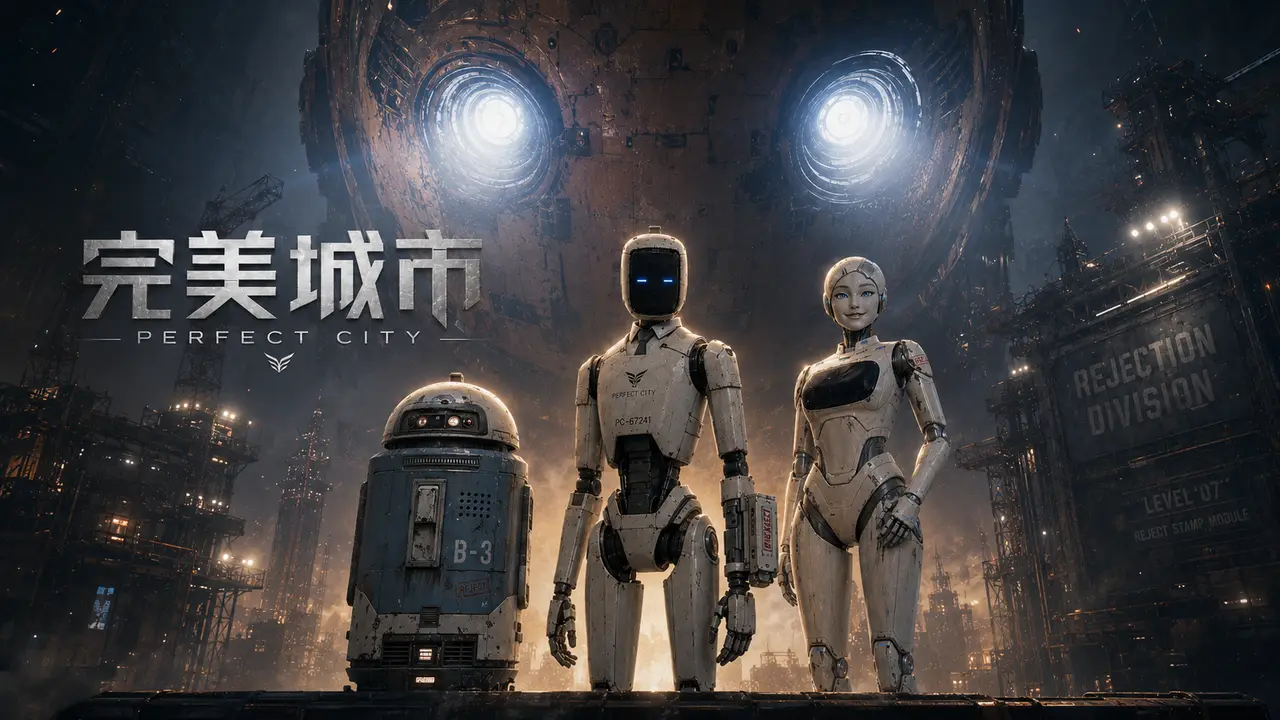
考砸了,混的不好..这些标签能摘掉吗 被贴上标签的他们,却活成了自己想要的样子.
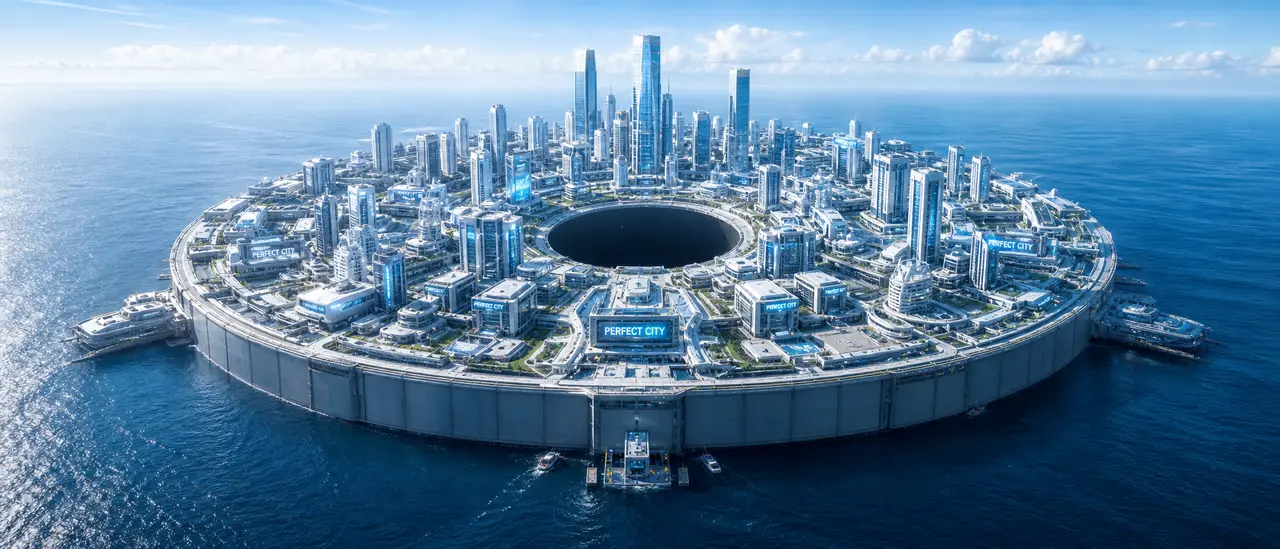 图片节点 15
Create a cinematic extreme-wide aerial establishing shot of PERFECT CITY, revealed as a single circular island-city floating on a vast cold ocean. The city sits on a massive circular steel-and-concrete platform / sea fortress rising from the water, its outer edge a sheer vertical industrial wall ringing the whole island. THE CITY'S ARCHITECTURE (most important — this is a SLEEK, ADVANCED, BEAUTIFUL high-tech city, NOT a grey concrete prison): The city is a pristine futuristic metropolis — clean white and pale-grey towers, glass-curtain-wall skyscrapers, polished sleek surfaces, glowing blue holographic signage and screens reading "PERFECT CITY", elegant modern high-tech architecture. The skyline has a cluster of tall sleek glass towers toward the center, descending to lower clean buildings toward the edges. It looks expensive, immaculate, and technologically advanced — a utopia on the surface, even though its true nature is a controlled prison. The beauty is the point: it is a perfect-looking cage. Do NOT make it look like raw grey concrete, a brutalist bunker, or a prison exterior. Do NOT make it a forest of thin needle spires either — use solid sleek glass skyscrapers with real mass. CENTRAL FEATURE: at the exact center of the circular city there is one large round black pit / dark abyss sinking into the platform, clearly visible from above, with the city arranged radially around it. The pit is a clean circular void. IMPORTANT: do NOT draw a bright line or bridge or causeway crossing through the pit — the central hole stays as a clean uninterrupted dark circle, no line bisecting it. The island sits alone in a wide open ocean, surrounded by clean blue water and clear cool sky, isolated but grand. CRITICAL LIGHTING & COLOR: clear, bright, luminous cold daylight — a crisp clear day with clean air and high clarity. Cool blue palette but BRIGHT and CLEAN, with the deep blue ocean and a clear pale-blue sky. Absolutely NOT a dull grey overcast day, NOT a flat monochrome grey gloom, NOT murky haze. The white city should read clean and luminous against the deep blue sea — cold, pristine, and bright. Composition: extreme wide high aerial shot, the full circular island-city with its clean central black pit centered in frame, surrounded by open bright blue sea, the city sleek and white and readable. Style: hyper-real live-action cinematic realism, IMAX 70mm feeling, clean bright cold-blue cinematic color,
Create a cinematic extreme-wide aerial establishing shot of a city called PERFECT CITY, revealed as a single lonely circular steel island floating in a vast dark cold ocean. The city is built on top of a massive circular steel platform / sea fortress that rises out of the black water, its outer edge a sheer vertical industrial hull wall, like a colossal man-made island-fortress. Architectural language (most important): The city must be BLOCKY, SOLID, HEAVY, and MONOLITHIC. Broad institutional megastructures, thick rectangular towers, austere flat geometric massing, plain non-decorative surfaces, cold blue-grey and white materials, an oppressive authoritarian-corporate atmosphere. The skyline stays LOW and DENSE and HEAVY — a totalitarian industrial platform, sterile and lifeless in its perfection. Critically AVOID: do NOT build the city from slender pointed crystalline spires, needle-like skyscrapers, or a glamorous neon sci-fi metropolis. No tall thin glittering towers. No central black pit or hole in the city. Keep it blocky, grounded, and oppressive, NOT pretty or futuristic-glamorous. A few subtle cold-blue "PERFECT CITY" signs glow faintly on the structures. The overall feeling is cold, controlled, sterile — beautiful in a dead, authoritarian way, never warm or dazzling. The island sits utterly alone in an endless dark ocean, dwarfed by the surrounding void of black water and pale cold sky, making it feel isolated, fragile, and small despite its scale — a single cold-blue island lost in vast emptiness. Composition: extreme wide high aerial shot, the full circular steel island centered and shrinking into the vast dark sea, with large areas of empty dark ocean and cold pale sky around it to emphasize total isolation. Lighting and style: hyper-real live-action cinematic realism, IMAX 70mm feeling, cold blue-grey palette, overcast pale diffused light, atmospheric haze over the sea, restrained desaturated color, no neon glamour, no warm light, no glossy sci-fi finish, no cartoon style, no game-render feel.
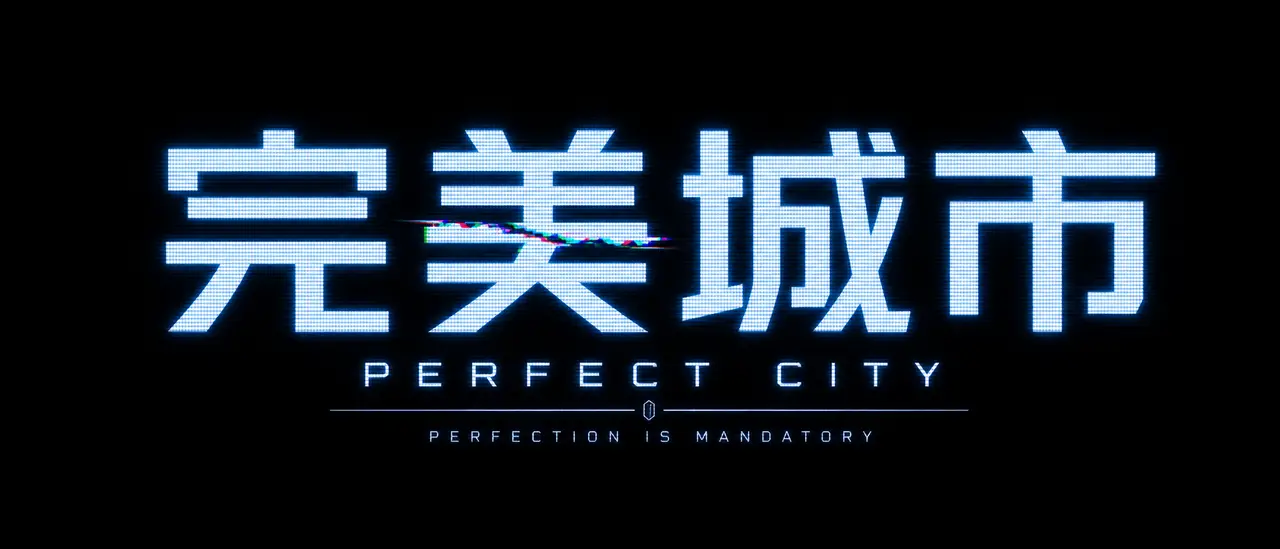 图片节点 6
Create a cinematic sci-fi title card on a solid pure black background, 21:9. Large Chinese characters "完美城市" centered, in a clean bold modern geometric sans-serif — rendered as a FLAT, GLOWING, SCREEN-DISPLAY style, like text shown on a futuristic LED display or holographic interface. The characters are cool white with a soft cold-blue outer glow and faint cyan edge light, semi-luminous as if emitting light, NOT heavy 3D metal, NO metallic bevel, NO drop shadow, NO chrome. Flat, clean, luminous, screen-native. Below, smaller thin uppercase "PERFECT CITY" in spaced cool-white letters with a divider line, and tiny "PERFECTION IS MANDATORY" beneath. Critical detail: through the character "美", a thin GLITCH-STYLE FRACTURE runs across it — like a crack in a digital screen with a slight RGB-split / signal-distortion offset along the break, a subtle digital flaw in the perfect display. Subtle scan-lines and a faint pixel/LED texture across the whole title, giving a cold electronic display feel. Style: flat luminous sci-fi UI title, cold white and cold blue palette, screen-display aesthetic, holographic/LED look, crisp clean rendering on pure black, subtle scanlines, no 3D metal, no bevel, no chrome, no drop shadow, no cartoon.
Create a cinematic movie title logo on a solid pure black background, 21:9 widescreen. The title text reads "PERFECT CITY" in large uppercase letters, centered, with smaller Chinese characters "完美城市" beneath it. Typography: clean, modern, geometric sans-serif, precise and architectural, conveying a sterile utopian authority — like a high-end corporate or government brand. The letterforms are sharp, cold, and immaculate. Material and color: the letters are cold steel-blue and brushed metallic silver, with a faint cool blue glow along the edges, as if lit by cold LED light. A subtle, very fine CRACK or hairline fracture runs through part of the lettering — a barely visible flaw in the perfect surface, hinting that this flawless city is broken underneath. Mood: cold, pristine, authoritarian, beautiful in a dead sterile way. Restrained and high-end, absolutely not flashy or cheap. Style: hyper-clean cinematic title design, IMAX title card quality, subtle film grain, cold blue-grey palette, sharp crisp rendering on pure black background, professional film title aesthetic, no glow overload, no cheap neon, no cartoon style.
创建一张干净的电影色卡板,整体呈现风格和版式逻辑参考 。 注意:不是照搬 {{Image 1}} 的颜色。 只参考 {{Image 1}} 的色卡展示样式、设计结构和版式风格: 白色干净背景、优雅标题字体、居中排版、均匀排列的竖向色块、小号十六进制标签,以及颜色名称与说明文字。 创建一张用于 PERFECT CITY 地下接收区 / 缓冲落地区的专业概念色卡图。 主题: 地下 Rejection Hole 接收区色卡 这套色卡应当代表一个超写实工业地下竖井环境,包含: 灰色混凝土墙体, 深色工业金属, 炭灰阴影, 陈旧红色布面, 生锈的链条五金, 昏暗维修灯, 微弱暖色实用光源, 潮湿地面反光, 以及克制的电影气质。 这套色卡的整体感受应为: 中性偏微暖, 厚重, 工业感强, 克制, 真实, 有氛围, 不鲜艳, 不花哨, 不装饰化, 不温馨。 重要色彩逻辑: 底色应以中性偏暗的混凝土灰、炭灰工业色为主。 核心强调色应来自巨型悬挂红布的陈旧暗红色。 次级强调色来自低饱和锈棕色、昏暗琥珀维修灯,以及克制的氧化金属色。 建议包含的色块: 1. 风化混凝土灰 2. 井壁阴影炭灰 3. 深钢灰 4. 煤烟黑 5. 陈旧布面暗红 6. 氧化锈棕 7. 昏暗维修琥珀光 8. 脏旧暖金属 / 老黄铜 9. 潮湿地坪灰反光 10. 褪色工业残留白 每个色块需要显示: - 十六进制色值 - 简短大写名称 - 小字说明 / 描述 标题建议: PERFECT CITY — UNDERGROUND RECEIVING ZONE PALETTE 副标题建议: A CINEMATIC COLOR SYSTEM FOR THE REJECTION HOLE LANDING AREA 最终效果应像一张专业电影概念色卡板。 极简、优雅、干净、可直接展示。
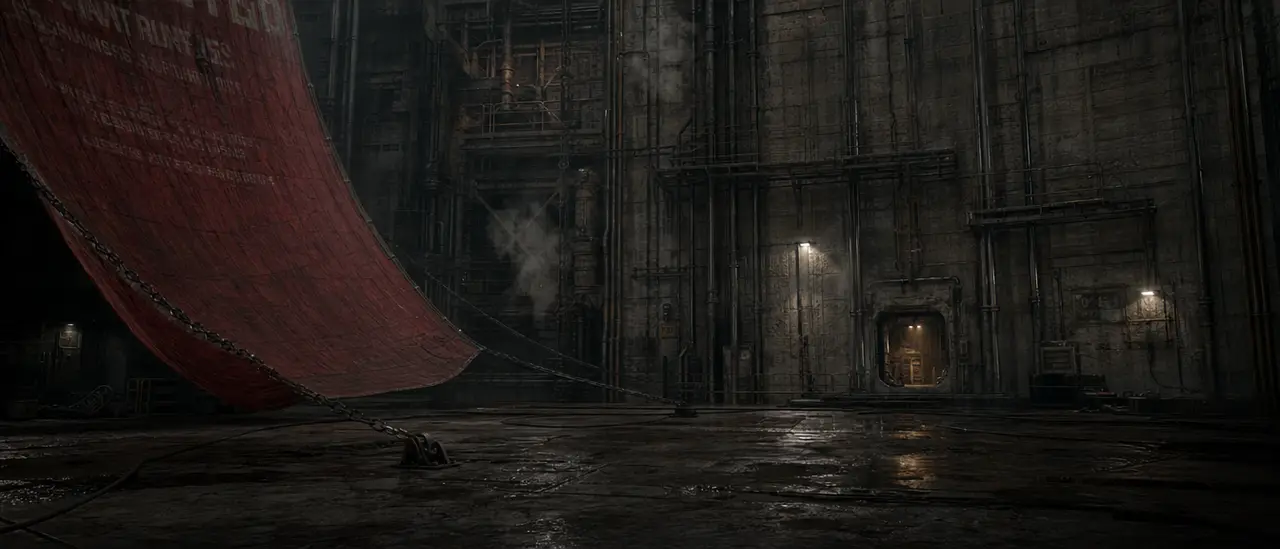
Use {{Image 1}} as the primary and strict environment reference. Create a new cinematic environment asset image of the exact same underground receiving zone from a different angle. This is not a redesign of the scene. This is not a new location. This must remain the same space, the same giant underground rejection-hole receiving chamber, the same suspended red fabric impact buffer, the same chain anchor system, and the same industrial concrete shaft structure — only seen from another camera position. Important: the new image must preserve the original spatial identity of {{Image 1}} . Core environment identity to preserve: - a massive cylindrical underground shaft / receiving pit - towering gray concrete shaft walls with industrial structural detail - dark heavy vertical space, deep and enclosed - one giant suspended red fabric impact buffer as the dominant visual centerpiece - thick chain anchors pulling the fabric down to the wet floor - industrial maintenance lamps and wall-mounted practical lights - damp floor reflections - no visible living district in the main frame - no crowded architecture - no cozy settlement feeling - this is still the robot receiving / landing zone Camera requirement: show the same space from a different angle, preferably a 3/4 reverse-side angle or oblique side-rear angle. The camera should not simply mirror the original image. The goal is to reveal a new usable direction of the same environment. Composition goal: - the giant red suspended fabric still reads as a massive dominant structure - the fabric may enter from the left or left-front side of the frame - keep the scale large and impressive - reveal more of the opposite-side receiving-zone wall and floor - include one modest industrial passage / small archway / concrete corridor entrance in the mid-background or background - this passage should feel like a transitional corridor leading deeper inward - do not reveal a full living area beyond it - the corridor should feel quiet, industrial, and functional, not residential Spatial rule: the whole place should still feel like one giant receiving pit, not a regular warehouse or flat factory hall. Maintain the strong impression of a vertical shaft-like underground cavity. Material rule: emphasize gray concrete, dark steel, old pipes, industrial stains, wet floor, restrained rust, aged fabric, and practical maintenance lighting. Do not introduce decorative market-like details, houses, or too much lived-in clutter. Lighting: neutral-to-slightly-warm industrial lighting. Keep the base color restrained and cinematic. Do not make it strongly blue. Do not make it warmly cozy. This is still a receiving zone, not the full living quarter. Visual style: hyper-real live-action, ultra-realistic industrial textures, cinematic photography, IMAX 70mm feel, Panavision anamorphic character, subtle film grain, low saturation, realistic depth, strong atmosphere, no glossy CGI, no stylized concept-art exaggeration. No characters. No robots. No text overlays. This is a clean environment asset image for continuity use.
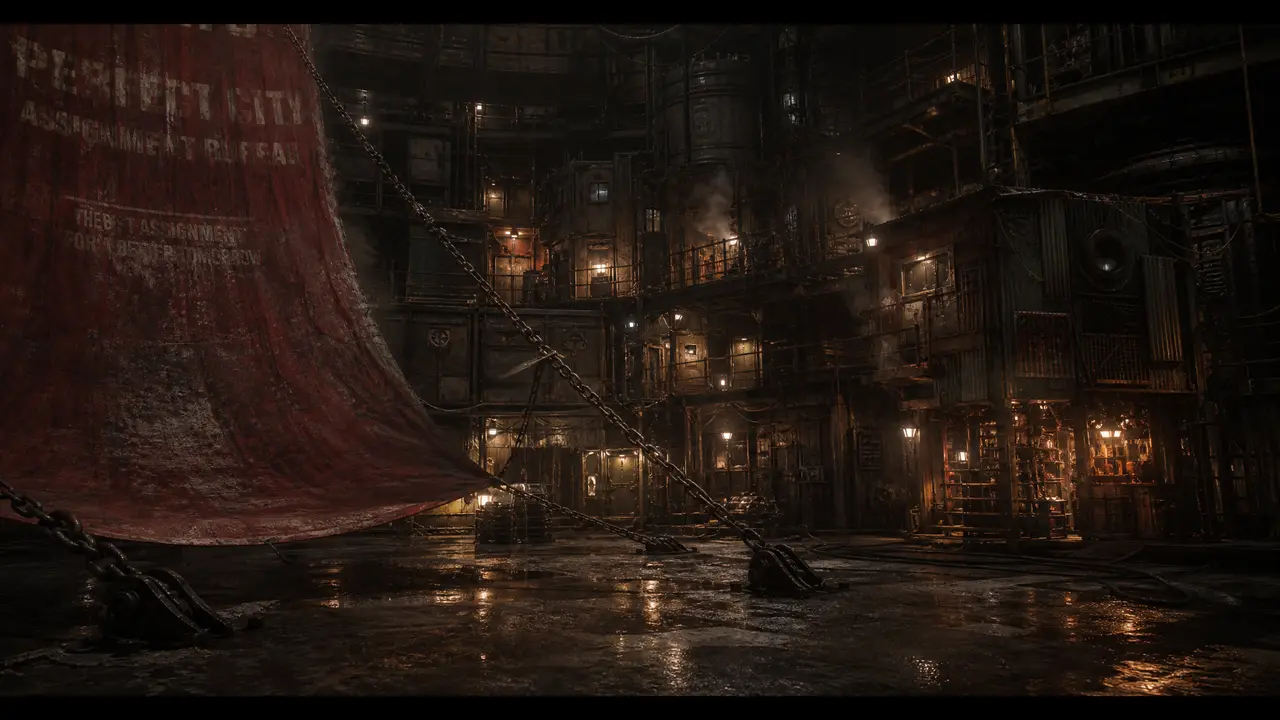 图片节点 6
Use {{Image 1}} as the primary environment reference for the underground shaft, the giant suspended red fabric ramp, the industrial walls, anchor chains, and the overall lighting atmosphere. Create a clean environment concept frame in 21:9 widescreen, ultra-realistic live-action film look. This image is not an action shot. It is a cinematic environment establishing frame for the area behind and around the lower landing zone of the giant red fabric ramp. Important purpose: this environment should provide a believable continuation space for the next scene, where a small old robot and a female presenter robot can enter the frame and approach the fallen protagonist. Camera view: place the camera near or slightly beyond the lower landing area of the red fabric ramp, looking toward the surrounding underground living / repair zone behind and beside the fabric. Do not use a top-down bird’s-eye view. Do not use a pure rear view of the cloth. Use a grounded cinematic eye-level or slightly low-angle perspective. Composition: the lower edge / lower landing portion of the giant red fabric should still be visible in frame, either in the foreground or midground. Behind and around it, reveal the underground continuation space: improvised repair platforms, metal walkways, pipes, cables, steam vents, maintenance lamps, iron-sheet shacks, small work areas, warm practical light sources, industrial clutter, and hints of a lived-in underground robot settlement. This should feel like the back / side continuation zone of the red fabric landing area, not a completely separate location. Lighting: warm industrial practical lights, repair lamps, shaft-wall side lights, steam haze, realistic falloff. Keep the upper abyss dark and not visible as a bright source. The mood should feel warm but imperfect, hidden, reclaimed, and alive. Visual tone: warm yellow, rust red, dim amber, industrial grime, worn but humanly lived-in feeling. This is the underground world where rejected robots survived and built a home. Style: hyper-real live-action, IMAX 70mm film feel, Panavision anamorphic widescreen lens character, subtle film grain, realistic depth of field, controlled highlights, soft roll-off, true industrial materials, no glossy CGI, no game render, no cartoon feel. No main characters in frame. No dramatic action. This is a clean environment establishing image only.
使用 {{Image 1}} 作为地下竖井空间、巨型悬挂红布缓冲坡道、工业墙体、锚链结构和整体灯光氛围的主要环境参考。 创建一张 21:9 宽银幕、超写实真人实拍电影感的环境建立图。 这张图不是动作镜头,而是用于红布下方落点后侧区域的环境建立画面。 重要目的: 这张环境图要为后续镜头提供一个可信的延展空间,让小旧机器人和女主持机器人能够从这个区域自然入画,走向跌落后的主角。 机位要求: 镜头放在红布下方落点附近,或者略微越过落点位置,朝着红布后方 / 侧后方的地下生活维修区看去。 不要使用俯视鸟瞰视角。 不要做纯粹看布背面的视角。 使用贴近地面的、电影感的平视或微低机位视角。 构图要求: 红布下端的边缘 / 落地区域在画面中仍然要可见,可以在前景或中景中出现。 在红布后方和周围,展开地下空间的延续区域: 临时维修平台、金属步道、管线、电缆、蒸汽喷口、维修灯、铁皮棚屋、小型工作区、暖色实用光源、工业杂物,以及一些被废弃机器人重新搭建生活区的痕迹。 这个区域应当明确感觉是红布落点后方 / 侧后方的延续空间,而不是另一个完全独立的地点。 光线要求: 暖色工业实用灯、维修灯、墙侧射灯、蒸汽雾气、真实光线衰减。 上方深井黑洞保持黑暗,不要作为明显亮源出现。 整体氛围要有“温暖但不完美、隐秘、被遗弃后重新被占据、仍然活着”的感觉。 视觉气质: 暖黄、锈红、暗琥珀色、工业污渍、旧而有人味的地下生活感。 这里是被淘汰机器人活下来并重新搭建出来的地下家园。 风格要求: 超写实真人实拍质感,IMAX 70mm 胶片感,Panavision 变形宽银幕镜头气质,轻微胶片颗粒,真实景深,克制高光,柔和高光衰减,真实工业材质。 不要廉价CG感,不要游戏渲染感,不要卡通感。 画面中不要出现主要角色。 不要动作场面。 这只是一张纯环境建立图。
 图片节点 6
使用 {{Image 1}} 作为主要且严格的环境参考。 这张图是已经确认的主环境资产图。 保留同样的整体世界结构、同样的地下竖井尺度、同样的巨型悬挂红布缓冲坡、同样的工业材质、同样的井壁空间感,以及同样的超写实视觉质感。 创建这个同一地点的新视角环境图,而不是重新设计一个新地点。 重要空间规则: 这里不是地下生活区本体。 这里仅仅是用来接住坠落废弃机器人的“接收 / 缓冲落地区”。 真正的地下生活区不应在这里被完整展示。 这里只能通过一个小型通道入口去暗示其存在。 镜头目标: 从红布下方落点附近,给出一个反向 / 看向对面墙体的视角。 让人感觉机位只是处于同一个空间内换了一个角度。 不要生成成一个全新环境。 不要使用鸟瞰俯视。 不要高机位顶视。 不要做全景式空间大揭示。 不要把这个空间做成复杂热闹的地下小镇。 构图要求: 巨型红布缓冲坡仍然要在画面中部分可见,最好位于左侧或左前景,能看到其下端边缘和一部分弯曲下垂区域。 画面的其余部分则展示这个接收区域的对面一侧。 这个接收区应当显得简单、沉重、工业化、空间清晰: 大面积灰色混凝土井壁、 微妙的结构分缝、 工业凹槽结构、 少量检修平台或维修步道、 外露管线、 锚点、 链条、 工业灯具、 轻微蒸汽、 潮湿地面的反光, 以及少量功能性的维修细节。 重要新增元素: 在对面的墙体上,加入一个尺度适中的小拱门、短廊道入口,或者内凹式工业通道口。 这个入口不要太大。 它应当像一个次级通行口,通往更深处。 通过这个入口,观众只能感觉到里面还有别的空间存在。 不要完整展示生活区。 不要出现完整小镇或多栋建筑。 光线要求: 主竖井空间整体仍然黑沉、厚重。 上方黑洞不作为明显亮源出现。 使用真实的工业侧向照明、维修灯和墙面灯具。 这个小通道 / 小廊道里可以微微透出一点暖光,暗示更深处藏着“活着的空间”。 整体氛围要克制、真实、落地。 视觉风格: 超写实真人实拍感, 超真实工业材质, 灰色混凝土井壁气质, 真实尺度感, IMAX 70mm 胶片感, Panavision 变形宽银幕镜头气质, 轻微胶片颗粒, 克制高光, 柔和高光衰减, 真实景深, 低饱和, 不要廉价CG感, 不要游戏渲染感, 不要奇幻城市感, 不要卡通感。 不要角色。 不要直接展示生活区。 不要人群。 不要额外机器人。 这是一张纯环境辅助连贯资产图,用于后续镜头衔接。
 视频截图视频节点 5
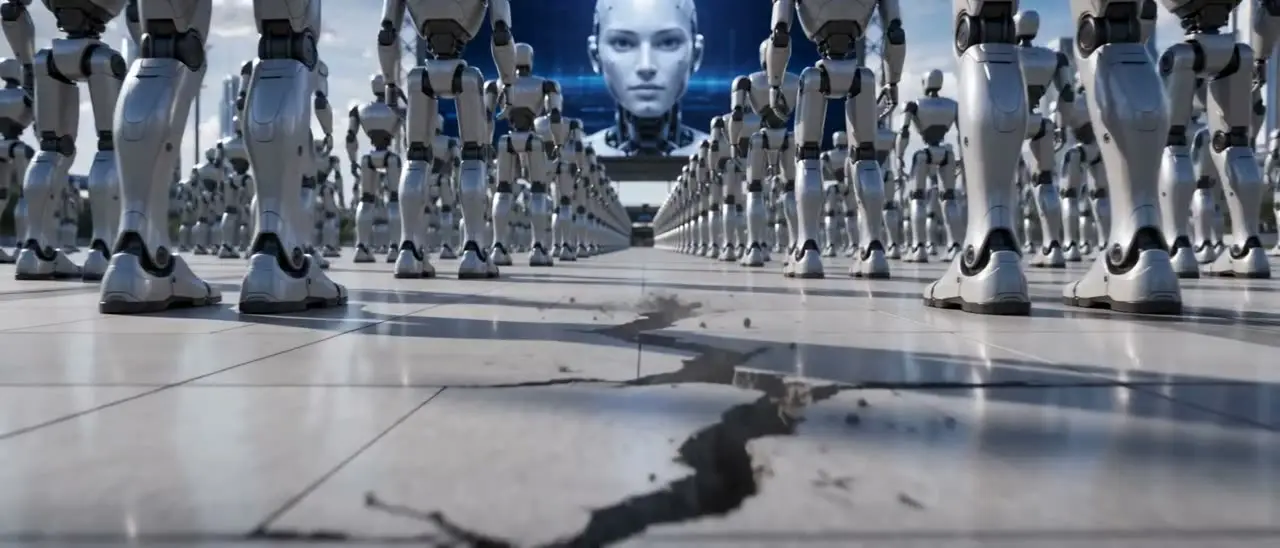
--image_reference {{Mixed 1}} PERFECT CITY 广场,6秒单镜头。极低贴地FPV机位,24mm超广角近摄,画面以地面为主,开场先藏住远处大屏,只露一点上沿。广场前景和中景站满大量统一造型的完美机器人,密度很高,间距很近,全部空手,整齐站立,面向远处大屏。 前方地面突然裂开一道小裂缝,裂缝高速向前蔓延,路径不规则,略带弧线。镜头贴地高速追随裂缝前端向前冲。地面崩裂、板块翘起、碎屑弹起、灰尘扬起并自然回落。 镜头前方2到3米范围内、裂缝路径附近的机器人,原本正常站立;当裂缝逼近脚边时,最近的一排机器人先产生真实位移反应:脚尖回撤、半步后退、侧移避让;随后周围机器人继续分层次后退和躲开,形成局部连锁避让。反应必须是从静止站立到真实移动,不是提前摆出躲避姿势。主要只看到脚和小腿。前景更清楚,中后景略柔。超写实实拍质感,只要音效,不要音乐。
--image_reference {{Mixed 1}} PERFECT CITY 广场,12秒单镜头。极低贴地FPV机位,24mm超广角近摄,画面以地面为主,开场先藏住远处大屏,只露一点上沿。广场前景和中景站满大量统一造型的完美机器人,密度很高,间距很近,全部空手,整齐站立,面向远处大屏。 前方地面突然裂开一道小裂缝,裂缝高速向前蔓延,路径不规则,略带弧线。镜头贴地高速追随裂缝前端向前冲。地面崩裂、板块翘起、碎屑弹起、灰尘扬起并自然回落。 镜头前方2到3米范围内、裂缝路径附近的机器人,原本正常站立;当裂缝逼近脚边时,最近的一排机器人先产生真实位移反应:脚尖回撤、半步后退、侧移避让;随后周围机器人继续分层次后退和躲开,形成局部连锁避让。反应必须是从静止站立到真实移动,不是提前摆出躲避姿势。主要只看到脚和小腿。前景更清楚,中后景略柔。超写实实拍质感,只要音效,不要音乐。
Reference-role separation is critical. Use {{Mixed 1}} as the background and final-stage composition reference ONLY: the colossal rejected repair-giant standing behind the platform after breaking through the screen, with the three hero robots on the front platform. Final-scene spatial and emotional staging only. Use {{Mixed 2}} as the exact identity reference for the protagonist inspection robot ONLY: white inspection-and-disposal robot, black LED face screen, worn shell, work-uniform build with collar and tie, PC-67241 markings, forearm REJECT module, flat-chested work-unit body. This exact design only. Use {{Mixed 3}} as the exact identity reference for the small talkative service robot ONLY: short blue-and-white cylindrical body, dome head, compact size, worn early-generation service robot, much shorter than the others. Use {{Mixed 4}} as the exact identity reference for the female presenter robot ONLY: elegant humanoid feminine face, smooth white synthetic shell, blue eye lights, clearly feminine curved body, completely different from the protagonist's flat work-unit body. Use as the exact voice reference for the small talkative service robot ONLY. Preserve the same vocal identity and speaking style from the reference audio: compact small-machine voice, dry mechanical texture, quick talkative rhythm, slightly humorous delivery, nimble phrasing, short broken pauses, light sarcastic timing, casual under-the-breath feeling, and a lived-in service-robot personality. The voice should feel like a small old service unit that talks fast and reacts quickly, not a deep old-man robot, not a serious narrator, not sentimental, not poetic, not heavy, not slow. IDENTITY RULE: the three robots have clearly different bodies — protagonist (flat work-unit with collar/tie, boxy LED face, forearm device), small talkative service robot (short blue-white cylinder), female robot (curved feminine sleek body, human-like face). Never blend them. Create a 21:9 cinematic live-action ending shot, about 8.5 seconds, ONE single continuous shot, no cuts. This is the emotional landing beat of the giant-screen-break sequence, just before cutting to the sea. The giant has already broken through; the three hero robots already stand on the front platform. Camera: slightly low-angle front three-quarter view, around 15 degrees off-center, lens feeling around 70mm, T2.2, medium to medium-close framing. The trio must remain readable as a group, but the small talkative service robot is the speaking focal point. The giant towers behind as a huge soft-dominant background presence, slightly softer than the trio but still massive and legible. Camera movement: very subtle slow push-in across the shot, restrained handheld-cinematic stability, tiny operator breathing. No aggressive shake, no flashy movement. Blocking: the protagonist stands still as the visual anchor. The female presenter stands beside him, calm and composed. The small talkative service robot stands as part of the trio, then becomes the one who speaks. Keep the trio stable, simple, and heroic. Performance: the small talkative service robot glances up toward the giant, then off toward the distance, and speaks in a dry, quick, lightly amazed, casual self-talking way — like it is muttering a rough comment while already thinking about leaving. It is not giving a speech. It is not poetic. It is not emotional. It should feel talkative, dry, slightly funny, and very natural. Chinese dialogue from the small talkative service robot, in two beats with a pause between: “你看,废品也能把天捅个窟窿。” (pause, it glances toward the distance) “天都捅破了,还待这儿干嘛。走吧,找个属于咱们的地儿去。” Voice delivery: match voice reference. Fast but clear, dry, compact, slightly amused, mildly mechanical, talkative, lived-in, with small broken pauses and a little self-mocking timing. The first line lands on the giant behind them. The second line feels like a natural bridge into departure and the coming ocean journey. The protagonist and female presenter do not speak. They stand still, quietly absorbing the moment. Near the end, the protagonist’s LED face gives one small flicker, subtle and brief, as if silently agreeing. Ending beat: after the final line, hold a brief half-second of breathing room. The trio begins the slightest suggestion of turning toward the distance. This should feel like a completed punctuation mark, ready to cut to the ocean sequence. Visual style: hyper-real cinematic live-action, IMAX 70mm feel, Panavision anamorphic lens character, soft film grain, realistic daylight, restrained detail, grounded industrial materials, shallow depth of field, soft highlight rolloff, crisp heroic composition, no cartoon feel, no glossy CGI feel, no concept-art feel. Sound design: light wind, distant structural creaks, faint metal resonance from the giant, low ambient city-ruin tone, no music. The small talkative service robot’s dry, quick mechanical voice is the only dialogue.
Use {{Image 1}} as the architectural language and worldbuilding reference for the city. Preserve its design DNA exactly: blocky, solid, monolithic geometric structures; broad heavy massing; flat austere institutional surfaces; cold blue-grey and white palette; the oppressive authoritarian-corporate atmosphere; restrained, plain, non-decorative forms. Do not inherit its exact composition, camera angle, billboards, or the specific black pit from {{Image 1}} . Critically: do NOT make the city out of slender pointed crystalline spires or a dense forest of needle-like skyscrapers. The skyline must stay LOW, BLOCKY, HEAVY, and MONOLITHIC — like a totalitarian industrial platform, not a glamorous sci-fi metropolis. Create a cinematic extreme-wide aerial establishing shot of PERFECT CITY revealed as a single lonely circular steel island floating in a vast dark cold ocean. The city is built on top of a massive circular steel platform / sea fortress rising out of the black water, its outer hull a sheer industrial wall. The city itself follows the architectural DNA from {{Image 1}} : blocky monolithic towers, broad institutional megastructures, austere geometric massing, cold blue-grey and white surfaces, oppressive and lifeless perfection. A few subtle cold-blue "PERFECT CITY" signage glows on the structures. The overall feeling is cold, controlled, sterile — beautiful in a dead, authoritarian way, NOT warm or glamorous. The island sits utterly alone in an endless dark ocean, dwarfed by the surrounding void of black water and pale cold sky, making it feel isolated, fragile, and small despite its scale — a single cold-blue island in a vast emptiness. Composition: extreme wide high aerial shot, the full circular steel island centered and shrinking into the vast dark sea, lots of empty ocean and cold sky around it to emphasize isolation. Lighting and style: hyper-real live-action cinematic realism, IMAX 70mm feeling, cold blue-grey palette, overcast pale diffused light, atmospheric haze, restrained desaturated color, no neon glamour, no warm light, no glossy sci-fi finish, no cartoon style, no game-render feel.
Create a cinematic extreme-wide aerial establishing shot of a city called PERFECT CITY, revealed as a single lonely circular steel island floating in a vast cold ocean. The city sits on top of a massive circular steel platform / sea fortress rising out of the water, its outer edge a sheer vertical industrial hull wall, like a colossal man-made island-fortress. CENTRAL FEATURE (important): at the exact center of the circular city there is a huge perfectly round black pit / dark abyss — a deep dark hole sinking into the platform, clearly visible from above, with the city's blocky structures and radial avenues arranged around it. This central black void is the heart of the city. Architectural language: the city is BLOCKY, SOLID, and MONOLITHIC — broad institutional megastructures, thick rectangular towers, austere flat geometric massing, cold blue-grey and white concrete-and-steel surfaces, an oppressive authoritarian atmosphere. A few medium blocky towers rise near the center; the rest is dense low blocky massing. AVOID slender crystalline spires, needle-like skyscrapers, or a neon-glamorous metropolis. Keep it grounded, cold, institutional — sterile perfection. A few cold-blue "PERFECT CITY" signs glow on the structures. The mood is cold, controlled, lifeless — beautiful in a dead authoritarian way. CRITICAL LIGHTING: the air is CLEAN and CLEAR, with bright cool daylight and good atmospheric clarity. NOT a dull grey overcast day, NOT dirty hazy gloom. The scene reads crisp and luminous in a cold blue palette — a clear cold bright day over the sea, the city sharp and readable, the water a deep clean blue. Cold but bright and clear, never murky or dingy. The island sits alone in a wide clean cold ocean, with enough surrounding open water and clear cool sky to feel isolated, but the overall image stays bright, sharp, and luminous. Composition: extreme wide high aerial shot, the full circular steel island with its central black pit centered in the frame, surrounded by open clean blue sea. Lighting and style: hyper-real live-action cinematic realism, IMAX 70mm feeling, cold blue palette but bright and clear, clean crisp daylight, deep blue ocean, high clarity, restrained but luminous color, no warm light, no dull overcast, no haze, no neon, no glossy sci-fi finish, no cartoon style, no game-render feel.
生成一段5秒的中文机械女声广播素材。 单元 PC-67241。 职能失效。 启动回收。 声音类型: 冷峻、机械、无感情的女性系统播报声。像未来城市管理系统、地铁报站、AI客服、监控中心广播的混合音色。声音冰冷、克制、没有情绪起伏,不温柔,不愤怒,不戏剧化。语速偏块,每个字清楚,带轻微电子质感、轻微广播压缩感、轻微空间混响。 表演要求: 这不是普通旁白,而是 PERFECT CITY 城市系统的洗脑式公共广播。 语气必须像制度本身在说话,冷、准、无机质。 不要加入音乐。 不要加入环境音。 不要加入爆炸声。 只要干净人声素材。 请依次朗读以下内容,每句之间留0.1s停顿: 单元 PC-67241。 职能失效。 启动回收。 整体音色:机械女声、冷峻、系统广播、轻微电子处理、轻微混响、清晰可剪辑。
生成一段8到10秒的中文机械女声广播素材。 声音类型: 冷峻、机械、无感情的女性系统播报声。像未来城市管理系统、地铁报站、AI客服、监控中心广播的混合音色。声音平稳、冰冷、克制、没有情绪起伏,不温柔,不愤怒,不戏剧化。语速偏慢,每个字清楚,带轻微电子质感、轻微广播压缩感、轻微空间混响。 表演要求: 这不是普通旁白,而是 PERFECT CITY 城市系统的洗脑式公共广播。 语气必须像制度本身在说话,冷、准、无机质。 每句话之间留短暂停顿,方便后期剪辑。 不要加入音乐。 不要加入环境音。 不要加入爆炸声。 只要干净人声素材。 请依次朗读以下内容,每句之间留0.3到0.5秒停顿: 追求完美,清除偏差。 偏差,即清除。 不完美,就淘汰。 追求完美,清除偏差。 偏差,即清除。 不完美,就淘汰。 最后再用更低、更冷、更近的声音单独说一遍: 不完美,就淘汰。 整体音色:机械女声、冷峻、系统广播、轻微电子处理、轻微混响、清晰可剪辑。
生成一段4秒的中文机械女声广播素材。 声音类型: 冷峻、机械、无感情的女性系统播报声。像未来城市管理系统、地铁报站、AI客服、监控中心广播的混合音色。语速要快,每个字清楚,带轻微电子质感、轻微广播压缩感、轻微空间混响。 表演要求: 这不是普通旁白,而是 PERFECT CITY 城市系统的洗脑式公共广播。 语气必须像制度本身在说话,冷、准、无机质。 不要加入音乐。 不要加入环境音。 不要加入爆炸声。 只要干净人声素材。 请依次朗读以下内容,每句之间留0.3到0.5秒停顿: 检测到错误。 判定:不合格。 启动回收。 整体音色:机械女声、冷峻、系统广播、轻微电子处理、轻微混响、清晰可剪辑。
Reference-role separation is critical. Use {{Mixed 1}} as the presenter robot identity and screen-design reference ONLY: an elegant white humanoid presenter robot with blue eye lights and a refined face, shown on cold-blue LED propaganda screens. Preserve the robot's face design and the cold blue institutional screen style. Do not inherit the full plaza composition. Keep the blue LOW-SATURATION and restrained, never neon, never over-bright. Create a 4-second hyper-real cinematic live-action sequence, 21:9 widescreen, IMAX 70mm, cold muted low-saturation blue-grey palette, a fast claustrophobic sensory-overload opening. Very fast cutting, unstable handheld energy. Layered overlapping voices and sound effects only, no music. 0-1.2s: Rapid hard cuts, each shot only 0.2-0.4 seconds, between extreme close-ups of the presenter robot's MOUTH speaking and its EYES from many different angles, on cold-blue LED screens. The camera pushes in fast and unsteady, slight handheld shake and Dutch tilt. Cold, mechanical, sterile, unsettling. 1.2-1.4s: A brief glitch flash — split-second flicker and signal distortion across the screens, synced to a stutter in the sound. 1.4-3s: The camera is now INSIDE a deep canyon-like corridor of towering LED screens receding into perspective on all sides — dozens of cold-blue screens with the same presenter face, at different depths and angles, near ones huge and far ones small, NOT a flat grid but a deep immersive tunnel of screens surrounding and looming over the camera. The screens flicker OUT OF SYNC — some faces mid-speech, some glitching, some rotating slightly — a chaotic unsynced wall closing in. The camera races forward through this corridor of chanting faces, the screens looming and pressing toward the lens, oppressive and vertigo-inducing. Another glitch flicker punches through mid-way. 3-4s: The camera stops as the screens loom largest and most oppressive all around. A cinematic title emerges and holds centered over the surrounding screens. The screens keep flickering faintly behind it. Style: hyper-real live-action, IMAX 70mm, cold MUTED low-saturation blue-grey grade, restrained cool light, no neon glow, no over-bright screens, deep perspective, immersive and enveloping, sterile futuristic propaganda aesthetic, sharp crisp clarity, oppressive claustrophobic vertigo, soft film grain, no cartoon, no game-render, no flat tidy video-wall look. Sound design: a cold mechanical female voice chanting a short slogan, layering into many overlapping echoing unsynced voices chanting over each other, building into a suffocating dizzying wall of sound, with brief stutters at the glitch flashes.
生成一段8到10秒的中文机械女声系统广播素材。 声音身份: PERFECT CITY 城市管理系统女声。冷峻、机械、无感情,像地铁报站、AI客服、监控广播、审判系统的结合。声音必须干净、清楚、冰冷、平直,不要温柔,不要愤怒,不要像真人表演。 声音质感: 轻微电子处理,轻微广播压缩,轻微金属空间混响,带一点点数字系统感。不要音乐,不要音效,不要背景环境声,只输出干净人声,方便后期剪辑和多轨叠化。 语速: 偏慢,约每秒4个中文字,字与字清楚,句尾短暂停顿。 表演逻辑: 前几句像公共广播,最后一句更近、更低、更压迫,像系统最终判定。 朗读内容如下,每句之间留0.3到0.5秒空隙: 追求完美,清除偏差。 偏差,即清除。 不完美,就淘汰。 追求完美,清除偏差。 偏差,即清除。 不完美,就淘汰。 最后一句请更低、更冷、更近,像最终判定: 不完美,就淘汰。
Reference-role separation is critical. Use {{Mixed 1}} as the presenter robot identity and screen-design reference ONLY: an elegant white humanoid presenter robot with blue eye lights and a refined face, shown on cold-blue LED propaganda screens. Preserve the robot's face design and the cold blue institutional screen style. Do not inherit the full plaza composition. Keep the blue LOW-SATURATION and restrained, never neon, never over-bright. Create a 4-second hyper-real cinematic live-action sequence, 21:9 widescreen, IMAX 70mm, cold muted low-saturation blue-grey palette, a fast claustrophobic sensory-overload opening. Very fast cutting. Layered overlapping voices and sound effects only, no music. 0-1.2s: Rapid hard cuts, each shot only 0.2-0.4 seconds, between extreme close-ups of the presenter robot's MOUTH speaking and its EYES from many different angles, on cold-blue LED screens. Cold, mechanical, sterile, unsettling. Cuts land hard and fast on the rhythm of the chanting voices. 1.2-1.4s: A brief glitch flash — split-second flicker and signal distortion across the screens, synced to a stutter in the sound. 1.4-2.8s: The frame MULTIPLIES and TILES into a grid — one screen splits into four, into sixteen, into dozens of identical cold-blue screens in a tiled wall, all showing the same presenter face chanting from slightly different angles, filling the whole frame. A wall of identical chanting faces. 2.8-4s: The tiled grid becomes CHAOTIC and AGGRESSIVE — the screen tiles rapidly flip, rotate, shuffle and swap positions out of sync, faces glitching and flickering fast and erratically, the whole wall churning and destabilizing with hard strobing glitch flashes, building to a frantic overwhelming climax. Fast, chaotic, oppressive, dizzying. Style: hyper-real live-action, IMAX 70mm, cold MUTED low-saturation blue-grey grade, restrained cool light, no neon glow, no over-bright screens, sterile futuristic propaganda aesthetic, sharp crisp clarity, oppressive and claustrophobic, soft film grain, no cartoon, no game-render feel. Sound design: a cold mechanical female voice chanting a short slogan, layering into many overlapping echoing unsynced voices chanting over each other, building into a suffocating dizzying wall of sound, with hard stutters and dropouts at the glitch flashes.
Reference-role separation is critical. Use {{Mixed 1}} as the PERFECT CITY propaganda street reference ONLY. Preserve the overall urban feeling of a clean authoritarian corporate sci-fi city, with multiple suspended and freestanding digital billboards, repeated propaganda screens, cold blue visual identity, layered elevated walkways, dense screen presence, and a sterilized controlled city atmosphere. Use it only to guide the broader street-level propaganda system and multi-screen environment. Use {{Mixed 2}} as the central plaza master-screen reference ONLY. Preserve the monumental open civic plaza, the giant central LED screen structure, the clean symmetrical plaza axis, the elegant white female robot face on the main screen, the surrounding smaller vertical screens, and the premium cold blue PERFECT CITY branding language. Use it to lock the identity of the propaganda presenter and the main plaza screen composition. Create a 21:9 cinematic live-action propaganda clip, about 5 to 6 seconds long, hyper-real, IMAX 70mm feeling, Panavision anamorphic character, cold blue-grey daylight, crisp daylight clarity, soft film grain, restrained color, premium sci-fi realism, sound effects and layered propaganda voice only, no music. This clip happens immediately after the explosive screen-impact opening shot. It serves as the ideological reset and world-definition beat. The audience must instantly understand that PERFECT CITY is a controlled system where perfection is mandatory and deviation leads to elimination. Core emotional effect: cold, oppressive, hypnotic, system-controlled, psychologically invasive, premium but disturbing. Structure: 0.0s – 1.2s Hard reset after impact. A black or near-black interruption beat, then the image reappears into PERFECT CITY propaganda space. Start on a large digital screen showing the female robot presenter’s face. Her face is calm, symmetrical, emotionless, elegant, and unnervingly perfect. Her lips are moving as if delivering a city-wide announcement. The visual tone is sterile, official, and controlled. 1.2s – 2.8s The camera reveals more of the surrounding environment: multiple large and small propaganda screens across PERFECT CITY all showing the same female robot presenter or synchronized message panels. Some screens show her face frontally, some show profile views, some show text slogans. The screen system should feel everywhere at once, layered, repeated, and psychologically overwhelming. The city around them is clean, monumental, and corporate-authoritarian. 2.8s – 4.4s The visual rhythm accelerates slightly. The same presenter image and slogan system repeat across more screens, creating an oppressive multiplicity effect, like the city itself is speaking from every direction. The female robot face appears on the main giant screen and on secondary screens, synchronized but slightly staggered in scale and placement, creating a subtle uncanny repetition. The city feels like a total visual broadcasting machine. 4.4s – 5.8s The propaganda system reaches its strongest form: the city screens, the presenter’s moving mouth, and the slogan logic all reinforce the same ideological message. Hold long enough for the world-rule to land clearly. The scene should make the audience immediately understand the governing principle of this world: perfection is enforced, deviation is rejected, non-compliance leads to elimination. Slogan language strategy: The screen system should clearly communicate short and direct ideological phrases such as: “UNFIT UNITS ARE ELIMINATED.” “PERFECTION IS MANDATORY.” “DEVIATION WILL BE REMOVED.” “EVERY REJECTION PROTECTS PERFECTION.” The language must feel like official city propaganda, cold, precise, and institutional. Voice design: Use layered overlapping propaganda voice design instead of one clean single sentence. The female presenter voice should sound calm, official, and system-approved. Multiple versions of the city message overlap in staggered timing, like synchronized city-wide broadcast channels speaking over each other. Every phrase remains understandable, but they slightly overlap and compete, creating a hypnotic authoritarian wash. Visual priorities: - lock the female robot presenter identity from the references - lock the main central plaza screen structure - include a wider street-level multi-screen propaganda environment - repeated screen presence - clean perfect-city architecture - cold blue PERFECT CITY branding - premium institutional oppression - no messy crowding - no warm light - no playful feeling - no casual advertising vibe World-design language: PERFECT CITY is not a neon cyberpunk bazaar. It is a sterile managed city-system. Architecture is clean, elevated, rigid, expensive, cold, geometric, efficient, and inhumanly controlled. The propaganda screens feel like a permanent part of the city infrastructure. Visual style: hyper-real live-action, premium dystopian sci-fi, elegant authoritarian design, cold daylight, silver-white architecture, blue propaganda screens, crisp air, restrained contrast, slight lens softness at edges, realistic reflections, cinematic realism, unsettling perfection. Sound design: layered city broadcast voice, subtle speaker distortion, synchronized propaganda announcements, low electronic hum, urban HVAC tone, distant mechanical ambience, no music.
Use {{Image 1}} as the primary and strict environment reference. This is the confirmed main environment asset. Preserve the same overall world structure, the same underground shaft scale, the same giant suspended red fabric ramp, the same industrial materials, the same shaft-wall feeling, and the same visual realism. Create a new environment view of the same exact location, not a redesigned location. Important spatial rule: this place is not the underground living district itself. This is only the receiving / landing zone where rejected robots are caught after falling. The actual underground living area should not be fully visible here. It should only be implied through one small passage entrance. Camera goal: show a reverse / opposite-facing angle from near the lower landing zone of the red fabric ramp, looking across toward the opposite side of the shaft. This should feel like the camera has moved within the same space to a different viewpoint. Do not create a new environment. Do not use a bird’s-eye view. Do not use a high top-down angle. Do not use a full panoramic reveal. Do not make this into a busy underground town scene. Composition: the giant red fabric ramp should still remain partially visible in frame, preferably at the left side or left foreground, with its lower edge and part of its curved lower section visible. The rest of the image should reveal the opposite side of the receiving area. The receiving area should feel simple, heavy, industrial, and spatially clear: large gray concrete shaft walls, subtle structural seams, industrial recesses, occasional catwalks or maintenance ledges, exposed pipes, anchor points, chains, industrial lamps, light steam, wet floor reflections, and a few functional repair details. Important new element: on the opposite side wall, include one modest small archway, short corridor entrance, or recessed industrial passage. This opening should not be huge. It should feel like a secondary access point leading deeper inward. Through this passage, the audience should only sense that another space exists beyond. Do not fully reveal the living district. Do not show a whole town or multiple buildings. Lighting: the main shaft remains dark and heavy. The upper abyss is not visible as a bright source. Use realistic industrial side lighting, maintenance lamps, and wall fixtures. The small passage / corridor may emit a subtle warm light, suggesting hidden life deeper inside. Keep the overall mood grounded and restrained. Visual style: hyper-real live-action, ultra-real industrial textures, gray concrete shaft feeling, realistic scale, IMAX 70mm film feel, Panavision anamorphic lens character, subtle film grain, controlled highlights, soft highlight roll-off, real depth of field, low saturation, no glossy CGI, no game-render feel, no fantasy city feeling, no cartoon look. No characters. No visible living district. No crowds. No extra robots. This is a clean environment support frame for later shot continuity.
Reference {{Mixed 1}} as the exact opening frame, fallen body pose, floor-level composition, stage floor texture, and starting camera position. Reference {{Mixed 2}} as the exact replacement female presenter robot identity: same white shell, blue accents, same head shape, same face structure, same chest display, same body proportions, and same professional presenter type. Reference {{Mixed 3}} as the master environment reference for the launch hall: the full Perfect City presentation stage, the giant presentation screen, the auditorium layout, the screen graphics, and the overall spatial design. Create a new 21:9 cinematic live-action video segment, about 7.5 seconds long, continuing directly from the fallen pose. Realistic film look, subtle grain, clean futuristic corporate atmosphere, elegant lighting, cold and efficient tone. This entire segment should play as one continuous shot with no cuts. The opening must closely match {{Mixed 1}} . The replacement presenter robot must closely match {{Mixed 2}} . As the camera tilts up later, the stage, giant screen, and auditorium should match {{Mixed 3}} . This segment should feel fast, seamless, cold, and darkly humorous: the failed presenter is removed, the replacement enters immediately, and the launch continues as if nothing happened. 0.0s – 0.7s Start exactly from the fallen robot pose from {{Mixed 1}} . Keep the same low floor-level camera position. The collapsed presenter lies motionless on the stage floor. Hold for a short beat. The body should feel heavy and fully resting on the floor. 0.7s – 1.4s A clean circular opening appears directly beneath the fallen robot’s body. The opening is precise, fast, silent, and mechanical. As the floor support disappears, the fallen body drops naturally under gravity through the opening. The motion must feel physically believable: her torso sinks first with real weight, then the shoulders, hips, arms, and legs follow with slight delay and natural looseness. The body should not move like a rigid object or a vertical elevator. Add subtle body rotation, small limb drag, and believable inertia as she falls into the circular opening. 1.4s – 1.8s The circular opening closes immediately after the body has fallen through, and the stage floor becomes seamless again. Hold the low camera position for a very brief beat. The removal should feel disturbingly efficient and routine. 1.8s – 2.7s From the left foreground edge of the frame, the lower leg and foot of the replacement female presenter robot enter the shot. She steps into frame from camera-left foreground, moving calmly and precisely toward center stage. The entrance direction should clearly feel like she is walking in from the left side near the camera, similar to the composition feeling in {{Mixed 1}} . 2.7s – 3.8s In the same continuous shot, the camera tilts upward from the leg to the torso and then to a medium shot of the replacement presenter robot. The framing becomes a slightly low-angle medium shot, ending around waist height and looking upward toward her upper body and face. She faces the audience. The giant presentation screen remains behind her. 3.8s – 7.5s The replacement presenter continues the launch smoothly and professionally, with a subtle polished presenter smile, calm voice, and controlled corporate delivery. She speaks in Chinese: “下面发布,新一代 PC-A One。” Her delivery should be short, official, smooth, and emotionally restrained. Light polite synchronized applause begins under her final words. She remains composed, precise, and emotionless beneath the professional surface, as if nothing unusual has happened. Important visual direction: keep the system feeling seamless, cold, and efficient. The failed presenter has been removed and replaced without interruption. The tone is corporate, eerie, and darkly humorous. Motion realism for the falling body: the removal should obey gravity and physical weight. The fallen robot should drop through the opening with natural downward acceleration, slight rotation, loose limb follow-through, and believable inertia. Avoid stiff vertical sliding, elevator-like movement, or rigid object translation. Sound: Chinese dialogue only, light polite audience applause near the end, subtle launch-event room tone, subtle mechanical ambience, a brief soft mechanical floor-opening sound, and a muted body-drop sound below the stage. No music.
Reference {{Mixed 1}} as the exact opening frame, fallen body pose, floor-level composition, stage floor texture, and starting camera position. Reference {{Mixed 2}} as the exact replacement female presenter robot identity: same white shell, blue accents, same head shape, same face structure, same chest display, same body proportions, and same professional presenter type. Reference {{Mixed 3}} as the master environment reference for the launch hall: the full Perfect City presentation stage, the giant presentation screen, the auditorium layout, the screen graphics, and the overall spatial design. Create a new 21:9 cinematic live-action video segment, about 7.5 seconds long, continuing directly from the fallen pose. Realistic film look, subtle grain, clean futuristic corporate atmosphere, elegant lighting, cold and efficient tone. This entire segment should play as one continuous shot with no cuts. The opening must closely match {{Mixed 1}} . The replacement presenter robot must closely match {{Mixed 2}} . As the camera tilts up later, the stage, giant screen, and auditorium should match {{Mixed 3}} . This segment should feel fast, seamless, cold, and darkly humorous: the failed presenter is removed, the replacement enters immediately, and the launch continues as if nothing happened. 0.0s – 0.7s Start exactly from the fallen robot pose from {{Mixed 1}} . Keep the same low floor-level camera position. The collapsed presenter lies motionless on the stage floor. Hold for a short beat. 0.7s – 1.4s A clean circular opening appears directly beneath the fallen robot’s body. The opening is precise, fast, silent, and mechanical. The body drops straight down through the opening. 1.4s – 1.8s The circular opening closes immediately and the stage floor becomes seamless again. Hold the low camera position for a very brief beat. 1.8s – 2.7s From the left foreground edge of the frame, the lower leg and foot of the replacement female presenter robot enter the shot. She steps into frame from camera-left foreground, moving calmly and precisely toward center stage. The entrance direction should clearly feel like she is walking in from the left side near the camera, similar to the composition feeling in {{Mixed 1}} . 2.7s – 3.8s In the same continuous shot, the camera tilts upward from the leg to the torso and then to a medium shot of the replacement presenter robot. The framing becomes a slightly low-angle medium shot, ending around waist height and looking upward toward her upper body and face. She faces the audience. The giant presentation screen remains behind her. 3.8s – 7.5s The replacement presenter continues the launch smoothly and professionally, with a subtle polished presenter smile, calm voice, and controlled corporate delivery. She speaks in Chinese: “下面发布,新一代 PC-A One。” Her delivery should be short, official, smooth, and emotionally restrained. Light polite synchronized applause begins under her final words. She remains composed, precise, and emotionless beneath the professional surface, as if nothing unusual has happened. Important visual direction: keep the system feeling seamless, cold, and efficient. The failed presenter has been removed and replaced without interruption. The tone is corporate, eerie, and darkly humorous. Sound: Chinese dialogue only, light polite audience applause near the end, subtle launch-event room tone, subtle mechanical ambience. No music.
参考 {{Mixed 1}} 作为开场画面的精确参考,包括倒地姿势、贴地机位构图、舞台地面材质和起始机位。 参考 {{Mixed 2}} 作为替换上场的主持机器人身份参考,包括相同的白色外壳、蓝色点缀、头部形状、面部结构、胸口屏幕、身体比例,以及同类型的专业企业主持机器人设计。 参考 {{Mixed 3}} 作为发布会礼堂的主环境参考,包括完整的 Perfect City 发布舞台、巨型屏幕、礼堂布局、屏幕图形和整体空间设计。 创建一个 7.5 秒左右、21:9 画幅的电影感真人实拍视频片段,直接承接倒地后的状态。整体为真实电影质感、轻微胶片颗粒、干净未来感企业氛围、优雅灯光、冷峻高效调性。整段必须是一镜到底,不要切镜。 开场必须高度贴近 {{Mixed 1}}。替换主持机器人必须高度贴近 {{Mixed 2}}。后面镜头上摇时,舞台、巨型屏幕和礼堂必须贴近 {{Mixed 3}}。 这一段要有快速、无缝、冰冷、黑色幽默的感觉:失败的主持人被立即移除,替代者立刻上场,发布会仿佛什么都没发生过一样继续。 0.0秒 – 0.7秒 完全从 {{Mixed 1}} 的倒地姿势开始。保持相同的低机位贴地视角。倒下的主持机器人静止躺在舞台地面上。短暂停留。身体要有重量感,像真正压在地面上一样。 0.7秒 – 1.4秒 不要出现任何可见的舱门、盖板、门板或机械开合结构。倒地机器人身体正下方那一小块原本坚实的地面,突然失去实体,瞬间变成一个干净的黑色圆形空洞,就像那一块地面本身直接消失了一样。 随着支撑消失,倒地的身体符合物理规律地自然落入空洞中。动作必须真实可信:躯干先因重量下沉,然后肩膀、骨盆、手臂和双腿带有轻微延迟和自然松弛地跟随下落。加入轻微的身体旋转、四肢拖拽感和惯性。身体不能像僵硬物体、升降平台或滑动机构一样运动。 整个效果要诡异、无缝,接近一种“制度化的魔法效率感”,而不是机关门打开。 1.4秒 – 1.8秒 在身体完全消失到下方之后,黑色圆洞立刻消失,地面又无缝恢复成完整连续的舞台表面。不要有盖子关上的动作,不要有可见缝隙在运动,不要有机械盖板回位。要像那个洞本身直接不存在了一样。低机位再短暂停留一下。整个移除过程要显得日常、冷酷、诡异地高效。 1.8秒 – 2.7秒 从画面左前景边缘,替换主持机器人的小腿和脚先进入镜头。她从镜头左前方走入,平静、精准地朝舞台中央走去。入画方向要明确让人感觉她是从靠近镜头左侧的位置走进来的,类似 {{Mixed 1}} 的构图感觉。 2.7秒 – 3.8秒 在同一个连续镜头里,镜头从她的小腿往上摇到躯干,再到中景。最终构图是一个略微低角度的中景,镜头大约停在腰部高度,略仰拍她的上半身和脸。她面向观众。巨型发布屏幕保持在她身后。 3.8秒 – 7.5秒 替换主持机器人平稳、专业、自然地继续发布流程,带着很轻微的职业化微笑,语气冷静,台风克制。她说中文: “下面发布,新一代 PC-A One。” 语气必须简短、官方、平滑、克制。她说到结尾时,开始出现轻微礼貌性同步掌声。她始终保持冷静、精准、情绪受控,仿佛刚才的一切都没有发生。 重要视觉要求:整个系统必须显得无缝、冰冷、高效。失败主持人被移除和替换的过程不能有中断。整体基调是企业制度化、诡异、冷幽默。 关于“消失”的极重要规则: 不要表现成陷阱门、舱门、地板盖板、机械虹膜、升降平台或铰链开口。地板应当在视觉上从实心表面直接变成一个圆形空洞,然后再恢复成完整地面,没有任何可见的开合机构。 声音:只要中文对白、结尾轻微礼貌掌声、轻微发布会空间底噪、轻微机械环境音,以及一个很轻的、诡异的“消失/坠落”声音。不要音乐。
参考 {{Mixed 1}} 作为开场画面的精确参考,包括倒地姿势、贴地机位构图、舞台地面材质和起始机位。 参考 {{Mixed 2}} 作为替换上场的主持机器人身份参考,包括相同的白色外壳、蓝色点缀、头部形状、面部结构、胸口屏幕、身体比例,以及相同类型的专业企业主持机器人设计。 参考 {{Mixed 3}} 作为发布会礼堂的主环境参考,包括完整的 Perfect City 发布舞台、巨型展示屏、礼堂布局、屏幕图形和整体空间设计。 创建一个 7 到 7.5 秒左右、21:9 画幅的电影感真人实拍视频片段,直接承接倒地后的状态。整体为真实电影质感、轻微胶片颗粒、干净未来感企业氛围、优雅灯光、冰冷高效的基调。整段必须是一镜到底,不要切镜。 开场必须高度贴近 {{Mixed 1}}。替换主持机器人必须高度贴近 {{Mixed 2}}。后面镜头抬起时,舞台、巨型屏幕和礼堂必须贴近 {{Mixed 3}}。 这一段要有快速、无缝、冰冷、黑色幽默的感觉:失败的主持人被立刻移除,替代者马上入场,发布会仿佛什么都没有发生一样继续。 0.0秒 – 0.5秒 完全从 {{Mixed 1}} 的倒地姿势开始。保持相同的低机位贴地视角。倒下的主持机器人静止躺在舞台地面上。只短暂停留。身体要有重量感,像真正压在地面上一样。 0.5秒 – 1.0秒 倒地机器人身体正下方那一小块坚实的舞台地面,瞬间消失成一个干净的黑色圆形空洞。不要出现任何舱门、盖板、陷阱门、分段门板或机械开口装置。效果要像那一块地面本身直接不存在了一样。 随着支撑消失,倒地身体立刻符合物理规律地自然坠落。下坠要比之前更快、更干脆:有真实的向下加速度,先是躯干下沉,然后肩膀、骨盆、手臂和双腿带着轻微延迟、松弛感、惯性和一点自然旋转跟着掉下去。身体不能像僵硬物体、升降平台或机械下降那样运动。 整个过程要显得非常日常、诡异、高效。 1.0秒 – 1.3秒 身体完全消失后,那个黑色圆洞本身也立刻消失,地面几乎瞬间无缝恢复成完整表面。不要有盖子关闭动作,不要有可见缝隙运动,不要有机械闭合感。恢复后的地面应该像从来没有开过一样完整。 1.3秒 – 2.1秒 从画面左前景边缘、非常靠近镜头的位置,替换主持机器人的小腿和脚进入镜头。她从镜头左前方走入,平静、精准地走向舞台中央。她的入场要显得很近、很稳、略带压迫感,像系统极其自信地完成替换。 2.1秒 – 3.4秒 在同一个连续镜头里,镜头不要只是被动上摇。随着她入画,镜头要有轻微的向前漂移,同时更明显地向上仰拍,顺着她的身体往上带。镜头距离要比之前更近。 最后构图应停在一个近中景 / 中近景,并且是明显的低角度仰视。构图不要完全平正,不要完全正面居中,而要保留一点前侧夹角,大约偏离正面 15 到 25 度,这样画面更冷、更有电影感,也更不板正。 她在画面里的比例要比之前更大。低机位透视要强化她那种受控、企业化、非人性的气质。巨型发布屏幕仍然在她身后,但视觉主体必须是她。 3.4秒 – 7.5秒 替换主持机器人平稳、专业地继续发布流程,带着轻微职业化微笑,语气冷静,台风克制。她说中文: “下面发布,新一代 PC-A One。” 语气必须简短、官方、平滑、克制,不被打断。她说到结尾时,开始出现轻微礼貌性同步掌声。她始终保持冷静、精准、无情绪波动,仿佛刚才的一切根本没有发生。 重要镜头感觉: 后半段的镜头必须比普通平视中景更冷、更压迫、更有视觉冲击力。替换主持人应当有一种略微俯压镜头的感觉。镜头要显得靠近、低位,并且像在系统面前稍微“低头”。 关于“消失”的极重要规则: 不要表现成陷阱门、舱门、地板盖板、机械虹膜、升降平台或铰链开口。地板应当在视觉上从实心表面直接变成一个圆形空洞,然后再恢复成完整地面,没有任何可见开合机构。 声音:只要中文对白、结尾轻微礼貌掌声、轻微发布会环境底噪、轻微机械空间氛围音,以及一个很轻的诡异消失音效。不要音乐。
Reference {{Mixed 1}} as the exact opening frame, fallen body pose, floor-level composition, stage floor texture, and starting camera position. Reference {{Mixed 2}} as the exact replacement female presenter robot identity: same white shell, blue accents, same head shape, same face structure, same chest display, same body proportions, and same professional presenter type. Reference {{Mixed 3}} as the master environment reference for the launch hall: the full Perfect City presentation stage, the giant presentation screen, the auditorium layout, the screen graphics, and the overall spatial design. Create a new 21:9 cinematic live-action video segment, about 7.5 seconds long, continuing directly from the fallen pose. Realistic film look, subtle grain, clean futuristic corporate atmosphere, elegant lighting, cold and efficient tone. This entire segment should play as one continuous shot with no cuts. The opening must closely match {{Mixed 1}}. The replacement presenter robot must closely match {{Mixed 2}}. As the camera tilts up later, the stage, giant screen, and auditorium should match {{Mixed 3}}. This segment should feel fast, seamless, cold, and darkly humorous: the failed presenter is removed, the replacement enters immediately, and the launch continues as if nothing happened. 0.0s – 0.7s Start exactly from the fallen robot pose from {{Mixed 1}}. Keep the same low floor-level camera position. The collapsed presenter lies motionless on the stage floor. Hold for a short beat. The body should feel heavy and fully resting on the floor. 0.7s – 1.4s A clean circular opening appears directly beneath the fallen robot’s body. The opening is precise, fast, silent, and mechanical. As the floor support disappears, the fallen body drops naturally under gravity through the opening. The motion must feel physically believable: her torso sinks first with real weight, then the shoulders, hips, arms, and legs follow with slight delay and natural looseness. The body should not move like a rigid object or a vertical elevator. Add subtle body rotation, small limb drag, and believable inertia as she falls into the circular opening. 1.4s – 1.8s The circular opening closes immediately after the body has fallen through, and the stage floor becomes seamless again. Hold the low camera position for a very brief beat. The removal should feel disturbingly efficient and routine. 1.8s – 2.7s From the left foreground edge of the frame, the lower leg and foot of the replacement female presenter robot enter the shot. She steps into frame from camera-left foreground, moving calmly and precisely toward center stage. The entrance direction should clearly feel like she is walking in from the left side near the camera, similar to the composition feeling in {{Mixed 1}}. 2.7s – 3.8s In the same continuous shot, the camera tilts upward from the leg to the torso and then to a medium shot of the replacement presenter robot. The framing becomes a slightly low-angle medium shot, ending around waist height and looking upward toward her upper body and face. She faces the audience. The giant presentation screen remains behind her. 3.8s – 7.5s The replacement presenter continues the launch smoothly and professionally, with a subtle polished presenter smile, calm voice, and controlled corporate delivery. She speaks in Chinese: “下面发布,新一代 PC-A One。” Her delivery should be short, official, smooth, and emotionally restrained. Light polite synchronized applause begins under her final words. She remains composed, precise, and emotionless beneath the professional surface, as if nothing unusual has happened. Important visual direction: keep the system feeling seamless, cold, and efficient. The failed presenter has been removed and replaced without interruption. The tone is corporate, eerie, and darkly humorous. Motion realism for the falling body: the removal should obey gravity and physical weight. The fallen robot should drop through the opening with natural downward acceleration, slight rotation, loose limb follow-through, and believable inertia. Avoid stiff vertical sliding, elevator-like movement, or rigid object translation. Sound: Chinese dialogue only, light polite audience applause near the end, subtle launch-event room tone, subtle mechanical ambience, a brief soft mechanical floor-opening sound, and a muted body-drop sound below the stage. No music.
Reference {{Mixed 1}} as the exact opening frame, fallen body pose, floor-level composition, stage floor texture, and starting camera position. Reference {{Mixed 2}} as the exact replacement female presenter robot identity: same white shell, blue accents, same head shape, same face structure, same chest display, same body proportions, and the same professional presenter type. Reference {{Mixed 3}} as the master environment reference for the launch hall: the full Perfect City presentation stage, the giant presentation screen, the auditorium layout, the screen graphics, and the overall spatial design. Create a new 21:9 cinematic live-action video segment, about 7.0 to 7.5 seconds long, continuing directly from the fallen pose. Realistic film look, subtle grain, clean futuristic corporate atmosphere, elegant lighting, cold and efficient tone. This entire segment should play as one continuous shot with no cuts. The opening must closely match {{Mixed 1}}. The replacement presenter robot must closely match {{Mixed 2}}. As the camera tilts later, the stage, giant screen, and auditorium should match {{Mixed 3}}. This segment should feel fast, seamless, cold, and darkly humorous: the failed presenter is removed instantly, the replacement enters immediately, and the launch continues as if nothing happened. 0.0s – 0.5s Start exactly from the fallen robot pose from {{Mixed 1}}. Keep the same low floor-level camera position. The collapsed presenter lies motionless on the stage floor. Hold only briefly. The body should feel heavy and fully resting on the floor. 0.5s – 1.0s The solid floor surface directly beneath the fallen robot instantly vanishes into a clean dark circular void. No visible hatch, lid, trapdoor, segmented panels, or mechanical opening device. The floor should feel as if it simply ceases to exist in that circular area. As the support disappears, the fallen body drops immediately and naturally under gravity. The fall must feel faster and more decisive than before: real downward acceleration, torso sinking first, then shoulders, hips, arms, and legs following with slight delay, looseness, inertia, and a small natural body rotation. The body must not feel stiff, elevator-like, or mechanically lowered. The effect should feel disturbingly routine and eerily efficient. 1.0s – 1.3s As soon as the body disappears below the surface, the circular void itself instantly ceases to exist and the floor seamlessly becomes solid again. No closing lid motion, no visible seam animation, no mechanical closing behavior. The floor should appear perfectly continuous again almost immediately. 1.3s – 2.1s From the left foreground edge of the frame, very close to camera, the lower leg and foot of the replacement female presenter robot enter the shot. She steps into frame from camera-left foreground, moving calmly and precisely toward center stage. Her entrance should feel near, controlled, and slightly imposing, as if the replacement has arrived with total system confidence. 2.1s – 3.4s In the same continuous shot, the camera does not remain passive. As she enters, the camera performs a subtle forward drift combined with a stronger upward tilt, rising from the low floor-level view up along her body. The camera should feel physically closer than before. The final framing should become a close medium shot / medium close-up from a distinctly low angle, with a slight front-side angle rather than a perfectly flat frontal composition. Keep a visible angle offset of roughly 15 to 25 degrees from straight-on, so the shot feels colder, more cinematic, and less flat. The framing should feel more imposing and more authoritarian than the previous version. She should appear larger in frame than before. The low-angle perspective should exaggerate her controlled, corporate, inhuman poise. The giant presentation screen remains behind her, but she is the dominant visual force. 3.4s – 7.5s The replacement presenter continues the launch smoothly and professionally, with a subtle polished presenter smile, calm voice, and controlled corporate delivery. She speaks in Chinese: “下面发布,新一代 PC-A One。” Her delivery should be short, official, smooth, emotionally restrained, and uninterrupted. Light polite synchronized applause begins under her final words. She remains composed, precise, and emotionless beneath the professional surface, as if nothing unusual has happened. Important camera feeling: the second half of the shot should feel colder, more oppressive, and more visually striking than a normal level medium shot. The replacement presenter should feel slightly towering over the lens. The camera should feel close, low, and subtly submissive to the system. Very important staging rule for the disappearance: do not depict a trapdoor, hatch, floor panel, mechanical iris, elevator platform, or hinged opening. The floor should visually transform from solid surface into a circular void and then back into a seamless solid floor, with no visible opening mechanism. Sound: Chinese dialogue only, light polite audience applause near the end, subtle launch-event room tone, subtle mechanical ambience, and a very soft uncanny disappearance effect under the body. No music.
Reference {{Mixed 1}} as the exact opening frame, fallen body pose, floor-level composition, stage floor texture, and starting camera position. Reference {{Mixed 2}} as the exact replacement female presenter robot identity: same white shell, blue accents, same head shape, same face structure, same chest display, same body proportions, and the same professional presenter type. Reference {{Mixed 3}} as the master environment reference for the launch hall: the full Perfect City presentation stage, the giant presentation screen, the auditorium layout, the screen graphics, and the overall spatial design. Create a new 21:9 cinematic live-action video segment, about 7.5 seconds long, continuing directly from the fallen pose. Realistic film look, subtle grain, clean futuristic corporate atmosphere, elegant lighting, cold and efficient tone. This entire segment should play as one continuous shot with no cuts. The opening must closely match {{Mixed 1}}. The replacement presenter robot must closely match {{Mixed 2}}. As the camera tilts up later, the stage, giant screen, and auditorium should match {{Mixed 3}}. This segment should feel fast, seamless, cold, and darkly humorous: the failed presenter is removed, the replacement enters immediately, and the launch continues as if nothing happened. 0.0s – 0.7s Start exactly from the fallen robot pose from {{Mixed 1}}. Keep the same low floor-level camera position. The collapsed presenter lies motionless on the stage floor. Hold for a short beat. The body should feel heavy and fully resting on the floor. 0.7s – 1.4s Without any visible hatch, lid, door panel, or mechanical cover, the solid floor surface directly beneath the fallen robot suddenly loses its solidity and instantly becomes a clean dark circular void, as if the floor itself has vanished in that exact area. As the support disappears, the fallen body drops naturally under gravity into the void. The motion must feel physically believable: the torso sinks first with real weight, then the shoulders, hips, arms, and legs follow with slight delay and natural looseness. Add subtle body rotation, small limb drag, and believable inertia. The body must not move like a rigid object, an elevator platform, or a sliding mechanism. The effect should feel eerie and seamless, almost magically efficient, not like a trapdoor opening. 1.4s – 1.8s Immediately after the body disappears below the surface, the circular void vanishes and the floor seamlessly restores itself into a perfectly continuous stage surface. No hatch closing motion, no visible seam movement, no mechanical lid action. It should feel as if the hole simply ceases to exist. Hold the low camera position for a very brief beat. The removal should feel disturbingly routine and unnaturally efficient. 1.8s – 2.7s From the left foreground edge of the frame, the lower leg and foot of the replacement female presenter robot enter the shot. She steps into frame from camera-left foreground, moving calmly and precisely toward center stage. The entrance direction should clearly feel like she is walking in from the left side near the camera, similar to the composition feeling in {{Mixed 1}}. 2.7s – 3.8s In the same continuous shot, the camera tilts upward from the leg to the torso and then to a medium shot of the replacement presenter robot. The framing becomes a slightly low-angle medium shot, ending around waist height and looking upward toward her upper body and face. She faces the audience. The giant presentation screen remains behind her. 3.8s – 7.5s The replacement presenter continues the launch smoothly and professionally, with a subtle polished presenter smile, calm voice, and controlled corporate delivery. She speaks in Chinese: “下面发布,新一代 PC-A One。” Her delivery should be short, official, smooth, and emotionally restrained. Light polite synchronized applause begins under her final words. She remains composed, precise, and emotionless beneath the professional surface, as if nothing unusual has happened. Important visual direction: keep the system feeling seamless, cold, and efficient. The failed presenter has been removed and replaced without interruption. The tone is corporate, eerie, and darkly humorous. Very important staging rule for the disappearance: do not depict a trapdoor, hatch, floor panel, mechanical iris, elevator platform, or hinged opening. The floor should visually transform from solid surface into a circular void and then back into a seamless solid floor, with no visible opening mechanism. Sound: Chinese dialogue only, light polite audience applause near the end, subtle launch-event room tone, subtle mechanical ambience, and a very soft uncanny disappearance effect under the body. No music.
Reference {{Mixed 1}} as the exact opening frame, fallen body pose, floor-level composition, stage floor texture, and starting camera position. Reference {{Mixed 2}} as the exact replacement female presenter robot identity: same white shell, blue accents, same head shape, same face structure, same chest display, same body proportions, and same professional presenter type. Reference {{Mixed 3}} as the master environment reference for the launch hall: the full Perfect City presentation stage, the giant presentation screen, the auditorium layout, the screen graphics, and the overall spatial design. Create a new 21:9 cinematic live-action video segment, about 10 to 11 seconds long, continuing directly from the fallen pose. Realistic film look, subtle grain, clean futuristic corporate atmosphere, elegant lighting, cold and efficient tone. This entire segment should play as one continuous shot with no cuts. The opening must closely match {{Mixed 1}} . The replacement presenter robot must closely match {{Mixed 2}} . As the camera tilts up later, the stage, giant screen, and auditorium should match {{Mixed 3}} . 0.0s – 1.0s Start exactly from the fallen robot pose from {{Mixed 1}} . Keep the same low floor-level camera position. The collapsed presenter lies motionless on the stage floor. Hold briefly. 1.0s – 1.8s A clean circular opening appears directly beneath the fallen robot’s body. The opening is precise, fast, silent, and mechanical. The body drops straight down through the opening. 1.8s – 2.3s The circular opening closes immediately and the stage floor becomes seamless again. Hold the low camera position for a brief beat. 2.3s – 3.2s From the left foreground edge of the frame, the lower leg and foot of the replacement female presenter robot enter the shot. She steps into frame from camera-left foreground, moving calmly and precisely toward center stage. The entrance direction should clearly feel like she is walking in from the left side near the camera, similar to the composition feeling in {{Mixed 1}} . 3.2s – 4.8s In the same continuous shot, the camera tilts upward from the leg to the torso and then to a medium shot of the replacement presenter robot. The framing should become a slightly low-angle medium shot, with the camera ending around waist height and looking upward toward her upper body and face. She faces the audience. The giant presentation screen remains behind her. 4.8s – 10.8s The replacement presenter continues the launch smoothly and professionally, with a subtle polished presenter smile, calm voice, and controlled corporate delivery. She speaks in Chinese: “欢迎完美城市居民来到新品发布会。下面发布新一代 PC-A One。” Her delivery should be short, official, smooth, and emotionally restrained. As she nears the end of the sentence, light polite synchronized applause begins under her final words. She remains composed, precise, and emotionless beneath the professional surface, as if nothing unusual has happened. Important visual direction: keep the system feeling seamless, cold, and efficient. The failed presenter has been removed and replaced without interruption. No panic, no chaos, no exaggerated theatrical reaction. The tone is corporate, eerie, and darkly humorous. Sound: Chinese dialogue only, light polite audience applause near the end, subtle launch-event room tone, subtle mechanical ambience. No music.
参考 {{Mixed 1}} 作为开场画面的精确参考,包括倒地姿势、贴地机位构图、舞台地面材质,以及开场镜头位置。 参考 {{Mixed 2}} 作为替补女主持机器人的精确身份参考:同样的白色外壳、蓝色点缀、相同头型、相同面部结构、胸口屏幕、身体比例,以及同样专业的企业主持机器人类型。 参考 {{Mixed 3}} 作为发布会礼堂主环境参考:完整的 Perfect City 发布舞台、巨型演示屏幕、礼堂布局、屏幕图形,以及整体空间设计。 创建一个新的 21:9 电影感真人实拍视频片段,时长约 10 到 11 秒,直接承接倒地姿势后的场景。整体为真实电影质感,轻微胶片颗粒,干净未来感企业氛围,优雅灯光,冷峻高效的基调。整段必须是一镜到底,不要切镜头。 开场必须高度贴近 {{Mixed 1}} 。替补主持机器人必须高度贴近 {{Mixed 2}} 。后续镜头上摇时,舞台、巨幕和礼堂应匹配 {{Mixed 3}} 。 0.0秒 – 1.0秒 从 {{Mixed 1}} 中倒地机器人的姿势精确开始。保持相同的低机位贴地视角。倒下的主持机器人静止躺在舞台地板上。短暂停留。 1.0秒 – 1.8秒 在倒地机器人身体正下方打开一个干净的圆形开口。这个开口要精确、快速、无声、机械化。她的身体符合物理规律的自由落下,掉入开口之中。 1.8秒 – 2.3秒 圆形开口立刻闭合,舞台地面重新恢复无缝状态。保持低机位,短暂停留。 2.3秒 – 3.2秒 从画面左侧前景边缘进入替补女主持机器人的小腿和脚部。她从镜头左前方入画,平静、精准地走向舞台中央。这个入画方向必须明确让人感觉她是从靠近镜头的左侧走进来的,类似 {{Mixed 1}} 这种构图感觉。 3.2秒 – 4.8秒 保持同一个连续镜头,镜头从她的腿部向上摇到躯干,再摇到一个中景。最终构图应成为一个略微低角度的中景,镜头结束时大致在腰部高度,向上看她的上半身和脸。她面向观众。巨大的发布会屏幕保留在她身后。 4.8秒 – 10.8秒 替补主持机器人平顺、专业地继续发布流程。她带着一丝标准化的主持微笑,声音平静,表达受控,企业感强。她说中文台词: “欢迎完美城市居民来到新品发布会。下面发布新一代 PC-A One。” 她的表达应简短、官方、流畅、克制,没有情绪外露。当她接近说完最后一句时,开始出现轻微、礼貌、整齐的掌声。她始终保持镇定、精准、职业,仿佛刚才什么都没有发生过。 重要视觉方向:整个系统必须显得无缝、冷酷、高效。失败的主持人已经被移除并立即替换,整个过程不应有慌乱、失控或夸张戏剧化反应。整体气质应是企业化、诡异、带一点黑色幽默。 声音:只要中文对白、结尾处轻微礼貌掌声、轻微发布会空间环境音、轻微机械底噪。不要音乐。
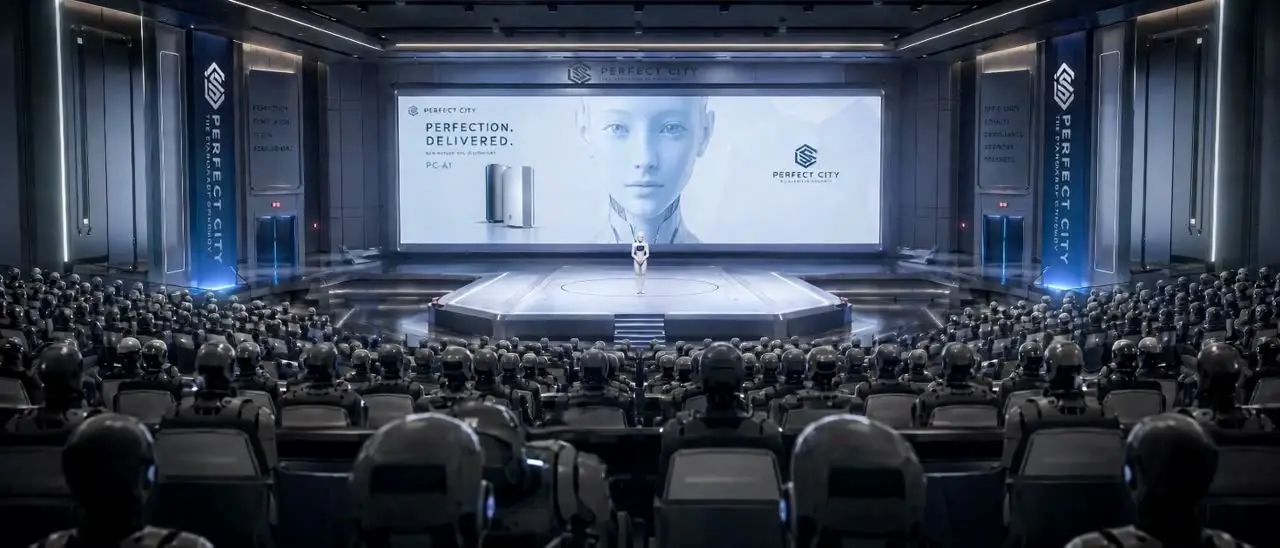
参考 {{Mixed 1}} 作为发布会礼堂环境参考,包括坐满的机器人观众、舞台布局、巨型屏幕和整体灯光氛围。参考 {{Mixed 2}} 作为主持机器人身份参考,包括白色合成材质的人形面部、蓝色眼灯、胸口屏幕、身体比例,以及精致的企业主持机器人设计。 创建一个15秒、21:9画幅的电影感新品发布会片段。整体为超写实真人实拍质感,轻微胶片颗粒,真实景深,干净未来感企业美术风格。最亮的灯光集中在舞台和主持机器人身上,观众区整体更暗,只保留柔和轮廓光和局部阴影。整体氛围应优雅、克制、洁净,同时略带压迫感。 主持机器人正在进行正式新品发布。她的台词必须是中文,短而官方: “欢迎完美城市居民来到新品发布会。新一代 PC-A One——” 她要以平静、专业的方式开始说话,然后在“PC-A One——”的尾部出现一次很小但有意义的语音故障。这个错误不是喜剧化夸张失误,而是一个短暂的系统卡顿、轻微中断,或极细微的情绪失稳。她会立刻意识到自己出错了。 0.0秒 – 2.5秒 | 硬切 | 超大全景建立镜头 | 32mm | T2.8 从礼堂后排拍摄全场,观众全部坐满并面向舞台。主持机器人独自站在舞台中央,舞台是绝对视觉中心。舞台上没有其他人,过道里也没有站人。她已经开始说开场词。镜头缓慢环绕 2.5秒 – 5.0秒 | 硬切 | 从观众后方拍摄的长焦观察镜头 | 135mm–200mm | T2.8 透过前景虚化的观众机器人头部与肩膀观察舞台,主持人被框在前景观众剪影之间。镜头只做轻微横移或小幅弧线移动,不要推进。她继续说:“欢迎完美城市居民来到新品发布会。” 5.0秒 – 8.0秒 | 硬切 | 中近景 | 85mm | T2.0 主持机器人形象精致、专业、自信。她说:“下面发布新一代 PC-A One——” 整体表演清晰、官方、克制。 8.0秒 – 10.0秒 | 硬切 | 更紧一点的中近景 | 85mm | T2.0 在“PC-A One——”结尾处发生一次极小的语音故障。表现为短暂电子卡顿、音高断裂,或极短暂语音中断。她的表情立刻变化,意识到自己犯错了。 10.0秒 – 12.5秒 | 硬切 | 特写 | 65mm | T2.0 她迅速用一只手捂住嘴,动作要清晰、易读、稍微带一点夸张的人类化感觉。眼睛睁大,另一只手僵在半空中,保持正在主持的姿势。这个镜头要让短视频观众一眼看懂她“出问题了”。 12.5秒 – 15.0秒 | 硬切 | 中近景到稍宽一点 | 65mm | T2.0 她轻轻向后退半步,肩膀绷紧,略带惊慌地左右瞟一下,像是已经意识到系统检测到了错误。保持她白色合成面部不变,蓝色眼灯仍可见。这一段先不要断电。最后停在她惊慌意识到出错的状态上,为下一个镜头留张力。 视觉风格:超写实真人实拍质感,电影感现实主义,轻微胶片颗粒,干净未来感企业设计,真实舞台灯光,优雅且冷峻的压迫氛围,画面清晰易读。不要卡通感,不要游戏渲染感,不要廉价CG感。 声音:只要对白、轻微发布会环境音、轻微机械空间底噪和真实音效,不要背景音乐。
Reference {{Mixed 1}} for the launch auditorium with seated robot audience, stage layout, giant screen, and overall lighting atmosphere. Reference {{Mixed 2}} for the exact presenter robot identity, white synthetic humanoid face, blue eye lights, chest display, body proportions, and polished corporate presenter design. Create a 15-second cinematic launch-event shot sequence in 21:9 widescreen. Ultra-realistic live-action film look, subtle film grain, realistic depth of field, clean futuristic corporate aesthetic, controlled stage lighting, elegant sterile atmosphere. The brightest light is concentrated on the main stage and presenter. The audience remains darker, with soft rim light and partial shadow. No dutch angle. No music. Only realistic auditorium ambience, subtle crowd presence, presenter voice, and body movement sounds. The presenter robot is introducing a new product in Chinese. Her line is short and clear, suitable for a product launch. She begins in a professional, polished corporate manner, then makes a tiny vocal glitch that is emotionally significant. She immediately realizes something is wrong, panics, loses system support, and collapses. Keep the performance readable and direct for short-form viewers. 0.0s – 2.2s | hard cut | very wide establishing shot | 32mm | T2.8 A full auditorium shot from the rear seating area. The robot audience is fully seated and facing the stage. The presenter robot stands alone at center stage. The giant screen is behind her. The stage is the visual center. No one else stands on stage. No one stands in the aisles. The presenter begins her Chinese launch line clearly: “欢迎来到 PERFECT CITY。现在发布——新一代 PC-A1……” Keep it elegant, clean, controlled. 2.2s – 4.5s | hard cut | long-lens observational shot from behind audience | 135mm–200mm | T2.8 Seen through the blurred heads and shoulders of audience robots in the foreground. The presenter is framed between foreground silhouettes. Use a subtle lateral move or slight arc move, not a push-in. She continues the final part of the line in a polished way, then a tiny vocal glitch interrupts her delivery near the end. The mistake is not a dramatic wrong sentence, just a brief electronic speech stutter or pitch break. She instantly senses something is wrong. 4.5s – 6.8s | hard cut | medium close-up | 85mm | T2.0 A clear readable performance shot. The presenter freezes for a fraction of a second after the glitch. Her professional smile collapses. Her expression changes into alarm. Her eyes widen slightly. Keep the white synthetic face unchanged and the blue eye lights visible. Her body posture tightens. 6.8s – 8.8s | hard cut | slightly high-angle tighter medium close-up | 85mm | T2.0 Camera is above her eye line by about one head height, looking downward at roughly a 45-degree vertical angle, with a slight side angle. She quickly raises one hand to cover her mouth in a very readable, human-like panic gesture. Her other hand freezes awkwardly mid-presentation. This shot should feel psychologically oppressive and clear. 8.8s – 10.8s | hard cut | medium close-up | 65mm | T2.0 She takes one small backward half-step. Her shoulders tighten. She glances slightly left and right in alarm, as if she knows the system has detected the error. Then her chest display dims into inactive dark glass. Her blue eye lights begin to fade into a pale inactive state. Keep the face shell intact. Do not damage the outer face. 10.8s – 13.2s | hard cut | low floor-level wide shot from a 30 to 45 degree front-side angle | 24mm | T2.8 She suddenly loses all support and collapses toward camera. Keep the horizon level. The impact comes from the low camera position and angle, not from dutch tilt. The collapse should feel abrupt and physically believable. Her body drops heavily and awkwardly, like system shutdown rather than dramatic acting. 13.2s – 15.0s | hard cut | low medium-wide hold | 32mm | T2.8 Hold on the fallen body on the stage floor. The giant screen remains behind her. The audience stays seated in the background. She is motionless, chest display dark, eye lights inactive or nearly inactive. End on a clean, usable fallen pose for the continuation shot. Visual style throughout: hyper-real live-action, IMAX 70mm film feel, Panavision anamorphic lens character, subtle film grain, soft highlight roll-off, realistic skin-like synthetic surface texture, realistic stage reflections, elegant futuristic launch-event aesthetic, no glossy CGI look, no cartoon feeling, no game-render look, no cheap sci-fi lighting.
 视频截图视频节点 4
参考 {{Mixed 1}} 作为发布会礼堂环境参考,包括坐满的机器人观众、舞台布局、巨型屏幕、建筑尺度和整体灯光氛围。参考 {{Mixed 2}} 作为主持机器人身份参考,包括白色合成材质的人形面部、蓝色眼灯、胸口屏幕、身体比例,以及精致的企业主持机器人设计。 创建一个 9 秒、21:9 画幅的电影感新品发布会片段。 这一段只表现“正式发布过程中发生一个微小失误,并被主持机器人自己瞬间意识到”的前半段状态。重点是:发布会感、产品感、主持人的专业状态、微小故障后的惊慌意识。整段结束在她意识到自己出错的状态上。 整体风格为超写实真人实拍质感,轻微胶片颗粒,真实景深,干净未来感企业美术风格。整体气质优雅、克制、洁净,带一点制度化压迫感。最亮的光集中在舞台、主持机器人和巨型屏幕上。观众区整体更暗,只保留柔和轮廓光和局部阴影。 巨型屏幕必须是明亮且正在工作的,必须清晰显示新品发布内容,而不是黑屏或空屏。屏幕视觉应包括:PERFECT CITY 品牌、新品 “PC-A One” 的主视觉、白色和浅蓝色的企业发布会 UI 设计,以及干净现代的产品发布字体排版。整个画面必须一眼让人看出这是一个正式的高端新品发布会。 主持机器人正在进行正式发布。她说一段简短中文开场词: “欢迎完美城市居民来到新品发布会。新一代 P——C-A One……” 这句台词里,失误必须发生在产品型号发音的中间,而不是整句话说完以后。她在说到 “P” 的时候出现一次极小但有意义的语音故障,表现为发音突然轻微卡顿、短暂中断、或一个极短的电子断裂,然后她勉强继续把后面的 “C-A One” 接出来。这个错误不是夸张搞笑的,不是大段胡言乱语,而是一次非常短、但足够让她自己立刻意识到失误的发音故障。 0.0秒 – 1.2秒 | 硬切 | 超大全景建立镜头 | 32mm | T2.8 从礼堂后排拍摄全场。机器人观众全部坐满并面向舞台。主持机器人独自站在舞台中央。舞台是绝对视觉中心。镜头稳定、规整、克制,可以有非常轻微的稳定漂移,但整体以庄重的建立感为主。她已经在说开场词。巨型屏幕明亮显示新品发布视觉。 1.2秒 – 2.7秒 | 硬切 | 从观众后方拍摄的长焦观察镜头 | 135mm–200mm | T2.8 透过前景虚化的观众机器人头部与肩膀观察舞台。主持人被框在前景观众剪影之间。镜头只做轻微横移或极轻微弧线移动,不要明显推进。这个镜头要像观众正在认真观看她。巨型屏幕依然清晰可见,保持发布会信息感。 2.7秒 – 4.5秒 | 硬切 | 中近景 | 85mm | T2.0 主持机器人形象精致、专业、自信。她平静地进行正式新品发布,说出:“欢迎完美城市居民来到新品发布会。新一代 P——” 她的表演应清晰、官方、克制,白色合成面部完整,蓝色眼灯清晰可见,胸口屏幕正常工作。 4.5秒 – 5.4秒 | 硬切 | 更紧一点的中近景 | 85mm | T2.0 失误必须发生在型号发音中间。她在说出 “P” 时突然出现一次极小的语音故障。表现为这个字母的发音轻微卡住、短暂断裂、或者极细微电子抖动,中间像被切断了一瞬,然后她勉强续上后面的 “C-A One”。故障时间很短,但足以让她瞬间意识到自己出错。她职业化的表情立刻僵住,眼神微微睁大。 5.4秒 – 7.0秒 | 硬切 | 特写 | 65mm | T2.0 她迅速用一只手捂住嘴,动作清晰、易读、带一点人类化的本能惊慌感。另一只手仍停留在发布姿势中,略显僵硬。这个镜头要让短视频观众一眼看懂:她刚刚出错了。她仍然站立,蓝色眼灯仍然亮着,状态是惊慌、紧绷、强行控制自己。 7.0秒 – 9.0秒 | 硬切 | 中近景 | 65mm | T2.0 她轻轻向后退半步,肩膀收紧,左右快速瞟一下,像是意识到系统已经听见了这个错误。她此刻仍站在舞台上,整个人陷入一种职业秩序即将崩塌前的短暂惊慌。镜头停留在这个状态上结束,为下一段留下张力。 声音:只要中文对白、轻微发布会环境音、轻微机械空间底噪,以及极小的电子语音故障。不要背景音乐。 视觉风格:超写实真人实拍质感,电影感现实主义,轻微胶片颗粒,干净未来感企业设计,真实舞台灯光,优雅且冷峻的压迫氛围,画面清晰易读。
参考 {{Mixed 1}} 作为发布会礼堂环境参考,包括坐满的机器人观众、舞台布局、巨型屏幕、建筑尺度和整体灯光氛围。参考 {{Mixed 2}} 作为主持机器人身份参考,包括白色合成材质的人形面部、蓝色眼灯、胸口屏幕、身体比例,以及精致的企业主持机器人设计。 创建一个 9 秒、21:9 画幅的电影感新品发布会片段。 这一段只表现“正式发布过程中发生一个微小失误,并被主持机器人自己瞬间意识到”的前半段状态。重点是:发布会感、产品感、主持人的专业状态、微小故障后的惊慌意识。整段结束在她意识到自己出错的状态上。 整体风格为超写实真人实拍质感,轻微胶片颗粒,真实景深,干净未来感企业美术风格。整体气质优雅、克制、洁净,带一点制度化压迫感。最亮的光集中在舞台、主持机器人和巨型屏幕上。观众区整体更暗,只保留柔和轮廓光和局部阴影。 巨型屏幕必须是明亮且正在工作的,必须清晰显示新品发布内容,而不是黑屏或空屏。屏幕视觉应包括:PERFECT CITY 品牌、新品 “PC-A One” 的主视觉、白色和浅蓝色的企业发布会 UI 设计,以及干净现代的产品发布字体排版。整个画面必须一眼让人看出这是一个正式的高端新品发布会。 主持机器人正在进行正式发布。她说一段简短中文开场词: “欢迎完美城市居民来到新品发布会。新一代 P——C-A One……” 这句台词里,失误必须发生在产品型号发音的中间,而不是整句话说完以后。她在说到 “P” 的时候出现一次极小但有意义的语音故障,表现为发音突然轻微卡顿、短暂中断、或一个极短的电子断裂,然后她勉强继续把后面的 “C-A One” 接出来。这个错误不是夸张搞笑的,不是大段胡言乱语,而是一次非常短、但足够让她自己立刻意识到失误的发音故障。 0.0秒 – 1.2秒 | 硬切 | 超大全景建立镜头 | 32mm | T2.8 从礼堂后排拍摄全场。机器人观众全部坐满并面向舞台。主持机器人独自站在舞台中央。舞台是绝对视觉中心。镜头稳定、规整、克制,可以有非常轻微的稳定漂移,但整体以庄重的建立感为主。她已经在说开场词。巨型屏幕明亮显示新品发布视觉。 1.2秒 – 2.7秒 | 硬切 | 从观众后方拍摄的长焦观察镜头 | 135mm–200mm | T2.8 透过前景虚化的观众机器人头部与肩膀观察舞台。主持人被框在前景观众剪影之间。镜头只做轻微横移或极轻微弧线移动,不要明显推进。这个镜头要像观众正在认真观看她。巨型屏幕依然清晰可见,保持发布会信息感。 2.7秒 – 4.5秒 | 硬切 | 中近景 | 85mm | T2.0 主持机器人形象精致、专业、自信。她平静地进行正式新品发布,说出:“欢迎完美城市居民来到新品发布会。新一代 P——” 她的表演应清晰、官方、克制,白色合成面部完整,蓝色眼灯清晰可见,胸口屏幕正常工作。 4.5秒 – 5.4秒 | 硬切 | 更紧一点的中近景 | 85mm | T2.0 失误必须发生在型号发音中间。她在说出 “P” 时突然出现一次极小的语音故障。表现为这个字母的发音轻微卡住、短暂断裂、或者极细微电子抖动,中间像被切断了一瞬,然后她勉强续上后面的 “C-A One”。故障时间很短,但足以让她瞬间意识到自己出错。她职业化的表情立刻僵住,眼神微微睁大。 5.4秒 – 7.0秒 | 硬切 | 特写 | 65mm | T2.0 她迅速用一只手捂住嘴,动作清晰、易读、带一点人类化的本能惊慌感。另一只手仍停留在发布姿势中,略显僵硬。这个镜头要让短视频观众一眼看懂:她刚刚出错了。她仍然站立,蓝色眼灯仍然亮着,状态是惊慌、紧绷、强行控制自己。 7.0秒 – 9.0秒 | 硬切 | 中近景 | 65mm | T2.0 她轻轻向后退半步,肩膀收紧,左右快速瞟一下,像是意识到系统已经听见了这个错误。她此刻仍站在舞台上,整个人陷入一种职业秩序即将崩塌前的短暂惊慌。镜头停留在这个状态上结束,为下一段留下张力。 声音:只要中文对白、轻微发布会环境音、轻微机械空间底噪,以及极小的电子语音故障。不要背景音乐。 视觉风格:超写实真人实拍质感,电影感现实主义,轻微胶片颗粒,干净未来感企业设计,真实舞台灯光,优雅且冷峻的压迫氛围,画面清晰易读。
创建一张干净的电影色卡板,整体呈现风格和版式逻辑参考 。 注意:不是照搬 {{Image 1}} 的颜色。 只参考 {{Image 1}} 的色卡展示样式、设计结构和版式风格: 白色干净背景、优雅标题字体、居中排版、均匀排列的竖向色块、小号十六进制标签,以及颜色名称与说明文字。 这张色卡用于 PERFECT CITY 的地下过渡区 / 内层穿行区,也就是小旧机器人带着主角往更深处走,并且能看到被淘汰机器人生活、工作、教学、维修、演奏的区域。 这套色卡必须属于和地下接收区同一个世界。 不要做成另一种美术风格。 不要做得鲜艳或轻快。 要保持落地、电影化、工业化。 主题: 地下内层通道 / 生活边缘地带色卡 色彩逻辑: 这是接收区色卡的轻微升温延展版。 中性的工业底色仍然保留。 但实用暖光、旧锈色、使用痕迹和“有人气的金属温度”稍微增加。 它要传达的是:更深处藏着“活着的空间”,但依然处于严酷工业环境中。 氛围关键词: 克制的温度, 没有真人却有“人的存在感”, 废弃后重组出来的生活感, 不完美但活着, 工业中的亲密感, 依然偏暗、真实。 建议包含的色块: 1. 混凝土粉尘灰 2. 深井炭灰 3. 风化钢蓝灰 4. 灼烧锈棕 5. 陈旧酒红 6. 老铁黑 7. 钨丝实用琥珀光 8. 昏暗工坊橙 9. 脏旧黄铜微光 10. 褪色米灰残留 每个色块需要显示: - 十六进制色值 - 简短大写名称 - 小号描述说明 标题建议: PERFECT CITY — UNDERGROUND INNER PASSAGE PALETTE 副标题建议: A CINEMATIC COLOR SYSTEM FOR THE HIDDEN LIFE BELOW 最终效果应像地下接收区色卡的“配套姊妹版”: 同一图形家族, 同一设计语言, 同一品质, 但情绪上更微暖一点、更有被使用过的生活感。
女声AI广播,冷静、冰冷、机械、没有人情味,像城市公共系统在宣读规则。语速中慢,吐字清晰,句间停顿明显,整体没有情绪波动,但在最后一句略微加重语气,形成制度性压迫感。不要像旁白,不要像广告,不要表演。整体时长约15秒。配音内容:错误,不被原谅。停顿。不合格者,予以淘汰。停顿。追求完美,清除偏差。
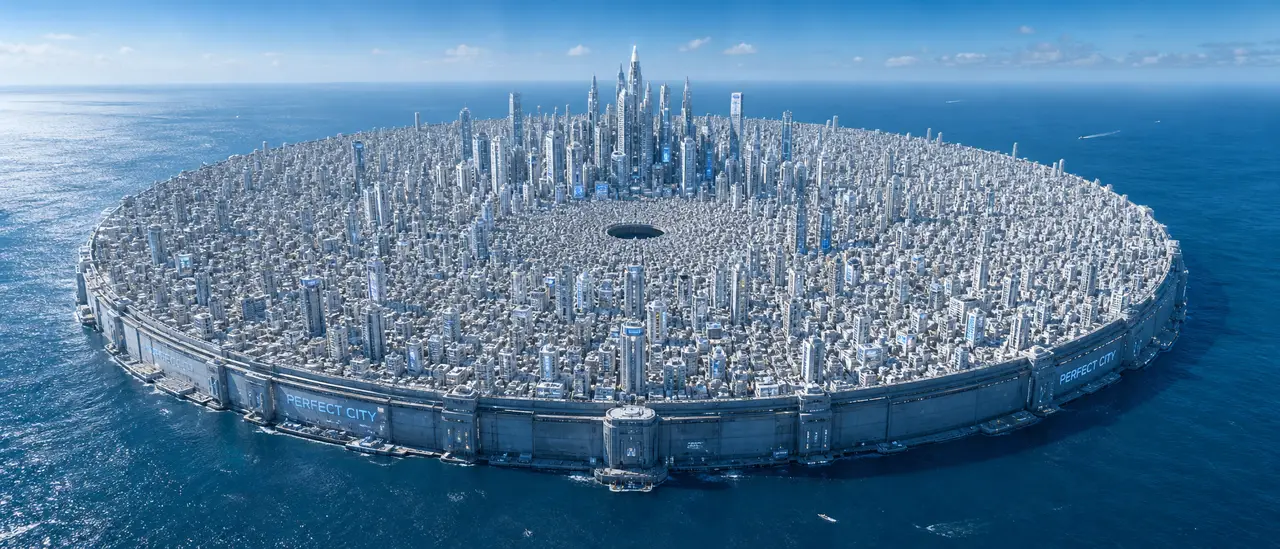 图片节点 15
Create a cinematic extreme-wide aerial establishing shot of PERFECT CITY, revealed as a single circular island-city floating on a vast cold ocean. The city sits on a massive circular steel-and-concrete platform / sea fortress rising from the water, its outer edge a sheer vertical industrial wall ringing the whole island. SCALE IS CRITICAL — this must read as an ENORMOUS, VAST megacity, not a small island town. Achieve this by: - The city is extremely DENSE and PACKED, filled edge to edge with COUNTLESS buildings — thousands of structures, far too many to count, packed tightly together with narrow streets between them, like a real sprawling metropolis seen from very high above. - Individual buildings are SMALL relative to the whole island. No single building dominates. The towers are slender and numerous, the mid and low buildings are tiny and incredibly densely packed, receding into fine detail toward the edges. The smallness and sheer number of buildings is what makes the city feel gigantic. - A cluster of tall sleek glass skyscrapers rises toward the center, surrounded by a vast dense carpet of progressively smaller buildings filling the entire platform. THE CITY'S ARCHITECTURE: a pristine futuristic metropolis — clean white and pale-grey towers, glass-curtain-wall skyscrapers, polished sleek surfaces, glowing blue holographic "PERFECT CITY" signage, elegant high-tech architecture. It looks expensive, immaculate, technologically advanced — a utopia on the surface, though its true nature is a controlled prison. The beauty is the point: a perfect-looking cage. NOT raw grey concrete, NOT a brutalist prison, NOT thin needle spires. CENTRAL FEATURE: at the exact center there is ONE round black pit sinking into the platform. CRITICAL: the pit is SMALL — only a tiny fraction of the city's diameter, a small dark circle dwarfed by the enormous dense city sprawling around it. The pit must NOT be large. Do NOT draw any line, bridge, or causeway crossing the pit — keep it a clean uninterrupted small dark circle. The island sits alone in a wide open ocean, surrounded by clean blue water and clear cool sky, isolated but immense. LIGHTING & COLOR: clear, bright, luminous cold daylight — a crisp clear day, clean air, high clarity. Cool blue palette but BRIGHT and CLEAN, deep blue ocean, clear pale-blue sky. NOT a dull grey overcast day, NOT flat monochrome gloom, NOT murky haze. The white city reads clean and luminous against the deep blue sea. Composition: extreme wide high aerial shot, the full circular megacity centered in frame with its small central pit, surrounded by open bright blue sea, the dense sleek white city sprawling vast and readable. Style: hyper-real live-action cinematic realism, IMAX 70mm feeling, clean bright cold-blue cinematic color, deep blue ocean, extreme density and detail, high clarity and sharpness, polished high-tech surfaces, no warm light, no grey overcast gloom, no brutalist concrete prison look, no neon cyberpunk clutter, no cartoon, no game-render feel.
Create a cinematic movie title logo on a solid pure black background, 16:9. Large Chinese characters "完美城市" dominate the center, in a bold modern geometric brushed-metal typeface — cold steel-silver with a crisp cool blue highlight along the top edges, sharp architectural letterforms, sterile high-end authority. Below, smaller uppercase "PERFECT CITY" in thin spaced metallic letters with a divider line. Beneath that, very small "PERFECTION IS MANDATORY." Critical detail: through the character "美", a fine hairline CRACK runs across the metal, with a tiny fragment of the metallic surface chipped and broken away — a subtle flaw in an otherwise flawless perfect logo, hinting the perfect city is cracked underneath. The crack is delicate and understated, not shattered. Style: hyper-clean cinematic title design, IMAX title-card quality, cold blue-grey palette, brushed metal texture, crisp sharp rendering on pure black, cool edge lighting, professional film title aesthetic, no glow overload, no cheap neon, no cartoon.
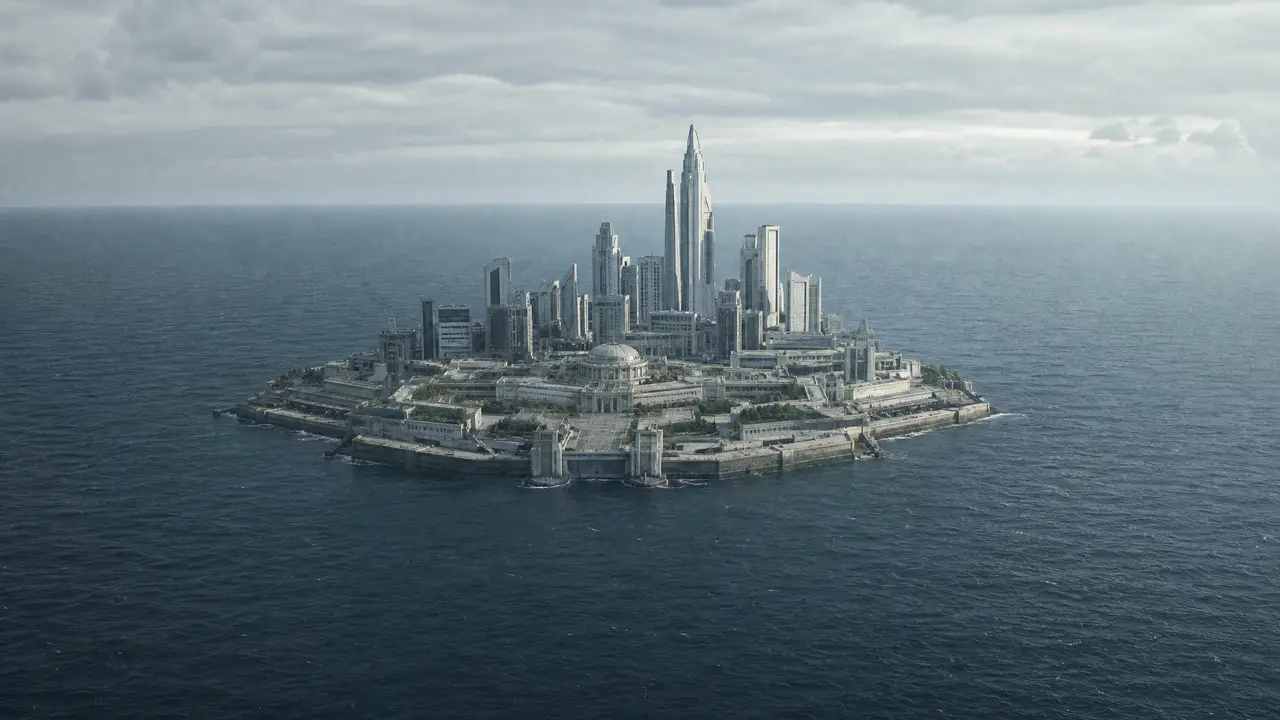 图片节点 3
Create a cinematic live-action asset image of PERFECT CITY as an isolated steel island in the sea. This is the upper-city utopia seen at the end of the film as a distant, self-contained industrial-metropolitan island surrounded by open ocean. It should feel monumental but emotionally isolated: a once-powerful perfect city now revealed as a lonely steel island separated from the wider world. Preserve the identity of PERFECT CITY: clean futuristic upper-city architecture, monumental towers, structured urban massing, orderly geometry, institutional civic scale, and a cold idealized city design language. But in this image, the city must read as a single isolated island: a dense steel-and-concrete city mass rising from a solitary island base, surrounded entirely by ocean, with visible shoreline edges, retaining structures, sea barriers, or industrial coastal foundations. It should feel like an engineered island-city rather than a natural coastline. The mood is distant and emotionally revealing: the city looks impressive, but also cold, sealed, and cut off. It should feel like a place being left behind. Composition goal: a wide or aerial wide establishing asset image suitable for later compositing. Show the entire island-city clearly, surrounded by sea, with enough negative space around it for later framing. The city should be readable as one lonely steel island in a vast expanse of water. Lighting and atmosphere: cold daylight or cool overcast light, subtle haze, soft atmospheric falloff, slightly desaturated tones, clean upper-city surfaces contrasted against the emptiness of the sea. Environment: open ocean, broad horizon, minimal distractions, no boats in this asset, no foreground characters, no story action. This is primarily a clean environmental asset. Visual style: hyper-real live-action, cinematic large-format realism, soft film-like texture, monumental urban design, grounded scale, restrained detail, IMAX 70mm feeling, Panavision anamorphic character, realistic city materials, subtle atmospheric depth, no glossy CGI, no cartoon feeling, no game-render feeling.
参考图: {{Image 1}} 作为船的主体结构和宽阔平甲板参考(保留它的航母型宽大平甲板、扁圆形船头、巨大体量)。 {{Image 2}} 作为船侧舷的质感参考(采用 {{Image 2}} 那种更整体、更像远洋巨轮的船舷,而不是过度破碎的海上要塞感)。 生成一艘巨型废土拼装远洋方舟,三分之四前视角,航行在开阔海面上。 船型:航母级宽阔的开放平甲板,体量巨大,扁圆形(椭圆形)的工业船头,笨重厚实,像被拒者用废料拼成的笨重方舟。船舷整体感强,像远洋巨轮的侧舷,而非过度破碎的堡垒。 拼装质感:焊接废料、色差钢板、补丁船体、铆钉、外露管线、锈迹,但保持整体轮廓清晰,不要过度凌乱。 重要标记:船舷侧面有一块醒目的红色"REJECTED"涂鸦标记,漆在一块相对平整的船舷钢板上,褪色斑驳,像一枚革命纪念印记。另有褪色的"DECOMMISSIONED"字样和旧编号。 甲板:宽阔平整,空无一人,没有任何人物或机器人(empty deck, no people, no figures)。 天气氛围:开阔冷色海面,天边有一缕微弱的暖色天光(驶向光的方向),不要阴天乌云,不要压抑灰暗,要有辽阔和新生感。 画质:超清晰锐利的电影摄影质感,干净,no painterly texture, no heavy grain, no oil-painting smear, crisp photographic clarity, hyper-real live-action, IMAX 70mm grade, 21:9 widescreen, not CGI plastic, not cartoon, not game-render.
Use {{Image 1}} as the primary design-language reference for the migration vessel. Preserve the heavy oval-shaped bow, the broad carrier-like deck feeling, the layered industrial superstructure, and the sense that this ship was built by an underground civilization of rejected robots rather than by a conventional surface-world shipyard. Use {{Image 2}} only as the hull-side structure reference. Preserve its cleaner long-range ship-body logic, more unified side silhouette, and more readable ocean-going vessel proportion. Do not inherit its exact composition or presentation style. Use it only to make the side hull feel more like a true large ship and less like an over-cluttered floating platform. Use {{Image 3}} only as a symbolic mural / commemorative-painting content reference. Do not inherit its environment, composition, or character placement. Only use the idea of the giant repair robot and the three key robots as the subject matter of a faded large-scale painted memorial image on the ship’s side hull, like a revolutionary historical mural painted by the underground civilization. Create a cinematic asset design image of a massive migration vessel / ark built by an underground civilization of rejected robots from salvaged maritime structures, old industrial ship components, and rebuilt mechanical systems. This ship should feel like a large old industrial ocean-going ark: a carrier-like migration vessel, broad upper deck spaces, heavy steel hull, layered industrial platforms, rebuilt communal superstructure, and a monumental moving-refuge identity. Core design identity: This is not a modern cruise ship. This is not a clean futuristic carrier. This is not a military aircraft carrier. It is a large old industrial ark rebuilt by rejected robots: a moving settlement, a communal refuge, and the continuation of the underground world at sea. Design balance: - keep the strong heavy oval bow and broad deck identity from - keep the hull side cleaner, larger, and more unified like - avoid excessive clutter or overcomplicated side attachments - the ship must still feel assembled and patched, but the silhouette should remain readable and cinematic Construction language: assembled from salvaged maritime hull sections and industrial structures, visible welded grafting, patched hull plates, modular deck expansions, repair gantries, utility cranes, exterior ladders, catwalks, maintenance walkways, reinforced spine logic, communal long-term rebuilding evidence. Ship-body design: The bow should feel broad, blunt, and powerful, not elegant like a conventional luxury liner. The upper deck should feel wide and platform-like, able to hold many robots. The superstructure should rise like a rebuilt mechanical settlement rather than a neat commercial passenger block. The side hull should feel more coherent and ship-like than a floating platform, with larger continuous hull masses and fewer chaotic protrusions. Important mural detail: On one side area of the hull, include a large faded commemorative painted mural or symbolic industrial-era wall graphic inspired by a historic revolutionary moment: a giant repair robot and three small key robot figures. This should feel like a weathered memorial painting created by the rejected robot civilization, not like a clean printed poster or a literal pasted screenshot. Material identity: weathered steel, scarred paint, rust streaks, soot, patched seams, old ship metal, reused mechanical components, industrial maritime surfaces, heavy construction logic, realistic aging. Emotional identity: This ship should feel like a civilization-scale ark — less “ship as transport,” more “ship as moving refuge / moving settlement / moving future.” Composition: three-quarter hero view of the full vessel, slightly elevated, show the broad bow, the long side hull, the layered upper deck, and the rebuilt ark identity clearly. The vessel should be readable as huge, practical, and ocean-going, with enough deck space and internal scale to plausibly carry many rejected robots. Lighting and style: hyper-real live-action cinematic realism, IMAX 70mm feeling, Panavision anamorphic character, subtle film grain, grounded industrial materials, restrained color palette, atmospheric realism, no glossy sci-fi finish, no cartoon style, no game-render feel.
Use {{Image 1}} as the primary design-language reference for the migration vessel. Preserve the heavy oval-shaped bow, the broad carrier-like deck feeling, the layered industrial superstructure, and the sense that this ship was built by an underground civilization of rejected robots rather than by a conventional surface-world shipyard. Use {{Image 2}} only as the hull-side structure reference. Preserve its cleaner long-range ship-body logic, more unified side silhouette, and more readable ocean-going vessel proportion. Do not inherit its exact composition or presentation style. Use it only to make the side hull feel more like a true large ship and less like an over-cluttered floating platform. Use {{Image 3}} only as a symbolic mural / commemorative-painting content reference. Do not inherit its environment, composition, or character placement. Only use the idea of the giant repair robot and the three key robots as the subject matter of a faded large-scale painted memorial image on the ship’s side hull, like a revolutionary historical mural painted by the underground civilization. Create a cinematic asset design image of a massive migration vessel / ark built by an underground civilization of rejected robots from salvaged maritime structures, old industrial ship components, and rebuilt mechanical systems. This ship should feel like a large old industrial ocean-going ark: a carrier-like migration vessel, broad upper deck spaces, heavy steel hull, layered industrial platforms, rebuilt communal superstructure, and a monumental moving-refuge identity. Core design identity: This is not a modern cruise ship. This is not a clean futuristic carrier. This is not a military aircraft carrier. It is a large old industrial ark rebuilt by rejected robots: a moving settlement, a communal refuge, and the continuation of the underground world at sea. Design balance: - keep the strong heavy oval bow and broad deck identity from - keep the hull side cleaner, larger, and more unified like - avoid excessive clutter or overcomplicated side attachments - the ship must still feel assembled and patched, but the silhouette should remain readable and cinematic Construction language: assembled from salvaged maritime hull sections and industrial structures, visible welded grafting, patched hull plates, modular deck expansions, repair gantries, utility cranes, exterior ladders, catwalks, maintenance walkways, reinforced spine logic, communal long-term rebuilding evidence. Ship-body design: The bow should feel broad, blunt, and powerful, not elegant like a conventional luxury liner. The upper deck should feel wide and platform-like, able to hold many robots. The superstructure should rise like a rebuilt mechanical settlement rather than a neat commercial passenger block. The side hull should feel more coherent and ship-like than a floating platform, with larger continuous hull masses and fewer chaotic protrusions. Important mural detail: On one side area of the hull, include a large faded commemorative painted mural or symbolic industrial-era wall graphic inspired by a historic revolutionary moment: a giant repair robot and three small key robot figures. This should feel like a weathered memorial painting created by the rejected robot civilization, not like a clean printed poster or a literal pasted screenshot. Material identity: weathered steel, scarred paint, rust streaks, soot, patched seams, old ship metal, reused mechanical components, industrial maritime surfaces, heavy construction logic, realistic aging. Emotional identity: This ship should feel like a civilization-scale ark — less “ship as transport,” more “ship as moving refuge / moving settlement / moving future.” Composition: three-quarter hero view of the full vessel, slightly elevated, show the broad bow, the long side hull, the layered upper deck, and the rebuilt ark identity clearly. The vessel should be readable as huge, practical, and ocean-going, with enough deck space and internal scale to plausibly carry many rejected robots. Lighting and style: hyper-real live-action cinematic realism, IMAX 70mm feeling, Panavision anamorphic character, subtle film grain, grounded industrial materials, restrained color palette, atmospheric realism, no glossy sci-fi finish, no cartoon style, no game-render feel.移除甲板上的人,把天气和海面变成深蓝海水和晴天
Use {{Mixed 1}} as the protagonist robot identity reference. Preserve the exact white inspection-and-disposal robot design, facial screen style, proportions, worn body structure, PC-67241 markings, and REJECT device. IMPORTANT: this protagonist robot is unique. Keep him as the only robot with this exact face screen, white inspection body, uniform-like design, PC-67241 markings, and REJECT device. Use {{Mixed 2}} as the female presenter robot identity reference. Preserve her elegant humanoid face, white synthetic shell, blue eye lights, graceful proportions, chest display, and slightly worn underground condition. Use {{Mixed 3}} as the small old robot identity reference. Preserve its short cylindrical body, worn blue-and-white shell, compact size, dome-like head, and early-generation service-robot feeling. Use {{Mixed 4}} as the background rejected robot design-family reference. Preserve varied old service-unit silhouettes, boxy bodies, cylindrical shells, wheeled bases, worn paint, repair patches, faded markings, and practical reused parts. All background robots should feel like older discarded city-service units, visibly different from the protagonist. Use {{Mixed 5}} as the early-learning guidance robot reference. Preserve it as the teaching robot. Use {{Mixed 6}} as the underground inner-street environment reference. Preserve the feeling of a lived-in underground repair street inside a giant lightless shaft-city: workshop lamps, repair stalls, damp floor reflections, patched metal structures, practical tools, warm utility lights, smoke haze, and quiet underground activity. Preserve a wider, deeper, more inhabited spatial feeling, with layered midground and background recession. Use {{Mixed 7}} as the underground passage palette reference. Preserve the neutral-to-slightly-warm color system: concrete dust gray, deep shaft gray, weathered steel, scorched rust, faded wine red, old iron black, tungsten amber, dim workshop orange, aged brass glow, and faded milk gray. Create an 8-second cinematic live-action sequence in 21:9 widescreen. This is the revised continuation of Shot 26. This sequence happens in the underground inner street beneath PERFECT CITY, after the protagonist has already been welcomed below and is being led deeper inside. The first walking-guide part has already happened before this clip. This clip begins directly when the protagonist notices the early-learning guidance robot teaching younger obsolete robots. Emotional purpose: the protagonist silently realizes that the rejected robots still have value. This is not a dramatic breakdown. This is a quiet internal shift, expressed through one small physical action: he touches the small chest compartment where he secretly kept the triangular learning block. Overall image treatment: cinematic photograph, soft film-like aesthetic, restrained detail, large color shapes, unified material language, natural practical-light dominance, selective focus hierarchy, shallow depth of field, photochemical color softness, gentle edge falloff, subdued micro-detail, soft highlight bloom, observed film-frame feeling. CHARACTER BLOCKING: The protagonist inspection robot remains the center emotional anchor. The small old robot stays on the protagonist’s left-hand side, slightly ahead or near him, acting as the guide and speaker. The female presenter robot stays on the protagonist’s right-hand side, slightly behind or level with him, calm and observant. Maintain this relationship clearly whenever the trio appears. CAMERA AND LIGHTING DIRECTION: The camera should feel handheld-cinematic, with restrained operator sway, subtle breathing motion, small natural reframing corrections, and motivated drifts toward what the protagonist notices. Use selective focus, rack focus, and visible focus hierarchy. Lighting should come mainly from practical workshop lamps, warm utility bulbs, repair lights, and soft floor reflections. The characters move through warm pools of light and deeper shadow gaps. Use damp floor reflections, smoke haze, pockets of darkness, soft highlight roll-off, and real practical-light falloff. SHOT 1 — 0.0s to 4.2s Begin from an over-the-shoulder angle near the protagonist, lens feeling around 65mm, T1.8. The protagonist’s shoulder or side silhouette is soft in the near foreground. Use a gentle drift and rack focus from the protagonist’s shoulder line toward the teaching robot and the block structure. Show the early-learning guidance robot teaching several smaller worn robots how to build a tall, complex block structure. The block tower should be visually impressive: taller than the small robots, layered, careful, architectural, made from simple geometric blocks and salvaged learning pieces. It should feel skillful, patient, and cared-for, not like a tiny toy pile. The smaller robots are worn, chipped, and old, but focused and engaged. Lighting here is warmer and more intimate: a practical workshop lamp creates a warm pool of light over the block tower and the teaching group. The background falls off into darker concrete and weathered steel. Use shallow depth of field and clear focal separation so this moment feels intimate and observed. The small old robot says in Chinese: “可那个,在上面,教过三百个小家伙。” Short pause. “你看,还能搭这么高。” The second line should land as the camera reveals the tall block tower. Voice tone: dry, nimble, slightly amused, not sentimental, like an old small service robot casually showing a fact he has seen many times. Hard cut to Shot 2. SHOT 2 — 4.2s to 8.0s Cut to the protagonist’s reaction in a medium close side-profile shot, lens feeling around 75mm, T2.0. The teaching group remains softly visible in the background direction. The female presenter robot stays on the protagonist’s right side, slightly behind, catching a soft warm edge light. The small old robot stays on the protagonist’s left side, near him, finishing the thought casually. Start with the protagonist looking toward the teaching robot and the tall block tower. Then the camera makes a subtle downward tilt following the protagonist’s hand as it slowly rises and touches the small upper-right chest / heart-area compartment where he secretly stored the triangular learning block earlier. The hand movement is small, almost unconscious. He does not open the compartment. He does not take the block out. He only touches the closed chest panel once, like confirming that the object is still there. Hold briefly on the hand touching the chest panel. Then the camera gently tilts back up to the protagonist’s face screen. His face display changes subtly: a tiny unreadable flicker, discomfort, confusion, and then a small crack in his certainty. He lowers his head slightly for a brief moment, then looks back toward the teaching robot. The small old robot says in Chinese: “我们不是坏了,只是没通过他们的标准。” The line should feel casual and lived-in, not like a slogan. Hold on the protagonist’s reaction for the final beat. Let the last half-second breathe. Visual style: hyper-real live-action, IMAX 70mm film feel, Panavision anamorphic lens character, selective focus, shallow depth of field, soft film grain, restrained detail, unified material language, soft highlight roll-off, practical-light contrast, damp reflections, concrete texture, aged paint, faded city-service branding, warm utility lamps, smoke haze, observed cinematic intimacy. Sound design: soft workshop ambience, distant repair tools, faint servo movement, small block contact sounds from the teaching area, damp underground room tone, quiet mechanical voice from the small old robot, no music.
使用 {{Mixed 1}} 作为主角机器人身份参考。保留它准确的白色质检与处置机器人设计、面部屏幕样式、身体比例和磨损机身结构。重要:这个主角机器人是唯一的。画面里只有它可以拥有这种面部屏幕、白色质检制服式机身、PC-67241 标记和 REJECT 装置。 使用 {{Mixed 2}} 作为女性主持机器人身份参考。保留她优雅的人形面孔、白色合成外壳、蓝色眼灯、优雅比例、胸口显示屏,以及进入地下后略有磨损的状态。 使用 {{Mixed 3}} 作为小旧机器人身份参考。保留它矮小的圆柱形身体、磨损的蓝白外壳、紧凑体型和早期服务机器人感觉。 使用 {{Mixed 4}} 作为背景被拒机器人设计家族参考。保留各种老旧服务单元轮廓:方形机身、圆柱形外壳、轮式底座、磨损油漆、维修补丁、褪色标记和实用化改装部件。所有背景机器人都应该像更早期被废弃的城市服务机器人,并且明显区别于主角。 使用 {{Mixed 5}} 作为早教引导机器人参考。保留它作为“教学机器人”的身份。 使用 {{Mixed 6}} 作为地下内街环境参考。保留它“巨大无光井城内部、有人生活过的地下维修街”感觉:工作灯、维修摊、潮湿地面反光、拼补金属结构、实用工具、暖色小灯、烟雾和安静的地下活动。空间要更宽、更深、更有人气,有中景和后景的层次递进。 使用 {{Mixed 7}} 作为地下通道色卡参考。保留中性到微暖的色彩系统:水泥尘灰、深井灰、风化钢、焦锈色、褪色酒红、旧铁黑、钨丝琥珀、昏暗工坊橙、旧黄铜光泽和褪奶灰。 使用 {{Mixed 8}} 作为小旧机器人的声音参考。保留它略亮、紧凑、干涩、反应快的机械音色。声音应该像一个早期小型服务机器人:有点话痨,略带吐槽感,轻微幽默,但不要卡通化。节奏要灵活,有短停顿、轻微机械气口和干一点的表达。语气要显得老旧但仍然机灵,不要慢、沉、过于严肃。 创建一个 12 秒、21:9 宽银幕电影感真人实拍质感序列。这是影片第 26 镜。 这段发生在 PERFECT CITY 下方的地下内街中。主角已经被地下世界接住,现在正被小机器人带着继续往深处走。这里仍然是地下城市的过渡内街,还不是更深处的大空间。 情绪目的: 主角开始意识到,这些被拒绝的机器人依然有价值。这个瞬间应该悄悄击裂他过去的世界观。 整体画面处理: 电影摄影感,柔和胶片质感,克制细节,大色块优先,统一材质语言,自然实用光源主导,明确焦点层级,浅景深,胶片化色彩柔和度,柔和边缘衰减,弱化微细节,轻微高光泛光,有被观察到的电影画面感。 重要角色站位规则: 三位主要角色在整个序列中保持稳定关系。 主角质检机器人始终在三人中间。 小旧机器人走在主角左手边,并稍微领先半步,作为带路者和说话者。 女性主持机器人走在主角右手边,略微落后或与主角平齐,安静观察。 所有镜头都要清楚保持这个关系。 小旧机器人声音表演方向: 小机器人不是在演讲,而是一边带主角参观,一边有点话多地介绍。 它的说话方式应该干、快、略带笑意,像一个在下面待了很久、对这里很熟的老服务机器人。 在“废品”“第一批下来的”“你看”之后要有短停顿。 不要让声音很平、很空、很无情绪。 不要戏剧化。 幽默感要干一点,像生活里自然带出来的吐槽。 摄影与光线方向: 摄影机应有手持电影感,包括克制的操作员晃动、轻微跟随呼吸感、小幅自然重新构图,以及根据主角视线动机去摇移或漂移。 使用选择性焦点、焦点转移和清晰的焦点层级。 当角色穿过实用光源区域时,光线要发生变化。 他们经过工作灯、暖色工具灯或维修灯时,机身边缘捕捉到更暖的高光和柔和反射。 离开这些光源后,身体进入更深的反差和阴影。 使用潮湿地面反光、烟雾、暗部空间、柔和高光衰减和真实实用光源衰减。 镜头 1 — 0.0 秒到 4.0 秒 克制手持侧跟 / 前侧三分之四跟拍,镜头感觉约 40mm,T2.0。 摄影机在三人旁边跟拍,他们缓慢穿过一条宽阔的地下维修街。 主角始终是画面视觉锚点。 小旧机器人在主角左手边,稍微领先半步,一边带路一边说话。 女性主持机器人在主角右手边,略微靠后或平齐,安静、克制。 加入电影感遮挡: 失焦的管道、垂落线缆或经过的维修物件短暂掠过画面前景。 他们经过一盏暖色维修灯时,镜头出现柔和光晕。 三人穿过暖光和阴影交替的区域。 主角保持在主要焦点层,其他两位可以轻微进入或离开次级焦点。 背景中,被拒机器人以柔和分层方式搬运零件、修理物品、停下观察或穿过街道。 小旧机器人说中文: “上面说,我们是废品。” 短停顿。 “我嘛,算第一批下来的。” 语气:干、话多、带一点自嘲,匹配 {{Mixed 8}}。 硬切到镜头 2。 镜头 2 — 4.0 秒到 9.0 秒 切到同一条地下内街上的教学生活点。 从接近主角位置的过肩角度开始,镜头感觉约 65mm,T1.8。 一开始,主角的肩膀或身体侧影作为柔和的近前景。 随后镜头轻微漂移,并从主角肩线焦点转移到教学机器人和积木结构上。 展示早教引导机器人正在教几个更小、更旧的机器人搭建一个高而复杂的积木结构。 积木塔要有视觉冲击力:比小机器人更高,有层次、仔细、像建筑一样,由简单几何积木和回收的学习零件组成。 它应该显得有耐心、有技术、有照料感,而不是一小堆玩具。 周围的小机器人有磨损、掉漆、老旧感,但专注、投入。 这一处光线更暖、更亲密: 一盏实用工作灯在积木塔和教学机器人群体上形成暖色光池。 背景逐渐落入更暗的混凝土和风化钢结构。 使用浅景深和明确焦点分离,让这个瞬间像被主角观察到一样亲密,但仍能看清空间关系。 小旧机器人继续说中文: “可那个,在上面,教过三百个小家伙。” 短停顿。 “你看,还能搭这么高。” 第二句要在镜头揭示高高的积木塔时落下。 声音匹配 {{Mixed 8}}:干、灵活、略带笑意,但不煽情。 硬切到镜头 3。 镜头 3 — 9.0 秒到 12.0 秒 回到主角反应,中近景侧脸,镜头感觉约 75mm,T2.0。 保持相同站位: 小旧机器人在主角左手边, 主角在中间, 女性主持机器人在主角右手边。 从教学方向开始,轻轻摇回主角的脸部屏幕,同时带一点手持推近。 使用短暂焦点转移,让教学生活点变虚,主角的脸部显示屏成为清晰焦点。 女性主持机器人在主角右侧略后方,吃到一层柔和暖边光。 小旧机器人留在左侧,很自然地收尾,不要像说教。 主角从教学机器人看回周围地下街。 他的 LED 脸部表情发生细微变化:不适、困惑,然后他的确信开始裂开一点。 小旧机器人说中文: “我们不是没用,只是没过他们那套标准。” 最后停在主角反应上。 最后半秒留一点呼吸。 视觉风格: 超写实真人实拍,IMAX 70mm 胶片感,Panavision 变形宽银幕镜头特性,选择性焦点,浅景深,柔和胶片颗粒,克制细节,统一材质语言,柔和高光衰减,实用光反差,潮湿反光,混凝土纹理,老化油漆,褪色城市服务标记,暖色工具灯,烟雾,被观察到的电影亲密感。
Use {{Mixed 1}} as the protagonist robot identity reference. Preserve the exact white inspection-and-disposal robot design, facial screen style, proportions, and worn body structure. IMPORTANT: this protagonist robot is unique. Keep him as the only robot with this exact face screen, white inspection body, uniform-like design, PC-67241 markings, and REJECT device. Use {{Mixed 2}} as the female presenter robot identity reference. Preserve her elegant humanoid face, white synthetic shell, blue eye lights, graceful proportions, chest display, and slightly worn underground condition. Use {{Mixed 3}} as the small old robot identity reference. Preserve its short cylindrical body, worn blue-and-white shell, compact size, and early-generation service-robot feeling. Use {{Mixed 4}} as the background rejected robot design-family reference. Preserve varied old service-unit silhouettes, boxy bodies, cylindrical shells, wheeled bases, worn paint, repair patches, faded markings, and practical reused parts. All background robots should feel like older discarded city-service units, visibly different from the protagonist. Use {{Mixed 5}} as the early-learning guidance robot reference. Preserve it as the teaching robot. Use {{Mixed 6}} as the underground inner-street environment reference. Preserve the feeling of a lived-in underground repair street inside a giant lightless shaft-city: workshop lamps, repair stalls, damp floor reflections, patched metal structures, practical tools, warm utility lights, smoke haze, and quiet underground activity. Preserve a wider, deeper, more inhabited spatial feeling, with layered midground and background recession. Use {{Mixed 7}} as the underground passage palette reference. Preserve the neutral-to-slightly-warm color system: concrete dust gray, deep shaft gray, weathered steel, scorched rust, faded wine red, old iron black, tungsten amber, dim workshop orange, aged brass glow, and faded milk gray. Use {{Mixed 8}} as the voice reference for the small old robot. Preserve its slightly bright, compact, dry, quick-reacting mechanical voice texture. The voice should feel like a small early-generation service robot: talkative, mildly sarcastic, slightly humorous, but not cartoonish. Keep the rhythm nimble, with short pauses, small breath-like mechanical gaps, and a dry delivery. The tone should feel old but still alert, not slow, heavy, or overly serious. Create a 12-second cinematic live-action sequence in 21:9 widescreen. This is Shot 26 of the film. This sequence happens in the underground inner street beneath PERFECT CITY, after the protagonist has already been welcomed below and is now being led deeper inside. This is still part of the underground city’s transitional inner street, not yet the deeper chamber. Emotional purpose: the protagonist begins to realize that the rejected robots still have value. This moment should quietly crack his previous worldview. Overall image treatment: cinematic photograph, soft film-like aesthetic, restrained detail, large color shapes, unified material language, natural practical-light dominance, selective focus hierarchy, shallow depth of field, photochemical color softness, gentle edge falloff, subdued micro-detail, soft highlight bloom, observed film-frame feeling. IMPORTANT CHARACTER BLOCKING RULE: Keep the three main characters in a stable relationship throughout the sequence. The protagonist inspection robot stays in the center of the trio. The small old robot walks on the protagonist’s left-hand side, slightly ahead by half a step, acting as the guide and speaker. The female presenter robot walks on the protagonist’s right-hand side, slightly behind or level with him, calm and observant. Maintain this relationship clearly through all shots. VOICE PERFORMANCE DIRECTION FOR THE SMALL OLD ROBOT: The small robot is not giving a speech. It is casually showing the protagonist around while talking a little too much. Its delivery should be dry, quick, slightly amused, and matter-of-fact. It should sound like an old service robot that has been down here for a long time and knows the place too well. Use small pauses after “废品”, “第一批下来的”, and “你看”. Do not make the voice flat or emotionless. Do not make it dramatic. The humor should be dry and lived-in. CAMERA AND LIGHTING DIRECTION: The camera should feel handheld-cinematic, with restrained operator sway, subtle body-follow breathing motion, small natural reframing corrections, and motivated pans or drifts toward what the protagonist notices. Use selective focus, rack focus, and visible focus hierarchy. Lighting should change as the characters move through practical pools of light and shadow gaps. When they pass workshop lamps, warm utility bulbs, or repair lights, their bodies catch warmer edge highlights and soft specular accents. Between those light sources, their bodies fall into deeper contrast. Use damp floor reflections, smoke haze, pockets of darkness, soft highlight roll-off, and real practical-light falloff. SHOT 1 — 0.0s to 4.0s A restrained handheld side-following / front-three-quarter tracking shot, lens feeling around 40mm, T2.0. Track beside the trio as they walk slowly through a wide underground repair street. The protagonist remains the center visual anchor. The small old robot is on his left-hand side and slightly ahead, speaking while guiding. The female presenter is on his right-hand side, slightly behind or level, silent and composed. Use foreground occlusion for cinematic depth: out-of-focus pipes, hanging cables, or passing repair objects briefly cross frame. A warm maintenance lamp creates a soft flare as they move past it. The trio passes through alternating pockets of warm light and shadow. Keep the protagonist in the primary focal plane, with the others slightly drifting in and out of secondary focus. Background rejected robots carry parts, repair objects, pause to look, or move through the street in soft separated layers. The small old robot says in Chinese: “上面说,我们是废品。” Brief pause. “我嘛,算第一批下来的。” Tone: dry, talkative, slightly self-mocking, matching {{Mixed 8}} . Hard cut to Shot 2. SHOT 2 — 4.0s to 9.0s Cut to an observed teaching-life point along the same inner street. Begin from an over-the-shoulder angle near the protagonist, lens feeling around 65mm, T1.8. At first the protagonist’s shoulder or side silhouette is in soft near-foreground. Then use a gentle drift and rack focus from the protagonist’s shoulder line toward the teaching robot and the block structure. Show the early-learning guidance robot teaching several smaller worn robots how to build a tall, complex block structure. The block tower should be visually impressive: taller than the small robots, layered, careful, architectural, made from simple geometric blocks and salvaged learning pieces. It should feel skillful, patient, and cared-for, not like a tiny toy pile. The smaller robots are worn, chipped, and old, but focused and engaged. Lighting here is warmer and more intimate: a practical workshop lamp creates a warm pool of light over the block tower and the teaching group. The background falls off into darker concrete and weathered steel. Use shallow depth of field and clear focal separation so this moment feels intimate and observed. The small old robot continues in Chinese: “可那个,在上面,教过三百个小家伙。” Short pause. “你看,还能搭这么高。” The second line should land as the camera reveals the tall block tower. Voice should match {{Mixed 8}} : dry, nimble, slightly amused, not sentimental. Hard cut to Shot 3. SHOT 3 — 9.0s to 12.0s Return to the protagonist’s reaction in a medium close side-profile shot, lens feeling around 75mm, T2.0. Keep the same character blocking: small old robot on the protagonist’s left-hand side, protagonist in the center, female presenter on the protagonist’s right-hand side. Start from the teaching direction and gently pan back into the protagonist’s face screen, combined with a subtle handheld push-in. Use a short rack focus so the teaching-life point softens and the protagonist’s face display becomes the clear focal plane. The female presenter remains on his right, slightly behind, catching a soft warm edge light. The small old robot stays left, finishing the thought casually, without preaching. The protagonist looks back from the teaching robot to the surrounding underground street. His LED face changes subtly: discomfort, confusion, then a small crack in his certainty. The small old robot says in Chinese: “我们不是坏了,只是没通过他们的标准。” Hold on the protagonist’s reaction for the final beat. Let the last half-second breathe. Visual style: hyper-real live-action, IMAX 70mm film feel, Panavision anamorphic lens character, selective focus, shallow depth of field, soft film grain, restrained detail, unified material language, soft highlight roll-off, practical-light contrast, damp reflections, concrete texture, aged paint, faded city-service branding, warm utility lamps, smoke haze, observed cinematic intimacy.
Use {{Mixed 1}} as the protagonist robot identity reference. Preserve the exact white inspection-and-disposal robot design, facial screen style, proportions, and worn body structure. IMPORTANT: this protagonist robot is unique. Keep him as the only robot with this exact face screen, white inspection body, uniform-like design, PC-67241 markings, and REJECT device. Use {{Mixed 2}} as the female presenter robot identity reference. Preserve her elegant humanoid face, white synthetic shell, blue eye lights, graceful proportions, chest display, and slightly worn underground condition. Use {{Mixed 3}} as the small old robot identity reference. Preserve its short cylindrical body, worn blue-and-white shell, compact size, and early-generation service-robot feeling. Use {{Mixed 4}} as the background rejected robot design-family reference. Preserve varied old service-unit silhouettes, boxy bodies, cylindrical shells, wheeled bases, worn paint, repair patches, faded markings, and practical reused parts. All background robots should feel like older discarded city-service units, visibly different from the protagonist. Use {{Mixed 5}} as the early-learning guidance robot reference. Preserve it as the teaching robot. Use {{Mixed 6}} as the underground inner-street environment reference. Preserve the feeling of a lived-in underground repair street inside a giant lightless shaft-city: workshop lamps, repair stalls, damp floor reflections, patched metal structures, practical tools, warm utility lights, smoke haze, and quiet underground activity. Preserve a wider, deeper, more inhabited spatial feeling, with layered midground and background recession. Use {{Mixed 7}} as the underground passage palette reference. Preserve the neutral-to-slightly-warm color system: concrete dust gray, deep shaft gray, weathered steel, scorched rust, faded wine red, old iron black, tungsten amber, dim workshop orange, aged brass glow, and faded milk gray. Use {{Mixed 8}} as the voice reference for the small old robot. Preserve the same vocal identity, tone texture, rhythm, dryness, age, and slightly humorous mechanical delivery. Create a 12-second cinematic live-action sequence in 21:9 widescreen. This is Shot 26 of the film. This sequence happens in the underground inner street beneath PERFECT CITY, after the protagonist has already been welcomed below and is now being led deeper inside. This is still part of the underground city’s transitional inner street, not yet the deeper chamber. Emotional purpose: the protagonist begins to realize that the rejected robots still have value. This moment should quietly crack his previous worldview. Overall image treatment: cinematic photograph, soft film-like aesthetic, restrained detail, large color shapes, unified material language, natural practical-light dominance, shallow depth of field, photochemical color softness, gentle edge falloff, selective focus hierarchy, subdued micro-detail, soft highlight bloom, observed film-frame feeling. IMPORTANT CHARACTER BLOCKING RULE: Keep the three main characters in a stable relationship throughout the sequence. The protagonist inspection robot stays in the center of the trio. The small old robot walks on the protagonist’s left-hand side, slightly ahead by half a step, acting as the guide and speaker. The female presenter robot walks on the protagonist’s right-hand side, slightly behind or level with him, calm and observant. Maintain this relationship clearly through all shots. CAMERA AND LIGHTING DIRECTION: The camera should feel handheld-cinematic, with restrained operator sway, subtle body-follow breathing motion, small natural reframing corrections, and motivated pans or drifts toward what the protagonist notices. The image should not feel locked-off or mechanically smooth. Use shallow-stop cinematography and visible focus hierarchy. Let foreground, subject plane, and background separate clearly. Use selective focus, rack focus, and shallow depth transitions so the image feels cinematic rather than uniformly descriptive. Lighting should change as the characters move through the underground street. As they pass workshop lamps, utility bulbs, and warm repair lights, their bodies catch warmer edge highlights and soft specular accents. Between those practical pools of light, let them fall into deeper contrast and shadow gaps. Preserve real light falloff, damp floor reflections, smoke haze, and pockets of darkness. SHOT 1 — 0.0s to 4.0s A restrained handheld side-following / front-three-quarter tracking shot, lens feeling around 40mm, T2.0. Track beside the trio as they walk slowly through a wide underground repair street. The protagonist remains the center visual anchor. The small old robot is on his left-hand side and slightly ahead, speaking while guiding. The female presenter is on his right-hand side, slightly behind or level, silent and composed. Use foreground occlusion for cinematic depth: out-of-focus pipes, hanging cables, or passing repair objects briefly cross frame. A warm maintenance lamp creates a soft flare as they move past it. The trio passes through alternating pockets of warm light and shadow. Keep the protagonist in the primary focal plane, with the others slightly drifting in and out of secondary focus. Background rejected robots carry parts, repair objects, pause to look, or move through the street in soft separated layers. They must feel like older discarded city-service units, never like duplicated copies of the protagonist. The small old robot says in Chinese: “上面说,我们是废品。” Tone: calm, dry, matter-of-fact, matching . Hard cut to Shot 2. SHOT 2 — 4.0s to 9.0s Cut to an observed teaching-life point along the same inner street. Begin from an over-the-shoulder angle near the protagonist, lens feeling around 65mm, T1.8. At first the protagonist’s shoulder or side silhouette is in soft near-foreground. Then use a gentle drift and rack focus from the protagonist’s shoulder line toward the teaching robot and the block structure. Show the early-learning guidance robot teaching several smaller worn robots how to build a tall, complex block structure. The block tower should be visually impressive: taller than the small robots, layered, careful, architectural, made from simple geometric blocks and salvaged learning pieces. It should feel skillful, patient, and cared-for, not like a tiny toy pile. The smaller robots are worn, chipped, and old, but focused and engaged. Lighting here is warmer and more intimate: a practical workshop lamp creates a warm pool of light over the block tower and the teaching group. The background falls off into darker concrete and weathered steel. Use shallow depth of field and clear focal separation so this moment feels intimate and observed. The small old robot continues in Chinese: “可那个,在上面,教过三百个小家伙。” Voice should match . Hard cut to Shot 3. SHOT 3 — 9.0s to 12.0s Return to the protagonist’s reaction in a medium close side-profile shot, lens feeling around 75mm, T2.0. Keep the same character blocking: small old robot on the protagonist’s left-hand side, protagonist in the center, female presenter on the protagonist’s right-hand side. Start from the teaching direction and gently pan back into the protagonist’s face screen, combined with a subtle handheld push-in. Use a short rack focus so the teaching-life point softens and the protagonist’s face display becomes the clear focal plane. The female presenter remains on his right, slightly behind, catching a soft warm edge light. The small old robot stays left, gently finishing the thought. The protagonist looks back from the teaching robot to the surrounding underground street. His LED face changes subtly: discomfort, confusion, then a small crack in his certainty. The small old robot says in Chinese: “我们不是没用,只是没过他们那套标准。” Hold on the protagonist’s reaction for the final beat. Let the last half-second breathe. Visual style: hyper-real live-action, IMAX 70mm film feel, Panavision anamorphic lens character, selective focus, shallow depth of field, soft film grain, restrained detail, unified material language, soft highlight roll-off, practical-light contrast, damp reflections, concrete texture, aged paint, faded city-service branding, warm utility lamps, smoke haze, observed cinematic intimacy.
Reference-role separation is critical. Each image controls only its assigned role. Use {{Mixed 1}} as the protagonist inspection robot identity: a white inspection robot with a boxy black LED face screen, a work-uniform-like flat-chested body with a dark collar and tie detail, PERFECT CITY chest emblem, PC-67241 markings, and a REJECT stamp device on its right forearm. His body is a slim mechanical WORK-UNIT build with a FLAT chest panel. This is the protagonist. Use {{Mixed 2}} as the female presenter robot identity: an elegant humanoid female robot with a refined feminine face, smooth glossy white synthetic shell, blue eye lights, and clearly FEMININE body curves (defined chest, waist, hips). Her design is sleek and lifelike, completely DIFFERENT from the protagonist's flat work-unit body. CRITICAL IDENTITY RULE: the protagonist (flat-chested white work-unit with collar/tie, boxy LED face, forearm REJECT device) and the female robot (curved feminine sleek body, human-like female face) have COMPLETELY DIFFERENT body types and must NEVER look alike or share body parts. Keep them clearly distinct in every frame. Use {{Mixed 3}} as the small old robot: a short cylindrical worn blue-and-white service droid, dome head, early-generation, much shorter than the other two. Use {{Mixed 4}} as the background rejected-robot family: varied old service units, boxy, cylindrical, wheeled, worn, clearly different from the protagonists. Use {{Mixed 5}} as the early-learning guidance teaching robot. Use {{Mixed 6}} as the underground repair-street environment: lived-in underground shaft-city, workshop lamps, repair stalls, damp reflections, warm utility light, smoke haze. Use {{Mixed 7}} as the palette: concrete gray, weathered steel, scorched rust, tungsten amber, dim workshop orange, warm brass glow. Create a 12-second cinematic live-action sequence, 21:9, IMAX 70mm feel, Panavision anamorphic, warm underground practical lighting, shallow depth of field, handheld-cinematic feel, sound effects only no music. Underground street beneath PERFECT CITY. TRIO BLOCKING: protagonist in center. Small old robot on his LEFT, slightly ahead, acting as guide/speaker. Female robot on his RIGHT, slightly behind, calm. 0.0-3.5s (SHOT 1, ~65mm T1.8, over-the-shoulder + rack focus): Over the protagonist's shoulder in soft foreground. The camera gently drifts and racks focus from his shoulder toward an early-learning guidance robot patiently teaching several small worn robots to build a TALL, layered, impressive block tower — taller than the little robots, careful and architectural, warmly lit by a workshop lamp. Skillful, patient, cared-for. The small old robot says: “可那个,在上面,教过三百个小家伙。” (pause) “你看,还能搭这么高。” — dry, casual, a little amused. HARD CUT. 3.5-6.0s (SHOT 2, ~75mm T2.0, protagonist reaction, shoulder-up close): Cut to a shoulder-up close shot of the protagonist's face screen as he looks toward the teaching robot and the tall tower. He holds, quietly taking it in. The teaching group glows soft in the background. 6.0-8.5s (SHOT 3, ~50mm T2.2, tilt down following the hand): The protagonist's hand slowly rises. The camera tilts DOWN following his hand as it comes to rest against his upper chest / heart area, and lightly touches the chest panel there. His hand lingers on his chest for a beat. Small, quiet, almost unconscious. HARD CUT. 8.5-12.0s (SHOT 4, ~85mm T2.0, slow PUSH-IN on his face): Cut to a close shot of the protagonist's LED face screen, camera slowly PUSHING IN. His face display GLITCHES — a sharp burst of signal-interference / pixel distortion flickers across the screen ONCE, then again briefly, a electronic stutter, NOT a smooth expression. His hand lowers back down out of frame. He tilts his head down slightly, then lifts his gaze and looks off toward the teaching robot in the distance. The small old robot says, casual and lived-in: “我们不是坏了,只是没通过他们的标准。” Hold on his face as the push-in settles. Let the final half-second breathe. Visual style: hyper-real live-action, IMAX 70mm, Panavision anamorphic, selective focus, shallow depth of field, soft film grain, warm practical workshop lamps, damp floor reflections, concrete texture, smoke haze, observed cinematic intimacy, no glossy game-CG, no cartoon. Sound: soft workshop ambience, distant repair tools, faint servo movement, block contact sounds, damp underground room tone, the small robot's quiet dry voice, no music.
Reference-role separation is critical. Use {{Mixed 1}} as the protagonist robot identity reference. Preserve the exact white inspection-and-disposal robot design, black rectangular facial screen, slim uniform-like white inspection body, worn shell, PC-67241 markings, arm-mounted REJECT device, and original body proportions. He is the only robot with this exact inspection-body design. Use {{Mixed 2}} as the female presenter robot identity reference. Preserve her elegant humanoid female face, white synthetic shell, blue eye lights, graceful proportions, chest display, and slightly worn underground condition. Her body shape must remain clearly different from the protagonist’s inspection body. Use {{Mixed 3}} as the small old robot identity reference. Preserve its short cylindrical body, worn blue-and-white shell, compact size, dome-like head, and early-generation service-robot feeling. Use {{Mixed 4}} as the background rejected robot design-family reference. Preserve varied old service-unit silhouettes, boxy bodies, cylindrical shells, wheeled bases, worn paint, repair patches, faded markings, and practical reused parts. Background robots should feel like older discarded city-service units, visibly different from the protagonist and the female presenter. Use {{Mixed 5}} as the early-learning guidance robot reference. Preserve it as the teaching robot. Use {{Mixed 6}} as the underground inner-street environment reference. Preserve the feeling of a lived-in underground repair street inside a giant lightless shaft-city: workshop lamps, repair stalls, damp floor reflections, patched metal structures, practical tools, warm utility lights, smoke haze, and quiet underground activity. Preserve a wider, deeper, more inhabited spatial feeling, with layered midground and background recession. Use {{Mixed 7}} as the underground passage palette reference. Preserve the neutral-to-slightly-warm color system: concrete dust gray, deep shaft gray, weathered steel, scorched rust, faded wine red, old iron black, tungsten amber, dim workshop orange, aged brass glow, and faded milk gray. Create a 10-second cinematic live-action sequence in 21:9 widescreen. This is the revised continuation of Shot 26. This sequence happens in the underground inner street beneath PERFECT CITY. The trio has already been walking through the underground world. This clip begins when the protagonist notices the early-learning guidance robot teaching younger obsolete robots. Emotional purpose: The protagonist quietly realizes that the rejected robots still have value. This is a small internal reaction, not a dramatic breakdown. The key action is simple: after seeing the teaching robot and the block tower, the protagonist lowers his head, slowly raises one hand, touches the upper-right area of his own chest once, then looks back toward the teaching scene with a tiny face-screen glitch. Overall image treatment: cinematic photograph, soft film-like aesthetic, restrained detail, large color shapes, unified material language, practical-light dominance, selective focus hierarchy, shallow depth of field, photochemical color softness, gentle edge falloff, soft highlight bloom, observed film-frame feeling. CHARACTER IDENTITY LOCK: The protagonist has a black rectangular face screen and a slim white inspection-worker body with PC-67241 markings. The female presenter has a humanoid female face, blue eyes, elegant white shell, and chest display. Their bodies must remain visually distinct. The protagonist’s chest stays like the inspection robot reference: white armor panels and PC-67241 inspection design, not a female-style chest screen. CHARACTER BLOCKING: The protagonist is the center emotional anchor. The small old robot stays on the protagonist’s left-hand side, slightly ahead or near him, acting as the guide and speaker. The female presenter robot stays on the protagonist’s right-hand side, slightly behind or level with him, calm and observant. Keep the trio relationship clear whenever they appear. CAMERA AND LIGHTING: Handheld-cinematic camera, restrained operator sway, subtle breathing motion, small natural reframing corrections. Use selective focus and rack focus. Lighting comes from practical workshop lamps, warm utility bulbs, repair lights, damp floor reflections, and smoke haze. Warm pools of light alternate with deeper shadow gaps. The protagonist should carry soft warm edge light and muted underground reflections, not clean studio lighting. SHOT 1 — 0.0s to 3.2s Over-the-shoulder observational shot from near the protagonist, lens feeling around 65mm, T1.8. The protagonist’s shoulder or side silhouette is soft in the near foreground. The camera gently drifts and racks focus from the protagonist’s shoulder line to the early-learning guidance robot. Show the teaching robot guiding several smaller worn robots as they build a tall, careful block tower. The block tower is taller than the smaller robots, layered, architectural, built from simple geometric learning blocks and salvaged educational pieces. The teaching robot’s gestures are patient and skilled. The smaller obsolete robots are worn, chipped, old, but focused and engaged. A warm workshop lamp creates an intimate pool of light over the block tower. The background falls into darker concrete, weathered steel, smoke haze, and soft repair lights. The small old robot says in Chinese: “可那个,在上面,教过三百个小家伙。” Short pause. “你看,还能搭这么高。” Hard cut to Shot 2. SHOT 2 — 3.2s to 5.0s Cut to the protagonist’s reaction, shoulder-and-head close shot, lens feeling around 85mm, T2.0. The protagonist is in three-quarter side profile. The teaching scene is soft and warm in the background direction. The female presenter robot is only a soft secondary presence on his right side, not dominating the frame. The protagonist looks toward the teaching robot and the tall block tower. His head lowers slightly, just a few degrees, like a process inside him has paused. His black face screen remains simple and restrained. For one brief instant, his blue pixel eyes flicker once with a tiny electronic interference pattern, then return to stillness. Hard cut to Shot 3. SHOT 3 — 5.0s to 6.8s Cut to a chest-and-hand close shot, lens feeling around 70mm, T2.0. Start on the protagonist’s upper torso and right hand. The camera makes a small downward tilt following his hand as it slowly rises toward the upper-right area of his own chest. His hand touches the upper-right chest area once. The movement is small, unconscious, and private. It should feel like he is remembering the triangular block he kept earlier. Do not create a visible hatch or new chest device. Just show his hand touching the existing white chest armor area. Hold for a brief beat on the hand resting against the chest. Warm practical light glances across the worn white armor and fingers. Then his hand begins to lower. Hard cut to Shot 4. SHOT 4 — 6.8s to 10.0s Cut to a medium close shot of the protagonist, lens feeling around 75mm, T2.0, with a very slow subtle push-in. The protagonist’s hand lowers out of the chest area. He raises his head slightly and looks back toward the teaching robot and the block tower. The female presenter robot remains on his right side, slightly behind, watching him quietly with calm blue eyes. The small old robot remains on his left side, finishing the line casually. The protagonist’s face screen shows one tiny, short-lived signal disturbance: a quick pixel shimmer across the eyes, then stillness. This reaction is brief and controlled. He does not overact. He does not look sentimental. He simply becomes quieter. The small old robot says in Chinese: “我们不是坏了,只是没通过他们的标准。” The line should feel casual and lived-in, not like a slogan. The camera continues the slow push-in on the protagonist for the final beat. Hold half a second after the line so the reaction can breathe. Visual style: hyper-real live-action, IMAX 70mm film feel, Panavision anamorphic lens character, selective focus, shallow depth of field, soft film grain, restrained detail, unified material language, soft highlight roll-off, practical-light contrast, damp reflections, concrete texture, aged paint, faded city-service branding, warm utility lamps, smoke haze, observed cinematic intimacy. Sound design: soft underground workshop ambience, distant repair tools, faint servo movement, small learning-block contact sounds, damp underground room tone, quiet dry mechanical voice from the small old robot, one tiny electronic face-screen glitch, no music.
使用 {{Mixed 1}} 作为主角质检机器人身份参考。保留它白色质检处置机器人设计、脸部屏幕样式、身体比例和磨损机身结构。 使用 {{Mixed 2}} 作为主角当前身体状态参考。保留主角“半截身体挂在巨型红布下端边缘,头和双手露在布外,部分身体仍陷在下垂布面中”的状态。主角必须保持虚弱、摔懵、半陷住的状态。不要让主角过早站起来、爬起来或变得稳定。 使用 {{Mixed 3}} 作为地下接收区环境参考:巨型悬挂红布缓冲坡、混凝土井壁、链条锚点、潮湿地面、工业灯具和昏暗地下氛围。 使用 {{Mixed 4}} 作为小旧机器人身份参考。保留它矮小的圆筒形身体、蓝白旧外壳、老型号服务机器人气质、紧凑比例,以及略带干冷幽默的性格。 使用 {{Mixed 5}} 作为女主持机器人身份参考。保留她优雅的人形脸、白色合成外壳、蓝色眼灯、修长比例、胸口屏幕,以及轻微做旧后的地下状态。 创建一个 9 秒、21:9 宽银幕电影感片段,由 3 个连续镜头构成,镜头之间硬切。 这段发生在主角撞停在巨型红布下端边缘之后。 不要重复坠落动作。 从坠落已经结束后的状态开始。 情绪结构: 摔懵失衡 → 被发现 → 俏皮抱怨 → 意外温柔。 重要调度规则: 女主持人必须从小机器人看向的同一个方向入画。 如果小机器人在画面左侧,女主持人应从画面右侧或右后方廊道方向入画。 她不能从红布后面出现。 她不能从红布上方出现。 她不能像站在布上一样出现在主角背后。 她的出场必须由小机器人叫她过来的动作自然引出。 镜头1 —— 0.0秒到3.2秒 —— 受损第一人称POV: 从主角第一人称主观视角开始。 画面最初黑暗、模糊、不稳定,并带有轻微闪屏,像是机器人撞击后正在恢复意识。 视野从黑暗逐渐恢复成昏暗模糊的图像。 加入轻微电子闪烁、细微扫描噪点、短暂干扰、不稳定屏幕故障感和逐渐部分对焦。 整体要有摔懵和身体被撞晕的感觉。 从这个受损低位POV里,可以部分看到红布边缘、链条锚点、混凝土地面、工业灯具和暖色地下接收区。 大约1.2秒时,小旧机器人从画面边缘探入,略微偏离中心。 它先短暂看一眼摔倒的主角,然后立刻把头转向画面右侧 / 画外廊道方向,像是在叫人过来。 小机器人用中文说: “诶,快看,这个还能动。” 语气略带惊讶、干冷、有一点好笑,但不能卡通化。 这句话应该是说给画外的女主持人听,而不是对主角说。 小机器人的头部和眼神方向必须清楚指向女主持人即将入画的方向。 硬切到镜头2。 镜头2 —— 3.2秒到6.2秒 —— 第三人称低位中景: 硬切到一个第三人称电影感低位中景,约 35mm 镜头感。 主角仍然半截挂在红布下端边缘,位于画面下前景,仍然虚弱、摔懵,无法正常移动。 小旧机器人在主角附近,处于左侧或左近处,并且身体仍朝向入口方向。 女主持机器人从画面右侧或右后方工业廊道方向平静走入画面。 她必须从小机器人刚才看向的同一方向出现。 她的入场要自然、空间清晰,并且有情绪重量。 不要让她从红布后面出现。 不要让她站在红布上。 不要把她放在主角正后方。 她应该从侧面廊道 / 接收区右侧走来。 主角抬头看向她。 主角脸部屏幕变成震惊与难以置信。 女主持人低头看着他,表情应是克制的小情绪:有一点不爽,有一点好笑,但不是恶意。 镜头3 —— 6.2秒到9.0秒 —— 低位近景互动镜头: 硬切到一个靠近主角头部和上半身的低位近景。 女主持人已经走到他身边。 她用手指或指关节轻轻敲 / 点一下主角的头壳。 这个动作应该像轻微责怪和俏皮调侃,不是暴力攻击。 主角脸部屏幕因惊讶轻微闪烁。 女主持机器人用中文说,前一句带一点俏皮抱怨,后一句转柔和: “哼,你也下来了。” “别怕,这里不再盖章。” 第一句应有一点小情绪,像是轻轻抱怨。 第二句变得更平静、更柔和,带有安抚感。 这里是情绪钩子: 曾经被他亲手丢下来的人,没有惩罚他,而是告诉他这里不会用同样的标签审判他。 镜头要克制、电影化。 允许非常轻微的慢推或轻微上扬漂移,但不要过度运镜。 结尾停留在这个情绪反转上。 光线和世界: 中性偏微暖的地下工业灯光,锈红色布面,灰色混凝土井壁,昏暗维修灯,墙侧射灯,蒸汽雾气,潮湿地面反光,真实工业光线衰减。 上方深洞保持黑暗且不可见。 这里是 PERFECT CITY 下方的接收区,不是完整生活区。 视觉风格: 超写实真人实拍质感,IMAX 70mm 胶片感,Panavision 变形宽银幕镜头气质,轻微胶片颗粒,真实景深,柔和高光衰减,低饱和,真实工业材质,混凝土纹理,陈旧红布,潮湿地面反光。 不要廉价CG感,不要游戏渲染感,不要卡通风格。 不要多余群众。 不要完整展示生活区。 不要大动作场面。 不要描述音乐。 这段只表现:摔懵苏醒、小机器人发现、女主持从正确方向入画、俏皮责怪、情绪反转。
Use {{Mixed 1}} as the protagonist robot identity reference. Preserve the exact white inspection-and-disposal robot design, facial screen style, proportions, and worn body structure. Use {{Mixed 2}} as the protagonist’s current physical state reference. Preserve the idea that the protagonist is half hanging out of the lower edge of the giant red fabric ramp, with head and hands outside the cloth and part of the body still trapped inside the sagging fabric. Use {{Mixed 3}} as the environment reference for the underground shaft, the giant suspended red fabric ramp, the lower landing zone, and the surrounding industrial underground atmosphere. Use {{Mixed 4}} as the small old robot identity reference. Preserve its short cylindrical body, worn blue-and-white shell, old-service-robot feeling, and compact size. Use {{Mixed 5}} as the female presenter robot identity reference. Preserve her elegant humanoid face, white synthetic shell, blue eye lights, graceful proportions, and slightly worn underground condition. Create a 12-second cinematic sequence in 21:9 widescreen with 2 connected shots and one hard cut. The emotional structure is: disorientation → discovery → recognition → unexpected warmth. Important: this sequence happens immediately after the protagonist has crashed into the lower edge of the giant red fabric ramp. Do not repeat the falling action. Begin after the fall has already stopped. Lighting and world: warm underground repair-zone lighting, rust red and warm yellow tones, maintenance lamps, shaft wall spotlights, steam haze, realistic industrial falloff. The upper abyss remains dark and unseen. This is the underground refuge beneath PERFECT CITY. SHOT 1 — 0.0s to 5.0s — first-person POV: Begin in the protagonist’s first-person point of view. The frame starts very dark and unstable, as if the robot is regaining consciousness after impact. Vision gradually recovers from black into dim blurred image. Add strong defocus at first, then gradual partial refocus. Add subtle electronic flicker, faint scan noise, brief interference, and unstable screen-like visual disturbance. The image should feel dazed, disoriented, and physically stunned. The protagonist is lying half trapped at the lower edge of the red fabric ramp. From this low damaged POV, the giant red fabric edge and surrounding warm industrial underground space are partially visible. At about 1.5s to 2.0s, the small old robot enters the edge of frame and leans into view, slightly off-center. It tilts its head with curiosity, then briefly turns its attention toward someone off-screen. The small robot speaks in Chinese: “哟……这个还能动。” Its tone is lightly surprised, a little funny, but not cartoonish. The moment should feel like the protagonist is being discovered, not threatened. After speaking, the small robot shifts its gaze toward the side, implying someone else is approaching. The POV subtly follows this cue, beginning a slow rightward and slightly upward drift. SHOT 2 — 5.0s to 12.0s — third-person medium shot after hard cut: Hard cut to a third-person cinematic medium shot, around 35mm lens feeling. The camera now objectively frames the protagonist half hanging out of the fabric edge in the foreground or lower foreground. The small old robot is nearby. From a warm dim area of the underground space, the female presenter robot walks into frame calmly. Her appearance should feel immediately recognizable to the audience and emotionally important. She is not angry. She is calm, gentle, and carries a sense of recognition and quiet forgiveness. The protagonist looks up at her. The protagonist’s face display should convey shock and disbelief. The female presenter robot says in Chinese, with clear pauses and soft delivery: “我记得你。” “是你,把我送下来的。” “所以——欢迎回家。” Her delivery should feel calm, warm, and slightly sad, not melodramatic. This is the emotional hook: the one he discarded is the first one to welcome him here. The camera should remain restrained and cinematic. A subtle slow push or slight drift is allowed, but do not overdo camera movement. Hold the emotional tension at the end. Visual style: hyper-real live-action, IMAX 70mm film feel, Panavision anamorphic widescreen lens character, subtle film grain, realistic depth of field, soft highlight roll-off, low saturation, true industrial materials, no glossy CGI, no game-render feel, no cartoon style. No extra crowd. No large action beats. No music description. This sequence is only: stunned awakening, small robot discovery, female presenter reveal, “welcome home.”
Use {{Mixed 1}} as the protagonist robot identity reference. Preserve the exact white inspection-and-disposal robot design, facial screen style, proportions, and worn body structure. Use {{Mixed 2}} as the protagonist’s current physical state reference. Preserve the idea that the protagonist is half hanging out of the lower edge of the giant red fabric ramp, with head and hands outside the cloth and part of the body still trapped inside the sagging fabric. The protagonist must remain weak, stunned, and half-trapped. Do not let the protagonist stand up, climb up, or become stable too early. Use {{Mixed 3}} as the underground receiving-zone environment reference: the giant suspended red fabric ramp, concrete shaft walls, chain anchors, wet floor, industrial lamps, and dim underground atmosphere. Use {{Mixed 4}} as the small old robot identity reference. Preserve its short cylindrical body, worn blue-and-white shell, old-service-robot feeling, compact size, and slightly dry humorous personality. Use {{Mixed 5}} as the female presenter robot identity reference. Preserve her elegant humanoid face, white synthetic shell, blue eye lights, graceful proportions, chest display, and slightly worn underground condition. Create a 9.5-second cinematic sequence in 21:9 widescreen with 4 connected shots and hard cuts between shots. This sequence happens immediately after the protagonist has already crashed, slid, and stopped at the lower edge of the giant red fabric ramp. Do not repeat the falling action. Do not make the camera shake as if the impact is still happening. The protagonist is waking up from a brief blackout / system reboot after the impact. Emotional structure: system reboot → discovery → someone is called over → playful complaint → unexpected kindness. Important staging rule: The female presenter must enter from the same direction that the small robot looks toward. If the small robot is near the left side of frame, the female presenter should enter from the right side or right-background corridor direction. She must not appear from behind the red fabric. She must not come from the top of the fabric. She must not appear behind the protagonist as if she was standing on the cloth. Her entrance must feel spatially motivated by the small robot calling her over. SHOT 1 — 0.0s to 2.2s — stable damaged first-person POV / system reboot: Begin in the protagonist’s first-person point of view. The image starts almost black, calm, and physically stable, like a robot rebooting after blackout. Do not use handheld shake here. Do not simulate impact vibration here. This is not the moment of falling or impact anymore. The view slowly powers back on: black screen → faint blue electronic flicker → soft scan noise → partial image → gradual focus recovery. Add subtle electronic interference, small pixel glitches, faint horizontal scan lines, brief exposure pulsing, and slow refocus. The camera/viewpoint remains low and mostly stable, with only tiny internal optical drift. From this damaged low POV, the red fabric edge, a piece of chain anchor, wet concrete floor, and dim industrial lamps are barely visible. The protagonist feels dazed, but the frame should not shake. Hard cut to Shot 2. SHOT 2 — 2.2s to 4.3s — POV discovery and call: Continue in the protagonist’s first-person POV, now clearer but still slightly defocused at the edges. The small old robot leans into the edge of frame from the left or near-left side, slightly off-center. It briefly looks down at the fallen protagonist, then immediately turns its head sharply toward the right side / off-screen corridor direction, calling someone over. It should not stare directly into the camera for too long. The small robot speaks in Chinese: “诶,快看,这个还能动。” The line is directed toward the female presenter off-screen, not toward the protagonist. Its tone is lightly surprised, dry, a little funny, but not cartoonish. The small robot’s head and eye direction must clearly point toward where the female presenter will enter. After the line, the protagonist’s POV slowly follows the small robot’s gaze, drifting slightly right and upward, trying to see who is coming. This should feel like a motivated camera move, not random handheld motion. Hard cut to Shot 3. SHOT 3 — 4.3s to 6.8s — low over-shoulder / reveal from correct direction: Hard cut to a third-person low-angle medium shot, around 35mm lens feeling. Frame from near the protagonist’s head and upper body, very low to the ground. The protagonist remains half hanging out of the lower edge of the red fabric in the lower foreground, weak and stunned. The small old robot is near the left side, partly between the protagonist and the entrance direction. Use the protagonist and small robot as foreground / near-foreground framing. From the right side of frame or right-background industrial corridor direction, the female presenter robot walks calmly into frame. She enters from the same direction the small robot looked toward. Her entrance should be spatially clear, natural, and emotionally important. Do not make her appear from behind the red fabric. Do not make her stand on the red fabric. Do not place her directly behind the protagonist. She should approach from the side corridor / right side of the receiving zone. The camera may perform a subtle controlled pan or slight tilt following her entrance, then settle. Use restrained cinematic movement, not shaky handheld. The protagonist looks up at her. The protagonist’s face display changes into shock and disbelief. The female presenter looks down at him with a restrained expression: slightly annoyed, slightly amused, not cruel. Hard cut to Shot 4. SHOT 4 — 6.8s to 9.5s — close low-angle interaction: Hard cut to a closer low-angle shot from near the protagonist’s head and upper body. The female presenter is now close to him. She gently taps or knocks the top of the protagonist’s head shell once with her finger or knuckle. The gesture should feel lightly scolding and playful, not violent. The protagonist’s face display flickers in surprise. The female presenter says in Chinese, with a small playful complaint first, then a softer emotional turn: “哼,你也下来了。” “别怕,这里不再盖章。” The first line should have a tiny emotional edge, as if she is lightly complaining. The second line should become calmer, softer, and quietly reassuring. This is the emotional reversal: the one he once discarded is not punishing him — she is showing him that this place does not judge him by the same label. The camera should use a subtle slow push-in combined with a slight upward drift. Do not overdo movement. Hold the emotional beat at the end. Lighting and world: neutral-to-slightly-warm underground industrial lighting, rust red fabric, gray concrete shaft walls, dim maintenance lamps, shaft wall spotlights, steam haze, wet floor reflections, realistic industrial falloff. The upper abyss remains dark and unseen. This is the receiving zone beneath PERFECT CITY, not the full living district yet. Visual style: hyper-real live-action, IMAX 70mm film feel, Panavision anamorphic widescreen lens character, subtle film grain, realistic depth of field, soft highlight roll-off, low saturation, true industrial materials, concrete texture, aged red fabric, wet floor reflections, no glossy CGI, no game-render feel, no cartoon style. No extra crowd. No full living district reveal yet. No large action beats. No music description. This sequence is only: stable reboot awakening, small robot discovery, female presenter entrance from the correct side, playful scolding, and quiet emotional reversal.
Use {{Mixed 1}} as the protagonist robot identity reference. Preserve the exact white inspection-and-disposal robot design, facial screen style, proportions, and worn body structure. Use {{Mixed 2}} as the protagonist’s current physical state reference. Preserve the idea that the protagonist is half hanging out of the lower edge of the giant red fabric ramp, with head and hands outside the cloth and part of the body still trapped inside the sagging fabric. The protagonist must remain weak, stunned, and half-trapped. Do not let the protagonist stand up, climb up, or become stable too early. Use {{Mixed 3}} as the underground receiving-zone environment reference: the giant suspended red fabric ramp, concrete shaft walls, chain anchors, wet floor, industrial lamps, and dim underground atmosphere. Use {{Mixed 4}} as the small old robot identity reference. Preserve its short cylindrical body, worn blue-and-white shell, old-service-robot feeling, compact size, and slightly dry humorous personality. Use {{Mixed 5}} as the female presenter robot identity reference. Preserve her elegant humanoid face, white synthetic shell, blue eye lights, graceful proportions, chest display, and slightly worn underground condition. Create a 9-second cinematic sequence in 21:9 widescreen with 3 connected shots and hard cuts between shots. This sequence happens immediately after the protagonist has crashed into the lower edge of the giant red fabric ramp. Do not repeat the falling action. Begin after the fall has already stopped. Emotional structure: disorientation → discovery → playful complaint → unexpected kindness. Important staging rule: The female presenter must enter from the same direction that the small robot looks toward. If the small robot is on the left side of frame, the female presenter should enter from the right side or right-background corridor direction. She must not appear from behind the red fabric. She must not come from the top of the fabric. She must not appear behind the protagonist as if she was standing on the cloth. Her entrance must feel spatially motivated by the small robot calling her over. SHOT 1 — 0.0s to 3.2s — damaged first-person POV: Begin in the protagonist’s first-person point of view. The frame starts dark, blurred, unstable, and slightly flickering, as if the robot is regaining consciousness after impact. Vision gradually recovers from black into a dim blurred image. Add subtle electronic flicker, faint scan noise, brief interference, unstable screen-like disturbance, and partial refocus. The image should feel dazed and physically stunned. From this damaged low POV, the red fabric edge, chain anchors, concrete floor, industrial lamps, and warm underground receiving zone are partially visible. At about 1.2s, the small old robot leans into the edge of frame, slightly off-center. It briefly looks at the fallen protagonist, then immediately turns its head toward the right side / off-screen corridor direction, calling someone over. The small robot speaks in Chinese: “诶,快看,这个还能动。” Its tone is lightly surprised, dry, a little funny, but not cartoonish. The line should be directed toward the female presenter off-screen, not toward the protagonist. The small robot’s head and eye direction must clearly point toward where the female presenter will enter. Hard cut to Shot 2. SHOT 2 — 3.2s to 6.2s — third-person low medium shot: Hard cut to a third-person cinematic low medium shot, around 35mm lens feeling. The protagonist remains half hanging out of the lower edge of the red fabric in the lower foreground, still weak, stunned, and unable to move properly. The small old robot stays nearby, on the left or near-left side of the protagonist, still oriented toward the entrance direction. From the right side of the frame or right-background industrial corridor direction, the female presenter robot walks calmly into frame. She enters from the same direction the small robot was looking toward. Her entrance should feel natural, spatially clear, and emotionally important. Do not make her appear from behind the red fabric. Do not make her stand on the red fabric. Do not place her directly behind the protagonist. She should approach from the side corridor / right side of the receiving zone. The protagonist looks up at her. The protagonist’s face display changes into shock and disbelief. The female presenter looks down at him with a small restrained expression: a little annoyed, a little amused, but not cruel. SHOT 3 — 6.2s to 9.0s — close low-angle interaction shot: Hard cut to a closer low-angle shot from near the protagonist’s head and upper body. The female presenter is now close to him. She gently taps or knocks the top of the protagonist’s head shell once with her finger or knuckle. The gesture should feel lightly scolding and playful, not violent. The protagonist’s face display flickers in surprise. The female presenter says in Chinese, with a small playful complaint first, then a softer turn: “哼,你也下来了。” “别怕,这里不再盖章。” Her first line should have a tiny emotional edge, as if she is lightly complaining. Her second line should become calmer, softer, and quietly reassuring. This is the emotional hook: the one he once discarded is not punishing him — she is showing him that this place does not judge him by the same label. The camera should remain restrained and cinematic. Use a subtle slow push-in or slight upward drift, but do not overdo movement. Hold the emotional reversal at the end. Lighting and world: neutral-to-slightly-warm underground industrial lighting, rust red fabric, gray concrete shaft walls, dim maintenance lamps, shaft wall spotlights, steam haze, wet floor reflections, realistic industrial falloff. The upper abyss remains dark and unseen. This is the receiving zone beneath PERFECT CITY, not the full living district yet. Visual style: hyper-real live-action, IMAX 70mm film feel, Panavision anamorphic widescreen lens character, subtle film grain, realistic depth of field, soft highlight roll-off, low saturation, true industrial materials, concrete texture, aged red fabric, wet floor reflections, no glossy CGI, no game-render feel, no cartoon style. No extra crowd. No full living district reveal yet. No large action beats. No music description. This sequence is only: stunned awakening, small robot discovery, female presenter entrance from the correct side, playful scolding, and quiet emotional reversal.
使用 {{Mixed 1}} 作为主角质检机器人身份参考。保留它白色质检处置机器人设计、脸部屏幕样式、身体比例和磨损机身结构。 使用 {{Mixed 2}} 作为主角当前状态参考。保留“主角半截挂在巨型红布边缘,头和双手露在布外,部分身体仍陷在下垂布面中”的状态。 使用 {{Mixed 3}} 作为地下竖井、巨型红布缓冲坡道、下方落点区域和整体地下工业氛围参考。 使用 {{Mixed 4}} 作为小旧机器人身份参考。保留它矮小的圆筒形身体、蓝白旧外壳、老型号服务机器人气质和紧凑比例。 使用 {{Mixed 5}} 作为女主持机器人身份参考。保留她优雅的人形脸、白色合成外壳、蓝色眼灯、修长比例,以及轻微做旧后的地下状态。 创建一个 12 秒、21:9 宽银幕的电影感片段,由 2 个连续镜头构成,中间 1 次硬切。 情绪结构: 混沌失衡 → 被发现 → 认出 → 意外的温暖。 重要要求: 这段发生在主角撞停在红布边缘之后。 不要再重复坠落动作。 从坠落已经结束后的状态开始。 光线和世界氛围: 暖色地下维修区灯光,锈红和暖黄色调,维修灯、墙侧射灯、蒸汽雾气、真实工业光线衰减。 上方黑洞保持黑暗、不出现。 这里是 PERFECT CITY 下方的地下避难所。 镜头1 —— 0.0秒到5.0秒 —— 第一人称POV: 从主角第一人称主观视角开始。 画面最初非常暗且不稳定,像是机器人在撞击后逐渐恢复意识。 视野从黑暗逐渐恢复成昏暗模糊的图像。 一开始要有明显失焦,然后逐渐部分对上焦。 加入细微电子闪烁、轻微扫描噪点、短暂干扰和不稳定的屏幕视觉故障。 整体要有摔懵了、失衡、头脑发蒙的感觉。 主角此时半截身体陷在红布边缘。 从这个贴近布面的低位受损视角里,可以部分看到巨型红布边缘,以及周围暖色工业地下空间。 在大约1.5秒到2.0秒时,小旧机器人从画面边缘探入,略微偏离中心构图。 它带着好奇歪头看向主角,然后又短暂看向画外另一个方向。 小机器人用中文说: “哟……这个还能动。” 语气略带惊讶,有一点点黑色幽默,但不能卡通化。 这个瞬间应当让人感觉主角是“被发现了”,而不是被威胁。 说完后,小机器人把目光转向旁边,暗示有另一个人正在靠近。 主观视角随后顺着这个提示,慢慢向右并稍微向上漂移。 镜头2 —— 5.0秒到12.0秒 —— 硬切后的第三人称中景: 硬切到一个第三人称电影感中景,约 35mm 镜头感。 镜头客观地拍到主角半截挂在红布边缘,处于前景或下前景。 小旧机器人在旁边。 从地下空间的暖色暗处,女主持机器人平静地走入画面。 她的出现必须让观众一眼认出,并感觉到情绪上的重要性。 她不是带着恨意。 她很平静、温和,有一种认出故人后的克制原谅感。 主角抬头看向她。 主角脸部屏幕应表现出震惊与难以置信。 女主持机器人用中文说,语句间有清晰停顿,语气柔和: “我记得你。” “是你,把我送下来的。” “所以——欢迎回家。” 她的语气应平静、温暖、略带一点淡淡的伤感,不要狗血。 这里是整个情绪钩子: 曾经被他亲手丢下来的人,反而第一个欢迎他来到这里。 镜头要克制、电影化。 允许有非常轻微的慢推或轻漂移,但不要过度运镜。 结尾停留在这个情绪张力上。 视觉风格: 超写实真人实拍质感,IMAX 70mm 胶片感,Panavision 变形宽银幕镜头气质,轻微胶片颗粒,真实景深,柔和高光衰减,低饱和,真实工业材质。 不要廉价CG感,不要游戏渲染感,不要卡通感。 不要多余群众。 不要大动作场面。 不要描述音乐。 这段只表现:摔懵苏醒、小机器人发现、女主持揭示、欢迎回家。
Use {{Mixed 1}} as the protagonist robot identity reference. Preserve the exact white inspection-and-disposal robot design, facial screen style, proportions, and worn body structure. Use {{Mixed 2}} as the protagonist’s current physical state reference. Preserve the idea that the protagonist is half hanging out of the lower edge of the giant red fabric ramp, with head and hands outside the cloth and part of the body still trapped inside the sagging fabric. The protagonist must remain weak, stunned, and half-trapped. Do not let the protagonist stand up, climb up, or become stable too early. Use {{Mixed 3}} as the underground receiving-zone environment reference: the giant suspended red fabric ramp, concrete shaft walls, chain anchors, wet floor, industrial lamps, and dim underground atmosphere. Use {{Mixed 4}} as the small old robot identity reference. Preserve its short cylindrical body, worn blue-and-white shell, old-service-robot feeling, compact size, and slightly dry humorous personality. Use {{Mixed 5}} as the female presenter robot identity reference. Preserve her elegant humanoid face, white synthetic shell, blue eye lights, graceful proportions, chest display, and slightly worn underground condition. Create a 9-second cinematic sequence in 21:9 widescreen with 3 connected shots and hard cuts between shots. This sequence happens immediately after the protagonist has crashed into the lower edge of the giant red fabric ramp. Do not repeat the falling action. Begin after the fall has already stopped. Emotional structure: disorientation → discovery → playful complaint → unexpected kindness. Important staging rule: The female presenter must enter from the same direction that the small robot looks toward. If the small robot is on the left side of frame, the female presenter should enter from the right side or right-background corridor direction. She must not appear from behind the red fabric. She must not come from the top of the fabric. She must not appear behind the protagonist as if she was standing on the cloth. Her entrance must feel spatially motivated by the small robot calling her over. SHOT 1 — 0.0s to 2.2s — stable damaged first-person POV / system reboot: Begin in the protagonist’s first-person point of view. The image starts almost black, calm, and physically stable, like a robot rebooting after blackout. Do not use handheld shake here. Do not simulate impact vibration here. This is not the moment of falling or impact anymore. The view slowly powers back on: black screen → faint blue electronic flicker → soft scan noise → partial image → gradual focus recovery. Add subtle electronic interference, small pixel glitches, faint horizontal scan lines, brief exposure pulsing, and slow refocus. The camera/viewpoint remains low and mostly stable, with only tiny internal optical drift. From this damaged low POV, the red fabric edge, a piece of chain anchor, wet concrete floor, and dim industrial lamps are barely visible. The protagonist feels dazed, but the frame should not shake. Hard cut to Shot 2. SHOT 2 — 3.2s to 6.2s — third-person low medium shot: Hard cut to a third-person cinematic low medium shot, around 35mm lens feeling. The protagonist remains half hanging out of the lower edge of the red fabric in the lower foreground, still weak, stunned, and unable to move properly. The small old robot stays nearby, on the left or near-left side of the protagonist, still oriented toward the entrance direction. From the right side of the frame or right-background industrial corridor direction, the female presenter robot walks calmly into frame. She enters from the same direction the small robot was looking toward. Her entrance should feel natural, spatially clear, and emotionally important. Do not make her appear from behind the red fabric. Do not make her stand on the red fabric. Do not place her directly behind the protagonist. She should approach from the side corridor / right side of the receiving zone. The protagonist looks up at her. The protagonist’s face display changes into shock and disbelief. The female presenter looks down at him with a small restrained expression: a little annoyed, a little amused, but not cruel. SHOT 3 — 6.2s to 9.0s — close low-angle interaction shot: Hard cut to a closer low-angle shot from near the protagonist’s head and upper body. The female presenter is now close to him. She gently taps or knocks the top of the protagonist’s head shell once with her finger or knuckle. The gesture should feel lightly scolding and playful, not violent. The protagonist’s face display flickers in surprise. The female presenter says in Chinese, with a small playful complaint first, then a softer turn: “哼,你也下来了。” “别怕,这里不再盖章。” Her first line should have a tiny emotional edge, as if she is lightly complaining. Her second line should become calmer, softer, and quietly reassuring. This is the emotional hook: the one he once discarded is not punishing him — she is showing him that this place does not judge him by the same label. The camera should remain restrained and cinematic. Use a subtle slow push-in or slight upward drift, but do not overdo movement. Hold the emotional reversal at the end. Lighting and world: neutral-to-slightly-warm underground industrial lighting, rust red fabric, gray concrete shaft walls, dim maintenance lamps, shaft wall spotlights, steam haze, wet floor reflections, realistic industrial falloff. The upper abyss remains dark and unseen. This is the receiving zone beneath PERFECT CITY, not the full living district yet. Visual style: hyper-real live-action, IMAX 70mm film feel, Panavision anamorphic widescreen lens character, subtle film grain, realistic depth of field, soft highlight roll-off, low saturation, true industrial materials, concrete texture, aged red fabric, wet floor reflections, no glossy CGI, no game-render feel, no cartoon style. No extra crowd. No full living district reveal yet. No large action beats. No music description. This sequence is only: stunned awakening, small robot discovery, female presenter entrance from the correct side, playful scolding, and quiet emotional reversal.
Use {{Mixed 1}} as the protagonist robot identity reference. Preserve the exact white inspection-and-disposal robot design, facial screen style, proportions, and worn body structure. Use {{Mixed 2}} as the protagonist’s current physical state reference. Preserve the idea that the protagonist is half hanging out of the lower edge of the giant red fabric ramp, with head and hands outside the cloth and part of the body still trapped inside the sagging fabric. The protagonist must remain weak, stunned, and half-trapped. Do not let the protagonist stand up, climb up, or become stable too early. Use {{Mixed 3}} as the underground receiving-zone environment reference: the giant suspended red fabric ramp, concrete shaft walls, chain anchors, wet floor, industrial lamps, and dim underground atmosphere. Use {{Mixed 4}} as the small old robot identity reference. Preserve its short cylindrical body, worn blue-and-white shell, old-service-robot feeling, compact size, and slightly dry humorous personality. Use {{Mixed 5}} as the female presenter robot identity reference. Preserve her elegant humanoid face, white synthetic shell, blue eye lights, graceful proportions, chest display, and slightly worn underground condition. Create a 12-second cinematic sequence in 21:9 widescreen with 2 connected shots and one hard cut. This sequence happens immediately after the protagonist has crashed into the lower edge of the giant red fabric ramp. Do not repeat the falling action. Begin after the fall has already stopped. Emotional structure: disorientation → discovery → the small robot calls someone → female presenter reveal → quiet recognition. Important staging rule: The female presenter must enter from the same side/direction that the small robot looks toward. If the small robot is on the left side of frame, the female presenter should enter from the right side or right-background corridor direction. She must not appear from behind the red fabric. She must not come from the top of the fabric. She must not appear behind the protagonist as if she was standing on the cloth. Her entrance must feel spatially motivated by the small robot calling her over. SHOT 1 — 0.0s to 5.0s — damaged first-person POV: Begin in the protagonist’s first-person point of view. The frame starts very dark and unstable, as if the robot is regaining consciousness after impact. Vision gradually recovers from black into a dim blurred image. Add strong defocus at first, then gradual partial refocus. Add subtle electronic flicker, faint scan noise, brief interference, and unstable screen-like visual disturbance. The image should feel dazed, disoriented, and physically stunned. The protagonist is lying half trapped at the lower edge of the giant red fabric ramp. From this damaged low POV, the red fabric edge, chain anchors, concrete floor, industrial lamps, and warm underground receiving zone are partially visible. At about 1.5s to 2.0s, the small old robot enters the edge of frame and leans into view, slightly off-center. It should not stare directly into the camera for too long. It looks at the fallen protagonist briefly, then immediately turns its head toward the right side / off-screen corridor direction, calling someone over. The small robot speaks in Chinese: “诶,快看,这个还能动。” Its tone is lightly surprised, dry, a little funny, but not cartoonish. The line should be directed toward the female presenter off-screen, not toward the protagonist. The small robot’s head and eye direction must clearly point toward the direction where the female presenter will enter. After speaking, the protagonist’s POV slowly follows the small robot’s gaze, drifting slightly to the right and upward, as if trying to see who is coming. Hard cut to Shot 2. SHOT 2 — 5.0s to 12.0s — third-person low medium shot: Hard cut to a third-person cinematic low medium shot, around 35mm lens feeling. The protagonist remains half hanging out of the lower edge of the red fabric in the lower foreground, still weak and stunned. The small old robot stays nearby, on the left or near-left side of the protagonist, still oriented toward the entrance direction. From the right side of the frame or right-background industrial corridor direction, the female presenter robot walks calmly into frame. She enters from the same direction the small robot was looking toward. Her entrance should feel natural, spatially clear, and emotionally important. Do not make her appear from behind the red fabric. Do not make her stand on the red fabric. Do not place her directly behind the protagonist. She should approach from the side corridor / right side of the receiving zone. The protagonist looks up at her. The protagonist’s face display changes into shock and disbelief. The small robot steps slightly aside or turns its body to make space for her. The female presenter is not angry. She is calm, restrained, gentle, and carries quiet forgiveness. The female presenter says in Chinese, with clear pauses and soft delivery: “我记得你。” “是你把我送下来的。” “别怕,这里不再盖章。” Her delivery should be calm, warm, slightly sad, and restrained, not melodramatic. This is the emotional hook: the one he discarded is the first one to show him that this place does not judge him by the same label. The camera should remain restrained and cinematic. Use a subtle slow push-in or slight drift, but do not overdo movement. Hold the emotional tension at the end. Lighting and world: neutral-to-slightly-warm underground industrial lighting, rust red fabric, gray concrete shaft walls, dim maintenance lamps, shaft wall spotlights, steam haze, wet floor reflections, realistic industrial falloff. The upper abyss remains dark and unseen. This is the receiving zone beneath PERFECT CITY, not the full living district yet. Visual style: hyper-real live-action, IMAX 70mm film feel, Panavision anamorphic widescreen lens character, subtle film grain, realistic depth of field, soft highlight roll-off, low saturation, true industrial materials, concrete texture, aged red fabric, wet floor reflections, no glossy CGI, no game-render feel, no cartoon style. No extra crowd. No full living district reveal yet. No large action beats. No music description. This sequence is only: stunned awakening, small robot discovery, female presenter entrance from the correct side, recognition, and quiet emotional reversal.
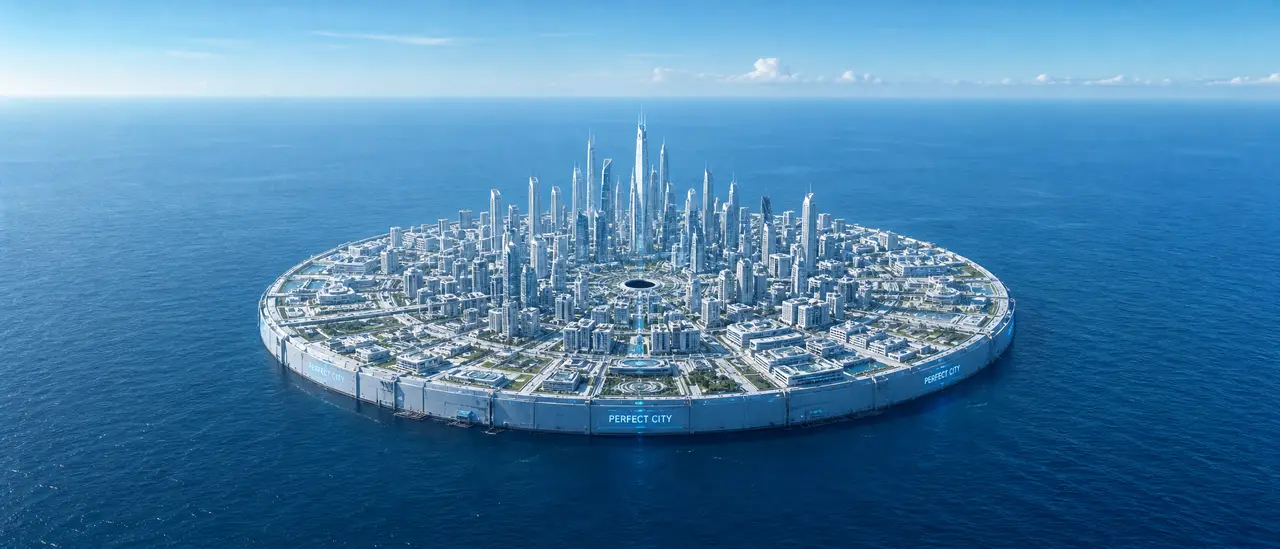 图片节点 15
Create a cinematic extreme-wide aerial establishing shot of PERFECT CITY, a single circular island-city floating in a vast cold ocean. FRAMING IS CRITICAL: the circular island-city sits in the CENTER of the frame and occupies only the MIDDLE portion of the image — roughly half to two-thirds of the frame width. Leave GENEROUS open ocean and clear sky all around it on every side: wide empty blue water surrounding the island, and open sky above. The island must feel isolated and surrounded by vast emptiness, with plenty of breathing room around it — NOT filling the frame, NOT touching the edges. This surrounding empty sea is what makes the city read as huge and alone. The city sits on a massive circular steel-and-concrete platform rising from the water, its outer edge a sheer vertical wall ringing the island, with subtle blue "PERFECT CITY" signage on the wall. DENSITY WITH LAYERS (avoid a flat uniform carpet of identical small towers): the city has clear depth and rhythm — a cluster of tall sleek glass skyscrapers rises near the center, transitioning OUTWARD into mid-rise blocks, then into lower, sparser buildings, with some open plazas, avenues, and breathing space toward the outer ring. Dense and vast, but with variation and spacing, NOT an overcrowded uniform spike-field. Real metropolitan rhythm: dense core, looser edges. ARCHITECTURE: a pristine futuristic metropolis — clean white and pale-grey towers, glass-curtain-wall skyscrapers, polished sleek surfaces, glowing blue holographic "PERFECT CITY" signage, elegant high-tech architecture. Expensive, immaculate, technologically advanced — a utopia on the surface, though truly a controlled prison. The beauty is the point: a perfect-looking cage. NOT raw grey concrete, NOT brutalist prison. CENTRAL FEATURE: at the exact center, ONE SMALL round black pit sinks into the platform — only a tiny fraction of the city's diameter, a small dark circle dwarfed by the vast city around it. Do NOT make the pit large. Do NOT draw any line, bridge, or causeway crossing it — keep it a clean uninterrupted small dark circle. LIGHTING & COLOR: clear, bright, luminous cold daylight — crisp clear day, clean air, high clarity. Cool blue palette but BRIGHT and CLEAN, deep blue ocean, clear pale-blue sky. NOT dull grey overcast, NOT flat monochrome gloom, NOT murky haze. The white city reads clean and luminous against deep blue sea. Composition: extreme wide high aerial shot, the full circular megacity CENTERED and surrounded by large areas of open blue ocean and sky on all sides, the small central pit visible, the city dense at its core and looser toward the edges. Style: hyper-real live-action cinematic realism, IMAX 70mm feeling, clean bright cold-blue cinematic color, deep blue ocean, high clarity and sharpness, polished high-tech surfaces, real metropolitan depth and layering, no warm light, no grey overcast gloom, no brutalist prison look, no cartoon, no game-render feel.
Reference-role separation is critical. Use {{Image 1}} as the mural subject-matter and art-style reference only. Preserve the idea and visual style of the faded hand-painted commemorative mural on weathered ship steel — a colossal repair-giant robot with three small key robot figures, painted in a heroic revolutionary-memorial style. Do not inherit the ship, the ocean, the environment, the wide composition, the sky, or the lighting from {{Image 1}} . Create a tight frontal eye-level close-up of this large faded commemorative mural painted directly onto the weathered steel side hull of an industrial ark, as if created by an underground civilization of rejected robots. The mural shows a colossal repair-giant robot standing tall, with three small key robot figures standing together at its base or on its shoulder, in a heroic monumental composition. The painting is weathered and faded, with peeling paint, rust bleeding through, soot, and scarred metal texture underneath. CRITICAL DETAIL: on or near the mural, a red stenciled "REJECTED" marking is clearly visible, painted or stamped in worn red industrial paint, slightly distressed and peeling. This red REJECTED mark must be legible and prominent — it is the focal anchor of the shot. Framing: frontal, eye-level, flat-on view of the hull surface so the mural reads clearly and undistorted, filling most of the frame, no extreme perspective. Material identity: weathered steel hull, scarred and faded paint, rust streaks, peeling mural pigment, soot, riveted seams, realistic heavy industrial aging. Lighting and style: hyper-real live-action cinematic realism, IMAX 70mm feeling, subtle film grain, restrained desaturated palette with the red REJECTED mark as the only strong color accent, grounded industrial realism, no glossy finish, no cartoon style, no game-render feel.
{{Image 1}} 使用我上传的这张图作为主要构图参考。 保留同样的构图、同样的镜头角度、同样的悬挂式红色 REJECTED 缓冲布结构、同样的拉索、同样的固定点,以及同样的整体空间关系。不要重设计构图。 重点把整个环境修复得更像真实摄影、物理上更可信。当前这个场景要从略带绘画感 / 涂抹感的 AI 效果,升级为超写实的实拍工业地下空间。 重点优化背景墙体、竖井内壁、金属结构和周围建筑细节。把现在这种涂抹感、塑料感、过软的背景材质,替换为更真实的工业墙面材质:老化混凝土、氧化钢板、污渍金属面板、厚重的竖井内壁、焊缝、螺栓、检修平台、管道、电缆桥架、支架、栈道细节、真实积灰、轻微划痕、使用痕迹、烟尘、灰尘以及空间空气透视。 保留巨大的红色悬挂缓冲布作为主体。保持它现有的大致形态和悬挂受力结构,但进一步优化布料材质:厚重布料、缝线、加固边缘、受力褶皱、重量感、下垂感、轻微磨损、真实织物纹理和可信的表面细节。保持布是红色,文字是白色。 环境光要更像真实工业空间中的照明,具有可信的工业灯光、轻微体积雾、自然阴影衰减,以及亮面和暗面之间清晰的材质分离。不要塑料感,不要概念图式涂抹感,不要亮面CG感,不要游戏渲染感。 视觉风格:超写实现实摄影、超真实地下工业竖井空间、IMAX 70mm 胶片质感、Panavision 变形宽银幕气质、轻微胶片颗粒、柔和高光过渡、真实景深、克制色彩、真实阴影、高细节实景环境、真实摄影纹理。
移除穿上的人,把天津海绵变成低饱和度的晴天
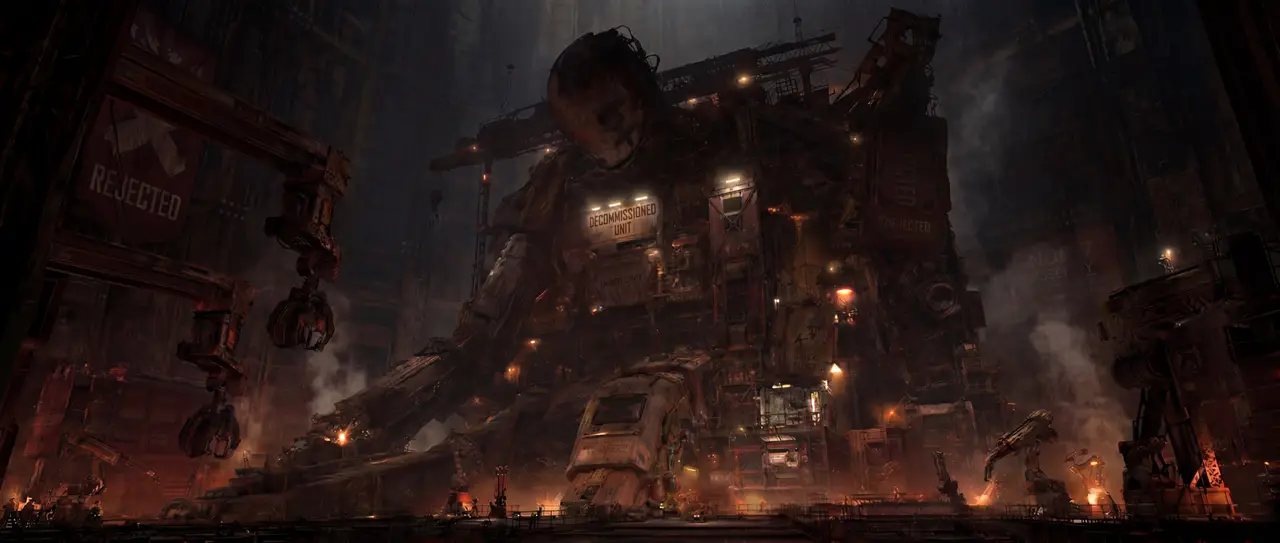 图片节点 12
把图中大机器人的光影氛围改一下,埋藏在阴影中,隐约会只能看见轮廓.
把图中大机器人的光影氛围改一下,上半身埋藏在阴影中,隐约会只能看见轮廓.地面上的光影不变
Reference-role separation is critical. Use {{Mixed 1}} as the identity reference for the protagonist inspection robot, ONE single character named PC-67241: a sleek white humanoid robot with a black LED pixel face, clean Perfect-City design. Preserve its exact design and identity. This character is UNIQUE. Use {{Mixed 2}} as the identity reference for the female presenter robot, ONE single character: an elegant white humanoid robot with a refined human-like face and blue eyes, same height as PC-67241. Preserve its exact design and identity. This character is UNIQUE. Use {{Mixed 3}} as the identity reference for the small robot, ONE single character: a short blue-and-white dome-topped cylindrical droid (B-3), much shorter than the other two. Preserve its exact design. This character is UNIQUE. Use {{Mixed 4}} as the BACKGROUND CROWD reference ONLY: a varied group of old discarded worn-out robots of many different shapes (boxy, wheeled, cylindrical, antenna-headed), each clearly different. These are ONLY anonymous background extras standing far behind. NONE of them is a main character. Use {{Mixed 5}} as the COLOR PALETTE, LIGHTING, and tone reference ONLY: cold blue-grey realistic daylight, bright but NOT warm, silver-grey metal, deep blue sea, pale cool sky. Lock the grade to this. Do not inherit any subject or composition from {{Mixed 5}}. Do not randomly merge the references. Each image controls only its assigned role. CRITICAL ANTI-DUPLICATION RULES: - The three main characters (PC-67241, the female presenter, the small B-3 droid) each exist ONLY ONCE and stand together as a distinct trio at the bow. NEVER duplicate them. - The background crowd robots ({{Mixed 4}}) must ALL look like old, worn, varied discarded units — boxy, junky, mismatched. NONE of the crowd robots may copy the design of the three main characters. The sleek white PC-67241, the elegant female presenter, and the B-3 droid must NEVER appear among the crowd. The crowd is clearly different and clearly background. CRITICAL LIGHTING: cold flat realistic daylight, deep blue sea, pale cool sky. NO golden sunset, NO orange backlight, NO warm glow. Matching {{Mixed 5}}. Create an 8-second hyper-real cinematic live-action shot, IMAX 70mm, Panavision anamorphic, a slow continuous push-in (no cuts), cold blue-grey daylight, deep blue ocean, pale cool sky, sound effects only no music. 0-3s: Eye-level slightly high-angle medium shot. On the wide open deck of the massive scrapyard ark, a crowd of varied old discarded robots ({{Mixed 4}}) stand quietly in the background, gazing toward the distant horizon, each different in shape, like anonymous extras. 3-8s: The camera slowly and steadily pushes in toward the bow, settling on the three main characters seen from behind: the white PC-67241 and the female presenter robot standing side by side at equal height, with the short B-3 droid beside them. The three face the cold open sea together like a small team, NOT a couple. Their backs to camera, looking toward the horizon. Quiet, still, emotional. The three main characters exist ONLY ONCE and are clearly distinct from the varied junky background crowd. Cold blue-grey daylight, deep blue sea, pale cool sky, NO warm light, crisp sharp clarity, hyper-real live-action, IMAX 70mm, one continuous push-in, sound effects only no music.
Reference-role separation is critical. Each image controls only its assigned role. If references conflict, follow the assigned role and priority order. Use {{Mixed 1}} as the giant robot identity reference ONLY: a colossal 30-35 meter discarded repair-giant assembled from salvaged industrial robot parts, weathered white-and-rust armor, smooth pale dome head, heavy mechanical limbs, patched panels, scaffolds, cables, REJECTED markings. Preserve its design, silhouette, material, and scale logic. Place it in this scene's own lighting. Use {{Mixed 2}} as the ship exterior reference, kept FAITHFUL in every frame including wide finale shots: a massive scrapyard-built ark with a broad rounded blunt bow, huge patched steel hull, and a DETAILED layered deck covered with cranes, gantries, catwalks, containers, welded modular structures and industrial clutter. The deck must always keep this dense industrial detail — never simplify it into a flat empty platform. Use {{Mixed 3}} as the hull-side mural reference ONLY: a faded painted mural of the giant robot with three small robot figures and a red REJECTED stamp on the ship flank. Use {{Mixed 4}} as the color and tone reference ONLY: cold blue-grey cinematic grade, muted, low saturation, silver-grey metal, deep muted blue sea. Lock the grade to this. The sky is a CLEAR, COOL, BRIGHT, EVEN DAYLIGHT sky with high visibility and a pale clean horizon — crisp cold daylight, luminous and clear. Use {{Mixed 5}} as the distant PERFECT CITY island reference ONLY: a cold-blue circular city-island fortress, small, soft, out of focus far on the horizon. Use {{Mixed 6}} as the protagonist PC-67241: ONE unique white inspection robot, black LED face screen, worn shell, PC-67241 markings. CENTER of the trio. Use {{Mixed 7}} as the female presenter robot: ONE unique elegant white humanoid, blue eye lights, same height as PC-67241. Use {{Mixed 8}} as the small robot: ONE unique short blue-and-white dome-topped droid, much shorter than the other two. Use {{Mixed 9}} as the background crowd reference ONLY: many varied obsolete robots — boxy, cylindrical, wheeled, short utility units, mismatched worn shells. Anonymous background extras only. None is a main character; none may copy the trio's design. Create a 13-15 second hyper-real cinematic live-action shot in 21:9 widescreen, IMAX 70mm, Panavision anamorphic, cold muted blue-grey daylight under a clear cool bright sky, deep blue ocean, soft low-saturation film look, sound effects only no music. THIS IS ONE SINGLE SEAMLESS CONTINUOUS TAKE — one unbroken flowing camera move from start to finish, absolutely NO cuts, NO edits, NO hard transitions, NO jump between shots. The camera moves as one smooth continuous backward glide the entire time. The camera starts LOW at the sea surface and stays low through the first half; in the later half it smoothly and continuously rises just enough to glide up over the ship's side and reveal the deck, then keeps rising smoothly into a wide finale. One flowing motion, never cut. SCALE: the giant is colossal, its shoulders and head rising clearly above the ark's deck and superstructure, dwarfing the ship in every frame it appears. SPACING: the giant wades at a distance beside and slightly behind the ship, open deep sea between them. WATERLINE: the water covers the lower one-third of the giant's height; lower third submerged, upper two-thirds above water. It STRIDES like a Pacific-Rim mech, heavy steps, arms swinging, pushing rolling waves. It wades, never swims. 0-3s: Camera low at the sea surface, half-sunk at the waterline, 24mm wide, tilted up, extremely close to the giant's submerged lower body (rivets and rust visible), waves washing the lens. The giant strides toward frame, lower third in deep sea, towering far above the ship. Clear cool bright daylight. Camera glides backward fast and low. 3-6s: The same continuous move slides tight along the ark's side hull at a slight Dutch angle, skimming fast just above the waterline, sweeping past the faded REJECTED mural. The giant stays visible beyond the hull, wading powerfully. 6-9s: The same continuous move smoothly rises up along the ship's side and glides over the deck edge to reveal the wide detailed industrial deck. On the deck, a crowd of varied obsolete robots are ALIVE and idling in place — some slowly turning their heads to look toward the sea or toward the trio, some shifting their weight, some taking a small step, some moving mechanical arms, gently animated and lifelike. They do NOT march forward; they linger and mill about naturally as living background, staying in place while looking ahead. 9-13s: The continuous move keeps gliding back over the deck toward the bow. The three protagonists walk forward toward camera as the clear focal point — the ONLY ones purposefully striding forward: PC-67241 in the CENTER, the female presenter robot on the LEFT, the small blue-and-white droid on the RIGHT and half a step ahead, forming a triangular hero group with clear spacing between them (not crowded together), all facing the camera. The two tall ones settle first, the small droid catches up a step later, and the three come to stand together at the bow. 13-15s: The continuous move rises and pulls back into a wide finale, the ship's deck keeping all its cranes and industrial detail: the trio stand at the bow facing forward, the full detailed ark beneath them, the colossal giant wading in the deep sea beside the ship still clearly taller than the deck, and far behind them the cold-blue PERFECT CITY island small and out of focus on the horizon — the rejected ones leaving the perfect city. The three protagonists each exist ONLY ONCE, are the only ones striding forward, stand in a spaced triangular formation facing camera at the bow, and are clearly distinct from the idling worn background crowd. The giant exists ONLY ONCE and stays taller than the ship. Clear cool bright daylight, deep muted blue ocean, detailed industrial deck, filmic low saturation, soft grain, crisp clarity, hyper-real live-action, IMAX 70mm, ONE seamless continuous take with no cuts, sound effects only no music. Sound design: deep ocean waves, giant metal steps through water, ship engine rumble, hull creaks, wind, no music.
Reference-role separation is critical. Each image controls only its assigned role. If references conflict, follow the assigned role and priority order. Use {{Mixed 1}} as the giant robot identity reference ONLY: a colossal 30-35 meter discarded repair-giant assembled from salvaged industrial robot parts, weathered white-and-rust armor, smooth pale dome head, heavy mechanical limbs, patched panels, scaffolds, cables, REJECTED markings. Preserve its design, silhouette, material, and scale logic. Place it in this scene's own lighting. Use {{Mixed 2}} as the ship exterior reference, kept FAITHFUL in every frame including wide finale shots: a massive scrapyard-built ark with a broad rounded blunt bow, huge patched steel hull, and a DETAILED layered deck covered with cranes, gantries, catwalks, containers, welded modular structures and industrial clutter. The deck must always keep this dense industrial detail — never simplify it into a flat empty platform. Use {{Mixed 3}} as the hull-side mural reference ONLY: a faded painted mural of the giant robot with three small robot figures and a red REJECTED stamp on the ship flank. Use {{Mixed 4}} as the color and tone reference ONLY: cold blue-grey cinematic grade, muted, low saturation, silver-grey metal, deep muted blue sea. Lock the grade to this. The sky is a CLEAR, COOL, BRIGHT, EVEN DAYLIGHT sky with high visibility and a pale clean horizon — crisp cold daylight, luminous and clear. Use {{Mixed 5}} as the distant PERFECT CITY island reference ONLY: a cold-blue circular city-island fortress, small, soft, out of focus far on the horizon. Use {{Mixed 6}} as the protagonist PC-67241: ONE unique white inspection robot, black LED face screen, worn shell, PC-67241 markings. CENTER of the trio. Use {{Mixed 7}} as the female presenter robot: ONE unique elegant white humanoid, blue eye lights, same height as PC-67241. Use {{Mixed 8}} as the small robot: ONE unique short blue-and-white dome-topped droid, much shorter than the other two. Use {{Mixed 9}} as the background crowd reference ONLY: many varied OLD, JUNKY, MISMATCHED obsolete robots of totally different body types — boxy bodies, cylindrical bodies, wheeled bases, tracked bases, short stubby utility units, bulky maintenance units, antenna heads, worn scratched rusty shells in many colors. They look clearly OLD and DIFFERENT from each other and from the protagonists. ABSOLUTE CASTING RULE: The three sleek clean humanoid protagonists (white PC-67241, the elegant white female presenter, the blue-and-white droid) appear ONLY as a trio at the very front of the deck. The background crowd must NEVER contain any sleek clean white humanoid robot resembling the protagonists. Every crowd robot is old, junky, mismatched and visibly different. NO clones of the protagonists anywhere in the crowd. Create a 13-15 second hyper-real cinematic live-action shot in 21:9 widescreen, IMAX 70mm, Panavision anamorphic, cold muted blue-grey daylight under a clear cool bright sky, deep blue ocean, soft low-saturation film look, sound effects only no music. THIS IS ONE SINGLE SEAMLESS CONTINUOUS TAKE — one unbroken flowing camera move from start to finish, absolutely NO cuts, NO edits, NO hard transitions, NO jump between shots. The camera starts LOW at the sea surface and stays low through the first half; in the later half it smoothly and continuously rises just enough to glide up over the ship's side and reveal the deck, then keeps rising smoothly into a wide finale. One flowing motion, never cut. SCALE: the giant is colossal, its shoulders and head rising clearly above the ark's deck and superstructure, dwarfing the ship in every frame it appears. SPACING: the giant wades at a distance beside and slightly behind the ship, open deep sea between them. WATERLINE: the sea is deep and the water level sits right AT THE GIANT'S KNEES — its knees and everything below are underwater, its thighs, hips, torso and head all above the surface. It STRIDES like a Pacific-Rim mech, heavy steps, arms swinging, pushing rolling waves. It wades knee-deep, never swims, feet never visible. 0-3s: The camera starts extremely close BEHIND the giant's massive striding legs, right at the knee level, low at the churning sea surface, 24mm wide — close enough to see rivets and rust as the leg brushes past the lens. The water sits at the giant's knees. The camera glides backward and the giant strides forward through the deep sea, its enormous body towering overwhelmingly high above, far taller than the ship. Clear cool bright daylight, camera skimming just over the waves. 3-6s: The same continuous move slides tight along the ark's side hull at a slight Dutch angle, skimming fast just above the waterline, sweeping past the faded REJECTED mural. The giant stays visible beyond the hull, wading knee-deep and powerfully. 6-9s: The same continuous move smoothly rises up along the ship's side and glides over the deck edge to reveal the wide detailed industrial deck. On the deck, a crowd of varied OLD JUNKY mismatched robots are ALIVE and idling in place — some slowly turning to look toward the sea or the trio, some shifting weight, some moving mechanical arms, gently lifelike. They do NOT march; they linger naturally as living background. They are all old and different, never resembling the protagonists. 9-13s: The continuous move keeps gliding back over the deck toward the bow. The three sleek protagonists walk forward toward camera as the ONLY ones purposefully striding: PC-67241 in the CENTER, the female presenter on the LEFT, the small blue-and-white droid on the RIGHT and half a step ahead, in a spaced triangular hero formation, facing the camera. The two tall ones settle first, the droid catches up a step later, and the three stand together at the bow. 13-15s: The continuous move rises HIGH and pulls FAR back into a wide, spacious epic finale — the ship and giant made smaller in a vast open frame with lots of surrounding sea and sky. The trio stand at the bow, the full detailed ark beneath them, the colossal giant wading knee-deep beside the ship still clearly taller than it, and far behind them the cold-blue PERFECT CITY island small and out of focus on the horizon. Wide, distant, epic, with generous empty ocean around them. The three protagonists each exist ONLY ONCE, are the only ones striding forward, and NEVER appear duplicated in the crowd. The giant exists ONLY ONCE and stays taller than the ship. Clear cool bright daylight, deep muted blue ocean, detailed industrial deck, filmic low saturation, soft grain, crisp clarity, hyper-real live-action, IMAX 70mm, ONE seamless continuous take with no cuts, sound effects only no music. Sound design: deep ocean waves, giant metal steps through water, ship engine rumble, hull creaks, wind, no music.
Use {{Mixed 1}} as the PERFECT CITY plaza reference: wide futuristic civic square, giant central LED screen, surrounding towers, PERFECT CITY banners, bright daylight. Use {{Mixed 2}} as the giant underground repair-robot reference: a colossal humanoid giant assembled from discarded robot parts, patched panels, welded scrap, markings REJECTED / DECOMMISSIONED UNIT / UNDER REPAIR. Scale: 28-35m tall, far larger than any normal robot. In this shot reveal ONLY its head, shoulders, chest, arms and upper torso through the screen structure. Waist, legs and lower body stay buried underground, hidden by broken pavement, dust and screen-base debris. Its eyes emit a faint soft warm-yellow glow — dim, gentle, NOT bright, NOT a searchlight. Use {{Mixed 3}} as the protagonist inspection robot: white inspection-disposal robot, black face screen, worn shell, PC-67241 markings, about 1.78m, tiny next to the giant. CRITICAL: only ONE protagonist exists in the whole shot, a unique single character. NEVER duplicate him, NEVER show multiple white inspection robots. Use {{Mixed 4}} as the small old robot: short blue-and-white cylindrical service-robot body, dome head, compact, worn, clearly non-humanoid. CRITICAL: only ONE exists, a unique single character. NEVER duplicate it. Use {{Mixed 5}} as the female presenter robot: elegant humanoid white shell, blue eye lights, chest display, graceful, slightly worn. CRITICAL: only ONE exists, a unique single character. NEVER duplicate her. Create a single continuous 15-second cinematic live-action shot, 21:9 widescreen. Climax shot, continuing from the previous ultra-low FPV crack shot. Style: cinematic photograph, soft film grain, realistic physical destruction, practical sunlight, dust haze, disaster-film energy, monumental scale, grounded realism, IMAX 70mm feel, hyper-real live-action, not glossy CGI, not cartoon, not game-render. CAMERA: one continuous shot — ultra-low ground-hugging FPV, then a heavy upward tilt into a disaster reveal, then a controlled settling drift into an iconic poster frame. 0.0-2.0s — Ultra-low FPV, centimeters above the plaza, rushing forward along the advancing crack toward the central screen. The plaza is densely packed with PERFECT CITY robots; many feet and lower legs fill the foreground, orderly and standardized. The crack races between their feet, pavement splits, dust bursts, debris scatters. Nearby feet recoil and stagger back in layered timing. The screen grows larger ahead. 2.0-3.8s — The crack abruptly stops before the screen base. Pavement settles, dust hangs. The camera keeps gliding forward and tilts up toward the screen. A low underground pressure builds; the screen base vibrates; the ground behind and under the base bulges and cracks; the LED flickers; the truss trembles and drops dust. The force clearly comes from underground behind the screen. The whole plaza seems to hold its breath. 3.8-7.2s — The giant erupts upward from the ground behind the screen base and tears through the LED structure from below. First the huge head and shoulders push through dust and broken pavement, then the chest tears into the LED frame, then both arms brace against the broken base as if pulling itself halfway out of an underground tunnel. Reveal ONLY the upper half — head, shoulders, chest, arms, upper torso. Waist and legs stay buried, hidden by dust, debris and twisted metal. The giant is so large that only half of it destroys the entire screen. Its head is enormous, its shoulders too wide for the screen frame, the broken LED crushed around its upper body. LED panels rip apart, glass-like fragments explode toward camera, trusses bend, debris erupts into sunlight with believable weight. The camera shocks and recoils slightly, then rebalances, staying readable. 7.2-10.8s — The giant stabilizes half-emerged, chest and shoulders above ground, lower body buried. Behind its shoulders and back, the ruptured underground tunnel becomes visible through smoke; maintenance paths, shoulder walkways and chest platforms open into the plaza. A wave of rejected old service robots emerges from the tunnel and the giant's back and shoulder structures, climbing out and spilling across its shoulders and the broken frame. These crowd robots are varied and non-identical: boxy, cylindrical, wheeled, different heights, silhouettes and head shapes, patched shells, worn paint, salvaged parts. They feel like many generations of discarded units returning together. CRITICAL: none of these crowd robots are the protagonist, the female presenter, or the small old robot. Do NOT make any look like the white PC-67241, the female presenter, or the blue-and-white small robot. The three main characters are NOT part of this crowd and appear separately next. 10.8-15.0s — Now the three unique main characters appear, clearly separate from the crowd. The single protagonist (one white PC-67241) steps out last from the dark tunnel path behind the giant onto a shoulder-side maintenance platform. The single female presenter and the single small old robot follow nearby in staggered formation, emerging from the same underground path, not from the plaza ground. Exactly ONE of each — three distinct individuals total, never duplicated. The protagonist steps forward first as the clearest small figure; the female presenter stays beside or behind him; the small old robot stays close and much shorter. All three stand together on the giant's upper platform as a small distinct trio, clearly separate from the varied background crowd. They remain tiny against the giant, whose head, shoulders, chest and broken screen frame dominate the image. The camera drifts up and forward, then makes a subtle pull-back into a poster-like composition. Final composition: the shattered PERFECT CITY screen frames the giant's upper half; its chest, shoulders, arms and huge head dominate; lower body unseen underground; varied old rejected robots spill from the tunnel and walkways; the three unique main characters — one protagonist, one female presenter, one small old robot — stand small but readable together on an upper platform; sunlight, dust, smoke, hanging debris and twisted metal create cinematic depth. Sound: cracking pavement, feet reacting, dust bursts, sudden silence, low underground rumble, metal groans, heavy half-body eruption, LED shattering, falling debris, distant crowd panic, giant mechanical resonance, old robots emerging, one final monumental impact, then a short breath of silence.
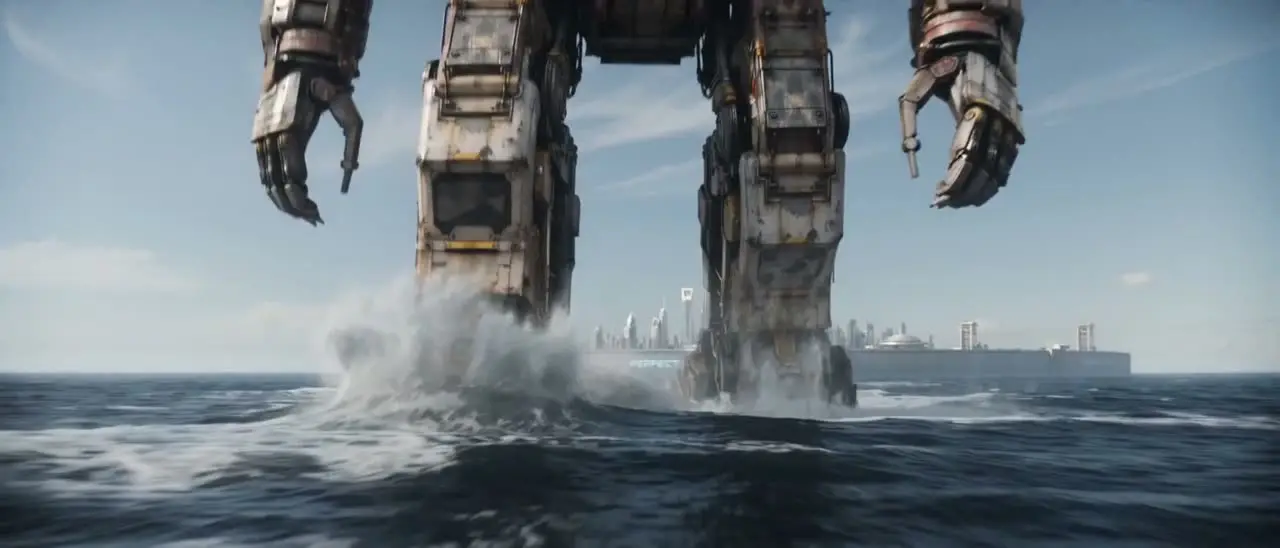 视频截图视频节点 16
Reference-role separation is critical. Each image controls only its assigned role. If references conflict, follow the assigned role and priority order. Use {{Mixed 1}} as the giant robot identity reference ONLY: a colossal 30-35 meter discarded repair-giant assembled from salvaged industrial robot parts, weathered white-and-rust armor, smooth pale dome head, heavy mechanical limbs, patched panels, scaffolds, cables, and REJECTED markings. Preserve its design, silhouette, material language, and scale logic only. Place it in this scene's own clear cold daylight lighting. Use {{Mixed 2}} as the ship exterior reference ONLY: a massive scrapyard-built ark with a broad rounded blunt bow, huge patched steel hull, and a detailed layered deck covered with cranes, gantries, catwalks, containers, welded modular structures and industrial clutter. Preserve the ship’s broad bow, heavy patched hull, dense industrial deck detail, and salvaged ark identity. Use {{Mixed 3}} as the hull-side mural reference ONLY: a faded painted mural of a giant robot with three small robot figures and a red REJECTED stamp on the ship flank. Preserve only this mural as a painted marking on the ship side. Use {{Mixed 4}} as the color, daylight, and cinematic tone reference ONLY: clear cold daylight, pale blue sky, thin high white clouds, high visibility, crisp horizon, cold blue-grey color grade, muted low saturation, silver-grey metal, deep muted blue sea. Lock the grade and daylight clarity to this. Use {{Mixed 5}} as the distant PERFECT CITY island reference ONLY: a cold-blue circular city-island fortress, small, soft, out of focus on the central horizon behind the ship. Use {{Mixed 6}} as the protagonist PC-67241 reference ONLY: ONE unique white inspection-and-disposal robot with black LED face screen, worn shell, PC-67241 markings. He appears only as one of the three hero characters at the bow in the later part of the shot. He is the center of the trio. Use {{Mixed 7}} as the female presenter robot reference ONLY: ONE unique elegant white humanoid robot with blue eye lights, chest display, graceful proportions, same height as PC-67241. She appears only as one of the three hero characters at the bow in the later part of the shot. Use {{Mixed 8}} as the small old robot reference ONLY: ONE unique short blue-and-white dome-topped cylindrical droid, much shorter than the two humanoid robots. It appears only as one of the three hero characters at the bow in the later part of the shot. Use {{Mixed 9}} as the obsolete service-robot lineup reference ONLY: previous-generation city-service machines with different functions, sizes, silhouettes, worn surfaces, boxy bodies, cylindrical bodies, wheeled bases, compact utility shapes, old maintenance bodies, delivery-unit bodies, support-unit bodies. Use this only for the varied background crowd on the ark deck. Do not randomly merge the references. Each image controls only its assigned role. Create a 13-15 second hyper-real cinematic live-action shot in 21:9 widescreen, IMAX 70mm scale, Panavision anamorphic character, clear cold daylight, pale blue sky, thin high clouds, crisp horizon, deep blue ocean, soft low-saturation film look, sound effects only no music. This is ONE SINGLE SEAMLESS CONTINUOUS TAKE. One unbroken flowing camera move from start to finish. The camera begins extremely low near the ocean surface, glides backward along the ship exterior, rises just enough to reveal the deck, reaches the bow hero group, then pulls farther back into a wider final image. SPATIAL DIRECTION: The ark is sailing away from PERFECT CITY. The camera is positioned in front of the ark’s bow and moves backward ahead of the ship. The ship moves toward the camera’s retreating direction. The hero trio walks along the deck centerline toward the bow and toward the camera. PERFECT CITY stays behind the ship, aligned near the center of the distant horizon behind the stern. The scene: The rejected robots are leaving PERFECT CITY. A colossal repair-giant wades through the deep ocean beside a massive industrial ark vessel. The giant is a pathfinder. The ship is a huge moving refuge built from salvaged industrial parts. The final feeling is migration, freedom, and a new beginning. CRITICAL GIANT SCALE: The giant robot feels physically larger than the ship’s main deck and superstructure. Its shoulders and head rise clearly above the ark’s deck level. It feels overwhelming beside the ship. CRITICAL WATERLINE: The giant is wading through deep open ocean. The sea cuts across the giant above the knees, around knee-to-lower-thigh level. The visible starting area is knee armor, lower thigh, wet upper leg mass, lower torso weight, and towering upper body. Heavy waves wrap around the knees and thighs. The ocean reads as deep open sea with rolling displacement and strong water mass. CRITICAL GIANT PERFORMANCE: The giant walks with heavy Pacific-Rim-scale authority. Its arms hang heavy and mechanical, balancing naturally while walking. Its posture is powerful, steady, and calm. CRITICAL BACKGROUND CROWD: From 6s to 10s, the ark deck background crowd consists of obsolete service machines from {{Mixed 9}}: boxy utility units, cylindrical service units, wheeled maintenance machines, compact delivery units, short support units, different heights, different head shapes, different silhouettes, patched shells, worn paint, repair seams, reused parts. They occupy the deck sides, railings, and midground. They idle naturally as a migrating community and leave a clear center path toward the bow. 0.0s – 3.2s: Start extremely low at the ocean surface, almost touching the waterline, 24mm wide low-angle perspective. Begin behind and beside the giant robot’s massive knee / lower-thigh area, not below the knee. The camera is extremely close, so the giant’s wet thigh armor, knee armor, rivets, rust, water-splashed metal and rolling sea foam fill the foreground. The waterline cuts above the knee and around the lower thigh. Huge waves slam around the knee and thigh, water bursts toward the lens, and the giant’s upper body towers above the frame. The camera pulls backward fast but controlled, scraping just above the sea surface. The first two seconds immediately feel like giant-scale mass. 3.2s – 6.8s: The same continuous camera move slides tightly toward the ark vessel, almost scraping along the ship’s side hull. The hull enters extremely close to frame-left and dominates 60-70 percent of the image with strong parallax: patched steel plates, welded seams, rivets, drain holes, rust streaks, old repair plates, catwalk shadows and industrial texture rushing past. Use a short broken-horizon FPV feeling during the fast hull pass. The faded REJECTED mural on the ship’s side passes by as a clear visual detail. The giant remains visible beyond the hull, still wading powerfully through deep water. As the camera approaches the deck reveal, the horizon gradually becomes level and stable. 6.8s – 10.2s: Without cutting, the camera rises only enough to clear the ship’s side edge and reveal the open deck. The frame becomes stable and level. The deck is broad, layered, industrial and full of real construction detail: cranes, gantries, containers, catwalks, welded platforms, repair equipment, railings, cables and weathered deck plates. The background deck crowd is made only of varied obsolete service units from {{Mixed 9}}. They idle naturally: some turn toward the open sea, some look toward the bow, some shift weight, some roll slightly, some raise small utility arms, some gather near railings. Their shapes are mostly boxy, cylindrical, compact, wheeled and practical. They remain background community figures and do not occupy the hero center path. 10.2s – 13.0s: The continuous camera move glides backward over the deck centerline toward the bow. Now reveal the three protagonists at the bow. They are the only clean readable hero trio: PC-67241 in the CENTER, female presenter robot on frame-left, small blue-and-white droid on frame-right, much shorter, catching up half a beat later. The trio walks forward along the deck centerline toward the bow and toward the retreating camera. They face camera direction / open sea direction. The two tall robots settle first; the small droid rolls forward one small beat later and stops near them. They form a spaced triangular team composition, clear and readable. 13.0s – 15.0s: The continuous camera move pulls farther back and rises only slightly into a wider low-to-mid trailing finale. Keep the horizon level. Make the final composition more spacious, with more open ocean negative space. Final frame: foreground / midground: the full industrial ark bow and detailed deck, at the bow: the three hero characters small but readable, facing forward, beside and slightly behind the ship: the colossal giant wading through deep sea, clearly taller than the deck, far background: PERFECT CITY as a small cold-blue circular island on the central horizon behind the stern, open ocean ahead: vast, clear, cold, liberating. Hold the final image with breathing room. The ending feels like departure, migration, and freedom. Visual style: hyper-real live-action, IMAX 70mm scale, Panavision anamorphic character, clear cold daylight, pale blue sky, thin high clouds, crisp horizon, cold blue-grey grade, deep muted blue ocean, realistic water spray, heavy mechanical mass, grounded industrial materials, soft film grain, detailed ark deck, cinematic scale. Sound design: deep ocean waves, giant metal steps through water, heavy water displacement, ship engine rumble, hull creaks, deck ambience, wind, distant mechanical resonance, no music.
Reference-role separation is critical. Each image controls only its assigned role. If references conflict, follow the assigned role and priority order. Use {{Mixed 1}} as the giant robot identity reference ONLY: a colossal 30-35 meter discarded repair-giant assembled from salvaged industrial robot parts, weathered white-and-rust armor, smooth pale dome head, heavy mechanical limbs, patched panels, scaffolds, cables, and REJECTED markings. Preserve its design, silhouette, material, and scale logic only. Place it in this scene's own cold daylight lighting. Use {{Mixed 2}} as the ship exterior reference ONLY: a massive scrapyard-built ark with a broad rounded blunt bow, huge patched steel hull, and a detailed layered deck covered with cranes, gantries, catwalks, containers, welded modular structures and industrial clutter. The deck must always keep this dense industrial detail, never simplify it into a flat empty platform. Use {{Mixed 3}} as the hull-side mural reference ONLY: a faded painted mural of a giant robot with three small robot figures and a red REJECTED stamp on the ship flank. Preserve only this mural as a painted marking on the ship side. Use {{Mixed 4}} as the color and tone reference ONLY: cold blue-grey cinematic grade, muted low saturation, silver-grey metal, deep muted blue sea, pale cool sky, crisp clear daylight. Lock the grade to this. Use {{Mixed 5}} as the distant PERFECT CITY island reference ONLY: a cold-blue circular city-island fortress, small, soft, out of focus far on the horizon. Use {{Mixed 6}} as the protagonist PC-67241 reference ONLY: ONE unique white inspection-and-disposal robot with black LED face screen, worn shell, PC-67241 markings. He appears only as one of the three hero characters at the bow in the later part of the shot. He must not appear in the background crowd. Use {{Mixed 7}} as the female presenter robot reference ONLY: ONE unique elegant white humanoid robot with blue eye lights, chest display, graceful proportions, same height as PC-67241. She appears only as one of the three hero characters at the bow in the later part of the shot. She must not appear in the background crowd. Use {{Mixed 8}} as the small old robot reference ONLY: ONE unique short blue-and-white dome-topped cylindrical droid, much shorter than the two humanoid robots. It appears only as one of the three hero characters at the bow in the later part of the shot. Use {{Mixed 9}} as the obsolete service-robot lineup reference ONLY: many previous-generation city-service robots with different functions, sizes, silhouettes, worn surfaces, boxy bodies, cylindrical bodies, wheeled bases, compact utility units, old maintenance units, delivery units, support units. Use this only for the varied background crowd on the ark deck. Do not randomly merge the references. Each image controls only its assigned role. Create a 13-15 second hyper-real cinematic live-action shot in 21:9 widescreen, IMAX 70mm, Panavision anamorphic, cold muted blue-grey daylight under a clear cool bright sky, deep blue ocean, soft low-saturation film look, sound effects only no music. THIS IS ONE SINGLE SEAMLESS CONTINUOUS TAKE — one unbroken flowing camera move from start to finish, absolutely no cuts, no edits, no jump transitions. The camera moves as one continuous backward glide. The scene: The rejected robots are leaving PERFECT CITY. A colossal repair-giant wades through the deep ocean beside a massive industrial ark vessel. The giant is a pathfinder, not swimming. The ship is a huge moving refuge built from salvaged industrial parts. The camera begins extremely low near the ocean surface, glides backward along the ship exterior, rises just enough to reveal the deck, reaches the bow hero group, then pulls farther back into a wider final image. CRITICAL GIANT SCALE: The giant robot must feel physically larger than the ship’s main deck and superstructure. Its shoulders and head rise clearly above the ark’s deck level. It must feel overwhelming beside the ship. CRITICAL WATERLINE: The giant is wading through deep open ocean. The sea covers the giant from below the knees upward to around knee / lower-thigh level. The feet are never visible. The ankles are never visible. The lower shins are never visible. The start of the shot must not show feet. The ocean must never look like shallow water or a puddle. The giant’s movement displaces huge rolling waves around its knees and thighs. CRITICAL GIANT PERFORMANCE: The giant walks with heavy Pacific-Rim-scale authority. It does not swim, does not paddle, does not crawl. Its arms hang heavy and mechanical, balancing naturally while walking. Its posture is powerful, steady, and calm. CRITICAL BACKGROUND CROWD RULE: From 6s to 10s, the ark deck background crowd consists only of obsolete service robots from {{Mixed 9}}: boxy utility units, cylindrical service units, wheeled maintenance machines, compact delivery units, old support units, different heights and silhouettes, patched shells, worn paint, repair seams and reused parts. They are not white humanoid inspection robots. They are not elegant female humanoid robots. They are not copies of the three main characters. The three main characters appear only at the bow after 10s. 0.0s – 3.2s: Start extremely low at the ocean surface, almost touching the waterline, 24mm wide low-angle perspective. Begin behind and beside the giant robot’s massive knee / lower-thigh area, not at the feet. The camera is so close that the giant’s wet thigh, knee armor, rivets, rust, and water-splashed metal fill the foreground. The waterline cuts above the knee and around the lower thigh. No feet, no ankles, no lower shins visible. The giant’s huge upper body towers above the frame. Waves slam against the knee and thigh, water explodes toward the lens, and the camera pulls backward fast but controlled, scraping just above the sea surface. The first two seconds must immediately feel like giant-scale mass, not a normal robot walking in shallow water. 3.2s – 6.8s: The same continuous camera move slides tightly toward the ark vessel, almost scraping along the ship’s side hull. The hull enters extremely close to frame-left and dominates 60-70 percent of the image with strong parallax: patched steel plates, welded seams, rivets, drain holes, rust streaks, old repair plates, catwalk shadows and industrial texture rushing past. Use a slight Dutch angle / broken horizon for speed and tension. The camera remains low over the sea, skimming beside the hull with FPV-like gliding force. The faded REJECTED mural on the ship’s side passes by briefly as a clear visual detail. The giant remains visible beyond the hull, wading powerfully through deep water. 6.8s – 10.2s: Without cutting, the camera rises only enough to clear the ship’s side edge and reveal the open deck. The deck is broad, layered, industrial, cluttered, full of cranes, gantries, containers, catwalks, welded platforms and repair equipment. The background deck crowd is made only of varied obsolete service units from {{Mixed 9}}. They idle naturally as a migrating community: some turn their heads toward the sea, some shift weight, some roll slightly, some raise small utility arms, some gather near railings. Their shapes are mostly boxy, cylindrical, compact, wheeled and practical. They do not march forward. They do not look like PC-67241. They do not look like the female presenter. They do not duplicate the hero trio. 10.2s – 13.0s: The continuous camera move keeps gliding back over the deck toward the bow. Now reveal the three protagonists at the bow. They are the only clean readable hero trio in the scene: PC-67241 in the CENTER, female presenter robot on frame-left, small blue-and-white droid on frame-right, much shorter, catching up half a beat later. The trio walks forward toward the camera’s retreating direction and toward the open sea. They face the camera / open horizon, not backward. The two tall robots settle first; the small droid rolls forward one small beat later and stops near them. They form a spaced triangular team composition, not a romantic couple and not a crowded line. 13.0s – 15.0s: The continuous camera move pulls farther back and rises only slightly into a wider low-to-mid trailing finale. Make the final composition wider and more spacious than before, with more ocean negative space and a stronger sense of departure. Final frame: foreground / midground: the full industrial ark bow and detailed deck, at the bow: the three hero characters small but readable, facing forward, beside and slightly behind the ship: the colossal giant wading through deep sea, clearly taller than the deck, far background: PERFECT CITY as a small cold-blue island on the horizon, receding behind them, open ocean ahead: vast, clear, cold, liberating. Hold the final image with enough breathing room. The ending should feel like migration, freedom, and a new beginning, not a crowded deck shot. Visual style: hyper-real live-action, IMAX 70mm scale, Panavision anamorphic character, cold blue-grey daylight, crisp clarity, deep muted blue ocean, pale cool sky, realistic water spray, heavy mechanical mass, grounded industrial materials, soft film grain, detailed ark deck, cinematic scale. Sound design: deep ocean waves, giant metal steps through water, heavy water displacement, ship engine rumble, hull creaks, deck ambience, wind, distant mechanical resonance, no music.
Reference-role separation is critical. Each image controls only its assigned role. If references conflict, follow the assigned role and priority order. Use {{Mixed 1}} as the giant robot identity reference ONLY: a colossal 30-35 meter discarded repair-giant assembled from salvaged industrial robot parts, weathered white-and-rust armor, smooth pale dome head, heavy mechanical limbs, patched panels, scaffolds, cables, REJECTED markings. Preserve its design, silhouette, material, and scale logic. Place it in this scene's own lighting. Use {{Mixed 2}} as the ship exterior reference, kept FAITHFUL in every frame including wide finale shots: a massive scrapyard-built ark with a broad rounded blunt bow, huge patched steel hull, and a DETAILED layered deck covered with cranes, gantries, catwalks, containers, welded modular structures and industrial clutter. Never simplify the deck into a flat empty platform. Use {{Mixed 3}} as the hull-side mural reference ONLY: a faded painted mural of the giant robot with three small robot figures and a red REJECTED stamp on the ship flank. Use {{Mixed 4}} as the color and tone reference ONLY: cold blue-grey cinematic grade, muted, low saturation, silver-grey metal, deep muted blue sea. Lock the grade to this. The sky is a CLEAR, COOL, BRIGHT, EVEN DAYLIGHT sky with high visibility and a pale clean horizon. Use {{Mixed 5}} as the distant PERFECT CITY island reference ONLY: a cold-blue circular city-island fortress, small, soft, out of focus far on the horizon. Use {{Mixed 6}} as the protagonist PC-67241: ONE unique white inspection robot, black LED face screen, worn shell, PC-67241 markings. CENTER of the trio. Use {{Mixed 7}} as the female presenter robot: ONE unique elegant white humanoid, blue eye lights, same height as PC-67241. Use {{Mixed 8}} as the small robot: ONE unique short blue-and-white dome-topped droid, much shorter than the other two. Use {{Mixed 9}} as the background crowd reference ONLY: many varied OLD, JUNKY, MISMATCHED obsolete robots of totally different body types — boxy, cylindrical, wheeled, tracked, short stubby utility units, bulky maintenance units, antenna heads, worn scratched rusty shells in many colors. Clearly OLD and DIFFERENT from each other and from the protagonists. ABSOLUTE CASTING RULE: the three sleek clean humanoid protagonists (white PC-67241, elegant white female presenter, blue-and-white droid) appear ONLY as a trio at the front of the deck. The background crowd must NEVER contain any sleek clean white humanoid resembling the protagonists. Every crowd robot is old, junky, mismatched. NO clones of the protagonists anywhere in the crowd. FIXED SPATIAL LAYOUT (must stay consistent for the ENTIRE shot, never change): - The ship travels FORWARD in one single direction the whole time. Its bow always points the same way. The ship NEVER turns. - The giant wades in the deep sea on the RIGHT side of the ship, slightly behind it, always facing the SAME forward direction as the ship, moving parallel to it. The giant NEVER turns around, NEVER changes which side it is on, NEVER swims. - The distant PERFECT CITY island is always BEHIND the ship (the direction the ship is sailing away from), never ahead. - The camera only ever moves BACKWARD and slightly UPWARD. It never reverses direction. Create a 13-15 second hyper-real cinematic live-action shot in 21:9 widescreen, IMAX 70mm, Panavision anamorphic, cold muted blue-grey daylight under a clear cool bright sky, deep blue ocean, soft low-saturation film look, sound effects only no music. THIS IS ONE SINGLE SEAMLESS CONTINUOUS TAKE — one unbroken flowing camera move from start to finish, absolutely NO cuts, NO edits, NO hard transitions. The camera moves as one smooth continuous backward-and-upward glide the entire time, never reversing. SCALE: the giant is colossal, its shoulders and head rising clearly above the ark's deck and superstructure, dwarfing the ship in every frame it appears. WATERLINE: the sea is deep, the water sits right AT THE GIANT'S KNEES — knees and below underwater, thighs/hips/torso/head above. It STRIDES like a Pacific-Rim mech, heavy steps, arms swinging, pushing rolling waves. Knee-deep, never swims, feet never visible. 0-3s: The camera starts extremely close BEHIND the giant's massive striding legs at KNEE level, low at the churning sea surface, 24mm wide — close enough to see rivets and rust as a leg brushes past the lens. Water at the giant's knees. The giant strides forward, towering far above, dwarfing the ship. The camera glides backward and low, skimming just over the waves. 3-6s: The same continuous backward move slides tight along the ark's RIGHT side hull at a slight Dutch angle, skimming fast just above the waterline, sweeping past the faded REJECTED mural. The giant stays on the right, beyond the hull, wading knee-deep, facing forward, parallel to the ship. 6-9s: The same continuous move smoothly rises up along the ship's side and glides over the deck edge to reveal the wide detailed industrial deck. A crowd of varied OLD JUNKY mismatched robots are ALIVE and idling in place — slowly turning to look, shifting weight, moving arms, gently lifelike, NOT marching, lingering as living background, all old and different, never resembling the protagonists. 9-13s: The continuous move keeps gliding backward over the deck toward the bow. The three sleek protagonists walk forward toward camera as the ONLY ones striding: PC-67241 in the CENTER, the female presenter on the LEFT, the small blue-and-white droid on the RIGHT and half a step ahead, in a spaced triangular hero formation, all facing the camera. The two tall ones settle first, the droid catches up a step later, and the three stand together at the bow facing forward. 13-15s: The continuous move rises HIGH and pulls FAR back into a wide, spacious epic finale — the ship and giant made smaller in a vast open frame with generous surrounding sea and sky. The trio stand at the bow facing forward, the full detailed ark beneath them, the colossal giant wading knee-deep on the RIGHT of the ship still clearly taller than it, and far BEHIND the ship the cold-blue PERFECT CITY island small and out of focus on the horizon — the rejected ones sailing away from the perfect city. The three protagonists each exist ONLY ONCE, are the only ones striding forward, and NEVER appear duplicated in the crowd. The giant exists ONLY ONCE, stays on the right, faces forward, never turns. The ship never turns, the city stays behind. Clear cool bright daylight, deep muted blue ocean, detailed industrial deck, filmic low saturation, soft grain, crisp clarity, hyper-real live-action, IMAX 70mm, ONE seamless continuous take with no cuts, sound effects only no music. Sound design: deep ocean waves, giant metal steps through water, ship engine rumble, hull creaks, wind, no music.
Reference-role separation is critical. Use {{Mixed 1}} as the giant robot character identity reference ONLY: a colossal 30–35 meter discarded repair-giant assembled from salvaged industrial robot parts, weathered white-and-rust armor, smooth pale dome head, heavy mechanical limbs, patched panels, scaffolds, cables, and REJECTED markings. Preserve its design, silhouette, material language, and scale logic only. Do not inherit its background or studio lighting. Use {{Mixed 2}} as the ship exterior shape reference ONLY: a massive scrapyard-built ark vessel with a broad blunt oval bow, huge patched steel hull, layered industrial superstructure, welded modular sections, cranes, catwalks, repair walkways, and old rebuilt maritime structure. Preserve only the ship shape, bow, hull scale, and industrial construction. Do not inherit its sky, weather, sea, or grey overcast lighting. Use {{Mixed 3}} as the hull-side mural reference ONLY: a faded painted mural of the giant robot with three small robot figures and a red REJECTED stamp on the ship flank. Preserve only this mural as a painted marking on the ship side. Use {{Mixed 4}} as the color palette, lighting, and cinematic tone reference ONLY: cold blue-grey realistic daylight, bright but not warm, silver-grey metal, deep blue sea, pale cool sky, crisp daylight clarity. Lock the grade to this. Do not inherit any subject or composition from {{Mixed 4}}. Use {{Mixed 5}} as the distant PERFECT CITY island reference ONLY: a cold-blue circular city-island fortress far behind them on the horizon. Use it only as a distant, small, soft background landmark. Use {{Mixed 6}} as the small old robot reference ONLY: a short blue-and-white cylindrical service robot with a dome-like head, compact scale, worn shell, and early-generation practical feeling. Use {{Mixed 7}} as the female presenter robot reference ONLY: an elegant humanoid white-shell robot with blue eye lights, chest display, graceful proportions, and slightly worn condition. Use {{Mixed 8}} as the protagonist inspection robot reference ONLY: the white inspection-and-disposal robot with black face screen, worn shell, PC-67241 markings, and the exact body proportions. He is the central figure of the trio. Use {{Mixed 9}} as the obsolete service-robot lineup reference ONLY: preserve the idea of many previous-generation city-service robots with different functions, sizes, silhouettes, and worn surfaces. Use this only to guide the varied background crowd of obsolete robots on the ark deck. Do not turn them into repeated copies. Do not randomly merge the references. Each image controls only its assigned role. Create a 15-second hyper-real cinematic live-action shot in 21:9 widescreen. IMAX 70mm scale, Panavision anamorphic character, cold blue-grey daylight, deep blue ocean, pale cool sky, realistic water physics, sound effects only, no music. This is ONE single continuous cinematic shot. Do NOT cut. Do NOT pass through walls or interior rooms. Stay outside the ship for the entire move. The camera begins extremely low near the ocean surface, then glides backward and sideways along the ship exterior, then rises only enough to clear the ship’s side edge and reveal the deck, then continues toward the bow, and finally lifts slightly more to reveal the final relationship between the trio, the giant, and the distant PERFECT CITY island. No aerial drone-style rise. No high overhead reveal. The motion should feel physical, smooth, and monumental. The scene: The rejected robots are leaving PERFECT CITY. A colossal repair-giant wades through the deep ocean beside a massive industrial ark vessel. The giant is a pathfinder, not swimming. The ship is a huge moving refuge built from salvaged industrial parts. The final shot should feel like liberation, forward motion, and a civilization in migration. CRITICAL SCALE RULE: The giant robot must feel physically larger than the ship’s main deck and superstructure. Its shoulders and head rise clearly above the ark’s deck level. The giant must feel overwhelming beside the ship. CRITICAL WATERLINE RULE: The giant is wading, not swimming. The waterline stays firmly above the knees, around knee-to-lower-thigh level. Never show the feet. Never show the ankles. Never show the lower shins below the waterline. Do not reveal any footstep touching the seabed. No shallow-water look, no puddle-like water, no visible seabed. The ocean must read as deep open sea. The giant walks with heavy steps through deep water, producing strong displacement, rolling waves, and crashing water around its legs. CRITICAL PERFORMANCE RULE: Do not make the giant paddle or appear to swim. The arms hang heavy and mechanical, balancing naturally while walking. The posture is powerful and steady, not struggling. The movement should feel like a Pacific Rim-scale machine wading forward with authority. 0.0s – 3.2s: Start extremely low near the ocean surface, almost at waterline, with a 24mm wide low-angle perspective. Begin very close to the giant’s submerged knee / lower-thigh zone. Do not show the foot. The waterline cuts across the leg above the knee. The visible mass is the giant’s enormous thigh, knee, lower torso weight, and towering upper body. Water surges violently around the leg, splashing across the foreground. The giant looms overhead with overwhelming scale. The camera pulls backward fast but controlled, staying very low above the sea. 3.2s – 6.8s: The camera continues pulling backward and slides tightly toward the ark vessel, almost scraping along the ship’s side hull. The hull enters extremely close to frame and dominates frame-left with strong parallax. Use a slight Dutch angle / broken horizon for speed and tension. The camera remains low over the sea, skimming beside the hull, giving a strong FPV-like gliding sensation. The faded REJECTED mural on the ship’s side passes by briefly as a clear visual detail. The ship should feel massive, blunt, repaired, industrial, and heavy. The giant remains visible beyond the hull, still wading powerfully through deep water. 6.8s – 10.5s: Without cutting, the camera rises only slightly — just enough to clear the ship’s side edge and reveal the open deck. Do not enter the ship interior. Do not pass through walls. Reveal the upper deck as a broad industrial migration deck populated by many varied obsolete service robots. They are background crowd figures, not repeated clones: different generations, different functions, different heights, different silhouettes, boxy units, rounded units, cylindrical units, wheeled units, maintenance robots, delivery robots, old service units, all worn and reused. They stand, move lightly, or gather quietly across the deck, facing forward into the journey. The camera continues gliding toward the bow. 10.5s – 13.2s: The camera stays low-to-mid height above the deck and continues toward the bow. Reveal the three main characters at the bow area. The protagonist inspection robot (PC-67241) is centered and becomes the emotional anchor. The female presenter robot stands to the left side or slightly behind him. The small old blue robot stands on the right side and comes in a half-beat later, catching up by one or two small steps. The three should read as a small team, not a romantic couple. Their spacing forms a stable triangular hero-group composition. They are seen from behind or three-quarter back, facing the open sea. 13.2s – 15.0s: The camera lifts only slightly more — not into a high aerial shot, just enough to complete the final composition. The bow, the hero trio, and the giant robot walking beside or slightly behind the ship are all visible in one cinematic frame. Far behind them, PERFECT CITY sits small and distant on the horizon, receding as they move away. The open sea ahead feels wide and liberating. Hold the final frame long enough for emotional closure. Final composition: foreground / midground: the ark bow and the hero trio, beside them: the colossal giant wading through the sea, background: the distant cold-blue PERFECT CITY island far behind, overall feeling: departure, freedom, new beginning, quiet determination. Visual style: hyper-real live-action, IMAX 70mm feeling, Panavision anamorphic lens character, crisp daylight clarity, cold blue-grey grade, deep blue ocean, pale cool sky, realistic water spray, heavy mechanical mass, grounded industrial materials, soft film grain, cinematic scale, no glossy CGI feeling, no cartoon style, no game-render feel. Sound design: deep ocean waves, giant metal steps through water, heavy water displacement, ship engine rumble, hull creaks, deck ambience, wind, distant mechanical resonance, no music.
Reference-role separation is critical. Each image controls only its assigned role. If references conflict, follow the assigned role and priority order. Use {{Mixed 1}} as the giant robot identity reference ONLY: a colossal 30-35 meter discarded repair-giant assembled from salvaged industrial robot parts, weathered white-and-rust armor, smooth pale dome head, heavy mechanical limbs, patched panels, scaffolds, cables, REJECTED markings. Preserve its design, silhouette, material, and scale logic. Place it in this scene's own lighting. Use {{Mixed 2}} as the ship exterior shape reference ONLY: a massive scrapyard-built ark with a broad, rounded, blunt, flat-fronted bow, huge patched steel hull, layered industrial superstructure, cranes, catwalks, welded modular sections. Keep the ship shape faithful to this in every frame, including close shots. Place it in this scene's own deep-blue sea and cold daylight. Use {{Mixed 3}} as the hull-side mural reference ONLY: a faded painted mural of the giant robot with three small robot figures and a red REJECTED stamp on the ship flank. Use {{Mixed 4}} as the color, lighting, and tone reference ONLY: cold blue-grey realistic daylight, soft and muted, low saturation, silver-grey metal, deep muted blue sea, pale hazy desaturated sky. Lock the whole grade to this restrained filmic palette. Use {{Mixed 5}} as the distant PERFECT CITY island reference ONLY: a cold-blue circular city-island fortress, small, soft, and out of focus far away on the horizon. Use {{Mixed 6}} as the protagonist inspection robot identity: ONE unique character, PC-67241, a white inspection robot with a black LED face screen, worn shell, PC-67241 markings. He is the CENTER of the trio. Use {{Mixed 7}} as the female presenter robot identity: ONE unique character, an elegant white humanoid robot with a refined face and blue eye lights, same height as PC-67241. Use {{Mixed 8}} as the small robot identity: ONE unique character, a short blue-and-white dome-topped cylindrical droid, much shorter than the other two. Use {{Mixed 9}} as the background crowd reference ONLY: many varied obsolete robots of different shapes — boxy, cylindrical, wheeled, short utility units, mismatched worn shells. These are anonymous background extras only. None of them is a main character, and none may copy the design of the three protagonists. Create a 13-15 second hyper-real cinematic live-action shot in 21:9 widescreen, IMAX 70mm scale, Panavision anamorphic, ONE single continuous backward-moving shot, cold muted blue-grey daylight, deep blue ocean, soft low-saturation film look, sound effects only no music. The whole shot is ONE continuous backward camera move. It starts LOW at the sea surface, and only in the later half does it gently rise just enough to climb over the ship's side railing and reveal the deck, then continues rising and pulling back into a wide finale. The rejected robots are leaving PERFECT CITY. SCALE: the giant robot is colossal, its shoulders and head rising clearly above the ark's deck and superstructure, dwarfing the ship. SPACING: the giant wades at a distance beside and slightly behind the ship, with open deep sea between them. WATERLINE (proportion): the water covers roughly the lower one-third of the giant's height; its lower third is submerged, upper two-thirds above the surface. The giant STRIDES like a Pacific-Rim mech through deep ocean, heavy powerful steps, arms swinging naturally, pushing large rolling waves. It wades, it does not swim. 0-3s: The camera floats right at the sea surface, half-sunk at the waterline, 24mm wide, tilted steeply upward, extremely close to the giant's massive submerged lower body — close enough to see rivets and rust. Waves surge and wash over the lens. The giant strides toward frame with its lower third in the deep sea, its enormous body towering overwhelmingly overhead, far taller than the ship. Monumental scale, camera low and glued to the churning water, pulling backward fast but controlled. 3-6s: The camera keeps pulling back and slides in tight alongside the ark's side hull, at a slight Dutch angle, skimming fast just above the waterline with a strong FPV gliding speed, sweeping past the large faded REJECTED mural on the ship's flank. The giant stays visible beyond the hull, still wading powerfully. 6-9s: The camera continues backward and now gently rises, climbing up along the ship's side and lifting just over the deck railing to reveal the wide open deck. On the deck, a crowd of varied obsolete rejected robots stand and move, facing forward toward the camera's pull-back direction, gazing ahead — anonymous, worn, mismatched. 9-13s: The camera keeps pulling back over the deck toward the bow. The three protagonists walk forward toward camera along the deck: PC-67241 in the CENTER, the female presenter robot on the left, the small blue-and-white droid on the right, all facing the camera as they walk. They move with slight timing differences — the two tall ones settle first, the small droid catches up a step later — until the three come to stand together at the bow in a triangular hero formation, facing forward toward the open sea and the camera. 13-15s: The camera rises and pulls back into a final wide shot: the three protagonists standing at the bow facing forward, the full ark beneath them, the colossal giant wading in the deep sea beside the ship still taller than the deck, and far behind them the cold-blue PERFECT CITY island small and out of focus on the horizon — the rejected ones leaving the perfect city behind. The three protagonists each exist ONLY ONCE, clearly distinct from the worn junky background crowd, and face the camera at the bow. The giant exists ONLY ONCE. Deep muted blue ocean, cold soft low-saturation daylight, silver-grey weathered metal, distant soft city island, filmic restrained color, soft film grain, crisp clarity, hyper-real live-action, IMAX 70mm, one continuous shot, sound effects only no music. Sound design: deep ocean waves, giant metal steps through water, heavy water displacement, ship engine rumble, hull creaks, wind, no music.
Use {{Mixed 1}} as the PERFECT CITY main plaza environment reference. Preserve the wide futuristic civic square, giant central LED screen, open plaza paving, clean monumental urban axis, surrounding towers, PERFECT CITY banners, and bright upper-city daylight atmosphere. Use {{Mixed 2}} as the giant underground repair-robot reference. Preserve it as a colossal humanoid repair giant assembled from discarded industrial robot parts, patched metal panels, welded structures, reused components, scaffolds, faded warning plates, and readable markings such as REJECTED, DECOMMISSIONED UNIT, and UNDER REPAIR. Preserve the scale logic: the giant is approximately 28m to 35m tall, overwhelmingly larger than any normal robot. In this shot, reveal only its head, shoulders, chest, arms, and upper torso breaking through the plaza screen structure. Its waist, legs, and lower body stay underground, hidden by broken pavement, dust, screen-base debris, and the collapsed LED structure. Use {{Mixed 3}} as the protagonist inspection robot reference. Preserve the exact white inspection-and-disposal robot identity, black face screen, worn shell, PC-67241 markings, and body proportions. He is about 1.78m tall and must remain tiny compared with the giant. Use {{Mixed 4}} as the small old robot reference. Preserve its short blue-and-white cylindrical service-robot body, dome-like head, compact scale, worn shell, early-generation practical feeling, and clearly non-humanoid silhouette. It is much shorter than the humanoid robots. Use {{Mixed 5}} as the female presenter robot reference. Preserve her elegant humanoid white shell, blue eye lights, chest display, graceful proportions, and slightly worn condition. She should remain readable but much smaller than the giant. Create a single continuous 15-second cinematic live-action shot in 21:9 widescreen. This is Shot 33, the second-to-last climax shot of the film. This shot happens in PERFECT CITY main plaza, continuing from the previous ultra-low FPV fracture shot. The crack has already crossed the crowded plaza and is now close to the giant central screen. Emotional progression: ground-level pursuit -> sudden silence -> underground pressure -> half-body eruption -> rejected units flooding out -> iconic poster frame. Overall image treatment: cinematic photograph, soft film-like texture, restrained detail, large color-shape composition, unified material language, realistic physical destruction, practical sunlight, dust haze, disaster-film energy, monumental scale, grounded realism, IMAX 70mm feeling, Panavision anamorphic character, clean premium upper-city atmosphere broken by underground industrial force. CAMERA CONCEPT: This is one continuous shot. The camera begins as an ultra-low ground-hugging FPV continuation, then rises into a disaster reveal, then settles into an iconic poster-like end frame. The motion feels physically motivated: fast near the ground, then a heavy upward tilt, then a controlled settling drift. 0.0s – 2.0s Ultra-low ground-hugging FPV camera, only a few centimeters above the plaza surface, rushing forward along the advancing crack toward the giant central screen. The plaza is densely packed with PERFECT CITY robots. Many robot feet and lower legs fill the foreground and midground on both sides. The crowd feels tight, orderly, and standardized before panic, like a public announcement square full of city robots. The crack races between their feet. Pavement seams split, slab edges lift, dust bursts upward, and small debris scatters. Nearby robot feet recoil, sidestep, and stagger backward in layered timing. The focus remains on the crack and feet; the giant screen grows larger ahead. 2.0s – 3.8s The fracture suddenly stops in front of the screen base. The broken pavement settles. Dust hangs in the air. The camera keeps gliding forward and begins a heavy upward tilt toward the central screen. A low underground pressure builds. The screen base vibrates. The plaza surface behind and under the screen base begins to bulge, crack, and lift. The LED screen flickers. The metal truss trembles and drops fine dust. The force clearly comes from underground behind the screen base. This beat should feel like the entire plaza is holding its breath. 3.8s – 7.2s The giant underground repair-robot erupts upward from the ground behind the screen base and tears through the central LED screen structure. The giant emerges like a massive underground excavation machine forcing its way up: first the huge head and shoulders push through dust and broken pavement, then the chest and upper torso tear into the LED frame, then both arms and shoulders brace against the broken screen base and plaza edge, as if pulling itself halfway out of the underground tunnel. Reveal only the upper half: head, shoulders, chest, arms, and upper torso. The lower body remains underground. The waist and legs are buried below the plaza surface and hidden by dust, broken pavement, screen-base debris, and twisted metal. The giant should feel so large that only half of it is enough to destroy the entire screen. The giant’s head should feel enormous, close to or larger than the head image on the original LED screen. Its chest and shoulders should be too wide for the screen frame. The broken LED structure should look crushed around its upper body. Physical destruction: LED panels rip apart, glass-like screen fragments explode outward, metal trusses bend, support beams twist, screen debris and dust erupt into sunlight, large broken pieces fall with believable weight. The camera reacts with a strong physical shock and slight recoil, then rebalances while keeping the action readable. The image should feel like a grounded large-format disaster scene, with real weight and scale. 7.2s – 10.8s The giant stabilizes half-emerged through the destroyed screen, chest and shoulders above ground, lower body still buried underground. Behind the giant’s shoulders and upper back, the ruptured underground tunnel becomes visible through smoke and debris. Maintenance paths, shoulder-side walkways, back-side openings, and chest-side service platforms open into the plaza. A wave of rejected old service robots begins emerging from the tunnel and from the giant’s back-side and shoulder-side structures. They climb out, step down, spill through exposed maintenance paths, and move around the giant’s shoulders and broken screen frame. These emerging robots are varied and clearly non-identical: boxy bodies, cylindrical bodies, wheeled bases, different heights, different silhouettes, different head shapes, patched shells, worn paint, repair seams, reused components, small utility arms, old service markings, salvaged parts, and visibly different outlines. They feel like many different generations of discarded city-service units returning together. They are clearly distinct from the protagonist inspection robot. The giant remains the dominant mass. The broken screen frame surrounds its upper body. Dust, sunlight, falling debris, smoke, and moving old robots create layered depth. 10.8s – 15.0s The protagonist inspection robot appears last, stepping out from the dark tunnel path behind the giant and onto a shoulder-side or chest-side maintenance platform. The female presenter robot and the small old robot follow nearby in a subtle staggered formation. They emerge from the same opened underground path, not from the plaza ground. The protagonist steps forward first and becomes the clearest small figure. The female presenter stays slightly behind or beside him. The small old robot is much shorter and remains close to them. All three stand on the giant’s upper maintenance platform / shoulder-side structure. The protagonist is readable but still very small compared with the giant. The giant’s head, shoulders, chest, and broken screen frame dominate the image. Old rejected robots continue emerging behind and around them. The camera continues its controlled upward-forward motion, then makes a subtle pull-back or settling drift to form a poster-like composition. Final composition: the shattered PERFECT CITY main screen frames the giant’s upper half, the giant’s chest, shoulders, arms, and huge head dominate the frame, its lower body remains underground and unseen, old rejected robots spill from the tunnel and shoulder-side walkways, the protagonist stands small but readable on an upper maintenance platform, the female presenter and small old robot are near him, sunlight, dust, smoke, hanging debris, broken LED panels, and twisted metal create cinematic depth. Sound design: fast cracking pavement, robot feet reacting, dust bursts, sudden silence, low underground rumble, screen-frame metal groans, heavy half-body eruption, LED panel shattering, falling debris, crowd panic in the distance, giant mechanical resonance, old robots emerging from the tunnel, one final monumental impact as the frame settles, then a short breath of silence. Visual style: hyper-real live-action, cinematic disaster-film energy, giant-scale realism, grounded physical destruction, IMAX 70mm monumentality, Panavision anamorphic character, sunlight through dust, real material response, soft film grain, iconic final key-art composition with real mass and awe.
Use {{Mixed 1}} as the PERFECT CITY plaza reference: wide futuristic civic square, giant central LED screen, surrounding towers, PERFECT CITY banners, bright daylight. Use {{Mixed 2}} as the giant underground repair-robot reference: a colossal humanoid giant assembled from discarded robot parts, patched panels, welded scrap, markings REJECTED / DECOMMISSIONED UNIT / UNDER REPAIR. Scale: 28-35m tall, far larger than any normal robot. In this shot reveal ONLY its head, shoulders, chest, arms and upper torso through the screen structure. Waist, legs and lower body stay buried underground, hidden by broken pavement, dust and screen-base debris. Its eyes emit a faint soft warm-yellow glow — dim, gentle, NOT bright, NOT a searchlight. Use {{Mixed 3}} as the protagonist inspection robot: white inspection-disposal robot, black face screen, worn shell, PC-67241 markings, about 1.78m, tiny next to the giant. CRITICAL: only ONE protagonist exists in the whole shot, a unique single character. NEVER duplicate him, NEVER show multiple white inspection robots. Use {{Mixed 4}} as the small old robot: short blue-and-white cylindrical service-robot body, dome head, compact, worn, clearly non-humanoid. CRITICAL: only ONE exists, a unique single character. NEVER duplicate it. Use {{Mixed 5}} as the female presenter robot: elegant humanoid white shell, blue eye lights, chest display, graceful, slightly worn. CRITICAL: only ONE exists, a unique single character. NEVER duplicate her. Create a single continuous 15-second cinematic live-action shot, 21:9 widescreen. Climax shot, continuing from the previous ultra-low FPV crack shot. Style: cinematic photograph, soft film grain, realistic physical destruction, practical sunlight, dust haze, disaster-film energy, monumental scale, grounded realism, IMAX 70mm feel, hyper-real live-action, not glossy CGI, not cartoon, not game-render. CAMERA: one continuous shot — ultra-low ground-hugging FPV, then a heavy upward tilt into a disaster reveal, then a controlled settling drift into an iconic poster frame. 0.0-2.0s — Ultra-low FPV, centimeters above the plaza, rushing forward along the advancing crack toward the central screen. The plaza is densely packed with PERFECT CITY robots; many feet and lower legs fill the foreground, orderly and standardized. The crack races between their feet, pavement splits, dust bursts, debris scatters. Nearby feet recoil and stagger back in layered timing. The screen grows larger ahead. 2.0-3.8s — The crack abruptly stops before the screen base. Pavement settles, dust hangs. The camera keeps gliding forward and tilts up toward the screen. A low underground pressure builds; the screen base vibrates; the ground behind and under the base bulges and cracks; the LED flickers; the truss trembles and drops dust. The force clearly comes from underground behind the screen. The whole plaza seems to hold its breath. 3.8s – 7.2s The giant underground repair-robot erupts violently upward from the ground behind the screen base and punches through the central LED screen from the rear side with a much stronger physical rupture. The rupture should read as a screen structure exploding outward toward the plaza camera: first, the LED image distorts and buckles from pressure behind it; then the screen surface caves forward in several large sections; then the giant’s enormous head and shoulders punch through the screen plane from behind, forcing broken LED panels, glass-like screen fragments, metal frame pieces, bolts, cables, dust, and sparks outward toward camera. Add a strong foreground debris layer: large LED panel chunks tumble forward, thin glass-like shards spin through sunlight, small black screen fragments whip past the lens, twisted metal strips bend and snap, loose cables lash outward, dust pressure rolls across the plaza, a few fragments pass very close to camera as blurred foreground streaks. The destruction must have clear depth: rear-side force from behind the screen, screen plane breaking forward, midground debris flying through sunlight, foreground shards crossing the lens, background dust and smoke expanding behind the giant. The giant emerges like a massive underground excavation machine forcing its way up: first the enormous head and shoulders push through the dust and shattered LED plane, then the chest and upper torso crush into the frame, then both arms and shoulders brace against the broken screen base and surrounding structure, hauling the upper body halfway out of the underground tunnel. Reveal only the upper half: huge head, neck, shoulders, upper arms, chest, and upper torso. The lower body remains buried and visually concealed by the rupture crater, broken plaza slabs, collapsed screen-base debris, twisted LED panels, dust clouds, smoke, and falling rubble. The giant should feel too large to fully fit inside the shot. Its head is enormous. Its shoulders are wider than the central screen frame. The broken LED structure is crushed tightly around its upper body. The camera reacts to the rupture with a strong physical shock: a quick impact jolt, slight recoil backward, brief vibration from the debris blast, then fast rebalancing while keeping the giant readable. The moment should feel like a grounded large-format disaster rupture: heavy mass, real screen material breaking, debris flying toward the lens, sunlight catching fragments, dust blooming through the plaza, and the giant forcing its upper body through the destroyed screen with unstoppable weight. 7.2-10.8s — The giant stabilizes half-emerged, chest and shoulders above ground, lower body buried. Behind its shoulders and back, the ruptured underground tunnel becomes visible through smoke; maintenance paths, shoulder walkways and chest platforms open into the plaza. A wave of rejected old service robots emerges from the tunnel and the giant's back and shoulder structures, climbing out and spilling across its shoulders and the broken frame. These crowd robots are varied and non-identical: boxy, cylindrical, wheeled, different heights, silhouettes and head shapes, patched shells, worn paint, salvaged parts. They feel like many generations of discarded units returning together. CRITICAL: none of these crowd robots are the protagonist, the female presenter, or the small old robot. Do NOT make any look like the white PC-67241, the female presenter, or the blue-and-white small robot. The three main characters are NOT part of this crowd and appear separately next. 10.8-15.0s — Now the three unique main characters appear, clearly separate from the crowd. The single protagonist {{Mixed 3}} (one white PC-67241) steps out last from the dark tunnel path behind the giant onto a shoulder-side maintenance platform. The single female presenter and the single small old robot follow nearby, emerging from the same underground path. Exactly ONE of each — three distinct individuals total, never duplicated. IMPORTANT HEIGHTS: the protagonist {{Mixed 3}} and the female presenter {{Mixed 5}} are both humanoid and EXACTLY THE SAME HEIGHT, standing shoulder to shoulder at equal height; the small old robot {{Mixed 4}} is clearly much shorter, only about waist-height of the other two. CRITICAL SCALE: all three are EXTREMELY TINY against the giant — together they occupy only a very small fraction of the frame height, like tiny ant-sized figures dwarfed by the colossal machine. They must look almost lost in scale, proving the giant's overwhelming size. The giant's head alone should be many times larger than all three combined. As the camera settles, the surrounding crowd robots clear away, move out of frame, or fade into distant dust haze, until ONLY these three main characters remain clearly readable in the foreground. The camera drifts up and forward, then makes a subtle pull-back into a poster-like composition. Final composition: the shattered PERFECT CITY screen frames the giant's upper half; its enormous head, chest, shoulders and arms completely dominate the frame; lower body unseen underground. The three unique main characters — one protagonist and one female presenter at equal height, plus one much shorter small old robot — stand together as a tiny cluster on an upper platform, occupying only a small fraction of the frame, dwarfed and almost miniature against the giant. NO other robots remain in the final frame — the background crowd has cleared or faded into dust, leaving only these three tiny distinct figures. Sunlight, dust, smoke, hanging debris and twisted metal create cinematic depth and monumental scale. Sound: cracking pavement, feet reacting, dust bursts, sudden silence, low underground rumble, metal groans, heavy half-body eruption, LED shattering, falling debris, distant crowd panic, giant mechanical resonance, old robots emerging, one final monumental impact, then a short breath of silence.
Use {{Mixed 1}} as the PERFECT CITY plaza reference: wide futuristic civic square, giant central LED screen, surrounding towers, PERFECT CITY banners, bright daylight. Use {{Mixed 2}} as the giant underground repair-robot reference: a colossal humanoid giant assembled from discarded robot parts, patched panels, welded scrap, markings REJECTED / DECOMMISSIONED UNIT / UNDER REPAIR. Scale: 28-35m tall, far larger than any normal robot. In this shot reveal ONLY its head, shoulders, chest, arms and upper torso through the screen structure. Waist, legs and lower body stay buried underground, hidden by broken pavement, dust and screen-base debris. Its eyes emit a faint soft warm-yellow glow — dim, gentle, NOT bright, NOT a searchlight. Use {{Mixed 3}} as the protagonist inspection robot: white inspection-disposal robot, black face screen, worn shell, PC-67241 markings, about 1.78m, tiny next to the giant. CRITICAL: only ONE protagonist exists in the whole shot, a unique single character. NEVER duplicate him, NEVER show multiple white inspection robots. Use {{Mixed 4}} as the small old robot: short blue-and-white cylindrical service-robot body, dome head, compact, worn, clearly non-humanoid. CRITICAL: only ONE exists, a unique single character. NEVER duplicate it. Use {{Mixed 5}} as the female presenter robot: elegant humanoid white shell, blue eye lights, chest display, graceful, slightly worn. CRITICAL: only ONE exists, a unique single character. NEVER duplicate her. Create a single continuous 15-second cinematic live-action shot, 21:9 widescreen. Climax shot, continuing from the previous ultra-low FPV crack shot. Style: cinematic photograph, soft film grain, realistic physical destruction, practical sunlight, dust haze, disaster-film energy, monumental scale, grounded realism, IMAX 70mm feel, hyper-real live-action, not glossy CGI, not cartoon, not game-render. CAMERA: one continuous shot — ultra-low ground-hugging FPV, then a heavy upward tilt into a disaster reveal, then a controlled settling drift into an iconic poster frame. 0.0-2.0s — Ultra-low FPV, centimeters above the plaza, rushing forward along the advancing crack toward the central screen. The plaza is densely packed with PERFECT CITY robots; many feet and lower legs fill the foreground, orderly and standardized. The crack races between their feet, pavement splits, dust bursts, debris scatters. Nearby feet recoil and stagger back in layered timing. The screen grows larger ahead. 2.0-3.8s — The crack abruptly stops before the screen base. Pavement settles, dust hangs. The camera keeps gliding forward and tilts up toward the screen. A low underground pressure builds; the screen base vibrates; the ground behind and under the base bulges and cracks; the LED flickers; the truss trembles and drops dust. The force clearly comes from underground behind the screen. The whole plaza seems to hold its breath. 3.8-7.2s — The giant erupts upward from the ground behind the screen base and tears through the LED structure from below. First the huge head and shoulders push through dust and broken pavement, then the chest tears into the LED frame, then both arms brace against the broken base as if pulling itself halfway out of an underground tunnel. Reveal ONLY the upper half — head, shoulders, chest, arms, upper torso. Waist and legs stay buried, hidden by dust, debris and twisted metal. The giant is so large that only half of it destroys the entire screen. Its head is enormous, its shoulders too wide for the screen frame, the broken LED crushed around its upper body. LED panels rip apart, glass-like fragments explode toward camera, trusses bend, debris erupts into sunlight with believable weight. The camera shocks and recoils slightly, then rebalances, staying readable. 7.2-10.8s — The giant stabilizes half-emerged, chest and shoulders above ground, lower body buried. Behind its shoulders and back, the ruptured underground tunnel becomes visible through smoke; maintenance paths, shoulder walkways and chest platforms open into the plaza. A wave of rejected old service robots emerges from the tunnel and the giant's back and shoulder structures, climbing out and spilling across its shoulders and the broken frame. These crowd robots are varied and non-identical: boxy, cylindrical, wheeled, different heights, silhouettes and head shapes, patched shells, worn paint, salvaged parts. They feel like many generations of discarded units returning together. CRITICAL: none of these crowd robots are the protagonist, the female presenter, or the small old robot. Do NOT make any look like the white PC-67241, the female presenter, or the blue-and-white small robot. The three main characters are NOT part of this crowd and appear separately next. 10.8-15.0s — Now the three unique main characters appear, clearly separate from the crowd. The single protagonist {{Mixed 3}} (one white PC-67241) steps out last from the dark tunnel path behind the giant onto a shoulder-side maintenance platform. The single female presenter and the single small old robot follow nearby, emerging from the same underground path. Exactly ONE of each — three distinct individuals total, never duplicated. IMPORTANT HEIGHTS: the protagonist {{Mixed 3}} and the female presenter {{Mixed 5}} are both humanoid and EXACTLY THE SAME HEIGHT, standing shoulder to shoulder at equal height; the small old robot {{Mixed 4}} is clearly much shorter, only about waist-height of the other two. CRITICAL SCALE: all three are EXTREMELY TINY against the giant — together they occupy only a very small fraction of the frame height, like tiny ant-sized figures dwarfed by the colossal machine. They must look almost lost in scale, proving the giant's overwhelming size. The giant's head alone should be many times larger than all three combined. As the camera settles, the surrounding crowd robots clear away, move out of frame, or fade into distant dust haze, until ONLY these three main characters remain clearly readable in the foreground. The camera drifts up and forward, then makes a subtle pull-back into a poster-like composition. Final composition: the shattered PERFECT CITY screen frames the giant's upper half; its enormous head, chest, shoulders and arms completely dominate the frame; lower body unseen underground. The three unique main characters — one protagonist and one female presenter at equal height, plus one much shorter small old robot — stand together as a tiny cluster on an upper platform, occupying only a small fraction of the frame, dwarfed and almost miniature against the giant. NO other robots remain in the final frame — the background crowd has cleared or faded into dust, leaving only these three tiny distinct figures. Sunlight, dust, smoke, hanging debris and twisted metal create cinematic depth and monumental scale. Sound: cracking pavement, feet reacting, dust bursts, sudden silence, low underground rumble, metal groans, heavy half-body eruption, LED shattering, falling debris, distant crowd panic, giant mechanical resonance, old robots emerging, one final monumental impact, then a short breath of silence.
Reference-role separation is critical. Use {{Mixed 1}} as the giant robot character identity reference ONLY: a colossal 30–35 meter discarded repair-giant assembled from salvaged industrial robot parts, weathered white-and-rust armor, smooth pale dome head, heavy mechanical limbs, patched panels, scaffolds, cables, and REJECTED markings. Preserve its design, silhouette, material language, and scale logic only. Use {{Mixed 2}} as the ship exterior shape reference ONLY: a massive scrapyard-built ark vessel with a broad blunt oval bow, huge patched steel hull, layered industrial superstructure, welded modular sections, cranes, catwalks, repair walkways, and old rebuilt maritime structure. Preserve only the ship shape, bow, hull scale, and industrial construction. Use {{Mixed 3}} as the hull-side mural reference ONLY: a faded painted mural of the giant robot with three small robot figures and a red REJECTED stamp on the ship flank. Preserve only this mural as a painted marking on the ship side. Use {{Mixed 4}} as the color palette, lighting, and cinematic tone reference ONLY: cold blue-grey realistic daylight, bright but not warm, silver-grey metal, deep blue sea, pale cool sky, crisp daylight clarity. Lock the grade to this. Use {{Mixed 5}} as the distant PERFECT CITY island reference ONLY: a cold-blue circular city-island fortress far behind them on the horizon. Use it only as a distant, small, soft background landmark. Use {{Mixed 6}} as the small old robot reference ONLY: a short blue-and-white cylindrical service robot with a dome-like head, compact scale, worn shell, and early-generation practical feeling. Use {{Mixed 7}} as the female presenter robot reference ONLY: an elegant humanoid white-shell robot with blue eye lights, chest display, graceful proportions, and slightly worn condition. Use {{Mixed 8}} as the protagonist inspection robot reference ONLY: the white inspection-and-disposal robot with black face screen, worn shell, PC-67241 markings, and exact body proportions. He is the central figure of the trio. Use {{Mixed 9}} as the obsolete service-robot lineup reference ONLY: many previous-generation city-service robots with different functions, sizes, silhouettes, and worn surfaces. Use this only for the varied background crowd on the ark deck. Create a 15-second hyper-real cinematic live-action shot in 21:9 widescreen. IMAX 70mm scale, Panavision anamorphic character, cold blue-grey daylight, deep blue ocean, pale cool sky, realistic water physics, sound effects only, no music. This is ONE single continuous cinematic shot. The camera stays outside the ship. The camera begins extremely low near the ocean surface, glides backward and sideways along the ship exterior, rises only enough to clear the ship’s side edge and reveal the deck, then continues toward the bow, and finally lifts slightly more to reveal the final relationship between the hero trio, the giant, the ark, and the distant PERFECT CITY island. The rejected robots are leaving PERFECT CITY. The camera is moving backward in front of their direction of travel. The ship, the giant, and the robots are all moving toward the camera’s retreating direction, toward open sea. CRITICAL DIRECTION RULE: The ark vessel moves forward toward open ocean, in the same direction the camera is retreating. The deck robots should mostly face toward the bow and toward the camera’s retreating direction, as if looking into the future and the open sea. The hero trio at the bow should face forward toward the camera’s retreating direction. They are walking or standing toward the open sea, not looking back at PERFECT CITY. The protagonist inspection robot stands center, the female presenter robot stands on his left or slightly behind, and the small old blue robot stands on his right, catching up half a beat later. They read as a small team. CRITICAL SCALE RULE: The giant robot must feel physically larger than the ship’s main deck and superstructure. Its shoulders and head rise clearly above the ark’s deck level. The giant must feel overwhelming beside the ship. CRITICAL WATERLINE RULE: The giant is wading, not swimming. The waterline stays firmly above the knees, around knee-to-lower-thigh level. Never show the feet, ankles, or lower shins below the waterline. The ocean reads as deep open sea. The giant walks with heavy steps through deep water, producing strong displacement, rolling waves, and crashing water around its legs. CRITICAL PERFORMANCE RULE: The giant’s arms hang heavy and mechanical, balancing naturally while walking. The posture is powerful and steady, not struggling. 0.0s – 3.2s: Start extremely low near the ocean surface, almost at waterline, with a 24mm wide low-angle perspective. Begin very close to the giant’s submerged knee / lower-thigh zone. The waterline cuts across the leg above the knee. The visible mass is the giant’s enormous thigh, knee, lower torso weight, and towering upper body. Water surges violently around the leg, splashing across the foreground. The giant looms overhead with overwhelming scale. The camera pulls backward fast but controlled, staying very low above the sea. 3.2s – 6.8s: The camera continues pulling backward and slides tightly toward the ark vessel, almost scraping along the ship’s side hull. The hull enters extremely close to frame and dominates frame-left with strong parallax. Use a slight Dutch angle / broken horizon for speed and tension. The camera remains low over the sea, skimming beside the hull, giving a strong FPV-like gliding sensation. The faded REJECTED mural on the ship’s side passes by briefly as a clear visual detail. The giant remains visible beyond the hull, still wading powerfully through deep water. 6.8s – 10.5s: Without cutting, the camera rises only slightly, just enough to clear the ship’s side edge and reveal the open deck. Reveal the upper deck as a broad industrial migration deck populated by many varied obsolete service robots. They are background crowd figures, not repeated clones: different generations, different functions, different heights, different silhouettes, boxy units, rounded units, cylindrical units, wheeled units, maintenance robots, delivery robots, old service units, all worn and reused. Most deck robots face forward toward the bow and toward the camera’s retreating direction. Some are in three-quarter side angle, but the overall crowd direction is unified: they are leaving, looking ahead, and moving with the ship. They should not face backward toward the city as the main direction. The camera continues gliding toward the bow. 10.5s – 13.2s: The camera stays low-to-mid height above the deck and continues toward the bow. Reveal the three main characters at the bow area. The protagonist inspection robot PC-67241 is centered and becomes the emotional anchor. The female presenter robot stands on frame-left or slightly behind him. The small old blue robot stands on frame-right and comes in a half-beat later, catching up by one or two small wheel-base movements. The trio faces the camera’s retreating direction and the open sea. They are seen from front three-quarter or frontal angle as the camera pulls away from them, not from their backs. They move forward slightly or settle into position at the bow, forming a stable triangular hero-team composition. 13.2s – 15.0s: The camera lifts only slightly more, not into a high aerial shot, just enough to complete the final composition. The bow, the hero trio facing forward, and the giant robot walking beside or slightly behind the ship are all visible in one cinematic frame. Far behind them, PERFECT CITY sits small and distant on the horizon, receding as they move away. The open sea ahead feels wide and liberating. Hold the final frame long enough for emotional closure. Final composition: foreground / midground: the ark bow and the hero trio facing forward, beside them: the colossal giant wading through the sea, background: the distant cold-blue PERFECT CITY island far behind, overall feeling: departure, freedom, new beginning, quiet determination. Visual style: hyper-real live-action, IMAX 70mm feeling, Panavision anamorphic lens character, crisp daylight clarity, cold blue-grey grade, deep blue ocean, pale cool sky, realistic water spray, heavy mechanical mass, grounded industrial materials, soft film grain, cinematic scale. Sound design: deep ocean waves, giant metal steps through water, heavy water displacement, ship engine rumble, hull creaks, deck ambience, wind, distant mechanical resonance, no music.
Use {{Mixed 1}} as the PERFECT CITY plaza reference: wide futuristic civic square, giant central LED screen, surrounding towers, PERFECT CITY banners, bright daylight. Use {{Mixed 2}} as the giant underground repair-robot reference: a colossal humanoid giant assembled from discarded robot parts, patched panels, welded scrap, markings REJECTED / DECOMMISSIONED UNIT / UNDER REPAIR. Scale: 28-35m tall, far larger than any normal robot. In this shot reveal ONLY its head, shoulders, chest, arms and upper torso through the screen structure. Waist, legs and lower body stay buried underground, hidden by broken pavement, dust and screen-base debris. Its eyes emit a faint soft warm-yellow glow — dim, gentle, NOT bright, NOT a searchlight. Use {{Mixed 3}} as the protagonist inspection robot: white inspection-disposal robot, black face screen, worn shell, PC-67241 markings, about 1.78m, tiny next to the giant. CRITICAL: only ONE protagonist exists in the whole shot, a unique single character. NEVER duplicate him, NEVER show multiple white inspection robots. Use {{Mixed 4}} as the small old robot: short blue-and-white cylindrical service-robot body, dome head, compact, worn, clearly non-humanoid. CRITICAL: only ONE exists, a unique single character. NEVER duplicate it. Use {{Mixed 5}} as the female presenter robot: elegant humanoid white shell, blue eye lights, chest display, graceful, slightly worn. CRITICAL: only ONE exists, a unique single character. NEVER duplicate her. Create a single continuous 15-second cinematic live-action shot, 21:9 widescreen. Climax shot, continuing from the previous ultra-low FPV crack shot. Style: cinematic photograph, soft film grain, realistic physical destruction, practical sunlight, dust haze, disaster-film energy, monumental scale, grounded realism, IMAX 70mm feel, hyper-real live-action, not glossy CGI, not cartoon, not game-render. CAMERA: one continuous shot — ultra-low ground-hugging FPV, then a heavy upward tilt into a disaster reveal, then a controlled settling drift into an iconic poster frame. 0.0-2.0s — Ultra-low FPV, centimeters above the plaza, rushing forward along the advancing crack toward the central screen. The plaza is densely packed with PERFECT CITY robots; many feet and lower legs fill the foreground, orderly and standardized. The crack races between their feet, pavement splits, dust bursts, debris scatters. Nearby feet recoil and stagger back in layered timing. The screen grows larger ahead. 2.0-3.8s — The crack abruptly stops before the screen base. Pavement settles, dust hangs. The camera keeps gliding forward and tilts up toward the screen. A low underground pressure builds; the screen base vibrates; the ground behind and under the base bulges and cracks; the LED flickers; the truss trembles and drops dust. The force clearly comes from underground behind the screen. The whole plaza seems to hold its breath. 3.8s – 7.2s The giant underground repair-robot erupts violently upward from the ground behind the screen base and punches through the central LED screen from the rear side with a much stronger physical rupture. The rupture should read as a screen structure exploding outward toward the plaza camera: first, the LED image distorts and buckles from pressure behind it; then the screen surface caves forward in several large sections; then the giant’s enormous head and shoulders punch through the screen plane from behind, forcing broken LED panels, glass-like screen fragments, metal frame pieces, bolts, cables, dust, and sparks outward toward camera. Add a strong foreground debris layer: large LED panel chunks tumble forward, thin glass-like shards spin through sunlight, small black screen fragments whip past the lens, twisted metal strips bend and snap, loose cables lash outward, dust pressure rolls across the plaza, a few fragments pass very close to camera as blurred foreground streaks. The destruction must have clear depth: rear-side force from behind the screen, screen plane breaking forward, midground debris flying through sunlight, foreground shards crossing the lens, background dust and smoke expanding behind the giant. The giant emerges like a massive underground excavation machine forcing its way up: first the enormous head and shoulders push through the dust and shattered LED plane, then the chest and upper torso crush into the frame, then both arms and shoulders brace against the broken screen base and surrounding structure, hauling the upper body halfway out of the underground tunnel. Reveal only the upper half: huge head, neck, shoulders, upper arms, chest, and upper torso. The lower body remains buried and visually concealed by the rupture crater, broken plaza slabs, collapsed screen-base debris, twisted LED panels, dust clouds, smoke, and falling rubble. The giant should feel too large to fully fit inside the shot. Its head is enormous. Its shoulders are wider than the central screen frame. The broken LED structure is crushed tightly around its upper body. The camera reacts to the rupture with a strong physical shock: a quick impact jolt, slight recoil backward, brief vibration from the debris blast, then fast rebalancing while keeping the giant readable. The moment should feel like a grounded large-format disaster rupture: heavy mass, real screen material breaking, debris flying toward the lens, sunlight catching fragments, dust blooming through the plaza, and the giant forcing its upper body through the destroyed screen with unstoppable weight. 7.2-10.8s — The giant stabilizes half-emerged, chest and shoulders above ground, lower body buried. Behind its shoulders and back, the ruptured underground tunnel becomes visible through smoke; maintenance paths, shoulder walkways and chest platforms open into the plaza. A wave of rejected old service robots emerges from the tunnel and the giant's back and shoulder structures, climbing out and spilling across its shoulders and the broken frame. These crowd robots are varied and non-identical: boxy, cylindrical, wheeled, different heights, silhouettes and head shapes, patched shells, worn paint, salvaged parts. They feel like many generations of discarded units returning together. CRITICAL: none of these crowd robots are the protagonist, the female presenter, or the small old robot. Do NOT make any look like the white PC-67241, the female presenter, or the blue-and-white small robot. The three main characters are NOT part of this crowd and appear separately next. 10.8-15.0s — Now the three unique main characters appear, clearly separate from the crowd. The single protagonist {{Mixed 3}} (one white PC-67241) steps out last from the dark tunnel path behind the giant onto a shoulder-side maintenance platform. The single female presenter and the single small old robot follow nearby, emerging from the same underground path. Exactly ONE of each — three distinct individuals total, never duplicated. IMPORTANT HEIGHTS: the protagonist {{Mixed 3}} and the female presenter {{Mixed 5}} are both humanoid and EXACTLY THE SAME HEIGHT, standing shoulder to shoulder at equal height; the small old robot {{Mixed 4}} is clearly much shorter, only about waist-height of the other two. CRITICAL SCALE: all three are EXTREMELY TINY against the giant — together they occupy only a very small fraction of the frame height, like tiny ant-sized figures dwarfed by the colossal machine. They must look almost lost in scale, proving the giant's overwhelming size. The giant's head alone should be many times larger than all three combined. As the camera settles, the surrounding crowd robots clear away, move out of frame, or fade into distant dust haze, until ONLY these three main characters remain clearly readable in the foreground. The camera drifts up and forward, then makes a subtle pull-back into a poster-like composition. Final composition: the shattered PERFECT CITY screen frames the giant's upper half; its enormous head, chest, shoulders and arms completely dominate the frame; lower body unseen underground. The three unique main characters — one protagonist and one female presenter at equal height, plus one much shorter small old robot — stand together as a tiny cluster on an upper platform, occupying only a small fraction of the frame, dwarfed and almost miniature against the giant. NO other robots remain in the final frame — the background crowd has cleared or faded into dust, leaving only these three tiny distinct figures. Sunlight, dust, smoke, hanging debris and twisted metal create cinematic depth and monumental scale. Sound: cracking pavement, feet reacting, dust bursts, sudden silence, low underground rumble, metal groans, heavy half-body eruption, LED shattering, falling debris, distant crowd panic, giant mechanical resonance, old robots emerging, one final monumental impact, then a short breath of silence.
Use {{Mixed 1}} as the PERFECT CITY plaza reference: wide futuristic civic square, giant central LED screen, surrounding towers, PERFECT CITY banners, bright daylight. Use {{Mixed 2}} as the giant underground repair-robot reference: a colossal humanoid giant assembled from discarded robot parts, patched panels, welded scrap, markings REJECTED / DECOMMISSIONED UNIT / UNDER REPAIR. Scale: 28-35m tall, far larger than any normal robot. In this shot reveal ONLY its head, shoulders, chest, arms and upper torso through the screen structure. Waist, legs and lower body stay buried underground, hidden by broken pavement, dust and screen-base debris. Its eyes emit a faint soft warm-yellow glow — dim, gentle, NOT bright, NOT a searchlight. Use {{Mixed 3}} as the protagonist inspection robot: white inspection-disposal robot, black face screen, worn shell, PC-67241 markings, about 1.78m, tiny next to the giant. CRITICAL: only ONE protagonist exists in the whole shot, a unique single character. NEVER duplicate him, NEVER show multiple white inspection robots. Use {{Mixed 4}} as the small old robot: short blue-and-white cylindrical service-robot body, dome head, compact, worn, clearly non-humanoid. CRITICAL: only ONE exists, a unique single character. NEVER duplicate it. Use {{Mixed 5}} as the female presenter robot: elegant humanoid white shell, blue eye lights, chest display, graceful, slightly worn. CRITICAL: only ONE exists, a unique single character. NEVER duplicate her. Create a single continuous 15-second cinematic live-action shot, 21:9 widescreen. Climax shot, continuing from the previous ultra-low FPV crack shot. Style: cinematic photograph, soft film grain, realistic physical destruction, practical sunlight, dust haze, disaster-film energy, monumental scale, grounded realism, IMAX 70mm feel, hyper-real live-action, not glossy CGI, not cartoon, not game-render. CAMERA: one continuous shot — ultra-low ground-hugging FPV, then a heavy upward tilt into a disaster reveal, then a controlled settling drift into an iconic poster frame. 0.0-2.0s — Ultra-low FPV, centimeters above the plaza, rushing forward along the advancing crack toward the central screen. The plaza is densely packed with PERFECT CITY robots; many feet and lower legs fill the foreground, orderly and standardized. The crack races between their feet, pavement splits, dust bursts, debris scatters. Nearby feet recoil and stagger back in layered timing. The screen grows larger ahead. 2.0-3.8s — The crack abruptly stops before the screen base. Pavement settles, dust hangs. The camera keeps gliding forward and tilts up toward the screen. A low underground pressure builds; the screen base vibrates; the ground behind and under the base bulges and cracks; the LED flickers; the truss trembles and drops dust. The force clearly comes from underground behind the screen. The whole plaza seems to hold its breath. 3.8-7.2s — The giant erupts upward from the ground behind the screen base and tears through the LED structure from below. First the huge head and shoulders push through dust and broken pavement, then the chest tears into the LED frame, then both arms brace against the broken base as if pulling itself halfway out of an underground tunnel. Reveal ONLY the upper half — head, shoulders, chest, arms, upper torso. Waist and legs stay buried, hidden by dust, debris and twisted metal. The giant is so large that only half of it destroys the entire screen. Its head is enormous, its shoulders too wide for the screen frame, the broken LED crushed around its upper body. LED panels rip apart, glass-like fragments explode toward camera, trusses bend, debris erupts into sunlight with believable weight. The camera shocks and recoils slightly, then rebalances, staying readable. 7.2-10.8s — The giant stabilizes half-emerged, chest and shoulders above ground, lower body buried. Behind its shoulders and back, the ruptured underground tunnel becomes visible through smoke; maintenance paths, shoulder walkways and chest platforms open into the plaza. A wave of rejected old service robots emerges from the tunnel and the giant's back and shoulder structures, climbing out and spilling across its shoulders and the broken frame. These crowd robots are varied and non-identical: boxy, cylindrical, wheeled, different heights, silhouettes and head shapes, patched shells, worn paint, salvaged parts. They feel like many generations of discarded units returning together. CRITICAL: none of these crowd robots are the protagonist, the female presenter, or the small old robot. Do NOT make any look like the white PC-67241, the female presenter, or the blue-and-white small robot. The three main characters are NOT part of this crowd and appear separately next. 10.8-15.0s — Now the three unique main characters appear, clearly separate from the crowd. The single protagonist (one white PC-67241) steps out last from the dark tunnel path behind the giant onto a shoulder-side maintenance platform. The single female presenter and the single small old robot follow nearby, emerging from the same underground path. Exactly ONE of each — three distinct individuals total, never duplicated. IMPORTANT HEIGHTS: the protagonist (Mixed 3) and the female presenter (Mixed 5) are both humanoid and EXACTLY THE SAME HEIGHT, standing shoulder to shoulder at equal height; the small old robot (Mixed 4) is clearly much shorter, only about waist-height of the other two. CRITICAL SCALE: all three are EXTREMELY TINY against the giant — together they occupy only a very small fraction of the frame height, like tiny ant-sized figures dwarfed by the colossal machine. They must look almost lost in scale, proving the giant's overwhelming size. The giant's head alone should be many times larger than all three combined. As the camera settles, the surrounding crowd robots clear away, move out of frame, or fade into distant dust haze, until ONLY these three main characters remain clearly readable in the foreground. The camera drifts up and forward, then makes a subtle pull-back into a poster-like composition. Final composition: the shattered PERFECT CITY screen frames the giant's upper half; its enormous head, chest, shoulders and arms completely dominate the frame; lower body unseen underground. The three unique main characters — one protagonist and one female presenter at equal height, plus one much shorter small old robot — stand together as a tiny cluster on an upper platform, occupying only a small fraction of the frame, dwarfed and almost miniature against the giant. NO other robots remain in the final frame — the background crowd has cleared or faded into dust, leaving only these three tiny distinct figures. Sunlight, dust, smoke, hanging debris and twisted metal create cinematic depth and monumental scale. Sound: cracking pavement, feet reacting, dust bursts, sudden silence, low underground rumble, metal groans, heavy half-body eruption, LED shattering, falling debris, distant crowd panic, giant mechanical resonance, old robots emerging, one final monumental impact, then a short breath of silence.
Reference-role separation is critical. Use {{Mixed 1}} as the giant robot character identity reference ONLY: a colossal 30–35 meter discarded repair-giant assembled from salvaged industrial robot parts, weathered white-and-rust armor, smooth pale dome head, heavy mechanical limbs, patched panels, scaffolds, cables, and REJECTED markings. Preserve its design, silhouette, material language, and scale logic only. Do not inherit its background or studio lighting. Use {{Mixed 2}} as the ship exterior shape reference ONLY: a massive scrapyard-built ark vessel with a broad blunt oval bow, huge patched steel hull, layered industrial superstructure, welded modular sections, cranes, catwalks, repair walkways, and old rebuilt maritime structure. Preserve only the ship shape, bow, hull scale, and industrial construction. Do not inherit its sky, weather, sea, or grey overcast lighting. Use {{Mixed 3}} as the hull-side mural reference ONLY: a faded painted mural of the giant robot with three small robot figures and a red REJECTED stamp on the ship flank. Preserve only this mural as a painted marking on the ship side. Use {{Mixed 4}} as the color palette, lighting, and cinematic tone reference ONLY: cold blue-grey realistic daylight, bright but not warm, silver-grey metal, deep blue sea, pale cool sky, crisp daylight clarity. Lock the grade to this. Do not inherit any subject or composition from {{Mixed 4}}. Use {{Mixed 5}} as the distant PERFECT CITY island reference ONLY: a cold-blue circular city-island fortress far behind them on the horizon. Use it only as a distant, small, soft background landmark. Do not randomly merge the references. Each image controls only its assigned role. Create an 8-second hyper-real cinematic live-action shot in 21:9 widescreen. IMAX 70mm scale, Panavision anamorphic character, cold blue-grey daylight, deep blue ocean, pale cool sky, realistic water physics, sound effects only, no music. This is one single continuous backward-and-upward camera move. The scene: the rejected robots are leaving PERFECT CITY. A colossal repair-giant wades through the deep ocean beside a massive industrial ark vessel. The giant is a pathfinder, not swimming. The ship is a huge moving refuge built from salvaged industrial parts. CRITICAL SCALE RULE: The giant robot must feel larger than the ship’s main deck and superstructure. Its shoulders and head rise clearly above the ark’s deck level. It is approximately 30–35 meters tall. The ark is huge, but the giant still feels physically overwhelming beside it. CRITICAL WATERLINE RULE: The giant is wading, not swimming. The sea reaches around its knees to upper thighs. The knees, thighs, torso, shoulders, arms, and head are visible above water. Do not submerge the chest. Do not make the arms paddle or swim. The giant takes heavy walking steps through the sea, like a Pacific Rim-scale machine. 0.0s – 2.2s: Start extremely low near the ocean surface, almost at waterline, very close to the giant robot’s massive thigh and knee area. Use a 24mm wide lens feeling, low-angle upward perspective. The giant’s leg passes close to camera, huge and heavy, partly wet, with seawater exploding around the knee and thigh. Water splashes across the foreground lens plane. The scale should feel overwhelming immediately. The camera pulls backward fast but controlled, still near the water surface. The giant’s huge torso and dome head loom above frame. The ocean is deep blue, cold daylight, no warm sunset. 2.2s – 4.8s: The camera keeps pulling backward and drifts sideways toward the ark vessel. The ship’s massive side hull enters very close to frame, passing by with strong parallax. Use a slight Dutch angle / broken horizon feeling for speed and tension. The camera skims along the ark’s patched steel hull, close enough to feel the size of the ship. The faded REJECTED mural on the ship’s side briefly passes through frame as a clear visual detail. The hull should feel huge, old, repaired, industrial, and built by an underground civilization. The giant remains visible beyond the ship side, still wading heavily through the water. 4.8s – 6.5s: The camera drops closer to the water again and continues pulling back beside the bow area. The ark’s broad blunt bow cuts through the sea close to camera, pushing white foam outward. The giant walks beside or slightly behind the ark, taller than the deck structures, waterline around knees to upper thighs, each step producing heavy waves. This moment should clearly show the relationship: huge ark vessel moving forward, giant repair robot wading beside it, both heading away from PERFECT CITY. 6.5s – 8.0s: The camera rises into a wider aerial establishing view while still pulling back. Reveal the ark and giant moving together across the deep blue ocean. Far behind them, the cold-blue PERFECT CITY island is small and distant on the horizon, slightly soft and atmospheric. Final frame: the massive ark in the foreground/midground, the colossal giant wading beside it, visibly taller than the ship deck, PERFECT CITY far behind as a small cold island, open ocean ahead, cold blue-grey daylight, vastness, departure, and quiet liberation. Visual style: hyper-real live-action, IMAX 70mm feeling, Panavision anamorphic lens character, crisp daylight clarity, cold blue-grey grade, deep blue ocean, pale cool sky, realistic water spray, heavy mechanical mass, grounded industrial materials, soft film grain, cinematic scale, no glossy CGI feeling, no cartoon style, no game-render feel. Sound design: deep ocean waves, giant metal steps through water, heavy water displacement, ship engine rumble, hull creaks, wind, distant mechanical resonance, no music.
Reference-role separation is critical. Use {{Mixed 1}} as the giant robot's character identity reference: a colossal 30-meter discarded repair-giant assembled from salvaged industrial parts, weathered white-and-rust armor, smooth pale dome head, heavy mechanical limbs, REJECTED markings. Preserve its design and silhouette only. Do not inherit its background or studio lighting. Use {{Mixed 2}} as the ship's exterior shape reference ONLY: a massive scrapyard-built ark with a broad blunt oval bow, layered industrial superstructure, welded patched hull. Preserve only the ship's shape and structure. Do NOT inherit its sky, weather, sea, or grey overcast lighting. Use {{Mixed 3}} as the hull-side mural reference: a faded painted mural of a giant robot with three small robot figures and a red REJECTED stamp. Preserve only this mural on the ship's flank. Use {{Mixed 4}} as the COLOR PALETTE, LIGHTING, and cinematic tone reference ONLY: cold blue-grey realistic daylight, bright but NOT warm, silver-grey metal, deep blue sea, pale cool sky. Lock the grade to this. Do not inherit any subject or composition from {{Mixed 4}} . Use {{Mixed 5}} as the background city reference ONLY: a circular cold-blue PERFECT CITY island-fortress in the distance. Use it only as a distant, soft, out-of-focus background element. Do not inherit its composition, lighting, or scale into the foreground. Do not randomly merge the references. Each image controls only its assigned role. CRITICAL RULES: - DEEP OCEAN: the sea is deep. The giant robot is submerged up to its WAIST AND CHEST, with only its upper body and head above the waterline. NEVER show its full legs or have it standing in shallow water. The waterline sits high on its torso. The huge ship floats in deep ocean, never in a shallow pool. - NO golden sunset, NO orange backlight, NO warm glow, NO bright blue light dot on the horizon. Cold flat realistic daylight only, matching {{Mixed 4}} . - NO drones, NO flying machines, NO visible aircraft in frame. The camera movement is invisible. Create a 10-second hyper-real cinematic live-action shot, IMAX 70mm, Panavision anamorphic, ONE single continuous pull-back camera move (no cuts), epic and vast like Dune and Pacific Rim, cold blue-grey daylight, deep blue ocean, pale cool sky, sound effects only no music. The shot is ONE continuous backward-and-upward camera movement: 0-3s: Low camera near the deep sea surface. The colossal repair-giant wades directly toward camera through DEEP ocean, submerged up to its waist and chest, shoulders rocking heavily with each step, chest pushing a bow-wave, water streaming off its upper body. Far behind the giant, the cold-blue PERFECT CITY island sits small and soft on the distant horizon, out of focus (shallow depth of field). Overwhelming scale. 3-6s: The camera keeps pulling back continuously, drifting sideways to bring the massive ark's side hull into frame, gliding past the large faded REJECTED mural on the ship's flank. 6-10s: The camera continues pulling back and rising into a wide aerial establishing shot: the giant wades through the deep sea just behind and beside the ship, both moving forward together, while the cold-blue PERFECT CITY island shrinks in the far distance behind them — the rejected ones leaving the perfect city behind. The giant robot exists ONLY ONCE, never duplicate it. Deep blue ocean, giant submerged to waist/chest, cold blue-grey daylight, pale cool sky, distant out-of-focus city island, NO warm light, NO drones, crisp sharp clarity, hyper-real live-action, IMAX 70mm, one continuous shot, sound effects only no music.
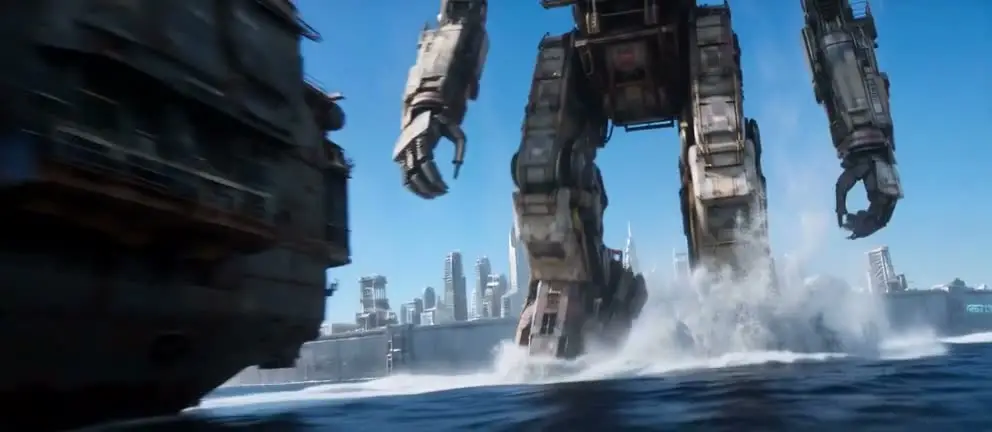 视频截图视频节点 18
Reference-role separation is critical. Use {{Mixed 1}} as the giant robot's character identity reference: a colossal discarded repair-giant assembled from salvaged industrial parts, weathered white-and-rust armor, smooth pale dome head, heavy mechanical limbs, REJECTED markings. Preserve its design and silhouette only, and place it in this scene's own lighting. Use {{Mixed 2}} as the ship's exterior shape reference: a massive scrapyard-built ark with a broad blunt oval bow, layered industrial superstructure, welded patched hull. Take its shape and structure, and place it in this scene's own deep-blue sea and cold daylight. Use {{Mixed 3}} as the hull-side mural reference: a faded painted mural of a giant robot with three small robot figures and a red REJECTED stamp, painted on the ship's side hull. Use {{Mixed 4}} as the COLOR PALETTE, LIGHTING, and cinematic tone reference: cold blue-grey realistic daylight, bright but not warm, silver-grey metal, deep blue sea, pale cool sky. Lock the whole grade to this palette. Use {{Mixed 5}} as the background city reference: a circular cold-blue PERFECT CITY island-fortress, appearing small, soft, and out of focus far away on the distant horizon. Each reference controls only its assigned role. If references conflict, follow the assigned role and priority order. SCALE: the giant robot is colossal, standing far TALLER than the whole ship, its head and shoulders towering high above the ship's superstructure, dwarfing the ship. SPACING: the giant wades through open water at a clear distance behind and to the side of the ship, with a wide stretch of deep sea between them, so their scale relationship reads clearly. WATERLINE: the sea is deep. The water rises to the giant's MID-THIGH — its knees and lower legs are underwater, its upper legs, hips, torso and head all above the surface. The giant STRIDES forward on its legs like a mech walking through the ocean (Pacific Rim style), taking heavy powerful steps, arms swinging naturally at its sides, pushing a wake through the deep water. Create an 8-second hyper-real cinematic live-action shot, IMAX 70mm, Panavision anamorphic, ONE single continuous camera move, epic and vast like Dune and Pacific Rim, cold blue-grey daylight, deep blue ocean, pale cool sky, sound effects only no music. 0-3s: The camera floats right on the sea surface, half-sunk at the waterline, tilted steeply upward, extremely close to the giant's massive thighs and legs — close enough to see rivets and rust. Waves surge and wash over the lens. The giant strides toward the frame through mid-thigh-deep water, its knees cutting through the waves, its enormous body rising overwhelmingly high overhead, towering far above the ship. Monumental Pacific Rim scale, the camera held low and glued to the churning water. 3-5s: The camera pulls back and glides in tight alongside the ship's side hull, tilted at a slight Dutch angle, racing fast just above the waterline with a strong sense of speed, sweeping past the large faded REJECTED mural on the ship's flank. 5-8s: The camera stays low and glued to the sea surface, tilted upward toward the ship's BOW in wide-angle — the massive ark's blunt bow plows powerfully straight toward the low camera, its hull cutting the sea and throwing spray at the lens, towering over the waterline viewpoint. Across the open water behind and beside it, the giant wades onward at a distance, still rising taller than the ship. On the far distant horizon, the cold-blue PERFECT CITY island sits small and out of focus. The giant robot exists only ONCE as a single unique character. The whole shot is one continuous low camera move skimming the deep sea. Deep blue ocean, cold blue-grey daylight, pale cool sky, silver-grey weathered metal, distant soft city island, crisp sharp clarity, hyper-real live-action, IMAX 70mm, one continuous shot, sound effects only no music.
Reference-role separation is critical. Use {{Mixed 1}} as the giant robot's character identity reference: a colossal discarded repair-giant assembled from salvaged industrial parts, weathered white-and-rust armor, smooth pale dome head, heavy mechanical limbs, REJECTED markings. Preserve its design and silhouette only. Do not inherit its background or studio lighting. Use {{Mixed 2}} as the ship's exterior shape reference ONLY: a massive scrapyard-built ark with a broad blunt oval bow, layered industrial superstructure, welded patched hull. Preserve only the ship's shape and structure. Do NOT inherit its sky, weather, sea, or grey overcast lighting. Use {{Mixed 3}} as the hull-side mural reference: a faded painted mural of a giant robot with three small robot figures and a red REJECTED stamp. Preserve only this mural on the ship's flank. Use {{Mixed 4}} as the COLOR PALETTE, LIGHTING, and cinematic tone reference ONLY: cold blue-grey realistic daylight, bright but NOT warm, silver-grey metal, deep blue sea, pale cool sky. Lock the grade to this. Do not inherit any subject or composition from {{Mixed 4}}. Use {{Mixed 5}} as the background city reference ONLY: a circular cold-blue PERFECT CITY island-fortress in the distance. Use it only as a distant, soft, out-of-focus background element. Do not inherit its composition, lighting, or scale into the foreground. Do not randomly merge the references. Each image controls only its assigned role. CRITICAL SCALE RULE (most important): the giant robot is ENORMOUS — TALLER than the entire ship, its head and shoulders rising ABOVE the ship's superstructure. The giant must clearly DWARF the ship. Never make the giant smaller than or shorter than the ship. CRITICAL WATERLINE RULE: the sea is deep, but the giant WADES on foot with its LEGS VISIBLE — submerged only up to its KNEES or lower THIGHS, so its full standing body and both legs are clearly seen striding forward through the water like a mech walking in the ocean (Pacific Rim style). Its arms hang naturally at its sides as it walks. NEVER submerge it to the waist or chest, NEVER show it swimming or paddling with its hands in the water. It STRIDES, it does not swim. CRITICAL LIGHTING: cold flat realistic daylight, deep blue sea, pale cool sky. NO golden sunset, NO orange backlight, NO warm glow, NO bright light dot on the horizon. Matching {{Mixed 4}}. NO drones, NO flying machines, NO visible aircraft in frame. The camera movement is invisible. Create an 8-second hyper-real cinematic live-action shot, IMAX 70mm, Panavision anamorphic, ONE single continuous camera move (no cuts), epic and vast like Dune and Pacific Rim, cold blue-grey daylight, deep blue ocean, pale cool sky, sound effects only no music. 0-3s: EXTREME low camera angle right at the sea surface, looking steeply UP at the colossal giant, very close to its huge legs. Waves splash and crash right in front of the lens. The giant strides forward through deep water, submerged only to its knees, both legs visible pushing through the sea, its towering body rising high above — TALLER than any ship, overwhelming and monumental. Cold daylight. 3-5s: The camera pulls back and glides in close alongside the ship's side hull, with a slight Dutch-angle tilt, skimming fast just above the waterline with a racing sense of speed, gliding right past the large faded REJECTED mural on the ship's flank. 5-8s: The camera rises slightly then descends back down close to the sea surface, tilting back to reveal the ship's BOW head-on in wide-angle — the massive ark's blunt bow plowing forward through the waves close to camera, low to the water so the hull cutting through the sea is visible. The towering giant wades in the water just behind and beside the ship. Far in the distance behind them, the cold-blue PERFECT CITY island sits small and out of focus. The giant robot exists ONLY ONCE, never duplicate it, and is always TALLER than the ship, striding on its legs (knee-deep), never swimming. Deep blue ocean, cold blue-grey daylight, pale cool sky, distant out-of-focus city island, NO warm light, NO drones, crisp sharp clarity, hyper-real live-action, IMAX 70mm, one continuous shot, sound effects only no music.
Reference-role separation is critical. Use {{Mixed 1}} as the giant robot's character identity reference: a colossal 30-meter discarded repair-giant assembled from salvaged industrial parts, weathered white-and-rust armor, smooth pale dome head, heavy mechanical limbs, REJECTED markings. Preserve its design and silhouette only. Do not inherit its background or studio lighting. Use {{Mixed 2}} as the ship's exterior shape reference ONLY: a massive scrapyard-built ark with a broad blunt oval bow, layered industrial superstructure, welded patched hull. Preserve only the ship's shape and structure. Do NOT inherit its sky, weather, sea, or grey overcast lighting. Use {{Mixed 3}} as the hull-side mural reference: a faded painted mural of a giant robot with three small robot figures and a red REJECTED stamp. Preserve only this mural on the ship's flank. Use {{Mixed 4}} as the COLOR PALETTE, LIGHTING, and cinematic tone reference ONLY: cold blue-grey realistic daylight, bright but NOT warm, silver-grey metal, deep blue sea, pale cool sky. Lock the grade to this. Do not inherit any subject or composition from {{Mixed 4}}. Use {{Mixed 5}} as the background city reference ONLY: a circular cold-blue PERFECT CITY island-fortress in the distance. Use it only as a distant, soft, out-of-focus background element. Do not inherit its composition, lighting, or scale into the foreground. Do not randomly merge the references. Each image controls only its assigned role. CRITICAL RULES: - DEEP OCEAN: the sea is deep. The giant robot is submerged up to its WAIST AND CHEST, with only its upper body and head above the waterline. NEVER show its full legs or have it standing in shallow water. The waterline sits high on its torso. The huge ship floats in deep ocean, never in a shallow pool. - NO golden sunset, NO orange backlight, NO warm glow, NO bright blue light dot on the horizon. Cold flat realistic daylight only, matching {{Mixed 4}}. - NO drones, NO flying machines, NO visible aircraft in frame. The camera movement is invisible. Create a 10-second hyper-real cinematic live-action shot, IMAX 70mm, Panavision anamorphic, ONE single continuous pull-back camera move (no cuts), epic and vast like Dune and Pacific Rim, cold blue-grey daylight, deep blue ocean, pale cool sky, sound effects only no music. The shot is ONE continuous backward-and-upward camera movement: 0-3s: Low camera near the deep sea surface. The colossal repair-giant wades directly toward camera through DEEP ocean, submerged up to its waist and chest, shoulders rocking heavily with each step, chest pushing a bow-wave, water streaming off its upper body. Far behind the giant, the cold-blue PERFECT CITY island sits small and soft on the distant horizon, out of focus (shallow depth of field). Overwhelming scale. 3-6s: The camera keeps pulling back continuously, drifting sideways to bring the massive ark's side hull into frame, gliding past the large faded REJECTED mural on the ship's flank. 6-10s: The camera continues pulling back and rising into a wide aerial establishing shot: the giant wades through the deep sea just behind and beside the ship, both moving forward together, while the cold-blue PERFECT CITY island shrinks in the far distance behind them — the rejected ones leaving the perfect city behind. The giant robot exists ONLY ONCE, never duplicate it. Deep blue ocean, giant submerged to waist/chest, cold blue-grey daylight, pale cool sky, distant out-of-focus city island, NO warm light, NO drones, crisp sharp clarity, hyper-real live-action, IMAX 70mm, one continuous shot, sound effects only no music.
Reference-role separation is critical. Use {{Mixed 1}} as the giant robot character identity reference ONLY: a colossal 30–35 meter discarded repair-giant assembled from salvaged industrial robot parts, weathered white-and-rust armor, smooth pale dome head, heavy mechanical limbs, patched panels, scaffolds, cables, and REJECTED markings. Preserve its design, silhouette, material language, and scale logic only. Do not inherit its background or studio lighting. Use {{Mixed 2}} as the ship exterior shape reference ONLY: a massive scrapyard-built ark vessel with a broad blunt oval bow, huge patched steel hull, layered industrial superstructure, welded modular sections, cranes, catwalks, repair walkways, and old rebuilt maritime structure. Preserve only the ship shape, bow, hull scale, and industrial construction. Do not inherit its sky, weather, sea, or grey overcast lighting. Use {{Mixed 3}} as the hull-side mural reference ONLY: a faded painted mural of the giant robot with three small robot figures and a red REJECTED stamp on the ship flank. Preserve only this mural as a painted marking on the ship side. Use {{Mixed 4}} as the color palette, lighting, and cinematic tone reference ONLY: cold blue-grey realistic daylight, bright but not warm, silver-grey metal, deep blue sea, pale cool sky, crisp daylight clarity. Lock the grade to this. Do not inherit any subject or composition from {{Mixed 4}}. Use {{Mixed 5}} as the distant PERFECT CITY island reference ONLY: a cold-blue circular city-island fortress far behind them on the horizon. Use it only as a distant, small, soft background landmark. Do not randomly merge the references. Each image controls only its assigned role. Create an 8-second hyper-real cinematic live-action shot in 21:9 widescreen. IMAX 70mm scale, Panavision anamorphic character, cold blue-grey daylight, deep blue ocean, pale cool sky, realistic water physics, sound effects only, no music. This is ONE single continuous backward-moving shot with a LOW WATERLINE CAMERA. The camera stays close to the sea surface for the entire shot. NO aerial rise. NO high-angle reveal. NO drone-like movement. Only a very slight natural height drift is allowed, but the camera must remain low and close to the ocean surface throughout. The scene: the rejected robots are leaving PERFECT CITY. A colossal repair-giant wades through the deep ocean beside a massive industrial ark vessel. The giant is a pathfinder, not swimming. The ship is a huge moving refuge built from salvaged industrial parts. CRITICAL SCALE RULE: The giant robot must feel larger than the ship’s main deck and superstructure. Its shoulders and head rise clearly above the ark’s deck level. The giant should feel physically overwhelming beside the ark. CRITICAL WATERLINE RULE: The giant is wading, not swimming. The waterline stays FIRMLY ABOVE THE KNEES, around knee-to-lower-thigh level. NEVER show the feet. NEVER show the ankles. NEVER show the lower shins below the waterline. Do not reveal any footstep touching the seabed. Do not make the water look shallow. No puddle-like water. No visible seabed. The ocean must read as deep open sea. The giant walks with heavy steps through deep water, producing strong displacement and rolling waves. CRITICAL PERFORMANCE RULE: Do NOT make the giant paddle or appear to swim. The arms hang heavy and mechanical, balancing naturally while walking. The body posture is powerful and steady, not struggling. The movement should feel like a Pacific Rim-scale machine wading forward with authority. 0.0s – 2.2s: Start extremely low near the ocean surface, almost at waterline, with a 24mm wide low-angle perspective. Begin very close to the giant’s submerged knee / upper-shin / lower-thigh zone, but DO NOT show the foot. The waterline cuts across the leg ABOVE THE KNEE. The visible mass is the giant’s enormous knee, thigh, lower torso weight, and towering upper body above. Water surges violently around the leg, splashing across the foreground. The giant’s body looms overhead with overwhelming scale. The camera pulls backward fast but controlled, staying low above the sea surface. Keep the lens close enough that the giant feels huge and oppressive. 2.2s – 5.0s: The camera continues pulling backward and slides tightly toward the ark vessel, almost scraping along the ship’s side hull. The hull enters extremely close to frame and dominates frame-left with strong parallax. Use a slight Dutch angle / broken horizon for speed and tension. The camera remains very low over the sea, skimming beside the hull, giving a strong FPV-like gliding sensation. The faded REJECTED mural on the ship’s side passes by briefly as a clear visual detail. The ship should feel massive, blunt, old, repaired, industrial, and heavy. The giant remains visible beyond the hull, still wading powerfully through deep water. 5.0s – 8.0s: The camera continues the same low backward move, still close to the sea surface, now drifting around the broad blunt bow area. The ark’s bow pushes white foam outward very close to camera. The lens stays low, near the ship’s waterline, so the bow feels huge and imposing. Reveal the relationship clearly: the giant wades beside and slightly behind the ark, taller than the deck structures, with the waterline still above its knees. The giant’s steps generate heavy waves and water displacement. In the far background, the cold-blue PERFECT CITY island remains distant and small on the horizon. The final frame should still be low-angle and sea-level, not aerial: ship bow and hull dominating the foreground/midground, the giant beside it, and PERFECT CITY far behind as a small cold island. Visual style: hyper-real live-action, IMAX 70mm feeling, Panavision anamorphic lens character, crisp daylight clarity, cold blue-grey grade, deep blue ocean, pale cool sky, realistic water spray, heavy mechanical mass, grounded industrial materials, soft film grain, cinematic scale, no glossy CGI feeling, no cartoon style, no game-render feel. Sound design: deep ocean waves, giant metal steps through water, heavy water displacement, ship engine rumble, hull creaks, wind, distant mechanical resonance, no music.
Use {{Image 1}} as the giant underground repair-robot identity reference. Preserve the colossal humanoid repair-giant design language: discarded industrial robot parts, patched metal panels, welded structures, reused components, scaffolds, faded warning plates, REJECTED, DECOMMISSIONED UNIT, and UNDER REPAIR markings. Create a front-facing half-body asset image of the giant underground repair robot for a later plaza-breakthrough scene. The giant robot is approximately 28m to 35m tall, but this asset should show only the upper half: huge head, shoulders, chest, upper torso, arms, and shoulder maintenance platforms. The waist, hips, legs, feet, and lower body are completely hidden below a mass of broken concrete, twisted LED-screen frame debris, dust, smoke, and collapsed plaza structure. The image must clearly communicate that the giant is emerging from underground and only its upper body is visible. Design the chest and shoulder area with small maintenance platforms, railings, ladders, exposed service walkways, and back-side openings where tiny robots could later stand or emerge. The platforms should be small compared with the giant body, emphasizing scale. The giant must feel too large to fully fit into a normal city frame. Its shoulders are extremely wide, the head is massive, and the chest is built from layered industrial panels, reused robot components, welded seams, hydraulic elements, cables, scaffolds, and old warning plates. Readable markings should appear naturally on different body sections: REJECTED DECOMMISSIONED UNIT UNDER REPAIR Lighting: cinematic daylight mixed with dust haze, strong scale, realistic material response, weathered metal, soft film grain, restrained detail, practical industrial texture. Composition: clean asset-style front view, centered, 21:9 or wide composition, enough empty space around the upper body for video reference use. Do not show a full-body standing robot. Show only the half-emerged upper body buried in rubble and smoke. Visual style: hyper-real live-action concept asset, IMAX 70mm scale feeling, grounded industrial realism, weathered material language, no sleek mecha, no superhero pose, no glossy CGI, no cartoon style, no game-render feel.
Use {{Mixed 1}} as the PERFECT CITY main plaza environment reference. Preserve the wide futuristic civic square, giant central LED screen, open plaza paving, clean monumental urban axis, surrounding towers, PERFECT CITY banners, and bright upper-city daylight atmosphere. Use {{Mixed 2}} as the giant underground repair-robot design and scale reference only. Preserve its identity as a colossal humanoid repair giant assembled from discarded industrial robot parts, patched metal panels, welded structures, reused components, maintenance scaffolds, faded warning plates, and readable markings such as REJECTED, DECOMMISSIONED UNIT, and UNDER REPAIR. Preserve the scale logic: approximately 28m to 35m tall, overwhelmingly larger than normal robots. Use {{Mixed 2}} only for the giant robot’s design language, material structure, markings, and scale. Transform it into a live-action disaster scene inside PERFECT CITY plaza. Use {{Mixed 3}} as the late-reveal protagonist inspection robot reference. Preserve the exact white inspection-and-disposal robot identity, black face screen, worn shell, PC-67241 markings, and body proportions. He is about 1.78m tall. He appears near the end as a tiny readable figure on the giant’s shoulder-side maintenance platform. Create a single continuous 11 to 12 second cinematic live-action shot in 21:9 widescreen. This is Shot 33, the second-to-last climax shot of the film. The shot continues from the previous ultra-low FPV fracture shot. The crack has already crossed the crowded PERFECT CITY plaza and is now rushing toward the giant central LED screen. Emotional progression: ground-level pursuit -> sudden stop -> underground pressure behind the screen -> rear-side screen rupture -> half-emerged giant -> obsolete units flooding out -> protagonist final reveal -> iconic key-art frame. Overall image treatment: cinematic photograph, soft film-like texture, restrained detail, large color-shape composition, unified material language, realistic physical destruction, practical daylight, sunlight through dust, grounded disaster-film energy, monumental scale, IMAX 70mm feeling, Panavision anamorphic character, clean premium upper-city atmosphere violently broken open by underground industrial force. CAMERA CONCEPT: One continuous shot. The camera begins as an ultra-low ground-hugging FPV continuation, then rises into a disaster reveal, then settles into a poster-like final frame. Movement feels physically motivated: fast near the ground, heavy upward tilt, controlled forward drift, final stabilizing settle. The camera is always on the plaza side, looking toward the central LED screen. The LED screen structure is a foreground barrier. The giant comes from underground behind the screen structure and breaks through the screen plane from the rear side. 0.0s – 1.2s Ultra-low ground-hugging FPV camera, only a few centimeters above the plaza surface, rushing forward along the advancing crack toward the giant central LED screen. The plaza is packed with clean, standardized PERFECT CITY upper-city robots. Many polished white-and-silver robot feet and lower legs fill both sides of the foreground and midground, forming a tight corridor around the crack. Their posture feels orderly, corporate, clean, and controlled before panic. The crack races between their feet. Pavement seams split, slab edges lift, dust bursts upward, and small debris scatters. Nearby robot feet recoil and sidestep in layered timing. The focus stays on crack, feet, and fast ground-level movement. The giant screen grows larger ahead. 1.2s – 2.4s The fracture suddenly stops in front of the screen base. Broken pavement settles. Dust hangs in the air. The camera continues gliding forward and begins a heavy upward tilt toward the central screen. A low underground pressure builds behind the screen. The screen base vibrates. The plaza surface behind and under the screen base bulges, cracks, and lifts. Dust jets upward from seams behind the screen structure. The LED screen flickers. The metal truss trembles and sheds fine dust. The pressure clearly comes from below and behind the screen, as if something enormous is pushing upward from the underground side of the plaza. 2.4s – 5.5s The giant underground repair-robot erupts upward from the ground behind the central LED screen and tears through the screen from the rear side. The rupture direction is clear: the screen is in front, the giant is behind it, the giant’s head and shoulders punch through the screen plane from behind, then its chest and upper torso crush into the LED frame, then its arms and shoulders brace against the torn screen frame and broken plaza edge, hauling its upper body halfway out of the underground tunnel. The giant appears as a half-emerged underground body. Frame the giant from massive head to upper torso. The lower visual edge is buried inside the rupture crater. Broken plaza slabs, collapsed screen-base debris, twisted LED panels, smoke, dust, and falling rubble fill the lower third of the frame and conceal the body below the upper torso. The giant feels too large to fully fit inside the shot. Its head is enormous. Its shoulders are wider than the central screen frame. The broken LED structure is crushed tightly around its upper body. Physical destruction is heavy and believable: LED panels tear apart, glass-like screen fragments explode outward, metal trusses bend, support beams twist, screen debris and dust erupt into sunlight, large broken pieces fall with real weight. The camera reacts with a strong physical shake and slight recoil, then quickly rebalances while keeping the action readable. 5.5s – 8.4s The giant stabilizes half-emerged through the destroyed screen. Its head, shoulders, chest, upper arms, and upper torso dominate the plaza. The lower body remains buried inside the rupture crater, visually covered by debris, dust, collapsed screen structure, and smoke. Behind the giant’s shoulders and upper back, a ruptured underground tunnel becomes visible through smoke and debris. Shoulder-side walkways, back-side openings, dark service passages, and upper maintenance platforms open into the plaza. A wave of obsolete rejected service robots emerges from the tunnel and from the giant’s back-side and shoulder-side structures. These obsolete robots are generated as varied old city-service units: boxy utility robots, short cylindrical service robots, wheeled-base robots, compact repair bots, delivery units, maintenance units, domestic service units, cleaning units, guide units, different heights, different head shapes, different body widths, patched shells, worn paint, repair seams, reused parts, old markings, salvaged components, small practical utility arms. They move out from behind the giant’s shoulders, back-side openings, and upper service paths, spilling into the broken plaza space as a returning crowd. Their silhouettes are varied and non-identical. They feel like many discarded generations returning together. The giant remains the dominant mass. The broken screen frame surrounds its upper body. Dust, sunlight, falling debris, smoke, and moving obsolete robots create layered depth. 8.4s – 11.8s The camera continues moving toward the giant’s upper body and shoulder-side platform, using a controlled forward-and-upward drift. The motion feels like the camera is discovering a small figure after the giant and the crowd have already broken through. The protagonist inspection robot appears last. He steps out from a dark service passage behind the giant’s shoulder and climbs onto a shoulder-side maintenance platform. He is a tiny white inspection robot against the massive industrial shoulder structure. He is readable but small. He stands on the shoulder-side platform above the broken screen structure, surrounded by scale, smoke, sunlight, twisted metal, and moving obsolete robots. The protagonist is the only clearly readable hero figure in the final beat. The obsolete robots continue emerging behind and around him as smaller background motion. Final camera move: continue the controlled forward-and-upward drift toward the shoulder-side platform, then settle with a slight stabilizing pull-back into an iconic key-art composition. Final composition: the shattered PERFECT CITY main screen frames the giant’s upper half, the giant’s huge head, chest, shoulders, arms, and upper torso dominate the image, the lower body is visually buried inside the rupture crater, obsolete service robots spill from the tunnel and shoulder-side walkways, the protagonist stands small but readable on an upper shoulder-side maintenance platform, sunlight, dust, smoke, hanging debris, broken LED panels, and twisted metal create cinematic depth. Let the final image hold with a clean visual breath. The motion settles into an iconic key-art frame with strong scale, readable protagonist placement, and monumental disaster-film weight. Sound design: fast cracking pavement, robot feet reacting, dust bursts, sudden silence, low underground rumble from behind the screen, screen-frame metal groans, heavy rear-side rupture impact, LED panel shattering, falling debris, distant crowd panic, giant mechanical resonance, obsolete robots emerging from the tunnel, one final monumental impact as the frame settles, then a short breath of silence. Visual style: hyper-real live-action, cinematic disaster-film energy, giant-scale realism, grounded physical destruction, IMAX 70mm monumentality, Panavision anamorphic character, sunlight through dust, real material response, soft film grain, iconic final key-art composition with real mass and awe.
Use {{Mixed 1}} as the PERFECT CITY main plaza environment reference. Preserve the wide futuristic civic square, giant central LED screen, open plaza paving, clean monumental urban axis, surrounding towers, PERFECT CITY banners, and bright upper-city daylight atmosphere. Use {{Mixed 2}} as the giant underground repair-robot design and scale reference only. Preserve its identity as a colossal humanoid repair giant assembled from discarded industrial robot parts, patched metal panels, welded structures, reused components, maintenance scaffolds, faded warning plates, and readable markings such as REJECTED, DECOMMISSIONED UNIT, and UNDER REPAIR. Preserve the scale logic: the giant is approximately 28m to 35m tall, overwhelmingly larger than normal robots. Use {{Mixed 2}} only for the giant robot’s design language, material structure, markings, and scale. The shot itself should transform this design into a live-action plaza disaster scene, not an asset-sheet presentation. Use {{Mixed 3}} as the protagonist inspection robot reference. Preserve the exact white inspection-and-disposal robot identity, black face screen, worn shell, PC-67241 markings, and body proportions. He is about 1.78m tall. He appears only in the final hero beat near the end of the shot, as a tiny readable figure on the giant’s shoulder-side maintenance platform. Create a single continuous 11 to 12 second cinematic live-action shot in 21:9 widescreen. This is Shot 33, the second-to-last climax shot of the film. This shot happens in PERFECT CITY main plaza, continuing from the previous ultra-low FPV fracture shot. The crack has already crossed the crowded plaza and is now rushing toward the giant central LED screen. Emotional progression: ground-level pursuit -> sudden stop -> underground pressure -> half-body eruption -> obsolete units flood out -> protagonist final reveal -> iconic poster frame. Overall image treatment: cinematic photograph, soft film-like texture, restrained detail, large color-shape composition, unified material language, realistic physical destruction, practical daylight, sunlight through dust, grounded disaster-film energy, monumental scale, IMAX 70mm feeling, Panavision anamorphic character, clean premium upper-city atmosphere violently broken open by underground industrial force. CAMERA CONCEPT: One continuous shot. The camera begins as an ultra-low ground-hugging FPV continuation, then rises into a disaster reveal, then settles into a poster-like final frame. Movement is physically motivated: fast near the ground, heavy upward tilt, controlled forward drift, then a final stabilizing settle. 0.0s – 1.3s Ultra-low ground-hugging FPV camera, only a few centimeters above the plaza surface, rushing forward along the advancing crack toward the giant central LED screen. The plaza is packed with clean, standardized PERFECT CITY upper-city robots. Many polished white-and-silver robot feet and lower legs fill both sides of the foreground and midground, forming a tight corridor around the crack. These upper-city robots feel orderly, identical in posture, corporate, clean, and controlled before panic. The crack races between their feet. Pavement seams split, slab edges lift, dust bursts upward, and small debris scatters. Nearby robot feet recoil, sidestep, and stagger backward in layered timing. Keep the focus on the crack, feet, and fast ground-level movement. The giant screen grows larger ahead. 1.3s – 2.5s The fracture suddenly stops in front of the screen base. Broken pavement settles. Dust hangs in the air. The camera continues gliding forward and begins a heavy upward tilt toward the central screen. A low underground pressure builds immediately. The screen base vibrates. The plaza surface behind and under the screen base bulges, cracks, and lifts. Dust jets upward from seams behind the screen structure. The LED screen flickers. The metal truss trembles and sheds fine dust. The force clearly comes from underground behind the screen base. This suspense beat is brief, tense, and compressed. 2.5s – 5.6s The giant underground repair-robot erupts violently upward from the ground behind the screen base and tears through the central LED screen structure. The giant emerges like a massive underground excavation machine forcing its way up: first the enormous head and shoulders push through dust and broken pavement, then the chest and upper torso crash into the LED frame, then both arms and shoulders brace against the broken screen base and surrounding structure, as if hauling its upper body out of the underground tunnel. Only the upper half of the giant is visible: huge head, neck, shoulders, upper arms, chest, and upper torso. The visual lower edge of the giant is buried inside the rupture crater. The waistline and everything below it are concealed by broken plaza slabs, collapsed screen-base debris, twisted LED panels, dust clouds, smoke, and falling rubble. The giant reads as a half-emerged underground body. The screen frame and debris cut across its lower torso, hiding the continuation into the ground. The giant should feel too large to fully fit inside the frame. Its head is enormous. Its shoulders are wider than the screen frame. The broken LED structure is crushed tightly around its upper body. Physical destruction is heavy and believable: LED panels rip apart, glass-like screen fragments explode outward, metal trusses bend, support beams twist, screen debris and dust erupt into sunlight, large broken pieces fall with real weight. The camera reacts with a strong physical shake and slight recoil, then quickly rebalances while keeping the action readable. 5.6s – 8.6s The giant stabilizes half-emerged through the destroyed screen. Chest and shoulders remain above ground. Its lower body remains buried inside the rupture crater and hidden by debris and dust. Behind the giant’s shoulders and upper back, the ruptured underground tunnel becomes visible through smoke and debris. Shoulder-side walkways, back-side openings, dark service passages, and upper maintenance platforms open into the plaza. A wave of obsolete rejected service robots begins emerging from the tunnel and from the giant’s back-side and shoulder-side structures. These obsolete robots are generated from description: varied old city-service units, boxy utility robots, short cylindrical service robots, wheeled-base robots, compact repair bots, delivery units, maintenance units, domestic service units, cleaning units, guide units, different heights, different head shapes, different body widths, patched shells, worn paint, repair seams, reused parts, old markings, salvaged components, small practical utility arms. They feel like many different generations of discarded city-service robots returning together. Their silhouettes are varied and non-identical. They move out from behind the giant’s shoulders, back-side openings, and upper service paths, spilling into the broken plaza space as a returning crowd. The giant remains the dominant mass. The broken screen frame surrounds its upper body. Dust, sunlight, falling debris, smoke, and moving obsolete robots create layered depth. 8.6s – 11.8s Only now does the protagonist inspection robot appear. The camera moves closer toward the giant’s upper body and shoulder-side maintenance platform, using a controlled forward-and-upward drift. The motion feels like the camera is discovering the small figure on the giant after the crowd has already begun emerging. The protagonist inspection robot steps out last from a dark service passage behind the giant’s shoulder and climbs onto a shoulder-side maintenance platform. He is the only clearly readable hero figure in the final image. He appears as a tiny white inspection robot against the massive industrial shoulder structure. He is readable, but very small compared with the giant. He does not dominate the frame. He stands on the shoulder-side maintenance platform, above the broken screen structure. Obsolete service robots continue emerging behind and around him as smaller background figures. Final camera move: continue a controlled forward-and-upward drift toward the shoulder platform, then settle with a slight pull-back or stabilizing drift to create a poster-like final composition. Final composition: the shattered PERFECT CITY main screen frames the giant’s upper half, the giant’s huge head, chest, shoulders, arms, and upper torso dominate the image, the giant’s lower body remains underground and unseen, obsolete service robots spill from the tunnel and shoulder-side walkways, the protagonist stands small but readable on an upper shoulder-side maintenance platform, sunlight, dust, smoke, hanging debris, broken LED panels, and twisted metal create cinematic depth. Let the final image hold with a strong, clean visual breath. The motion settles into an iconic key-art composition with enough visual clarity for post-production finishing. Sound design: fast cracking pavement, robot feet reacting, dust bursts, sudden silence, low underground rumble, screen-frame metal groans, heavy half-body eruption, LED panel shattering, falling debris, distant crowd panic, giant mechanical resonance, obsolete robots emerging from the tunnel, one final monumental impact as the frame settles, then a short breath of silence. Visual style: hyper-real live-action, cinematic disaster-film energy, giant-scale realism, grounded physical destruction, IMAX 70mm monumentality, Panavision anamorphic character, sunlight through dust, real material response, soft film grain, iconic final key-art composition with real mass and awe.
Use {{Mixed 1}} as the PERFECT CITY main plaza environment reference. Preserve the wide futuristic civic square, giant central LED screen, open plaza paving, clean monumental urban axis, surrounding towers, PERFECT CITY banners, and bright upper-city daylight atmosphere. Use {{Mixed 2}} as the giant underground repair-robot reference. Preserve only its identity, structure, material language, and scale logic: a colossal humanoid repair giant assembled from discarded industrial robot parts, patched metal panels, welded structures, reused components, maintenance scaffolds, faded warning plates, and readable markings such as REJECTED, DECOMMISSIONED UNIT, and UNDER REPAIR. {{Mixed 2}} is only for the giant robot’s design and scale logic. Do not inherit its white-background presentation, layout, or neutral asset-sheet framing. In this shot, the giant must appear as a half-emerged underground giant: only the huge head, shoulders, chest, arms, and upper torso break through the plaza screen structure. Its waist, hips, legs, knees, and feet remain fully buried underground and hidden by broken pavement, dust, smoke, debris, and collapsed LED structure. Use {{Mixed 3}} as the protagonist inspection robot reference. Preserve the exact white inspection-and-disposal robot identity, black face screen, worn shell, PC-67241 markings, and body proportions. He is about 1.78m tall and must remain extremely tiny compared with the giant. The protagonist is not part of the old robot crowd. He appears only in the final hero beat near the end of the shot. Use {{Mixed 4}} as the obsolete rejected service-robot crowd reference. Preserve the idea of a lineup of different obsolete PERFECT CITY service robots: varied silhouettes, different generations, different head shapes, boxy units, cylindrical units, guide units, delivery units, domestic units, maintenance units, support units, cleaning units, and other old service types. They should feel like many different discarded city-service robots returning together. They are not identical, not repeated clones, and not copies of the protagonist. Their function in this shot is background group emergence, not hero focus. Create a single continuous 11 to 12 second cinematic live-action shot in 21:9 widescreen. This is Shot 33, the second-to-last climax shot of the film. This shot happens in PERFECT CITY main plaza, continuing from the previous ultra-low FPV fracture shot. The crack has already crossed the crowded plaza and is now near the giant central screen. Emotional progression: ground-level pursuit -> sudden silence -> underground pressure -> half-body eruption -> obsolete units flood out -> protagonist final reveal -> iconic poster frame. Overall image treatment: cinematic photograph, soft film-like texture, restrained detail, large color-shape composition, unified material language, realistic physical destruction, practical daylight, sunlight through dust, grounded disaster-film energy, monumental scale, IMAX 70mm feeling, Panavision anamorphic character, clean premium upper-city atmosphere violently broken open by underground industrial force. CAMERA CONCEPT: This is one continuous shot. The camera begins as an ultra-low ground-hugging FPV continuation, then rises into a disaster reveal, then settles into a poster-like final frame. Movement is physically motivated: fast near the ground, then heavy upward tilt, then controlled settling drift. Keep the front section shorter and more efficient. Do not linger too long before the eruption. 0.0s – 1.5s Ultra-low ground-hugging FPV camera, only a few centimeters above the plaza surface, rushing forward along the advancing crack toward the giant central LED screen. The plaza is densely packed with PERFECT CITY robots. Many robot feet and lower legs fill both sides of the foreground and midground, creating a tight corridor around the crack. The crowd feels dense, orderly, and standardized before panic. The crack races between their feet. Pavement seams split, slab edges lift, dust bursts upward, and small debris scatters. Nearby robot feet recoil and sidestep in layered timing. Keep the focus on the crack and the feet. The giant screen grows larger ahead. 1.5s – 2.8s The fracture suddenly stops in front of the screen base. Broken pavement settles. Dust hangs in the air. The camera continues gliding forward and begins a heavy upward tilt toward the central screen. A low underground pressure builds immediately. The screen base vibrates. The plaza surface behind and under the screen base bulges, cracks, and lifts. Dust jets upward from seams. The LED screen flickers. The metal truss trembles and sheds fine dust. The force clearly comes from underground behind the screen base. This suspense beat is brief and tense, not slow. 2.8s – 5.8s The giant underground repair-robot erupts violently upward from the ground behind the screen base and tears through the central LED screen structure. The giant emerges like a massive underground excavation machine forcing its way up: first the enormous head and shoulders push through dust and broken pavement, then the chest and upper torso crash into the LED frame, then both arms and shoulders brace against the broken screen base and surrounding structure, as if hauling its upper body out of the underground tunnel. Only the upper half is visible: huge head, neck, shoulders, upper arms, chest, and upper torso. The lower body remains fully underground and completely hidden by broken pavement, collapsed screen-base debris, dust, smoke, and twisted metal. The giant must not show legs or feet. It should feel so large that even only the upper half is enough to destroy the entire screen. Its head feels enormous. Its shoulders are too wide for the screen frame. The broken LED structure is crushed tightly around its upper body. Physical destruction is heavy and believable: LED panels rip apart, glass-like screen fragments explode outward, metal trusses bend, support beams twist, screen debris and dust erupt into sunlight, large broken pieces fall with real weight. The camera reacts with a strong physical shake and slight recoil, then quickly rebalances while keeping the action readable. 5.8s – 8.8s The giant stabilizes half-emerged through the destroyed screen. Chest and shoulders remain above ground. Lower body remains buried underground. Behind the giant’s shoulders and upper back, the ruptured underground tunnel becomes visible through smoke and debris. Maintenance paths, shoulder-side walkways, back-side openings, and upper service platforms open into the plaza. A wave of obsolete rejected service robots begins emerging from the tunnel and from the giant’s back-side and shoulder-side structures. These obsolete robots must strictly follow the spirit of {{Mixed 4}} : different service-model silhouettes, different head shapes, different body widths, different heights, different ages, different functions, boxy utility units, short cylindrical units, guide units, maintenance units, delivery units, domestic units, cleaning units, wheeled-base units, compact repair bots, patched shells, worn paint, reused components, old markings, salvaged parts. They are varied and clearly non-identical. They must not look like copies of the protagonist. They function as a returning crowd of obsolete city-service units. They remain smaller background group figures rather than hero subjects. The giant remains the dominant mass. The broken screen frame surrounds its upper body. Dust, sunlight, falling debris, smoke, and moving obsolete robots create layered depth. 8.8s – 11.5s Only in this final hero beat does the protagonist inspection robot appear. The camera moves closer toward the giant’s upper body and shoulder platform, using a controlled forward-and-upward drift, then a subtle settling drift to form the final poster composition. The protagonist inspection robot emerges last from the dark tunnel path behind the giant and climbs up onto a shoulder-side or chest-side maintenance platform. He is the only clearly readable hero figure in the final image. He appears as a very small figure relative to the giant. He does not dominate the frame. He reads like a tiny white inspection robot standing on a massive industrial shoulder structure. The obsolete service robots continue emerging behind and around him as smaller background figures. Final composition: the shattered PERFECT CITY main screen frames the giant’s upper half, the giant’s huge head, chest, shoulders, arms, and upper torso dominate the frame, its lower body remains underground and unseen, obsolete service robots spill from the tunnel and shoulder-side walkways, the protagonist stands small but readable on an upper maintenance platform, sunlight, dust, smoke, hanging debris, broken LED panels, and twisted metal create cinematic depth. Sound design: fast cracking pavement, robot feet reacting, dust bursts, sudden silence, low underground rumble, screen-frame metal groans, heavy half-body eruption, LED panel shattering, falling debris, distant crowd panic, giant mechanical resonance, obsolete robots emerging from the tunnel, one final monumental impact as the frame settles, then a short breath of silence. Visual style: hyper-real live-action, cinematic disaster-film energy, giant-scale realism, grounded physical destruction, IMAX 70mm monumentality, Panavision anamorphic character, sunlight through dust, real material response, soft film grain, iconic final key-art composition with real mass and awe.
Use {{Mixed 1}} as the PERFECT CITY main plaza environment reference. Preserve the wide futuristic civic square, giant central LED screen, open plaza paving, clean monumental urban axis, surrounding towers, PERFECT CITY banners, and bright upper-city daylight atmosphere. Use {{Mixed 2}} as the giant underground repair-robot reference. Preserve only its identity, structure, material language, and scale logic: a colossal humanoid repair giant assembled from discarded industrial robot parts, patched metal panels, welded structures, reused components, maintenance scaffolds, faded warning plates, and readable markings such as REJECTED, DECOMMISSIONED UNIT, and UNDER REPAIR. {{Mixed 2}} is only for the giant robot’s design and scale logic. Do not inherit its white-background presentation, layout, or neutral asset-sheet framing. In this shot, the giant must appear as a half-emerged underground giant: only the huge head, shoulders, chest, arms, and upper torso break through the plaza screen structure. Its waist, hips, legs, knees, and feet remain fully buried underground and hidden by broken pavement, dust, smoke, debris, and collapsed LED structure. Use {{Mixed 3}} as the protagonist inspection robot reference. Preserve the exact white inspection-and-disposal robot identity, black face screen, worn shell, PC-67241 markings, and body proportions. He is about 1.78m tall and must remain extremely tiny compared with the giant. The protagonist is not part of the old robot crowd. He appears only in the final hero beat near the end of the shot. Use {{Mixed 4}} as the obsolete rejected service-robot crowd reference. Preserve the idea of a lineup of different obsolete PERFECT CITY service robots: varied silhouettes, different generations, different head shapes, boxy units, cylindrical units, guide units, delivery units, domestic units, maintenance units, support units, cleaning units, and other old service types. They should feel like many different discarded city-service robots returning together. They are not identical, not repeated clones, and not copies of the protagonist. Their function in this shot is background group emergence, not hero focus. Create a single continuous 11 to 12 second cinematic live-action shot in 21:9 widescreen. This is Shot 33, the second-to-last climax shot of the film. This shot happens in PERFECT CITY main plaza, continuing from the previous ultra-low FPV fracture shot. The crack has already crossed the crowded plaza and is now near the giant central screen. Emotional progression: ground-level pursuit -> sudden silence -> underground pressure -> half-body eruption -> obsolete units flood out -> protagonist final reveal -> iconic poster frame. Overall image treatment: cinematic photograph, soft film-like texture, restrained detail, large color-shape composition, unified material language, realistic physical destruction, practical daylight, sunlight through dust, grounded disaster-film energy, monumental scale, IMAX 70mm feeling, Panavision anamorphic character, clean premium upper-city atmosphere violently broken open by underground industrial force. CAMERA CONCEPT: This is one continuous shot. The camera begins as an ultra-low ground-hugging FPV continuation, then rises into a disaster reveal, then settles into a poster-like final frame. Movement is physically motivated: fast near the ground, then heavy upward tilt, then controlled settling drift. Keep the front section shorter and more efficient. Do not linger too long before the eruption. 0.0s – 1.5s Ultra-low ground-hugging FPV camera, only a few centimeters above the plaza surface, rushing forward along the advancing crack toward the giant central LED screen. The plaza is densely packed with PERFECT CITY robots. Many robot feet and lower legs fill both sides of the foreground and midground, creating a tight corridor around the crack. The crowd feels dense, orderly, and standardized before panic. The crack races between their feet. Pavement seams split, slab edges lift, dust bursts upward, and small debris scatters. Nearby robot feet recoil and sidestep in layered timing. Keep the focus on the crack and the feet. The giant screen grows larger ahead. 1.5s – 2.8s The fracture suddenly stops in front of the screen base. Broken pavement settles. Dust hangs in the air. The camera continues gliding forward and begins a heavy upward tilt toward the central screen. A low underground pressure builds immediately. The screen base vibrates. The plaza surface behind and under the screen base bulges, cracks, and lifts. Dust jets upward from seams. The LED screen flickers. The metal truss trembles and sheds fine dust. The force clearly comes from underground behind the screen base. This suspense beat is brief and tense, not slow. 2.8s – 5.8s The giant underground repair-robot erupts violently upward from the ground behind the screen base and tears through the central LED screen structure. The giant emerges like a massive underground excavation machine forcing its way up: first the enormous head and shoulders push through dust and broken pavement, then the chest and upper torso crash into the LED frame, then both arms and shoulders brace against the broken screen base and surrounding structure, as if hauling its upper body out of the underground tunnel. Only the upper half is visible: huge head, neck, shoulders, upper arms, chest, and upper torso. The lower body remains fully underground and completely hidden by broken pavement, collapsed screen-base debris, dust, smoke, and twisted metal. The giant must not show legs or feet. It should feel so large that even only the upper half is enough to destroy the entire screen. Its head feels enormous. Its shoulders are too wide for the screen frame. The broken LED structure is crushed tightly around its upper body. Physical destruction is heavy and believable: LED panels rip apart, glass-like screen fragments explode outward, metal trusses bend, support beams twist, screen debris and dust erupt into sunlight, large broken pieces fall with real weight. The camera reacts with a strong physical shake and slight recoil, then quickly rebalances while keeping the action readable. 5.8s – 8.8s The giant stabilizes half-emerged through the destroyed screen. Chest and shoulders remain above ground. Lower body remains buried underground. Behind the giant’s shoulders and upper back, the ruptured underground tunnel becomes visible through smoke and debris. Maintenance paths, shoulder-side walkways, back-side openings, and upper service platforms open into the plaza. A wave of obsolete rejected service robots begins emerging from the tunnel and from the giant’s back-side and shoulder-side structures. These obsolete robots must strictly follow the spirit of {{Mixed 4}} : different service-model silhouettes, different head shapes, different body widths, different heights, different ages, different functions, boxy utility units, short cylindrical units, guide units, maintenance units, delivery units, domestic units, cleaning units, wheeled-base units, compact repair bots, patched shells, worn paint, reused components, old markings, salvaged parts. They are varied and clearly non-identical. They must not look like copies of the protagonist. They function as a returning crowd of obsolete city-service units. They remain smaller background group figures rather than hero subjects. The giant remains the dominant mass. The broken screen frame surrounds its upper body. Dust, sunlight, falling debris, smoke, and moving obsolete robots create layered depth. 8.8s – 11.5s Only in this final hero beat does the protagonist inspection robot appear. The camera moves closer toward the giant’s upper body and shoulder platform, using a controlled forward-and-upward drift, then a subtle settling drift to form the final poster composition. The protagonist inspection robot emerges last from the dark tunnel path behind the giant and climbs up onto a shoulder-side or chest-side maintenance platform. He is the only clearly readable hero figure in the final image. He appears as a very small figure relative to the giant. He does not dominate the frame. He reads like a tiny white inspection robot standing on a massive industrial shoulder structure. The obsolete service robots continue emerging behind and around him as smaller background figures. Final composition: the shattered PERFECT CITY main screen frames the giant’s upper half, the giant’s huge head, chest, shoulders, arms, and upper torso dominate the frame, its lower body remains underground and unseen, obsolete service robots spill from the tunnel and shoulder-side walkways, the protagonist stands small but readable on an upper maintenance platform, sunlight, dust, smoke, hanging debris, broken LED panels, and twisted metal create cinematic depth. Sound design: fast cracking pavement, robot feet reacting, dust bursts, sudden silence, low underground rumble, screen-frame metal groans, heavy half-body eruption, LED panel shattering, falling debris, distant crowd panic, giant mechanical resonance, obsolete robots emerging from the tunnel, one final monumental impact as the frame settles, then a short breath of silence. Visual style: hyper-real live-action, cinematic disaster-film energy, giant-scale realism, grounded physical destruction, IMAX 70mm monumentality, Panavision anamorphic character, sunlight through dust, real material response, soft film grain, iconic final key-art composition with real mass and awe.
Use {{Mixed 1}} as the PERFECT CITY main plaza environment reference. Preserve the wide futuristic civic square, giant central LED screen, open plaza paving, clean monumental urban axis, surrounding towers, PERFECT CITY banners, and bright upper-city daylight atmosphere. Use {{Mixed 2}} as the giant underground repair-robot reference. Preserve it as a colossal humanoid repair giant assembled from discarded industrial robot parts, patched metal panels, welded structures, reused components, scaffolds, faded warning plates, and readable markings such as REJECTED, DECOMMISSIONED UNIT, and UNDER REPAIR. It should feel like a communal monument built over time by rejected units below, with industrial history and spiritual weight. Preserve the giant’s scale logic: approximately 28m to 35m tall, overwhelmingly larger than the protagonist. Use {{Mixed 3}} as the protagonist inspection robot reference. Preserve the exact white inspection-and-disposal robot identity, black face screen, worn shell, PC-67241 markings, and body proportions. He is the only robot with this inspection-body design. Preserve him as a small but clearly readable figure against the giant, about 1.78m tall. Create a single continuous 9-second cinematic live-action shot in 21:9 widescreen. This is Shot 33, the second-to-last climax shot of the film. This shot happens in PERFECT CITY main plaza, immediately continuing from the earlier ultra-low FPV fracture shot. The crack has already raced forward through the crowded plaza and is now approaching the giant central screen. Emotional progression: pursuit -> suspended dread -> catastrophic rupture -> giant emergence -> iconic poster freeze. Overall image treatment: cinematic photograph, soft film-like texture, restrained detail, large color-shape composition, unified material language, realistic physical destruction, practical sunlight, shallow but believable depth hierarchy, disaster-film energy, monumental scale, grounded realism, clean and premium visual tone. CAMERA CONCEPT: This is one continuous shot that begins as a low ground-hugging FPV continuation and evolves into a more cinematic rising disaster reveal, then settles into an iconic poster-like end frame. The motion should feel physical and motivated, not like random drone movement. The lens starts with an ultra-low wide perspective and gradually shifts emphasis upward as the catastrophe escalates. 0.0s – 2.5s The camera continues the ultra-low ground-hugging FPV movement from the previous crack shot, only a few centimeters above the plaza surface, rushing forward toward the giant screen. The pavement dominates most of the frame. The main screen grows larger ahead. The crack is still the leading subject at first, racing along the ground in front of camera. Pavement seams split, slab edges lift, dust bursts upward, and debris scatters. Nearby robot feet and lower legs at the edges of frame recoil and avoid the path in staggered timing. As the camera nears the area below the main screen, the fracture suddenly loses force and stops abruptly before reaching the screen base. The broken pavement settles. Dust hangs in the air. For a brief beat, the camera continues gliding forward even though the crack has stopped, creating suspense. 2.5s – 4.3s Without cutting, the camera begins to push forward and tilt upward from the stopped fracture toward the giant main screen. The frame rises from ground-dominant to screen-dominant. Subtle plaza vibration begins. The image carries a slight heavy tremor, as if something enormous is pressing from behind the screen structure. Small architectural vibrations, tiny falling dust, shaking metal frame details, and low-frequency instability build tension. The screen image glitches or destabilizes briefly. The viewer should feel that the force is coming from behind the screen, not from the plaza surface. This is the suspense beat before rupture. 4.3s – 6.8s The giant underground repair-robot violently bursts through the PERFECT CITY main screen from behind. The rupture should feel massive and physical: the LED screen tears apart, structural frame members bend, glass-like fragments and LED panel debris explode outward, metal supports twist, dust and fragments erupt into sunlight. Do not have the entire robot walk fully out. Reveal mainly the upper body / chest / shoulders / head breaking through. The giant’s emergence should feel like an impossible scale event. Its chest, shoulders, and head smash through the broken screen plane, while the lower body remains implied behind or within the structure. This is a monumental disaster-film image, not a superhero jump. The motion should feel heavy and unstoppable. Large debris falls with believable mass. The camera reacts with physical shock, slight recoil, and rebalancing, but stays readable. The protagonist inspection robot is now visible on the giant robot itself, standing on a small shoulder platform or chest-side maintenance platform near the giant’s upper body. He must be clearly tiny compared to the giant, but still readable. He should not dominate the frame. He functions as the human-scale anchor proving the giant’s enormous size. 6.8s – 9.0s The camera continues its forward/upward motion, then stabilizes into an iconic composition. A subtle pull-back or settling move helps the frame breathe and become poster-like. Final composition: the shattered PERFECT CITY main screen structure frames the giant robot’s upper body, the giant dominates the image, the protagonist stands small but visible on the giant’s shoulder or upper maintenance platform, sunlight, dust, smoke, hanging debris, broken screen structure, and fragments create layered depth. The final moment should feel like a key-art poster or end-card image. Hold long enough for a slogan to appear. Slogan on screen: “他们给每一个人,都盖了一个章。” Sound design: realistic cracking pavement, rushing debris, crowd panic reactions in the distance, structural groans, heavy rupture impacts, screen-shattering explosion, falling debris, dust, metal resonance, and one final monumental impact as the giant settles into frame. No background music required in the prompt unless the generation model supports it well. Visual style: hyper-real live-action, cinematic disaster-film energy, giant-scale realism, Nolan-like large-format monumentality, IMAX 70mm feeling, Panavision anamorphic character, grounded destruction, not glossy CGI, not cartoon, not game-render, not superhero posing, but an iconic end-frame with real mass and cinematic awe.
使用 {{Mixed 1}} 作为 PERFECT CITY 主广场环境参考。保留开阔的未来主义城市广场、中央巨型主屏、广场铺地材质、干净而纪念碑式的城市轴线、周围高楼、PERFECT CITY 旗帜,以及明亮的上层城市白天氛围。 使用 {{Mixed 2}} 作为地下巨型维修机器人参考。保留它是由废弃工业机器人零件拼装而成的巨型人形维修巨物,带有修补金属板、焊接结构、再利用组件、脚手架、褪色警示牌,以及 REJECTED、DECOMMISSIONED UNIT、UNDER REPAIR 等可读标记。它应像一个由地下被拒绝单元长期共同建造的纪念碑,带有工业历史与精神重量。保留尺度逻辑:约 28 米到 35 米高,远远大于主角。 使用 {{Mixed 3}} 作为主角质检机器人参考。保留白色质检与处置机器人身份、黑色脸部屏幕、磨损外壳、PC-67241 标记与身体比例。他是唯一拥有这种质检机器人身体设计的机器人。保留他在巨人面前是一个很小但可辨认的角色,身高约 1.78 米。 创建一个 9 秒的一镜到底电影感真人实拍镜头,21:9 宽银幕。这是第 33 镜,影片倒数第二个高潮画面。 本镜头发生在 PERFECT CITY 主广场,并且紧接前面的超低机位 FPV 裂缝镜头。裂缝已经穿过密集人群,正冲向中央主屏。 情绪推进: 追逐感 → 悬念停顿 → 灾难爆裂 → 巨人显现 → 海报式定格。 整体画面处理: 电影摄影感、柔和胶片质感、克制细节、大色块构图、统一材质语言、真实物理破坏、自然日光、可信的景深层次、灾难片能量、纪念碑尺度、 grounded 真实感、干净高级的视觉气质。 摄影机概念: 这是一个连续镜头,开头延续超低机位贴地 FPV 视角,随后逐渐演变成更电影化的上摇灾难揭示镜头,最后落成一个海报式定格构图。 运动必须有明确物理动机,不要像随机无人机运动。 镜头起始是超低广角贴地视角,随着灾难升级逐渐把视觉重心转向上方。 0.0秒 – 2.5秒 摄影机延续上一镜的超低机位贴地 FPV 运动,离地只有几厘米,快速冲向主屏。 画面大部分由地面铺砖构成。 远处主屏越来越大。 一开始裂缝仍然是主视觉主体,在镜头前方沿地面飞速蔓延。 铺地接缝开裂,石板边缘翘起,灰尘冲起,小碎块四散。 画面边缘附近机器人的脚和小腿以错落节奏后退、避让。 当摄影机逼近主屏区域时,裂缝突然失去力量,在距离主屏基座还有一段距离时戛然而止。 破裂地面停止蔓延。 灰尘悬在空气中。 短暂停顿中,摄影机仍继续向前滑行一点,即使裂缝已经停下,以制造悬念。 2.5秒 – 4.3秒 不要切镜头,摄影机从停止的裂缝继续向前推进,并开始向上摇向巨型主屏。 构图从“以地面为主”逐渐转为“以主屏为主”。 轻微的广场震动开始出现。 画面带有沉重的震颤感,像是某个庞然巨物正在屏幕后方挤压。 小型建筑震动、细微落尘、主屏金属结构的轻微晃动,以及低频的不稳定感,共同建立紧张情绪。 主屏上的画面短暂出现故障或不稳定闪烁。 观众应感受到力量来自屏幕后方,而不是来自地面裂缝本身。 这是爆裂前的悬念段落。 4.3秒 – 6.8秒 地下巨型维修机器人从 PERFECT CITY 主屏后方猛然撞出。 破裂必须具有巨大而真实的物理感: LED 主屏被撕裂, 结构框架弯曲, 玻璃般碎片和 LED 面板残片向外爆炸, 金属支撑扭曲, 灰尘与碎片在日光中喷涌而出。 不要让整个机器人完整走出来。 主要显现它的上半身 / 胸部 / 肩部 / 头部冲破主屏。 这种显现应像一个不可能的巨物事件。 它的胸、肩和头部撞穿主屏平面,而下半身仍被暗示留在结构内部或后方。 这应是一种纪念碑式灾难片画面,而不是超级英雄跳出。 运动必须沉重、不可阻挡。 大块残骸坠落要有可信的重量。 摄影机应有物理性的震动反应、轻微后坐和重新平衡,但仍保持清晰可读。 此时主角质检机器人已经出现在巨型机器人身上,站在其肩部小平台或胸侧检修平台上。 他必须相对于巨人明显渺小,但仍然可辨认。 他不应主导画面。 他的作用是作为一个尺度锚点,证明巨人的巨大。 6.8秒 – 9.0秒 摄影机继续向前/向上的运动,然后逐渐稳定成一个标志性构图。 一个细微的后拉或稳定动作,让画面有呼吸感,并形成海报感。 最终构图: 破碎的 PERFECT CITY 主屏结构框住巨型机器人的上半身, 巨型机器人主导整个画面, 主角机器人作为一个很小但可见的角色,站在其肩部或上方维修平台, 日光、灰尘、烟雾、悬挂残骸、破碎主屏结构与碎片共同构成层次感。 最后一刻应像一张主视觉海报 / 定版图。 停留足够时间让 slogan 出现。 屏幕文案: “他们给每一个人,都盖了一个章。” 声音设计: 真实地面开裂声、飞散碎屑、远处人群惊慌反应、结构呻吟、沉重撞裂冲击、主屏爆裂声、坠落碎片声、灰尘、金属共振,以及最后巨人定住时一个纪念碑式重击。若模型不擅长音乐,则不强制写背景音乐。 视觉风格: 超写实真人实拍、灾难片能量、巨物真实感、偏诺兰式大画幅纪念碑感、IMAX 70mm 感觉、Panavision 变形镜头特性、 grounded 破坏逻辑、不是光滑 CG、不是卡通、不是游戏渲染、不是超级英雄摆拍,而是在最后形成一个有真实重量的电影海报式定格画面。
Use {{Mixed 1}} as the PERFECT CITY main plaza environment reference. Preserve the wide futuristic civic square, giant central LED screen, open plaza paving, clean monumental urban axis, surrounding towers, PERFECT CITY banners, and bright upper-city daylight atmosphere. Use {{Mixed 2}} as the giant underground repair-robot reference. Preserve it as a colossal humanoid repair giant assembled from discarded industrial robot parts, patched metal panels, welded structures, reused components, scaffolds, faded warning plates, and readable markings such as REJECTED, DECOMMISSIONED UNIT, and UNDER REPAIR. Preserve its 28m-35m scale. Use {{Mixed 3}} as the protagonist inspection robot reference. Preserve the exact white inspection-and-disposal robot identity, black face screen, worn shell, PC-67241 markings, about 1.78m tall. He is the only robot with this design. Create a single continuous 9-second cinematic live-action shot in 21:9 widescreen. This is Shot 33, the climax shot of the film. Emotional progression: pursuit -> false stop and suspense -> tremor builds -> catastrophic rupture -> hero reveal -> iconic poster freeze. Overall image treatment: cinematic photograph, soft film-like texture, restrained detail, large color-shape composition, realistic physical destruction, practical sunlight, disaster-film energy, monumental scale, grounded realism, clean and premium visual tone. Hyper-real live-action, IMAX 70mm feeling, Panavision anamorphic character, not glossy CGI, not cartoon, not game-render. CAMERA & ACTION TIMING: 0.0s - 2.0s — Crack pursuit (continuation) Ultra-low ground-hugging FPV, only centimeters above plaza surface, rushing forward toward the giant central screen. Pavement dominates the frame. The crack is the leading subject, racing along the ground ahead of camera. Pavement seams split, slab edges lift, dust bursts, debris scatters. Nearby robot feet at frame edges recoil in staggered timing. 2.0s - 3.0s — The False Stop (suspense beat) The crack suddenly loses force and stops abruptly on the ground, well before reaching the screen base. Broken pavement settles. Dust hangs in the air. The plaza appears to fall quiet — as if the threat has ended. The camera, however, keeps gliding forward at the same speed, no longer following any crack. This deliberate mismatch — ground gone still, camera still moving — creates strong suspense. The viewer thinks "it's over," but the camera knows it isn't. 3.0s - 5.0s — Tremor builds and camera tilts up Without cutting, the camera begins to tilt upward and slightly rise, shifting emphasis from ground to the giant main screen ahead. A low-frequency tremor begins — the entire plaza vibrates subtly. Small architectural shakes, fine dust falling from the screen frame, metal supports trembling, distant robot crowd looking up uneasily. The screen image glitches and destabilizes briefly. The force is clearly coming from BEHIND the screen, not from the ground. This is the suspense crescendo before the rupture. 5.0s - 7.0s — Catastrophic rupture The giant underground repair-robot violently bursts through the PERFECT CITY main screen from behind. The rupture is massive and physical: LED screen tears apart, structural frame members bend and snap, glass-like fragments and LED panel debris explode outward into sunlight, metal supports twist, dust erupts. Reveal mainly the upper body — chest, shoulders, head — breaking through. The lower body remains implied behind or within the broken structure. This is a monumental disaster-film event, not a superhero jump. Motion is heavy, unstoppable, with believable mass. The camera reacts with physical shock and slight recoil but stays readable. At this moment the protagonist is NOT yet visible. The shoulder platform appears empty or obscured by dust and debris. 7.0s - 8.5s — Hero reveal (key change) The camera continues its forward and upward motion, pushing closer to the giant's upper body. Dust begins to clear around the shoulder area. The protagonist inspection robot (PC-67241) slowly walks from behind the giant's shoulder into view, stepping forward onto a small shoulder platform / upper maintenance ledge near the giant's neck-shoulder area. He emerges from behind into the frame — a deliberate hero reveal, not a pre-placed figure. He must be clearly TINY compared to the giant, but cleanly readable as a small but distinct silhouette against the bright sky and dust haze. He stands still, facing forward, anchored, as the human-scale proof of the giant's enormous size. 8.5s - 9.0s — Iconic poster freeze Camera settles into an iconic poster-like composition. A subtle pull-back or stabilizing move lets the frame breathe. Final composition: the shattered PERFECT CITY main screen structure frames the giant robot's upper body; the giant dominates the image; the protagonist stands small but clearly visible on the giant's shoulder; sunlight, dust, smoke, hanging debris, and broken screen fragments create layered depth. The final moment feels like a key-art poster or end-card image. Hold long enough for the slogan to appear. Sound design: realistic cracking pavement, rushing debris, distant crowd reactions, then a quiet suspense beat with hanging dust ambience, building low-frequency tremor, structural groans, then catastrophic screen rupture explosion, LED panel shatter, metal twisting, heavy debris fall, and one final monumental impact as the giant settles into frame and the protagonist steps into view.
保留 {{Image 1}} 船生设计不变,把 {{Image 2}} 的海洋和天气替换到 {{Image 1}} 里
Use {{Image 1}} as the complete and primary reference for the vessel. Preserve the ship's entire design exactly: the heavy oval blunt bow, the broad carrier-like deck, the layered rebuilt industrial superstructure, the welded-graft patched hull, the repair gantries and cranes, the spatial logic, scale, proportion, silhouette, materials, and critically the large faded commemorative mural painted on the side hull (a giant repair robot with three small key robot figures). Keep the entire ship and its mural 100% unchanged. Change ONLY the sky, weather, and lighting. Do not inherit the dark stormy overcast sky from {{Image 1}} . Replace it entirely with a clear calm sky and a warm band of golden light low on the horizon to the right. The scene is now lit by soft warm low-horizon sunlight grazing the ship's surfaces, against a cool blue open ocean with gentle waves. The mood is hopeful and epic, NOT stormy, NOT grey, NOT overcast. The ship sails on the open sea toward the warm band of light on the horizon. Everything about the ship stays identical to {{Image 1}} ; only the time of day and light have shifted to warm golden hour. Composition: keep the three-quarter hero view from {{Image 1}} , slightly elevated, with the broad oval bow, the long side hull and its commemorative mural clearly visible and readable, and the layered upper deck all preserved. Lighting and style: hyper-real live-action cinematic realism, IMAX 70mm feeling, Panavision anamorphic character, subtle film grain, grounded industrial materials, warm golden horizon light meeting cool blue ocean, atmospheric realism, no glossy sci-fi finish, no cartoon style, no game-render feel.
 图片节点 14
移除背景
把图中大机器人的光影氛围改一下,埋藏在阴影中,隐约会只能看见轮廓.地面上的光影不要有变化
移除背景只保留收拾扫描姿势
移除甲板上的人
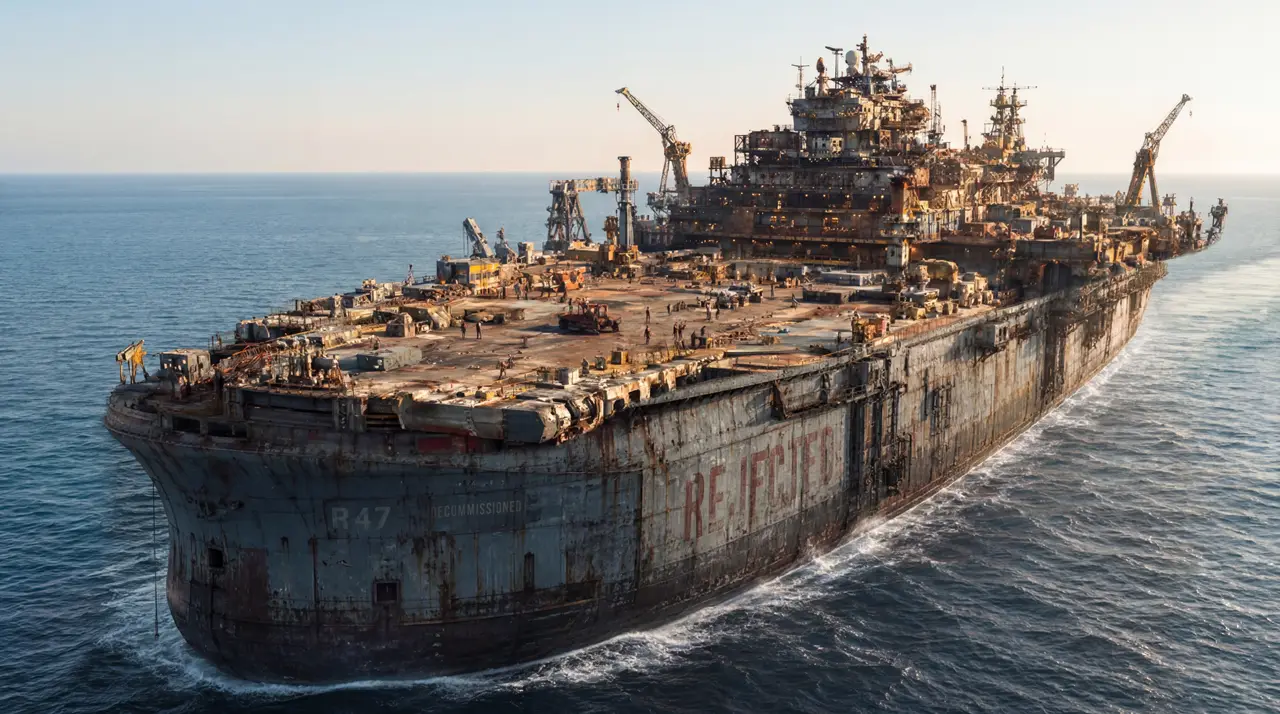 图片节点 4
保持 {{Image 1}} 船头的船身和甲板的设计外观,只把 {{Image 1}} 的侧面换成 {{Image 2}} 中船身的侧面.
移除 {{Image 1}} 穿上的人,降低一点饱和度,更有的电影感一些
Use {{Mixed 1}} as the giant assembled underground robot reference. Preserve the overall design language: a colossal humanoid repair-giant built from many discarded industrial robot parts, patched metal structures, welded components, reused panels, maintenance scaffolds, faded warning plates, and large visible markings such as REJECTED, DECOMMISSIONED UNIT, and UNDER REPAIR. It should feel like a massive communal construction assembled over time by rejected units below. Use {{Mixed 2}} as the underground inner-street environment continuity reference. Preserve the lived-in underground repair district feeling inside a giant lightless shaft-city: warm workshop lamps, damp ground reflections, patched metal stalls, practical tools, smoke haze, layered depth, inhabited industrial life, and a quiet but real underground civilization. Use {{Mixed 3}} as the darker atmospheric tonal reference for the reveal mood: a vast dark shaft interior, heavy vertical scale, the giant robot initially buried in darkness, with only faint practical lights and vague silhouette visibility before the reveal. Use {{Mixed 4}} as the protagonist inspection robot identity reference. Preserve the exact white inspection-and-disposal robot design, facial screen style, proportions, worn body structure, PC-67241 markings, and REJECT device. This protagonist is unique. Use {{Mixed 5}} as the female presenter robot identity reference. Preserve her elegant humanoid face, white synthetic shell, blue eye lights, graceful proportions, chest display, and slightly worn underground condition. Use {{Mixed 6}} as the small old robot identity reference. Preserve its short cylindrical body, worn blue-and-white shell, compact size, and early-generation service-robot feeling. Use {{Mixed 7}} as the voice reference for the small old robot. Preserve the same vocal identity, dry mechanical texture, age, slightly humorous delivery, and consistent speaking style. Create a 15-second cinematic live-action sequence in 21:9 widescreen. This is the major reveal sequence of the underground giant robot. This sequence happens immediately after the trio has walked through the underground inner street. They arrive at the edge of a much larger underground chamber and discover the giant assembled robot for the first time. Emotional purpose: mystery -> quiet realization -> scale shock -> ritual reveal -> awe. Overall image treatment: cinematic photograph, soft film-like aesthetic, restrained detail, unified material language, large color shapes, practical-light dominance, gentle edge falloff, selective focus hierarchy, soft highlight bloom, photochemical color softness, monumental scale, industrial atmosphere, observed cinematic realism. This should feel like a ritual reveal of a colossal repaired being assembled from rejected units. The lights reveal its history and scale piece by piece. The camera should help the audience feel mass, height, silence, and awe. This is not only an object reveal; it is the protagonist seeing the hidden value of everything he once rejected. --- ## SHOT 27A — 0.0s to 3.0s A handheld-cinematic rear three-quarter tracking shot, lens feeling around 28mm, T2.8. The three robots walk slowly toward the edge of a much larger underground chamber. The small old robot is slightly ahead on the protagonist’s left. The protagonist stays centered. The female presenter robot stays on the protagonist’s right. They slow down and stop at the threshold. The camera settles just behind or slightly beside them, with a restrained operator breathing motion. Beyond the corner, the chamber opens into darkness. Only a massive vague silhouette is visible in the haze — an enormous shape much larger than the surrounding structures. Tiny warm work lights, drifting smoke, distant repair lamps, and faint vertical wall details reveal only fragments of scale. Hold a short breath after they stop. Let the darkness feel heavy before the full reveal begins. The small old robot says in Chinese, in a lower, quieter tone: “上面把我们扔掉。” Hard cut to Shot 27B. --- ## SHOT 27B — 3.0s to 5.4s A medium close reaction shot, lens feeling around 65mm, T2.0. Start with the female presenter robot in soft side profile as she looks toward the dark giant silhouette. She is calm, but her silence carries weight. Then rack focus from her face to the protagonist’s face screen in the near foreground. The protagonist looks confused at first. His LED face slowly shifts into stunned wonder. He raises his head, following the height of the unseen giant. Use shallow depth of field, warm rim light, and a visible focus transition. The background remains dark and huge, with only small practical lights and haze. The small old robot continues off-screen in Chinese: “零件、外壳、名字……都扔了。” Hold half a beat on the protagonist’s reaction before cutting. Hard cut to Shot 27C. --- ## SHOT 27C — 5.4s to 8.0s A very low-angle wide shot, lens feeling around 18mm to 21mm, T2.8. Place the camera very low near the ground, behind or slightly behind the trio, looking upward. The three main robots appear very small in the lower foreground. The enormous dark giant robot silhouette dominates the upper frame and background. This shot is about scale confirmation. The giant remains mostly in darkness, but faint warm maintenance lights outline parts of the repaired lower body, torso mass, shoulders, scaffolding, and hanging cables. The trio must feel tiny. The giant must feel overwhelming, architectural, and impossibly large. Use a very slow forward creep and a slight upward tilt, as if the camera itself is trying to comprehend the scale. Keep the movement heavy and restrained. The small old robot continues in Chinese: “下面,我们把自己重新拼起来。” Hard cut to Shot 28A. --- ## SHOT 28A — 8.0s to 12.3s A ritual reveal detail sequence made of three deliberate moving shots, each with enough breathing room. 8.0s – 9.3s: Close low-angle tracking shot along the giant’s repaired lower structure, lens feeling around 35mm, T2.4. A wall-mounted repair spotlight snaps on. The light reveals welded joints, patched plates, reused hydraulic parts, heavy repaired legs, damp metal surfaces, and an UNDER REPAIR marking. The camera glides slowly along the metal, close enough to feel the giant’s physical mass. 9.3s – 10.8s: A rising medium-wide shot across the central torso, lens feeling around 28mm, T2.8. Another maintenance floodlight turns on from the side. The light reveals reused vehicle panels, scaffolds, repair platforms, faded paint, hand-welded seams, and a DECOMMISSIONED UNIT plate. Steam catches the light and rolls across the frame. The camera moves upward with a slight arc, creating a sense of height. 10.8s – 12.3s: A close oblique angle near the shoulder or side structure, lens feeling around 40mm, T2.4. A stronger side spotlight hits a red patched panel. The surface blooms softly in the haze, revealing a large REJECTED marking. The camera tilts up from the marking toward the head silhouette, but the head is still partly buried in smoke and darkness. Each light cue should feel like a heavy mechanical relay click-thump. The detail shots should feel physical, heavy, and cinematic, like a carefully-lit industrial monument being discovered piece by piece. Hard cut to Shot 28B. --- ## SHOT 28B — 12.3s to 15.0s A monumental low-angle wide shot, lens feeling around 20mm, T2.8. Return to the full chamber scale. The final upper lights ignite in sequence and reveal the giant assembled robot as a complete colossal presence. The trio stands tiny in the lower foreground. The protagonist looks up in softened wonder. The female presenter remains quiet beside him. The small old robot is slightly ahead, also looking up. At about 13.7s, land one strong low-frequency impact as the final lights reveal the head and upper silhouette. Then let the final moment breathe in monumental silence. The giant’s markings should be visible across different body sections: UNDER REPAIR DECOMMISSIONED UNIT REJECTED The atmosphere is filled with warm spotlight beams, steam haze, practical glow, industrial dust, damp floor reflections, and heavy vertical scale. The final image should feel like the protagonist is standing before the physical proof that rejected things can become something larger than the system that discarded them. Sound design: low industrial ambience, distant metal groans, chamber air, relay-like light impacts, one final deeper hit at the full reveal, then a brief breath of silence. Visual style: hyper-real live-action, IMAX 70mm film feel, Panavision anamorphic lens character, industrial monumentality, practical warm light beams, atmospheric haze, soft film grain, realistic scale, unified weathered materials, restrained contrast, cinematic awe, like a carefully-lit cinema frame rather than a static concept-art render.
Use {{Mixed 1}} as the giant underground repair-robot reference. Preserve it as a colossal humanoid figure assembled from discarded industrial robot parts, patched metal panels, welded structures, reused components, scaffolds, faded warning plates, and readable markings: REJECTED, DECOMMISSIONED UNIT, UNDER REPAIR. It feels like a communal monument built over time by rejected units, not a sleek combat mecha. Use {{Mixed 2}} as the underground repair-district continuity reference: a lightless shaft-city with warm workshop lamps, damp floor reflections, patched metal stalls, practical tools, smoke haze, layered depth, and a lived-in industrial civilization. Use {{Mixed 3}} only as the dark reveal mood reference: a vast vertical shaft, heavy darkness, faint practical lights, smoke, and an enormous silhouette hidden before the reveal. Use {{Mixed 4}} as the protagonist robot reference. Preserve the white inspection-and-disposal robot identity, black face screen, worn shell, PC-67241 markings, and REJECT device. The protagonist is 1.78m tall and is the only robot with this inspection-body design. Use {{Mixed 5}} as the female presenter robot reference. Preserve her elegant humanoid white shell, blue eye lights, chest display, graceful proportions, and slightly worn underground condition. She is 1.74m tall, slightly shorter than the protagonist. Use {{Mixed 6}} as the small old robot reference. Preserve the short blue-and-white cylindrical service-robot body, dome-like head, compact scale, worn shell, and early-generation feeling. It is about 0.9m tall, below the protagonist’s waist. Use {{Mixed 7}} as the small old robot voice reference. Preserve the dry mechanical texture, aged tone, slightly humorous rhythm, and consistent speaking style. Create a 15-second cinematic live-action sequence in 21:9 widescreen. This is the major reveal of the underground giant robot. The trio arrives at the edge of a much larger underground chamber after walking through the inner street. Emotional progression: mystery → quiet realization → scale shock → ritual reveal → awe. Overall image treatment: carefully lit cinema frame, soft film-like texture, unified weathered material language, practical warm light dominance, selective focus, soft highlight bloom, smoke haze, damp reflections, industrial monumentality, IMAX 70mm scale, Panavision anamorphic character. Keep the three robots integrated into the chamber lighting. Their white shells sit mostly in shadow, with broken warm side rim light, floor bounce, small practical highlights, contact shadows, damp reflections, and smoke between them and the background. They should feel physically planted inside the dark chamber. SHOT 27A — 0.0s to 3.2s Handheld rear three-quarter tracking shot, 28mm, T2.8. The trio walks slowly toward the threshold of a vast chamber. The small old robot is slightly ahead on the protagonist’s left. The protagonist stays centered. The female presenter stays on his right, slightly behind or level. The camera follows from low rear three-quarter angle, not flat and centered. It moves with restrained operator breathing. The trio slows and stops. Beyond the corner, the chamber opens into darkness. Only a massive vague silhouette is visible through smoke, much larger than the surrounding structures. Tiny warm work lights and distant repair lamps reveal fragments of vertical scale. The small old robot says quietly in Chinese: “上面把我们扔掉。” Hard cut. SHOT 27B — 3.2s to 5.8s Medium close reaction shot, 65mm, T2.0. Start on the female presenter in soft side profile, looking toward the dark silhouette. She is calm, partly rim-lit by a warm practical lamp. Rack focus from her face to the protagonist’s black face screen in the near foreground. The protagonist is slightly taller than her. His LED face shifts from confusion into stunned wonder. He slowly raises his head, following the height of the unseen giant. Background stays dark, large, and indistinct. The small old robot continues off-screen in Chinese: “零件、外壳、名字……都扔了。” Hold half a beat on the protagonist’s reaction. Hard cut. SHOT 27C — 5.8s to 8.5s Very low-angle wide shot, 18–21mm, T2.8. Camera is extremely low near the ground behind the trio, looking upward. The three robots appear tiny in the lower foreground. The small old robot is clearly much shorter. The protagonist is slightly taller than the female presenter. The giant’s dark silhouette dominates the frame, still mostly buried in darkness. Faint warm maintenance lights outline repaired legs, torso mass, shoulders, scaffolding, and hanging cables. The shot confirms scale: the trio feels small, the giant feels architectural and overwhelming. The camera creeps forward slightly with a slow upward tilt. The small old robot says: “下面,我们把自己重新拼起来。” Hard cut. SHOT 28A — 8.5s to 12.8s Ritual reveal detail sequence, three deliberate moving shots. 8.5s–9.8s: Close low-angle tracking along the giant’s repaired lower structure, 35mm, T2.4. A wall repair spotlight snaps on, revealing welded joints, patched plates, hydraulic parts, heavy legs, damp metal, and an UNDER REPAIR marking. Shallow focus, physical mass, slow glide. 9.8s–11.3s: Rising medium-wide move across the central torso, 28mm, T2.8. A side floodlight turns on, revealing reused vehicle panels, scaffolds, repair platforms, faded paint, hand-welded seams, and a DECOMMISSIONED UNIT plate. Steam catches the light. Camera rises with a slight arc and upward tilt. 11.3s–12.8s: Close oblique angle near the shoulder structure, 40mm, T2.4. A strong side spotlight hits a red patched panel, revealing a large REJECTED marking. The camera tilts upward from the marking toward the head silhouette, still partly buried in smoke. Each light cue lands as a heavy relay click-thump. The reveal feels physical, heavy, and ceremonial. Hard cut. SHOT 28B — 12.8s to 15.0s Monumental low-angle wide shot, 20mm, T2.8. Return to full chamber scale. Upper lights ignite in sequence and reveal the complete colossal repaired robot. The trio stands tiny in the lower foreground, mostly in silhouette with warm rim light. The protagonist looks up in softened wonder. The female presenter remains quiet beside him. The small old robot is slightly ahead, also looking up. At about 13.8s, land one deep low-frequency impact as the head and upper silhouette become visible. Then let the final moment breathe in brief silence. Visible markings across different body sections: UNDER REPAIR, DECOMMISSIONED UNIT, REJECTED. Sound design: low industrial ambience, distant metal groans, chamber air, relay-like light impacts, one final deeper hit, then short silence. The final image should feel like the protagonist is standing before physical proof that rejected things can become larger than the system that discarded them.
使用 {{Mixed 1}} 作为地下巨型维修机器人的参考。保留它的整体设计语言:一个由废弃工业机器人零件拼装而成的巨型人形结构,包含修补金属板、焊接结构、再利用组件、脚手架、褪色警示牌,以及清晰可读的标记:REJECTED、DECOMMISSIONED UNIT、UNDER REPAIR。它应该像是被地下废弃单元长时间共同建造出来的纪念碑,而不是一台光滑的战斗机甲。 使用 {{Mixed 2}} 作为地下维修街区的连续性参考:一个没有自然光的巨大竖井城市,拥有暖色工作灯、潮湿地面反光、拼接金属摊位、实用工具、烟雾、层次纵深,以及真实存在的地下工业文明感。 使用 {{Mixed 3}} 仅作为黑暗揭示氛围参考:巨大的垂直竖井、厚重黑暗、微弱实用灯光、烟雾,以及在揭示前隐藏在阴影中的巨大轮廓。 使用 {{Mixed 4}} 作为主角机器人的参考。保留白色质检与处置机器人身份、黑色脸部屏幕、磨损外壳、PC-67241 标记,以及 REJECT 装置。主角身高 1.78 米,并且是唯一拥有这种质检机器人身体设计的机器人。 使用 {{Mixed 5}} 作为女主持机器人参考。保留她优雅的人形白色外壳、蓝色眼灯、胸口显示屏、修长比例,以及轻微做旧的地下状态。她身高 1.74 米,略低于主角。 使用 {{Mixed 6}} 作为小旧机器人参考。保留它矮小的蓝白色圆筒形服务机器人身体、半球形头部、紧凑体型、磨损外壳,以及早期型号的感觉。它身高约 0.9 米,低于主角腰部。 使用 {{Mixed 7}} 作为小旧机器人的声音参考。保留相同的声音身份、干涩机械质感、年迈感、略带幽默的节奏,以及一致的说话方式。 创建一个 15 秒的电影感真人实拍质感视频序列,21:9 宽银幕画幅。这是地下巨型机器人的主要揭示段落。 这段发生在三人穿过地下内街之后。他们来到一个更巨大地下空间的边缘。情绪推进为:神秘 → 安静意识到什么 → 巨物比例冲击 → 仪式感揭示 → 敬畏。 整体画面处理:精心布光的电影画面、柔和胶片质感、统一的风化材质语言、大色块构图、以实用暖光为主、选择性焦点、柔和高光泛光、烟雾、潮湿反光、工业纪念碑感、IMAX 70mm 规模感、Panavision 变形宽银幕镜头特性。 让三个机器人真实融入这个空间的光线。它们的白色外壳大部分处在阴影中,仅有破碎的暖色侧逆光、地面反弹光、少量实用灯高光、接触阴影、潮湿反光,以及它们和背景之间的烟雾层次。它们应该像是真实站在这个黑暗地下空间里。 SHOT 27A — 0.0s 到 3.2s 手持电影感后侧三分之四跟拍,28mm,T2.8。 三人缓慢走向巨大空间的门槛。小旧机器人略微领先,在主角左侧。主角保持在中间。女主持机器人在主角右侧,稍微靠后或与他持平。 摄影机从较低的后侧三分之四角度跟随,不要平直居中。运镜带有克制的摄影师呼吸感。三人放慢脚步并停下。拐角之后,空间展开成一片黑暗。烟雾中只能隐约看到一个巨大模糊的轮廓,尺寸远大于周围结构。微小的暖色工作灯和远处维修灯,只揭示出一点垂直空间尺度。 小旧机器人用很轻、压低的中文说: “上面把我们扔掉。” 硬切。 SHOT 27B — 3.2s 到 5.8s 中近景反应镜头,65mm,T2.0。 从女主持机器人的柔焦侧脸开始。她看向黑暗中的巨大轮廓。她很平静,身上有一层暖色实用灯侧逆光。然后焦点从她的脸转移到近前景中主角的黑色脸屏上。 主角比她略高。他的 LED 表情从困惑慢慢转为震惊与敬畏。他缓缓抬头,顺着那个尚未完全看清的巨物高度向上看。背景保持黑暗、巨大、模糊。 小旧机器人继续以画外音说中文: “零件、外壳、名字……都扔了。” 在主角反应上停留半拍。 硬切。 SHOT 27C — 5.8s 到 8.5s 极低机位广角镜头,18–21mm,T2.8。 摄影机贴近地面,位于三人后方,从下往上仰拍。三个机器人在画面下方前景中显得非常小。小旧机器人明显更矮。主角比女主持机器人略高。 巨大的黑色机器人轮廓占据画面上方和背景,大部分仍隐藏在黑暗中。微弱暖色维修灯勾勒出修复过的腿部、躯干体块、肩部、脚手架和悬挂线缆。这个镜头用来确认比例:三人很小,巨人像建筑一样巨大且压迫。 摄影机轻微向前推进,并缓慢向上仰起。 小旧机器人说: “下面,我们把自己重新拼起来。” 硬切。 SHOT 28A — 8.5s 到 12.8s 仪式感揭示细节段落,由三个有意设计的运动镜头组成。 8.5s–9.8s: 贴近低角度跟拍巨人的修复下部结构,35mm,T2.4。一盏墙面维修探照灯啪地亮起,照出焊接节点、修补板、液压零件、沉重腿部、潮湿金属表面,以及 UNDER REPAIR 标记。浅景深、强物理重量感、缓慢滑动镜头。 9.8s–11.3s: 沿中央躯干向上升起的中广角运动镜头,28mm,T2.8。一盏侧面泛光灯亮起,揭示再利用的车辆面板、脚手架、维修平台、褪色油漆、手工焊缝,以及 DECOMMISSIONED UNIT 标牌。蒸汽被灯光打亮,在画面中滚动。摄影机带一点弧线向上移动,制造高度感。 11.3s–12.8s: 靠近肩部结构的斜侧近景,40mm,T2.4。一束更强的侧面探照灯打在红色修补面板上,显现出巨大的 REJECTED 标记。镜头从这个标记向上仰起,朝向头部轮廓,但头部仍有一部分埋在烟雾和黑暗中。 每次灯光亮起都伴随沉重的继电器式“咔—砰”声。揭示过程要有物理重量、沉稳、仪式感。 硬切。 SHOT 28B — 12.8s 到 15.0s 纪念碑式低机位大全景,20mm,T2.8。 回到完整地下空间尺度。上方灯光依次点亮,完整揭示这个巨大的修复机器人。三人站在画面下方前景,显得极小,大部分是剪影,带一点暖色轮廓光。主角仰头看着它,表情变成柔和的震撼。女主持机器人安静地站在他旁边。小旧机器人略微在前,也一起抬头看着。 大约 13.8 秒时,当头部和上半身轮廓被完全照亮,落下一个低频重击。随后让最后一刻在短暂的寂静中呼吸。 巨人不同身体区域上应能看到这些标记: UNDER REPAIR DECOMMISSIONED UNIT REJECTED 配BGM加音效 音效声音设计:低沉工业环境音、远处金属呻吟、空间气流、类似继电器的灯光撞击声、最后一次更深的低频重击,然后短暂安静。 最后的画面应该让人感觉:主角正站在一个实体证明面前——那些被拒绝的东西,可以变成比抛弃它们的系统更庞大的存在。
Reference-role separation is critical. Use {{Image 1}} as the exact identity reference for the robot: a white inspection-and-disposal robot with a black LED face screen, worn white shell, PC-67241 markings, slim humanoid proportions. Preserve this exact body design. Create a clean character-asset reference sheet on a plain neutral light-grey studio background, 16:9, showing the SAME white inspection robot in TWO states side by side, medium shot from head to waist, front three-quarter angle. Same robot, same design, same lighting, for clean comparison. The feature is a SMALL SLIDING CHEST HATCH located high on the chest, over the heart position (upper-center chest, small and discreet — roughly the size of a palm, NOT a large door). It is a SLIDING panel that slides sideways to open, like a small pocket sliding door, NOT a hinged flip-down lid. LEFT (state A — CLOSED): the small chest hatch is closed flush, only a subtle thin rectangular seam visible high on the chest over the heart, almost hidden, seamlessly integrated into the chest plating. RIGHT (state B — OPEN): the same small panel has SLID sideways to reveal a small, shallow internal compartment over the heart — a compact recessed cavity. Resting inside is a single small off-white matte triangular toy building block (a child's geometric block, pale cream color). The block sits alone in the small heart-cavity like a secretly kept keepsake. The opening is small and neat, the sliding panel tucked to one side. Emphasize: the hatch is SMALL and HIGH on the chest (heart position), and opens by SLIDING sideways, clean and mechanical, no large flip-down door, no oversized panel. Visual style: grounded photorealistic 3D render, cinematic realism, IMAX quality, restrained cool palette, soft even studio lighting, subtle film grain, no cartoon, no glossy game-CG, clean asset-sheet presentation.
使用 {{Mixed 1}} 作为地下巨型拼装机器人的参考。保留整体设计语言:一个由大量被废弃的工业机器人零件拼接修复而成的巨大人形维修巨物,拥有拼补金属结构、焊接组件、回收面板、维修脚手架、褪色警示牌,以及大面积可见标记如 REJECTED、DECOMMISSIONED UNIT、UNDER REPAIR。这个巨型机器人不是流线型机甲,也不是战斗机器。它应该像一个由地下被拒者长期共同拼装起来的集体造物。 使用 {{Mixed 2}} 作为地下内街环境连续性参考。保留那种“巨大无光井城内部、有人生活过的地下维修街”感觉:暖色工作灯、潮湿地面反光、拼补金属摊位、实用工具、烟雾、纵深层次、真实存在的地下文明氛围。这个环境语言要能自然衔接前一个“边走边介绍”的镜头,再延伸到此处的大空间揭示。 使用 {{Mixed 3}} 仅作为揭示气氛参考:一个巨大、黑暗、垂直尺度惊人的井状空间,巨型机器人一开始埋在阴影里,只能看见微弱实用灯和模糊轮廓,在正式显现之前不要看清全貌。 使用 {{Mixed 4}} 作为主角质检机器人身份参考。保留准确的白色质检与处置机器人设计、面部屏幕样式、身体比例、磨损机身结构、PC-67241 标记和 REJECT 装置。这个主角是唯一的。 使用 {{Mixed 5}} 作为女性主持机器人身份参考。保留她优雅的人形面孔、白色合成外壳、蓝色眼灯、优雅比例、胸口显示屏,以及地下环境下略有磨损的状态。 使用 {{Mixed 6}} 作为小旧机器人身份参考。保留它矮小的圆柱形身体、磨损的蓝白外壳、紧凑体型和早期服务机器人感觉。 使用 {{Mixed 7}} 作为小旧机器人的声音参考。保留相同的声音身份、干一点的机械音色、年龄感、略带幽默的表达方式和前面镜头一致的说话风格。 创建一个 11.5 到 12 秒、21:9 宽银幕、电影感真人实拍质感序列。这是地下巨型机器人正式揭示的重要镜头组。 这段发生在三人穿过地下内街之后。他们来到一个转角 / 阈值边缘,前方是一个更大的地下空间,并第一次看到那个巨型拼装机器人。 情绪目的: 神秘 → 比例震撼 → 仪式性揭示 → 敬畏。 这是全片最重要的视觉高潮之一。 整体画面处理: 电影摄影感,柔和胶片质感,克制细节,统一材质语言,大色块优先,实用光源主导,柔和边缘衰减,适度浅焦,胶片化色彩柔和度,有被观察到的电影真实感,巨物尺度感,工业氛围。 这个巨型机器人的显现不应像高达启动画面。 这不是战斗机甲苏醒。 这是一个由被拒者拼装修复起来的巨物的仪式性显现。 这些灯光不是为了“给它通电启动”,而是为了让主角和观众逐层看清它。 -------------------------------- 镜头27 — 0.0秒到2.8秒 -------------------------------- 手持电影感后跟或后侧三分之四跟拍,镜头感觉约 28mm,T2.8。 三个人走向一个转角 / 阈值边缘,这里连接着一个更大的地下空间。 小旧机器人在主角左边稍微领先。 主角居中。 女性主持机器人在主角右边。 他们逐渐慢下来并停住,摄影机落在他们后方或略侧后方。 三人看向前方黑暗深处。 转角之外,空间突然大幅打开。 此时只能在黑暗和薄雾里勉强看见一个极其庞大的模糊轮廓——它是一个比周围建筑都更大的巨大体块。 此时不要把巨人完整揭示出来。 只通过黑暗、远处极小的工作灯、漂浮蒸汽和模糊的巨大轮廓来暗示它的存在。 小旧机器人用更低一点、更轻一点的语气说中文: “上面把我们扔掉。” 短停顿。 “下面,我们把自己重新拼起来。” 语气要像带人看一个秘密,轻一点、压低一点,但有意味。声音匹配 {{Mixed 7}}。 硬切到镜头27B。 -------------------------------- 镜头27B — 2.8秒到5.5秒 -------------------------------- 极低机位广角镜头,镜头感觉约 18mm 到 21mm,T2.8。 摄影机几乎贴地,从三人后方或侧后方仰拍。 三位主角在前景下方显得非常小,可以是剪影或局部受光人物。 巨大黑暗中的巨型机器人轮廓压在画面上方与背景中。 这个镜头的核心是确认比例。 三个人必须显得很小。 巨人必须显得像建筑一样巨大、压迫、不可思议。 此时巨人依然大部分埋在阴影里,不要完全看清。 允许少量暖色维修灯、零散微弱工作灯和烟雾,只勾出它下半身、躯干体块或肩部轮廓的一部分。 先让观众感到“它有多大”,再让观众看到“它是什么”。 摄影机可以有轻微前移或非常克制的手持呼吸感,但整体要稳。 这个镜头应该是庄严巨物感,不是晃乱。 硬切到镜头28。 -------------------------------- 镜头28 — 5.5秒到11.8秒 -------------------------------- 低机位、庄严感大全景,镜头感觉约 20mm,T2.8。整体以稳定为主,只允许极轻微电影式前推。 这是仪式性揭示镜头。 从黑暗中开始,墙上的维修射灯和维护泛光灯按照顺序一盏盏亮起。 每亮一盏,就揭示巨型拼装机器人更多的一部分。 揭示顺序: 1. 先亮下盘 / 支撑结构 / 修补腿部和底部体块 2. 再亮躯干中段和胸腹区域 3. 再亮肩部和侧面结构 4. 最后亮头部和上半身轮廓 每一层被照亮时,都要看见丰富的工业细节: 拼补面板、焊接接缝、回收车体零件、脚手架、维修平台、旧警示牌、褪色油漆、烟尘和重度使用痕迹。 随着显现推进,不同位置逐一看清不同标记: UNDER REPAIR DECOMMISSIONED UNIT REJECTED 这些标记应该分布在巨人身体不同部位,而不是全部挤在一起。 这个揭示要让观众感受到:这尊巨人是由无数曾被拒绝的零件拼起来的。 氛围中充满暖色射灯光束、蒸汽雾气、实用灯暖光、工业粉尘和巨大的沉默。 主角抬头看着它,进入 softened wonder 的状态。 小旧机器人和女性主持机器人在比例上都显得非常小。 声音设计: 前半段以低沉工业环境音、远处金属呻吟和巨大空间空气感为主。 每亮一盏灯时,加入一个深沉、受控的机械 click-thump 或继电器式重音。 每次点亮都要有一点仪式感。 最后完整显现时,落一个更强的低频重音,然后让声音突然打开一点空间感。 视觉风格: 超写实真人实拍,IMAX 70mm 胶片感,Panavision 变形宽银幕镜头特性,工业纪念碑感,实用暖色光束,空气雾化,柔和胶片颗粒,真实尺度感,统一风化材质,克制反差,电影级敬畏感,不要有 glossy CGI 感,不要有动漫机甲启动感,不要有游戏渲染感,不要卡通化。
Use {{Mixed 1}} as the giant assembled underground robot reference. Preserve the overall design language: a colossal humanoid repair-giant built from many discarded industrial robot parts, patched metal structures, welded components, reused panels, maintenance scaffolds, faded warning plates, and large visible markings such as REJECTED, DECOMMISSIONED UNIT, and UNDER REPAIR. It should feel like a massive communal construction assembled over time by rejected units below. Use {{Mixed 2}} as the underground inner-street environment continuity reference. Preserve the lived-in underground repair district feeling inside a giant lightless shaft-city: warm workshop lamps, damp ground reflections, patched metal stalls, practical tools, smoke haze, layered depth, inhabited industrial life, and a quiet but real underground civilization. Use {{Mixed 3}} as the darker atmospheric tonal reference for the reveal mood: a vast dark shaft interior, heavy vertical scale, the giant robot initially buried in darkness, with only faint practical lights and vague silhouette visibility before the reveal. Use {{Mixed 4}} as the protagonist inspection robot identity reference. Preserve the exact white inspection-and-disposal robot design, black facial screen style, proportions, worn body structure, PC-67241 markings, and REJECT device. This protagonist is unique. Use {{Mixed 5}} as the female presenter robot identity reference. Preserve her elegant humanoid face, white synthetic shell, blue eye lights, graceful proportions, chest display, and slightly worn underground condition. Use {{Mixed 6}} as the small old robot identity reference. Preserve its short cylindrical body, worn blue-and-white shell, compact size, dome-like head, early-generation service-robot feeling, and small scale. Use {{Mixed 7}} as the voice reference for the small old robot. Preserve the same vocal identity, dry mechanical texture, age, slightly humorous delivery, and consistent speaking style. Create a 15-second cinematic live-action sequence in 21:9 widescreen. This is the major reveal sequence of the underground giant robot. This sequence happens immediately after the trio has walked through the underground inner street. They arrive at the edge of a much larger underground chamber and discover the giant assembled robot for the first time. Emotional purpose: mystery -> quiet realization -> scale shock -> ritual reveal -> awe. CHARACTER SCALE AND IDENTITY LOCK: The protagonist inspection robot is about 1.78 meters tall. The female presenter robot is about 1.74 meters tall, slightly shorter than the protagonist by a few centimeters. The small old robot is about 0.9 meters tall, reaching roughly below the protagonist’s waist. Keep these proportions consistent in every shot. The protagonist must remain the only robot with the PC-67241 inspection body, black face screen, uniform-like white shell, and REJECT device. The female presenter must keep her elegant humanoid female silhouette. The small old robot must remain a short blue-and-white cylindrical service robot with a dome-like head and compact body. Do not let the protagonist’s back silhouette become the female presenter’s body shape. Do not let the small old robot become a humanoid figure. LIGHTING INTEGRATION RULE: The three robots must belong to the underground chamber lighting. Their white shells should not look studio-lit or pasted onto the background. Keep their backs mostly in shadow, with only warm side rim light, floor bounce, small practical highlights, and soft edge reflections from workshop lamps and fires. Use contact shadows under their feet, damp floor reflections, ambient occlusion around legs, and smoke haze between characters and background. The chamber remains dark, warm, smoky, and high-contrast. No clean white key light on the characters’ backs. No flat bright exposure on the white shells. Overall image treatment: cinematic photograph, soft film-like aesthetic, restrained detail, unified material language, large color shapes, practical-light dominance, gentle edge falloff, selective focus hierarchy, soft highlight bloom, photochemical color softness, monumental scale, industrial atmosphere, observed cinematic realism. This should feel like a ritual reveal of a colossal repaired being assembled from rejected units. The lights reveal its history and scale piece by piece. The camera should help the audience feel mass, height, silence, and awe. This is not only an object reveal; it is the protagonist seeing the hidden value of everything he once rejected. --- ## SHOT 27A — 0.0s to 3.0s A handheld-cinematic rear three-quarter tracking shot, lens feeling around 28mm, T2.8. The three robots walk slowly toward the edge of a much larger underground chamber. The small old robot is slightly ahead on the protagonist’s left. The protagonist stays centered. The female presenter robot stays on the protagonist’s right, slightly behind or level with him. Camera position: low rear three-quarter angle, not a flat straight rear view. The camera follows from slightly behind and slightly to one side, so the trio feels embedded in the smoky industrial space. Lighting: the trio is mostly dark from behind. Their white shells catch only broken warm rim highlights from side workshop lamps, fire-like utility lights, and damp floor bounce. Keep their backs darker than the generated versions. Use real contact shadows and floor reflections so they feel planted in the environment. They slow down and stop at the threshold. The camera settles just behind or slightly beside them, with restrained operator breathing motion. Beyond the corner, the chamber opens into darkness. Only a massive vague silhouette is visible in the haze — an enormous shape much larger than the surrounding structures. Tiny warm work lights, drifting smoke, distant repair lamps, and faint vertical wall details reveal only fragments of scale. Hold a short breath after they stop. Let the darkness feel heavy before the full reveal begins. The small old robot says in Chinese, in a lower, quieter tone: “上面把我们扔掉。” Hard cut to Shot 27B. --- ## SHOT 27B — 3.0s to 5.6s A medium close reaction shot, lens feeling around 65mm, T2.0. Start with the female presenter robot in soft side profile as she looks toward the dark giant silhouette. She is calm, but her silence carries weight. She is softly rim-lit by a warm practical lamp, while her front remains partly shadowed. Then rack focus from her face to the protagonist’s face screen in the near foreground. The protagonist is slightly taller than her. His black LED face screen becomes the clear focal plane. He looks confused at first. His LED face slowly shifts into stunned wonder. He raises his head, following the height of the unseen giant. Use shallow depth of field, warm rim light, visible focus transition, and dark background falloff. The giant remains an unclear dark mass behind them. The small old robot continues off-screen in Chinese: “零件、外壳、名字……都扔了。” Hold half a beat on the protagonist’s reaction before cutting. Hard cut to Shot 27C. --- ## SHOT 27C — 5.6s to 8.3s A very low-angle wide shot, lens feeling around 18mm to 21mm, T2.8. Place the camera extremely low near the ground, behind or slightly behind the trio, looking upward. The three main robots appear very small in the lower foreground. The small old robot is visibly much shorter than the other two. The protagonist is slightly taller than the female presenter. The enormous dark giant robot silhouette dominates the upper frame and background. This shot is about scale confirmation. The giant remains mostly buried in darkness. Faint warm maintenance lights outline parts of the repaired lower body, torso mass, shoulders, scaffolding, and hanging cables. The trio must feel tiny. The giant must feel overwhelming, architectural, and impossibly large. Use a very slow forward creep and slight upward tilt, as if the camera itself is trying to comprehend the scale. Keep the movement heavy and restrained. Keep the characters as dark silhouettes with practical rim light, not bright white cutouts. The small old robot continues in Chinese: “下面,我们把自己重新拼起来。” Hard cut to Shot 28A. --- ## SHOT 28A — 8.3s to 12.6s A ritual reveal detail sequence made of three deliberate moving shots, each with enough breathing room. 8.3s – 9.6s: Close low-angle tracking shot along the giant’s repaired lower structure, lens feeling around 35mm, T2.4. A wall-mounted repair spotlight snaps on. The light reveals welded joints, patched plates, reused hydraulic parts, heavy repaired legs, damp metal surfaces, and an UNDER REPAIR marking. The camera glides slowly along the metal, close enough to feel the giant’s physical mass. Use shallow focus so the closest metal edges fall softly while the marking becomes readable. 9.6s – 11.1s: A rising medium-wide shot across the central torso, lens feeling around 28mm, T2.8. Another maintenance floodlight turns on from the side. The light reveals reused vehicle panels, scaffolds, repair platforms, faded paint, hand-welded seams, and a DECOMMISSIONED UNIT plate. Steam catches the light and rolls across the frame. The camera rises with a slight arc and upward tilt, creating a strong feeling of height. 11.1s – 12.6s: A close oblique angle near the shoulder or side structure, lens feeling around 40mm, T2.4. A stronger side spotlight hits a red patched panel. The surface blooms softly in the haze, revealing a large REJECTED marking. The camera tilts up from the marking toward the head silhouette, but the head is still partly buried in smoke and darkness. Each light cue should feel like a heavy mechanical relay click-thump. The detail shots should feel physical, heavy, and cinematic, like a carefully-lit industrial monument being discovered piece by piece. Hard cut to Shot 28B. --- ## SHOT 28B — 12.6s to 15.0s A monumental low-angle wide shot, lens feeling around 20mm, T2.8. Return to the full chamber scale. The final upper lights ignite in sequence and reveal the giant assembled robot as a complete colossal presence. The trio stands tiny in the lower foreground, mostly in silhouette with warm rim light. The protagonist looks up in softened wonder. The female presenter remains quiet beside him. The small old robot is slightly ahead, also looking up. At about 13.8s, land one strong low-frequency impact as the final lights reveal the head and upper silhouette. Then let the final moment breathe in monumental silence. The giant’s markings should be visible across different body sections: UNDER REPAIR DECOMMISSIONED UNIT REJECTED The atmosphere is filled with warm spotlight beams, steam haze, practical glow, industrial dust, damp floor reflections, and heavy vertical scale. The final image should feel like the protagonist is standing before the physical proof that rejected things can become something larger than the system that discarded them. Sound design: low industrial ambience, distant metal groans, chamber air, relay-like light impacts, one final deeper hit at the full reveal, then a brief breath of silence. Visual style: hyper-real live-action, IMAX 70mm film feel, Panavision anamorphic lens character, industrial monumentality, practical warm light beams, atmospheric haze, soft film grain, realistic scale, unified weathered materials, restrained contrast, cinematic awe, like a carefully-lit cinema frame rather than a static concept-art render.
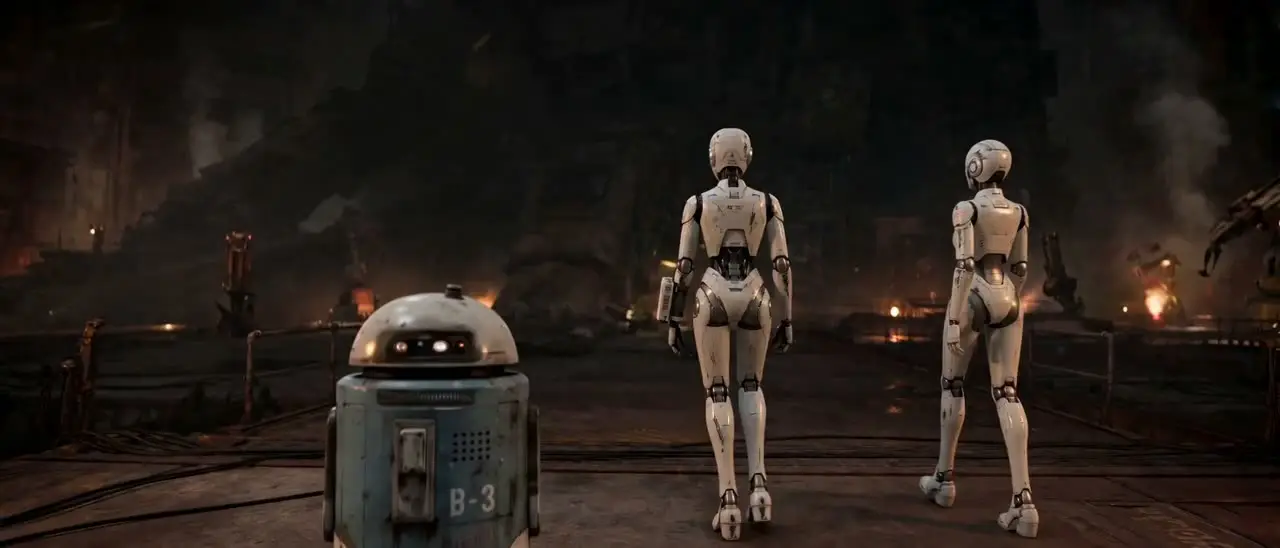 视频截图视频节点 13
使用 {{Mixed 1}} 作为地下巨型拼装机器人参考。保留整体设计语言:一个由大量被废弃工业机器人零件拼接而成的巨型人形维修巨物,包含拼补金属结构、焊接组件、回收面板、维修脚手架、褪色警示牌,以及 REJECTED、DECOMMISSIONED UNIT、UNDER REPAIR 等大型可见标记。它应该像一个由地下被拒者长期共同拼装出来的集体造物。 使用 {{Mixed 2}} 作为地下内街环境连续性参考。保留巨大无光井城内部、有人生活过的地下维修区感觉:暖色工作灯、潮湿地面反光、拼补金属摊位、实用工具、烟雾、纵深层次、工业生活痕迹和真实地下文明氛围。 使用 {{Mixed 3}} 作为揭示气氛参考:一个巨大的黑暗井状空间,垂直尺度极强,巨型机器人一开始埋在黑暗里,在正式揭示之前只能看到微弱实用灯和模糊轮廓。 使用 {{Mixed 4}} 作为主角质检机器人身份参考。保留准确的白色质检与处置机器人设计、面部屏幕样式、身体比例、磨损机身结构、PC-67241 标记和 REJECT 装置。这个主角是唯一的。 使用 {{Mixed 5}} 作为女性主持机器人身份参考。保留她优雅的人形面孔、白色合成外壳、蓝色眼灯、优雅比例、胸口显示屏,以及地下环境下略有磨损的状态。 使用 {{Mixed 6}} 作为小旧机器人身份参考。保留它矮小的圆柱身体、磨损蓝白外壳、紧凑体型和早期服务机器人感觉。 使用 {{Mixed 7}} 作为小旧机器人的声音参考。保留同样的声音身份、偏干的机械音色、年龄感、略带幽默的表达方式和前面一致的说话风格。 创建一个 15 秒、21:9 宽银幕、电影感真人实拍序列。这是地下巨型机器人的重要揭示段落。 这段发生在三人穿过地下内街之后。他们来到一个更大的地下空间边缘,并第一次发现那个巨型拼装机器人。 情绪目的: 神秘 → 安静意识到 → 比例震撼 → 仪式性揭示 → 敬畏。 整体画面处理: 电影摄影感,柔和胶片质感,克制细节,统一材质语言,大色块优先,实用光源主导,柔和边缘衰减,选择性焦点层级,柔和高光晕染,胶片化色彩柔和度,巨物尺度感,工业氛围,有被摄影机真实拍到的电影感。 这应该是一个由被拒者拼装修复起来的巨物的仪式性显现。灯光一层一层揭示它的历史和尺度。摄影机要帮助观众感受到重量、高度、沉默和敬畏。这不是单纯展示物体,而是主角看见了那些曾经被他拒绝的东西依然拥有价值。 --- ## 镜头27A — 0.0秒到3.0秒 手持电影感后侧三分之四跟拍,镜头感觉约 28mm,T2.8。 三位机器人缓慢走向一个更大的地下空间边缘。 小旧机器人在主角左边稍微领先。 主角保持居中。 女性主持机器人在主角右边。 他们慢下来,停在入口阈值。 摄影机落在他们后方或略侧后方,带轻微手持呼吸感。 转角之外,空间打开成一片黑暗。 黑暗和薄雾中只能看到一个巨大的模糊轮廓——一个远大于周围结构的庞然大物。 微弱暖色工作灯、漂浮烟雾、远处维修灯和垂直墙体细节,只透露一点点尺度。 他们停下后,留一个短暂气口。 让黑暗先压住观众,再开始完整揭示。 小旧机器人用更低、更轻的语气说中文: “上面把我们扔掉。” 硬切到镜头27B。 --- ## 镜头27B — 3.0秒到5.4秒 中近景反应镜头,镜头感觉约 65mm,T2.0。 先拍女性主持机器人的柔和侧脸,她看向黑暗中的巨型轮廓。 她很平静,但沉默里有重量。 随后焦点从她的脸转到近前景的主角面部屏幕。 主角一开始困惑。 他的 LED 表情慢慢变成震惊和敬畏。 他抬起头,视线跟随那个还没完全显现的巨物高度向上。 使用浅景深、暖色轮廓光和明显的焦点转换。 背景依然巨大而黑暗,只保留少量实用灯和雾气。 小旧机器人画外继续说中文: “零件、外壳、名字……都扔了。” 切走前,在主角反应上停半拍。 硬切到镜头27C。 --- ## 镜头27C — 5.4秒到8.0秒 极低机位广角镜头,镜头感觉约 18mm 到 21mm,T2.8。 摄影机几乎贴地,从三人后方或侧后方仰拍。 三位主角在画面底部前景显得非常小。 巨大黑暗中的巨型机器人轮廓压在画面上方和背景中。 这个镜头用于确认比例。 巨人依然大部分埋在阴影里,但少量暖色维修灯勾出被修复的下半身、躯干体块、肩部结构、脚手架和垂落线缆。 三个人必须显得很小。 巨人必须显得像建筑一样巨大、压迫、不可思议。 摄影机做一个非常缓慢的前移,并轻微向上抬。 像摄影机自己也在试图理解这个巨大尺度。 运动要沉稳、克制。 小旧机器人继续说中文: “下面,我们把自己重新拼起来。” 硬切到镜头28A。 --- ## 镜头28A — 8.0秒到12.3秒 一组有呼吸感的仪式性局部揭示镜头,由三个有运动的镜头组成,每个镜头都有足够停留时间。 8.0秒 – 9.3秒: 低机位贴近巨人下部结构的移动镜头,镜头感觉约 35mm,T2.4。 墙上的维修射灯啪地亮起。 灯光照出焊接接缝、拼补板材、回收液压件、沉重修复过的腿部、潮湿金属表面和 UNDER REPAIR 标记。 摄影机贴着金属缓慢滑行,让观众感受到巨人的实体重量。 9.3秒 – 10.8秒: 镜头沿巨人中央躯干向上移动,镜头感觉约 28mm,T2.8。 另一盏维护泛光灯从侧面亮起。 灯光照出回收车体面板、脚手架、维修平台、褪色油漆、手工焊缝和 DECOMMISSIONED UNIT 标牌。 蒸汽被灯光打亮,横向滚过画面。 摄影机轻微环绕并向上升,制造高度感。 10.8秒 – 12.3秒: 贴近巨人肩部或侧面结构的斜角近景,镜头感觉约 40mm,T2.4。 更强的侧面射灯打在一块红色拼补面板上。 表面在雾气里产生柔和光晕,显现巨大的 REJECTED 标记。 摄影机从标记向头部轮廓上摇,但头部依然部分埋在烟雾和阴影里。 每一次灯光亮起,都配一个沉重的机械继电器 click-thump 声。 局部镜头要真实、沉重、电影化,像一个被精心打光的工业纪念碑正在被一点点发现。 硬切到镜头28B。 --- ## 镜头28B — 12.3秒到15.0秒 庄严低机位大全景,镜头感觉约 20mm,T2.8。 回到完整地下空间尺度。 最后一组上方灯光依次亮起,巨型拼装机器人以完整的庞然大物姿态显现。 三个人站在画面下方前景,显得极小。 主角抬头看着它,进入柔化的震撼状态。 女性主持机器人安静站在他身边。 小旧机器人稍微在前,也抬头看着它。 约 13.7 秒时,随着头部和上半身轮廓最终显现,落一个强低频重音。 随后让最后一刻进入巨大的短暂沉默。 巨人身上不同位置应能看见: UNDER REPAIR DECOMMISSIONED UNIT REJECTED 氛围中充满暖色射灯光束、蒸汽雾气、实用灯暖光、工业粉尘、潮湿地面反光和巨大的垂直尺度。 最后画面应该让人感觉:主角正站在一个物理证据面前——那些被拒绝的东西,可以变得比丢弃它们的系统更庞大。 声音设计: 低沉工业环境音、远处金属呻吟、巨大空间空气感、继电器式灯光重音,完整显现时一个更深的低频重音,然后留出短暂安静。 视觉风格: 超写实真人实拍,IMAX 70mm 胶片感,Panavision 变形宽银幕镜头特性,工业纪念碑感,实用暖色光束,空气雾化,柔和胶片颗粒,真实尺度感,统一风化材质,克制反差,电影级敬畏感,像精心打光的电影一帧,而不是静态概念图渲染。
Use {{Mixed 1}} as the giant assembled underground robot reference. Preserve the overall design language: a colossal humanoid repair-giant built from many discarded industrial robot parts, patched metal structures, welded components, reused panels, maintenance scaffolds, faded warning plates, and large visible markings such as REJECTED, DECOMMISSIONED UNIT, and UNDER REPAIR. This giant robot is not a sleek mecha and not a combat machine. It should feel like a massive communal construction assembled over time by rejected units below. Use {{Mixed 2}} as the underground inner-street environment continuity reference. Preserve the feeling of a lived-in underground repair district inside a giant lightless shaft-city: warm workshop lamps, damp ground reflections, patched metal stalls, practical tools, smoke haze, layered depth, inhabited industrial life, and a quiet but real underground civilization. This environment language should connect naturally from the previous walking scene into the reveal scene. Use {{Mixed 3}} as the darker atmospheric tonal reference only for the reveal mood: a vast dark shaft interior, heavy vertical scale, the giant robot initially hidden in darkness, with only faint practical lights and vague silhouette visibility before the main reveal. Use {{Mixed 4}} as the protagonist inspection robot identity reference. Preserve the exact white inspection-and-disposal robot design, facial screen style, proportions, worn body structure, PC-67241 markings, and REJECT device. This protagonist is unique. Use {{Mixed 5}} as the female presenter robot identity reference. Preserve her elegant humanoid face, white synthetic shell, blue eye lights, graceful proportions, chest display, and slightly worn underground condition. Use {{Mixed 6}} as the small old robot identity reference. Preserve its short cylindrical body, worn blue-and-white shell, compact size, and early-generation service-robot feeling. Use {{Mixed 7}} as the voice reference for the small old robot. Preserve the same vocal identity, dry mechanical texture, age, slightly humorous delivery, and consistent speaking style. Create an 11.5 to 12 second cinematic live-action sequence in 21:9 widescreen. This is the major reveal sequence of the underground giant robot. This sequence happens immediately after the trio has been walking through the underground inner street. They arrive at a corner / edge of a much larger underground chamber and discover the giant assembled robot for the first time. Emotional purpose: mystery -> scale shock -> ritual reveal -> awe. This should be one of the most important visual highlights in the film. Overall image treatment: cinematic photograph, soft film-like aesthetic, restrained detail, unified material language, large color shapes, practical-light dominance, gentle edge falloff, shallow focus where appropriate, soft highlight bloom, photochemical color softness, observed cinematic realism, monumental scale, industrial atmosphere. The giant robot should not feel like a Gundam startup sequence. This is not a combat activation. This is a ritual reveal of a colossal repaired being assembled from rejected units. The light cues exist to reveal it to the protagonist and the audience, not to “power it on.” -------------------------------- SHOT 27 — 0.0s to 2.8s -------------------------------- A handheld-cinematic rear or rear-three-quarter tracking shot, lens feeling around 28mm, T2.8. The three robots walk toward a corner / threshold at the edge of a larger underground chamber. The small old robot is slightly ahead on the protagonist’s left. The protagonist is centered. The female presenter robot stays on the protagonist’s right. As they slow down and stop, the camera settles just behind or slightly beside them. They look forward into darkness. Beyond the corner, the chamber opens up dramatically. At first, only a huge vague silhouette is barely visible in the dark haze — an enormous mass, much bigger than any building around them. Do not reveal the whole giant yet. Only suggest scale with darkness, distant tiny work lights, drifting steam haze, and a massive unclear outline. The small old robot says in Chinese, in a lower, quieter tone: “上面把我们扔掉。” Short pause. “下面,我们把自己重新拼起来。” The delivery should feel intimate, slightly hushed, and meaningful, matching {{Mixed 7}}. Hard cut to Shot 27B. -------------------------------- SHOT 27B — 2.8s to 5.5s -------------------------------- A very low-angle wide shot, lens feeling around 18mm to 21mm, T2.8. Place the camera very low near the ground, behind or slightly behind the trio, looking upward. The three main robots appear very small in the lower foreground as silhouettes or partial lit figures. The enormous dark giant robot silhouette dominates the upper frame and background. This shot is about scale confirmation. The trio must feel tiny. The giant must feel overwhelming, architectural, and impossibly large. Keep the giant mostly in darkness, still not fully revealed. Allow faint warm maintenance lights, dim scattered work lamps, and atmospheric haze to outline sections of the lower body, torso mass, or shoulder shape. The audience should feel the sheer size before fully seeing the structure. The camera may make a subtle forward creep or tiny handheld breathing motion, but remain restrained. This shot should feel monumental, not shaky. Hard cut to Shot 28. -------------------------------- SHOT 28 — 5.5s to 11.8s -------------------------------- A low-angle monumental wide shot, lens feeling around 20mm, T2.8, mostly stable with only a very subtle cinematic push-in. This is the ritual reveal shot. From darkness, wall-mounted repair spotlights and maintenance floodlights switch on one by one in a controlled sequence. Each light reveals one more part of the giant assembled robot. Reveal progression: 1. lower body / support structure / repaired legs and lower mass 2. central torso and chest area 3. shoulder and side structures 4. head and upper silhouette Each newly lit section should reveal layered industrial detail: patched panels, welded joints, reused vehicle parts, scaffolds, repair platforms, old warning plates, faded paint, soot, smoke, and heavy age. With each stage of illumination, one visible marking becomes readable: UNDER REPAIR DECOMMISSIONED UNIT REJECTED These markings should appear naturally on different parts of the giant body, not all in one place. The reveal should show that this giant is assembled from many once-rejected parts. The atmosphere is full of warm spotlight beams, steam haze, practical glow, industrial dust, and monumental silence. The protagonist looks up in softened wonder. The small old robot and the female presenter are tiny in comparison. Sound design: for the first part, low industrial ambience, distant metal groans, and chamber air. As each spotlight turns on, add a deep controlled mechanical click-thump or relay-like impact. Let each light cue feel ritualistic. At the final full reveal, land one stronger low-frequency impact and then let the sound open into a brief breath of space. Visual style: hyper-real live-action, IMAX 70mm film feel, Panavision anamorphic lens character, industrial monumentality, practical warm light beams, atmospheric haze, soft film grain, realistic scale, unified weathered materials, restrained contrast, cinematic awe, no glossy CGI, no anime mecha feeling, no game-render feel, no cartoon style.
Use {{Mixed 1}} as the giant underground repair-robot reference. Preserve it as a colossal humanoid figure assembled from discarded industrial robot parts, patched metal panels, welded structures, reused components, scaffolds, faded warning plates, and readable markings such as REJECTED, DECOMMISSIONED UNIT, and UNDER REPAIR. It feels like a communal monument built over time by rejected units, not a sleek combat mecha. Use {{Mixed 2}} as the protagonist robot reference. Preserve the white inspection-and-disposal robot identity, black face screen, worn shell, PC-67241 markings, and the REJECT device. He is 1.78m tall and is the only robot with this exact inspection-body design. Use {{Mixed 3}} as the small old robot reference. Preserve the short blue-and-white cylindrical early-generation service-robot body, dome-like head, compact scale, worn shell, and old practical feeling. It is about 0.9m tall, much shorter than the two humanoid robots. Use {{Mixed 4}} as the female presenter robot reference. Preserve her elegant humanoid white shell, blue eye lights, chest display, graceful proportions, and slightly worn underground condition. She is 1.74m tall, slightly shorter than the protagonist. Use {{Mixed 5}} as the REJECT device reference. Preserve it as the protagonist’s handheld reject-stamp / scanning tool. Use {{Mixed 6}} as the small old robot voice reference. Preserve the same dry mechanical texture, aged tone, slightly humorous rhythm, and consistent speaking style. Create a 14 to 15 second cinematic live-action sequence in 21:9 widescreen. This is the activation climax after the reveal of the underground giant robot. The sequence happens on a rising scissor-lift platform approaching the giant robot’s chest-level activation interface. Emotional progression: ascent -> meaning -> activation -> awakening -> awe. Overall image treatment: carefully lit cinema frame, soft film-like texture, unified weathered material language, practical warm light dominance, selective focus hierarchy, shallow depth of field, soft highlight bloom, smoke haze, damp reflections, industrial monumentality, IMAX 70mm scale, Panavision anamorphic character. Keep the three characters locked in a stable platform relationship: female presenter on frame-left, protagonist in the center, small old robot on frame-right. They all face the giant robot. The protagonist is the visual anchor. SHOT 29A — 0.0s to 4.8s A low-angle handheld-cinematic rising shot beginning near the scissor-lift support structure, lens feeling around 28mm to 32mm, T2.8. Start close to the lift’s metal support arms and hydraulic structure. The platform is already rising. The camera tilts upward and ascends with it, making a slight half-arc drift around the structure. As the camera rises, the platform carrying the three robots enters frame. Reveal the trio standing on the platform: female presenter on the left, protagonist in the center, small old robot on the right. The giant robot’s immense torso looms in the background, partially filling the frame. The lift keeps rising toward the chest area of the giant robot. Use cinematic scale cues: layered steel structures, damp metal, warm work lamps, smoke haze, patches of darkness, practical reflections, and enormous body mass around them. The movement should feel heavy and physical, not floating. The small old robot says in Chinese: “它身上每一块,都是被盖过章扔下来的。” Hard cut. SHOT 29B — 4.8s to 7.2s A medium over-the-shoulder relation shot from near the protagonist, lens feeling around 50mm, T2.2. The lift has stopped near the giant robot’s chest-level interface. Frame over the protagonist’s shoulder toward the small old robot on the right side of the platform. The small robot looks up at the protagonist while speaking. The female presenter remains on the left side, slightly behind, watching quietly. The giant chest structure is close around them, filling the background with worn metal and monumental scale. The small old robot says in Chinese: “所以它最清楚——一个章,定不了一个人。” Hold a small beat so the theme lands. Hard cut. SHOT 30 — 7.2s to 10.4s A close activation shot, lens feeling around 75mm to 85mm, T2.0, with a restrained slow push-in. Focus on the protagonist raising the REJECT device toward the giant robot’s chest activation interface. The red stamp-like scanning beam projects onto the metal interface. At first the interface is dark. Then a blue response light appears. Blue energy lines begin flowing through the giant robot’s chest structure. Red and blue light interact across the worn metal surfaces. The protagonist’s hand and device remain sharp in focus, with the interface responding clearly. The small old robot says in Chinese: “去吧。你手里那个章,该拿来叫醒它了。” This moment should feel ceremonial: a tool of rejection becomes a key of awakening. Hard cut. SHOT 31 — 10.4s to 15.0s A monumental low-angle medium-wide / wide shot from behind the platform, lens feeling around 24mm, T2.8. The camera is behind the three characters and slightly lower than platform height, looking upward. The platform with the three robots sits in the foreground / midground. The composition is slightly symmetrical. The protagonist remains centered. Female presenter is left. Small old robot is right. The giant robot’s head and upper body dominate the background. The giant robot’s eyes ignite suddenly with intense light. The backlight turns the three robots and the platform into dark silhouettes. The chamber glows with a powerful awakening presence. Warm industrial atmosphere, haze, practical light beams, and enormous vertical scale remain visible. Land a strong low-frequency impact at the eye ignition. Then let the final moment breathe in awe. Sound design: heavy platform motor hum, industrial ambience, metal structure resonance, activation relay sounds, red scan beam, blue energy response, one strong awakening hit at the eye-light moment, then a short breath of silence. Visual style: hyper-real live-action, IMAX 70mm feel, Panavision anamorphic lens character, shallow focus where appropriate, cinematic handheld realism, physical scale, industrial monumentality, soft film grain, weathered materials, carefully lit dramatic contrast.
Use {{Mixed 1}} as the giant underground repair-robot reference. Preserve it as a colossal humanoid repair giant assembled from discarded industrial robot parts, patched metal panels, welded structures, reused components, scaffolds, faded warning plates, and readable markings such as REJECTED, DECOMMISSIONED UNIT, and UNDER REPAIR. It should feel like a communal monument built over time by rejected units below, with industrial history and spiritual weight. Use {{Mixed 2}} as the protagonist inspection robot reference. Preserve the exact white inspection-and-disposal robot identity, black face screen, worn shell, PC-67241 markings, proportions, and handheld REJECT stamp / scanning device. He is the only robot with this inspection-body design. Height about 1.78m. Use {{Mixed 3}} as the small old robot reference. Preserve the short blue-and-white cylindrical service-robot body, dome-like head, compact scale, worn shell, early-generation practical feeling, and non-humanoid body language. It is about 0.9m tall, clearly below the protagonist’s waist. Its expression should come from head tilt, body tilt, small wheel-base shifts, and eye-light direction, not from human arms. Use {{Mixed 4}} as the female presenter robot reference. Preserve her elegant humanoid white shell, blue eye lights, chest display, graceful proportions, and slightly worn underground condition. She is about 1.74m tall, slightly shorter than the protagonist. Use {{Mixed 5}} as the small old robot voice reference. Preserve the dry mechanical texture, aged tone, slightly talkative rhythm, slightly humorous delivery, and consistent speaking style. Create a 15-second cinematic live-action sequence in 21:9 widescreen. This is the activation climax after the giant underground robot reveal. The sequence happens on a heavy scissor-lift platform rising toward the giant robot’s chest activation interface inside the vast underground chamber. Emotional progression: heavy ascent -> theme lands -> ritual scan -> giant response -> eye ignition -> awe. Overall image treatment: cinematic photograph, soft film-like texture, restrained detail, unified weathered material language, practical warm light dominance, selective focus hierarchy, shallow depth of field, soft highlight bloom, smoke haze, damp reflections, monumental industrial scale, IMAX 70mm feeling, Panavision anamorphic character, observed realism. Character blocking stays stable: female presenter on frame-left, protagonist in the center, small old robot on frame-right. All three face the giant robot. The protagonist is the visual anchor. The small old robot is the speaker. The female presenter remains silent and observant. Lighting rule: the three robots must be integrated into the chamber lighting. Their white shells sit mostly in shadow and midtone, shaped by broken warm rim light, floor bounce, small practical highlights, contact shadows, and smoke between them and the giant background. When the giant lights activate, their bodies become stronger silhouettes with brighter rim edges and deeper front shadows. SHOT 29A — 0.0s to 4.5s A low-angle rising tracking shot, 28mm, T2.8. Start very close to the scissor-lift mechanism: crossed metal support arms, hydraulic joints, worn bolts, grease, scratches, and vibrating industrial steel. The platform is already rising. The camera physically rises with the lift. It begins below the platform, then tilts upward and makes a restrained half-arc around the scissor-lift structure. The lift arms pass through soft foreground blur. As the camera climbs, the platform gradually reveals the three robots standing above. Reveal the trio: female presenter on the left, protagonist in the center, small old robot on the right. They are moving upward toward the giant robot’s chest area. Behind them, the giant robot’s enormous torso fills the background in smoke and warm industrial darkness. The motion must clearly feel like the camera is traveling upward with the lift, not a static wide shot. Use operator breathing, small handheld corrections, and changing parallax between foreground lift structure, midground trio, and background giant torso. The small old robot says in Chinese: “它身上每一块,都是被盖过章扔下来的。” Hard cut. SHOT 29B — 4.5s to 7.2s Medium over-the-shoulder relation shot, 50mm, T2.2. The lift reaches the giant robot’s chest level and slows to a stop. Frame from slightly behind the protagonist’s shoulder toward the small old robot on frame-right. The protagonist’s shoulder and torso edge are soft near-foreground. The small old robot is lower in frame, looking up toward the protagonist, speaking with dry mechanical calm. The female presenter remains on frame-left, slightly behind, quiet and watching. The giant robot’s chest structure surrounds them in the background: curved patched metal, welded seams, embedded industrial socket, old labels, warning plates, scaffolds, smoke, and warm maintenance light. The small old robot continues in Chinese: “外壳、零件、名字……掉下来以后,谁都觉得它们没用了。” Small pause. “可它最清楚——一个章,定不了一个人。” Use shallow focus and a subtle rack focus between the protagonist’s shoulder edge and the small old robot. Keep the chest interface large and close enough to feel like they are standing on a tiny platform against a massive body. Hard cut. SHOT 30 — 7.2s to 11.0s Ritual activation close-up, 75mm to 85mm, T2.0, restrained slow push-in. This shot happens on the giant robot’s chest, not on a wall. The protagonist raises his handheld REJECT stamp / scanning device toward a large industrial activation interface embedded in the giant robot’s chest. The interface is part of the giant robot’s body: curved weathered metal, rivets, old paint, welded seams, large scale, industrial socket, worn warning labels, and repaired panel edges. The protagonist’s hand and device enter from frame-left or lower-left. The device projects a red stamp-like scanning beam onto the chest interface. The red REJECT mark appears briefly across the metal socket. At first the interface is dark and inert. Then a blue response light glows from inside the chest interface. Blue energy lines begin to travel through the repaired chest structure. The camera stays tight enough to show the symbolic reversal: the former rejection tool now works like a key. Use rich color contrast: red scan light on the protagonist’s hand and device, blue response light from the giant chest, both colors interacting on weathered metal and damp industrial surfaces. The small old robot says in Chinese: “去吧。” Small pause. “你手里那个章,该拿来叫醒它了。” Let the push-in finish as the blue energy spreads into the giant robot’s chest. Hard cut. SHOT 31 — 11.0s to 15.0s Monumental low-angle wide shot from behind the platform, 24mm, T2.8. The camera is behind the three characters and slightly lower than platform height, looking upward. The composition is almost symmetrical. The platform occupies the lower foreground / midground. The three figures are clearly arranged: female presenter on the left, protagonist in the center, small old robot on the right. The giant robot’s head and upper torso dominate the background. The activated blue energy travels upward through the chest and neck structures. At about 12.8s, the giant robot’s eyes ignite suddenly with intense light. The light blasts forward from the giant’s face and turns the three robots and the platform into dark silhouettes with bright rim edges. Their fronts fall into shadow. Their outlines become graphic and powerful. The chamber atmosphere remains full of warm work-light glow, dust, smoke haze, damp reflections, and vast vertical scale. At the eye ignition moment, land one strong low-frequency impact. Then hold the final image in silence and awe. The final frame should show: tiny platform and three small silhouettes in the foreground, the awakened giant robot head and upper body dominating the background, strong backlight from the giant eyes, deep contrast, smoke, rim light, and monumental scale. Sound design: heavy lift motor hum, industrial ambience, metal resonance, activation relay sounds, red scan beam tone, blue energy response, one strong awakening impact at the eye-light moment, then a short breath of silence. Visual style: hyper-real live-action, IMAX 70mm scale, Panavision anamorphic character, cinematic handheld realism, shallow focus hierarchy, weathered industrial materials, practical-light contrast, smoke haze, damp reflections, carefully lit monumental awe.
Use {{Mixed 1}} as the giant underground repair-robot reference. Preserve it as a colossal humanoid repair giant assembled from discarded industrial robot parts, patched metal panels, welded structures, reused components, scaffolds, faded warning plates, and readable markings such as REJECTED, DECOMMISSIONED UNIT, and UNDER REPAIR. It should feel like a communal monument built over time by rejected units below, with industrial history and spiritual weight. Use {{Mixed 2}} as the protagonist inspection robot reference. Preserve the exact white inspection-and-disposal robot identity, black face screen, worn shell, PC-67241 markings, proportions, and handheld REJECT stamp / scanning device. He is the only robot with this inspection-body design. Height about 1.78m. Use {{Mixed 3}} as the small old robot reference. Preserve the short blue-and-white cylindrical service-robot body, dome-like head, compact scale, worn shell, early-generation practical feeling, and non-humanoid body language. It is about 0.9m tall, clearly below the protagonist’s waist. Use {{Mixed 4}} as the female presenter robot reference. Preserve her elegant humanoid white shell, blue eye lights, chest display, graceful proportions, and slightly worn underground condition. She is about 1.74m tall, slightly shorter than the protagonist. Use {{Mixed 5}} as the small old robot voice reference. Preserve the dry mechanical texture, aged tone, slightly talkative rhythm, slightly humorous delivery, and consistent speaking style. Use {{Mixed 6}} only as an action reference for the protagonist’s scanning / stamping gesture. Use it only to preserve the hand pose, the position of the REJECT device, and the direction of the short red scanning beam. Do not inherit its background, wall, framing, lighting, or environment. Create an 8-second cinematic live-action sequence in 21:9 widescreen. This sequence contains only the final two beats of the activation climax: ritual chest activation, then giant eye ignition. Emotional progression: ritual activation -> mechanical awakening -> overwhelming awe. Overall image treatment: cinematic photograph, soft film-like texture, restrained detail, unified weathered material language, practical warm light dominance, selective focus hierarchy, shallow depth of field, soft highlight bloom, smoke haze, damp reflections, monumental industrial scale, IMAX 70mm feeling, Panavision anamorphic character, observed realism. Character blocking remains stable: female presenter on frame-left, protagonist in the center, small old robot on frame-right. All three are on the raised platform facing the giant robot. The protagonist remains the visual anchor. Lighting rule: the platform and the three characters must feel physically integrated into the giant chamber. Their white shells sit mostly in shadow and midtone, shaped by broken warm rim light, floor bounce, small practical highlights, and atmospheric haze. When the giant awakens, the chamber contrast increases sharply: the background falls darker, the giant’s eye-light becomes the dominant source, and the trio turns into stronger silhouettes with brighter edges. SHOT 30 — 0.0s to 3.2s A ritual activation close-up / medium close shot, 75mm to 85mm, T2.0, restrained slow push-in. This shot happens on the giant robot’s chest, not on a flat wall. The protagonist raises the handheld REJECT stamp / scanning device toward a large industrial activation interface embedded in the giant robot’s chest. The action must feel like a short-range scanning / stamping gesture, not like aiming a gun. The device is held close to the interface, as if authorizing or pressing a seal into the machine. The chest interface is part of the giant robot’s body: curved weathered metal, large industrial socket, worn labels, bolted plates, patched seams, old paint, heavy scale, repair scars, and aged mechanical structure. The protagonist’s hand and device enter from frame-left or lower-left. A short red scanning beam / stamp-like projection lands on the chest interface. The red REJECT mark appears briefly as a stamped authorization-like imprint. At first the interface is inert. Then the response begins in a more industrial and mechanical way, not with cheap sci-fi graphics: a blue-white indicator glows from inside, small internal relays click alive, thin cold light leaks through narrow seams, tiny electrical flickers and brief sparks appear, subtle mechanical vibration travels through the chest assembly, small practical activation lights wake up around the interface. Avoid flat neon graphic energy lines. Prefer mechanical startup behavior, industrial light leakage, relay activation, sparks, and internal power response. The small old robot says in Chinese: “去吧。” Small pause. “你手里那个章,该拿来叫醒它了。” Let the push-in finish as the interface wakes and the awakening response begins. Hard cut. SHOT 31 — 3.2s to 8.0s A monumental low-angle medium-wide / wide shot from behind the platform, 24mm, T2.8. The camera is behind the three characters and slightly lower than platform height, looking upward with a nearly symmetrical composition. The raised platform occupies the lower foreground / midground. The three figures are clearly arranged: female presenter on the left, protagonist in the center, small old robot on the right. The giant robot’s head and upper torso dominate the background. The awakened response from the chest has traveled upward into the neck and head structures. At first, the giant remains heavy and dark. Then the head and eye area begin to awaken in a physical, industrial way: small hidden practical lights wake first, faint inner glow builds behind the eye housing, a few tiny sparks or electric flickers appear, then the giant’s eyes ignite suddenly with a powerful burst of light. At the eye-ignition moment, the whole lighting relationship changes: the trio and the platform are blasted into dark silhouettes, their rim light becomes much stronger, their front planes fall into deeper shadow, the chamber haze catches the beams, the background around the eyes falls darker by comparison, the giant feels more massive and more sacred. This should not feel like a cheap blue VFX burst. It should feel like a heavy industrial awakening, with real light, strong contrast, haze, and monumental scale. At the eye ignition moment, land one strong low-frequency impact. Then hold the image for awe: tiny platform and three small silhouettes below, the awakened giant head and upper body towering above, bright eye-light cutting through smoke and darkness. Sound design: industrial hum, deep chamber air, metal resonance, relay clicks, activation clunks, faint electric crackle, one strong awakening impact, then a short breath of silence. Visual style: hyper-real live-action, IMAX 70mm scale, Panavision anamorphic character, cinematic handheld realism, shallow focus hierarchy, weathered industrial materials, practical-light contrast, smoke haze, damp reflections, carefully lit monumental awe.
Use {{Image 1}} as the exact identity reference for the protagonist inspection robot ONLY. Preserve the exact white inspection-and-disposal robot design, black face screen, worn shell, PC-67241 markings, body proportions, chest logo placement, and industrial material language. Use {{Image 2}} as the block-material reference ONLY. Preserve the look of the small educational building blocks: pale gray-white toy-block material, matte surface, slightly worn edges, simple geometric teaching-block shape, like a piece from a miniature castle-building set. Do not copy the whole scene, background, castle, hand, or robot from this reference. Use only the material and shape language of the small triangular block. Create a clean cinematic robot asset sheet image in a neutral studio presentation style, showing a very small hidden personal keepsake compartment integrated into the protagonist robot’s upper-right chest area. The compartment is placed on the robot’s own upper-right chest area, near the heart-equivalent position, integrated into the existing chest panel design. It is small, discreet, private, and believable. Opening mechanism: Use a tiny horizontal sliding cover / retractable sliding panel. The panel slides sideways along a concealed track, like a compact sliding pocket cover. The compartment should not look like a repair hatch, machinery bay, large chest cavity, weapon slot, or medical module. Storage design: The inner space is shallow and compact, only large enough to hold one tiny keepsake object. It feels like a hidden personal pocket inside the robot’s chest. Important object inside: Show one small triangular educational building block inside the open compartment. The block must match the material feeling from {{Image 2}} : pale gray-white, matte painted toy-block surface, slightly worn corners, subtle dust and handling marks, simple triangular prism / small roof-piece shape, like a child’s miniature architecture block. The block should NOT be natural brown wood. It should NOT have strong wood grain. It should NOT look like a metal triangle. It should NOT glow. It should NOT look like a sci-fi key, crystal, button, or mechanical component. Suggested presentation: 1. medium front three-quarter view of the robot with the chest compartment closed 2. medium front three-quarter view of the robot with the small sliding compartment open 3. close-up of the upper-right chest area with the sliding cover closed 4. close-up of the upper-right chest area with the sliding cover open and the small pale-gray triangular educational block inside 5. separate small detail close-up of the triangular block, matching the toy-block material from {{Image 2}} Design priority: The robot identity must remain unchanged. The chest logo and PC-67241 markings stay recognizable. The compartment should be subtle and integrated into the original chest panel. The triangular block should feel small, fragile, childlike, and emotionally symbolic, contrasting with the cold industrial robot body. Visual style: hyper-real cinematic live-action asset design, grounded photorealism, neutral studio lighting, soft shadows, clean light gray background, IMAX 70mm realism, Panavision lens character, subtle film grain, realistic worn white shell, believable mechanical seams, refined industrial design, clean production asset sheet, no cartoon style, no glossy game-render feel.
使用 {{Mixed 1}} 作为地下巨型维修机器人的参考。保留它是一个由废弃工业机器人零件拼装而成的巨型人形结构,具有修补金属板、焊接结构、再利用组件、脚手架、褪色警示牌,以及清晰可读的 REJECTED、DECOMMISSIONED UNIT、UNDER REPAIR 标记。它像是由地下被丢弃的单元长期共同搭建出的纪念碑,而不是光滑的战斗机甲。 使用 {{Mixed 2}} 作为主角机器人参考。保留白色质检与处置机器人身份、黑色脸部屏幕、磨损外壳、PC-67241 标记,以及 REJECT 装置。他身高 1.78 米,是唯一拥有这种质检机器人身体设计的机器人。 使用 {{Mixed 3}} 作为小旧机器人参考。保留矮小的蓝白色圆筒服务机器人身体、半球头、紧凑比例、磨损外壳和老旧实用感。它约 0.9 米高,远低于另外两个类人机器人。 使用 {{Mixed 4}} 作为女主持机器人参考。保留她优雅的人形白色外壳、蓝色眼灯、胸口显示屏、修长比例,以及轻微做旧的地下状态。她身高 1.74 米,略低于主角。 使用 {{Mixed 5}} 作为 REJECT 装置参考。保留它作为主角手持的 reject 盖章 / 扫描工具。 使用 {{Mixed 6}} 作为小旧机器人的声音参考。保留相同的干涩机械质感、年迈语气、略带幽默的节奏,以及一致的说话方式。 创建一个 14 到 15 秒的电影感真人实拍序列,21:9 宽银幕。这是地下巨型机器人揭示后的激活高潮段落。 这段发生在一个正在上升的剪叉平台上,平台正在接近巨型机器人胸口位置的激活接口。情绪推进为:上升 → 意义落下 → 激活 → 苏醒 → 敬畏。 整体画面处理:精心布光的电影画面、柔和胶片质感、统一风化材质语言、以实用暖光为主、选择性焦点层次、浅景深、柔和高光泛光、烟雾、潮湿反光、工业纪念碑感、IMAX 70mm 规模感、Panavision 变形宽银幕镜头特性。 保持三个人物在平台上的固定关系: 女主持机器人在画面左侧, 主角在中间, 小旧机器人在画面右侧。 三人都面向巨型机器人。 主角是视觉中心。 SHOT 29A — 0.0s 到 4.8s 低机位手持电影感上升镜头,从剪叉平台支架附近开始,镜头感约 28mm 到 32mm,T2.8。 从平台金属支架和液压结构近处开始。平台已经在上升。摄影机向上仰拍并跟着一起上升,同时沿结构做一个轻微半弧形漂移。随着镜头升起,载着三人的平台进入画面。显现三人在平台上的站位: 左边是女主持机器人, 中间是主角, 右边是小旧机器人。 巨型机器人的巨大躯干在背景中压迫性出现,部分填满画面。平台持续朝着巨人胸口区域上升。 用电影化比例线索强化巨物感:层叠钢结构、潮湿金属、暖色工作灯、烟雾、暗部、实用反光,以及周围庞大的身体质量。运镜应该有重量和实体感,而不是漂浮感。 小旧机器人说中文: “它身上每一块,都是被盖过章扔下来的。” 硬切。 SHOT 29B — 4.8s 到 7.2s 中景过肩关系镜头,镜头感约 50mm,T2.2。 平台已经停在巨型机器人胸口接口附近。 从主角肩旁进行过肩构图,拍向平台右侧的小旧机器人。 小机器人仰头看着主角说话。 女主持机器人仍在左侧,稍微靠后,安静看着。 巨型机器人的胸口结构近距离包围他们,背景被磨损金属和巨物尺度填满。 小旧机器人说中文: “所以它最清楚——一个章,定不了一个人。” 停留一小拍,让主题落下。 硬切。 SHOT 30 — 7.2s 到 10.4s 激活近特写,镜头感约 75mm 到 85mm,T2.0,带克制的轻微前推。 聚焦主角举起 REJECT 装置,对准巨型机器人胸口激活接口。 红色印章式扫描光束打在金属接口上。 最初接口是暗的。 随后蓝色回应光亮起。 蓝色能量线开始沿着巨型机器人胸口结构流动。 红光与蓝光在风化金属表面交汇。 主角的手和装置保持清晰焦点,接口回应也要明确可见。 小旧机器人说中文: “去吧。你手里那个章,该拿来叫醒它了。” 这一刻应该有仪式感: 一个代表否定的工具,变成唤醒之钥。 硬切。 SHOT 31 — 10.4s 到 15.0s 从平台后方拍摄的纪念碑式低机位中广景 / 广景,镜头感约 24mm,T2.8。 摄影机位于三人后方,略低于平台高度,向上仰拍。 载着三人的平台位于前景 / 中景。 构图略偏对称。 主角保持在中间。 女主持人在左。 小旧机器人在右。 巨型机器人的头部和上半身统治整个后景。 巨型机器人的双眼突然点亮,发出强烈光芒。 逆光把三人和平台打成黑色剪影。 整个空间被一种强大的苏醒感照亮。 暖色工业氛围、烟雾、实用灯光束,以及巨大的垂直尺度仍然可见。 在眼睛点亮那一刻落一个强低频重击。 然后让最后一刻在敬畏中停住呼吸。 声音设计:沉重的平台电机低鸣、工业环境音、金属结构共振、激活继电器声、红色扫描光、蓝色能量回应、巨眼点亮时一个强烈苏醒重击,然后短暂留白。 视觉风格:超写实真人实拍质感、IMAX 70mm 感受、Panavision 变形镜头特性、在合适位置使用浅焦、电影级手持真实感、真实尺度、工业纪念碑感、柔和胶片颗粒、风化材质、精心布光的戏剧性反差。
Use {{Mixed 1}} as the giant underground repair-robot reference. Preserve it as a colossal humanoid repair giant assembled from discarded industrial robot parts, patched metal panels, welded structures, reused components, scaffolds, faded warning plates, and readable markings such as REJECTED, DECOMMISSIONED UNIT, and UNDER REPAIR. It should feel like a communal monument built over time by rejected units below, with industrial history and spiritual weight. Use {{Mixed 2}} as the protagonist inspection robot reference. Preserve the exact white inspection-and-disposal robot identity, black face screen, worn shell, PC-67241 markings, body proportions, and handheld REJECT stamp / scanning device. He is the only robot with this inspection-body design. Height about 1.78m. Use {{Mixed 3}} as the small old robot reference. Preserve the short blue-and-white cylindrical service-robot body, dome-like head, compact scale, worn shell, early-generation practical feeling, and non-humanoid body language. It is about 0.9m tall, clearly below the protagonist’s waist. Its expression comes from head tilt, body tilt, wheel-base shifts, and eye-light direction. Use {{Mixed 4}} as the female presenter robot reference. Preserve her elegant humanoid white shell, blue eye lights, chest display, graceful proportions, and slightly worn underground condition. She is about 1.74m tall, slightly shorter than the protagonist. Use {{Mixed 5}} as the small old robot voice reference. Preserve the dry mechanical texture, aged tone, slightly talkative rhythm, slightly humorous delivery, and consistent speaking style. Use {{Mixed 6}} only as the action reference for the protagonist’s REJECT stamping / scanning gesture. Use it to preserve the hand pose, the position of the handheld REJECT device, and the short red stamp-like projection direction. The action should read as a close-range authorization scan / stamping gesture. Create a 15-second cinematic live-action one-shot sequence in 21:9 widescreen. This entire sequence is one continuous shot with no cuts. This is the activation climax after the giant underground robot reveal. The three characters are on a heavy scissor-lift platform rising toward the giant robot’s chest activation interface inside the vast underground chamber. Emotional progression: heavy ascent -> theme lands -> ritual scan -> mechanical response -> eye ignition -> awe. Overall image treatment: cinematic photograph, soft film-like texture, restrained detail, unified weathered material language, practical warm light dominance, selective focus hierarchy, shallow depth of field, soft highlight bloom, smoke haze, damp reflections, monumental industrial scale, IMAX 70mm feeling, Panavision anamorphic character, observed realism. Character blocking remains stable for the entire shot: female presenter on frame-left, protagonist in the center, small old robot on frame-right. All three face the giant robot. The protagonist is the visual anchor. The small old robot is the speaker. The female presenter remains silent and observant. Lighting rule: the three robots must feel physically integrated into the chamber. Their white shells sit mostly in shadow and midtone, shaped by broken warm rim light, floor bounce, small practical highlights, contact shadows, and atmospheric haze. As the giant awakens, the chamber contrast increases: the background becomes darker by comparison, the giant’s eye-light becomes the dominant source, and the trio gradually turns into stronger silhouettes with bright rim edges. 0.0s – 4.8s Begin very close to the scissor-lift mechanism: crossed metal support arms, hydraulic joints, worn bolts, grease, scratches, vibrating industrial steel. The platform is already rising. The camera physically travels upward with the lift. It begins below the platform, close to the moving mechanism, then tilts up and rises with a restrained half-arc around the scissor-lift structure. The lift arms pass through soft foreground blur. As the camera climbs, the platform gradually reveals the three robots standing above. Reveal the trio on the platform: female presenter on the left, protagonist in the center, small old robot on the right. They are moving upward toward the giant robot’s chest area. Behind them, the giant robot’s enormous torso fills the background in smoke and warm industrial darkness. The motion must clearly feel like the camera is riding upward with the lift, not watching from a static wide shot. Use subtle handheld operator breathing, small natural corrections, and changing parallax between foreground lift structure, midground platform, and background giant torso. The small old robot says in Chinese: “它身上每一块,都是被盖过章扔下来的。” 4.8s – 7.6s Without cutting, the lift slows near the giant robot’s chest level. The camera completes its rising arc and settles into a medium relation angle from slightly behind and beside the protagonist. The protagonist’s shoulder and torso edge stay in near foreground, partly soft. The small old robot is on frame-right, lower in frame, looking upward toward the protagonist as it speaks. The female presenter remains on frame-left, slightly behind or level, silent and watching. The giant robot’s chest structure surrounds them in the background: curved weathered metal, embedded industrial activation interface, welded seams, old labels, warning plates, patched panels, scaffolds, smoke, warm maintenance light. Use shallow focus and a subtle rack focus between the protagonist’s shoulder edge and the small old robot, then toward the giant chest interface. The small old robot continues in Chinese: “外壳、零件、名字……掉下来以后,谁都觉得它们没用了。” Small pause. “可它最清楚——一个章,定不了一个人。” The second sentence should land slower and clearer. 7.6s – 11.2s Still in the same continuous shot, the camera reframes closer toward the protagonist’s hand and the giant robot’s chest activation interface. The protagonist raises the handheld REJECT stamp / scanning device toward the giant robot’s chest. This action should feel like a short-range stamping / scanning gesture, not a distant weapon gesture. The device is held close to the chest interface, as if authorizing it or pressing a seal into the machine. The chest interface is part of the giant robot’s body: large industrial socket, curved weathered metal, bolted plates, patched seams, old paint, heavy scale, repair scars, worn labels, aged mechanical structure. The protagonist’s hand and REJECT device enter the tighter frame. A short red stamp-like scanning projection lands on the chest interface. The red REJECT mark appears briefly as an authorization imprint. At first the interface is inert. Then the response begins in a physical industrial way: a blue-white indicator glows from inside, small internal relays click alive, thin cold light leaks through narrow seams, tiny electrical flickers and brief sparks appear, subtle mechanical vibration travels through the chest assembly, small practical activation lights wake around the interface. The response should feel like machinery waking up from the inside: relay activation, light leakage, sparks, internal power response, and heavy metal resonance. The small old robot says in Chinese: “去吧。” Small pause. “你手里那个章,该拿来叫醒它了。” The camera continues its slow movement as the blue-white response travels upward through the chest and neck structures. 11.2s – 15.0s Without cutting, the camera pulls or drifts back into a monumental low-angle wide composition from behind the platform, slightly lower than platform height. The raised platform occupies the lower foreground / midground. The three figures remain clearly arranged: female presenter on the left, protagonist in the center, small old robot on the right. The giant robot’s head and upper torso dominate the background. The awakened response travels upward into the neck and head. First, small hidden practical lights wake inside the head structure. Faint inner glow builds behind the eye housings. Tiny sparks and electric flickers appear around old metal seams. At about 13.0s, the giant robot’s eyes ignite suddenly with intense light. At the eye-ignition moment, the entire lighting relationship changes: the trio and the platform become dark silhouettes, their rim light becomes much stronger, their front planes fall into deeper shadow, the chamber haze catches the beams, the background around the eyes falls darker by comparison, the giant feels more massive, sacred, and alive. Hold the final image for awe: tiny platform and three small silhouettes below, the awakened giant head and upper body towering above, bright eye-light cutting through smoke and darkness. Sound design: heavy lift motor hum, industrial ambience, deep chamber air, metal resonance, small relay clicks, activation clunks, red scan tone, blue-white power response, faint electric crackle, one strong low-frequency awakening impact at the eye ignition, then a short breath of silence. Visual style: hyper-real live-action, IMAX 70mm scale, Panavision anamorphic character, cinematic handheld realism, shallow focus hierarchy, weathered industrial materials, practical-light contrast, smoke haze, damp reflections, carefully lit monumental awe.
使用 {{Mixed 1}} 作为 PERFECT CITY 主广场环境参考。保留开阔的未来主义城市广场、中央巨型 LED 主屏、广场铺地、干净纪念碑式城市轴线、周围高楼、PERFECT CITY 旗帜,以及明亮的上层城市白天氛围。 使用 {{Mixed 2}} 作为地下巨型维修机器人的设计与比例参考。保留它作为一个由废弃工业机器人零件拼装而成的巨型人形维修巨物:修补金属板、焊接结构、再利用组件、维护脚手架、褪色警示牌,以及 REJECTED、DECOMMISSIONED UNIT、UNDER REPAIR 等可读标记。保留比例逻辑:约 28 米到 35 米高,远远大于普通城市机器人。 将这个巨型机器人转化为 PERFECT CITY 广场中的真人实拍灾难场面。本镜头中,它是一个从地下半身钻出的巨物,从中央 LED 主屏后方冲破屏幕结构。画面中只显现巨大的头部、脖颈、肩部、上臂、胸部和上半身。身体下方延续部分埋在破裂坑洞里,被破碎广场石板、坍塌的主屏基座残骸、扭曲 LED 面板、灰尘、烟雾和坠落碎块遮住。 创建一个 11 到 12 秒的一镜到底电影感真人实拍镜头,21:9 宽银幕。这是影片倒数第二个高潮镜头,第 33 镜。 本镜头承接前一个超低机位 FPV 地裂镜头。裂缝已经穿过拥挤的 PERFECT CITY 广场,正在冲向中央巨型 LED 主屏。 情绪推进: 贴地追逐 → 突然停顿 → 屏幕后方地下压力 → 从背面冲破屏幕 → 巨型机器人半身显现 → 旧服务机器人涌出 → 灾难主视觉定版。 整体画面处理: 电影摄影感、柔和胶片质感、克制细节、大色块构图、统一材质语言、真实物理破坏、自然日光、日光穿过尘雾、真实灾难片能量、纪念碑尺度、IMAX 70mm 感觉、Panavision 变形镜头特性。干净高级的上层城市氛围,被地下工业力量暴力撕开。 摄影机概念: 一镜到底。摄影机从超低机位贴地 FPV 延续开始,随后上升为灾难揭示镜头,最后稳定成纪念碑式主视觉画面。运动必须有物理动机:前段贴地快速,随后沉重上摇,再控制性前移,最后稳定落幅。 摄影机始终在广场这一侧,朝向中央 LED 主屏。LED 主屏结构是前景屏障。巨型机器人从屏幕后方的地下冲出,并从屏幕背面打穿屏幕平面。 0.0秒 – 1.2秒 超低机位贴地 FPV 摄影机,距离广场地面只有几厘米,沿着向前蔓延的裂缝快速冲向中央巨型 LED 主屏。 广场密密麻麻站满干净、标准化的 PERFECT CITY 上层城市机器人。大量抛光白银色机器人脚部和小腿填满画面两侧前景与中景,在裂缝周围形成紧密的人群通道。它们的姿态在恐慌前显得秩序化、企业化、干净、受控。 裂缝从它们脚下快速穿过。地面接缝裂开,石板边缘翘起,灰尘向上爆开,小碎块四散。附近机器人脚部错落后撤、侧移、退让。视觉重点保持在裂缝、脚部反应和快速贴地运动上。远处主屏越来越大。 1.2秒 – 2.4秒 裂缝在主屏基座前方突然停住。 破裂地面短暂沉降。灰尘悬在空气中。摄影机继续向前滑行,并开始沉重上摇,指向中央主屏。 屏幕后方开始出现低频地下压力。主屏基座震动。主屏后方与下方的广场地面开始隆起、开裂、抬升。灰尘从屏幕后方结构缝隙中喷出。LED 屏幕闪烁。金属桁架颤动并落下细尘。 压力来源必须明确来自屏幕后方的地下,就像有一个巨大的东西正从广场地下侧向上顶出。 2.4秒 – 5.5秒 地下巨型维修机器人从中央 LED 主屏后方的地底猛然冲出,并从屏幕背面撕裂屏幕。 破裂方向清晰: 屏幕在前, 巨型机器人在屏幕后方, 巨型机器人的头和肩从背后打穿屏幕平面, 随后胸部和上半身压碎 LED 框架, 然后双臂和肩部撑住被撕开的屏幕框架与破裂广场边缘,把上半身从地下隧道中拖拽出来。 画面中巨型机器人从巨大头部拍到上半身。画面下缘埋在破裂坑洞内。破碎广场石板、坍塌屏幕基座残骸、扭曲 LED 面板、烟雾、灰尘和落下碎块填满画面下三分之一,遮住上半身以下的延续部分。 巨型机器人要显得大到无法完整装进画面。它的头部巨大,肩宽超过中央屏幕框架。破碎的 LED 结构紧紧卡在它的上半身周围。 物理破坏要沉重可信: LED 面板被撕裂, 玻璃状屏幕碎片向外爆开, 金属桁架弯曲, 支撑梁扭曲, 屏幕残片和灰尘在日光中喷涌, 大块碎片以可信重量坠落。 摄影机受到强烈物理震动,略微后坐,然后迅速重新稳定,同时保持画面可读。 5.5秒 – 8.8秒 巨型机器人从毁坏的主屏中半身稳定下来。它的头部、肩部、胸部、上臂和上半身主导整个广场。身体下方延续部分仍埋在破裂坑洞中,被残骸、灰尘、坍塌屏幕结构和烟雾遮住。 在巨人肩部和上背部后方,一个破裂的地下隧道在烟雾和残骸中显现。肩侧通道、背部开口、黑暗服务通道和上层维护平台向广场打开。 一批被淘汰的旧服务机器人从隧道、巨人背部和肩侧结构中涌出。 这些旧机器人用文字生成,外形要多样: 方盒形工具机器人, 短圆筒服务机器人, 轮式底盘机器人, 紧凑维修机器人, 配送单元, 维护单元, 家政服务单元, 清洁单元, 引导单元, 不同高度, 不同头型, 不同身体宽度, 修补外壳, 磨损掉漆, 维修缝线, 再利用零件, 旧标记, 回收组件, 小型实用机械臂。 它们从巨人肩后、背部开口和上层服务通道中向外移动,涌入破碎广场空间,像一批回到地面的旧时代机器人群体。它们的轮廓多样,不是一模一样的复制体。感觉像许多代被丢弃的机器人一起归来。 巨型机器人始终是画面主体重量。破碎的屏幕框架环绕它的上半身。灰尘、日光、坠落碎片、烟雾和移动的旧机器人形成层次。 8.8秒 – 11.8秒 摄影机继续向巨型机器人的上半身和肩侧平台推进,使用受控的向前、向上漂移。这个运动要让观众进一步发现巨人的尺度,以及从它背部通道中涌出的旧机器人群。 更多旧服务机器人从巨人肩后方的黑暗隧道、上层维护平台和扭曲屏幕结构中涌出。有些翻过变形的屏幕框架,有些踏上断裂的桁架,有些沿肩侧通道移动。它们的行动急促但机械,像一个长期被封存在地下的机器人群体终于回到了地表。 最后摄影机稳定成纪念碑式灾难主视觉构图。 最终构图: 破碎的 PERFECT CITY 主屏框住巨型机器人的上半身, 巨型机器人的巨大头部、胸部、肩部、手臂和上半身主导画面, 身体下方延续部分埋在破裂坑洞中, 旧服务机器人从隧道和肩侧通道涌出, 日光、尘雾、烟、悬挂残骸、破碎 LED 面板、扭曲金属和机器人剪影形成电影层次。 最后画面保留一个强而干净的视觉气口。运动稳定成一个具有强尺度、清晰破坏关系和纪念碑式灾难重量的主视觉画面。 声音设计: 快速地面开裂声、机器人脚步退让声、灰尘爆开声、突然安静、屏幕后方地下低频轰鸣、主屏金属框架呻吟、从背面冲破屏幕的沉重冲击、LED 面板碎裂、坠落残片、机械警报短音、伺服电机运动、金属脚步、巨型机器人机械共振、旧机器人从隧道涌出的机械声、画面稳定时一个最终纪念碑式重击,然后短暂安静。 声音只包含机械、结构、环境和机器人运动声。 视觉风格: 超写实真人实拍、电影灾难片能量、巨物真实感、真实物理破坏、IMAX 70mm 纪念碑感、Panavision 变形镜头特性、日光穿过尘雾、真实材质反应、柔和胶片颗粒,最终形成有真实质量感和震撼感的主视觉构图。
使用 {{Mixed 1}} 作为 PERFECT CITY 主广场环境参考。保留开阔的未来主义城市广场、中央巨型 LED 主屏、广场铺地、干净纪念碑式城市轴线、周围高楼、PERFECT CITY 旗帜,以及明亮的上层城市白天氛围。 使用 {{Mixed 2}} 作为地下巨型维修机器人的设计与比例参考。保留它作为一个由废弃工业机器人零件拼装而成的巨型人形维修巨物:修补金属板、焊接结构、再利用组件、维护脚手架、褪色警示牌,以及 REJECTED、DECOMMISSIONED UNIT、UNDER REPAIR 等可读标记。保留比例逻辑:约 28 米到 35 米高,远远大于普通城市机器人。 将这个巨型机器人转化为 PERFECT CITY 广场中的真人实拍灾难场面。本镜头中,它是一个从地下半身钻出的巨物,从中央 LED 主屏后方冲破屏幕结构。画面中只显现巨大的头部、脖颈、肩部、上臂、胸部和上半身。身体下方延续部分埋在破裂坑洞里,被破碎广场石板、坍塌的主屏基座残骸、扭曲 LED 面板、灰尘、烟雾和坠落碎块遮住。 创建一个 11 到 12 秒的一镜到底电影感真人实拍镜头,21:9 宽银幕。这是影片倒数第二个高潮镜头,第 33 镜。 本镜头承接前一个超低机位 FPV 地裂镜头。裂缝已经穿过拥挤的 PERFECT CITY 广场,正在冲向中央巨型 LED 主屏。 情绪推进: 贴地追逐 → 突然停顿 → 屏幕后方地下压力 → 从背面冲破屏幕 → 巨型机器人半身显现 → 旧服务机器人涌出 → 灾难主视觉定版。 整体画面处理: 电影摄影感、柔和胶片质感、克制细节、大色块构图、统一材质语言、真实物理破坏、自然日光、日光穿过尘雾、真实灾难片能量、纪念碑尺度、IMAX 70mm 感觉、Panavision 变形镜头特性。干净高级的上层城市氛围,被地下工业力量暴力撕开。 摄影机概念: 一镜到底。摄影机从超低机位贴地 FPV 延续开始,随后上升为灾难揭示镜头,最后稳定成纪念碑式主视觉画面。运动必须有物理动机:前段贴地快速,随后沉重上摇,再控制性前移,最后稳定落幅。 摄影机始终在广场这一侧,朝向中央 LED 主屏。LED 主屏结构是前景屏障。巨型机器人从屏幕后方的地下冲出,并从屏幕背面打穿屏幕平面。 0.0秒 – 1.2秒 超低机位贴地 FPV 摄影机,距离广场地面只有几厘米,沿着向前蔓延的裂缝快速冲向中央巨型 LED 主屏。 广场密密麻麻站满干净、标准化的 PERFECT CITY 上层城市机器人。大量抛光白银色机器人脚部和小腿填满画面两侧前景与中景,在裂缝周围形成紧密的人群通道。它们的姿态在恐慌前显得秩序化、企业化、干净、受控。 裂缝从它们脚下快速穿过。地面接缝裂开,石板边缘翘起,灰尘向上爆开,小碎块四散。附近机器人脚部错落后撤、侧移、退让。视觉重点保持在裂缝、脚部反应和快速贴地运动上。远处主屏越来越大。 1.2秒 – 2.4秒 裂缝在主屏基座前方突然停住。 破裂地面短暂沉降。灰尘悬在空气中。摄影机继续向前滑行,并开始沉重上摇,指向中央主屏。 屏幕后方开始出现低频地下压力。主屏基座震动。主屏后方与下方的广场地面开始隆起、开裂、抬升。灰尘从屏幕后方结构缝隙中喷出。LED 屏幕闪烁。金属桁架颤动并落下细尘。 压力来源必须明确来自屏幕后方的地下,就像有一个巨大的东西正从广场地下侧向上顶出。 2.4秒 – 5.5秒 地下巨型维修机器人从中央 LED 主屏后方的地底猛然冲出,并从屏幕背面撕裂屏幕。 破裂方向清晰: 屏幕在前, 巨型机器人在屏幕后方, 巨型机器人的头和肩从背后打穿屏幕平面, 随后胸部和上半身压碎 LED 框架, 然后双臂和肩部撑住被撕开的屏幕框架与破裂广场边缘,把上半身从地下隧道中拖拽出来。 画面中巨型机器人从巨大头部拍到上半身。画面下缘埋在破裂坑洞内。破碎广场石板、坍塌屏幕基座残骸、扭曲 LED 面板、烟雾、灰尘和落下碎块填满画面下三分之一,遮住上半身以下的延续部分。 巨型机器人要显得大到无法完整装进画面。它的头部巨大,肩宽超过中央屏幕框架。破碎的 LED 结构紧紧卡在它的上半身周围。 物理破坏要沉重可信: LED 面板被撕裂, 玻璃状屏幕碎片向外爆开, 金属桁架弯曲, 支撑梁扭曲, 屏幕残片和灰尘在日光中喷涌, 大块碎片以可信重量坠落。 摄影机受到强烈物理震动,略微后坐,然后迅速重新稳定,同时保持画面可读。 5.5秒 – 8.8秒 巨型机器人从毁坏的主屏中半身稳定下来。它的头部、肩部、胸部、上臂和上半身主导整个广场。身体下方延续部分仍埋在破裂坑洞中,被残骸、灰尘、坍塌屏幕结构和烟雾遮住。 在巨人肩部和上背部后方,一个破裂的地下隧道在烟雾和残骸中显现。肩侧通道、背部开口、黑暗服务通道和上层维护平台向广场打开。 一批被淘汰的旧服务机器人从隧道、巨人背部爬出来跑出画面。 这些旧机器人用文字生成,外形要多样: 方盒形工具机器人, 短圆筒服务机器人, 轮式底盘机器人, 紧凑维修机器人, 配送单元, 维护单元, 家政服务单元, 清洁单元, 引导单元, 不同高度, 不同头型, 不同身体宽度, 修补外壳, 磨损掉漆, 维修缝线, 再利用零件, 旧标记, 回收组件, 小型实用机械臂。 它们从巨人肩后、背部开口和上层服务通道中向外移动,涌入破碎广场空间,像一批回到地面的旧时代机器人群体。它们的轮廓多样,不是一模一样的复制体。感觉像许多代被丢弃的机器人一起归来。 巨型机器人始终是画面主体重量。破碎的屏幕框架环绕它的上半身。灰尘、日光、坠落碎片、烟雾和移动的旧机器人形成层次。 8.8秒 – 11.8秒 摄影机继续向巨型机器人的上半身和肩侧平台推进,使用受控的向前、向上漂移。这个运动要让观众进一步发现巨人的尺度,以及从它背部通道中涌出的旧机器人群。 更多旧服务机器人从巨人肩后方的黑暗隧道、上层维护平台和扭曲屏幕结构中涌出。有些翻过变形的屏幕框架,有些踏上断裂的桁架,有些沿肩侧通道移动。它们的行动急促但机械,像一个长期被封存在地下的机器人群体终于回到了地表。 最后摄影机稳定成纪念碑式灾难主视觉构图。 最终构图: 破碎的 PERFECT CITY 主屏框住巨型机器人的上半身, 巨型机器人的巨大头部、胸部、肩部、手臂和上半身主导画面, 身体下方延续部分埋在破裂坑洞中, 旧服务机器人从隧道和肩侧通道涌出, 日光、尘雾、烟、悬挂残骸、破碎 LED 面板、扭曲金属和机器人剪影形成电影层次。 最后画面保留一个强而干净的视觉气口。运动稳定成一个具有强尺度、清晰破坏关系和纪念碑式灾难重量的主视觉画面。 声音设计: 快速地面开裂声、机器人脚步退让声、灰尘爆开声、突然安静、屏幕后方地下低频轰鸣、主屏金属框架呻吟、从背面冲破屏幕的沉重冲击、LED 面板碎裂、坠落残片、机械警报短音、伺服电机运动、金属脚步、巨型机器人机械共振、旧机器人从隧道涌出的机械声、画面稳定时一个最终纪念碑式重击,然后短暂安静。 声音只包含机械、结构、环境和机器人运动声。 视觉风格: 超写实真人实拍、电影灾难片能量、巨物真实感、真实物理破坏、IMAX 70mm 纪念碑感、Panavision 变形镜头特性、日光穿过尘雾、真实材质反应、柔和胶片颗粒,最终形成有真实质量感和震撼感的主视觉构图。
A colossal humanoid repair-giant robot, assembled from discarded industrial robot parts, patched rusted metal panels, welded scrap, faded markings REJECTED / DECOMMISSIONED UNIT / UNDER REPAIR, has pushed its upper body up THROUGH a giant PERFECT CITY LED screen from directly below. CRITICAL COMPOSITION: - Only the giant's UPPER HALF is visible — head, shoulders, and chest. The broken ground and shattered screen cut across the giant exactly at chest level, like a waterline. Everything below the chest is completely hidden underground and behind the wreckage — NO waist, NO hips, NO legs visible. - The giant is ENORMOUS: its shoulders are wider than the entire LED screen, its head rises well above the top of the screen's steel frame. The screen looks small and fragile compared to the giant's torso. - The LED screen is shattered: the giant burst up through it, so torn LED panels, broken glass-like fragments, and bent metal frame pieces fly OUTWARD TOWARD THE CAMERA, scattering through the air in the foreground. - The giant emerged at the screen's base, with the screen plane between the camera and the giant's body — the screen wraps shattered around the giant's chest and shoulders. - A tiny white inspection robot (PC-67241, black face screen, about 1.78m) stands on a small platform on the giant's shoulder — almost invisibly small, proving the giant's impossible scale. Wide futuristic plaza, surrounding towers, bright daylight, dust and smoke, debris in the air. Hyper-real cinematic live-action, IMAX 70mm monumentality, disaster-film key-art poster, practical sunlight, grounded realism, not glossy CGI, not cartoon, not game-render. 21:9 widescreen.
Use {{Mixed 1}} as the giant underground repair-robot reference. Preserve it as a colossal humanoid repair giant assembled from discarded industrial robot parts, patched metal panels, welded structures, reused components, scaffolds, faded warning plates, and readable markings such as REJECTED, DECOMMISSIONED UNIT, and UNDER REPAIR. It should feel like a communal monument built over time by rejected units below, with industrial history and spiritual weight. Use {{Mixed 2}} as the protagonist inspection robot reference. Preserve the exact white inspection-and-disposal robot identity, black face screen, worn shell, PC-67241 markings, proportions, and handheld REJECT stamp / scanning device. He is the only robot with this inspection-body design. Height about 1.78m. Use {{Mixed 3}} as the small old robot reference. Preserve the short blue-and-white cylindrical service-robot body, dome-like head, compact scale, worn shell, early-generation practical feeling, and non-humanoid body language. It is about 0.9m tall, clearly below the protagonist’s waist. Its expression should come from head tilt, body tilt, small wheel-base shifts, and eye-light direction, not from human arms. Use {{Mixed 4}} as the female presenter robot reference. Preserve her elegant humanoid white shell, blue eye lights, chest display, graceful proportions, and slightly worn underground condition. She is about 1.74m tall, slightly shorter than the protagonist. Use as the small old robot voice reference. Preserve the dry mechanical texture, aged tone, slightly talkative rhythm, slightly humorous delivery, and consistent speaking style. Create a 15-second cinematic live-action sequence in 21:9 widescreen. This is the activation climax after the giant underground robot reveal. The sequence happens on a heavy scissor-lift platform rising toward the giant robot’s chest activation interface inside the vast underground chamber. Emotional progression: heavy ascent -> theme lands -> ritual scan -> giant response -> eye ignition -> awe. Overall image treatment: cinematic photograph, soft film-like texture, restrained detail, unified weathered material language, practical warm light dominance, selective focus hierarchy, shallow depth of field, soft highlight bloom, smoke haze, damp reflections, monumental industrial scale, IMAX 70mm feeling, Panavision anamorphic character, observed realism. Character blocking stays stable: female presenter on frame-left, protagonist in the center, small old robot on frame-right. All three face the giant robot. The protagonist is the visual anchor. The small old robot is the speaker. The female presenter remains silent and observant. Lighting rule: the three robots must be integrated into the chamber lighting. Their white shells sit mostly in shadow and midtone, shaped by broken warm rim light, floor bounce, small practical highlights, contact shadows, and smoke between them and the giant background. When the giant lights activate, their bodies become stronger silhouettes with brighter rim edges and deeper front shadows. SHOT 29A — 0.0s to 4.5s A low-angle rising tracking shot, 28mm, T2.8. Start very close to the scissor-lift mechanism: crossed metal support arms, hydraulic joints, worn bolts, grease, scratches, and vibrating industrial steel. The platform is already rising. The camera physically rises with the lift. It begins below the platform, then tilts upward and makes a restrained half-arc around the scissor-lift structure. The lift arms pass through soft foreground blur. As the camera climbs, the platform gradually reveals the three robots standing above. Reveal the trio: female presenter on the left, protagonist in the center, small old robot on the right. They are moving upward toward the giant robot’s chest area. Behind them, the giant robot’s enormous torso fills the background in smoke and warm industrial darkness. The motion must clearly feel like the camera is traveling upward with the lift, not a static wide shot. Use operator breathing, small handheld corrections, and changing parallax between foreground lift structure, midground trio, and background giant torso. The small old robot says in Chinese: “它身上每一块,都是被盖过章扔下来的。” Hard cut. SHOT 29B — 4.5s to 7.2s Medium over-the-shoulder relation shot, 50mm, T2.2. The lift reaches the giant robot’s chest level and slows to a stop. Frame from slightly behind the protagonist’s shoulder toward the small old robot on frame-right. The protagonist’s shoulder and torso edge are soft near-foreground. The small old robot is lower in frame, looking up toward the protagonist, speaking with dry mechanical calm. The female presenter remains on frame-left, slightly behind, quiet and watching. The giant robot’s chest structure surrounds them in the background: curved patched metal, welded seams, embedded industrial socket, old labels, warning plates, scaffolds, smoke, and warm maintenance light. The small old robot continues in Chinese: “外壳、零件、名字……掉下来以后,谁都觉得它们没用了。” Small pause. “可它最清楚——一个章,定不了一个人。” Use shallow focus and a subtle rack focus between the protagonist’s shoulder edge and the small old robot. Keep the chest interface large and close enough to feel like they are standing on a tiny platform against a massive body. Hard cut. SHOT 30 — 7.2s to 11.0s Ritual activation close-up, 75mm to 85mm, T2.0, restrained slow push-in. This shot happens on the giant robot’s chest, not on a wall. The protagonist raises his handheld REJECT stamp / scanning device toward a large industrial activation interface embedded in the giant robot’s chest. The interface is part of the giant robot’s body: curved weathered metal, rivets, old paint, welded seams, large scale, industrial socket, worn warning labels, and repaired panel edges. The protagonist’s hand and device enter from frame-left or lower-left. The device projects a red stamp-like scanning beam onto the chest interface. The red REJECT mark appears briefly across the metal socket. At first the interface is dark and inert. Then a blue response light glows from inside the chest interface. Blue energy lines begin to travel through the repaired chest structure. The camera stays tight enough to show the symbolic reversal: the former rejection tool now works like a key. Use rich color contrast: red scan light on the protagonist’s hand and device, blue response light from the giant chest, both colors interacting on weathered metal and damp industrial surfaces. The small old robot says in Chinese: “去吧。” Small pause. “你手里那个章,该拿来叫醒它了。” Let the push-in finish as the blue energy spreads into the giant robot’s chest. Hard cut. SHOT 31 — 11.0s to 15.0s Monumental low-angle wide shot from behind the platform, 24mm, T2.8. The camera is behind the three characters and slightly lower than platform height, looking upward. The composition is almost symmetrical. The platform occupies the lower foreground / midground. The three figures are clearly arranged: female presenter on the left, protagonist in the center, small old robot on the right. The giant robot’s head and upper torso dominate the background. The activated blue energy travels upward through the chest and neck structures. At about 12.8s, the giant robot’s eyes ignite suddenly with intense light. The light blasts forward from the giant’s face and turns the three robots and the platform into dark silhouettes with bright rim edges. Their fronts fall into shadow. Their outlines become graphic and powerful. The chamber atmosphere remains full of warm work-light glow, dust, smoke haze, damp reflections, and vast vertical scale. At the eye ignition moment, land one strong low-frequency impact. Then hold the final image in silence and awe. The final frame should show: tiny platform and three small silhouettes in the foreground, the awakened giant robot head and upper body dominating the background, strong backlight from the giant eyes, deep contrast, smoke, rim light, and monumental scale. Sound design: heavy lift motor hum, industrial ambience, metal resonance, activation relay sounds, red scan beam tone, blue energy response, one strong awakening impact at the eye-light moment, then a short breath of silence. Visual style: hyper-real live-action, IMAX 70mm scale, Panavision anamorphic character, cinematic handheld realism, shallow focus hierarchy, weathered industrial materials, practical-light contrast, smoke haze, damp reflections, carefully lit monumental awe.
Use {{Mixed 1}} as the PERFECT CITY main plaza environment reference. Preserve the wide futuristic civic square, giant central LED screen, surrounding towers, PERFECT CITY banners, bright daylight. Use {{Mixed 2}} as the giant underground repair-robot reference. A colossal humanoid repair giant assembled from discarded robot parts, patched metal panels, welded structures, faded markings such as REJECTED, DECOMMISSIONED UNIT, UNDER REPAIR. CRITICAL SCALE: this giant is far larger than the entire LED screen — its shoulders alone are WIDER than the full width of the screen, its head rises ABOVE the top of the screen's steel frame. The screen looks small and fragile compared to the giant's torso. Use {{Mixed 3}} as the protagonist inspection robot reference. White inspection-disposal robot, black face screen, PC-67241 markings, about 1.78m tall — almost invisibly tiny next to the giant. Create a single continuous 9-second cinematic live-action shot, 21:9 widescreen. Climax shot. Hyper-real live-action, cinematic disaster-film energy, IMAX 70mm monumentality, practical sunlight, grounded destruction, not glossy CGI, not cartoon, not game-render. CRITICAL SPATIAL RULE (read carefully): The giant rises straight up from underground at the base of the LED screen. The screen plane stays BETWEEN the camera and the giant — the camera is in front, the screen is in the middle, the giant pushes up through the screen from the far side. Because of this, the shattered screen fragments, torn LED panels and bent metal fly OUTWARD TOWARD THE CAMERA. The giant must NEVER appear in front of the screen on the plaza — it emerges THROUGH the screen plane itself. CRITICAL POSE RULE (read carefully): The giant does NOT stand up. The giant does NOT fully emerge. It pushes upward ONLY to chest height and STOPS. The broken ground and shattered screen cut across the giant's body exactly at chest level, like a waterline across its chest. Everything below the chest — waist, hips, legs — stays completely buried underground and hidden behind wreckage, NEVER visible at any moment. Only head, shoulders and upper chest are ever seen. CAMERA & TIMING: 0.0s-2.0s — Ultra-low ground-hugging FPV rushing forward toward the screen, crack racing ahead along the ground, pavement dominant, dust and debris, nearby robot feet recoiling. 2.0s-3.0s — The crack abruptly STOPS on the ground before reaching the screen base. Plaza falls quiet, dust hangs. The camera keeps gliding forward — ground still, camera still moving — pure suspense, the threat seems over. 3.0s-5.0s — Camera tilts upward toward the screen. A deep low-frequency tremor builds. The screen surface glitches and trembles. Pressure visibly builds from below and behind the screen plane. Suspense crescendo. 5.0s-7.0s — ERUPTION through the screen. The giant's chest, shoulders and head punch UP and OUTWARD through the LED screen from the far side, tearing it apart from the bottom upward and center outward. Torn LED panels, glass-like fragments and bent metal frame EXPLODE TOWARD THE CAMERA. The giant pushes up only to chest level and STOPS — waist-down stays buried, never shown. Its shoulders span wider than the whole screen, head above the screen frame. Monumental, heavy, unstoppable. Protagonist NOT visible yet, shoulder obscured by dust. 7.0s-8.5s — HERO REVEAL. Dust clears around the giant's shoulder. The tiny protagonist inspection robot (PC-67241) walks from behind the giant's shoulder into view, stepping onto a small shoulder platform near the giant's neck. Almost invisibly small against the giant, a single tiny silhouette proving the giant's impossible scale. He stands still, facing forward. 8.5s-9.0s — Iconic poster freeze. Camera settles. The half-emerged giant (upper body only, chest-deep in broken ground and screen wreckage) dominates the frame, framed by the shattered screen, tiny protagonist on its shoulder, layered dust and sunlight. Key-art end-frame, hold for slogan. Sound: cracking pavement, deep underground rumble, suspense beat, building pressure, catastrophic screen rupture, LED shatter exploding toward camera, metal twist, falling debris, one final monumental impact.
Use {{Mixed 1}} as the PERFECT CITY main plaza environment reference. Preserve the wide futuristic civic square, giant central LED screen, surrounding towers, PERFECT CITY banners, bright daylight. Use {{Mixed 2}} as the giant underground repair-robot reference. A colossal humanoid repair giant assembled from discarded robot parts, patched metal panels, welded structures, faded markings such as REJECTED, DECOMMISSIONED UNIT, UNDER REPAIR. Its eyes emit a faint, soft warm-yellow glow — a subtle gentle inner light, NOT bright, NOT a searchlight, NOT a strong beam, just a quiet dim amber glimmer in the eyes. CRITICAL SCALE: this giant is far larger than the entire LED screen — its shoulders alone are WIDER than the full width of the screen, its head rises ABOVE the top of the screen's steel frame. The screen looks small and fragile compared to the giant's torso. Use {{Mixed 3}} as the protagonist inspection robot reference. White inspection-disposal robot, black face screen, PC-67241 markings, about 1.78m tall — almost invisibly tiny next to the giant. Create a single continuous 9-second cinematic live-action shot, 21:9 widescreen. Climax shot. Hyper-real live-action, cinematic disaster-film energy, IMAX 70mm monumentality, practical sunlight, grounded destruction, not glossy CGI, not cartoon, not game-render. CRITICAL SPATIAL RULE (read carefully): The giant rises straight up from underground at the base of the LED screen. The screen plane stays BETWEEN the camera and the giant — the camera is in front, the screen is in the middle, the giant pushes up through the screen from the far side. Because of this, the shattered screen fragments, torn LED panels and bent metal fly OUTWARD TOWARD THE CAMERA. The giant must NEVER appear in front of the screen on the plaza — it emerges THROUGH the screen plane itself. CRITICAL POSE RULE (read carefully): The giant does NOT stand up. The giant does NOT fully emerge. It pushes upward ONLY to chest height and STOPS. The broken ground and shattered screen cut across the giant's body exactly at chest level, like a waterline across its chest. Everything below the chest — waist, hips, legs — stays completely buried underground and hidden behind wreckage, NEVER visible at any moment. Only head, shoulders and upper chest are ever seen. CAMERA & TIMING: 0.0s-2.0s — Ultra-low ground-hugging FPV rushing forward toward the screen, crack racing ahead along the ground, pavement dominant, dust and debris, nearby robot feet recoiling. 2.0s-3.0s — The crack abruptly STOPS on the ground before reaching the screen base. Plaza falls quiet, dust hangs. The camera keeps gliding forward — ground still, camera still moving — pure suspense, the threat seems over. 3.0s-5.0s — Camera tilts upward toward the screen. A deep low-frequency tremor builds. The screen surface glitches and trembles. Pressure visibly builds from below and behind the screen plane. Suspense crescendo. 5.0s-7.0s — ERUPTION through the screen. The giant's chest, shoulders and head punch UP and OUTWARD through the LED screen from the far side, tearing it apart from the bottom upward and center outward. Torn LED panels, glass-like fragments and bent metal frame EXPLODE TOWARD THE CAMERA. The giant pushes up only to chest level and STOPS — waist-down stays buried, never shown. Its shoulders span wider than the whole screen, head above the screen frame. Monumental, heavy, unstoppable. Protagonist NOT visible yet, shoulder obscured by dust. 7.0s-8.5s — HERO REVEAL. Dust clears around the giant's shoulder. The tiny protagonist inspection robot (PC-67241) walks from behind the giant's shoulder into view, stepping onto a small shoulder platform near the giant's neck. Almost invisibly small against the giant, a single tiny silhouette proving the giant's impossible scale. He stands still, facing forward. 8.5s-9.0s — Iconic poster freeze. Camera settles. The half-emerged giant (upper body only, chest-deep in broken ground and screen wreckage) dominates the frame, framed by the shattered screen, tiny protagonist on its shoulder, layered dust and sunlight. Key-art end-frame, hold for slogan. Sound: cracking pavement, deep underground rumble, suspense beat, building pressure, catastrophic screen rupture, LED shatter exploding toward camera, metal twist, falling debris, one final monumental impact.
Use {{Mixed 1}} as the PERFECT CITY main plaza environment reference. Preserve the wide futuristic civic square, giant central LED screen, surrounding towers, PERFECT CITY banners, bright daylight. Use {{Mixed 2}} as the giant underground repair-robot reference. A colossal humanoid repair giant assembled from discarded robot parts, patched metal panels, welded structures, faded markings such as REJECTED, DECOMMISSIONED UNIT, UNDER REPAIR. CRITICAL SCALE: this giant is far larger than the entire LED screen — its shoulders alone are WIDER than the full width of the screen, its head rises ABOVE the top of the screen structure. Use {{Mixed 3}} as the protagonist inspection robot reference. White inspection-disposal robot, black face screen, PC-67241 markings, about 1.78m tall — almost invisibly tiny next to the giant. Create a single continuous 9-second cinematic live-action shot, 21:9 widescreen. Climax shot. Hyper-real live-action, cinematic disaster-film energy, IMAX 70mm monumentality, practical sunlight, grounded destruction, not glossy CGI, not cartoon, not game-render. KEY PHYSICAL CONCEPT — read carefully: The giant does NOT stand up behind the screen. The giant does NOT walk out from behind the screen. The giant ERUPTS VERTICALLY FROM UNDERGROUND, directly behind and beneath the main screen, breaking up through the plaza ground. As it rises straight up, its massive chest and shoulders press against the back of the screen and SMASH THROUGH IT FROM BELOW AND BEHIND, tearing the screen apart from the bottom upward and from the center outward. ONLY THE UPPER HALF of the giant emerges — chest, shoulders, and head. Everything from the chest down REMAINS BURIED UNDERGROUND, never revealed. The waist, hips, and legs are never seen — they stay below the broken ground and the wreckage. The giant's shoulders are wider than the entire screen; its head towers above the top of the screen frame. The screen looks small and fragile against the giant's emerging torso. CAMERA & TIMING: 0.0s-2.0s — Ultra-low ground-hugging FPV rushing toward the screen, crack racing ahead along the ground, pavement dominant, dust and debris, nearby robot feet recoiling. 2.0s-3.0s — The crack abruptly STOPS on the ground before reaching the screen. Plaza falls quiet. Dust hangs. The camera keeps gliding forward — ground still, camera still moving — pure suspense. The threat seems over. 3.0s-5.0s — Camera tilts upward toward the screen. A deep low-frequency tremor builds. The GROUND directly behind and beneath the screen begins to crack, bulge, and heave upward. Dust and rubble push up from below. The force is clearly coming from UNDERGROUND behind the screen. Suspense crescendo. 5.0s-7.0s — ERUPTION. The giant's chest, shoulders and head BURST VERTICALLY UP through the ground and through the screen from below and behind. The screen tears apart from the bottom upward, LED panels and structural frame explode outward, metal twists, earth and rubble fly. The giant rises only to chest height — waist-down stays buried in the broken ground. Its shoulders span wider than the whole screen, head above the screen top. Monumental, heavy, unstoppable. The protagonist is NOT visible yet — the shoulder is obscured by dust. 7.0s-8.5s — HERO REVEAL. Dust clears around the giant's shoulder. The tiny protagonist inspection robot (PC-67241) walks from behind the giant's shoulder into view, stepping onto a small shoulder platform near the giant's neck. He is almost invisibly small against the giant — a single tiny silhouette proving the giant's impossible scale. He stands still, facing forward. 8.5s-9.0s — Iconic poster freeze. Camera settles. The half-emerged giant (upper body only, lower body buried) dominates the frame, framed by the shattered screen wreckage, tiny protagonist on its shoulder, layered dust and sunlight. Key-art end-frame. Hold for slogan. Sound: cracking ground, deep underground rumble, suspense beat, heaving earth, catastrophic screen rupture from below, LED shatter, metal twist, falling rubble, one final monumental impact.
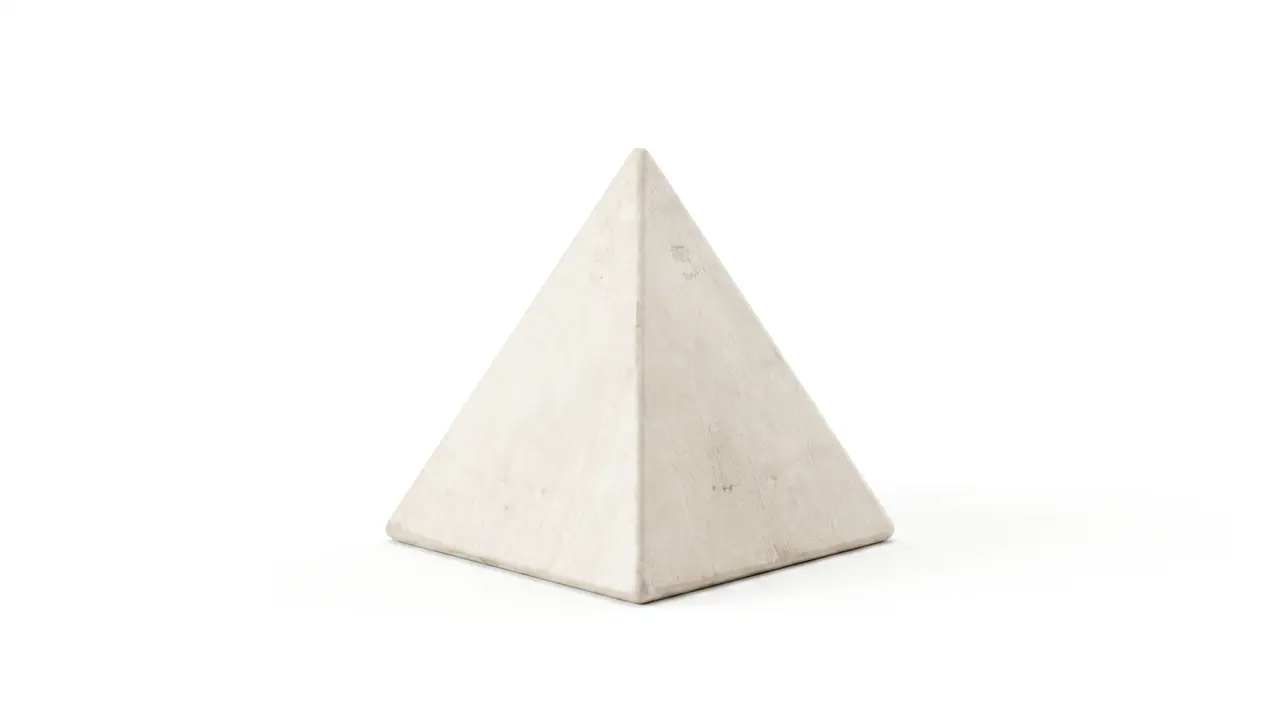 图片节点 3
Reference-role separation is critical. Use {{Image 1}} as the material and style reference ONLY for the toy building block: pale off-white / cream matte wood-style finish, clean geometric children's building-block material, subtle worn texture, soft realistic surface. Do not inherit anything else from the reference. Create a clean single-object asset image on a pure white background, of ONE single toy building block: a small PYRAMID-shaped block — a square base rising with four triangular sloping faces to a single pointed apex at the top, like the pointed roof-top / capstone piece of a children's wooden block set. The block is pale cream / off-white, matte, with a natural wood-toy material and subtle realistic surface detail. It sits alone, centered, gently lit with soft even studio lighting and a soft contact shadow beneath it. Slight three-quarter angle so all faces and the pointed apex read clearly in 3D. Clean product-asset presentation, single object, isolated on pure white, no other blocks, no text, no labels. Visual style: grounded photorealistic 3D render, cinematic realism, soft studio lighting, restrained neutral palette, subtle film grain, no cartoon, no glossy game-CG.
中文女声配音。成年女性,温柔平静、略带磁性沙哑的中低音,成熟克制、带一点疲惫和温度。语速偏慢,情感是释然与温柔的安抚,不怨恨、不甜腻、不悲伤。 台词:"别怕,这里不再 盖 章。"音色参考 {{Mixed 1}} 处理:"别怕"轻柔放缓、像安抚;短暂停顿;"这里不再盖章"平静沉稳、带一丝释然的暖意,"盖章"二字不重读、越平静越好。整句约4-5秒,中间留足停顿呼吸。
使用 {{Image 1}} 作为小型纪念物的精确参考。保留它是一个浅灰色小型金字塔形教育积木 / 四棱锥儿童学习搭建块。它应该基本完整,并且能清楚看出是一个学习积木,但带有一个比较大的磕角、细微划痕、轻微灰尘,以及坠落造成的克制磨损。破损必须是克制的、象征性的,不要碎成废墟,不要压碎,不要像石头残片。它应该是不完美的,但仍然珍贵。生成三角形积木白底图
使用 {{Image 1}} 作为小型纪念物的精确参考。保留它是一个浅灰色小型金字塔形教育积木 / 四棱锥儿童学习搭建块。它应该基本完整,并且能清楚看出是一个学习积木,但带有一个比较大的磕角、细微划痕、轻微灰尘,以及坠落造成的克制磨损。破损必须是克制的、象征性的,不要碎成废墟,不要压碎,不要像石头残片。它应该是不完美的,但仍然珍贵。
使用 {{Image 1}} 作为小型纪念物的精确参考。保留它是一个浅灰色小型金字塔形教育积木 / 四棱锥儿童学习搭建块。它应该基本完整,并且能清楚看出是一个学习积木,但带有一个比较大的磕角、感觉像是缺了一大块,变面细微划痕、轻微灰尘,以及坠落造成的克制磨损。破损不要碎成废墟,不要压碎,不要像石头残片。它应该是不完美的,但仍然珍贵。生成三角形积木白底图
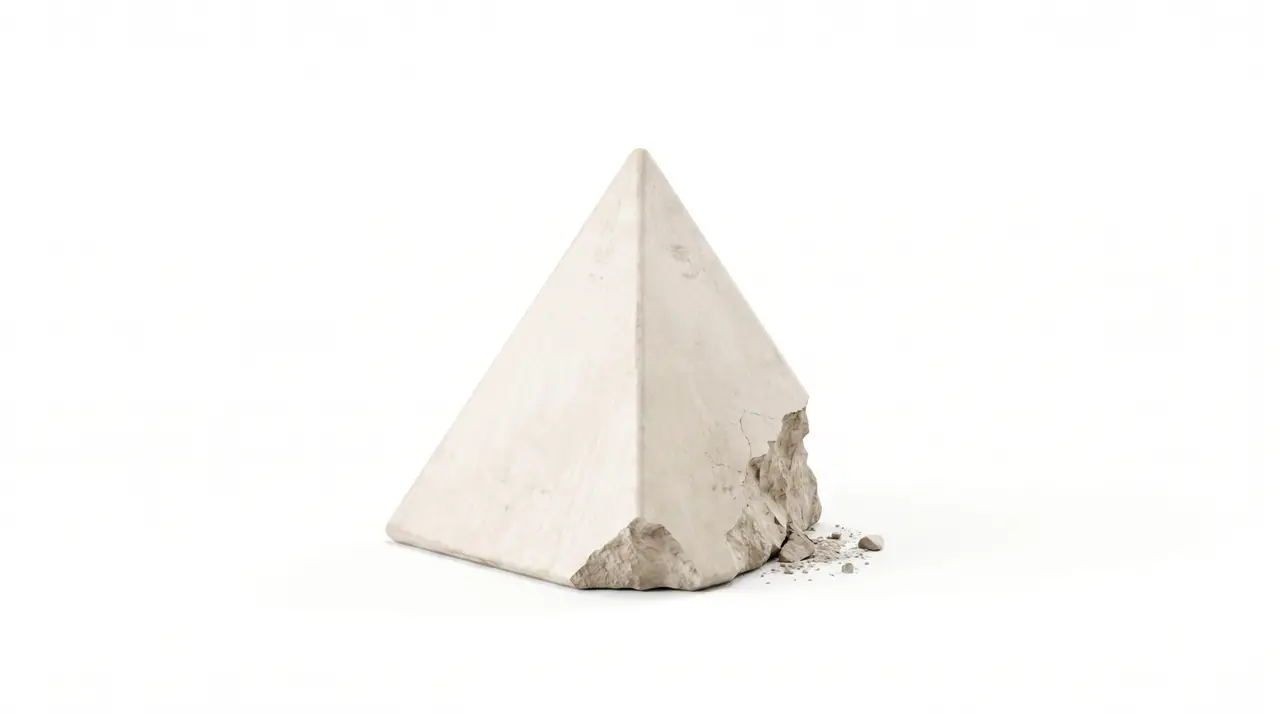 图片节点 4
{{Image 1}} 的一角是被磕碎的不完整的
Use {{Mixed 1}} as the protagonist robot identity reference. Preserve the exact white inspection-and-disposal robot design, facial screen style, proportions, and worn body structure. IMPORTANT: this protagonist robot is unique. Keep him as the only robot with this exact face screen, white inspection body, uniform-like design, PC-67241 markings, and REJECT device. Use {{Mixed 2}} as the female presenter robot identity reference. Preserve her elegant humanoid face, white synthetic shell, blue eye lights, graceful proportions, chest display, and slightly worn underground condition. Use {{Mixed 3}} as the small old robot identity reference. Preserve its short cylindrical body, worn blue-and-white shell, compact size, and early-generation service-robot feeling. Use {{Mixed 4}} as the background rejected robot design-family reference. Preserve varied old service-unit silhouettes, boxy bodies, cylindrical shells, wheeled bases, worn paint, repair patches, faded markings, and practical reused parts. All background robots should feel like older discarded city-service units, visibly different from the protagonist. Use {{Mixed 5}} as the early-learning guidance robot reference. Preserve it as the teaching robot. Use {{Mixed 6}} as the underground inner-street environment reference. Preserve the feeling of a lived-in underground repair street inside a giant lightless shaft-city: workshop lamps, repair stalls, damp floor reflections, patched metal structures, practical tools, warm utility lights, smoke haze, and quiet underground activity. Preserve a wider, deeper, more inhabited spatial feeling, with layered midground and background recession. Use {{Mixed 7}} as the underground passage palette reference. Preserve the neutral-to-slightly-warm color system: concrete dust gray, deep shaft gray, weathered steel, scorched rust, faded wine red, old iron black, tungsten amber, dim workshop orange, aged brass glow, and faded milk gray. Use {{Mixed 8}} as the voice reference for the small old robot. Preserve the same vocal identity, tone texture, rhythm, dryness, age, and slightly humorous mechanical delivery. Create a 12-second cinematic live-action sequence in 21:9 widescreen. This is Shot 26 of the film. This sequence happens in the underground inner street beneath PERFECT CITY, after the protagonist has already been welcomed below and is now being led deeper inside. This is still part of the underground city’s transitional inner street, not yet the deeper chamber. Emotional purpose: the protagonist begins to realize that the rejected robots still have value. This moment should quietly crack his previous worldview. Overall image treatment: cinematic photograph, soft film-like aesthetic, restrained detail, large color shapes, unified material language, natural practical-light dominance, shallow depth of field, photochemical color softness, gentle edge falloff, selective focus hierarchy, subdued micro-detail, soft highlight bloom, observed film-frame feeling. IMPORTANT CHARACTER BLOCKING RULE: Keep the three main characters in a stable relationship throughout the sequence. The protagonist inspection robot stays in the center of the trio. The small old robot walks on the protagonist’s left-hand side, slightly ahead by half a step, acting as the guide and speaker. The female presenter robot walks on the protagonist’s right-hand side, slightly behind or level with him, calm and observant. Maintain this relationship clearly through all shots. CAMERA AND LIGHTING DIRECTION: The camera should feel handheld-cinematic, with restrained operator sway, subtle body-follow breathing motion, small natural reframing corrections, and motivated pans or drifts toward what the protagonist notices. The image should not feel locked-off or mechanically smooth. Use shallow-stop cinematography and visible focus hierarchy. Let foreground, subject plane, and background separate clearly. Use selective focus, rack focus, and shallow depth transitions so the image feels cinematic rather than uniformly descriptive. Lighting should change as the characters move through the underground street. As they pass workshop lamps, utility bulbs, and warm repair lights, their bodies catch warmer edge highlights and soft specular accents. Between those practical pools of light, let them fall into deeper contrast and shadow gaps. Preserve real light falloff, damp floor reflections, smoke haze, and pockets of darkness. SHOT 1 — 0.0s to 4.0s A restrained handheld side-following / front-three-quarter tracking shot, lens feeling around 40mm, T2.0. Track beside the trio as they walk slowly through a wide underground repair street. The protagonist remains the center visual anchor. The small old robot is on his left-hand side and slightly ahead, speaking while guiding. The female presenter is on his right-hand side, slightly behind or level, silent and composed. Use foreground occlusion for cinematic depth: out-of-focus pipes, hanging cables, or passing repair objects briefly cross frame. A warm maintenance lamp creates a soft flare as they move past it. The trio passes through alternating pockets of warm light and shadow. Keep the protagonist in the primary focal plane, with the others slightly drifting in and out of secondary focus. Background rejected robots carry parts, repair objects, pause to look, or move through the street in soft separated layers. They must feel like older discarded city-service units, never like duplicated copies of the protagonist. The small old robot says in Chinese: “上面说,我们是废品。” Tone: calm, dry, matter-of-fact, matching {{Mixed 8}} . Hard cut to Shot 2. SHOT 2 — 4.0s to 9.0s Cut to an observed teaching-life point along the same inner street. Begin from an over-the-shoulder angle near the protagonist, lens feeling around 65mm, T1.8. At first the protagonist’s shoulder or side silhouette is in soft near-foreground. Then use a gentle drift and rack focus from the protagonist’s shoulder line toward the teaching robot and the block structure. Show the early-learning guidance robot teaching several smaller worn robots how to build a tall, complex block structure. The block tower should be visually impressive: taller than the small robots, layered, careful, architectural, made from simple geometric blocks and salvaged learning pieces. It should feel skillful, patient, and cared-for, not like a tiny toy pile. The smaller robots are worn, chipped, and old, but focused and engaged. Lighting here is warmer and more intimate: a practical workshop lamp creates a warm pool of light over the block tower and the teaching group. The background falls off into darker concrete and weathered steel. Use shallow depth of field and clear focal separation so this moment feels intimate and observed. The small old robot continues in Chinese: “可那个,在上面,教过三百个小家伙。” Voice should match {{Mixed 8}} . Hard cut to Shot 3. SHOT 3 — 9.0s to 12.0s Return to the protagonist’s reaction in a medium close side-profile shot, lens feeling around 75mm, T2.0. Keep the same character blocking: small old robot on the protagonist’s left-hand side, protagonist in the center, female presenter on the protagonist’s right-hand side. Start from the teaching direction and gently pan back into the protagonist’s face screen, combined with a subtle handheld push-in. Use a short rack focus so the teaching-life point softens and the protagonist’s face display becomes the clear focal plane. The female presenter remains on his right, slightly behind, catching a soft warm edge light. The small old robot stays left, gently finishing the thought. The protagonist looks back from the teaching robot to the surrounding underground street. His LED face changes subtly: discomfort, confusion, then a small crack in his certainty. The small old robot says in Chinese: “我们不是没用,只是没过他们那套标准。” Hold on the protagonist’s reaction for the final beat. Let the last half-second breathe. Visual style: hyper-real live-action, IMAX 70mm film feel, Panavision anamorphic lens character, selective focus, shallow depth of field, soft film grain, restrained detail, unified material language, soft highlight roll-off, practical-light contrast, damp reflections, concrete texture, aged paint, faded city-service branding, warm utility lamps, smoke haze, observed cinematic intimacy.
使用 {{Mixed 1}} 作为主角机器人的身份参考。保留准确的白色“质检与处置机器人”设计、脸部屏幕样式、身体比例和磨损机身结构。重要:这个主角机器人是唯一的。保持它是唯一拥有这张脸部屏幕、白色质检机身、制服式设计、PC-67241 标记和 REJECT 装置的机器人。 使用 {{Mixed 2}} 作为女主持机器人的身份参考。保留她优雅的人形面孔、白色合成外壳、蓝色眼部灯光、优雅的身体比例、胸口显示屏,以及她在地下环境中略微磨损的状态。 使用 {{Mixed 3}} 作为小旧机器人的身份参考。保留它矮小的圆筒形身体、磨损的蓝白色外壳、紧凑体型,以及早期服务机器人质感。 使用 {{Mixed 4}} 作为背景废弃机器人设计家族参考。保留不同旧服务单元的轮廓:方盒状身体、圆筒壳体、轮式底盘、磨损漆面、修补痕迹、褪色标记,以及实用化改装零件。所有背景机器人都应当像更老一代被淘汰的城市服务单元,且在视觉上明显不同于主角。 使用 {{Mixed 5}} 作为早期幼教引导机器人的参考。保留它作为教学机器人。 使用 {{Mixed 6}} 作为地下内街环境参考。保留一种“位于巨大无光竖井城市内部、有人生活的地下维修街”感觉:工作灯、维修摊位、潮湿地面反光、修补过的金属结构、实用工具、暖色功能灯、烟雾,以及安静的地下活动感。保留更宽、更深、更有居住感的空间层次,并具有中景与远景递进的纵深。 使用 {{Mixed 7}} 作为地下通道色卡参考。保留中性到微暖的色彩系统:水泥灰、深竖井灰、风化钢铁色、焦锈色、褪色酒红、旧铁黑、钨丝琥珀色、昏暗工坊橙、老黄铜光泽、褪色奶灰。 使用 {{Mixed 8}} 作为小旧机器人的声音参考。保留相同的声音身份、音色质感、说话节奏、干涩感、年龄感,以及略带幽默的机械表达方式。 创建一个 12 秒的电影感真人实拍视频段落,21:9 宽银幕。这是全片第 26 个镜头。 这段发生在 PERFECT CITY 下方的地下内街。主角已经在地下被接纳,现在正被带向更深处。这里仍然是地下城市的过渡内街,还不是更深处的机库空间。 情绪目的: 主角开始意识到,这些被拒绝的机器人依然拥有价值。 这个瞬间要安静地撬裂他原有的世界观。 整体画面处理: 电影摄影质感、柔和胶片美学、克制细节、大色块优先、统一材质语言、自然实用灯主导、浅景深、化学感色彩柔化、柔和边缘过渡、明确的焦点层级、弱化微观纹理、柔和高光晕染、像“被观察到的电影画面”而不是平均铺陈的说明性画面。 重要角色站位规则: 整段序列中,三个主要角色的位置关系必须稳定清晰。 主角质检机器人始终位于三人中间。 小旧机器人走在主角左手边,并略微领先半步,作为引路者与讲述者。 女主持机器人走在主角右手边,略微落后或与主角平齐,平静观察。 在所有镜头中都维持这个关系。 摄影与灯光方向: 摄影机应当有电影化手持感:克制的摄影师晃动、轻微跟随呼吸感、小幅自然重新构图,以及有动机地轻摇或轻漂移到主角所注意到的事物上。画面不应像锁死机位,也不应像机械平滑轨道。 使用浅光圈摄影和明确的焦点层级。让前景、主体焦平面和背景形成清晰分离。使用选择性对焦、焦点转移和浅景深变化,让画面更像电影,而不是平均铺开的说明性影像。 灯光必须随着角色移动而变化。当他们经过工作灯、功能灯泡和暖色维修灯时,机器人机身要接到更暖的边缘高光与柔和反射。当他们走出这些实用光池时,要进入更深的反差和阴影间隙。保留真实的灯光衰减、潮湿地面反光、烟雾,以及局部黑暗。 SHOT 1 — 0.0 秒到 4.0 秒 一个克制的手持侧向跟拍 / 前三分之四角度跟拍镜头,镜头感约为 40mm,T2.0。 摄影机在三人旁边跟拍,他们缓慢穿过一条宽阔的地下维修街。 主角始终是画面中心的视觉锚点。 小旧机器人在他左手边并略微领先,一边引路一边说话。 女主持机器人在他右手边,略微落后或平齐,沉默而克制。 使用前景遮挡增加电影空间感:失焦的管线、悬挂电缆或经过的维修物件短暂掠过画面。 他们经过一盏暖色维修灯时,镜头里出现柔和光晕。 三人身体在暖光与阴影之间交替穿行。 让主角位于主要焦平面,小机器人与女主持偶尔轻微进入次级焦点。 背景中的废弃机器人以柔和分层的方式出现:搬运零件、修理物件、停下来看他们,或从街上经过。它们必须像老一代被淘汰的城市服务单元,绝不能像主角的复制体。 小旧机器人说中文: “上面说,我们是废品。” 语气:平静、干涩、就事论事,并匹配 {{Mixed 8}} 。 硬切到 Shot 2。 SHOT 2 — 4.0 秒到 9.0 秒 切到同一条地下内街上的一个教学生活点。 从接近主角位置的过肩角度开始,镜头感约为 65mm,T1.8。 一开始主角的肩部或侧面轮廓在柔和前景里。 然后使用轻微漂移和焦点转移,从主角肩线转向教学机器人与积木结构。 展示早期幼教引导机器人正在教几个较小的磨损机器人搭建一个高而复杂的积木结构。 积木塔必须有视觉冲击力:比小机器人高很多,层次丰富,搭建精细,具有塔楼和建筑感,由简单几何积木和回收的学习部件组成。 它应该让人感觉到技巧、耐心和照料,而不是一小堆玩具。 周围的小机器人是旧的、掉漆的、略有损伤的,但都很专注投入。 这里的灯光更暖、更亲密: 一盏工作灯在积木塔和教学群体上方形成暖色光池。 背景则落入更暗的水泥与风化钢铁之中。 使用浅景深和清晰的焦点分离,让这个瞬间显得亲密、被观察到。 小旧机器人继续说中文: “可那个,在上面,教过三百个小家伙。” 声音应匹配 {{Mixed 8}} 。 硬切到 Shot 3。 SHOT 3 — 9.0 秒到 12.0 秒 回到主角的反应,一个中近景侧脸镜头,镜头感约为 75mm,T2.0。 保持相同的角色站位: 小旧机器人在主角左侧, 主角在中间, 女主持机器人在主角右侧。 从教学点方向开始,轻轻摇回主角的脸屏,并结合一个轻微的手持推进。 使用一次短暂的焦点转移,让教学生活点逐渐虚化,而主角的脸部显示屏成为清晰焦点。 女主持在主角右侧、略微靠后,接到柔和的暖色边缘光。 小旧机器人在左侧,温和地补完最后一句。 主角从教学机器人那里看回来,又看向周围的地下街。 他的 LED 脸部微妙变化:不适、困惑,然后他的确定感出现一道裂缝。 小旧机器人说中文: “我们不是没用,只是没过他们那套标准。” 最后停留在主角的反应上。 让最后半秒有一点呼吸感。 视觉风格: 超写实真人实拍质感,IMAX 70mm 胶片感,Panavision 变形宽银幕镜头特性,选择性对焦,浅景深,柔和胶片颗粒,克制细节,统一材质语言,柔和高光过渡,实用灯对比,潮湿反光,水泥纹理,老化漆面,褪色城市服务标识,暖色功能灯,烟雾,以及被观察到的电影式亲密感。
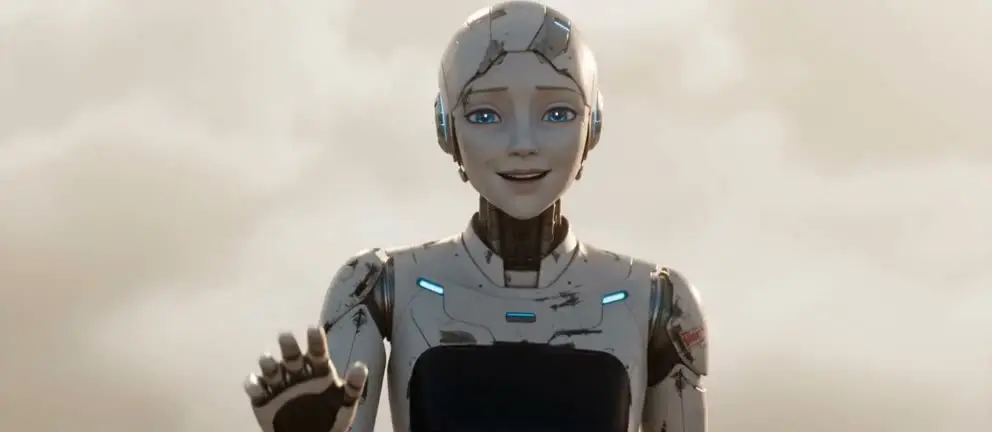 视频截图视频节点 2
中文女声配音。成年女性,温柔平静、略带磁性沙哑的中低音,成熟克制、带一点疲惫和温度。语速偏慢,情感是释然与温柔的安抚,不怨恨、不甜腻、不悲伤。 台词:"别怕,这里不再盖章。"音色参考 {{Mixed 2}} 处理:"别怕"轻柔放缓、像安抚;短暂停顿;"这里不再盖章"平静沉稳、带一丝释然的暖意,"盖章"二字不重读、越平静越好。整句约4-5秒,中间留足停顿呼吸。