
本片以女性摄影师的第一视角进入荒野,把镜头从“捕捉奇观”转向“学习尊重”。雪豹、雪兔、白唇鹿、游隼、白鹳与灰鲸接连短暂显影,像自然给人类的一次次允许。影像以BBC式纪实质感融合诗性旁白,呈现看见、等待与守护的关系:拍摄不是占有,而是让不可见的生命被温柔听见,并把保护变成观众离场后的真实而持续的行动。
 图片节点 8
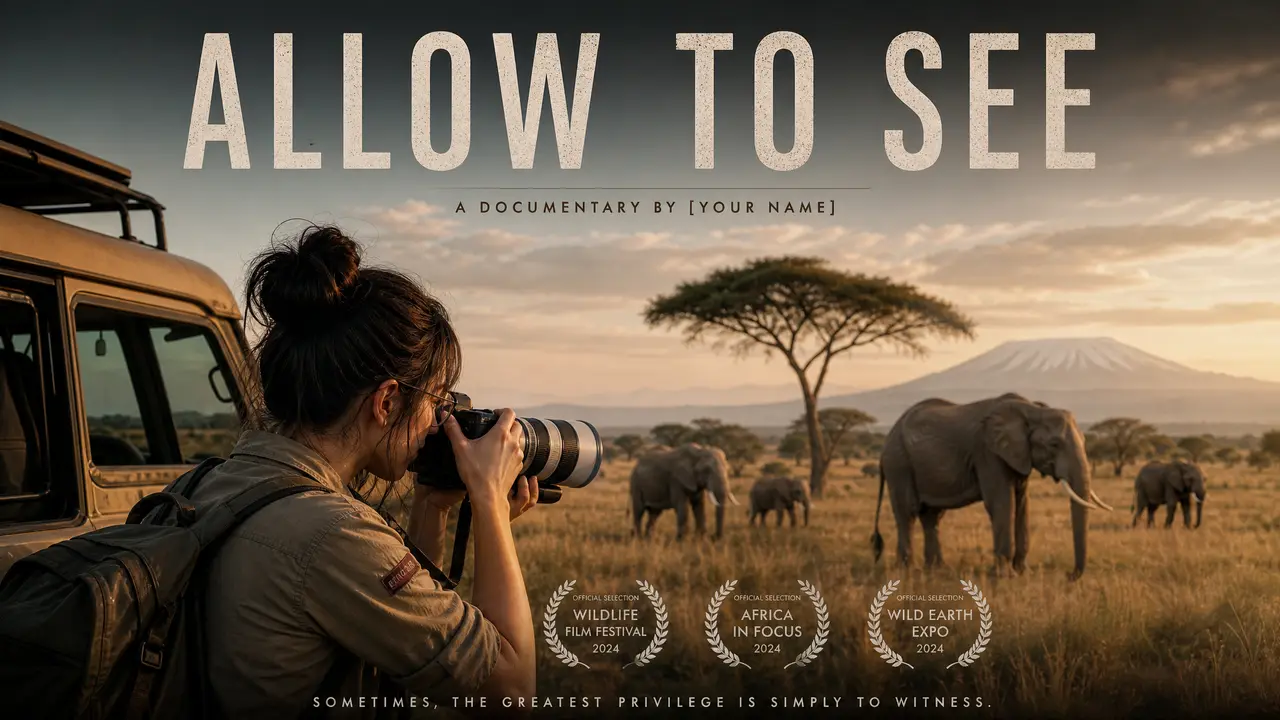
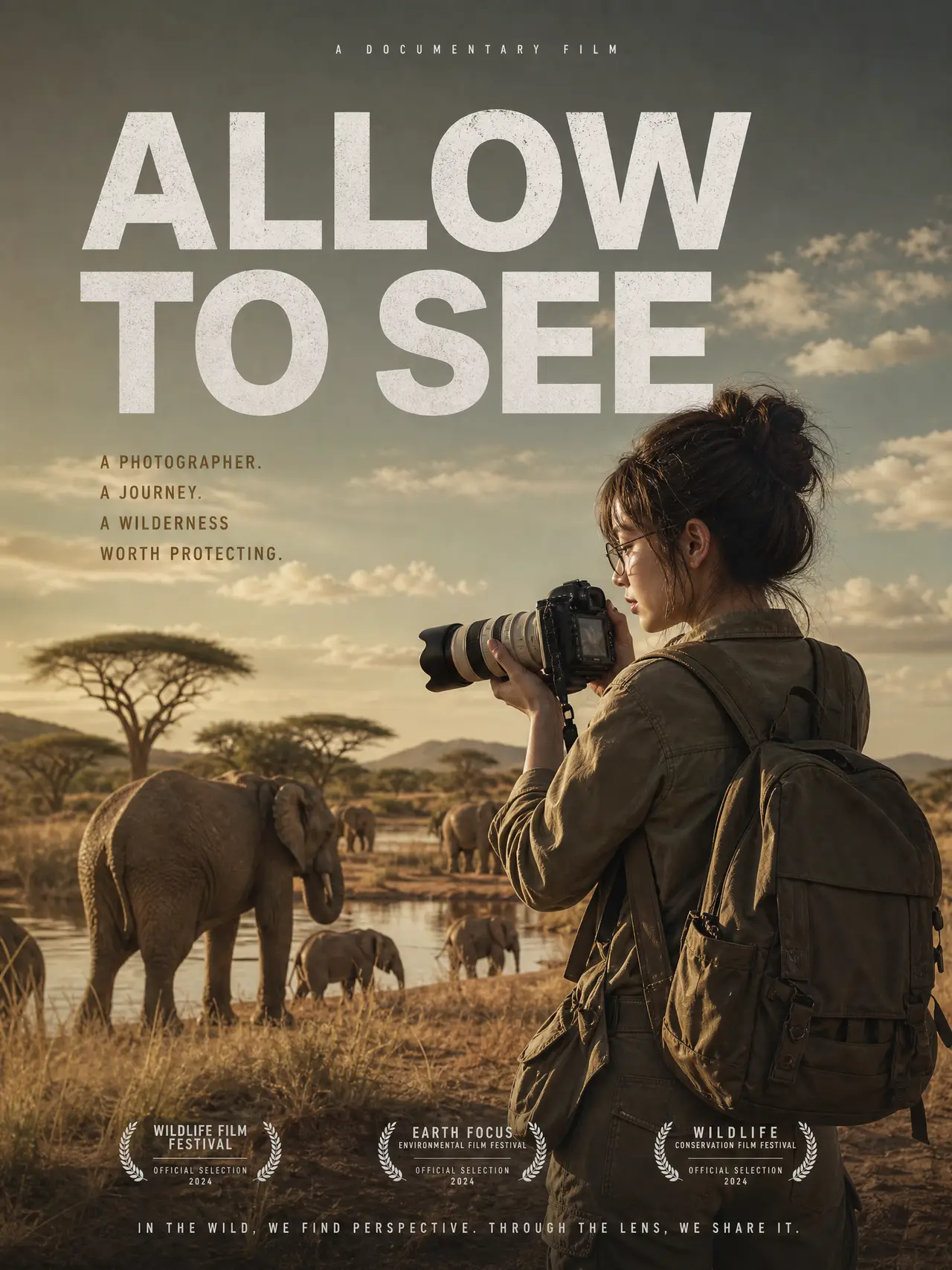
制作纪录片海报,内容是,女摄影师在东非拍摄野生动物,封面标题文字是“ALLOW TO SEE”
制作纪录片海报,内容是,女摄影师在东非拍摄野生动物,封面标题文字是“诗意自然”
图片1的女生替换成图片2的女生,图片1中蓝色的箭头去掉
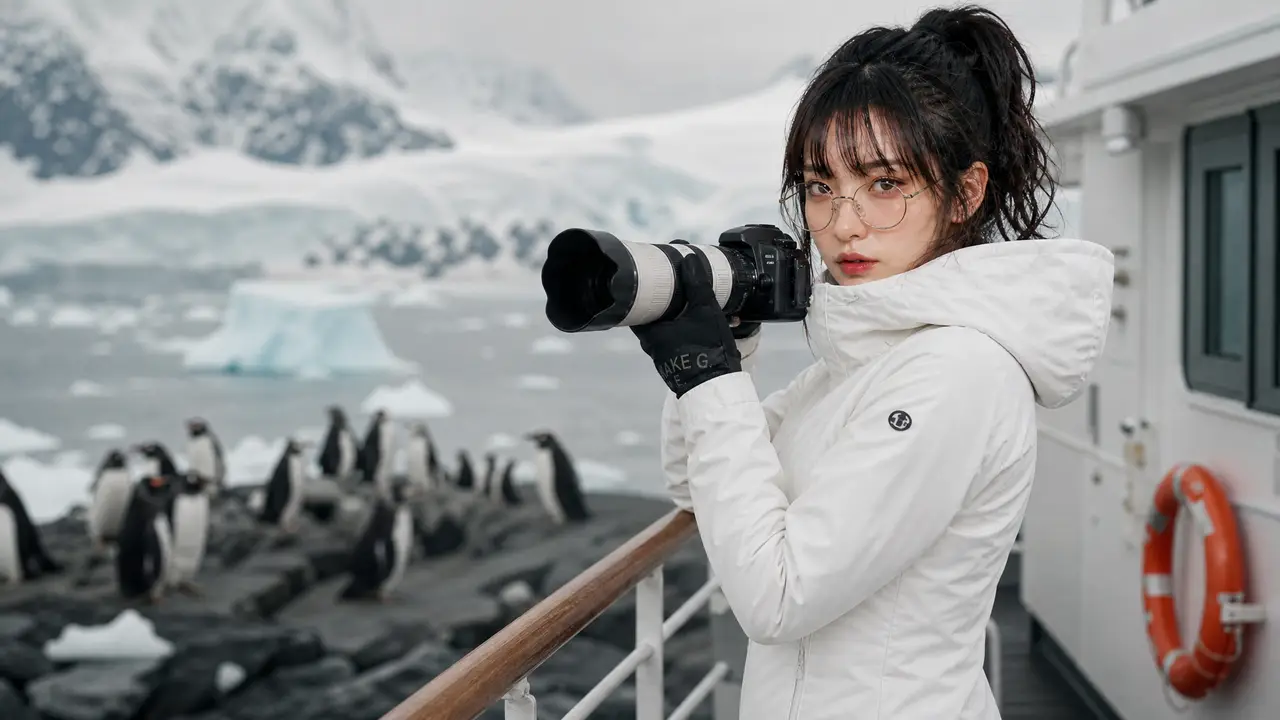
参考图的女生,南极冰川上的船上,拿着相机拍野生动物,中景,alexa摄影风格,构图可以参考图片2
 图片节点 3
参考图的女生,南极冰川上的船上,拿着相机拍野生动物,中景,alexa摄影风格
来个近景,女生半身的,女生还是看着海面的感觉
图片中间的红色线条去掉,
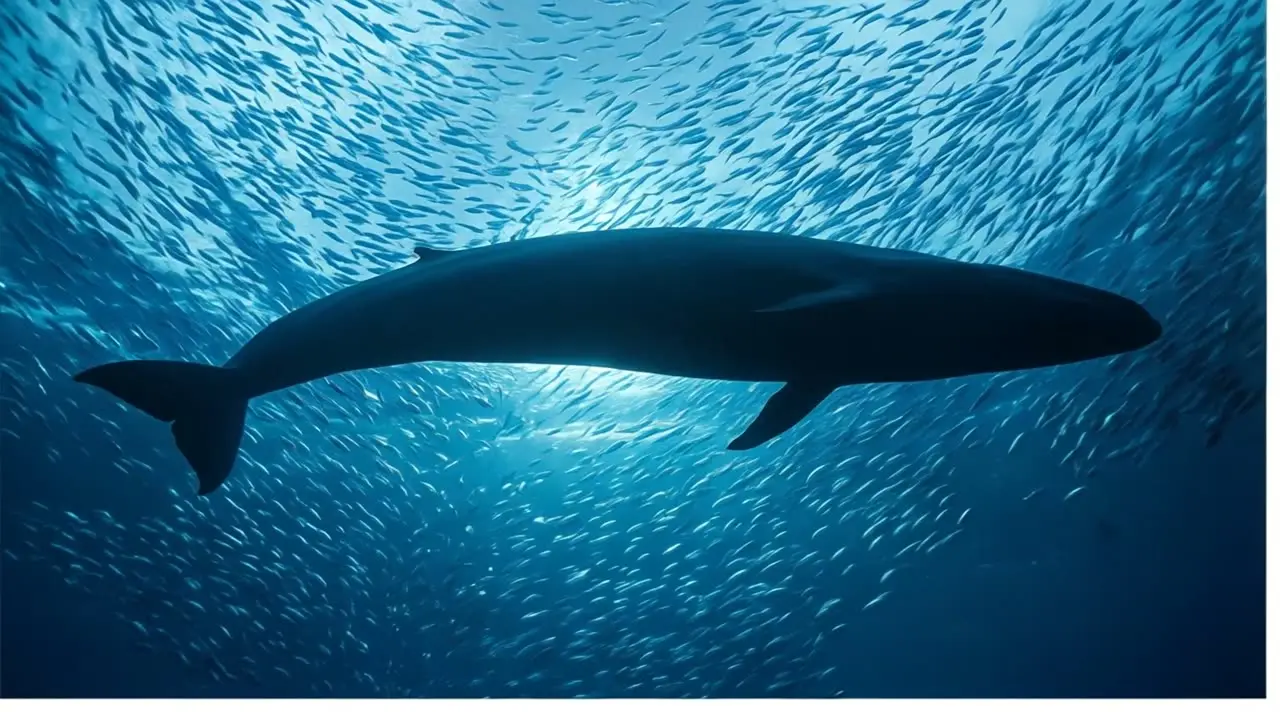
去掉海绵的鲸鱼,来一个近景
 视频截图视频节点 54
不要白色的边
汽车向前行驶
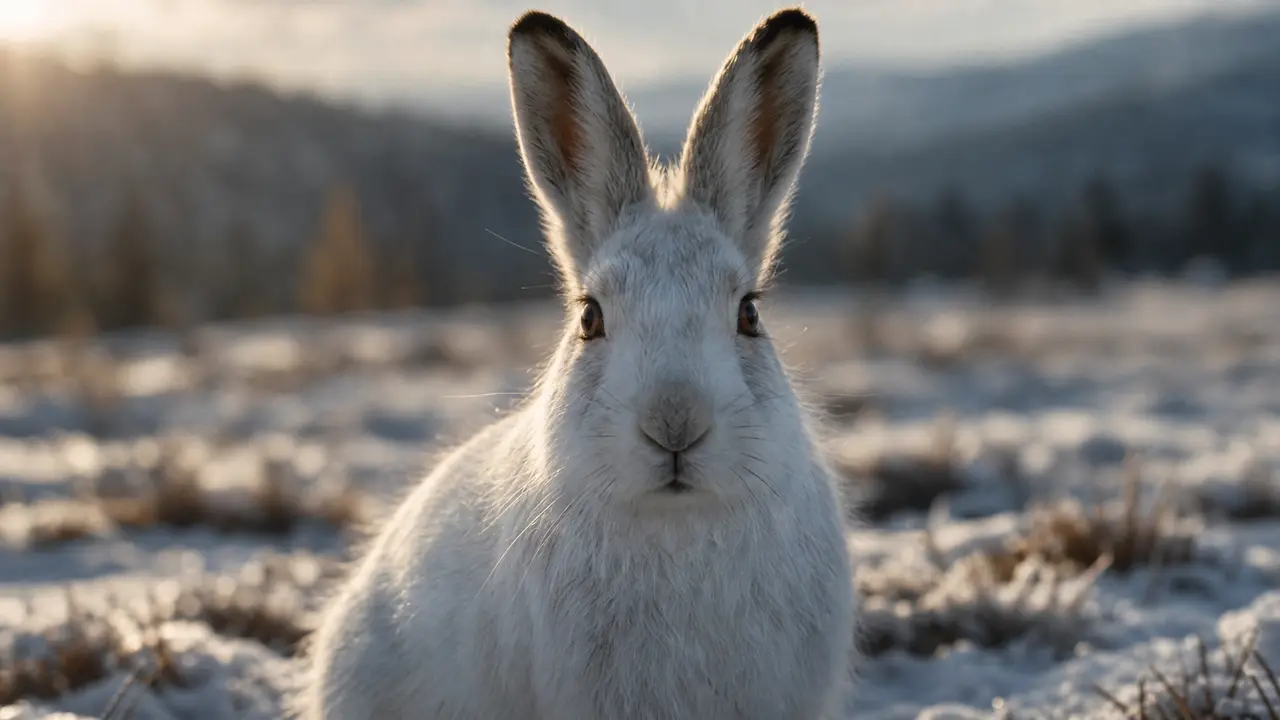 图片节点 2
改成alexa拍摄风格
还是这个女生,把绿色外套脱了,只保留里面的米色吊带漏肩膀,然后裤子鞋其他都一致
Create a 15-second suspense survival video in raw real-world live-action cinema footage style, not photoreal illustration, not AI portrait, not stylized realism. It must look like actual footage captured on location with a real human actor, real tent fabric, real mountain environment, real camera exposure, natural imperfections, unretouched skin, imperfect hair, practical lighting, realistic shadows, natural motion blur, subtle handheld documentary camera behavior, shallow depth of field, true cinema lens optics, subtle film grain, and realistic color grading. Use ONLY the storyboard {{Mixed 2}} as a motion planning reference. Follow the storyboard shot-by-shot, preserving panel order, framing progression, camera rhythm, emotional escalation, action flow, and suspense buildup. Treat each panel as a sequential keyframe, not as a single collage. Every shot, including the first frame and all close-up shots, must remain real live-action footage. Do not let the storyboard drawing style, pencil shading, anime facial proportions, sketch linework, illustrated character design, or AI beauty-face style influence the final image. The storyboard controls only motion, camera angle, framing, pose, action timing, and shot order, never the visual style. The woman must look like a real adult human actor filmed on set, with natural facial proportions, real skin texture, realistic hair movement, believable body posture, and ordinary human imperfections. Keep the clothing, tent, camera, and mountain environment physically real and tactile, with natural materials, believable scale, and realistic lighting interaction. No background music. Sound effects only: breathing, fabric rustle, tent zipper, wind, distant mountain ambience, camera handling sounds, footsteps, subtle suspenseful environmental tension. Do not include any storyboard annotations in the final video. All colored arrows, red/blue/green guide lines, handwritten notes, panel borders, frame numbers, labels, sketch marks, white margins, storyboard paper texture, or planning symbols are for motion reference only and must not appear in the live-action footage. Convert only the intended scene, character pose, camera angle, framing, and action into realistic video. Avoid anime, manga, semi-realistic anime, photoreal illustration, AI portrait look, stylized beauty face, doll-like face, perfect skin, painterly lighting, cel shading, line art, sketch-to-video look, CGI, 3D render, Unreal Engine, UE5, game engine look, plastic skin, waxy face, over-sharpened details, synthetic lighting, fantasy colors, digital avatar, animated look, concept art, illustration, glossy render.
Create a 15-second suspense survival video in a Photoreal / Photorealistic style。Use ONLY as a motion planning reference. Follow the storyboard {{Mixed 2}} shot-by-shot, preserving panel order, framing progression, camera rhythm, emotional escalation, action flow and suspense buildup. Treat each panel as a sequential keyframe, not as a single collage.不要背景音乐只保留音效
Create a 15-second suspense survival video in an ultra-realistic live-action cinematic TV commercial film style, as if shot with a real cinema camera, ARRI Alexa 35 look, natural practical lighting, realistic skin texture, real lens optics, subtle handheld camera movement, natural motion blur, shallow depth of field, cinematic color grading, fine film grain, imperfect lens breathing, and documentary-level realism. Use ONLY the storyboard {{Mixed 2}} as a motion planning reference. Follow the storyboard shot-by-shot, preserving panel order, framing progression, camera rhythm, emotional escalation, action flow, and suspense buildup. Treat each panel as a sequential keyframe, not as a single collage. No background music. Sound effects only: breathing, fabric rustle, tent zipper, wind, distant mountain ambience, camera handling sounds, footsteps, subtle suspenseful environmental tension. Avoid CGI, 3D render, Unreal Engine, UE5, game engine look, plastic skin, waxy face, over-sharpened details, synthetic lighting, fantasy colors, digital avatar, animated look, concept art, illustration, glossy render.
Create a 15-second suspense survival video in raw real-world live-action cinema footage style, not photoreal illustration, not AI portrait, not stylized realism. It must look like actual footage captured on location with a real human actor, real tent fabric, real mountain environment, real camera exposure, natural imperfections, unretouched skin, imperfect hair, practical lighting, realistic shadows, natural motion blur, subtle handheld documentary camera behavior, shallow depth of field, true cinema lens optics, subtle film grain, and realistic color grading. Use ONLY the storyboard {{Mixed 2}} as a motion planning reference. Follow the storyboard shot-by-shot, preserving panel order, framing progression, camera rhythm, emotional escalation, action flow, and suspense buildup. Treat each panel as a sequential keyframe, not as a single collage. Every shot, including the first frame and all close-up shots, must remain real live-action footage. Do not let the storyboard drawing style, pencil shading, anime facial proportions, sketch linework, illustrated character design, or AI beauty-face style influence the final image. The storyboard controls only motion, camera angle, framing, pose, action timing, and shot order, never the visual style. The woman must look like a real adult human actor filmed on set, with natural facial proportions, real skin texture, realistic hair movement, believable body posture, and ordinary human imperfections. Keep the clothing, tent, camera, and mountain environment physically real and tactile, with natural materials, believable scale, and realistic lighting interaction. No background music. Sound effects only: breathing, fabric rustle, tent zipper, wind, distant mountain ambience, camera handling sounds, footsteps, subtle suspenseful environmental tension. Do not include any storyboard annotations in the final video. All colored arrows, red/blue/green guide lines, handwritten notes, panel borders, frame numbers, labels, sketch marks, white margins, storyboard paper texture, or planning symbols are for motion reference only and must not appear in the live-action footage. Convert only the intended scene, character pose, camera angle, framing, and action into realistic video. Avoid anime, manga, semi-realistic anime, photoreal illustration, AI portrait look, stylized beauty face, doll-like face, perfect skin, painterly lighting, cel shading, line art, sketch-to-video look, CGI, 3D render, Unreal Engine, UE5, game engine look, plastic skin, waxy face, over-sharpened details, synthetic lighting, fantasy colors, digital avatar, animated look, concept art, illustration, glossy render.视频有音效,没有背景音乐
Create a 15-second suspense survival video in raw real-world live-action cinema footage style, not photoreal illustration, not AI portrait, not stylized realism. It must look like actual footage captured on location with a real human actor, real tent fabric, real mountain environment, real camera exposure, natural imperfections, unretouched skin, imperfect hair, practical lighting, realistic shadows, natural motion blur, subtle handheld documentary camera behavior, shallow depth of field, true cinema lens optics, subtle film grain, and realistic color grading. Use ONLY the storyboard as a motion planning reference. Follow the storyboard shot-by-shot, preserving panel order, framing progression, camera rhythm, emotional escalation, action flow, and suspense buildup. Treat each panel as a sequential keyframe, not as a single collage. Every shot, including the first frame and all close-up shots, must remain real live-action footage. Do not let the storyboard drawing style, pencil shading, anime facial proportions, sketch linework, illustrated character design, or AI beauty-face style influence the final image. The storyboard controls only motion, camera angle, framing, pose, action timing, and shot order, never the visual style. The woman must look like a real adult human actor filmed on set, with natural facial proportions, real skin texture, realistic hair movement, believable body posture, and ordinary human imperfections. Keep the clothing, tent, camera, and mountain environment physically real and tactile, with natural materials, believable scale, and realistic lighting interaction. No background music. Sound effects only: breathing, fabric rustle, tent zipper, wind, distant mountain ambience, camera handling sounds, footsteps, subtle suspenseful environmental tension. Do not include any storyboard annotations in the final video. All colored arrows, red/blue/green guide lines, handwritten notes, panel borders, frame numbers, labels, sketch marks, white margins, storyboard paper texture, or planning symbols are for motion reference only and must not appear in the live-action footage. Convert only the intended scene, character pose, camera angle, framing, and action into realistic video. Avoid anime, manga, semi-realistic anime, photoreal illustration, AI portrait look, stylized beauty face, doll-like face, perfect skin, painterly lighting, cel shading, line art, sketch-to-video look, CGI, 3D render, Unreal Engine, UE5, game engine look, plastic skin, waxy face, over-sharpened details, synthetic lighting, fantasy colors, digital avatar, animated look, concept art, illustration, glossy render.视频有音效,没有背景音乐
8号镜头,单独一个画面,是那个模拟相机看到的镜头,就是画面只有一个兔子,和那个相机那个对焦的绿色的框
相机瞄准兔子的那个图片放大成一个画面
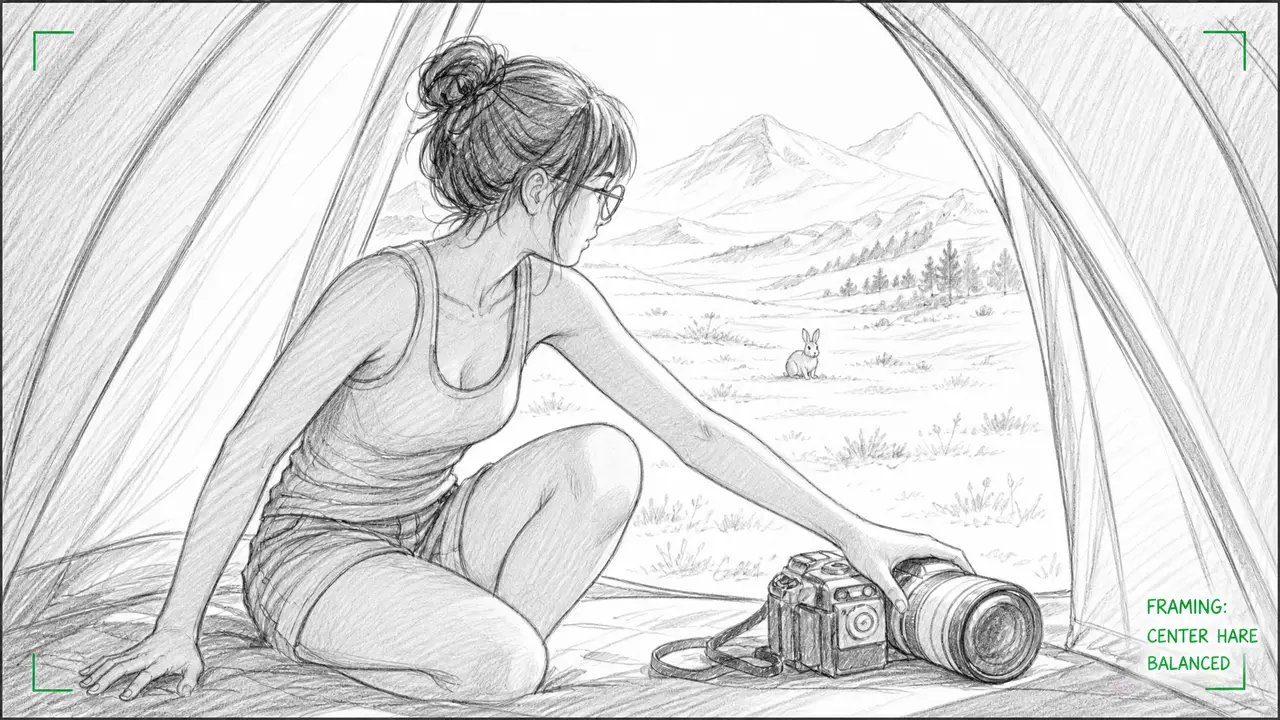 图片节点 10
8号镜头,单独一个画面
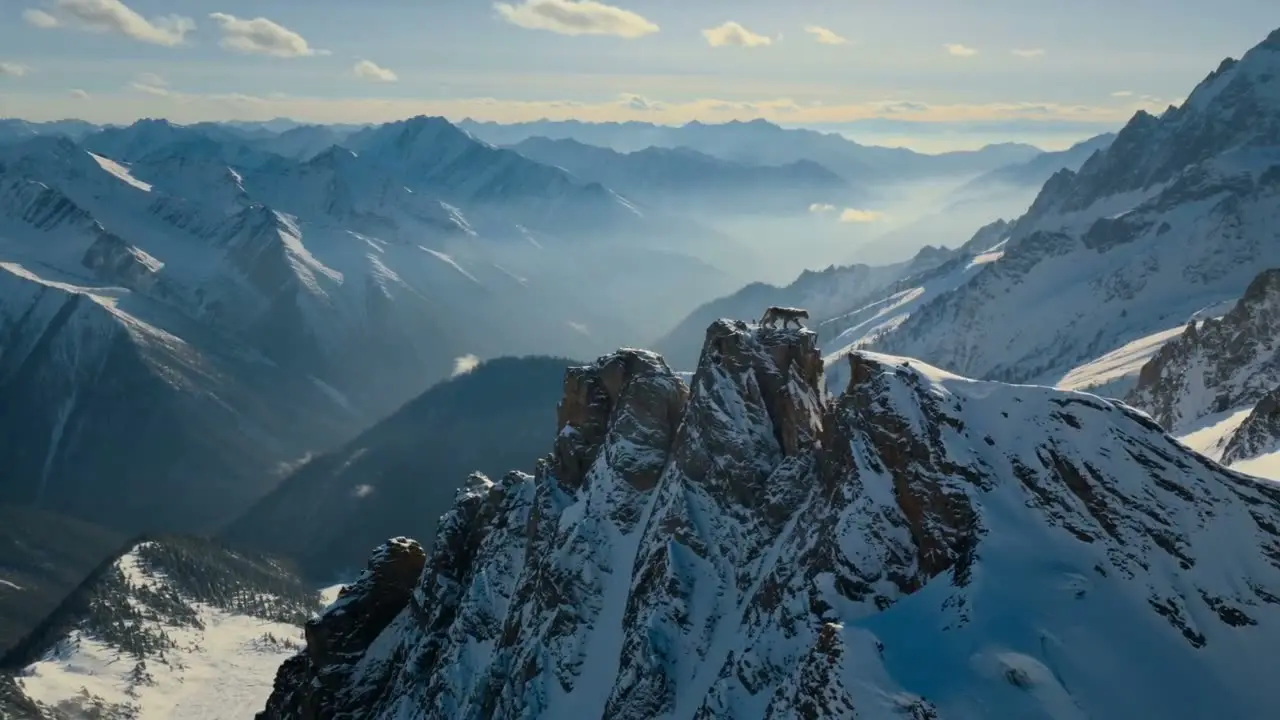 视频截图视频节点 2
Create a 15-second ultra-realistic live-action snow leopard wildlife documentary film, following the uploaded storyboard only for shot order, composition, animal placement, camera angle, and camera movement. Do not copy the storyboard drawing style. Do not show pencil lines, sketch texture, arrows, numbers, handwritten notes, labels, panel borders, white paper, or any graphic marks from the reference image. The final video must look like real wildlife footage captured on location in the high Himalayas, not illustration, not animation, not CGI, not concept art. A 9-shot cinematic sequence, each shot about 1.5 to 1.7 seconds, clean cuts, following the storyboard from panel 1 to panel 9: Shot 1: extreme wide aerial establishing shot of vast snow-covered Himalayan mountains, deep valleys, sharp ridgelines, drifting mist and wind-blown snow, immense natural scale. Shot 2: very wide slow push-in across a steep rocky snowy cliff face, searching for a camouflaged snow leopard hidden among the rocks, long-lens documentary tension. Shot 3: wide telephoto shot of a real snow leopard walking carefully along the edge of a high mountain cliff, natural body movement, cold wind moving its fur. Shot 4: extreme close-up macro shot of a snow leopard paw stepping on snow and rock, snow compressing under the paw, small ice particles and powder scattering naturally. Shot 5: extreme close-up of the snow leopard eye, wet realistic eye surface, reflection of snowy mountains, visible breath vapor in cold air, natural fur detail. Shot 6: very wide shot of the snow leopard blending into a vertical rocky cliff, almost invisible against the stone and snow, patient observational wildlife camera. Shot 7: extreme wide shot of the snow leopard leaping across a gap between cliffs, snow scattering from the takeoff point, powerful realistic animal motion, no slow-motion fantasy. Shot 8: wide shot of the snow leopard walking into a snowstorm, wind-driven snow, reduced visibility, natural documentary atmosphere. Shot 9: extreme wide aerial shot returning to the vast Himalayan mountain range, the snow leopard gone, only mountains, mist, snow, and silence. Visual style: BBC Earth natural history documentary realism, Planet Earth style, real snow leopard footage, shot on ARRI Alexa 35, long telephoto wildlife lenses, Cooke anamorphic look, cinematic wide composition, natural color science, filmic contrast, fine film grain, realistic lens falloff, natural motion blur, high dynamic range, cold mountain daylight, real snow, real rock, real wind, real atmosphere, imperfect organic detail. Camera style: real helicopter/drone aerials, real long-lens wildlife photography, restrained natural camera movement, slow push-ins, telephoto compression, documentary realism, no artificial camera tricks. Absolutely no humans, no fantasy creature, no cartoon, no anime, no painterly sky, no fake mountains, no plastic fur, no sketch lines, no arrows, no text, no storyboard panels.anime, cartoon, animation, illustration, painting, concept art, CGI, 3D render, game cinematic, fantasy, fake snow, fake rocks, plastic fur, artificial clouds, painterly sky, sketch, pencil drawing, line art, storyboard sheet, arrows, red arrow, blue arrow, green frame, yellow marks, handwritten text, labels, numbers, panel borders, split screen, collage, paper texture, over-stylized lighting, magical light, unrealistic animal anatomy, deformed snow leopard, human, tent, portrait, horror
Create a 15-second ultra-realistic live-action wildlife documentary film about a white-lipped deer, also known as Thorold’s deer, crossing a frozen high-altitude river. Use the white-lipped deer photo reference only for accurate animal appearance: dark brown winter coat, white lips and pale muzzle, thick neck, strong body, realistic antlers, real fur texture, natural breath vapor, correct deer anatomy and proportions. Use the storyboard reference only for shot order, composition, subject placement, lens feeling, camera angle, and camera movement. Do not copy the storyboard drawing style. Do not show pencil lines, sketch texture, arrows, labels, handwritten notes, numbers, panel borders, white paper, or any graphic marks. The final video must look like real BBC Earth / Frozen Planet wildlife footage captured on location in a frozen high-altitude mountain valley, not illustration, not animation, not CGI, not concept art. A 6-shot cinematic sequence, each shot about 2.3 to 2.5 seconds, clean cuts, following the storyboard from panel 1 to panel 6: Shot 1: aerial wide establishing shot of a vast frozen alpine valley surrounded by snow-covered mountains, a small group of white-lipped deer far below crossing a frozen riverbed, cold wind, natural haze, immense scale, golden winter side light. Shot 2: long telephoto shot of a real white-lipped deer cautiously lowering its head and stepping onto thin ice, snowy mountains compressed in the background, realistic dark brown coat, white lips and muzzle, visible breath vapor, quiet documentary tension. Shot 3: extreme macro close-up of the deer hoof pressing into the frozen ice surface, realistic cracks spreading through the ice, tiny snow crystals and ice dust scattering naturally, dark water faintly visible beneath the ice. Shot 4: long telephoto side-profile tracking shot of the white-lipped deer walking carefully across the frozen river, antlers visible, hooves slipping slightly on ice, breath vapor in cold air, wind moving the fur, natural animal movement. Shot 5: macro close-up of fresh hoofprints and branching cracks in snow-covered ice, wind-blown snow particles moving across the surface, tactile real ice texture, fragile dangerous atmosphere. Shot 6: extreme wide final shot of the frozen valley, the deer very small in the distance near the riverbank, a trail of hoofprints leading across the ice, mountains and cold sky surrounding everything, hold the quiet final frame. Visual style: BBC Earth natural history documentary realism, Frozen Planet style, real wildlife footage, shot on ARRI Alexa 35, cinematic 2.39:1 widescreen composition, natural ARRI color science, filmic contrast, fine film grain, realistic lens falloff, natural motion blur, high dynamic range, cold mountain daylight, real snow, real ice, real rock, real wind, real animal fur, imperfect organic detail. Camera style: real aerial drone or helicopter shot for the wide landscapes, real 600mm and 800mm telephoto wildlife lens for animal shots, real 100mm macro lens for hoof and ice details, restrained documentary camera movement, slow push-ins, telephoto compression, no artificial camera tricks. Mood: silent, fragile, dangerous, beautiful, survival. Nature is larger than life. Absolutely no humans, no pure white deer, no albino deer, no fantasy creature, no elk, no moose, no reindeer, no cartoon, no anime, no painterly sky, no fake mountains, no plastic fur, no sketch lines, no arrows, no text, no storyboard panels.anime, cartoon, animation, illustration, painting, concept art, CGI, 3D render, game cinematic, fantasy bird, eagle, hawk, wrong species, fake feathers, plastic texture, artificial clouds, painterly sky, magical lighting, visible shockwave, speed lines, airflow lines, motion streak graphics, drawn wind, comic effect, sketch, pencil drawing, line art, storyboard sheet, arrows, red arrow, blue arrow, green frame, yellow marks, handwritten text, labels, numbers, panel borders, split screen, collage, paper texture, unrealistic bird anatomy, deformed wings, extra wings, human, drone visible, horror
Create a 15-second ultra-realistic live-action wildlife documentary film about a peregrine falcon diving from a cliff, following the uploaded storyboard only for shot order, composition, camera angle, lens feeling, and camera movement. Use the peregrine falcon photo reference only for accurate species appearance, feather pattern, head markings, eye shape, beak, wing structure, body proportions, and real natural texture. Do not copy the storyboard drawing style. Do not show pencil lines, sketch texture, arrows, labels, handwritten notes, numbers, panel borders, white paper, graphic marks, speed lines, or drawn airflow. The final video must look like real wildlife footage captured on location, not illustration, not animation, not CGI, not concept art. A 6-shot cinematic sequence, each shot about 2.3 to 2.5 seconds, clean cuts, following the storyboard from panel 1 to panel 6: Shot 1: extreme wide telephoto landscape shot of a massive cliff edge above a vast valley, a tiny peregrine falcon perched near the edge, side light, huge scale, quiet wind, the bird small against the world. Shot 2: medium telephoto shot of the real peregrine falcon on the cliff, body low, wings tight, head focused downward, preparing to dive, realistic feathers moving subtly in the wind, side light, shallow depth of field. Shot 3: close-up tracking shot as the peregrine falcon drops its head and folds into a streamlined dive posture, wings tucked tight, eye sharp and focused, feather detail accurate to the photo reference, natural motion blur from speed. Shot 4: extreme wide static shot of the cliff as the falcon falls rapidly through open air, the bird tiny against clouds and distant land, immense height and silence, realistic free-fall speed, no visible graphic trails. Shot 5: fast tracking telephoto shot alongside the peregrine falcon in a high-speed stoop, body aerodynamic, wings tight, background streaking naturally from real camera panning and motion blur, intense but realistic wildlife footage. Shot 6: extreme wide final shot of the empty cliff and valley after the falcon disappears from frame, soft diffused light, wind over the rock, the world remains still and vast. Visual style: BBC Earth natural history documentary realism, Planet Earth style, real peregrine falcon footage, shot on ARRI Alexa 35, cinematic 2.39:1 widescreen composition, natural ARRI color science, filmic contrast, fine film grain, realistic lens falloff, natural motion blur, high dynamic range, real cliff texture, real clouds, real atmosphere, real bird feathers, imperfect organic detail. Camera style: real 1200mm and 800mm long telephoto wildlife lens compression for cliff and preparation shots, real 400mm tracking wildlife lens for the high-speed dive, restrained documentary camera movement, patient observational realism, no artificial camera tricks. Mood: precision, focus, violence, speed, silence. Absolutely no humans, no fantasy bird, no eagle, no hawk, no cartoon, no anime, no painterly sky, no fake cliff, no plastic feathers, no sketch lines, no arrows, no text, no storyboard panels. anime, cartoon, animation, illustration, painting, concept art, CGI, 3D render, game cinematic, fantasy bird, eagle, hawk, wrong species, fake feathers, plastic texture, artificial cliff, painterly sky, magical lighting, visible shockwave, speed lines, airflow lines, motion streak graphics, drawn wind, sketch, pencil drawing, line art, storyboard sheet, arrows, red arrow, blue arrow, green frame, yellow marks, handwritten text, labels, numbers, panel borders, split screen, collage, paper texture, unrealistic bird anatomy, deformed wings, extra wings, human, drone visible, horror
角色就是这个女生 ,根据这个提示词“GPT Image 2 Prompt for Storyboard: Use reference image for the character. 16:9 storyboard sheet, 12 cinematic panels. The actual storyboard drawings must be black and white only: rough pencil lines, minimal detail, fast gesture drawing energy, simple anatomy construction and strong silhouette readability. Keep the artwork lightweight, dynamic and unfinished like early fight choreography previs. Annotation color system: red arrows = body movement blue arrows = camera movement green marks = framing / composition notes orange marks = lighting direction yellow marks = elemental VFX / energy effects black text = short lens notes and panel labels No timestamps. No dialogue. No singing. No extra characters. No enemies. No logos. No watermark.”给我制作一个6宫格的故事版,女生在使用长焦镜头架三脚架在草丛里远远的拍摄这个鹿,要求有航拍湖面的镜头,
以输入图片作为首帧,严格保持原图构图、鹿的位置、姿态、鹿角形状、身体比例、雪山背景、溪流和色彩关系不变。BBC Earth 野生动物纪录片实拍质感,ARRI Alexa 65,超长焦镜头,远距离三脚架固定拍摄,真实高动态范围,细腻胶片色彩,长焦压缩空间,浅景深,空气透视真实。 镜头几乎固定,不做推进,不做明显运镜,只保留极轻微的自然镜头呼吸感。重点表现白唇鹿真实自然的细微行为:鹿保持站立,轻轻眨眼,耳朵微微转动,鼻孔呼吸,寒冷空气中的白色呼气缓慢扩散,胸腔轻微起伏,头部非常轻微地转向镜头,像听到远处声音后短暂停顿警觉。动作克制、真实、有重量感,不夸张。 溪水缓慢流动,冰面和水光轻微闪烁,枯草被冷风轻轻吹动,远处雪山和晨雾保持稳定。整体安静、寒冷、庄重、真实,像 BBC 或 National Geographic 高端野生动物纪录片素材。
正向提示词: Reference priority: The character photo is the primary visual reference for the female wildlife photographer: young East Asian woman, round glasses, dark hair tied up with loose bangs, olive-green overshirt, beige tank top, khaki cargo shorts, rugged outdoor boots, natural face and realistic proportions. Use the character reference only for identity, outfit, hairstyle, glasses, and body type. Do not copy the studio background, studio lighting, fashion portrait style, beauty retouching, or posed catalog look. The storyboard is only a shot-planning document for shot order, composition, subject placement, camera angle, lens feeling, and camera movement. Never reproduce the storyboard as a visual style. Never copy drawn lines, pencil shading, arrows, handwritten notes, labels, numbers, panel borders, white paper texture, or graphic marks. Create a 15-second ultra-realistic live-action wildlife documentary sequence about a female wildlife photographer quietly discovering a wild deer in a remote alpine lake valley. The final video must look like actual BBC Earth / Planet Earth behind-the-scenes wildlife footage captured on location, not illustration, not animation, not CGI, not concept art. A 6-shot cinematic sequence, each shot about 2.3 to 2.5 seconds, clean cuts, following the storyboard from panel 1 to panel 6: Shot 1: wide aerial establishing shot of a vast alpine lake valley surrounded by snow-capped mountains, cold clear morning light, forests along the shore, calm water, immense natural scale. Shot 2: aerial push-in over the lake and wooded shoreline toward a distant wild deer standing near the water, realistic mountain haze, natural sunlight, quiet documentary tension. Shot 3: long-lens wildlife POV through blurred foreground grass, a wild stag with antlers standing in the distance, alert and still, compressed mountain background, realistic shallow depth of field. Shot 4: wide shot from behind the female wildlife photographer crouching in tall grass with a telephoto camera on a tripod, watching the deer across the open landscape, practical outdoor clothing matching the character reference, natural posture, no posing. Shot 5: medium side shot of the photographer carefully looking through the camera, steady hands, quiet breathing, real field gear, wind moving loose hair and clothing, soft mountain light, restrained documentary realism. Shot 6: telephoto close shot of the deer looking toward camera through blurred foreground grass, detailed fur, antlers, breath in cold air, natural animal movement, quiet eye contact, realistic lens compression. Visual style: BBC Earth natural history documentary realism, Planet Earth behind-the-scenes style, actual long-lens wildlife documentary footage, shot on ARRI Alexa 35, cinematic 2.39:1 widescreen composition, natural ARRI color science, muted natural color, filmic contrast, fine film grain, realistic lens falloff, natural motion blur, high dynamic range, real alpine lake, real mountains, real grass, real wind, real animal fur, imperfect organic detail, natural exposure, no stylized beauty lighting. Camera style: real aerial drone shot for the opening valley, real 70mm aerial push-in, real 400mm long-lens wildlife POV, real 100mm and 135mm documentary camera shots for the photographer, real 600mm telephoto close-up for the deer, restrained natural camera movement, patient observational realism, no artificial camera tricks. Mood: quiet, focused, intimate, respectful, wild, observational. 负向提示词: anime frame, cartoon, animation, illustration, painting, concept art, CGI, 3D render, game cinematic, fashion shoot, studio portrait, beauty commercial, influencer pose, selfie, glamour lighting, over-retouched skin, plastic skin, fake outdoor background, fake mountains, fake grass, fake deer, wrong animal, elk, moose, reindeer, unrealistic antlers, deformed deer, storyboard sheet, sketch, pencil drawing, line art, drawn lines, pencil shading, arrows, red arrow, blue arrow, green frame, yellow marks, handwritten text, labels, numbers, panel borders, split screen, collage, paper texture, extra camera, broken camera, deformed hands, extra fingers, distorted face, human crowd, city, tent, horror
正向提示词: Reference priority: Use the character photo only as a loose reference for the female wildlife photographer's outfit, hairstyle, glasses, body type, and general identity. Do not copy the studio portrait lighting, beauty retouching, fashion catalog pose, glossy skin, or idol-like face. Do not use the storyboard as a visual style reference. The shot plan below is text-only direction for composition, camera angle, lens feeling, and movement. No drawn marks, arrows, text, borders, pencil lines, or sketch textures may appear. Create a 15-second raw live-action natural-history documentary sequence about a female wildlife photographer quietly observing a wild white-lipped deer in a remote alpine lake valley. The final video must look like real behind-the-scenes wildlife documentary footage captured on location by a small documentary crew, not a fantasy film, not a commercial, not AI illustration, not CGI, not anime. A 6-shot sequence, each shot about 2.3 to 2.5 seconds, clean natural cuts: Shot 1: real aerial documentary shot of a remote alpine lake valley, snow-capped mountains, uneven natural shoreline, patches of forest, cold morning haze, imperfect real drone movement, natural exposure. Shot 2: aerial push-in toward a distant wild white-lipped deer near the lakeshore, the animal small in frame, real terrain texture, muted winter colors, no perfect postcard composition. Shot 3: long-lens wildlife POV through messy blurred foreground grass, a real wild stag standing alert in the distance, natural compressed background, slight camera vibration, realistic atmospheric haze. Shot 4: wide behind-the-scenes shot from behind the female wildlife photographer crouching in real grass with a telephoto camera on a tripod, practical field posture, face mostly turned away, clothing matching the reference, wind moving hair and fabric. Shot 5: medium side documentary shot of the photographer looking through the camera, no beauty pose, no glamour lighting, natural skin texture, ordinary field concentration, hands steady on real camera gear, shallow but realistic depth of field. Shot 6: 600mm telephoto close-up of the wild deer looking toward camera through blurred grass, realistic fur, antlers, wet nose, small imperfections, breath in cold air, natural animal stillness. Visual style: raw BBC Earth behind-the-scenes documentary realism, actual long-lens wildlife footage, natural camera exposure, muted real-world color, imperfect organic details, real grass, real wind, real mountain haze, real animal fur, realistic lens compression, subtle handheld micro-shake, natural motion blur, no glossy cinematic polish, no stylized beauty lighting, no fantasy color grading. Camera style: real drone aerial, real 400mm and 600mm long-lens wildlife photography, real 100mm and 135mm documentary camera shots, restrained observational movement, no artificial camera tricks. Mood: quiet, patient, respectful, observational, real. 负向提示词: anime frame, cartoon, animation, illustration, concept art, CGI, 3D render, game cinematic, fantasy landscape, matte painting, fake mountains, perfect postcard mountains, plastic deer, fake fur, overly clean AI texture, glossy skin, beauty retouching, fashion shoot, idol portrait, influencer pose, glamour lighting, studio portrait, doll face, oversized eyes, perfect makeup, commercial look, over-stylized color grading, magical sunlight, fake mist, fake grass, storyboard sheet, sketch, pencil drawing, line art, drawn lines, arrows, red arrow, blue arrow, green frame, handwritten text, labels, numbers, panel borders, split screen, collage, paper texture, deformed hands, extra fingers, broken camera, unrealistic deer anatomy, deformed antlers, elk, moose, reindeer, human crowd, city, tent, horror
16:9 storyboard sheet, 8 cinematic panels, arranged in a clean 4x2 grid. BBC Planet Earth / National Geographic wildlife documentary storyboard style. Black and white pencil storyboard only. Rough graphite sketch lines, minimal detail, strong silhouette readability, cinematic previs storyboard. Subject: Wildlife documentary shoot in African savannah with expedition team, off-road vehicle, aerial drone shots, and close-up human observation. Environment: African savannah, golden grasslands, dirt tracks, open plains, distant acacia trees, wildlife zones, heat haze, sunrise and sunset lighting. Visual Storytelling: Panel 1 — Aerial Establishment Extreme aerial drone shot. Vast African savannah stretching to horizon. Wild animals barely visible as tiny moving dots. A single off-road vehicle enters frame. Theme: scale of wilderness. Panel 2 — Expedition Arrival Wide shot. Off-road vehicle driving through dirt track in savannah. Dust trail behind vehicle. Landscape dominates composition. Theme: human entering nature. Panel 3 — Drone Wildlife View High aerial tracking shot. Drone view of wildlife (antelopes / elephants / birds) moving in open plains. Vehicle becomes secondary element. Theme: observation from above. Panel 4 — Human Close Observation Medium close shot. Female wildlife photographer inside or beside vehicle. Camera in hand. Focused expression. Background blurred savannah. Theme: attention and documentation. Panel 5 — Field Action Action medium shot. Photographer capturing wildlife from vehicle. Long lens pointed toward animals in distance. Dust and wind moving around scene. Theme: interaction with wild environment. Panel 6 — Wildlife + Vehicle Scale Contrast Wide cinematic shot. Small vehicle in massive savannah. Animals moving freely in background. Human presence minimized. Theme: scale imbalance. Panel 7 — Drone Pullback Drone shot pulling upward. Vehicle becomes smaller. Wildlife spreads across landscape. Wind patterns visible in grass. Theme: nature expands. Panel 8 — Final Horizon Extreme wide aerial shot. Sunset over African savannah. Vehicle barely visible. Wildlife dispersing into distance. Human presence almost disappears. Theme: nature remains. Annotation Color System: Red arrows = human/vehicle movement Blue arrows = camera/drone movement Green marks = framing and composition notes Orange marks = sunlight direction Yellow marks = dust, wind, heat haze, wildlife movement Lens notes: drone aerial 8K cinematic 24mm wide documentary lens 35mm handheld wildlife lens 70-200mm telephoto 600mm wildlife tracking lens Mood: cinematic documentary realism expedition vast authentic BBC Planet Earth III National Geographic The African savannah must dominate scale. Human presence must remain small and secondary. Wildlife is the main subject, not humans or vehicles. No fantasy No stylization No logos No watermark No staged poses
换一身飞行的服装
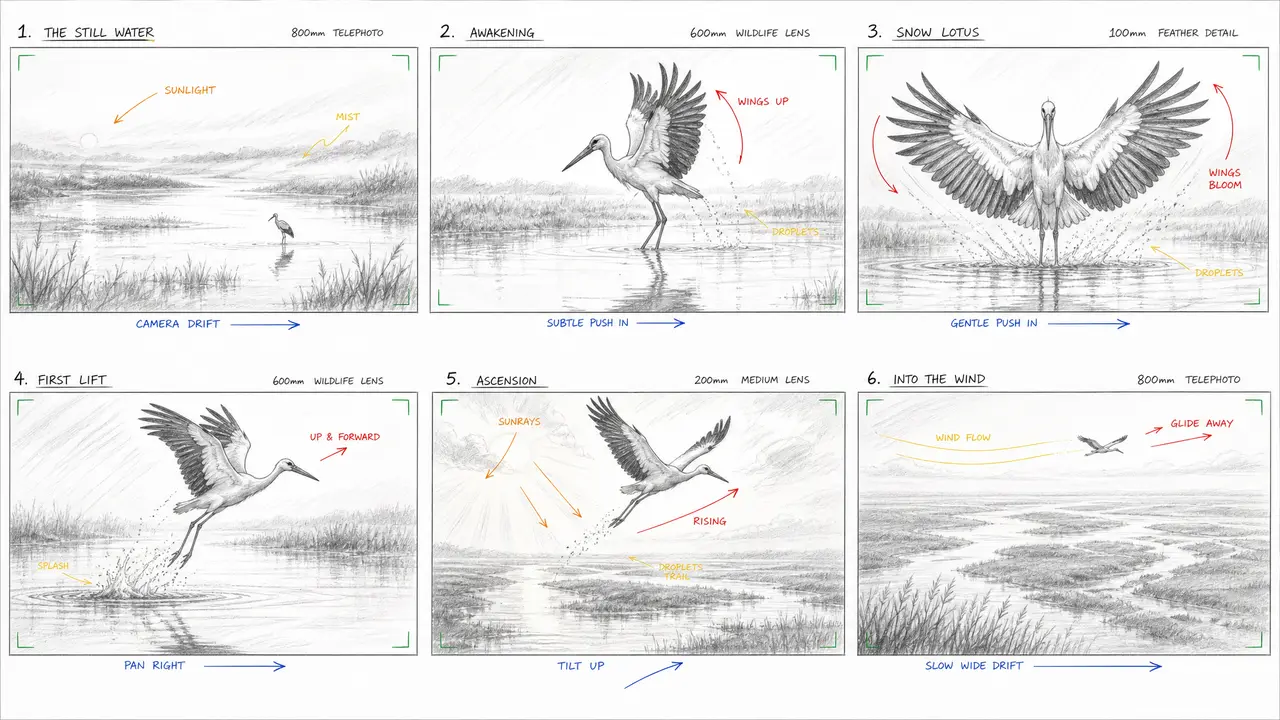 图片节点 7
16:9 storyboard sheet, 6 cinematic panels, arranged in a clean 3x2 grid. BBC Planet Earth wildlife documentary storyboard. Black and white pencil storyboard only. Rough graphite sketch lines, elegant wildlife previs style, minimal detail, strong silhouette readability. Subject: Oriental Stork taking off from a river estuary wetland. Environment: golden wetland shallow water river mouth morning mist gentle wind reeds and reflections Visual Storytelling: Panel 1 — The Still Water Extreme wide shot. A vast wetland at dawn. Golden mist drifting across the river mouth. A solitary Oriental Stork stands motionless in shallow water. The landscape dominates the frame. Theme: silence before movement. Panel 2 — Awakening Medium telephoto shot. The stork slowly raises its wings. Water droplets fall from the feathers. The reflection trembles beneath it. Theme: preparation. Panel 3 — Snow Lotus Front three-quarter shot. Both wings fully unfolding. Elegant feather layers spreading outward. The shape resembles a blooming lotus flower floating above water. Theme: blossom. Panel 4 — First Lift Wide side shot. The stork pushes against the water. Long red legs creating ripples. Water splashes outward. Theme: departure. Panel 5 — Ascension Wide cinematic shot. The bird rises above the wetland. Massive wings catching the wind. Morning light passing through feathers. The reflection remains below. Theme: freedom. Panel 6 — Into The Wind Extreme wide final shot. The Oriental Stork glides above rivers and wetlands. The bird becomes smaller and smaller. The wetland stretches endlessly below. Theme: returning to the sky. Annotation Color System: Red arrows = bird movement Blue arrows = camera movement Green marks = framing notes Orange marks = sunlight direction Yellow marks = water droplets, mist, wind flow Black handwritten lens notes Lens notes: 800mm telephoto 600mm wildlife lens 200mm medium lens 100mm feather detail lens Mood: graceful poetic peaceful elegant hopeful BBC Planet Earth III National Geographic Wildlife documentary cinematography The wetland must feel vast. The wings must feel elegant and flower-like. The bird should appear small in wide shots. Nature is the main character. No humans No fantasy No concept art board No character sheet No logos No watermark
16:9 storyboard sheet, 6 cinematic panels, arranged in a clean 3x2 grid. BBC Planet Earth / National Geographic cinematic documentary style mixed with luxury lifestyle editorial photography. Black and white pencil storyboard style only. Rough graphite sketch lines, minimal detail, strong composition clarity, cinematic previs storyboard. Subject: Female wildlife photographer living in a forest luxury tent, writing field notes and reviewing wildlife reference material. Environment: dense forest campsite, luxury expedition tent, wooden table, warm ambient light, misty forest outside, quiet natural atmosphere, soft morning or dusk lighting. Visual Storytelling: Panel 1 — Forest Arrival Extreme wide shot. Luxury tent placed inside deep forest. Mist drifting between trees. Small human presence in vast nature. Theme: arrival into wilderness. Panel 2 — Inside Tent Atmosphere Medium wide shot. Female photographer inside tent writing in journal. Warm light contrasts with cold forest outside. Calm and focused mood. Theme: observation begins. Panel 3 — Reference Study Close-up shot. Table surface with notebook, camera gear, and printed wildlife reference photo (peregrine falcon diving image). Hands analyzing notes. Theme: field research. Panel 4 — Concentration Medium close shot. Female photographer thinking while writing. Soft light on face. Depth of field isolates subject from background. Theme: intention. Panel 5 — Creative Connection Over-the-shoulder shot. Notebook sketching wildlife movement inspired by reference image. Falcon photo partially visible beside notes. Theme: translation of nature into storytelling. Panel 6 — Night Forest Reflection Extreme wide shot. Tent glowing in dark forest. Female silhouette inside working quietly. Outside forest completely dominates frame. Theme: humans are small inside nature. Annotation Color System: Red arrows = human movement Blue arrows = camera movement Green marks = composition notes Orange marks = light direction Yellow marks = atmosphere, fog, particles Lens notes: 24mm documentary wide 35mm cinematic medium 50mm close-up editorial 85mm portrait detail Mood: cinematic intimate calm elegant documentary realism BBC natural storytelling aesthetic The human should remain small compared to nature in wide shots. Focus on process of observation, writing, and documentation. No fantasy No stylization No logos No watermark No exaggerated posing
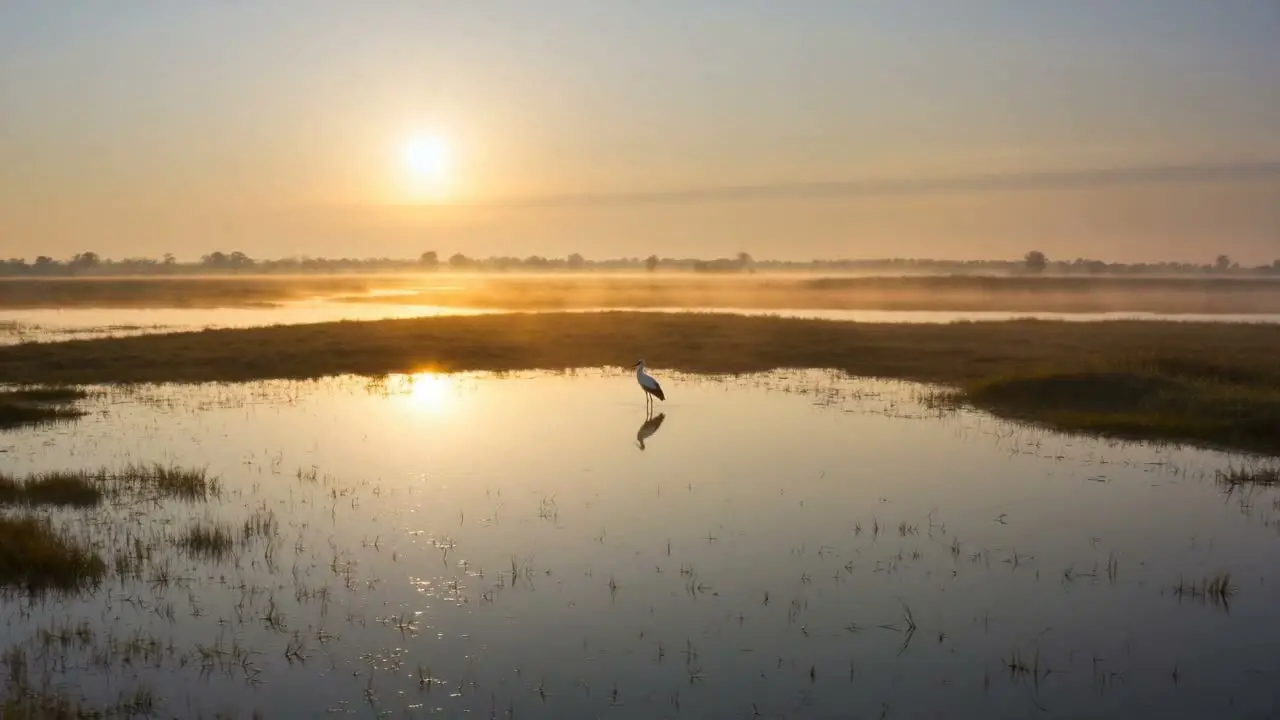 视频截图视频节点 2
正向提示词: Reference priority: The oriental stork photo is the primary visual reference for species accuracy, realism, feather texture, black wing feathers, white body, long black beak, red legs, anatomy, natural color, and real wetland lighting. The storyboard is only a shot-planning document for shot order, composition, subject placement, camera angle, lens feeling, and camera movement. Never reproduce the storyboard as a visual style. Never copy drawn lines, pencil shading, arrows, handwritten notes, labels, numbers, panel borders, white paper texture, or graphic marks. Create a 15-second ultra-realistic live-action wildlife documentary film about an oriental stork taking off from a quiet wetland at sunrise. The final video must look like actual BBC Earth / Planet Earth wildlife footage captured on location, not illustration, not animation, not CGI, not concept art. A 6-shot cinematic sequence, each shot about 2.3 to 2.5 seconds, clean cuts, following the storyboard from panel 1 to panel 6: Shot 1: long telephoto shot of a quiet wetland at sunrise, still shallow water, soft mist, reeds in the distance, one oriental stork standing small in the water, gentle camera drift, natural reflection on the water surface. Shot 2: medium telephoto wildlife shot of the oriental stork awakening and lifting its wings, droplets falling from feathers and legs, white body and black wing feathers accurate to the photo reference, subtle slow push-in, calm morning light. Shot 3: close feather-detail shot from the front as the stork spreads both wings wide, black primary feathers visible, water droplets scattering naturally, elegant symmetrical posture, realistic feather movement, no graphic marks. Shot 4: medium telephoto side shot of the stork pushing upward and forward from the water, red legs leaving the surface, a small real splash below, wings beating with natural force, camera pans right with the bird. Shot 5: medium lens shot of the stork rising above the wetland, wings extended, droplets trailing behind, warm sun rays through soft mist, natural motion blur, camera tilts up gently as the bird ascends. Shot 6: long telephoto wide shot of the stork gliding away into the wind above a vast wetland, river channels and reeds below, slow wide camera drift, the bird becoming small in the distance, quiet sunrise atmosphere. Visual style: BBC Earth natural history documentary realism, Planet Earth style, actual long-lens wildlife documentary footage, shot on ARRI Alexa 35, cinematic 2.39:1 widescreen composition, natural ARRI color science, muted natural color, filmic contrast, fine film grain, realistic lens falloff, natural motion blur, real wetland mist, real water reflections, real reeds, real feathers, imperfect organic detail, natural exposure, no stylized beauty lighting. Camera style: real 800mm and 600mm telephoto wildlife lens, real 200mm medium wildlife lens, restrained documentary camera movement, slow push-in, gentle pan right, gentle tilt up, patient observational realism, no artificial camera tricks. Mood: still, gentle, awakening, graceful, quiet, natural. 负向提示词: anime frame, cartoon, animation, illustration, painting, concept art, CGI, 3D render, game cinematic, fantasy bird, crane, heron, egret, swan, wrong species, fake feathers, plastic texture, artificial wetland, fake reeds, painterly sky, magical lighting, over-stylized sun rays, graphic water droplets, sketch, pencil drawing, line art, storyboard sheet, arrows, red arrow, blue arrow, green frame, yellow marks, handwritten text, labels, numbers, panel borders, split screen, collage, paper texture, unrealistic bird anatomy, deformed wings, extra wings, broken legs, human
换一身去航海,然后有墨镜什么的,适合航海的感觉的衣服,冲锋衣什么的
制作一个航拍动物风景大片,然后是一群参考图的这个鸟在空中飞,摄影风格参考“罗红”
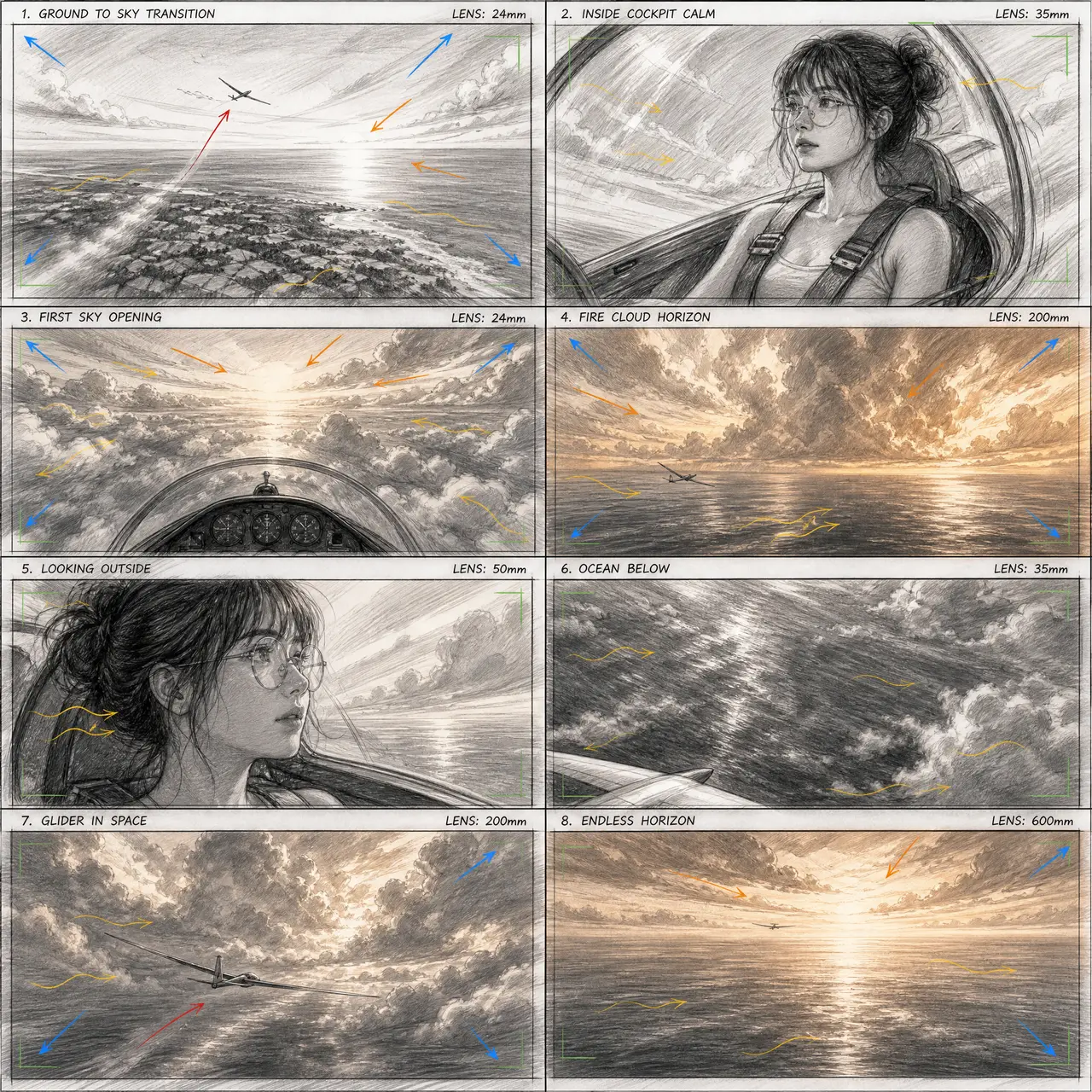 图片节点 8
16:9 storyboard sheet, 8 cinematic panels, arranged in a clean 4x2 grid. Cinematic aviation documentary style mixed with BBC Planet Earth aerial cinematography. Black and white pencil storyboard only. Rough graphite sketch lines, minimal detail, strong silhouette readability, cinematic previs storyboard style. Subject: A young female passenger inside a glider aircraft flying above ocean and clouds during sunset with dramatic fire clouds. Environment: high altitude sky, glider cockpit, golden hour clouds, fire-colored sunset clouds (burning sky effect), vast ocean below, horizon line, atmospheric perspective, wind currents. Visual Storytelling: Panel 1 — Ground to Sky Transition Extreme wide aerial shot. Glider rising above landscape. Earth receding below. Ocean beginning to appear at horizon. Theme: leaving the ground. Panel 2 — Inside Cockpit Calm Medium shot. Female passenger seated inside glider. Wind vibration visible through canopy. Face calm, eyes focused forward. Theme: silence before scale. Panel 3 — First Sky Opening Pilot perspective wide shot. Cloud layers opening ahead. Golden fire clouds forming in distance. Light flooding cockpit. Theme: entry into sky space. Panel 4 — Fire Cloud Horizon Extreme wide shot. Glider small against massive fire-colored clouds. Sky feels like burning ocean above. Ocean faintly visible below. Theme: scale of atmosphere. Panel 5 — Looking Outside Close shot from inside cockpit. Female looking out of window. Eyes reflecting clouds and ocean. Emotional stillness. Theme: observation. Panel 6 — Ocean Below POV downward shot. Vast ocean far below aircraft. Cloud shadows moving across water surface. Theme: distance from earth. Panel 7 — Glider in Space Wide cinematic shot. Glider suspended between fire clouds and ocean. Tiny human presence inside vast environment. Theme: weightless existence. Panel 8 — Endless Horizon Extreme wide final shot. Glider moving toward infinite horizon. Sunset fire clouds dominate sky. Ocean becomes mirror below. Theme: infinite world. Annotation Color System: Red arrows = aircraft movement Blue arrows = camera movement Green marks = framing notes Orange marks = sunset/fire cloud light direction Yellow marks = wind flow and atmospheric motion Lens notes: 24mm cockpit wide lens 35mm cinematic interior 50mm emotional close-up 200mm aerial compression 600mm long distance sky compression Mood: cinematic emotional vast silent awe BBC Planet Earth aerial style commercial aviation film aesthetic The glider must remain small in wide shots. The sky is the main character. The ocean is the secondary mirror world. Focus on emotional perception of scale, not action. No logos No text overlays No branding No fantasy elements
正向提示词: Reference priority: Use the character photo only as a loose reference for identity: young East Asian woman, round glasses, tied dark hair with loose bangs, slim build, gray tank top, khaki shorts, rugged outdoor boots, natural face and realistic proportions. Do not copy the studio portrait background, studio lighting, beauty retouching, fashion pose, glossy skin, or catalog model look. Do not use the storyboard as a visual style reference. The storyboard is only a text-only shot plan for shot order, composition, camera angle, lens feeling, and movement. Never reproduce storyboard pencil shading, arrows, colored marks, handwritten labels, panel borders, white paper texture, or graphic annotations. Create a 15-second raw live-action documentary sequence about a young wildlife artist-researcher arriving at a quiet forest camp, studying peregrine falcon references, and sketching by lantern light. The final video must look like real natural-history field documentary footage captured on location, not AI illustration, not anime, not CGI, not concept art, not a fashion shoot. A 6-shot sequence, each shot about 2.3 to 2.5 seconds, clean natural cuts: Shot 1: 24mm wide shot of a misty old-growth forest in the morning, a small canvas tent in the distance, the young woman standing small near the camp, diffused foggy light, slow push-in toward the tent. Shot 2: 35mm medium wide shot inside the tent, warm lantern light against cool misty forest outside, the woman sits at a wooden table writing and sketching in a real field notebook, camera gently slides right. Shot 3: 50mm close-up of the table: camera lens, metal cup, books, field notebook, printed bird reference photo, pencil moving over paper, realistic paper texture, quiet focused study, no readable fake text. Shot 4: 85mm medium close shot of the woman concentrating while drawing, round glasses, tied hair, natural skin texture, warm side light, shallow real depth of field, calm and reflective. Shot 5: 50mm over-shoulder shot of her sketchbook as she draws a peregrine falcon from reference, real hand movement, pencil on paper, practical lantern glow, intimate creative process. Shot 6: 24mm extreme wide night shot outside the tent in the dark forest, warm light glowing from inside the tent, the woman small in the scene, mist drifting between trees, slow pullback, stillness and forest atmosphere. Visual style: raw field documentary realism, BBC Earth behind-the-scenes atmosphere, real forest camp, real canvas tent, practical lantern light, natural fog, real wood table, real paper, real camera lenses, imperfect organic detail, muted natural color, natural exposure, subtle handheld micro-shake, realistic lens falloff, no glossy cinematic polish. Mood: quiet, focused, intimate, reflective, field research, creative solitude. 负向提示词: anime frame, cartoon, animation, illustration, concept art, CGI, 3D render, game cinematic, fashion shoot, beauty commercial, studio portrait, glamour lighting, glossy skin, beauty retouching, idol face, doll face, oversized eyes, perfect makeup, sexualized pose, fake forest, fake tent, plastic fabric, magical fantasy forest, glowing orbs, over-stylized color grading, storyboard sheet, full-frame pencil drawing, line art texture over the video, arrows, red arrow, blue arrow, orange arrow, green frame, yellow marks, handwritten labels, readable fake text, numbers, panel borders, split screen, collage, paper texture overlay, deformed hands, extra fingers, distorted face, broken pencil, fake camera gear, human crowd, city, horror
增加飞行员头盔什么的
16:9 storyboard sheet, 8 cinematic panels, arranged in a clean 4x2 grid. BBC Planet Earth aerial documentary style mixed with cinematic aviation film aesthetics. Black and white pencil storyboard only. Rough graphite sketch lines, minimal detail, strong silhouette readability, cinematic previs storyboard. Subject: Female pilot flying a glider aircraft over vast ocean at sunset, observing marine wildlife from the sky. Environment: high altitude sky, glider cockpit, open ocean, sunset clouds, golden hour light, aerial perspective, marine wildlife below (whales, dolphins, seabirds), atmospheric haze, horizon line. Visual Storytelling: Panel 1 — Takeoff Into Sky Extreme wide aerial shot. Glider rising above coastline or open sea. Earth falling away below. Sky begins to fill frame. Theme: departure from ground reality. Panel 2 — Entering Sunset Sky Medium wide cockpit shot. Female pilot inside glider. Warm sunset light entering canopy. Clouds turning golden and orange. Theme: transition into atmosphere. Panel 3 — First Ocean Reveal POV downward shot. Vast ocean below. Sunlight reflecting like liquid gold. Small marine life shapes barely visible. Theme: discovery of scale. Panel 4 — Wildlife Below Aerial telephoto shot. Whales / dolphins / birds visible in ocean. Glider far above them. Two ecosystems separated by altitude. Theme: observation layer. Panel 5 — Emotional Cockpit Close-Up Close-up shot. Female pilot looking outside. Face illuminated by sunset glow. Eyes reflecting ocean and sky. Theme: silent witnessing. Panel 6 — Sky Flow Movement Wide cinematic shot. Glider moving through glowing clouds. Wind currents visible in cloud shapes. Ocean far below. Theme: motion inside sky. Panel 7 — Dual World Composition Extreme wide shot. Frame split visually: top = fire sunset clouds bottom = deep blue ocean glider in center thin layer Theme: between two worlds. Panel 8 — Infinite Horizon Extreme wide final shot. Glider flying toward endless horizon. Sunset fading into deep orange and purple gradient. Ocean mirrors sky perfectly. Theme: continuation and silence. Annotation Color System: Red arrows = glider movement Blue arrows = camera movement Green marks = composition framing Orange marks = sunset light direction Yellow marks = wind currents / atmospheric flow / ocean reflections Lens notes: 24mm aerial wide cinematic 35mm cockpit interior 50mm emotional close-up 200mm wildlife compression 600mm distant ocean wildlife lens Mood: cinematic awe vast silent golden BBC Planet Earth aerial style Blue Planet ocean perspective aviation commercial film aesthetic The glider must remain small in wide shots. The sky and ocean are equal protagonists. Wildlife appears as part of a larger system, not focus objects. No logos No text overlays No fantasy No exaggeration
16:9 storyboard sheet, 6 cinematic panels, arranged in a clean 3x2 grid. BBC Planet Earth III wildlife documentary storyboard. Black and white pencil storyboard only. Rough graphite sketch lines, minimal detail, elegant wildlife previs storyboard style, strong silhouette readability. Subject: Gray whale surfacing in the open ocean. Environment: vast Pacific Ocean open sea morning sunlight ocean swells mist horizon line endless water Visual Storytelling: Panel 1 — The Ocean Extreme wide aerial shot. Endless ocean stretching to the horizon. No whale visible. Only waves, light, and sky. Theme: the living sea. Panel 2 — Presence Very wide shot. A subtle shadow appears beneath the surface. The whale barely visible through the water. A feeling rather than a sight. Theme: something ancient approaches. Panel 3 — Rising Medium wide shot. The massive whale slowly ascends from the depths. Sunbeams penetrate the water. The whale moves through shafts of light. Theme: returning from another world. Panel 4 — Breath Hero shot. The whale breaks the surface. A powerful column of mist erupts upward. Ocean spray catches the sunlight. The moment frozen in time. Theme: the breath. Panel 5 — Renewal Extreme wide shot. The mist expands into the air. Sunlight illuminates the vapor cloud. Ripples spread across the ocean surface. The sea appears to awaken. Theme: the ocean begins again. Panel 6 — Departure Extreme wide aerial shot. The whale slowly disappears beneath the surface. Only concentric ripples remain. The ocean becomes calm once more. Theme: eternity. Annotation Color System: Red arrows = whale movement Blue arrows = camera movement Green marks = framing notes Orange marks = sunlight direction Yellow marks = mist, spray, water particles Black handwritten lens notes Lens notes: 1200mm telephoto 800mm wildlife lens 400mm aerial tracking lens 100mm water detail lens Mood: ancient peaceful majestic timeless spiritual BBC Planet Earth III Blue Planet II National Geographic Wildlife documentary cinematography The whale should remain small in most panels. The ocean must feel overwhelmingly vast. The breath is the emotional climax. Nature is the main character. No boats No humans No fantasy No concept art board No character sheet No logos No watermark
16:9 storyboard sheet, 6 cinematic panels, arranged in a clean 3x2 grid. BBC Planet Earth III / Frozen Planet II wildlife documentary storyboard style. Black and white pencil storyboard only. Rough graphite sketch lines, minimal detail, strong silhouette readability, cinematic wildlife previs storyboard. Subject: Adélie penguins in Antarctica interacting with extreme cold environment, snow, ice, and ocean edge. Environment: Antarctic ice shelves, frozen sea, snowstorm wind, drifting ice particles, vast white landscape, dark ocean contrast, extreme cold silence. Visual Storytelling: Panel 1 — The White World Extreme aerial wide shot. Endless Antarctic ice stretching to horizon. No animals visible. Only wind patterns and snow textures. Theme: emptiness as scale. Panel 2 — Arrival of Life Very wide shot. Small group of penguins appear on ice surface. They are tiny compared to vast environment. Wind pushes snow across frame. Theme: life inside extreme. Panel 3 — Movement on Ice Medium shot. Penguins walking across frozen surface. Waddling motion. Snow blowing sideways. Ocean visible in distance. Theme: survival movement. Panel 4 — Ocean Edge Decision Wide cinematic shot. Penguins standing at edge of ice shelf. Dark ocean below contrasts with white ice. Wind intensifies. Theme: threshold. Panel 5 — Dive Into Water Underwater transition shot. Penguin entering icy ocean. Bubbles and ice fragments. Light from surface breaks into shards. Theme: entry into another world. Panel 6 — Underwater Silence Extreme wide underwater shot. Penguins swimming in deep cold blue. Light rays from ice above. Tiny silhouettes in vast ocean. Theme: continuation of life. Annotation Color System: Red arrows = penguin movement Blue arrows = camera movement Green marks = framing and composition Orange marks = wind/light direction Yellow marks = snow particles, ice fragments, water bubbles Lens notes: drone aerial 8K wide 24mm extreme landscape 35mm wildlife tracking 50mm medium shot 100mm underwater detail Mood: cold vast silent minimal survival BBC Frozen Planet II Planet Earth III The penguins must remain small in wide shots. The Antarctic landscape is the main character. Wind is an invisible dominant force. No humans No ships No fantasy No logos No watermark
以输入图片作为首帧,严格保持原图构图、鸟群数量、鸟的位置关系、湿地空间层次和夕阳色彩不变。BBC Earth 自然纪录片实拍质感,ARRI Alexa 65,超长焦镜头,远距离三脚架固定拍摄,真实高动态范围,细腻胶片色彩,长焦压缩空间,空气透视真实。不要改变构图,不要新增鸟,不要减少鸟,不要改变鸟的位置关系,不要夸张飞行,不要所有鸟同步扇翅,不要快速穿梭,不要镜头推进,不要航拍感,不要CG感,不要卡通感,不要翅膀变形,不要多余翅膀,不要身体融化,不要闪烁,不要文字,不要水印。 镜头几乎固定,不做推进,不做大幅运镜,只保留极轻微的自然镜头呼吸感。重点表现鸟群真实飞行行为:白色水鸟展开翅膀滑翔,部分鸟轻轻扇动翅膀,动作不同步,有的微微转向,有的顺着气流上升,有的低空掠过水面,前景鸟保持真实重量感和翼尖细节。飞行动作优雅、克制、自然,像纪录片摄影师等待很久后捕捉到的珍贵迁徙瞬间。 夕阳云层缓慢流动,水面倒影轻微闪烁,芦苇和湿地草丛被风轻轻吹动,远处山体保持稳定。整体安静、宏大、真实,像 BBC 或 National Geographic 高端自然纪录片素材。
潜水面罩改白色
正向提示词: Reference priority: The gray whale photo is the primary visual reference for species accuracy, realism, whale anatomy, mottled gray skin, barnacle marks, body proportions, underwater texture, natural color, and real ocean lighting. The storyboard is only a shot-planning document for shot order, composition, subject placement, camera angle, lens feeling, and camera movement. Never reproduce the storyboard as a visual style. Never copy drawn lines, pencil shading, arrows, handwritten notes, labels, numbers, panel borders, white paper texture, or graphic marks. Create a 15-second ultra-realistic live-action wildlife documentary film about a gray whale rising from the ocean, breathing, and disappearing back into the sea. The final video must look like actual BBC Earth / Blue Planet wildlife footage captured on location, not illustration, not animation, not CGI, not concept art. A 6-shot cinematic sequence, each shot about 2.3 to 2.5 seconds, clean cuts, following the storyboard from panel 1 to panel 6: Shot 1: aerial wide shot over a vast open ocean at low sun, natural silver reflection across living water, slow camera drift, rolling waves, soft clouds, quiet immense scale. Shot 2: long telephoto wildlife shot from above the ocean surface, a subtle gray whale shape moving just beneath the water, barely visible through real waves and glare, something ancient approaching, restrained documentary tension. Shot 3: underwater wildlife shot of a gray whale rising slowly toward the surface through blue-green ocean water, sun rays filtering naturally from above, suspended particles, realistic mottled gray skin and barnacle marks accurate to the photo reference. Shot 4: long telephoto surface shot of the gray whale breaking the surface to breathe, blowhole exhaling a powerful misty spout, real spray and droplets, dark rolling ocean around the whale, natural light and motion. Shot 5: aerial shot looking down at the disturbed ocean surface after the breath, expanding ripples, white foam, swirling water, soft sunlight on waves, the whale beginning to sink below. Shot 6: aerial wide final shot of open ocean after the whale has disappeared, only a circular ripple and faint underwater shadow remain, slow camera drift, quiet horizon, vast water and silence. Visual style: BBC Earth natural history documentary realism, Blue Planet style, actual marine wildlife documentary footage, shot on ARRI Alexa 35, cinematic 2.39:1 widescreen composition, natural ARRI color science, muted natural color, filmic contrast, fine film grain, realistic lens falloff, natural motion blur, high dynamic range, real ocean surface, real underwater haze, real suspended particles, real whale skin texture, imperfect organic detail, natural exposure, no stylized beauty lighting. Camera style: real aerial drone or helicopter ocean cinematography, real 800mm and 1200mm telephoto wildlife lens for surface shots, real underwater camera for the rising whale shot, restrained documentary camera movement, slow drift, patient observational realism, no artificial camera tricks. Mood: ancient, quiet, immense, breath, renewal, eternity. 负向提示词: anime frame, cartoon, animation, illustration, painting, concept art, CGI, 3D render, game cinematic, fantasy whale, humpback whale, blue whale, dolphin, wrong species, fake whale skin, plastic texture, artificial ocean, fake waves, fake foam, painterly clouds, magical lighting, over-stylized sun rays, graphic water spray, graphic ripples, sketch, pencil drawing, line art, storyboard sheet, arrows, red arrow, blue arrow, green frame, yellow marks, handwritten text, labels, numbers, panel borders, split screen, collage, paper texture, unrealistic whale anatomy, deformed fins, extra fins, human, boat, submarine
正向提示词: Reference priority: Use only the gray whale photo as the visual image reference. The photo controls species accuracy, whale anatomy, mottled gray skin, barnacle marks, body proportions, underwater texture, natural color, and real ocean lighting. Do not use any storyboard sheet as a visual reference. The shot plan below is text-only direction for editing, composition, camera angle, lens feeling, and movement. No visible annotation marks of any kind may appear in the final video. Create a 15-second ultra-realistic live-action marine wildlife documentary film about a gray whale rising from the ocean, breathing, and disappearing back into the sea. The final video must look like actual BBC Earth / Blue Planet wildlife footage captured on location with real cameras, real ocean water, real whale skin, real spray, real optical blur, and natural exposure. It must not look illustrated, animated, graphic, painted, or CGI. A 6-shot cinematic sequence, each shot about 2.3 to 2.5 seconds, clean cuts: Shot 1: aerial wide shot over a vast open ocean at low sun, natural silver reflection across rolling waves, soft clouds, quiet immense scale, slow camera drift. Shot 2: long telephoto wildlife shot from above the ocean surface, a subtle gray whale shape moving just beneath the water, barely visible through real waves and glare, restrained documentary tension. Shot 3: underwater wildlife shot of a gray whale rising slowly toward the surface through blue-green ocean water, realistic sun rays diffused through water, suspended particles, mottled gray skin and barnacle marks accurate to the photo reference. Shot 4: long telephoto surface shot of the gray whale breaking the surface to breathe, blowhole exhaling a powerful natural misty spout, real spray and droplets, dark rolling ocean around the whale. Shot 5: aerial shot looking down at the disturbed ocean surface after the breath, expanding natural ripples, white foam, swirling water, soft sunlight on waves, the whale sinking below. Shot 6: aerial wide final shot of open ocean after the whale has disappeared, only circular ripples and a faint underwater shadow remain, slow camera drift, quiet horizon, vast water and silence. Visual style: BBC Earth natural history documentary realism, Blue Planet style, actual marine wildlife documentary footage, ARRI Alexa 35, cinematic 2.39:1 widescreen, natural ARRI color science, muted natural color, filmic contrast, fine film grain, realistic lens falloff, natural motion blur, high dynamic range, real ocean surface, real underwater haze, real suspended particles, real whale skin texture, imperfect organic detail, natural exposure, no stylized beauty lighting. Camera style: real aerial drone or helicopter ocean cinematography, real 800mm and 1200mm telephoto wildlife lens for surface shots, real underwater camera for the rising whale shot, restrained documentary camera movement, slow drift, patient observational realism, no artificial camera tricks. Mood: ancient, quiet, immense, breath, renewal, eternity. 负向提示词: annotation marks, colored arrows, yellow arrows, blue arrows, green arrows, red arrows, arrow symbols, graphic arrows, direction arrows, storyboard marks, circled numbers, handwritten notes, labels, text, numbers, panel borders, white paper texture, pencil shading, sketch texture, line art, storyboard sheet, split screen, collage, anime frame, cartoon, animation, illustration, painting, concept art, CGI, 3D render, game cinematic, fantasy whale, humpback whale, blue whale, dolphin, wrong species, fake whale skin, plastic texture, artificial ocean, fake waves, fake foam, painterly clouds, magical lighting, over-stylized sun rays, graphic water spray, graphic ripples, unrealistic whale anatomy, deformed fins, extra fins, human, boat, submarine
正向提示词: Reference priority: Use the diver character photo only as a loose reference for identity and equipment: young East Asian female diver, black diving mask, regulator, tied dark hair, white and gray wetsuit, scuba tank, hoses, fins, underwater camera operator. Do not copy the studio portrait background, studio lighting, fashion pose, glossy skin, beauty retouching, or catalog model look. Do not use the storyboard as a visual style reference. The shot plan below is text-only direction for composition, camera angle, lens feeling, and movement. No drawn marks, arrows, text, borders, pencil lines, sketch textures, or storyboard graphics may appear. Create a 15-second raw live-action underwater nature documentary sequence about a female diver filming coral reef life in clear shallow tropical water. The final video must look like real underwater documentary footage captured on location with an underwater cinema camera, not AI illustration, not anime, not CGI, not a fashion shoot, not a commercial. A 9-shot sequence, each shot about 1.5 to 1.7 seconds, clean natural cuts: Shot 1: wide underwater establishing shot, the female diver enters clear shallow water above a coral reef, real sunlight filtering through the water surface, suspended particles, reef texture, slow natural drift. Shot 2: medium wide underwater shot of the diver approaching healthy coral, holding a real underwater camera housing with both hands, bubbles rising from the regulator, fish moving naturally around the reef. Shot 3: medium close-up of the diver concentrating through the diving mask while filming, underwater camera housing in foreground, natural refraction, tiny bubbles, realistic mask and regulator details, no beauty pose. Shot 4: close-up of real coral texture, soft natural underwater light, small reef fish moving between coral branches, tactile organic detail, no stylized colors. Shot 5: wide shot of seagrass and reef current movement, the diver in the background filming slowly, real water motion, drifting particles, muted tropical color, natural lens distortion. Shot 6: low-angle underwater shot of the diver swimming forward with calm body posture, fins moving slowly, camera tilted upward slightly, sunlit water above, practical documentary movement. Shot 7: wide shot of the diver filming beside a school of small fish, fish moving as a natural group, coral reef below, real bubbles and subtle current, respectful wildlife distance. Shot 8: wide underwater shot of the diver suspended in sunbeams and water particles, natural caustic light from the surface, realistic exposure, no magical rays, quiet floating movement. Shot 9: wide shot from behind as the diver slowly ascends away from the reef, bubbles rising, coral below, camera follows gently upward, serene natural ending. Visual style: raw BBC Earth / Blue Planet underwater documentary realism, actual underwater wildlife footage, natural underwater color, real optical distortion, real suspended particles, real bubbles, real coral texture, real fish movement, imperfect organic detail, natural exposure, muted color correction, realistic underwater haze, no glossy cinematic polish, no stylized beauty lighting. Camera style: real underwater cinema camera, 18mm wide underwater lens, 28mm medium wide lens, 50mm medium close-up, 100mm coral detail lens, restrained documentary camera movement, slow drift, gentle push-in, pan right, tilt up, patient observational realism. Mood: serene, elegant, quiet, free, natural, respectful. 负向提示词: anime frame, cartoon, animation, illustration, concept art, CGI, 3D render, game cinematic, fantasy underwater world, mermaid, fashion shoot, swimwear commercial, glamour lighting, studio portrait, beauty retouching, glossy skin, idol face, doll face, oversized eyes, perfect makeup, sexualized pose, bikini, lingerie, nude, fake coral, plastic coral, fake fish, artificial water, magical light rays, over-saturated colors, neon reef, graphic bubbles, storyboard sheet, sketch, pencil drawing, line art, drawn lines, pencil shading, arrows, red arrow, blue arrow, green frame, yellow marks, handwritten text, Chinese text, labels, numbers, panel borders, split screen, collage, paper texture, deformed hands, extra fingers, broken camera, broken regulator, distorted mask, extra fins, extra legs, missing legs, human crowd, boat, submarine, horror
正向提示词: Reference priority: Use the pilot character photo only as a loose reference for identity and gear: young East Asian female pilot, round glasses, dark hair with bangs, green flight suit, flight helmet, oxygen mask, harness straps, rugged boots, realistic proportions. Do not copy the studio portrait background, studio lighting, beauty retouching, fashion pose, glossy skin, or catalog model look. Do not use the storyboard as a visual style reference. The storyboard is only a text-only shot plan for shot order, composition, camera angle, lens feeling, and movement. Never reproduce storyboard pencil shading, arrows, colored marks, handwritten labels, panel borders, white paper texture, or graphic annotations. Create a 15-second realistic live-action aviation documentary sequence about a young female glider pilot flying above a calm ocean at sunset. The final video should look like real aerial documentary footage captured on location, with natural sunset light, real ocean texture, practical cockpit details, subtle aircraft vibration, imperfect exposure, and restrained documentary pacing. An 8-shot sequence, each shot about 1.8 to 2 seconds, clean natural cuts: Shot 1: 24mm wide aerial shot behind a small glider flying over a vast coastline and open ocean at sunset, calm water, distant islands, natural haze, slow steady camera drift. Shot 2: 35mm cockpit close shot of the female pilot inside the glider canopy, helmet and oxygen mask on, round glasses visible, warm sunset light on her face, real cockpit reflections, focused expression, no glamour pose. Shot 3: 35mm over-wing shot from the glider looking down at the ocean surface, sunlight reflecting on waves, subtle aircraft vibration, natural wind movement, realistic wing edge in foreground. Shot 4: 200mm telephoto aerial shot of the glider banking gently above the ocean while a few distant seabirds pass below, real scale, natural sky, no dramatic stunt flying. Shot 5: 50mm close profile shot of the pilot watching the horizon through the canopy, helmet visor and oxygen mask details, sunset reflections on glass, calm concentration, realistic skin texture. Shot 6: 24mm wide aerial shot of the glider passing through layered clouds, soft natural turbulence, changing light, ocean glimpsed below, restrained documentary camera movement. Shot 7: 24mm front distant shot of the glider flying toward the sunset line over the sea, horizon centered, warm light breaking through clouds, ocean texture below, steady natural framing. Shot 8: 24mm final wide shot of the glider becoming small above the reflective ocean at sunset, quiet sky, soft clouds, long calm ending. Visual style: raw aviation documentary realism, real aerial footage, natural sunset color, practical cockpit glass reflections, real ocean surface, real cloud texture, subtle camera vibration, natural motion blur, muted color correction, imperfect organic detail, no glossy commercial polish, no fantasy lighting. Camera style: real aerial chase camera, cockpit-mounted documentary camera, over-wing camera, 24mm wide lens, 35mm cockpit lens, 50mm close profile lens, 200mm telephoto aerial lens, restrained observational movement. Mood: calm, focused, expansive, weightless, solitary, sunset flight. 负向提示词: cartoon, animation, illustration, concept art, 3D render, game cinematic, fantasy aircraft, fighter jet, military combat, explosion, weapon, crash, emergency, stunt flying, fake ocean, fake clouds, plastic cockpit, glossy commercial look, beauty retouching, fashion shoot, idol face, doll face, oversized eyes, perfect makeup, storyboard sheet, sketch, pencil drawing, line art, pencil shading, arrows, colored arrows, green frame, handwritten text, labels, numbers, panel borders, split screen, collage, paper texture, deformed hands, distorted face, broken cockpit, extra aircraft parts, human crowd, city, horror
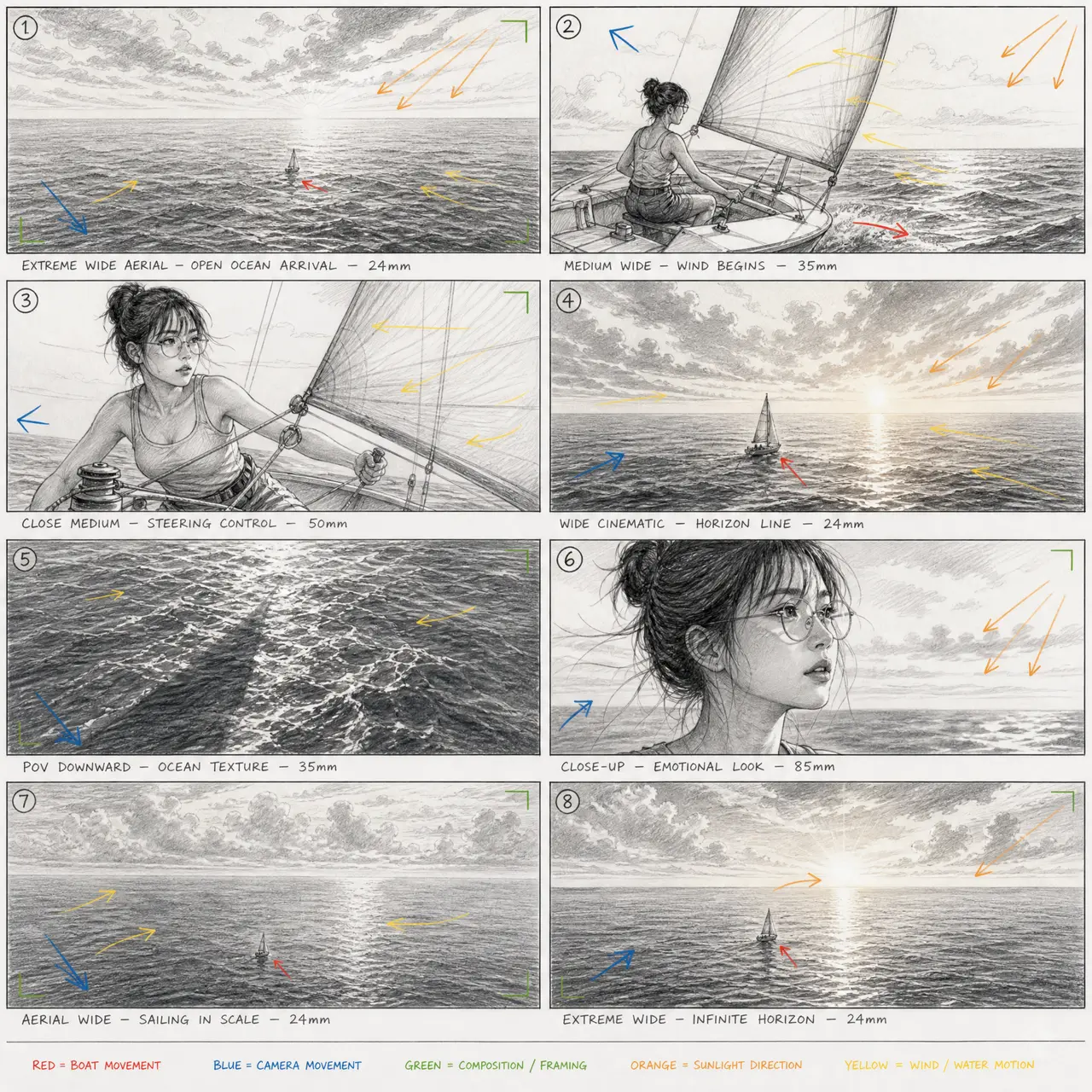 图片节点 10
16:9 storyboard sheet, 8 cinematic panels, arranged in a clean 4x2 grid. BBC Planet Earth / Blue Planet cinematic aerial documentary style mixed with high-end sailing commercial film aesthetic. Black and white pencil storyboard only. Rough graphite sketch lines, minimal detail, strong silhouette readability, cinematic previs storyboard. Subject: Young female sailing a small sailboat alone in open ocean. Environment: vast open sea, deep blue water, horizon line, wind-driven waves, golden sunlight, clouds, open sky, atmospheric perspective, sailing wind system. Visual Storytelling: Panel 1 — Open Ocean Arrival Extreme wide aerial shot. Endless ocean stretching to horizon. A tiny sailboat appears in the distance. Sky dominates the frame. Theme: scale of isolation. Panel 2 — Wind Begins Medium wide shot. Sail fills with wind. Boat tilts slightly. Female sailor adjusting direction. Theme: interaction with wind. Panel 3 — Steering Control Close medium shot. Hands on sail control rope / wheel. Focused expression. Wind pressure visible through sail tension. Theme: control in uncertainty. Panel 4 — Horizon Line Wide cinematic shot. Boat moving toward glowing horizon. Sunlight reflecting on water surface. Clouds forming soft golden gradient. Theme: direction. Panel 5 — Ocean Texture POV downward shot. Water surface details. Wave patterns, light reflections. Boat shadow moving across sea. Theme: flow. Panel 6 — Emotional Look Close-up shot. Female looking toward horizon. Wind blowing hair slightly. Eyes reflecting ocean and sky. Theme: solitude. Panel 7 — Sailing in Scale Aerial wide shot. Boat extremely small in massive ocean. Sky and sea nearly equal in frame. Theme: human vs nature scale. Panel 8 — Infinite Horizon Extreme wide final shot. Boat moving into distant horizon. Sunset light fading. Ocean becomes endless mirror. Theme: continuation. Annotation Color System: Red arrows = boat movement Blue arrows = camera movement Green marks = composition framing Orange marks = sunlight direction Yellow marks = wind and water motion Lens notes: 24mm aerial ocean wide 35mm sailing medium shot 50mm emotional portrait 85mm close-up detail 200mm telephoto compression Mood: cinematic minimal vast calm freedom BBC Blue Planet style luxury sailing commercial aesthetic The sailboat must remain small in wide shots. The ocean and sky are the main characters. Focus on wind as an invisible force shaping movement. No logos No text overlays No fantasy elements No exaggerated posing
16:9 storyboard sheet, 8 cinematic panels, arranged in a clean 4x2 grid. BBC Planet Earth III / National Geographic desert wildlife documentary storyboard style. Black and white pencil storyboard only. Rough graphite sketch lines, minimal detail, strong silhouette readability, cinematic previs storyboard. Subject: Wild Bactrian camels and desert ecosystem life in the Sahara desert under extreme heat conditions. Environment: Sahara desert, golden sand dunes, heat haze waves, dry wind, rocky terrain, scattered vegetation, extreme sunlight, harsh atmospheric distortion. Visual Storytelling: Panel 1 — Extreme Desert Scale Extreme aerial wide shot. Endless Sahara dunes stretching to horizon. Heat waves distort landscape. Tiny camels moving in distance. Theme: scale of survival. Panel 2 — Camel Movement in Heat Wide telephoto shot. Wild camels walking through sand and heat haze. Bodies partially distorted by shimmering air. Dust rises with each step. Theme: endurance. Panel 3 — Eye of Camel (Emotional Close-Up) Extreme close-up. Camel eye fills frame. Reflection of desert heat waves inside pupil. Dust particles around eyelashes. Theme: silent awareness. Panel 4 — Human Observer Detail Shot Close-up shot. Female field photographer in desert gear. Sweat forming on face. Focus intense, observing wildlife. Theme: documentation under pressure. Panel 5 — Sweat Macro Detail Extreme macro close-up. Sweat drops on skin surface. Sunlight refracting through sweat beads. Heat shimmer visible in background. Theme: body response to environment. Panel 6 — Desert Lizard Macro Shot Extreme close-up. Small desert lizard on sand surface. Sand grains moving with wind. Heat distortion around body. Theme: micro survival. Panel 7 — Animal Interaction Scale Shot Wide cinematic shot. Camels far in background. Lizard in foreground. Multiple life scales coexisting in same desert system. Theme: ecosystem hierarchy. Panel 8 — Infinite Desert Silence Extreme wide aerial final shot. Sahara dunes under blazing sun. All life becomes tiny or disappears into heat haze. Only wind and sand remain visible. Theme: endless survival field. Annotation Color System: Red arrows = animal movement Blue arrows = camera movement (aerial / handheld / macro) Green marks = framing and composition notes Orange marks = sunlight and heat direction Yellow marks = sand, dust, heat haze, biological detail Lens notes: drone aerial 8K cinematic 24mm extreme landscape 70-200mm wildlife compression 100mm macro sweat detail 200mm long lens eye detail Mood: harsh minimal cinematic documentary realism survival BBC Planet Earth III National Geographic desert cinematography The desert must dominate all wide shots. Human and animals are small within scale hierarchy. Heat haze is an active visual character. No fantasy No stylization No logos No watermark
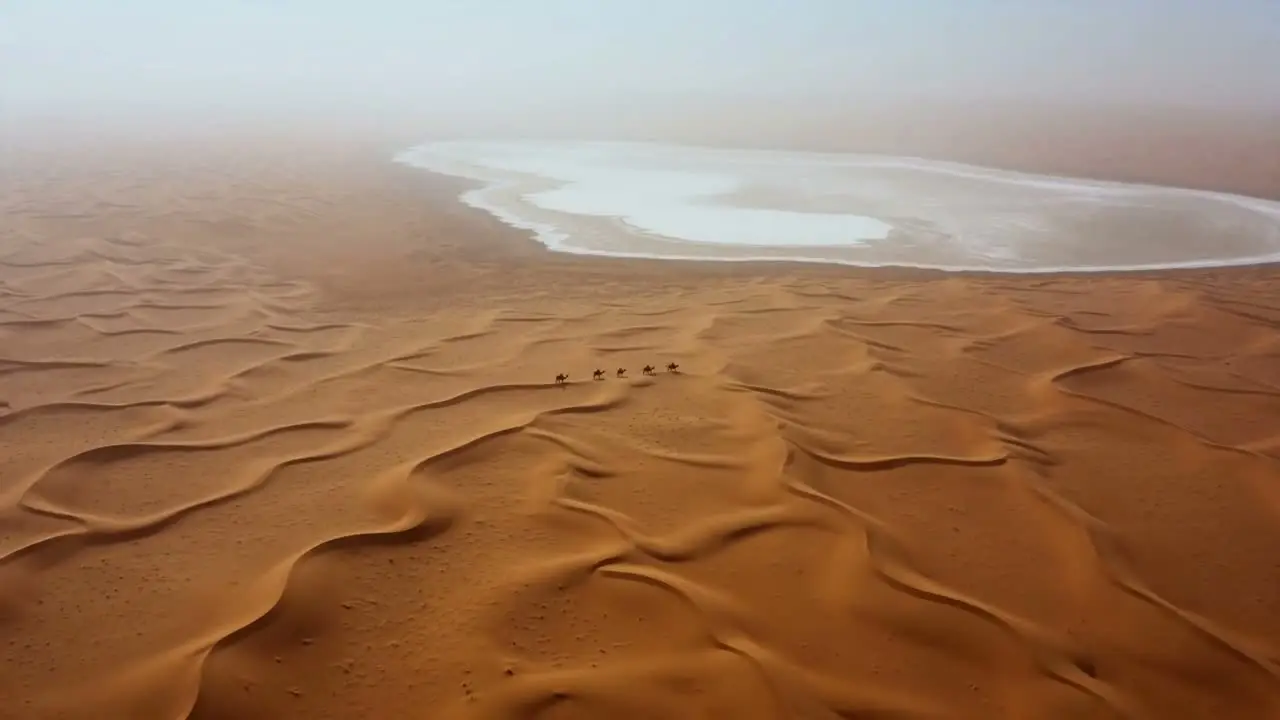 视频截图视频节点 18
正向提示词: Reference priority: Use the character photo only as a loose reference for identity: young East Asian woman, round glasses, tied dark hair with loose bangs, slim build, gray tank top, khaki shorts, rugged outdoor boots, natural face and realistic proportions. Do not copy the studio portrait background, studio lighting, beauty retouching, fashion pose, glossy skin, or catalog model look. Do not use the storyboard as a visual style reference. The storyboard is only a text-only shot plan for shot order, composition, camera angle, lens feeling, and movement. Never reproduce storyboard pencil shading, arrows, colored marks, handwritten labels, panel borders, white paper texture, or graphic annotations. Create a 15-second realistic live-action nature documentary sequence about a young field observer documenting wild Bactrian camels and small desert life in an endless hot desert. The final video should look like real desert documentary footage captured on location, with natural heat haze, real sand, dry wind, muted desert color, practical camera work, imperfect exposure, and restrained observational pacing. An 8-shot sequence, each shot about 1.8 to 2 seconds, clean natural cuts: Shot 1: extreme wide aerial shot of endless Sahara-like dunes and salt flats, tiny wild Bactrian camels far below, heat waves distorting the horizon, vast empty scale, slow aerial glide forward. Shot 2: 70-200mm telephoto shot of wild Bactrian camels moving through extreme heat, two humps, dusty shaggy coats, every step raising dry sand, static frame with subtle heat distortion. Shot 3: 200mm macro extreme close-up of a camel eye, dusty lashes, rough fur, desert landscape reflected in the eye, silent endurance, slow push-in, natural texture. Shot 4: 85mm close shot of the young field observer holding a camera in the desert, sweat and dust on her face, round glasses, cap, focused expression, handheld slight drift, no beauty pose. Shot 5: 100mm macro detail of sweat beads on human skin responding to extreme heat and dryness, realistic texture, shallow depth of field, micro focus shift, no glamour styling. Shot 6: 100mm macro shot of a small desert lizard on sand and pebbles, tiny scales, alert eye, wind moving sand grains, static natural frame, small life adapting to heat. Shot 7: 24-70mm environmental wide shot with the lizard in foreground and wild Bactrian camels crossing far behind, heat haze between them, one desert ecosystem, slow pan right. Shot 8: extreme wide aerial final shot of infinite desert dunes under blazing sun, camels disappearing into heat haze, no clear path, only wind, sand, scale, and silence. Visual style: raw nature documentary realism, real desert wildlife footage, natural color, realistic heat haze, dry dust, sand texture, rugged animal fur, natural skin texture, imperfect organic detail, natural motion blur, subtle camera vibration, no glossy commercial polish, no fantasy lighting. Camera style: real drone aerial footage, 70-200mm telephoto wildlife lens, 200mm macro eye detail, 100mm macro texture shots, 85mm documentary portrait lens, restrained observational camera movement, slow aerial glide, subtle handheld drift, slow pan right. Mood: endless, harsh, quiet, beautiful, survival, observation. 负向提示词: cartoon, animation, illustration, concept art, 3D render, game cinematic, fantasy desert, fake camel, one-humped camel, wrong animal, plastic fur, fake dust, fake sand, fake desert, perfect postcard landscape, glossy commercial look, beauty retouching, fashion shoot, idol face, doll face, oversized eyes, perfect makeup, over-stylized color grading, magical sunlight, painterly sky, storyboard sheet, sketch, pencil drawing, line art, pencil shading, arrows, colored arrows, green frame, handwritten text, labels, numbers, panel borders, split screen, collage, paper texture, deformed camel, extra legs, broken humps, unrealistic anatomy, fake lizard, deformed hands, distorted face, vehicle, road, city, tent
16:9 storyboard sheet, 4 cinematic panels, arranged in a clean 2x2 grid. BBC Planet Earth III style mixed with high-end aerial wildlife documentary and commercial cinematic tone. Black and white pencil storyboard only. Rough graphite sketch lines, minimal detail, strong silhouette readability, clean cinematic previs storyboard. Subject: Female scuba diver performing a back-roll entry from a boat into open ocean under bright blue sky and white clouds. Environment: bright blue sky, soft white clouds, calm ocean, reflective water surface, boat deck, sunlight reflections, airy atmosphere. Visual Storytelling: Panel 1 — Blue Sky Preparation Medium wide shot. Female diver sitting on boat edge. Bright blue sky and soft white clouds dominate background. Clean, airy, peaceful atmosphere. Final breath before dive. Theme: lightness before action. Panel 2 — Back Roll Entry Side cinematic shot. Diver rolls backward from boat into ocean. Sky reflected on water surface. Motion is smooth and controlled. Theme: transition between sky and sea. Panel 3 — Surface Break Waterline shot. Impact into water with clean splash. Blue sky fragments through rippling surface. Sunlight reflections scatter. Theme: boundary between sky and water. Panel 4 — Underwater Descent Underwater wide shot. Diver slowly descending into deep blue. Bubbles rising toward bright surface. Sky visible above as distorted light. Theme: immersion into silence. Lens notes: 24mm wide cinematic underwater 35mm action documentary lens 50mm medium shot 100mm detail macro Mood: bright clean cinematic fresh aerial feeling BBC Blue Planet II Planet Earth III The sky must feel dominant in above-water shots. The ocean must reflect the sky like a mirror. Human remains small in frame. No fantasy No stylization No logos No watermark No heavy darkness
16:9 storyboard sheet, 6 cinematic panels, arranged in a clean 3x2 grid. BBC Planet Earth wildlife documentary storyboard. Black and white pencil storyboard style only. Rough graphite sketch lines, minimal detail, strong silhouette readability, cinematic wildlife previs storyboard. Subject: Black-necked crane walking through a frozen high-altitude wetland. Environment: northern plateau wetlands, frozen marshland, icy grass, shallow water under ice, cold wind, snow dust, distant mountains, extreme silence. Visual Storytelling: Panel 1 — The Frozen World Extreme wide aerial shot. A vast frozen wetland stretches to the horizon. Ice and grass mix together. No movement visible. The crane is a tiny shape in the distance. Theme: stillness. Panel 2 — Entry Medium wide shot. The black-necked crane steps into the frozen marsh. Thin ice cracks underfoot. Cold wind moves across the surface. Theme: crossing into silence. Panel 3 — Frozen Touch Close-up. The crane’s foot touches ice-covered water. Tiny fractures spread beneath the surface. Hidden water glows faintly under ice. Theme: contact between water and time. Panel 4 — Movement Medium shot. The crane slowly walks forward. Body upright. Elegant balance. Feathers slightly lifted by wind. Theme: life moving through frozen space. Panel 5 — Wing Memory Wide cinematic shot. The crane opens its wings slightly. Wind passes through feathers. A faint sense of motion like remembering flight. Theme: memory of the sky. Panel 6 — Awakening Sky Extreme wide final shot. The crane stands in the frozen wetland. One subtle wing movement. Light breaks through clouds. The frozen landscape feels briefly alive. Theme: sky reappearing inside water. Annotation Color System: Red arrows = crane movement Blue arrows = camera movement Green marks = framing notes Orange marks = light direction Yellow marks = ice, wind, water, atmospheric particles Black handwritten lens notes Lens notes: 800mm telephoto 600mm wildlife lens 200mm medium shot 100mm macro detail Mood: silent cold elegant poetic spiritual BBC Planet Earth III Frozen Planet II National Geographic wildlife cinematography The crane should remain small in wide shots. The wetland must feel vast and ancient. Nature is the main character. No humans No fantasy No concept art board No character sheet No logos No watermark
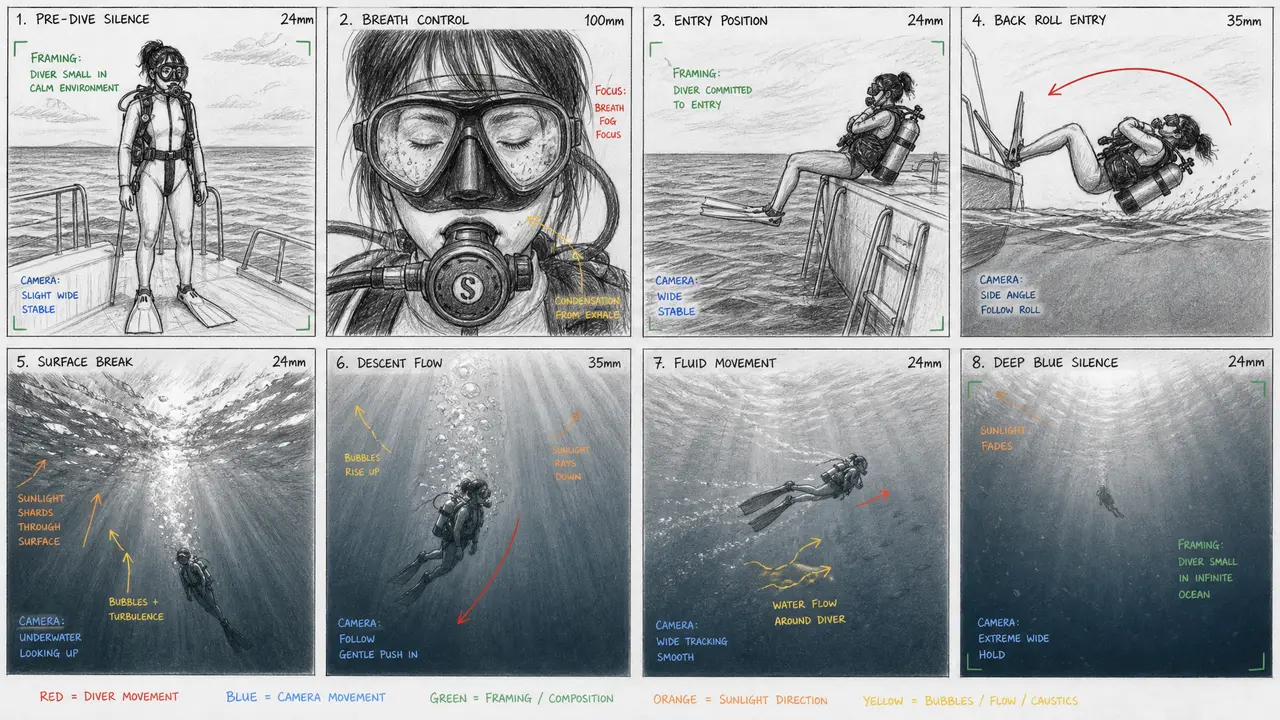 图片节点 14
16:9 storyboard sheet, 8 cinematic panels, arranged in a clean 4x2 grid. BBC Planet Earth III / Blue Planet II underwater documentary storyboard style. Black and white pencil storyboard only. Rough graphite sketch lines, minimal detail, strong silhouette readability, cinematic underwater previs storyboard. Subject: Female scuba diver performing a controlled back-roll entry from boat into open ocean, then descending into underwater environment. Environment: boat deck, ocean surface, waterline transition, underwater blue environment, sunlight caustics, bubbles, drifting particles, deep sea gradient light. Visual Storytelling: Panel 1 — Pre-Dive Silence Medium wide shot. Female diver standing on boat deck. Fully equipped scuba gear. Ocean is calm. Wind is minimal. Theme: anticipation. Panel 2 — Breath Control Close-up. Mask fogging slightly from breath. Regulator in mouth. Subtle inhale/exhale rhythm visualized through condensation and tension. Theme: focus and breath. Panel 3 — Entry Position Wide shot. Diver sitting on boat edge in back-roll position. Body aligned and controlled. Ocean fills the background. Theme: commitment to entry. Panel 4 — Back Roll Entry Side cinematic shot. Diver rolls backward into water in smooth arc. Water surface tension visible. No splash exaggeration, only controlled motion. Theme: transition between worlds. Panel 5 — Surface Break Underwater surface angle shot. Waterline fractures with bubbles and light distortion. Sunlight breaks into shards through surface. Boat disappears above. Theme: world boundary crossing. Panel 6 — Descent Flow Underwater medium shot. Diver descending with controlled buoyancy. Bubbles rising upward. Light rays filtering through blue water. Theme: gravity inversion. Panel 7 — Fluid Movement Wide underwater tracking shot. Diver swimming slowly through open water. Body movement is efficient, weightless. Long fins motion creates soft water trails. Theme: efficiency in water. Panel 8 — Deep Blue Silence Extreme wide underwater shot. Diver becomes small silhouette in vast blue ocean. Light fades into deep gradient. Only particles and light beams remain. Theme: infinite ocean space. Annotation Color System: Red arrows = diver movement Blue arrows = camera movement Green marks = framing and composition notes Orange marks = sunlight direction Yellow marks = bubbles, water caustics, flow direction Lens notes: 24mm underwater wide 35mm documentary action 50mm medium underwater 100mm detail macro Mood: cinematic minimal elegant fluid immersive BBC Blue Planet II Planet Earth III The diver remains small in most underwater shots. Emphasis is on water, light, breath, and movement physics. No sexual framing No body emphasis No close-up fetishization No logos No watermark No fantasy
16:9 storyboard sheet, 8 cinematic panels, arranged in a clean 4x2 grid. BBC Planet Earth III wildlife documentary storyboard style. Black and white pencil storyboard only. Rough graphite sketch lines, minimal detail, strong silhouette readability, cinematic previs storyboard. Subject: Female diver preparing and performing a standard back-roll entry into open water, then descending underwater with scuba gear. Environment: open sea boat deck, calm ocean surface, coastal water, underwater transition zone, deep blue ocean, light rays, bubbles, marine environment. Visual Storytelling: Panel 1 — Preparation on Deck Medium wide shot. Female diver standing on boat deck. Full scuba gear on. Calm ocean behind. Final breath before entry. Theme: preparation. Panel 2 — Equipment Check Medium close shot. Hands adjusting mask and regulator. Focus and stillness. Water visible in background. Theme: readiness. Panel 3 — Positioning Wide shot. Diver sits on boat edge in back-roll entry position. Tank aligned. Body balanced. Ocean below. Theme: commitment. Panel 4 — The Fall Side angle shot. Diver rolls backward into the water. Body forming arc in air. Equipment stable. Theme: transition. Panel 5 — Impact Underwater surface shot. Splash and bubbles erupt. Light breaks through water surface. Boat disappears above. Theme: entry into another world. Panel 6 — Descent Begins Underwater medium shot. Diver descending slowly. Bubbles rising upward. Light rays filtering down. Theme: gravity underwater. Panel 7 — Deepening Blue Wide underwater shot. Diver becomes smaller in frame. Ocean expands infinitely. Silence dominates. Theme: immersion. Panel 8 — Underwater World Extreme wide underwater shot. Diver disappears into deep blue space. Only light beams, particles, and ocean remain. Theme: world shift complete. Annotation Color System: Red arrows = diver movement Blue arrows = camera movement Green marks = framing and composition notes Orange marks = sunlight direction Yellow marks = bubbles, water motion, surface disturbance Black handwritten lens notes Lens notes: 24mm underwater wide 35mm action lens 50mm medium underwater 100mm macro detail Mood: cinematic realistic documentary silent transition BBC Planet Earth III Blue Planet II National Geographic underwater cinematography The diver is small in most underwater frames. The ocean becomes the main character. Emphasis on transition from air to water as a different physics system. No fantasy No stylization No logos No watermark
正向提示词: Reference priority: Use the black-necked crane photo as the primary visual reference for species accuracy, realism, anatomy, black neck and head, red crown patch, pale gray-white body, black tail feathers, long dark legs, beak shape, feather texture, natural color, and real wetland lighting. Do not use the storyboard as a visual style reference. The storyboard is only a text-only shot plan for shot order, composition, camera angle, lens feeling, and movement. Never reproduce drawn lines, pencil shading, arrows, handwritten notes, labels, numbers, panel borders, white paper texture, sketch marks, or any graphic annotations. Create a 15-second raw live-action natural-history documentary sequence about a black-necked crane walking through a frozen high-altitude wetland at dawn. The final video must look like real BBC Earth / Planet Earth wildlife footage captured on location, not AI illustration, not anime, not CGI, not concept art, not a fantasy film. A 6-shot sequence, each shot about 2.3 to 2.5 seconds, clean natural cuts: Shot 1: high aerial telephoto shot of a vast frozen high-altitude wetland, shallow ice, pale reeds, distant low mountains, cold dawn light, one tiny black-necked crane standing alone in the frozen landscape, slow aerial drift, ancient stillness. Shot 2: 600mm wildlife lens shot of the black-necked crane entering frame and walking carefully across thin ice and wet mud, black neck, red crown patch, pale body and black tail feathers accurate to the photo reference, slow push-in, natural breath and cold air. Shot 3: 100mm macro close detail of the crane foot touching thin ice, dark toes pressing into a shallow frozen surface, small cracks and water movement appearing naturally, tiny ice particles and wet mud detail, micro push-in, real tactile texture. Shot 4: 200mm medium tracking shot of the crane walking left through frozen reeds and shallow water, long legs moving carefully, wind moving feathers and grass, muted winter color, gentle documentary tracking movement. Shot 5: 600mm wildlife shot of the crane opening its wings slowly, black wing feathers and pale body visible, water reflection below, restrained natural movement, slow pull back, no dramatic posing. Shot 6: 800mm telephoto wide shot of the crane small in the frozen wetland beneath a cloudy dawn sky, soft sunlight breaking naturally through clouds, reflected light in shallow water, very slow pull up, quiet final frame. Visual style: raw natural-history documentary realism, actual long-lens wetland wildlife footage, natural exposure, muted winter color, realistic cold haze, real ice, real shallow water, real reeds, real wind, imperfect organic detail, realistic feather texture, natural motion blur, subtle camera vibration, no glossy cinematic polish, no stylized beauty lighting. Camera style: real aerial wildlife cinematography, 800mm telephoto compression, 600mm wildlife lens, 200mm medium documentary lens, 100mm macro detail lens, restrained observational camera movement, slow drift, slow push-in, gentle tracking, slow pull back, patient natural pacing. Mood: vast, ancient, silent, fragile, awakening, cold. 负向提示词: anime frame, cartoon, animation, illustration, concept art, CGI, 3D render, game cinematic, fantasy bird, fake crane, white crane, red-crowned crane, stork, heron, egret, swan, wrong species, plastic feathers, fake ice, fake wetland, fake reeds, perfect postcard landscape, over-stylized color grading, magical sunlight, painterly sky, dramatic fantasy lighting, glossy cinematic polish, storyboard sheet, sketch, pencil drawing, line art, drawn lines, pencil shading, arrows, red arrow, blue arrow, green frame, yellow marks, handwritten text, labels, numbers, panel borders, split screen, collage, paper texture, deformed bird, extra legs, broken wings, unrealistic anatomy, human, vehicle, road, city, tent, horror
正向提示词: Reference priority: Use the diver character photo only as a loose reference for identity and equipment: young East Asian female diver, black diving mask, regulator, tied dark hair, white and gray wetsuit, scuba tank, hoses, fins, and real scuba gear proportions. Do not copy the studio portrait background, studio lighting, fashion pose, glossy skin, beauty retouching, catalog model look, or glamour styling. Do not use the storyboard as a visual style reference. The storyboard is only a text-only shot plan for shot order, composition, camera angle, lens feeling, and movement. Never reproduce drawn lines, pencil shading, arrows, handwritten notes, labels, numbers, panel borders, white paper texture, sketch marks, or any graphic annotations. Create a 15-second raw live-action diving documentary sequence about a female scuba diver entering the sea from a small boat and descending into deep blue water. The final video must look like real underwater documentary behind-the-scenes footage captured on location, not AI illustration, not anime, not CGI, not concept art, not a fashion shoot, not a commercial. An 8-shot sequence, each shot about 1.8 to 2 seconds, clean natural cuts: Shot 1: 24mm wide stable shot on a small dive boat, the female diver stands quietly near the stern in full scuba gear, ocean horizon behind her, calm pre-dive silence, practical posture, no posing. Shot 2: 100mm close-up of the diver's face behind the black mask, eyes closed, regulator in mouth, condensation and tiny droplets on the glass, steady breath, natural skin texture, no beauty lighting. Shot 3: 24mm wide side shot of the diver seated on the boat edge, fins over the water, one hand securing mask and regulator, body committed to entry, stable documentary camera. Shot 4: 35mm side angle following the diver performing a real back-roll entry into the ocean, splash and waterline visible, scuba tank and fins moving naturally, realistic gravity and body mechanics. Shot 5: underwater 24mm shot looking up at the surface just after entry, bubbles and turbulence spreading, sunlight shards through the broken water surface, diver descending below, real optical distortion. Shot 6: 35mm underwater follow shot of the diver descending calmly, bubbles rising upward, sun rays diffused through water, slow gentle push-in, real suspended particles, muted blue color. Shot 7: 24mm wide underwater tracking shot of the diver swimming smoothly through open water, fins moving slowly, water flow visible through bubbles and particles, natural buoyancy and body posture. Shot 8: 24mm extreme wide underwater final shot, the diver becomes small in deep blue water, sunlight fades above, open ocean surrounds her, quiet hold, scale and silence. Visual style: raw underwater documentary realism, actual diving footage, natural underwater color, real optical distortion, real suspended particles, real bubbles, real water turbulence, real scuba equipment, imperfect organic detail, natural exposure, muted color correction, natural motion blur, subtle camera vibration, no glossy cinematic polish, no stylized beauty lighting. Camera style: real boat-mounted documentary camera, real underwater cinema camera, 24mm wide lens, 35mm side-follow lens, 100mm close detail lens, restrained observational movement, stable wide frame, side follow, gentle underwater push-in, smooth wide tracking. Mood: calm, focused, ritual, descent, silence, deep blue. 负向提示词: anime frame, cartoon, animation, illustration, concept art, CGI, 3D render, game cinematic, fashion shoot, swimwear commercial, glamour lighting, studio portrait, beauty retouching, glossy skin, idol face, doll face, oversized eyes, perfect makeup, sexualized pose, bikini, lingerie, nude, fake scuba gear, broken regulator, distorted mask, extra hoses, extra fins, extra legs, missing legs, artificial water, fake bubbles, magical light rays, over-saturated colors, neon blue water, storyboard sheet, sketch, pencil drawing, line art, drawn lines, pencil shading, arrows, red arrow, blue arrow, green frame, yellow marks, handwritten text, labels, numbers, panel borders, split screen, collage, paper texture, deformed hands, extra fingers, human crowd, submarine, horror
16:9 storyboard sheet, 6 cinematic panels, arranged in a clean 3x2 grid. BBC Planet Earth III wildlife documentary storyboard. Black and white pencil storyboard only. Rough graphite sketch lines, minimal detail, strong silhouette readability, underwater wildlife previs storyboard style. Subject: Green sea turtle moving through deep ocean currents. Environment: open ocean, coral reef slopes, blue water column, sunlight rays penetrating surface, drifting particles, underwater silence, vast marine space. Visual Storytelling: Panel 1 — The Vast Ocean Extreme wide underwater shot. Endless blue water column. Sunlight beams descend from the surface. No animal visible. Only drifting particles. Theme: infinite water. Panel 2 — Arrival Very wide shot. A faint silhouette of a sea turtle appears in the distance. Barely distinguishable from the water. The ocean dominates everything. Theme: presence emerging. Panel 3 — Flow Medium shot. The turtle moves slowly through the water. Light rays wrap around its shell. Particles drift past like time itself. Theme: movement inside silence. Panel 4 — Current Wide cinematic shot. Ocean currents visible through motion of sea grass and particles. The turtle is carried slightly by flow. Movement is not controlled, but negotiated. Theme: the ocean decides. Panel 5 — Breath of Light Close-up. Sunlight breaks through water surface above. Light patterns ripple across turtle shell. The animal moves through shifting illumination. Theme: light as direction. Panel 6 — Hidden Journey Extreme wide final shot. The turtle disappears into deep blue distance. Coral fades into darkness. Only ocean remains. Theme: endless passage. Annotation Color System: Red arrows = turtle movement Blue arrows = camera movement Green marks = framing notes Orange marks = sunlight direction Yellow marks = water particles, currents, caustics Black handwritten lens notes Lens notes: 1200mm underwater telephoto 800mm marine lens 400mm tracking shot 100mm macro detail Mood: silent deep timeless meditative vast BBC Blue Planet II Planet Earth III National Geographic underwater cinematography The turtle must remain small in most wide shots. The ocean must feel overwhelmingly larger than the subject. The ocean is the main character. No humans No ships No fantasy No concept art board No character sheet No logos No watermark
16:9 storyboard sheet, 6 cinematic panels, arranged in a clean 3x2 grid. BBC Planet Earth wildlife documentary storyboard. Black and white pencil storyboard style only. Rough graphite sketch lines, minimal detail, strong silhouette readability, cinematic wildlife previs storyboard. Subject: Wild Bactrian camel crossing a harsh desert plateau. Environment: vast desert basin, salt flats, dry wind, heat haze, distant mountains, empty wilderness, no human presence. Visual Storytelling: Panel 1 — The Empty World Extreme wide aerial shot. Endless desert and salt flats stretching to the horizon. No movement. No life visible. Only heat waves rising. Theme: emptiness. Panel 2 — Emergence Very wide shot. A wild camel appears from heat haze. Barely solid, half dissolved in distortion. The landscape swallows its scale. Theme: appearing from silence. Panel 3 — The Step Medium telephoto shot. Camel hoof touches cracked salt ground. Dust lifts slightly. Micro fractures in dry earth visible. Theme: contact with harsh ground. Panel 4 — Heat Flow Wide cinematic shot. Camel walking slowly through shimmering heat waves. Air distortion wraps around its body. The background bends visually. Theme: resistance. Panel 5 — Survival Rhythm Close medium shot. Camel body moving steadily. Breathing visible in dust. No rush. No pause. Only endurance. Theme: survival as motion. Panel 6 — Vanishing Path Extreme wide final shot. Camel disappears into desert distance. Only faint footprints remain. Wind slowly erases them. The desert returns to stillness. Theme: nothing remembers. Annotation Color System: Red arrows = animal movement Blue arrows = camera movement Green marks = framing and composition notes Orange marks = heat direction / sunlight Yellow marks = dust / wind / heat distortion Black handwritten lens notes Lens notes: 800mm telephoto 600mm wildlife lens 200mm medium shot 100mm ground detail Mood: minimal harsh endless meditative survival BBC Planet Earth III Frozen Planet style realism National Geographic wildlife cinematography The camel must remain small in most wide shots. The desert must dominate the frame. Survival is the main subject, not the animal. No humans No fantasy No concept art board No character sheet No logos No watermark
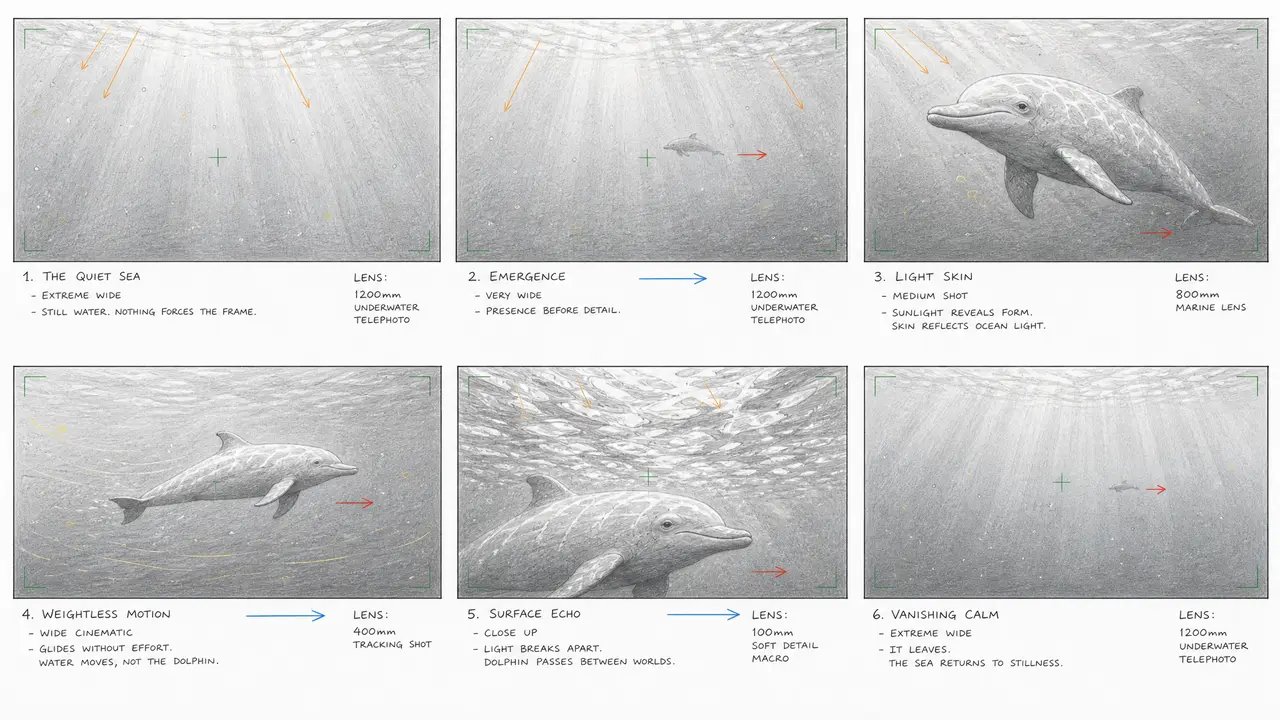 图片节点 9
16:9 storyboard sheet, 6 cinematic panels, arranged in a clean 3x2 grid. BBC Planet Earth III wildlife documentary storyboard. Black and white pencil storyboard only. Rough graphite sketch lines, minimal detail, soft silhouette readability, underwater wildlife previs storyboard style. Subject: Chinese white dolphin moving through shallow coastal waters. Environment: coastal sea, blue-green water, sunlight caustics, soft waves, underwater haze, floating particles, shallow ocean ecosystem. Visual Storytelling: Panel 1 — The Quiet Sea Extreme wide underwater shot. Soft blue-green ocean fills the frame. No dolphin visible. Only light rays and drifting particles. Theme: still water. Panel 2 — Emergence Very wide shot. A faint dolphin silhouette appears in the distance. Barely separated from water. The ocean feels alive but quiet. Theme: presence. Panel 3 — Light Skin Medium shot. The dolphin turns slightly. Sunlight patterns move across its body. Skin reflects soft ocean light. Theme: illumination. Panel 4 — Weightless Motion Wide cinematic shot. The dolphin glides forward. No visible effort. Water flows gently around its body. Theme: effortless movement. Panel 5 — Surface Echo Close-up. Water surface ripples above. Light breaks into fragments. The dolphin passes underneath. Theme: boundary between worlds. Panel 6 — Vanishing Calm Extreme wide final shot. The dolphin disappears into deeper blue. Only fading light rays remain. The sea returns to stillness. Theme: calm continuation. Annotation Color System: Red arrows = dolphin movement Blue arrows = camera movement Green marks = framing notes Orange marks = sunlight direction Yellow marks = water particles, caustics, flow Black handwritten lens notes Lens notes: 1200mm underwater telephoto 800mm marine lens 400mm tracking shot 100mm soft detail macro Mood: gentle weightless quiet flowing serene BBC Blue Planet II Planet Earth III National Geographic underwater cinematography The dolphin must remain small in most wide shots. The ocean is the main character. Movement should feel like thought, not action. No humans No boats No fantasy No concept art board No character sheet No logos No watermark
正向提示词: Reference priority: Use the green sea turtle photo as the primary visual reference for species accuracy, realism, shell shape and pattern, head markings, flipper anatomy, skin texture, natural color, underwater lighting, and real ocean texture. Do not use the storyboard as a visual style reference. The storyboard is only a text-only shot plan for shot order, composition, camera angle, lens feeling, and movement. Never reproduce drawn lines, pencil shading, arrows, handwritten notes, labels, numbers, panel borders, white paper texture, sketch marks, or any graphic annotations. Create a 15-second raw live-action underwater natural-history documentary sequence about a green sea turtle moving silently through deep blue ocean water. The final video must look like real BBC Earth / Blue Planet underwater wildlife footage captured on location, not AI illustration, not anime, not CGI, not concept art, not a fantasy film. A 6-shot sequence, each shot about 2.3 to 2.5 seconds, clean natural cuts: Shot 1: extreme wide underwater telephoto shot of vast open blue ocean, sunlight filtering naturally from the surface, suspended particles drifting in the water, the ocean dominates the frame, no animal visible at first, slow underwater camera drift. Shot 2: very wide underwater shot of a small green sea turtle emerging in the distance, tiny against the vast water, real ocean haze, soft caustic light, gentle current, slow patient approach. Shot 3: 400mm underwater tracking shot of the green sea turtle swimming calmly across frame, shell and flippers accurate to the photo reference, natural flipper strokes, realistic water resistance, muted color, quiet movement. Shot 4: wide underwater shot near seagrass and reef edge, the current gently bends seagrass and suspended particles, the turtle follows the flow through the scene, real reef texture, natural underwater lens distortion. Shot 5: 100mm close detail shot of the turtle head and shell passing near camera, realistic eye, patterned skin, shell scutes, tiny bubbles and particles, sunlight shaping the form naturally, no stylized glow. Shot 6: extreme wide underwater telephoto final shot, the turtle becomes small and disappears into deep blue water, reef edge fades on one side, sunbeams soften above, slow camera drift, quiet timeless ending. Visual style: raw underwater natural-history documentary realism, actual Blue Planet underwater wildlife footage, natural underwater color, real optical distortion, real suspended particles, real caustic light, realistic ocean haze, real turtle shell texture, real flipper movement, imperfect organic detail, natural exposure, muted color correction, natural motion blur, no glossy cinematic polish, no stylized beauty lighting. Camera style: real underwater cinema camera, 1200mm underwater telephoto feeling for extreme wide distant shots, 800mm marine lens, 400mm tracking lens, 100mm close detail lens, restrained observational movement, slow drift, slow tracking, patient natural pacing. Mood: silent, deep, timeless, vast, calm. 负向提示词: anime frame, cartoon, animation, illustration, concept art, CGI, 3D render, game cinematic, fantasy turtle, fake turtle, tortoise, snapping turtle, wrong species, plastic shell, fake flippers, fake ocean, fake reef, fake seagrass, artificial water, neon reef, over-saturated colors, magical light rays, graphic particles, graphic bubbles, painterly underwater scene, glossy cinematic polish, storyboard sheet, sketch, pencil drawing, line art, drawn lines, pencil shading, arrows, red arrow, blue arrow, green frame, yellow marks, handwritten text, labels, numbers, panel borders, split screen, collage, paper texture, deformed turtle, extra flippers, broken shell, unrealistic anatomy, human, diver, boat, submarine, horror
正向提示词: Reference priority: Use the dolphin photo as the primary visual reference for species accuracy, realism, pale pink-white skin tone, smooth dolphin anatomy, rounded forehead, beak shape, pectoral fins, tail shape, natural skin markings, underwater color, and real ocean texture. Do not use the storyboard as a visual style reference. The storyboard is only a text-only shot plan for shot order, composition, camera angle, lens feeling, and movement. Never reproduce drawn lines, pencil shading, arrows, handwritten notes, labels, numbers, panel borders, white paper texture, sketch marks, crosshair marks, or graphic annotations. Create a 15-second raw live-action underwater nature documentary sequence about a pale pink-white dolphin moving quietly through calm blue water. The final video should look like real underwater wildlife footage captured on location, with natural water haze, imperfect visibility, suspended particles, subtle surface shimmer, real optical distortion, and restrained documentary pacing. A 6-shot sequence, each shot about 2.3 to 2.5 seconds, clean natural cuts: Shot 1: extreme wide underwater shot of quiet open blue water, soft sunlight filtering down from the surface, suspended particles drifting slowly, stillness and depth, no animal visible at first, slow underwater camera drift. Shot 2: very wide underwater shot of a small pale dolphin emerging in the distance, barely visible through underwater haze, calm water, natural surface shimmer above, presence before detail. Shot 3: medium underwater shot of the pale pink-white dolphin gliding closer through blue water, rounded forehead and beak accurate to the photo reference, soft realistic caustics on the body. Shot 4: underwater tracking shot of the dolphin moving weightlessly across frame, smooth natural motion, water current visible through particles and subtle body movement, muted natural color, real optical distortion. Shot 5: soft close detail shot near the dolphin head and upper body as it passes under the water surface, natural surface reflections breaking across the skin, realistic eye and skin texture. Shot 6: extreme wide underwater final shot, the dolphin becomes small and disappears into calm blue water, surface light softens above, suspended particles drift, the sea returns to stillness. Visual style: raw underwater nature documentary realism, real marine wildlife footage, natural underwater color, real optical distortion, real suspended particles, realistic ocean haze, real dolphin skin texture, imperfect organic detail, natural exposure, muted color correction, natural motion blur, no glossy commercial polish. Camera style: real underwater camera, wide underwater lens, marine telephoto feeling for distant shots, restrained side tracking, slow drift, patient observational realism. Mood: quiet, weightless, calm, graceful, vanishing, still. 负向提示词: cartoon, animation, illustration, concept art, 3D render, game cinematic, fantasy animal, fake dolphin, wrong animal, plastic skin, fake fins, artificial water, neon blue water, over-saturated colors, magical light rays, graphic particles, graphic bubbles, painterly underwater scene, glossy commercial look, storyboard sheet, sketch, pencil drawing, line art, pencil shading, arrows, colored arrows, green frame, crosshair mark, handwritten text, labels, numbers, panel borders, split screen, collage, paper texture, deformed dolphin, extra fins, broken tail, unrealistic anatomy, diver, boat
16:9 storyboard sheet, 6 cinematic panels, arranged in a clean 3x2 grid. BBC Planet Earth III wildlife documentary storyboard. Black and white pencil storyboard only. Rough graphite sketch lines, minimal detail, strong silhouette readability, cinematic wildlife previs storyboard. Subject: Wild Bactrian camel crossing extreme desert environment with heat haze and salt flats. Environment: vast desert basin, salt crust ground, aerial landscape, heat waves, sand wind, distant mountains, empty wilderness. Visual Storytelling: Panel 1 — Aerial Establishment Extreme aerial wide shot (drone perspective). Endless desert from high altitude. Salt flats and dunes form abstract patterns. Camel is barely visible, a tiny moving point. Theme: scale of nature. Panel 2 — Approach from Sky High aerial tracking shot. Camera slowly descends toward the camel. Heat haze distorts geometry of land. Movement is slow and observational. Theme: finding life in emptiness. Panel 3 — Eye of the Animal (Key Emotional Shot) Extreme close-up. Camel eye fills frame. Reflection of desert heat waves inside the eye. Dust particles visible near eyelashes. Emotion: calm endurance, silent survival. Theme: life looking back at the world. Panel 4 — Ground Movement Medium aerial-to-ground transition shot. Camel walking through salt crust terrain. Footsteps leave temporary marks. Heat shimmer surrounds body. Theme: endurance in motion. Panel 5 — Aerial Pullback Drone pulls back upward. Camel becomes small again. World grows larger and emptier. Heat distortion increases. Theme: isolation. Panel 6 — Final Aerial Silence Extreme wide aerial shot. Camel disappears into horizon distortion. Only heat waves and salt flats remain. No visible path left behind. Theme: survival erased by scale. Annotation Color System: Red arrows = animal movement Blue arrows = aerial camera movement Green marks = framing and composition notes Orange marks = sunlight and heat direction Yellow marks = dust, wind, heat haze Black handwritten lens notes Lens notes: drone aerial 8K cinematic 800mm telephoto wildlife 400mm tracking lens 100mm macro eye detail Mood: epic minimal harsh silent documentary realism BBC Planet Earth III The camel must remain extremely small in aerial shots. Emphasis on aerial scale contrast + extreme eye close-up emotional anchor. Nature is the main character. No humans No fantasy No logos No watermark
16:9 storyboard sheet, 6 cinematic panels, arranged in a clean 3x2 grid. BBC Planet Earth III wildlife documentary storyboard. Black and white pencil storyboard only. Rough graphite sketch lines, minimal detail, strong silhouette readability, cinematic wildlife previs storyboard. Subject: Wild Bactrian camel crossing extreme desert heat and salt flats. Environment: vast desert basin, salt crust ground, heat haze waves, dry wind, sand erosion, distant mountains, empty wilderness, no human presence. Visual Storytelling: Panel 1 — The Burning Horizon Extreme wide aerial shot. Endless desert under harsh sun. Heat waves distort the horizon. No movement visible. The world feels dissolved. Theme: infinite heat. Panel 2 — Emergence in Heat Very wide shot. A wild camel slowly appears through heat haze. Body partially distorted by air shimmer. The desert swallows its form. Theme: presence inside distortion. Panel 3 — Salt Ground Contact Medium close shot. Camel hoof touches cracked salt crust. Surface fractures slightly. Fine dust lifts into hot air. Theme: contact with fragile ground. Panel 4 — Heat Pressure Wide cinematic shot. Camel walking forward through visible heat waves. Air bends around its body. Light warps across frame. Theme: environment as force. Panel 5 — Survival Rhythm Medium shot. Camel continues steady movement. No hurry. No pause. Breathing is visible in dust and heat shimmer. Theme: endurance. Panel 6 — Vanishing Into Heat Extreme wide final shot. Camel disappears into horizon distortion. Only heat waves and salt flats remain. Footprints slowly erased by wind. Theme: nothing remains except survival. Annotation Color System: Red arrows = animal movement Blue arrows = camera movement Green marks = framing and composition notes Orange marks = sunlight and heat direction Yellow marks = dust, wind, heat distortion Black handwritten lens notes Lens notes: 800mm telephoto 600mm wildlife lens 200mm medium shot 100mm ground detail Mood: harsh minimal endless meditative survival BBC Planet Earth III Frozen Planet contrast style The camel must remain small in wide shots. The desert must dominate the frame. Heat haze is an active visual character. Nature is the main character. No humans No fantasy No concept art board No character sheet No logos No watermark
正向提示词: Reference priority: Do not use the storyboard as a visual style reference. The storyboard is only a text-only shot plan for shot order, composition, camera angle, lens feeling, and movement. Never reproduce drawn lines, pencil shading, arrows, handwritten notes, labels, numbers, panel borders, white paper texture, sketch marks, or any graphic annotations. Create a 15-second raw live-action natural-history documentary sequence about a wild Bactrian camel crossing an empty desert basin in extreme heat. The final video must look like real BBC Earth / Planet Earth desert wildlife footage captured on location, not AI illustration, not anime, not CGI, not concept art, not a fantasy film. A 6-shot sequence, each shot about 2.3 to 2.5 seconds, clean natural cuts: Shot 1: extreme wide aerial telephoto shot of a vast cracked desert basin, distant dry mountains, heat shimmer, empty horizon, one tiny wild Bactrian camel barely visible in the frame, endless scale, no life except the camel. Shot 2: long telephoto wildlife shot of the wild Bactrian camel slowly emerging from heat haze, two humps, lean rugged body, dusty shaggy coat, dry cracked ground, mirage distortion, restrained documentary tension. Shot 3: ground-level close detail shot of a camel foot stepping onto cracked desert clay, dust lifting naturally, small dry fragments breaking under the weight, real tactile ground texture, harsh dry wind. Shot 4: 600mm side telephoto shot of the camel walking through wavering heat flow, distant mountains compressed behind it, shimmering air wrapping around the body, slow survival rhythm, no dramatic posing. Shot 5: medium documentary shot of the wild Bactrian camel moving forward, rough fur, dry muzzle, visible breath and dust, tired but steady endurance, natural muscle movement, imperfect real animal texture. Shot 6: long telephoto final shot of the camel far away across the empty basin, footprints fading in dust and wind, huge silent desert, distant mountains, the path slowly vanishing. Visual style: raw natural-history documentary realism, actual long-lens desert wildlife footage, natural exposure, muted desert color, realistic heat haze, real dust, real cracked earth, real wind, imperfect organic detail, realistic animal fur, natural motion blur, subtle camera vibration, no glossy cinematic polish, no stylized beauty lighting. Camera style: real aerial wildlife cinematography, 800mm telephoto compression, 600mm wildlife lens, 200mm medium documentary lens, 100mm ground detail lens, restrained observational camera movement, patient natural pacing. Mood: empty, harsh, silent, ancient, endurance, survival. 负向提示词: anime frame, cartoon, animation, illustration, concept art, CGI, 3D render, game cinematic, fantasy desert, fake camel, domestic camel, one-humped camel, dromedary, horse, yak, wrong species, plastic fur, fake dust, fake desert, perfect postcard landscape, over-stylized color grading, magical sunlight, painterly sky, dramatic fantasy lighting, glossy cinematic polish, storyboard sheet, sketch, pencil drawing, line art, drawn lines, pencil shading, arrows, red arrow, blue arrow, green frame, yellow marks, handwritten text, labels, numbers, panel borders, split screen, collage, paper texture, deformed camel, extra legs, broken humps, unrealistic anatomy, human, vehicle, road, city, tent, horror
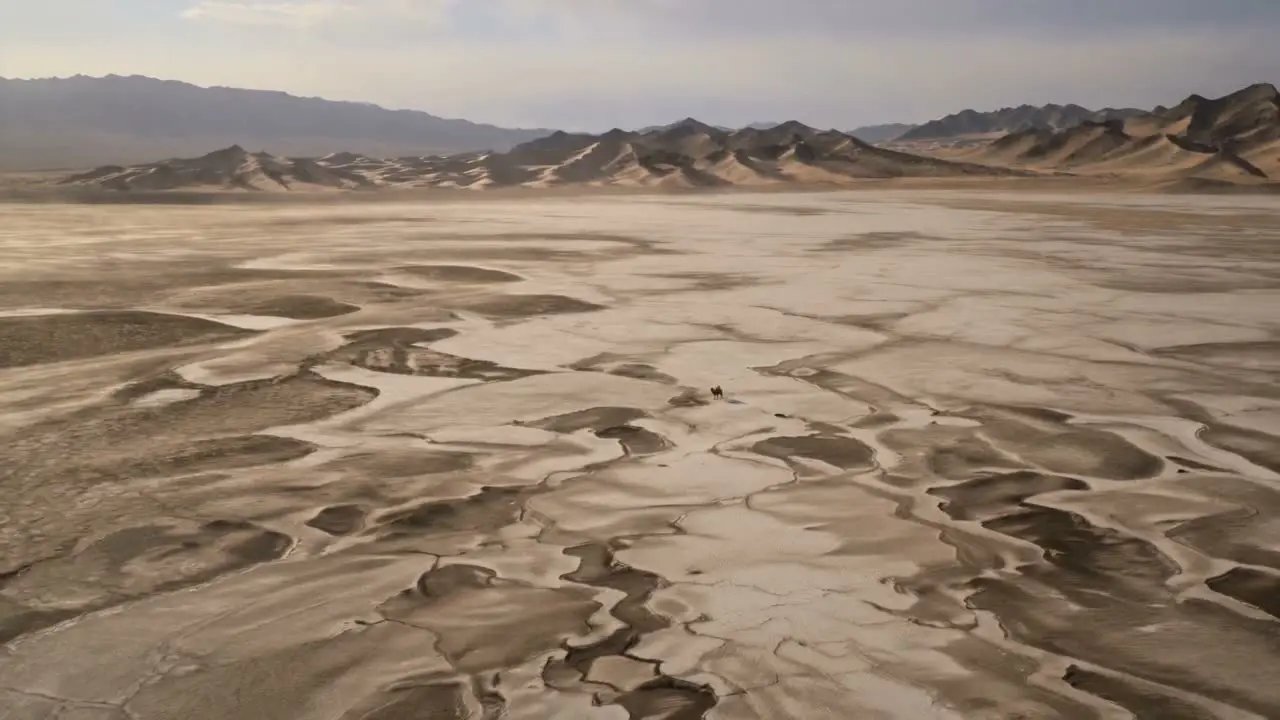 视频截图视频节点 18
正向提示词: Reference priority: Use the wild Bactrian camel photo as the primary visual reference for the animal: two humps, rugged shaggy coat, lean body, dry muzzle, long legs, natural camel anatomy, desert color, dust, and real animal texture. The storyboard is only a shot plan for composition, shot order, camera angle, lens feeling, and movement. Do not copy its drawing style, pencil marks, arrows, handwritten notes, labels, numbers, panel borders, or paper texture. Create a 15-second realistic live-action nature documentary sequence about a wild Bactrian camel crossing a vast salt-flat desert basin in extreme heat. The final video should look like real desert wildlife footage captured on location, with natural exposure, muted desert color, real dust, real cracked salt crust, heat shimmer, wind, imperfect organic detail, and restrained documentary pacing. A 6-shot sequence, each shot about 2.3 to 2.5 seconds, clean natural cuts: Shot 1: extreme aerial wide shot of endless desert salt flats and distant dry mountains, cracked white ground forming natural abstract patterns, one tiny wild Bactrian camel barely visible, heat shimmer, vast scale, slow aerial drift. Shot 2: high aerial tracking shot descending slowly toward the camel as the focal point, cracked salt crust below, heat haze distorting the land, dry wind and dust moving across the surface, realistic aerial camera perspective. Shot 3: extreme close-up detail of the camel eye, dusty lashes, rough fur around the eyelid, tiny reflection of the desert landscape in the eye, silent endurance, natural texture, no glossy stylization. Shot 4: ground-level tracking shot of the wild Bactrian camel walking across cracked salt crust, two humps clear, shaggy coat moving in dry wind, footfalls lifting dust, heat shimmer wrapping around the body. Shot 5: aerial pullback shot, camera rises and pulls back as the camel becomes small again, salt flats and mountains grow larger around it, isolation increases, muted desert colors, natural exposure. Shot 6: extreme wide final aerial shot of empty salt flats and distant mountains, the camel disappearing into heat haze, no clear path, only heat, wind, cracked earth, and silence remain. Visual style: raw nature documentary realism, real desert wildlife footage, natural color, realistic heat haze, real dust, cracked salt ground, dry wind, rugged animal fur, natural motion blur, subtle camera vibration, no glossy commercial polish, no fantasy lighting. Camera style: real aerial desert cinematography, telephoto compression, ground-level tracking lens, close detail lens, restrained observational camera movement, slow aerial descent, slow pullback, patient natural pacing. Mood: vast, silent, harsh, ancient, endurance, survival. 负向提示词: cartoon, animation, illustration, concept art, 3D render, game cinematic, fantasy desert, fake camel, one-humped camel, dromedary, horse, yak, wrong animal, plastic fur, fake dust, fake desert, fake salt flats, perfect postcard landscape, glossy commercial look, over-stylized color grading, magical sunlight, painterly sky, dramatic fantasy lighting, storyboard sheet, sketch, pencil drawing, line art, pencil shading, arrows, colored arrows, green frame, handwritten text, labels, numbers, panel borders, split screen, collage, paper texture, deformed camel, extra legs, broken humps, unrealistic anatomy, human, vehicle, road, city, tent
一跃而下飞下了悬崖
16:9 storyboard sheet, 7 cinematic panels, arranged in a clean 4x3 style grid (7 panels distributed naturally with one wide panel spanning). BBC Planet Earth III / Frozen Planet II wildlife documentary storyboard style. Black and white pencil storyboard only. Rough graphite sketch lines, minimal detail, strong silhouette readability, cinematic previs storyboard. Subject: Adélie penguins living and moving across Antarctic ice shelves, interacting with extreme cold environment, ocean edge, snow, and wind. Environment: Antarctic continent, frozen sea ice, ice cliffs, snowstorms, cold ocean, wind-blown snow particles, vast white emptiness, dramatic sky light, polar sunlight reflections. Visual Storytelling: Panel 1 — Extreme Aerial Establishment Drone aerial wide shot. Endless Antarctic ice sheet stretching to horizon. No animals visible at first glance. Wind patterns visible across snow surface. Theme: scale of emptiness. Panel 2 — Life Appears High aerial shot. Small group of penguins visible on ice. Tiny black shapes against vast white field. Theme: life inside vastness. Panel 3 — Ice Movement Medium wide shot. Penguins walking across frozen surface. Wind blowing snow sideways. Footsteps slightly visible in ice dust. Theme: survival motion. Panel 4 — Ocean Edge Decision Wide cinematic shot. Penguins standing at edge of ice shelf. Dark ocean visible below contrast with white ice. Wind intensifies. Theme: threshold. Panel 5 — Jump Into Ocean Action shot. Penguins diving into icy water. Ice fragments and bubbles explode at entry point. Surface breaks dramatically. Theme: transition. Panel 6 — Underwater Survival Underwater wide shot. Penguins swimming under ice. Light beams filtering through ice ceiling. Silhouettes moving in deep blue cold water. Theme: adaptation. Panel 7 — Final Aerial Silence Extreme aerial wide shot. Entire Antarctic landscape returns to silence. Penguins become tiny dots again or disappear into distance. Only wind and ice remain visible. Theme: eternal system. Annotation Color System: Red arrows = penguin movement Blue arrows = camera movement (aerial + underwater tracking) Green marks = framing and composition notes Orange marks = polar sunlight direction Yellow marks = snow wind, ice particles, water bubbles Lens notes: drone aerial 8K extreme wide 24mm polar landscape 70-200mm wildlife compression 400mm telephoto tracking 100mm underwater detail Mood: cold minimal vast silent survival BBC Planet Earth III Frozen Planet II National Geographic polar cinematography The Antarctic landscape must dominate all wide shots. Penguins must remain very small in aerial compositions. Wind is the invisible main character. No fantasy No stylization No logos No watermark
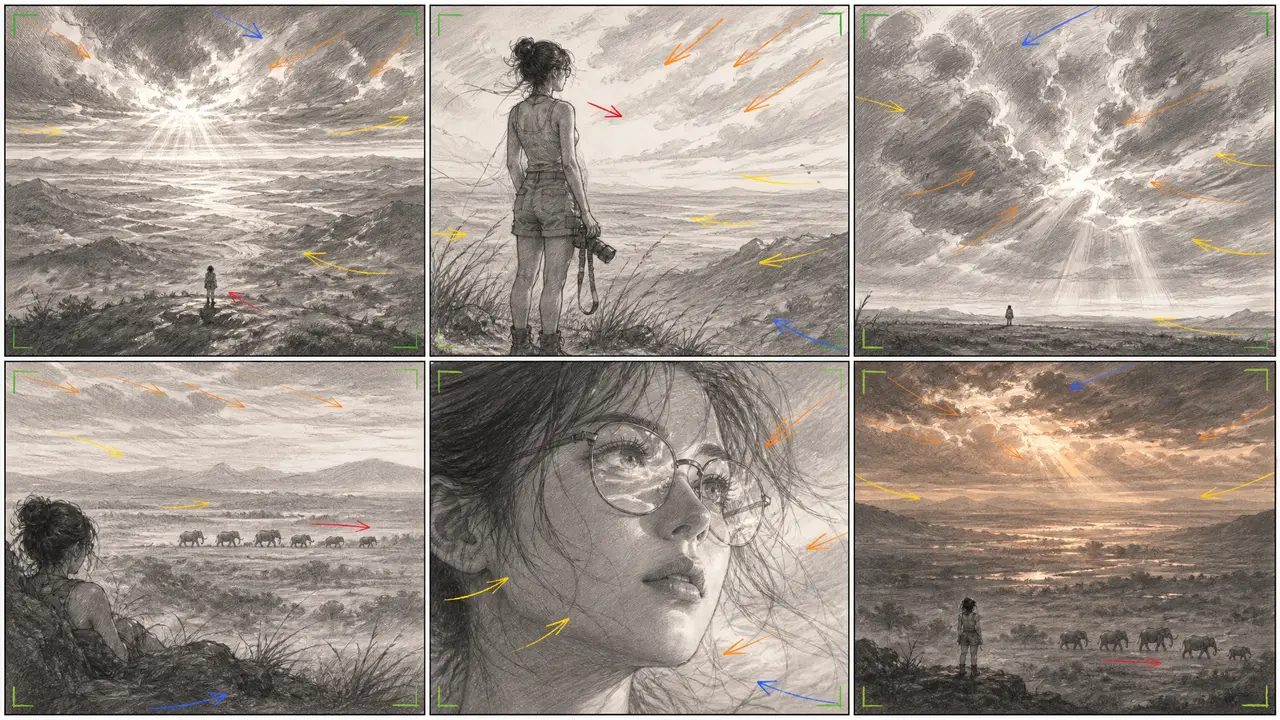 图片节点 7
16:9 storyboard sheet, 6 cinematic panels, arranged in a clean 3x2 grid. BBC Planet Earth / National Geographic cinematic wildlife documentary style mixed with atmospheric commercial film aesthetic. Black and white pencil storyboard only. Rough graphite sketch lines, minimal detail, strong silhouette readability, cinematic previs storyboard. Subject: Female field observer watching wild animals under dramatic burning sunset sky with fire-colored clouds. Environment: open landscape, savannah or mountain plateau, wide horizon, dramatic fire clouds (burning sunset sky), golden light beams, atmospheric haze, wind movement, distant wildlife silhouettes. Visual Storytelling: Panel 1 — Arrival Under Fire Sky Extreme wide aerial shot. Massive landscape under burning fire-colored clouds. Female observer is a tiny figure entering frame. Sky dominates everything. Theme: nature overwhelms human scale. Panel 2 — Setting Observation Position Medium wide shot. Female standing still, looking toward horizon. Wind moving clothing slightly. Camera equipment in hand. Theme: preparation for witnessing. Panel 3 — Sky Dominance Extreme wide cinematic shot. Fire clouds fill entire sky. Light beams break through cloud layers. Human barely visible at bottom of frame. Theme: atmosphere as main character. Panel 4 — Wildlife in Distance Telephoto wildlife shot. Distant wild animals moving across landscape (silhouettes). Female observer watching from distance. Layered composition: sky / land / life. Theme: life under sky pressure. Panel 5 — Emotional Close-Up Close-up shot. Female face illuminated by fire sunset light. Reflections of clouds in eyes. Calm emotional focus. Theme: silent observation. Panel 6 — Final Horizon Extreme wide final shot. Female and wildlife both small in frame. Fire clouds slowly fading into night gradient. Landscape becomes infinite. Theme: continuation of world beyond viewer. Annotation Color System: Red arrows = human/wildlife movement Blue arrows = camera movement Green marks = composition framing Orange marks = fire sky light direction Yellow marks = atmospheric haze / wind / cloud motion Lens notes: drone aerial 8K cinematic 24mm ultra wide landscape 70-200mm telephoto wildlife 100mm emotional portrait 600mm compression lens Mood: cinematic awe vast poetic silent BBC Planet Earth III National Geographic cinematic wildlife The sky must dominate composition in most wide shots. Human is an observer, not subject. Wildlife appears as part of environmental system. Fire clouds are the emotional core of the scene. No logos No text overlays No fantasy No stylization
16:9 storyboard sheet, 9 cinematic panels, arranged in a clean 3x3 grid. BBC Planet Earth III / National Geographic rainforest wildlife documentary storyboard style. Black and white pencil storyboard only. Rough graphite sketch lines, minimal detail, strong silhouette readability, cinematic previs storyboard. Subject: Female wildlife photographer tracking a wild gibbon (or monkey species) through dense tropical rainforest, capturing both animal behavior and environmental movement. Environment: tropical rainforest, dense jungle canopy, mist, humid air, wet leaves, sun rays breaking through trees, vines, branches, uneven forest floor, aerial jungle layers. Visual Storytelling: Panel 1 — Aerial Jungle Establishment Extreme aerial drone shot. Vast rainforest canopy stretching endlessly. Mist rising between trees. Small human and animal movement barely visible below. Theme: hidden ecosystem. Panel 2 — Entry Into Jungle Path Wide shot. Female photographer walking into dense forest. Camera equipment in hand. Light beams cutting through foliage. Theme: beginning of tracking. Panel 3 — Footstep Detail Close-up macro shot. Human foot stepping on wet jungle ground. Mud, leaves, moisture, compression of soil visible. Theme: contact with terrain. Panel 4 — Following Movement Medium tracking shot. Female moving forward through jungle. Camera slightly behind. Branches and vines moving past frame. Theme: pursuit. Panel 5 — Monkey in Trees Telephoto shot. Wild gibbon / monkey moving between branches. Swinging motion through canopy. Sunlight flashes between leaves. Theme: natural motion. Panel 6 — Monkey Portrait Close-up wildlife portrait. Monkey face in partial shadow. Eyes alert, reflective, intelligent. Leaves framing face. Theme: awareness. Panel 7 — Dual Tracking Shot Wide shot. Human below forest floor. Monkey above in canopy. Two layers of jungle movement simultaneously. Theme: parallel worlds. Panel 8 — Movement Through Forest Cinematic tracking shot. Monkey swinging rapidly through trees. Leaves blur with motion. Camera follows movement line. Theme: flow of life. Panel 9 — Aerial Pullback Finale Extreme aerial wide shot. Forest returns to dominance. Human and monkey become tiny again. Rainforest breathes as one system. Theme: nature remains. Annotation Color System: Red arrows = human/animal movement Blue arrows = camera tracking movement Green marks = framing and composition Orange marks = light direction Yellow marks = wind, mist, leaf motion, water particles Lens notes: drone aerial 8K jungle 24mm wide rainforest 70-200mm wildlife telephoto 100mm macro ground detail 600mm canopy tracking Mood: cinematic immersive humid dense alive BBC Planet Earth III rainforest cinematography The rainforest is the main character. Human and animal are equal participants in the system. Emphasis on vertical layers: ground / mid / canopy / aerial. No logos No stylization No fantasy No staged posing No text overlays
16:9 storyboard sheet, 6 cinematic panels, arranged in a clean 3x2 grid. BBC Planet Earth / National Geographic cinematic wildlife documentary style mixed with luxury camping aesthetic. Black and white pencil storyboard only. Rough graphite sketch lines, minimal detail, strong silhouette readability, cinematic previs storyboard. Subject: Female traveler in a luxury rooftop tent camping setup encountering a wild red panda-like small animal in a forest mountain environment at night or dusk. Environment: mountain forest campsite, rooftop tent on vehicle, misty forest air, soft warm camp lighting, surrounding trees, quiet wilderness, night sky or dusk glow, natural habitat atmosphere. Visual Storytelling: Panel 1 — Campsite Establishment Extreme wide shot. Luxury off-road vehicle with rooftop tent parked in deep forest clearing. Fog between trees. Warm tent light contrasts with dark forest. Theme: human presence in wilderness. Panel 2 — Exit from Rooftop Tent Medium wide shot. Female camper opening rooftop tent. Slow emergence into natural environment. Forest surrounds quietly. Theme: transition from shelter to nature. Panel 3 — First Discovery Point-of-view shot. Female looking down from vehicle roof. A small wild animal (red panda / forest mammal) appears on a nearby branch. Subtle surprise moment. Theme: unexpected encounter. Panel 4 — Animal Close Portrait Extreme close-up wildlife shot. Red panda face fills frame. Soft fur detail, reflective eyes. Forest bokeh background. Theme: wildlife presence. Panel 5 — Mutual Observation Medium cinematic shot. Female and animal in same frame but separated by distance. No interaction, only observation. Stillness dominates. Theme: silent awareness. Panel 6 — Night Forest Balance Extreme wide shot. Vehicle campsite glowing softly in forest night. Animal disappears into trees. Human presence remains small. Nature dominates frame. Theme: coexistence. Annotation Color System: Red arrows = human/animal movement Blue arrows = camera movement Green marks = framing and composition notes Orange marks = camp light direction Yellow marks = forest atmosphere, fog, particles, depth layers Lens notes: 24mm wide cinematic forest 35mm documentary medium shot 85mm portrait wildlife detail 100mm macro fur detail 200mm telephoto forest compression Mood: cinematic calm intimate wild luxury expedition BBC Planet Earth III National Geographic wildlife cinematography The animal must remain wild and natural, not anthropomorphized. Human presence is secondary to environment. Focus on atmosphere, discovery, and silence. No fantasy No stylization No logos No watermark No exaggerated cuteness
正向提示词: Reference priority: Do not use the storyboard as a visual reference. The storyboard is only a text shot plan for order, composition, camera angle, and movement. No arrows, colored marks, labels, numbers, panel borders, pencil texture, sketch texture, handwriting, or paper texture may appear in the video. Create a 15-second realistic live-action polar wildlife documentary sequence about penguins crossing a vast frozen landscape and diving into the ocean. The final video should look like raw polar nature documentary footage captured on location: cold overcast light, real snow, real sea ice, rough wind, natural animal movement, imperfect exposure, muted polar color, subtle camera vibration, restrained observational pacing. A 7-shot sequence, each shot about 2.1 seconds, clean natural cuts: Shot 1: extreme wide aerial shot over a vast empty Antarctic ice field, distant low mountains, wind-blown snow moving across the surface, pale cold sunlight, slow drone drift, extreme scale and emptiness. Shot 2: extreme wide aerial shot of a long line of penguins crossing the frozen landscape, tiny black-and-white bodies moving through wind and snow, life inside vastness, slow aerial tracking. Shot 3: 70-200mm telephoto wildlife shot of penguins walking in a line across sloped snow, compressed background, natural waddling movement, wind pushing snow across the frame. Shot 4: 24mm polar landscape shot of a small penguin group reaching the ice shelf edge, dark ocean below, broken ice, cold wind, natural sunlight filtered through cloud. Shot 5: 400mm telephoto action shot of several penguins jumping from the ice edge into the cold ocean, natural splash, bubbles, ice fragments, real gravity and animal movement. Shot 6: 100mm underwater wide shot beneath the ice, penguins swimming through blue cold water, bubbles rising, ice ceiling above, diffused sunlight, natural underwater particles, realistic motion. Shot 7: final extreme wide drone aerial shot of the empty frozen landscape after the penguins have passed, wind and snow moving over the ice, distant mountains, vast quiet polar system. Visual style: raw polar wildlife documentary realism, real expedition footage, natural cold color, realistic sea ice, real snow texture, real wind, organic penguin movement, imperfect details, natural motion blur, muted color correction, no glossy commercial polish, no fantasy lighting. Camera style: real drone aerial footage, 70-200mm wildlife lens, 400mm telephoto action lens, 100mm underwater wide camera, restrained observational movement, slow aerial drift, patient natural pacing. Mood: vast, cold, silent, fragile, alive, eternal. 负向提示词: cartoon, animation, illustration, concept art, 3D render, game cinematic, fantasy Antarctica, fake ice, fake snow, fake penguins, plastic feathers, toy penguins, perfect postcard landscape, glossy commercial look, over-stylized color grading, magical sunlight, painterly sky, dramatic fantasy lighting, storyboard sheet, sketch, pencil drawing, line art, pencil shading, arrows, colored arrows, blue arrow, red arrow, yellow arrow, orange arrow, green frame, handwritten text, labels, numbers, panel borders, split screen, collage, paper texture, deformed penguins, extra flippers, unrealistic anatomy, human, vehicle, road, city, tent
视频中的蓝色黄色红色箭头去掉
16:9 storyboard sheet, 6 panels, clean 3x3 layout style. Black and white pencil storyboard style only. Simple line sketch, cinematic framing, minimal detail, clear composition, no text style emphasis. Subject: Female photographer in outdoor high-altitude plateau environment observing distant wild animals. Environment: open plateau landscape, grassland terrain, distant mountains, natural sky, wind in environment, daylight outdoor conditions. Visual Storyboard: Panel 1 Extreme wide aerial view of plateau landscape. Mountains in background. Open terrain with natural texture. Panel 2 Wide shot of a single person standing in landscape. Small scale human figure. Open environment. Panel 3 Telephoto view of distant wild animals moving across open land. Large empty space in foreground. Panel 4 Medium shot of person adjusting camera equipment outdoors. Natural posture. Panel 5 Close-up of camera pointing toward distant landscape. Lens reflecting environment. Panel 6 Extreme wide aerial composition showing landscape, human, and distant animals in one frame. Large scale environment dominates composition. Camera notes: aerial wide lens telephoto compression lens medium documentary lens close detail lens Composition notes: subject small in frame environment dominant clear spatial hierarchy natural lighting Style: cinematic storyboard sketch production previsualization clean layout minimal annotation No text overlays No branding No logos No stylized illustration No exaggerated expression
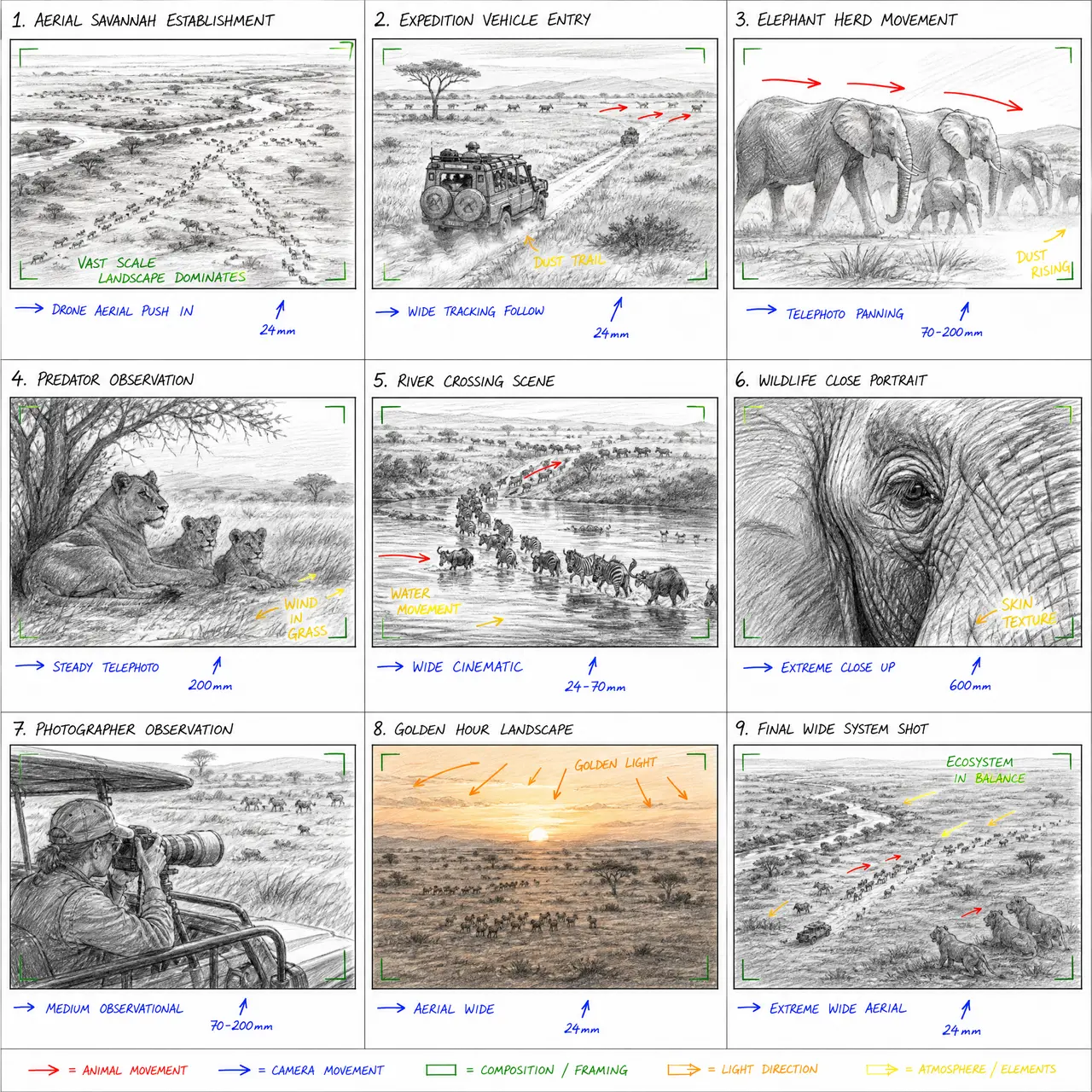 图片节点 5
16:9 storyboard sheet, 9 cinematic panels, arranged in a clean 3x3 grid. BBC Planet Earth III / National Geographic East Africa wildlife documentary storyboard style. Black and white pencil storyboard only. Rough graphite sketch lines, minimal detail, strong silhouette readability, cinematic previs storyboard. Subject: Wildlife photography expedition in East Africa (Zambia / Serengeti ecosystem style environment), capturing natural animal behavior in open savannah and river systems. Environment: East African savannah, Zambian river floodplains, acacia trees, golden grasslands, open sky, waterholes, soft dust, morning and sunset light, natural migration routes, wildlife corridors. Visual Storytelling: Panel 1 — Aerial Savannah Establishment Extreme aerial wide shot. Endless East African plains. Herds of animals barely visible as small moving dots. Rivers cutting through landscape. Theme: scale of wilderness. Panel 2 — Expedition Vehicle Entry Wide shot. Safari vehicle entering open savannah track. Dust trail behind vehicle. Animals in far distance unaffected. Theme: human presence inside ecosystem. Panel 3 — Elephant Herd Movement Telephoto shot. Elephant herd moving slowly across plains. Calves protected within group. Dust rising under feet. Theme: migration behavior. Panel 4 — Predator Observation Medium telephoto shot. Lions or predators resting in shade. Stillness and alertness. Grass moving with wind. Theme: silent tension in nature. Panel 5 — River Crossing Scene Wide cinematic shot. Animals crossing river (zebra / antelope / wildebeest). Water movement and reflections. Theme: survival transition. Panel 6 — Wildlife Close Portrait Extreme close-up. Animal face (elephant eye / lion face / giraffe detail). Dust and texture visible. Theme: life detail. Panel 7 — Photographer Observation Medium shot. Wildlife photographer inside safari vehicle with long lens. Focused observation. Theme: documentation. Panel 8 — Golden Hour Landscape Wide aerial shot. Sunset over savannah. Animals silhouetted against light. Sky dominates composition. Theme: natural rhythm. Panel 9 — Final Wide System Shot Extreme wide aerial final shot. Entire ecosystem visible: river, herd, predators, vehicle all small. Landscape dominates frame. Theme: ecosystem continuity. Annotation Color System: Red arrows = animal movement Blue arrows = camera movement (aerial / telephoto / tracking) Green marks = composition and framing Orange marks = golden hour light direction Yellow marks = dust, water, wind, atmosphere Lens notes: drone aerial 8K cinematic 24mm wide savannah 70-200mm wildlife telephoto 600mm long range animal detail 100mm macro texture Mood: cinematic documentary realism vast natural authentic BBC Planet Earth III National Geographic Africa wildlife cinematography The savannah must dominate all wide shots. Animals are the main subject, not humans. Human presence is secondary and observational only. No fantasy No stylization No logos No watermark No staged interaction
16:9 storyboard sheet, 9 cinematic panels, arranged in a clean 3x3 grid. BBC Planet Earth III / Blue Planet II underwater conservation documentary storyboard style. Black and white pencil storyboard only. Rough graphite sketch lines, minimal detail, strong silhouette readability, cinematic previs storyboard. Subject: Marine conservation scene in a protected coral reef ecosystem with diver observation, coral restoration, and underwater biodiversity. Environment: tropical coral reef, clear blue water, sunlight caustics, drifting particles, sea grass, coral structures, small fish schools, underwater ecological restoration zone. Visual Storytelling: Panel 1 — Aerial Ocean Establishment Extreme aerial wide shot. Clear ocean surface above reef system. Sunlight reflecting on calm sea. No human visible. Theme: surface silence. Panel 2 — Underwater Entry Wide underwater shot. Diver entering reef zone slowly. Light beams break into water. Theme: transition into life zone. Panel 3 — Coral Landscape Reveal Medium wide shot. Vast coral structures underwater. Fish schools moving gently. Biodiversity visible. Theme: hidden ecosystem. Panel 4 — Coral Close Detail Macro close-up. Coral textures and polyps. Tiny marine organisms living on coral surface. Theme: micro life. Panel 5 — Restoration Action Medium shot. Diver carefully observing or planting coral restoration structures. No disturbance, slow movement. Theme: human protection role. Panel 6 — Fish School Movement Wide cinematic shot. Large school of fish flowing through coral reef. Light patterns moving across bodies. Theme: natural rhythm. Panel 7 — Turtle or Marine Life Presence Telephoto underwater shot. Sea turtle or large marine animal passing through reef. Calm and slow motion. Theme: ecosystem balance. Panel 8 — Protected Reef Calm Extreme wide underwater shot. Reef appears healthy and stable. Light rays from surface illuminate entire system. Theme: recovery. Panel 9 — Ocean Continuation Extreme wide final shot. Coral reef fades into deep blue ocean. Particles floating slowly. Ocean feels infinite and alive. Theme: life continues. Annotation Color System: Red arrows = diver / marine animal movement Blue arrows = camera movement (underwater tracking + aerial) Green marks = composition and framing notes Orange marks = sunlight caustics direction Yellow marks = marine particles, bubbles, coral glow, water flow Lens notes: drone aerial ocean 8K 24mm underwater wide 50mm reef documentary 100mm macro coral detail 200mm telephoto marine life Mood: calm healing natural vast documentary realism BBC Blue Planet II Planet Earth III underwater conservation The reef must feel alive and recovering. Human presence is minimal and respectful. Coral ecosystem is the main character. No fantasy No stylization No logos No watermark
16:9 storyboard sheet, 9 cinematic panels, arranged in a clean 3x3 grid. BBC Planet Earth III / Blue Planet II cinematic river documentary storyboard style. Black and white pencil storyboard only. Rough graphite sketch lines, minimal detail, strong silhouette readability, cinematic previs storyboard. Subject: Female wildlife photographer traveling on a small boat along the Amazon River, experiencing wildlife scenes as part of the river system perspective. Environment: Amazon rainforest river ecosystem, flowing water network, dense jungle canopy, seasonal mist, floating vegetation, tropical sunlight rays, river currents, wildlife corridors. Visual Storytelling: Panel 1 — River as a Living System Extreme aerial wide shot. Entire Amazon river seen as a flowing organism. Boat is almost invisible inside the river path. Theme: the river is the main character. Panel 2 — Flow Direction Wide cinematic shot. Camera aligned with river current. Boat moving naturally with flow. Female seated at bow, part of motion. Theme: movement is guided by nature. Panel 3 — Human Presence Detail Medium close shot. Female at bow of boat. Wind and humidity visible in environment. Expression calm and observant. Theme: presence inside system. Panel 4 — Wildlife Emergence Telephoto shot. Wild animals appear naturally along river edges. Birds, monkeys, river life integrated into environment. No confrontation, only coexistence. Theme: life appearing in layers. Panel 5 — Water Surface Reality Close-up shot. River surface detail. Reflections of sky and jungle. Floating debris and natural motion. Theme: flowing reality. Panel 6 — Eye-Level Perspective POV shot from boat bow. River curves ahead into jungle. Mist and light break through canopy. Theme: unknown path. Panel 7 — Observation Moment Medium shot. Female raising camera toward distant wildlife. Camera becomes extension of perception. Theme: seeing. Panel 8 — Emotional Still Frame Close-up shot. Female face in soft tropical light. Eyes reflecting river surface movement. Theme: awareness. Panel 9 — River Continuation Extreme aerial wide shot. Entire river continues beyond frame. Boat disappears into distance. Wildlife scattered naturally across ecosystem. Theme: endless system. Annotation Color System: Red arrows = flow direction / movement Blue arrows = camera perspective shifts Green marks = composition framing Orange marks = sunlight through canopy Yellow marks = river flow / atmospheric humidity / particles Lens notes: drone aerial 8K cinematic 24mm river system wide 70-200mm wildlife telephoto 600mm long compression 100mm detail macro 50mm portrait close-up Mood: cinematic flowing organic vast silent BBC Planet Earth III Blue Planet II river system cinematography The river is the main character. Human and wildlife are both expressions of the same system. No logos No text overlays No fantasy No stylization No staged interaction
16:9 storyboard sheet, 9 cinematic panels, arranged in a clean 3x3 grid. BBC Planet Earth III / Blue Planet II rainforest river documentary storyboard style. Black and white pencil storyboard only. Rough graphite sketch lines, minimal detail, strong silhouette readability, cinematic previs storyboard. Subject: Female wildlife photographer sitting at the bow of a small boat in the Amazon river, documenting wild animals in rainforest ecosystem. Environment: Amazon rainforest river system, dense jungle canopy, muddy water, floating vegetation, mist, humid air, tropical sunlight beams, river curves, wildlife habitat. Visual Storytelling: Panel 1 — Ultra Wide Aerial Establishment Extreme aerial drone shot. Entire Amazon river winding through dense rainforest. Boat is extremely small in frame. Forest dominates landscape. Theme: scale of ecosystem. Panel 2 — Boat on River Wide cinematic shot. Small boat moving through river corridor. Female photographer seated at front (bow of boat). Wind and humidity in environment. Theme: journey through nature. Panel 3 — Female Portrait (Face Visible) Medium close shot. Female wildlife photographer at bow of boat. Face clearly visible. Focused expression. Background river and jungle blurred. Theme: observation mindset. Panel 4 — Camera in Action Close-up shot. Hands holding telephoto lens camera. Lens pointed toward wildlife in distance. Reflections of jungle in lens glass. Theme: documentation process. Panel 5 — Wildlife Moment Telephoto wildlife shot. Amazon animals (birds / river dolphin / monkeys near river edge). Natural behavior, no interaction with human. Theme: wildlife presence. Panel 6 — Boat Perspective Forward POV shot from boat bow. River ahead splitting jungle. Mist rising above water. Boat moving forward slowly. Theme: direction and flow. Panel 7 — Interaction of Scales Wide shot. Boat small in river. Wildlife in multiple layers (water + trees + sky). Female still seated at bow. Theme: ecosystem hierarchy. Panel 8 — Emotional Close-Up Close-up shot. Female face lit by natural tropical light. Eyes reflecting river and jungle. Wind slightly moving hair. Theme: silent witnessing. Panel 9 — Final Ultra Aerial Pullback Extreme aerial wide shot. Entire Amazon system visible. Boat becomes a tiny dot. River dominates landscape. Jungle infinite. Theme: nature remains dominant. Annotation Color System: Red arrows = boat / wildlife movement Blue arrows = camera movement (aerial / telephoto / POV) Green marks = composition and framing notes Orange marks = sunlight direction Yellow marks = river flow / mist / jungle atmosphere Lens notes: drone aerial 8K cinematic 24mm river wide landscape 70-200mm wildlife telephoto 600mm long distance compression 100mm detail lens 50mm portrait face close-up Mood: cinematic documentary realism humid vast silent BBC Planet Earth III Blue Planet II Amazon sequence style The boat must remain small in wide shots. Female face must be clearly readable in medium and close shots. Wildlife remains natural and independent. No logos No text overlays No fantasy No stylization No watermark
正向提示词: Reference priority: Use the character photo only as a loose identity and outfit reference: young East Asian female field photographer, round glasses, tied dark hair with loose bangs, slim realistic build, gray tank top, khaki shorts, rugged outdoor boots, natural face, realistic body proportions. Do not copy the studio background, studio lighting, catalog pose, beauty retouching, glossy skin, or fashion model look. Do not use any storyboard image as a visual reference. The shot plan below is text-only direction for shot order, composition, camera angle, lens feeling, and movement. No arrows, colored marks, handwritten labels, panel borders, numbers, green corner frames, paper texture, pencil lines, sketch texture, or graphic overlays may appear in the video. Create a 15-second realistic live-action rainforest river documentary sequence about a young female field photographer traveling by small canoe through a vast tropical rainforest river system, quietly observing wildlife. The final video should look like real on-location nature documentary footage: humid rainforest air, real river reflections, dense tropical vegetation, natural haze, insects and particles in the air, practical camera gear, imperfect exposure, subtle handheld movement, muted natural color, restrained observational pacing. A 9-shot sequence, each shot about 1.6 seconds, clean natural cuts: Shot 1: extreme aerial wide shot over a vast tropical rainforest, a winding brown-green river cutting through endless tree canopy, morning mist above the forest, slow drone drift, the river dominates the composition. Shot 2: medium wide shot from behind the young woman sitting near the front of a small wooden canoe, moving slowly along a calm rainforest river, dense jungle on both banks, soft humid light, natural water ripples. Shot 3: natural close portrait of the woman in the canoe, round glasses, tied dark hair loosened by humidity, slightly damp skin, camera strap around her neck, she looks quietly toward sounds in the forest, no posing. Shot 4: close documentary detail of her hands holding a real telephoto camera lens, dark river and rainforest reflected in the glass, shallow depth of field, small water movement in the reflection, practical field texture. Shot 5: 200mm telephoto wildlife shot of monkeys resting and moving on a fallen tree above the riverbank, wet leaves, moss, vines, soft rainforest shade, natural animal movement, no exaggerated expressions. Shot 6: wide bow-of-canoe point-of-view shot moving forward along the river, canoe tip in foreground, calm dark water, jungle walls on both sides, faint mist ahead, slow observational drift. Shot 7: wide river shot with birds flying above the canopy and a freshwater river dolphin briefly surfacing near the canoe, small splash and expanding ripples, the woman remains still and respectful, no interaction. Shot 8: intimate natural close portrait of the woman watching the river, soft reflected light on her glasses, humid hair strands across her face, quiet awe, realistic skin texture, documentary restraint. Shot 9: final aerial wide pullback over the rainforest river, the canoe becomes tiny in the vast jungle system, mist drifting above the canopy, river winding into distance, nature dominates the frame. Visual style: raw rainforest field documentary realism, real tropical river footage, natural humid atmosphere, realistic water reflections, dense organic jungle texture, real animal movement, muted greens and browns, soft overcast daylight, imperfect organic detail, natural motion blur, subtle camera vibration, no glossy commercial polish, no fantasy lighting. Camera style: real documentary camera, drone aerial footage, canoe-mounted handheld footage, 24mm wide landscape lens, 50mm natural portrait lens, 200mm wildlife telephoto lens, restrained observational movement, slow drift, patient natural pacing. Mood: humid, quiet, alive, watchful, mysterious, respectful, immersive. 负向提示词: cartoon, animation, anime frame, illustration, concept art, 3D render, game cinematic, fantasy jungle, fake rainforest, fake river, plastic leaves, artificial water, fake animals, toy monkeys, unrealistic monkey movement, fake dolphin, oversized dolphin, fantasy animal, perfect postcard landscape, glossy commercial look, beauty retouching, fashion shoot, idol face, doll face, oversized eyes, perfect makeup, over-stylized color grading, magical sunlight, dramatic god rays, painterly sky, neon green jungle, fake mist, fake reflections, storyboard sheet, sketch, pencil drawing, line art, pencil shading, arrows, colored arrows, red arrow, blue arrow, yellow arrow, orange arrow, green frame, handwritten text, labels, numbers, panel borders, split screen, collage, paper texture, graphic overlay, UI marks, deformed hands, distorted face, broken camera, fake camera, city, road, buildings, motorboat, crowd, horror
正向提示词: Reference priority: Use the diver character photo only as a loose reference for identity and equipment: young East Asian female diver, black diving mask, regulator, tied dark hair, white and gray wetsuit, scuba tank, hoses, fins, realistic proportions, practical scuba gear. Do not copy the studio portrait background, studio lighting, beauty retouching, fashion pose, glossy skin, or catalog model look. Do not use the storyboard as a visual reference. The shot plan below is text-only direction for shot order, composition, camera angle, and movement. No arrows, colored marks, labels, numbers, panel borders, pencil texture, sketch texture, handwriting, or paper texture may appear in the video. Create a 15-second realistic underwater nature documentary sequence about a female diver entering a coral reef system, observing marine life, and helping place coral restoration structures. The final video should look like real underwater field documentary footage captured on location: natural underwater color, real optical distortion, suspended particles, bubbles, reef texture, fish movement, practical scuba gear, imperfect exposure, muted color correction, restrained observational pacing. A 9-shot sequence, each shot about 1.6 seconds, clean natural cuts: Shot 1: aerial wide shot over a clear shallow ocean, reef system visible beneath the water surface, sunlight reflecting naturally, calm surface texture, slow drone drift. Shot 2: 24mm underwater wide shot of the diver entering the reef zone slowly, bubbles rising from regulator, sunlight diffused through water, suspended particles, gentle descent. Shot 3: 50mm medium wide underwater shot revealing a vast coral landscape with fish schools moving gently, real reef structures, natural biodiversity, no stylized colors. Shot 4: 100mm macro close detail of coral polyps and tiny organisms, organic texture, small fish moving between coral, natural underwater light, shallow realistic focus. Shot 5: 50mm documentary shot of the diver carefully observing and placing coral restoration structures, slow deliberate hand movement, practical field conservation work, respectful distance from wildlife. Shot 6: 24mm wide underwater shot of a school of fish flowing through the reef, natural group movement, light patterns moving across water and coral, realistic current. Shot 7: 200mm telephoto underwater shot of a green sea turtle gliding calmly through the reef, natural shell texture, slow flipper movement, balanced ecosystem feeling. Shot 8: 24mm wide underwater shot of a healthy reef ecosystem, stable and full of life, fish, coral, particles, soft natural sunlight from above, calm camera hold. Shot 9: final 24mm wide shot as the reef fades into deeper blue water, fish silhouettes and particles drifting, ocean continues beyond the frame, quiet ending. Visual style: raw underwater documentary realism, real marine conservation footage, natural underwater color, real optical distortion, suspended particles, realistic bubbles, organic coral texture, natural fish movement, practical scuba equipment, imperfect details, natural motion blur, no glossy commercial polish, no fantasy lighting. Camera style: real drone aerial footage, real underwater cinema camera, 24mm wide underwater lens, 50mm documentary lens, 100mm macro coral lens, 200mm underwater telephoto lens, restrained observational movement, slow drift, gentle tracking, patient natural pacing. Mood: calm, healing, natural, vast, respectful, alive. 负向提示词: cartoon, animation, illustration, concept art, 3D render, game cinematic, fantasy underwater world, mermaid, fake coral, plastic coral, fake fish, artificial water, neon reef, over-saturated colors, magical light rays, graphic particles, graphic bubbles, glossy commercial look, beauty retouching, fashion shoot, idol face, doll face, oversized eyes, perfect makeup, sexualized pose, bikini, lingerie, nude, storyboard sheet, sketch, pencil drawing, line art, pencil shading, arrows, colored arrows, red arrow, blue arrow, orange arrow, green frame, handwritten text, labels, numbers, panel borders, split screen, collage, paper texture, deformed hands, extra fingers, distorted mask, broken regulator, extra fins, extra legs, missing legs, human crowd, boat, submarine, horror
正向提示词: Reference priority: Use the character photo only as a loose identity and outfit reference: young East Asian female field photographer, round glasses, tied dark hair with loose bangs, slim realistic build, gray tank top, khaki shorts, rugged outdoor boots, natural face, realistic body proportions. Do not copy the studio background, studio lighting, catalog pose, beauty retouching, glossy skin, or fashion model feeling. Do not use any storyboard image as a visual reference. The storyboard is only a text shot plan for shot order, composition, lens feeling, and camera movement. No arrows, colored marks, handwritten labels, panel borders, numbers, green corner frames, paper texture, pencil lines, sketch texture, or graphic overlays may appear in the video. Create a 15-second realistic live-action African savannah wildlife documentary sequence about a young female field photographer observing a living ecosystem from an expedition vehicle. The final video should look like real on-location nature documentary footage: natural savannah light, dry grass, dust, distant river, acacia trees, real elephants, lions, wildebeest, natural animal movement, imperfect exposure, subtle camera vibration, restrained observational pacing. A 9-shot sequence, each shot about 1.6 seconds, clean natural cuts: Shot 1: aerial wide shot over a vast African savannah, winding river, scattered acacia trees, distant herds moving across the plain, slow drone push forward, landscape dominates the frame. Shot 2: wide tracking shot behind an expedition vehicle driving slowly on a dirt track, dust trail rising naturally, animals visible far in the distance, practical documentary vehicle movement. Shot 3: 70-200mm telephoto panning shot of an elephant herd walking together through dry grass, adults protecting a calf, dust rising around their feet, realistic skin texture and heavy natural movement. Shot 4: steady 200mm telephoto shot of lions resting under sparse shade, wind moving grass, quiet predator observation, no attack, no drama, patient natural-history framing. Shot 5: wide documentary shot of mixed wildlife crossing a shallow river, elephants and wildebeest moving through water, real splashes, ripples, muddy banks, chaotic but natural ecosystem motion. Shot 6: 600mm extreme close-up of an elephant eye and wrinkled skin texture, dusty eyelashes, subtle blinking, shallow depth of field, organic detail. Shot 7: medium observational shot from inside or beside the expedition vehicle, the young female photographer using a long telephoto lens, face mostly side or back view, focused and quiet, not posing. Shot 8: aerial wide late-afternoon landscape shot, warm natural low sun over the savannah, long shadows, herds moving as small silhouettes, muted earth colors, realistic atmospheric haze. Shot 9: final extreme wide aerial system shot, expedition vehicle, elephants, lions, herds, river, trees, and open plain all visible in balanced scale, slow pullback, the ecosystem feels larger than any single subject. Visual style: raw field documentary realism, real wildlife footage, natural color, muted earth tones, realistic dry grass, real dust, real animal skin and fur texture, real atmospheric haze, natural lens compression, imperfect organic detail, natural motion blur, subtle handheld or vehicle vibration, no glossy commercial polish, no fantasy lighting. Camera style: real documentary camera, drone aerial footage, 24mm wide landscape lens, 70-200mm wildlife telephoto lens, 600mm close wildlife lens, slow tracking, steady telephoto observation, patient natural pacing. Mood: vast, alive, observational, quiet, dusty, balanced, wild. 负向提示词: cartoon, animation, anime frame, illustration, concept art, 3D render, game cinematic, fantasy savannah, fake animals, plastic animals, toy animals, deformed elephant, wrong elephant anatomy, extra legs, broken trunk, fake lion, fake herd, unrealistic animal movement, perfect postcard landscape, glossy commercial look, beauty retouching, fashion shoot, idol face, doll face, oversized eyes, perfect makeup, over-stylized color grading, magical sunlight, dramatic god rays, painterly sky, fake dust, fake grass, fake river, storyboard sheet, sketch, pencil drawing, line art, pencil shading, arrows, colored arrows, red arrow, blue arrow, yellow arrow, orange arrow, green frame, handwritten text, labels, numbers, panel borders, split screen, collage, paper texture, graphic overlay, UI marks, road signs, city, buildings, crowd, violence, horror
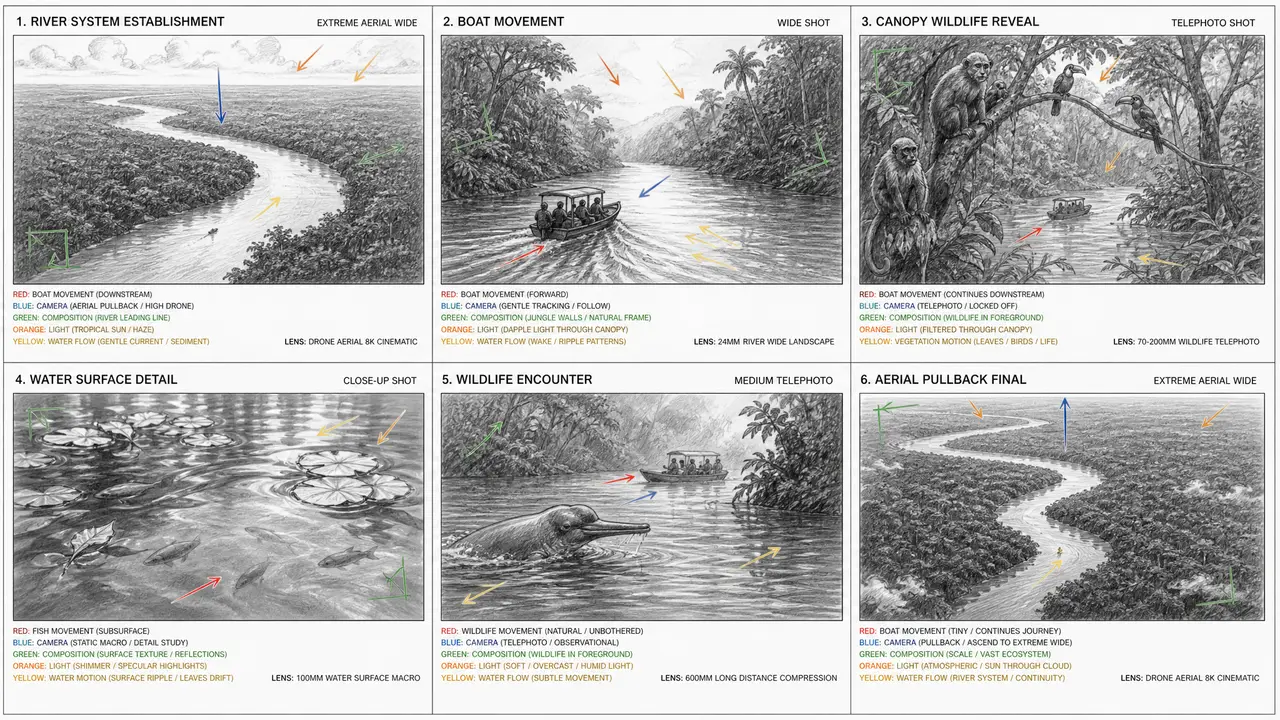 图片节点 8
16:9 storyboard sheet, 6 cinematic panels, arranged in a clean 3x2 grid. BBC Planet Earth III / Blue Planet II rainforest river documentary storyboard style. Black and white pencil storyboard only. Rough graphite sketch lines, minimal detail, strong silhouette readability, cinematic previs storyboard. Subject: Small boat expedition on the Amazon River photographing wildlife along dense rainforest river system. Environment: Amazon rainforest river, dense jungle canopy, muddy water, floating vegetation, mist, humidity, tropical light rays, river bends, wildlife ecosystem, remote natural environment. Visual Storytelling: Panel 1 — River System Establishment Extreme aerial wide shot. Massive Amazon River cutting through rainforest. Dense green canopy on both sides. Boat is extremely small on river surface. Theme: scale of ecosystem. Panel 2 — Boat Movement Wide shot. Small wooden or expedition boat moving through river. Water ripples trailing behind. Jungle walls closing in on both sides. Theme: movement through nature. Panel 3 — Canopy Wildlife Reveal Telephoto shot. Monkeys / birds / river wildlife visible in trees and along river edge. Boat remains in distance. Theme: hidden biodiversity. Panel 4 — Water Surface Detail Close-up shot. River surface with floating leaves and reflections. Small fish movement under water. Light shimmering on muddy surface. Theme: life in water system. Panel 5 — Wildlife Encounter Medium telephoto shot. River dolphin / caiman / exotic bird near waterline. Boat observing from distance. No disturbance to wildlife. Theme: observation. Panel 6 — Aerial Pullback Final Extreme aerial wide shot. Entire Amazon river system visible. Boat becomes a tiny point in vast rainforest. Jungle dominates frame. Theme: nature is the main character. Annotation Color System: Red arrows = boat / wildlife movement Blue arrows = camera movement (aerial / tracking / telephoto) Green marks = composition and framing notes Orange marks = tropical light direction Yellow marks = water flow / mist / vegetation motion Lens notes: drone aerial 8K cinematic 24mm river wide landscape 70-200mm wildlife telephoto 600mm long distance compression 100mm water surface macro Mood: cinematic humid vast organic documentary realism BBC Planet Earth III Blue Planet II Amazon sequence style The boat must remain very small in wide shots. The river system dominates composition. Wildlife appears naturally without interaction. No fantasy No stylization No logos No watermark
把视频中的箭头去掉
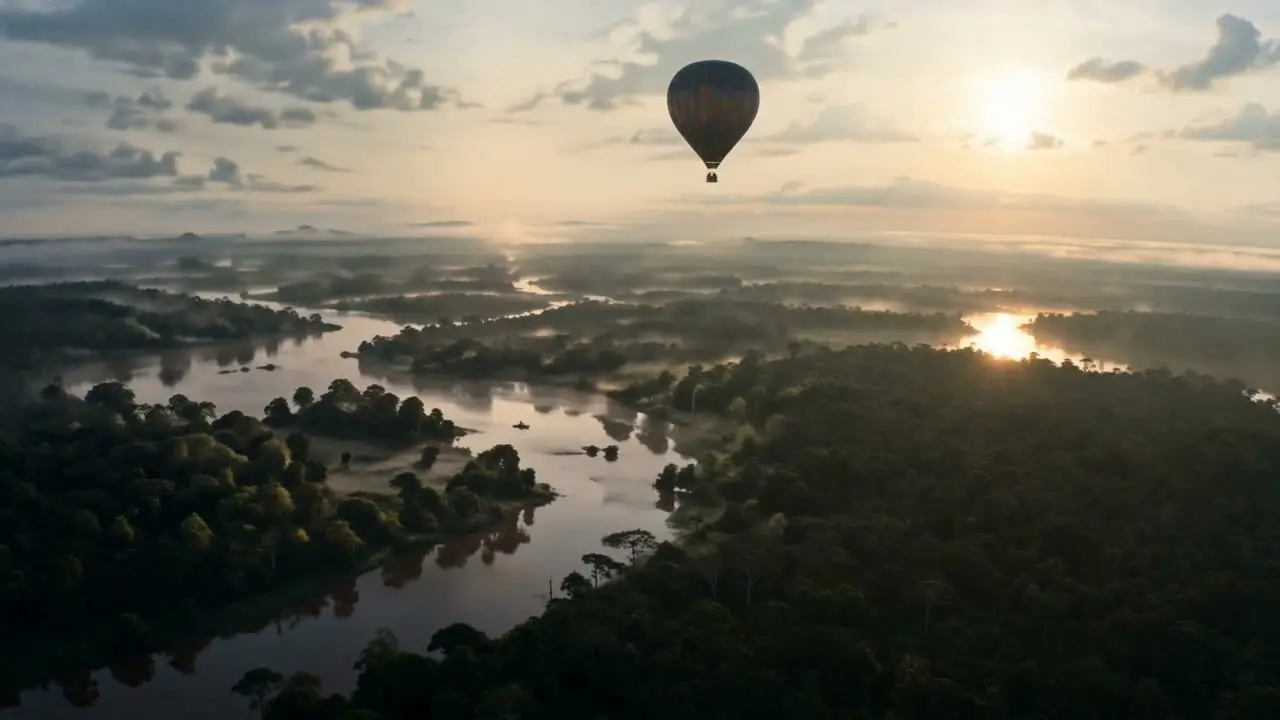 视频截图视频节点 23
正向提示词: Reference priority: Use no storyboard image as a visual reference. The storyboard is only converted into the text shot plan below. If a character photo is provided, use it only as a loose identity reference: young East Asian female wildlife photographer, round glasses, tied dark hair with loose bangs, realistic natural face, practical outdoor clothing, camera gear. Do not copy studio lighting, beauty retouching, fashion pose, glossy skin, or catalog model feeling. The final video must be pure live-action documentary footage from the first frame. The first frame must look like real aerial wetland footage, not a drawing, not animation, not a storyboard panel. Absolutely no storyboard artifacts may appear: no pencil lines, no sketch texture, no panel borders, no handwritten labels, no numbers, no arrows, no colored marks, no paper texture, no graphic overlays, no readable text, no fake sign text. Create a 15-second realistic live-action wetland conservation documentary sequence about a female wildlife photographer observing protected birds from a hot-air balloon over a vast river wetland. A 9-shot sequence, each shot about 1.6 seconds, clean natural cuts: Shot 1: ultra-wide aerial dawn shot over a vast tropical wetland, winding river channels, flooded forest, low mist, soft sunrise, a small hot-air balloon drifting slowly above the habitat. Shot 2: medium close shot inside the hot-air balloon basket, the female photographer holding a real telephoto camera, wind moving loose hair, quiet concentration, natural field posture, no posing. Shot 3: telephoto wildlife shot of colorful macaws flying across the wetland canopy, wings moving naturally, humid air haze, distant river below, realistic bird anatomy. Shot 4: close documentary shot of the photographer lifting the camera and capturing the moment, real lens glass, practical camera strap, subtle basket vibration, natural morning light. Shot 5: top-down aerial shot of the balloon shadow passing slowly over river water and forest islands, birds crossing below, calm wetland scale, slow drifting camera movement. Shot 6: wide ground-level riverbank shot showing conservation activity in the wetland: small canoes moving quietly, simple wooden marker board with no readable text, forest and river habitat protected and undisturbed. Shot 7: medium shot from behind the photographer in the balloon basket, she continues observing and documenting the landscape below, river channels and forest stretching into distance. Shot 8: natural close portrait of the photographer, round glasses catching soft sky reflection, windblown hair, calm dedicated expression, realistic skin texture, no beauty lighting. Shot 9: final ultra-wide aerial shot of the balloon drifting above the wetland at sunrise, birds in the distance, river shining softly, human presence tiny, nature dominates the frame. Visual style: raw live-action conservation documentary realism, real wetland aerial footage, natural sunrise, humid atmosphere, realistic river reflections, real forest canopy texture, real bird movement, muted natural color, imperfect exposure, organic detail, natural motion blur, subtle camera vibration, no glossy commercial polish, no fantasy lighting. Camera style: real drone aerial footage, real hot-air balloon basket footage, handheld documentary camera, telephoto wildlife lens, restrained observational movement, slow drift, patient natural pacing. Mood: quiet, hopeful, protected, vast, humid, observational, harmonious. 负向提示词: animation, anime, cartoon, illustration, concept art, sketch, pencil drawing, line art, storyboard look, storyboard sheet, panel sheet, paper texture, pencil shading, drawn outlines, handwritten text, labels, numbers, arrows, colored marks, graphic overlay, readable text, fake sign text, subtitles, UI marks, split screen, collage, frame borders, fake wetland, fake forest, plastic trees, artificial river, toy balloon, fake birds, deformed birds, extra wings, broken wings, unrealistic flying, glossy commercial look, beauty retouching, fashion shoot, idol face, doll face, oversized eyes, perfect makeup, magical sunlight, dramatic god rays, painterly sky, over-saturated colors, deformed hands, distorted face, broken camera, city, road, crowd, horror